Today, it’s remarkably easy to find a cell phone number, whether it’s a business contact, a private individual, or even a prospect. A Google search, a visit to a social network such as LinkedIn or Facebook, or the use of a mobile application such as Truecaller or an online directory is often all that’s needed to identify a number or find precise telephone contact details.
You can also use a prospecting service or buy the cell phone number for a few cents – often between 50 cts and 1€ per contact – via specialized platforms, or even less if you’re working with large databases. Today, it’s no longer access to telephone information that poses a problem, but rather its use, especially in terms of confidentiality, data security and respect for privacy.
In this article, we share with you 3 effective methods for finding a telephone number, whether via a reverse lookup, a telephone directory (such as the Yellow Pages or the White Pages), or web applications. We’ll also help you to better understand the pitfalls of selling personal data, so you can avoid scams, spam and other tricky situations.
Find the right service provider
Do you need to outsource your prospecting? Find the service provider that meets your real needs
Sommaire
The recommendation
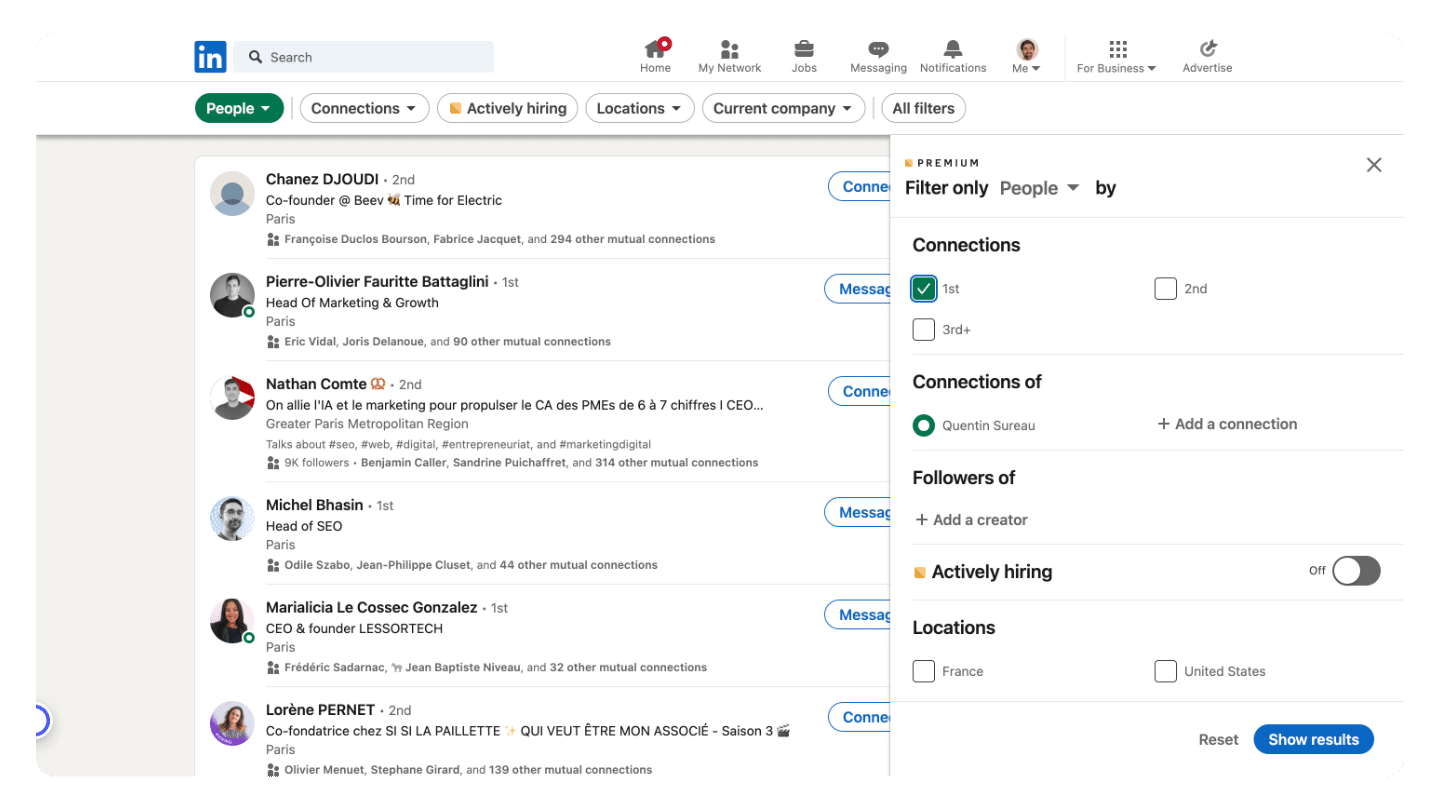
It’s by far the most effective way to get someone’s phone number. Calling a relationship in common.
You can easily list your common relations on Linkedin, by searching for your 1st-level relations who are relations of your target. Redoubtable. And very easy.
Find a mobile number directly on Google
Depending on your target profile, you can find a cell phone number directly online.
It’s very common, for example, for self-employed professionals or craftsmen to find their cell phone number indexed – sometimes without their knowledge – on one of the many appointment-setting platforms available on the Internet in the 2000s.
Basically, as soon as you address independents who were already independent in the 2000s, you have a very good chance of finding them easily.
To exploit this, there are two approaches:
- If you’re looking for someone’s phone number, a Google query like Last Name First Name “06” will often produce results.
- If you’re looking for the phone numbers of a slightly broader target group – for example, physiotherapists in the 9th arrondissement of Paris – you can find one of the many directories that were set up in those years, and retrieve all the numbers directly. Most of these directories are rarely updated these days.
Mobile number portability has been mandatory in France since 2007, so if your target hasn’t left France (permanently) since then, it’s very likely that their mobile number hasn’t changed.
Find a phone number on social networks
It’s much less common, but depending on your target, it can be a godsend.
All social networks have encountered the problem of fake accounts at one time or another. And they all tried to combat these fake accounts by validating the phone numbers.
Since the RGPD and the resurgence of personal data protection, leaking mobile numbers is out of the question, at least not by making them public by default.
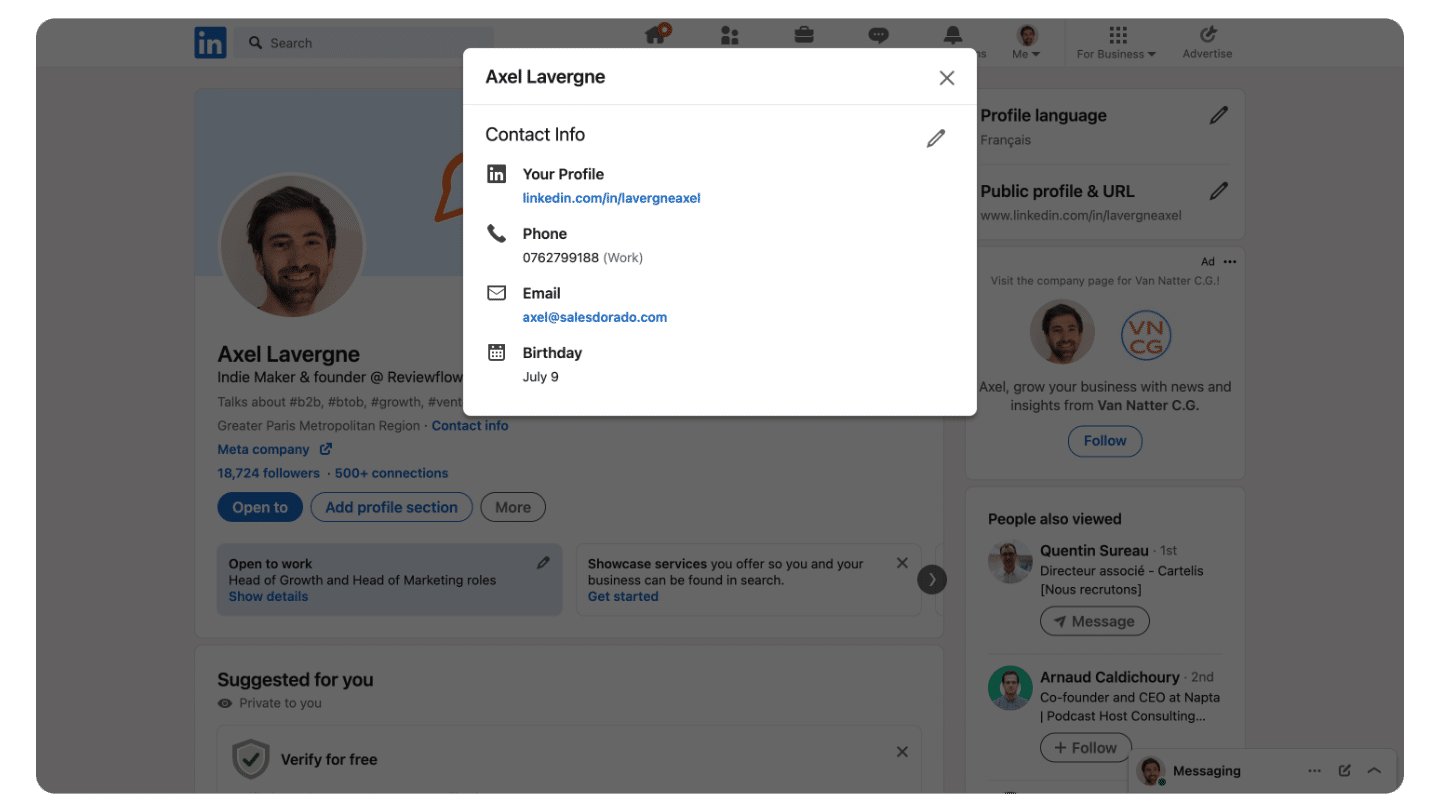
But Facebook, LinkedIn and the like have almost all made number sharing public by default at one time or another. All it takes is for your target to have created their account or changed their number at that time, and you’ll have access to their numbers, as long as they haven’t manually changed what they’re sharing.
On LinkedIn, for example, it would look like this
And don’t neglect “pseudo social networks” like “LeBonCoin”, “Airbnb”, “Gens de Confiance” and so on.
You can often find an ad from a Facebook or LinkedIn profile, and from an ad access the profile, with all the associated information.
In short, with a little digging on social networks, there’s a good chance you’ll find your target’s number.
Buy a cell phone number on a specialized platform
Fortunately, there’s much more to it than that.
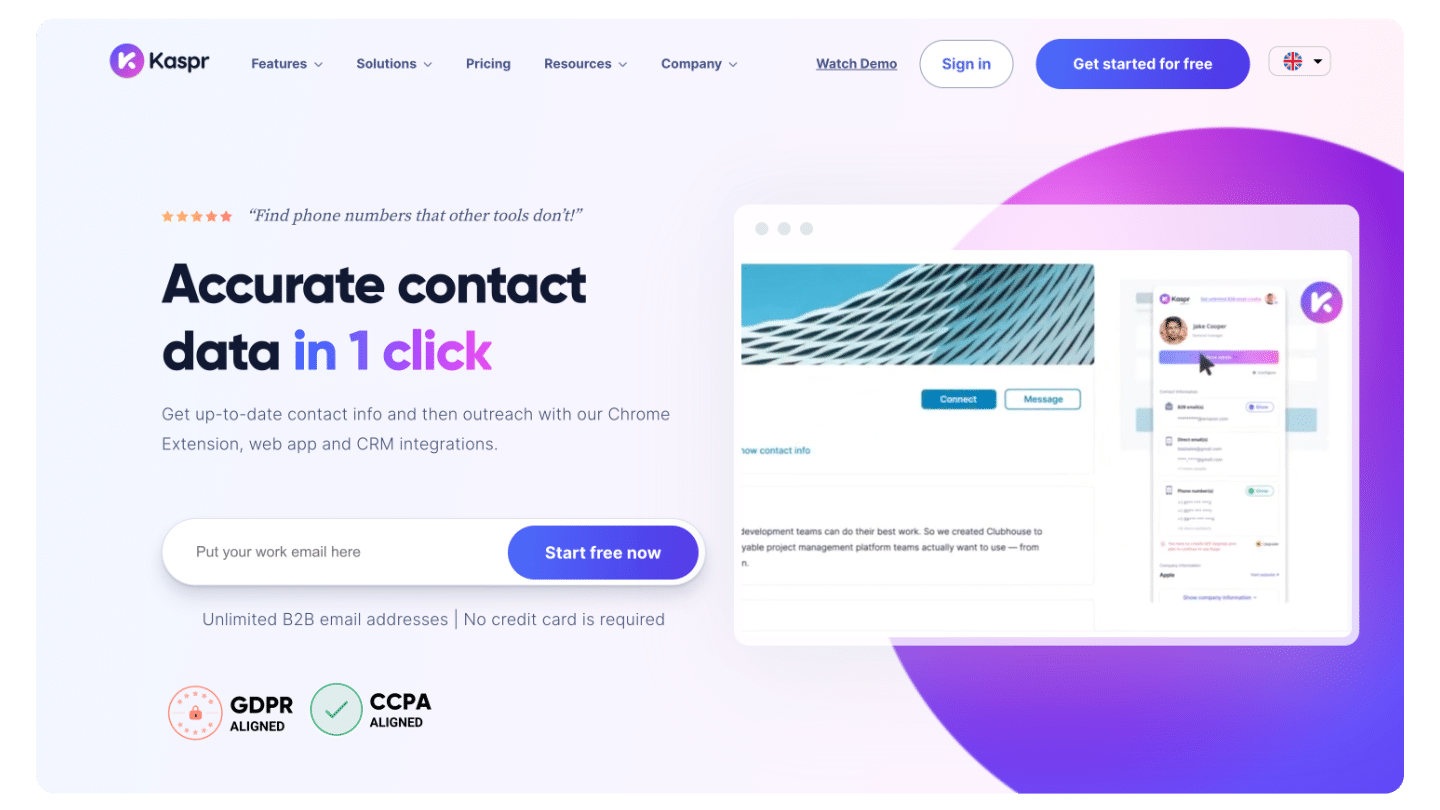
There are platforms that give access to virtually anyone’s mobile number.
The best-known are Apollo, Kaspr, Datagma and Lusha. A bit like an email finder – by the way, these 3 platforms also provide email addresses – you give them a full name and a company (or a domain name) and they send you back a phone number.
Simple as that.
And like email finders, they offer a number of free credits for you to try out. Apollo & Kaspr are by far the best performers, offering 5 free issues per month.
Save 15% on Kaspr
Use the code sd15monthly when purchasing a monthly subscription, or sd15yearly when purchasing an annual subscription to benefit from a 15% discount.
You can create a free trial account, and buy whenever you like with these codes. But don’t wait for them to change their minds!
How can I find entire databases of cell phone numbers?
This is a very slippery slope, and let’s be clear: anything we explain from now on is strictly forbidden.
In fact, we don’t explain it so much to help you get your hands on millions of cell phone numbers, as to help you understand how it all works, its limitations, and why you should use it responsibly and sparingly.
Finding a leak
It’s still all too common to see obvious data breaches when submitting a form with an error.
It’s a little technical, but in IT, in most cases, we use the same form to create or modify an object. Except that when we modify, we display the information we have in stock, and when we create, we display nothing.
And sometimes (often, in fact) the developer gets things mixed up.
This is what happened on the URSAAF website, for example – a flaw identified and reported by Quentin Lacointa. If you enter the SIRET of a company that has already declared employees on the employee declaration form, you’ll get the contact number transmitted (usually by the accountant) to URSAAF. And often it’s the manager’s cell phone number.
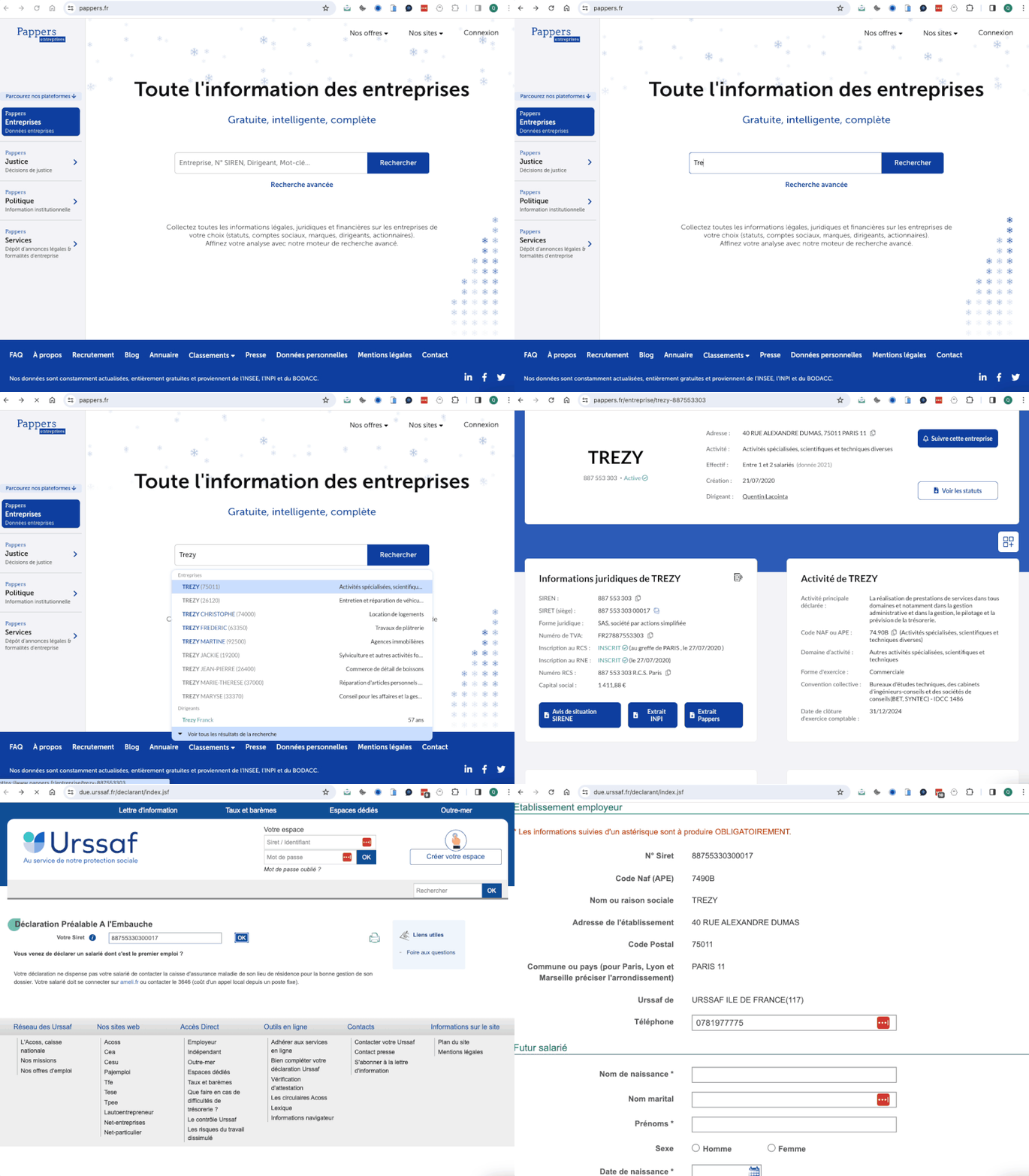
It’s a bit of a sensation, especially because it’s URSAAF, but there are plenty of them around.
And once you’ve found one, all you have to do is try every possible input to siphon all the information from the database.
More rarely, direct access to a database is also possible. That’s outright data theft, but it’s actually very common.
Find a data provider
In fact, the most common solution is to buy an entire database from a supplier.
The supplier could be the creator of a more or less bogus mobile application that requests access to your contacts.
This makes it possible to collect millions of phone numbers quickly, but it’s difficult to qualify them properly. It’s hard to get enough professional information about someone using personal contact databases. These usually end up as cheap databases that are sold to SMS fraudsters.
It can also be the creator of a chrome extension, which reads all the signatures in your emails. It’s a lot less volume, but it gives you access to a lot more information every time.
If you’ve ever installed a Chrome extension to get someone’s mobile number from Linkedin, or to take advantage of cash-back offers, or for whatever reason, now you know what it’s really for.
Use reverse directories to identify an unknown number
When it comes to telephone prospecting, or simply identifying a mobile or landline telephone number, reverse directories remain highly effective research tools. Services such as PagesJaunes, Truecaller and White Pages enable you to search for a person’s name from their number, free of charge. This feature, often available via apps on Google Play or websites, can help verify the identity of an unknown caller, whether a private individual or a professional. In the context of commercial prospecting, this can help find a prospect, or avoid spam. Using a reverse look-up directory is also useful for blocking unwanted calls, respecting privacy, and optimizing your telephone communication by identifying sources before answering. Be careful, however, to respect confidentiality and not abuse these search services, even if they are free or online.
Applications and services to enhance your telephone research
For prospecting professionals, modern search tools don’t stop at classic online directories. Many applications, such as Truecaller, offer instant identification of any incoming call. This facilitates data enrichment of your contact lists, and can turn a simple unknown number into usable contact details. Combined with a good CRM or telephony solution, these apps can display the owner’s name, consult other users’ reviews, and even automatically block risky or suspected scam numbers. Groups, forums and even online communities regularly share practical details of a caller’s location or identity, sometimes down to the department, region or city level. This is invaluable assistance, particularly for fixed-line telephony or B2B prospecting teams, in February 2025 as it is today. Used wisely, these free or paid solutions can considerably improve your sales efficiency, while preserving users’ privacy.