Why Lemwarm, Lemlist’s warm-up tool, and what’s it really worth? To understand the value of this type of tool, let’s take a step back. The obvious observation is that it has never been easier to conduct large-scale email prospecting. B2B databases that cost a fortune ten years ago are now accessible to all: tools such as La Growth Machine, Lemlist, Apollo or Clay give you access to hundreds of millions of contacts, enriched, verified and ready to be contacted in just a few clicks.
As a result, everyone started cold emailing, and that’s precisely the root of the problem.
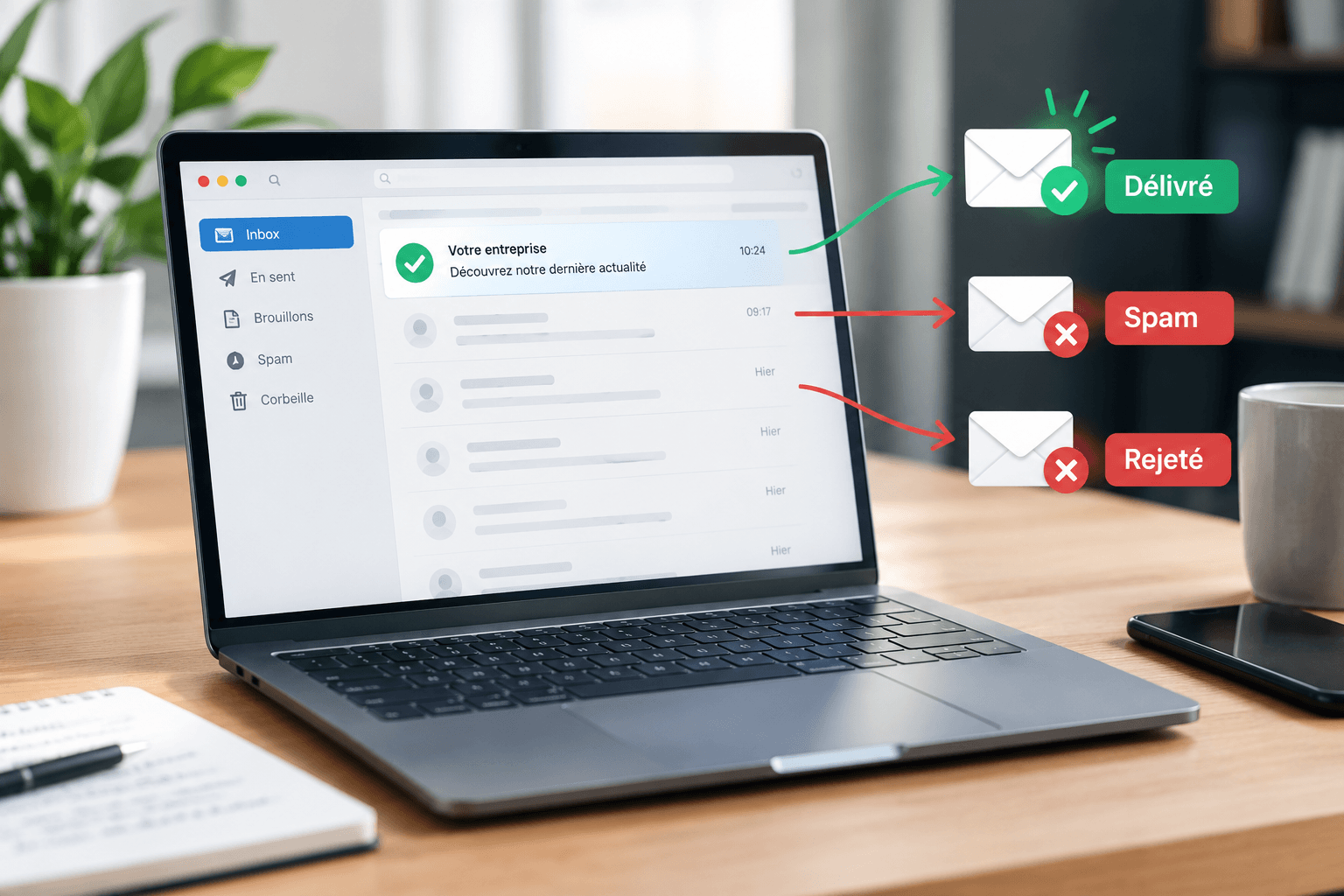
Because Gmail, Outlook and other e-mail providers have seen the wave coming. Faced with the explosion of automated mailings, they have tightened their filters, refined their algorithms and learned to spot suspicious senders with a few signals. A new mailbox that starts sending fifty emails a day? Spam, no warning. Many have experienced this and continue to do so.
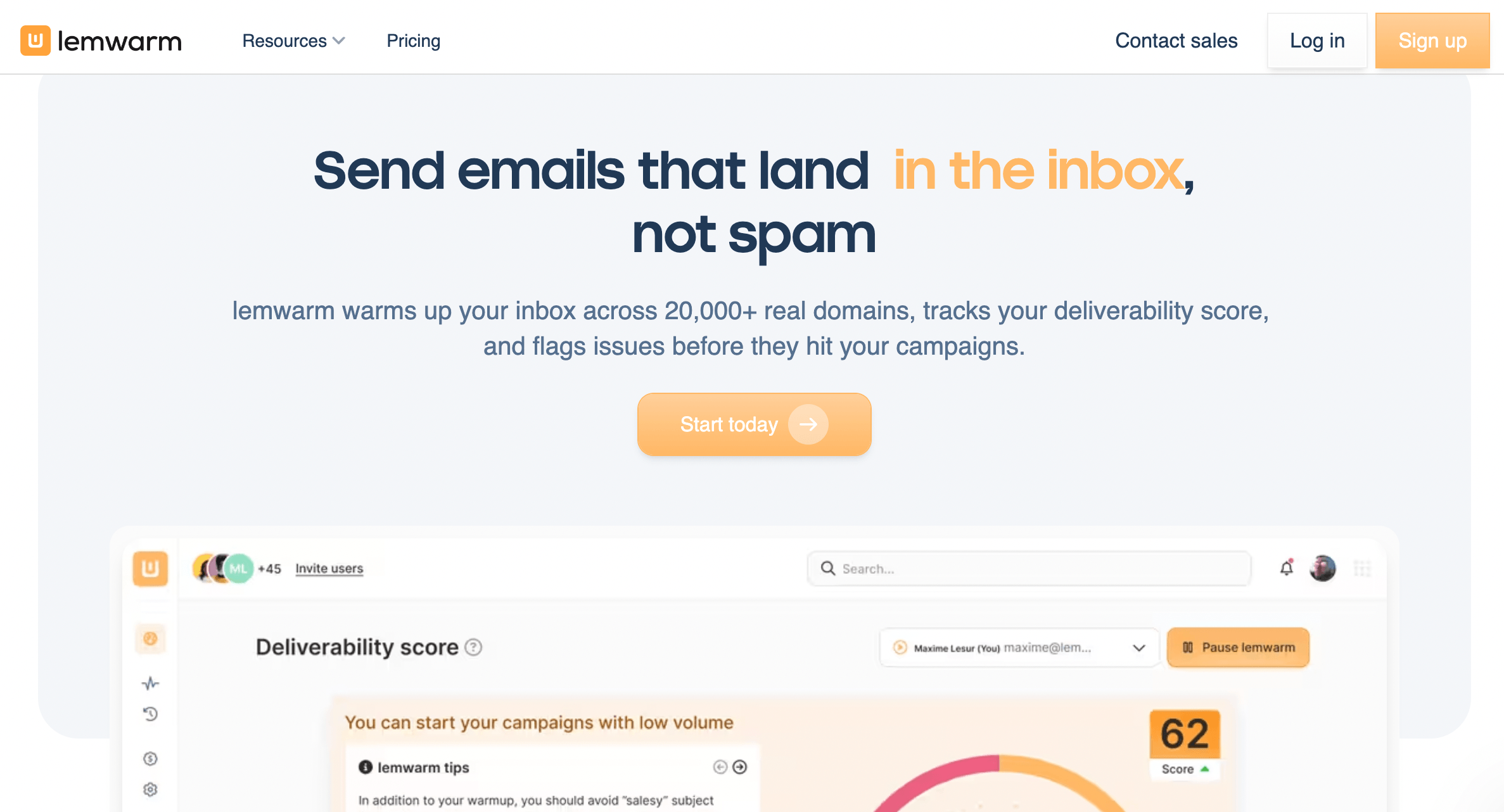
To get around this wall, the email warm-up was born. The principle is simple: gradually warm up your boxes to inspire confidence before launching your real campaigns.
The warm-up in 2026 immediately raises a question: does it still work? Or have suppliers also learned to detect it? In this article, we take a closer look at the subject, tell you what warm-up can and can’t do in 2026, and see whether Lemwarm, Lemlist’s tool, is really worth a look.
Sommaire
Our opinion on Lemwarm in brief
| Perimeter | Score | Our opinion |
|---|---|---|
| Overall rating | 4,4 / 5 | Lemwarm is a reliable warm-up tool, backed by a network of real Lemlist users and a clear deliverability dashboard. Its value depends entirely on the context: essential and free for those already on Lemlist, much more debatable as a stand-alone purchase when faced with cheaper alternatives. |
| Warm-up network quality | 4,5 / 5 | The network is based on real Lemlist user addresses, not phantom accounts. Exchanges take the form of real threads, simulating credible traffic. Over 20,000 domains in 150 countries. |
| Monitoring and reporting | 4,2 / 5 | A deliverability score from 0 to 100, updated daily, with an easy-to-read color code. DNS technical control (SPF, DKIM, DMARC) is integrated. What’s missing, however, is a real Main / Promotions / Spam placement test. |
| Easy to use | 4,5 / 5 | Almost automatic activation for Lemlist users, minimal learning curve. Activate, leave running, monitor score. |
| Quality-price ratio | 3,8 / 5 | Excellent when included in a Lemlist subscription. Significantly less competitive in standalone mode, where the price compares poorly with less expensive dedicated tools with sometimes unlimited volume. |
Lemwarm is included at no extra cost in all Lemlist paid plans, with a 14-day free trial on the platform. Ideal for checking in real-life conditions whether your deliverability score is improving before making a commitment.
What exactly is the email warm-up for?
Before judging Lemwarm, it’s important to understand the problem it sets out to solve.
When you send a commercial email, the recipient’s provider (Gmail, Outlook, Yahoo) doesn’t look at what you write first, it looks at who you are. In concrete terms, it evaluates the reputation of your domain and your sending address. A recent domain (or a box that has never sent anything) has no history. For Gmail, it’s a stranger, and a stranger who suddenly starts sending fifty e-mails a day looks an awful lot like a spammer.
Email warm-up solves this problem upstream. The principle: gradually increase the volume of mail sent from a new box, by generating exchanges that resemble real correspondence. Emails are sent out, opened and replied to, and removed from spam if they land there. After a few weeks, your domain has built up a legitimate sender history. You no longer arrive as a stranger the day you launch your real campaigns.
This is one aspect of deliverability, not the whole of it. Warm-up builds reputation, but sloppy DNS authentication, a dirty contact list or questionable content can undo it all. We’ll come back to this below, because this is precisely where many users go wrong.
Going further
- Our complete guide to email deliverability to understand all the levers beyond warm-up
- Writing an effective prospecting email once your boxes are warmed up
Will the warm-up still be working in 2026?
The short answer: yes, but less than before and never alone.
It’s important to understand recent history. In 2020, automatic warm-up worked remarkably well. Google and Microsoft gave real weight to the engagement signals generated by these tools. A box warmed up for three weeks arrived cleanly inbox. Those days are over. By 2024, the two providers had identified the IP address ranges and network patterns of the main warm-up services and mechanically reduced the weight of these signals.
Manual warm-up and peer-to-peer warm-up continue to work, because they generate real send signals between real people. The weak link is synthetic pool warm-up, those networks of fake accounts or AI-generated boxes sold by some of the tools on the market. Gmail has learned to recognize and devalue them.
This distinction works in Lemwarm’s favor, as we’ll see: its network is based on real Lemlist users, but it also imposes a conclusion: in 2026, plugging in a warm-up tool and believing the problem is solved is a mistake. The tool is a starting point, not a turnkey solution. .
Automated warm-up always brings a modest but real benefit. The problem is that it’s sold as all-risk insurance, when in fact it’s a complement. A warm-up tool plugged into a poorly configured box, with no manual responses or patience, will give you a nice internal score and poor results in a real campaign. The tool’s score is not the actual placement.
How Lemwarm works
Lemwarm is the warm-up tool developed by lempire, the publisher of Lemlist, one of the most established cold email platforms on the market.
Here’s what it actually does once activated.
A network of real users, not phantom accounts
This is Lemwarm’s technical highlight, and it follows directly from what we’ve just seen. Where many services use fake accounts to artificially inflate activity, Lemwarm circulates your warm-up emails through a network of real, verified Lemlist user addresses. Your messages interact with real recipients, sending suppliers a much more credible signal than a synthetic pool.
The important thing is that exchanges are not isolated emails with no head or tail. Lemwarm structures its conversations into real threads, just like normal correspondence. This simulates a natural sending pattern, where some competitors send replies that don’t even resemble real replies. The network covers more than 20,000 domains in over 150 countries.
An easy-to-read deliverability dashboard
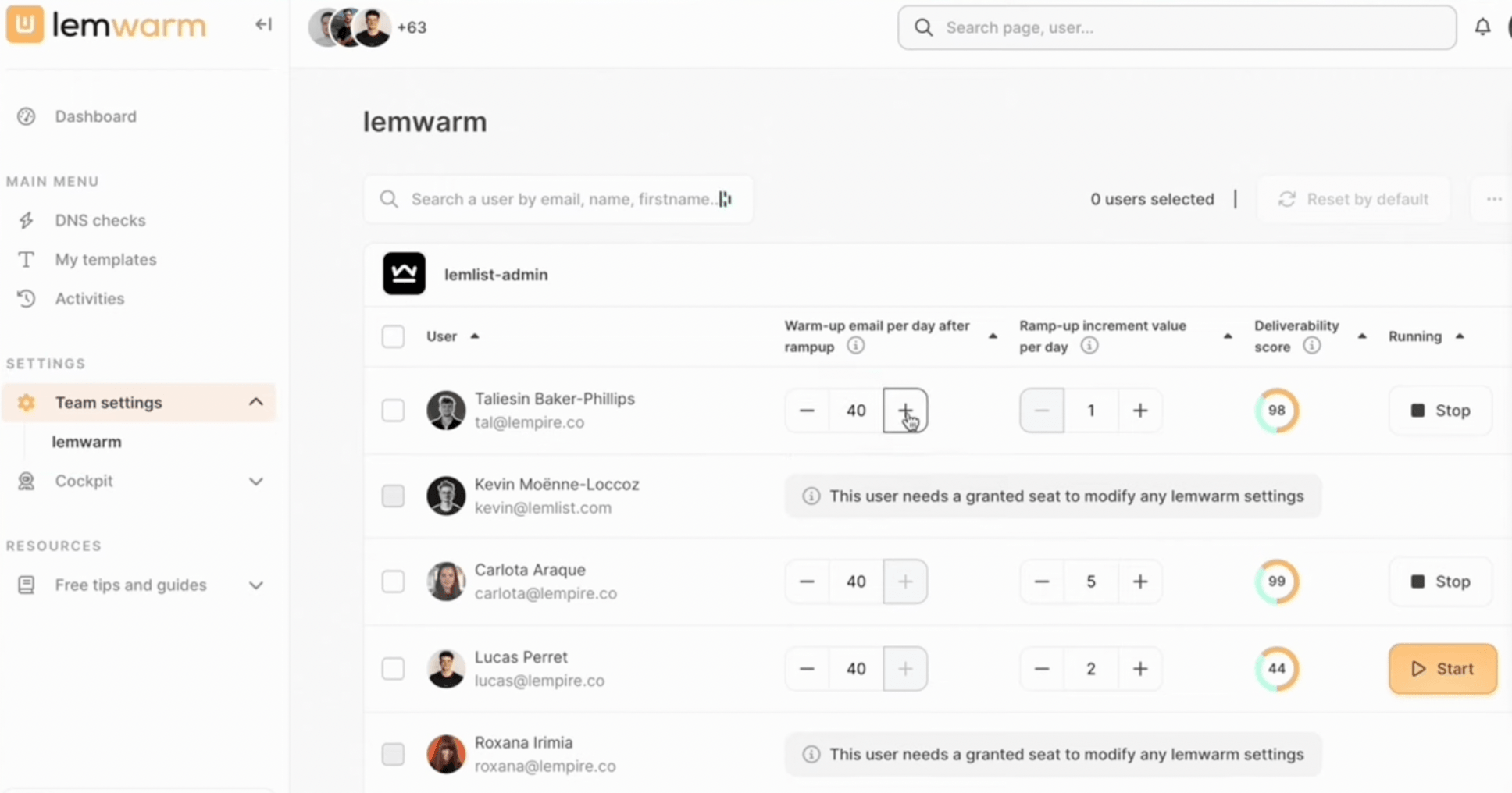
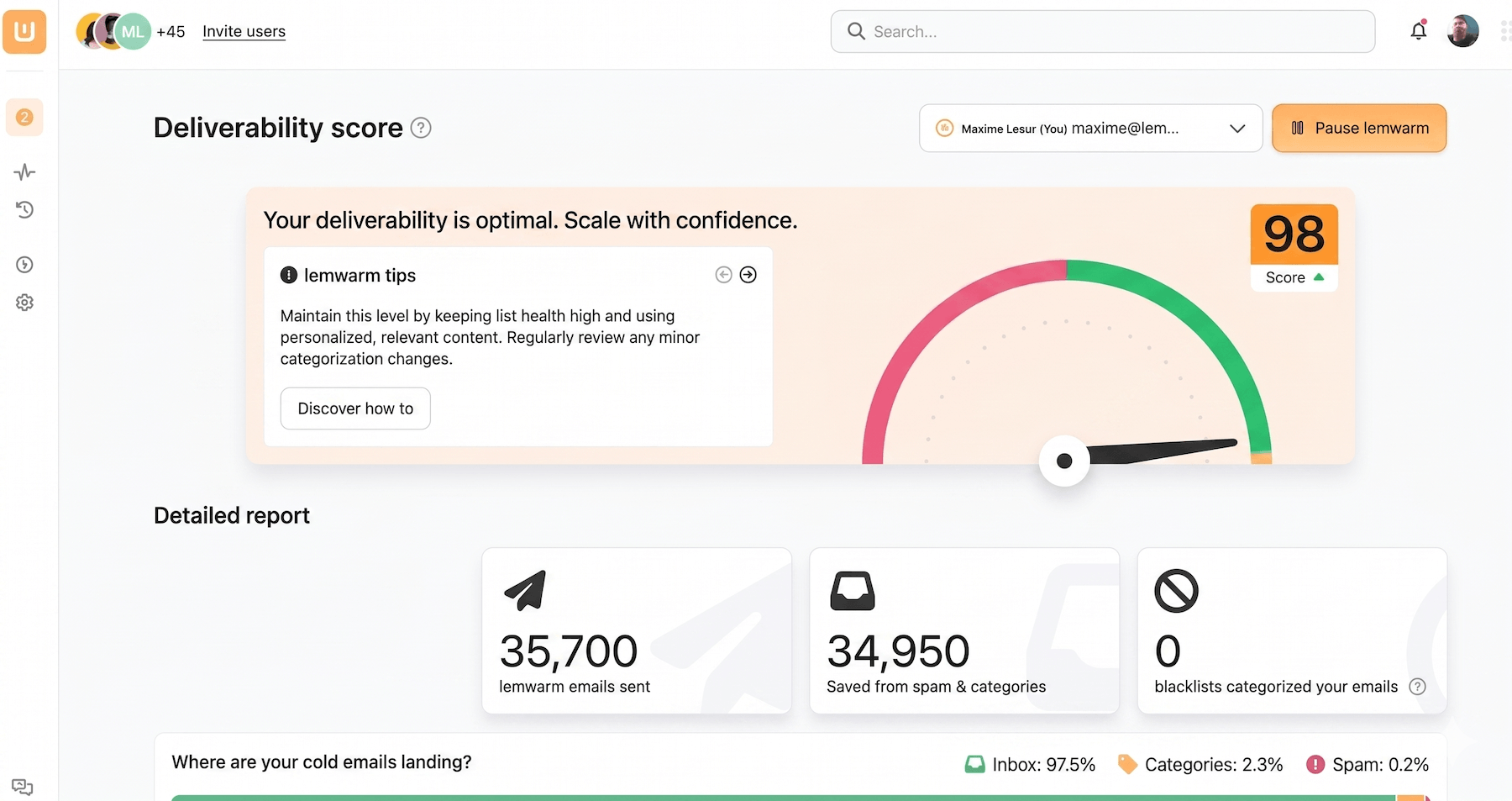
Once Lemwarm has been activated, you can track your sender health via a deliverability score ranging from 0 to 100, updated daily and displayed with a clear color code from red to green. The score is based on warm-up engagement, technical configuration and blacklist checks.
Graphs show the evolution of inbox placement versus spam over time, so you can see at a glance whether your reputation is improving.
Integrated DNS technical inspection
Lemwarm checks your technical configuration: SPF, DKIM, DMARC, MX records and personalized tracking domain. This is invaluable, because this is often where the real deliverability problems lie, long before the warm-up itself.
The tool also signals spam risk alerts based on your sending behavior and the content of your emails.
Lemwarm is included at no extra cost in all Lemlist paid plans, with a 14-day free trial on the platform. Ideal for checking in real-life conditions whether your deliverability score is improving before making a commitment.
Warm-up on your real templates and Smart Content
Lemwarm lets you heat up your boxes with your real campaign templates, not just with filler text.
On the top level, a content algorithm generates unique objects and message bodies for each exchange, shaped by your sector via a questionnaire.
The idea: to make warm-up emails feel like real prospecting, rather than just noise.
Where Lemwarm shows its limitations
In our opinion, Lemwarm has three main limitations:
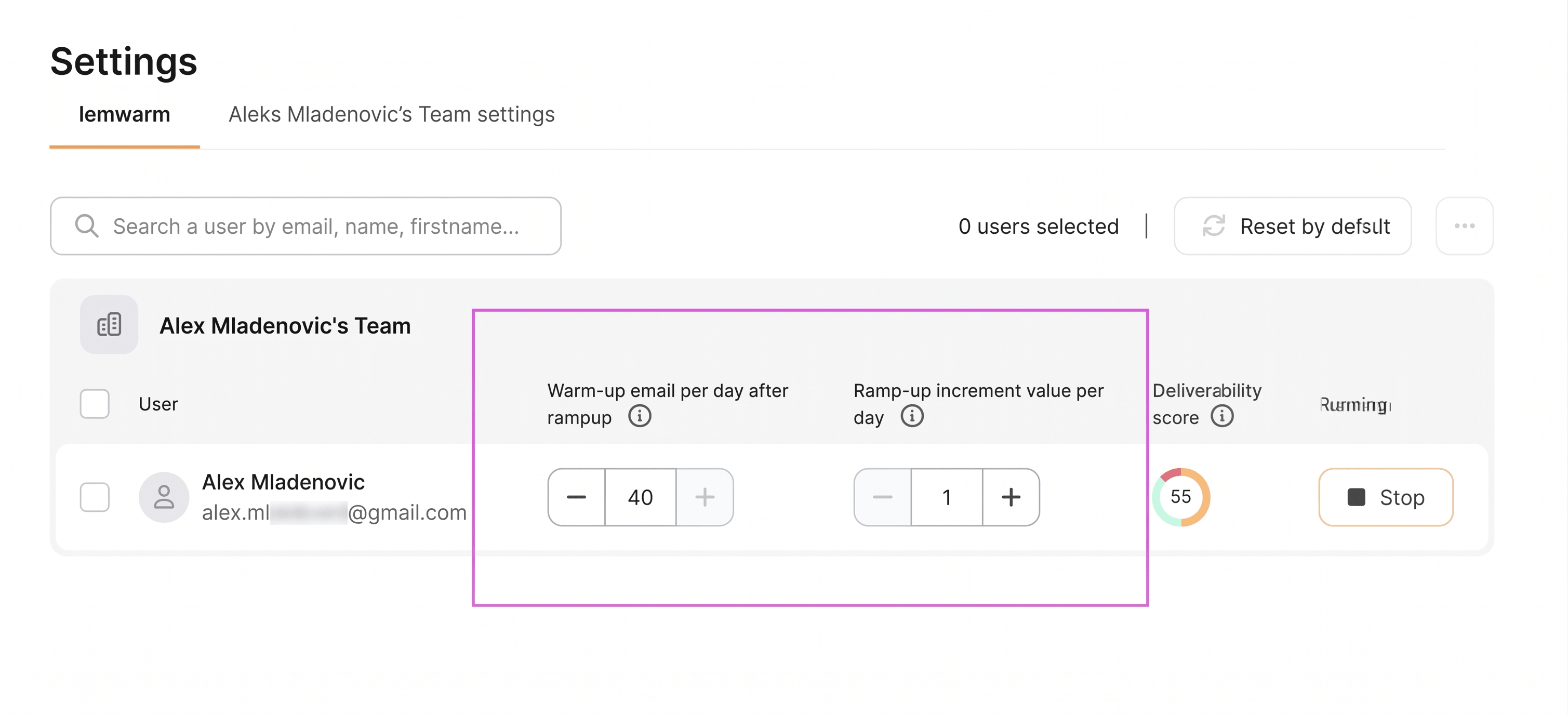
- Entry plan volume ceiling. The Essential plan limits warm-up to 40 emails per day. If you follow the community rule of keeping warm-up volume between 10 and 50% of your cold email volume, this limits you to a fairly modest actual send. For a solo start-up, this is sufficient. For a team looking to ramp up quickly, it’s short.
- The Smart Cluster feature, which is supposed to match you with warm-up partners relevant to your sector, doesn’t always live up to its promise.
- Lemwarm focuses on warm-up automation and monitoring, but offers no real inbox placement testing. You can’t send a test email and see exactly whether it lands in Main, Promotions or Spam, depending on the provider. For that, you need a dedicated tool.
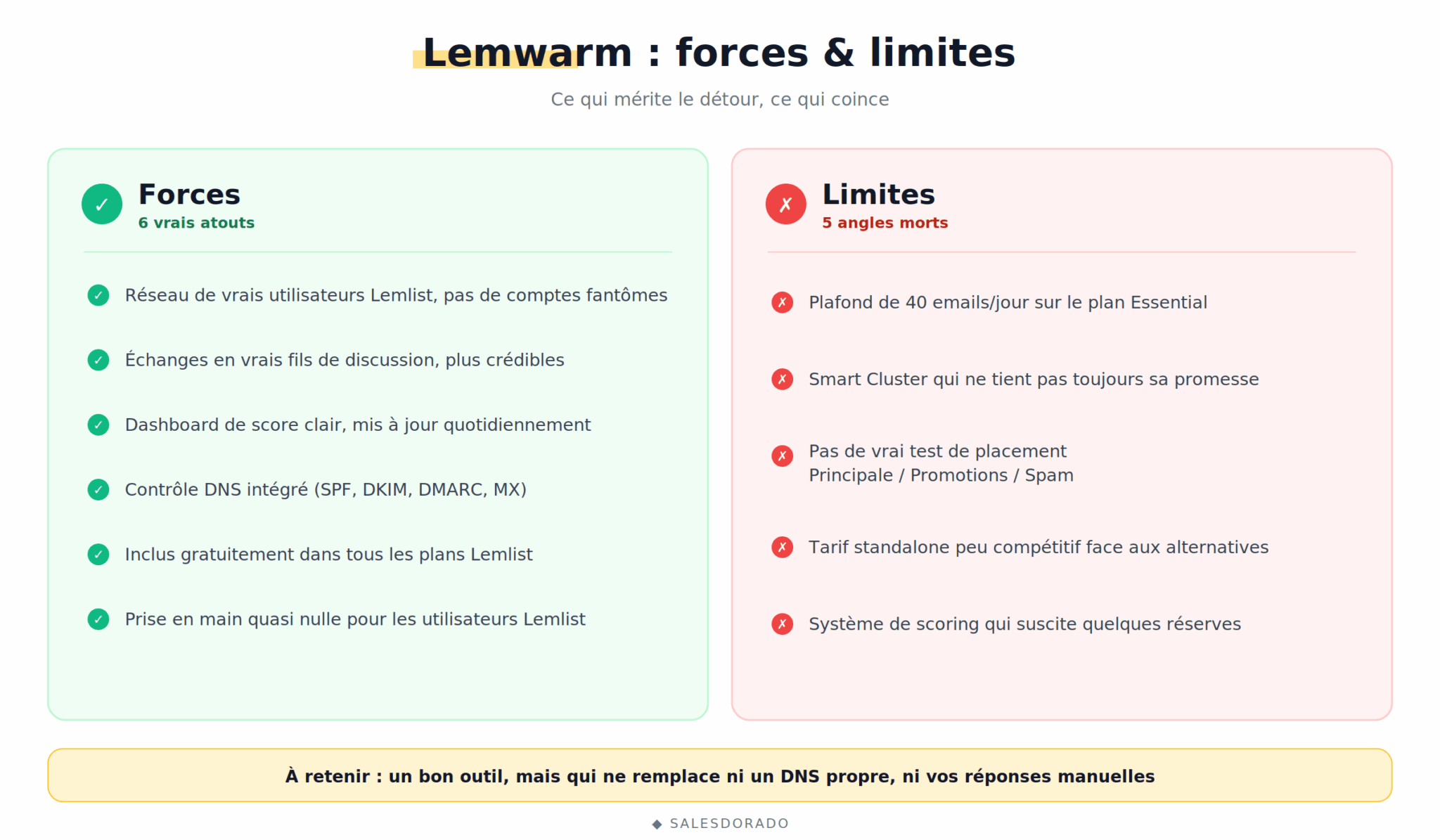
Summary of advantages and disadvantages:
- Network of real Lemlist users, no ghost accounts
- More credible exchanges in real threads
- Clear score dashboard, updated daily
- Integrated DNS control (SPF, DKIM, DMARC, MX)
- Included free of charge in all Lemlist plans
- Near-zero learning curve for Lemlist users
- Limit of 40 emails/day on Essential plan
- Smart Cluster that doesn’t always live up to its promise
- No real placement test Main / Promotions / Spam
- Standalone pricing not competitive with alternatives
Best practices for keeping mailboxes warm
Lemwarm, or any warm-up tool for that matter, will only work in a certain context. Here’s what really makes the difference today, and what the tool alone won’t do for you.
Here are a few tips:
- Configure DNS first. SPF, DKIM and DMARC must be in place before any warm-up is launched. This is the foundation, and it’s non-negotiable.
- Combine with manual responses. Occasionally reply to your own warm-up emails. Real human signals are worth more than any automated exchange.
- Avoid overly robotic patterns. Random send timing, no sudden volume peaks. A steady, irregular rise, just as a human would.
- Be patient. Count on 6 to 8 weeks, not 2 to 3. Rushing is the best way to burn out a new estate.
Lemwarm prices: how much does it cost?
This is where the whole decision comes in, because the price of Lemwarm depends on just one thing: are you already a Lemlist customer or not?
Lemwarm standalone
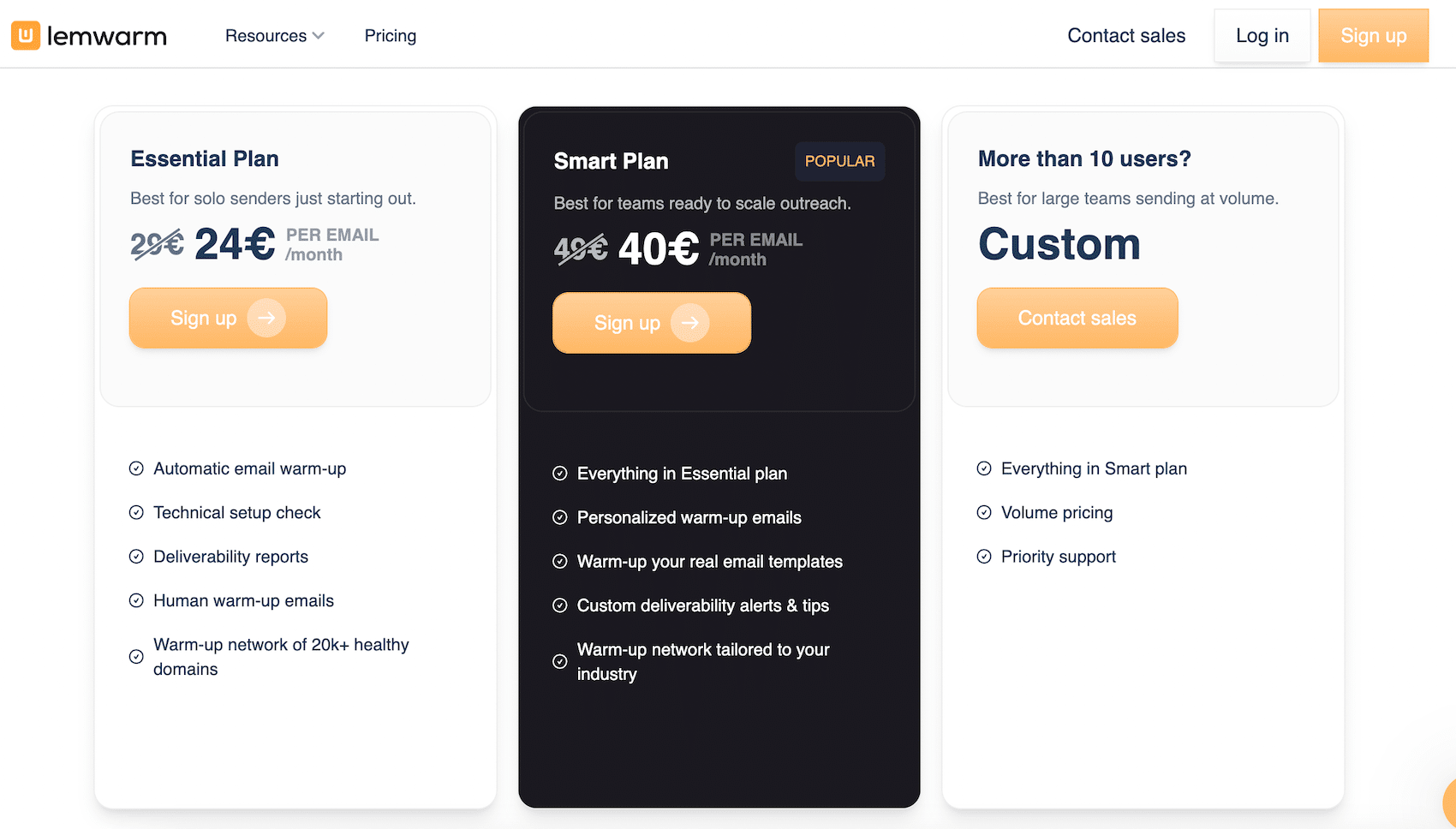
Purchased on its own, without a full Lemlist subscription, Lemwarm offers two plans, billed per email address and per month:
| Plan | Price (annual) | For whom |
| Essential | 24 € / email / month | Solo starter: automatic warm-up, technical check, deliverability reports, network of 20,000+ domains |
| Smart | 40 € / email / month | Teams that ramp up: warm-up on your real templates, customized content by sector, advanced alerts |
Lemwarm included in Lemlist
If you’re already on Lemlist, the game changes completely: Lemwarm is included at no extra cost in all paid plans. The Email plan starts at €31 per user per month on an annual basis, and the Multichannel plan at €87. In both cases, warm-up runs automatically on your connected mailboxes, with no separate configuration or additional line on the bill.
The rule is simple. If you’re already with Lemlist, activate Lemwarm immediately: it’s free and it’s a good tool, there’s no reason to deprive yourself of it. If you’re not with Lemlist and you’re only looking for warm-up, the calculation is less straightforward. The standalone rate compares poorly with dedicated tools that sometimes offer unlimited volume for a lower price. In that case, broaden your comparison before deciding.
Our verdict: Who’s Lemwarm for?
Lemwarm is a good warm-up tool. Not the most powerful on the market, not the cheapest to buy in isolation, but reliable, readable and backed by a real network of users.
Lemwarm is for you if :
- You’re already a Lemlist customer: it’s included, so activate it without thinking.
- You work alone or in a small team with a reasonable volume of shipments
- You want a simple tool, a clear score, and you intend to complement it with manual best practices.
- The deliverability of your cold email campaigns is a real issue for your business
Lemwarm is included at no extra cost in all Lemlist paid plans, with a 14-day free trial on the platform. Ideal for checking in real-life conditions whether your deliverability score is improving before making a commitment.
Skip it if :
- You’re not with Lemlist and looking for the cheapest warm-up: alternatives are more competitive
- You need a real advanced inbox placement test, which Lemwarm doesn’t offer.
- You’re sending very large volumes and the ceiling of the entrance plan is bridling you
- You expect a tool to take care of your deliverability on its own. Spoiler: none of them do in 2026!
Going further
- Our full review of Lemlist, the platform featuring Lemwarm
- Our opinion on Warmy.io, a warm-up alternative worth considering
- The best cold mailing tools for building your prospecting stack
- How to effectively follow up a prospect’s email once your inboxes have warmed up