The average salesperson sends 344 cold emails to secure a single meeting. That’s the figure Gong arrived at after analyzing 28 million prospecting emails, and it explains pretty well why you’re looking for templates.
The problem is that the template isn’t your most important variable. In that same study, the top 10% of salespeople secure 8.1 times more appointments than the average, in the same market and using the same tools. The difference doesn’t come from the way they phrase things. It comes from what triggers the email, and most of the templates you’ll find elsewhere violate three of the best-documented rules of cold emailing.
Here, we wanted to do things differently. First, we offer you a grid of 6 quantified criteria to rate any template before sending it—including those you’ve already collected. Then, we provide 8 cold email templates categorized by trigger rather than by copywriting formula, each with the source where you can find the trigger.
Sommaire
Why Cold Email Templates Don’t Work Anymore
Benchmarks published by email platform providers (Instantly, Woodpecker, Belkin, and others) currently put the average response rate for B2B cold emailing at around 3%, down from about 5% two years ago.
These figures should be treated with caution, of course—and we’ll come back to them below—but the overall trend is clear. There are three reasons for this decline, and only one of them really has to do with your copywriting:
- The first is saturation. AI has brought the marginal cost of a prospecting email down to nearly zero. The inevitable result: everyone is sending more. Your prospect now receives dozens of solicitations a week—all personalized, all seemingly relevant on the surface, all ignored at the same rate.
- The second is that published templates are burned. A template that appears on the first page of Google ends up in the prompt library of every automation tool on the market within a few weeks. Your prospect no longer reads it—they recognize it. And the sorting happens right in the inbox, even before it’s opened: Gong measures that executives take less than three seconds to decide whether to open or delete an email.
- The third point is that most of the available templates are clearly bad. They ask for a time slot, include a number in the subject line, pitch the product in the second sentence, and so on.
Articles on email templates regularly promise response rates of 15 to 30 percent. Publisher benchmarks put the market average at around 3 percent. Such a discrepancy cannot be explained by the quality of an email template, but rather by a vendor’s own definition of the metric. The only indicator that matters is the number of positive responses relative to the number of emails delivered.
Cold email: the grid of 6 criteria to convey
Here is the grid we recommend you use. Each line is based on measured data, not on a copywriter’s intuition. Criteria 1 through 5 come from two analyses by Gong Labs: the one on 28 million emails mentioned in the introduction and a second one on 304,174 calls to action . The sixth comes from French law (we’ll come back to that later).
Let’s be clear: any template that fails to meet two or more criteria goes in the trash.
| Criterion | The rule | What the data says |
|---|---|---|
| #1 The CTA | Ask for interest, never a specific time slot | 30% of appointments secured, compared to 15% for a request for a specific time slot and 13% for an open-ended request |
| #2 Length | Fewer than 100 words, 3 to 4 sentences | If it’s more than 100 words, the response rate drops significantly |
| #3 The Pitch | No product description | Pitching causes the response rate to drop by up to 57% |
| #4 The Object | Short, no numbers, no questions, no jargon | Up to 17.9% fewer opens when using numbers or marketing jargon |
| #5 ROI | No ROI argument at first contact | Quantified ROI promises lower the response rate in both Gong Labs analyses |
| #6 The Trigger | A specific, verifiable event that justifies sending the message today | This is also the condition set by the CNIL for conducting marketing outreach without consent |
Criterion 1 is worth a closer look, because it’s the one that the vast majority of published templates get wrong. Asking for a time slot triggers a cost calculation in the reader’s mind: their time is limited, and they aren’t interested in yours. Asking for interest costs no one anything. You’re not selling the meeting; you’re selling the conversation. The dynamic reverses once the deal is on the table, at which point requesting a specific time slot regains the upper hand.
Salesdorado’s take
Don’t treat this chart as gospel. The datasets contradict each other on at least one point: an older analysis by Gong recommended longer emails, while the most recent and comprehensive one recommends the opposite. The two measure different things. Our take is that short emails win out in terms of response rate, and that’s the metric to optimize for first contact. But if you’re selling a highly technical product to an audience of engineers, test the long format before taking our word for it.
Our 8 cold email templates at a glance
The templates below are organized by trigger, not by rhetorical device. This is intentional. AIDA, PAS, or the flattery approach are classifications based on literary techniques: they don’t tell you who to write to or when. The trigger does.
| Template | Trigger | Where to Find the Signal |
|---|---|---|
| #1 The Job Posting | A job posting that reveals the problem you’re solving | Welcome to the Jungle, LinkedIn Jobs, Careers page |
| #2 The New Decision-Maker | A role held for less than 90 days | Sales Navigator, job change alerts |
| #3 Changing Tools | A technical component added or removed | BuiltWith, Wappalyzer, job postings mentioning the tool |
| #4 The Public Announcement | Acquisitions, New Locations, New Markets | Business press, BODACC, press releases |
| #5 The comparable customer | A result you’ve just delivered to a competitor | Your own CRM |
| #6 The Recommendation | Someone has referred you to the right person | Your first email went to the wrong person |
| #7 The Field Issue | No signal, and you accept that | Your own customer conversations |
| #8 The Email to Management | A priority publicly announced by management | Annual report, interviews, public statements |
4 cold email templates based on an external signal
These are the easiest to scale, because the signal is visible from the outside and can be scraped. Our article on B2B business signals details the sources. Here, we’ll focus on what to write once you have that signal.
#1 The cold email template based on a job posting
A company that’s hiring spends money to solve a problem. The job title and the job description tell you what that problem is. This is the most reliable trigger of the bunch and the least used one because it requires reading job postings rather than buying a database.
Subject: Open Sales Administration PositionHello {First Name},
You’ve been recruiting for a sales administration manager for three weeks now. When a position like this opens up at a software company of your size, it usually means that invoicing has started to take up too much of the sales team’s time.
We’re working with {Comparable Client} on exactly this issue.
Does this sound familiar, or am I missing the point?
The line to rewrite: the second sentence. This is your hypothesis about what lies behind the hiring. If it’s too general, the whole argument falls apart. It must be specific enough that the reader will think either “exactly” or “not at all”—never “maybe.”
Rating: 6/6. Three-word subject line, 58 words total, no product mentions, an interesting call to action that leaves room for denial.
#2 Cold emailing a decision-maker who started 90 days ago
The window is short, but it’s an excellent one. Someone who has just taken a new position needs to show results quickly and hasn’t yet signed any contracts they’d have to defend. After six months, they’ve become the guardian of the status quo.
Subject: Your AppointmentHello {First Name},
You took over as head of sales at {Entreprise} in January. People who take on this role often tell us the same thing: it’s impossible to know what’s really going on in the pipeline until several months have passed.
{Similar client} faced the same blind spot when they took the position.
Are you currently working on this, or has it already been resolved?
The line to rewrite: the verbatim quote. “People who come into this role often tell us” must be followed by a sentence you actually heard during a meeting. If you make it up, it’ll be obvious.
Rating: 6/6. Be careful, though, with the alert mechanism: if you send this email the day after your LinkedIn title changes, the reader will realize it’s automated. Wait two or three weeks.
#3 Cold emails triggered by a change in tools
A change in the tech stack opens up a sales opportunity: the migration creates problems that no one anticipated, and the budget has already been approved. You can spot this signal in the page code, but also in job postings that mention a skill related to a tool the company wasn’t using last year.
Subject: Salesforce MigrationHello {First Name},
Two of your job postings require Salesforce experience, even though your site was still running on HubSpot at the beginning of the year. If you’re in the middle of a migration, transferring the history of interactions is usually the part that causes the most trouble.
We helped {Similar Client} with this exact step.
Is it worth discussing, or do you already have a strong support team in place?
The line to rewrite: the technical issue mentioned. It needs to be specific enough to show that you’ve already performed the migration and common enough to have a chance of being true.
Note: 6/6. The “or you are already well supported” option does a lot of work: it provides a respectable exit, which paradoxically increases the number of responses.
A trigger is only valuable if it’s fresh. For France, Pharow covers local signals well (recruitment, executives, legal data), while Sales Navigator remains unbeatable for job changes. We compared the two with their competitors in our head-to-head comparison of Pharow, Cognism, Sales Navigator, and Apollo .
#4 Cold emails after a funding round or acquisition
A word of caution before the template: a funding round is the most commonly used trigger in the market—and therefore the most overused. A startup that announces a Series A round receives hundreds of emails within a week, all built around the same opening line. If you must reference a public announcement, opt instead for an acquisition, a website launch, or entry into a new geographic market. It’s less flashy and much less crowded.
Subject: Madrid Office OpeningHello {First Name},
I saw that you are opening an office in Madrid. For the companies we work with, the biggest challenge with this type of expansion isn’t local hiring—it’s integrating Spanish sales data into the same reporting system as France.
Is this already an issue for you at this stage?
The line to rewrite: the counterintuitive approach. “The first difficulty isn’t X; it’s Y” only works if X is what everyone believes and Y is what you know. Otherwise, you lose the benefit of the formula.
Rating: 6/6. Three sentences, 55 words. This is the shortest of the eight and probably the one with the highest response rate in absolute terms.
2 cold email templates based on your customers
. These two don’t require any tools. The data is right there—in your CRM or your outbox. They’re underutilized precisely because they don’t automate well.
#5 The cold email that references a comparable client
Social proof works remarkably well in the body of an email. It doesn’t work well in the subject line, and that’s a subtle distinction that most articles overlook. Save the client’s name for the second sentence.
Subject: Feedback ondistribution Hello {First Name},
We just completed a project for {Client}, which, like you, sells to public sector procurement departments. The biggest improvement for them was the time between the quote request and its delivery, which went from nine days to two.
Can I send you the specific changes we made without scheduling a meeting?
The line to rewrite: the point of comparison. “Who sells to public sector procurement departments just like you do” is the part that does the trick—not the client’s name. The reader must see themselves in the description before recognizing the brand.
Rating: 6/6. Note that this figure refers to an operational timeline, not a return on investment. The distinction is the same as in criterion 5: a timeline is a verifiable fact, while an ROI is a promise.
#6 The Internal Recommendation Cold Email
Perhaps the most underutilized of the eight… You intentionally email someone who isn’t the right contact, ask them who is, and then email the right person, mentioning the first person. The second email gains a level of legitimacy you would never have achieved by reaching out directly.
Subject: Forwarded by {Contact’s First Name}Hello {First Name},
I wrote to {Contact’s First Name} last week regarding {issue}. He told me that you are in charge of this area.
I’m not sure if this is currently on your radar. If it is, I can send you the solution we implemented at {Similar Client}.
Otherwise, just let me know and I won’t pursue it further.
The line to rewrite: none, but there’s one absolute rule to follow: the recommendation must be genuine. Making up an internal referral is the best way to get yourself in trouble with two people instead of one, in a company where they have lunch together.
Rating: 6/6. The last sentence is the real key to this approach. Letting the other person know that you won’t press the issue makes it easy for them to say no, which increases the total number of responses and saves you time by eliminating objections you won’t have to address.
What kind of cold email should you send when you don’t have any leads?
Let’s be honest: most of the time, you won’t have a lead. Articles that claim otherwise have never done high-volume prospecting. Here are two formats that work even without a lead.
#7 Cold Emailing in the Real World, Without a Lead-
If you don’t have anything specific to say about the company, the only honest thing to do is to say so, and then ask a genuine question. Not a rhetorical question disguised as a sales pitch, but a question you genuinely want answered.
Subject: Discount ApprovalHello {First Name},
I don’t really have a good reason to write to you today, so I’ll get right to the point: I’m trying to understand how multi-location retailers handle discount approvals between headquarters and branch offices.
Of the six companies we looked at this quarter, five of them handle this using Excel.
Is that the case for you as well, or have you found a better solution?
The line to rewrite: the field statistic. It should be based on your own conversations and drawn from a modest sample size. “Of the six companies we looked at” is more credible than “87% of distributors,” because no one believes the latter.
Rating: 6/6. The initial admission is the twist that does all the work. It’s rare, so it disrupts the reader’s expectations. Use it sparingly: if your entire sequence begins with an admission of weakness, the effect is lost.
#8 Cold emails sent to executives
A third analysis by Gong Labs—this time covering more than one million sales cycles involving executives—reveals two statistics that change the way we write: members of the executive committee respond 30.2% less often than those in other roles, and when they open a prospecting email, they spend a maximum of nine seconds on it. This isn’t a reason not to write to them—it’s a reason to write differently: use their language of priorities, provide personalized social proof, and, above all, avoid asking for a meeting.
Subject: Margin ErosionHello {First Name},
You mentioned at the annual conference that the priority for the fiscal year was gross margin rather than revenue growth.
At {Comparable Client}, the biggest drain on that margin wasn’t production. It was the sales team’s time spent manually reworking quotes.
Should I send you the details in three bullet points, or should I put you in touch with their CEO?
The line to rewrite: the opening quote. It must be public, dated, and verifiable. A leader can instantly spot a loose paraphrase of his or her own speech.
Rating: 6/6. The CTA offers two options, neither of which is an appointment. This is the strictest application of criterion 1, and it is also what makes this model difficult to replicate exactly as is: the connection must be genuine.
Salesdorado’s review
: These eight models have a limited lifespan, and we’d rather let you know that up front. Once this article ranks well, they’ll circulate in the market’s prompt libraries just like the others. What never goes out of date is the six-criteria grid and the principle of ranking by trigger. Stick with the method, refresh your wording every quarter, and keep an eye out for when your response rate drops without anything else having changed. That’s a sign your template has run its course.
Do your cold emails comply with CNIL regulations?
In France, B2B email marketing does not require prior consent. It is based on legitimate interest, with a right to object that the recipient must be able to exercise easily. This is more flexible than in B2C, where opt-in remains mandatory.
But there is one condition, and it is crucial to our topic. The CNIL specifies that legitimate interest applies only if the purpose of the solicitation is “related to the profession of the person being approached.” Its example: presenting the benefits of a software program to a company’s IT director.
Read this sentence with the framework in mind. A generic template sent to a purchased list—with no demonstrable connection to the recipient’s role—fails the legal test just as it fails the performance test. A template built around a business trigger passes both tests. This is the only area of B2B marketing where compliance and effectiveness align, and it’s one more reason to organize your templates by signal rather than by formula.
Three practical points to keep in mind:
- Generic email addresses such as contact@ or info@ belong to the legal entity. They are not subject to this rule, but they are of no use for targeted marketing.
- The sender’s identity must be identifiable in every message. A complete signature is sufficient.
- The opt-out process must be simple. A line at the end of the email will do; an unsubscribe link is a cleaner option.
Cold email: The technical checklist before sending
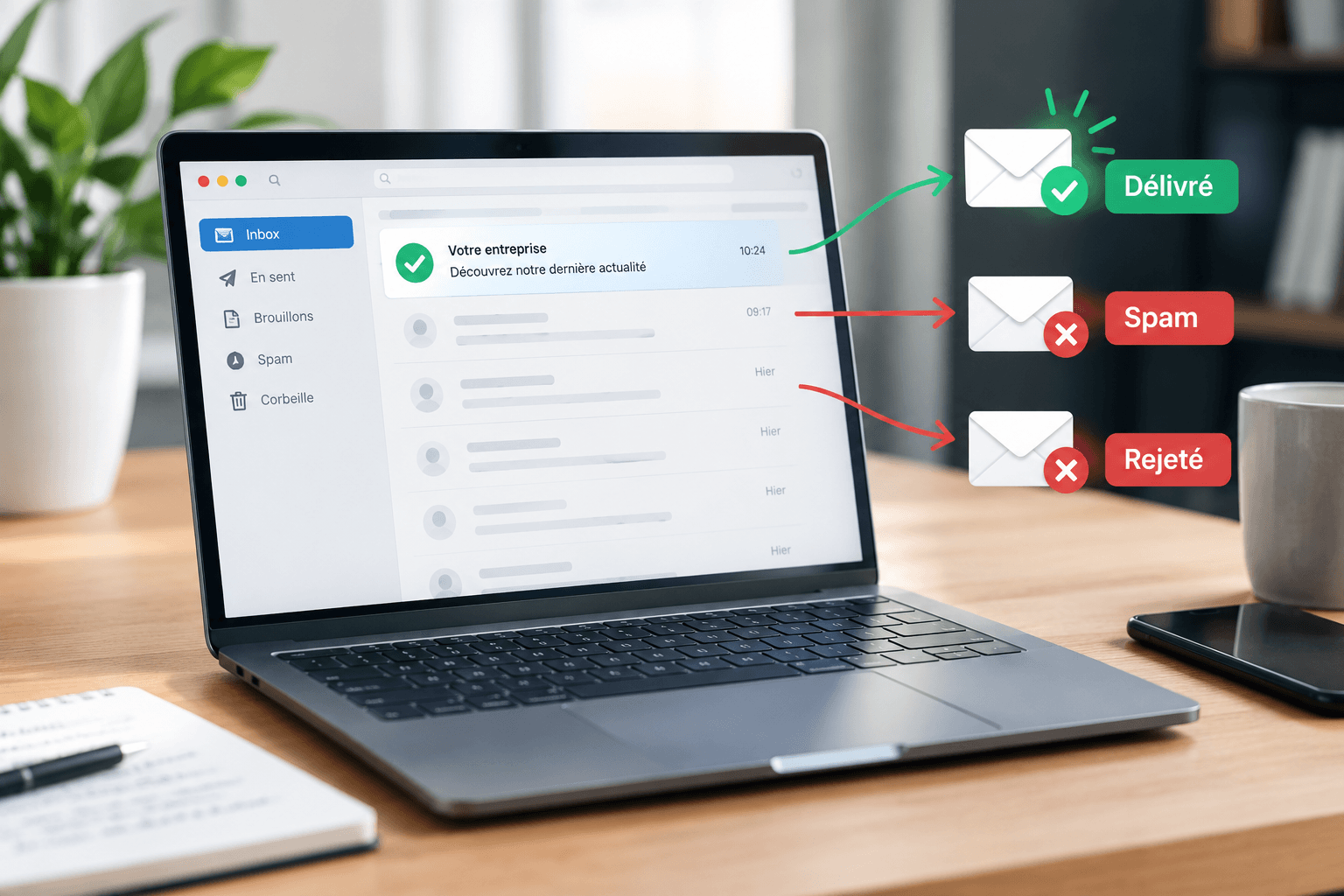
An excellent template in a faulty infrastructure won’t get you anywhere, because the response rate is capped by the deliverability rate. Google and Yahoo have required authentication for email sends since February 2024, and Microsoft since May 2025, for volumes exceeding 5,000 messages per day. The thresholds listed below are those published by these three providers in their respective sender guides. The penalty is no longer being marked as spam; it is outright rejection.
- SPF, DKIM, and DMARC configured, with sender domain alignment
- A secondary domain dedicated to lead generation—never the primary domain
- A gradual ramp-up before the first high-volume email campaign
- A complaint rate kept below 0.3%
- A cleaned-up list: bounces cost more than non-responses
Our guide to email deliverability details each of these points, and our comparison of cold emailing tools will help you choose the right sending platform.
One final reminder—and this applies to all eight models: a cold email is not a standalone task. It’s part of a multichannel prospecting sequence, and most responses come from follow-ups, not from the initial email.
Going further
- Cold Emailing: The Salesdorado Bible, Our Definitive Guide to the Topic
- 70+ examples of cold email subject lines to test Criterion 4 on a large scale
- 10 Examples of Follow-Up Emails, Because Most Responses Come After the First Send
- Personalizing Your B2B Prospecting Emails: Going Beyond Just Using the First Name as a Variable
- Creating an Actionable ICP: The Upstream Step That Determines Everything Else
- The Ultimate Cold Email Data Report from 30 Minutes to President’s Club (in English), if you want the raw data