Pharow is a French B2B prospecting platform with two distinctive features:
- Exclusively French coverage: 4 million companies and 10 million prospects, all located in France.
- A unique technical approach based on reconciling legal data (SIREN, INPI, INSEE), websites, LinkedIn profiles and recruitment sources.
The tool covers the entire outbound prospecting workflow: advanced targeting, email and telephone enrichment, bi-directional CRM synchronization (HubSpot, Pipedrive…), collaborative team prospecting.
We tested Pharow in depth, with a full demo led by Alexis Martel, the company’s COO. Here’s our detailed review of the tool’s features, pricing, strengths and limitations.
Sommaire
Our opinion of Pharow in a nutshell
| Perimeter | Score | Our opinion |
|---|---|---|
| Overall rating | 4,7 / 5 | Pharow is today the best B2B prospecting platform on the French market. Its strength lies in the invisible technical work of reconciling French data, which makes possible functionalities that would be impossible to reproduce elsewhere. Main limitation: French coverage only. |
| Data quality | 4,7 / 5 | A radically different approach to scrapers or pre-compiled databases. Pharow combines SIREN, website, LinkedIn and recruitment sources to produce a unified company file. The result: a 4% bounce rate on enriched emails, compared with an average of 8% for competing databases. |
| Powerful targeting | 4,8 / 5 | This is our real strength. Three combinable activity classification systems (NAF, Pharow Activities, Pharow Themes), free search of legal data and the web, targeting by size (FR workforce, group workforce, sales), magic filters organized into 8 categories and a Prospecting Filters module that transforms the status of your commercial activity into search criteria. |
| CRM synchronization | 4,6 / 5 | Where most tools simply export, Pharow turns your CRM and mailing tools into search filters. You can exclude deals in progress, retrieve lost contacts, detect obsolete data and discard prospects recently contacted via Lemlist or La Growth Machine. Native bidirectional synchronization with HubSpot, Pipedrive, Lemlist and La Growth Machine. |
| Enrichment | 4,5 / 5 | Dropcontact cascade + FullEnrich (meta-cascade of 15 suppliers) + Zerobounce, all included in the subscription. 78% email discovery rate, 76% on mobile. No stored email base: on-demand querying for freshness and RGPD compliance. |
| Quality-price ratio | 4,4 / 5 | From €105 ex-VAT/month for 1 user, with annual commitment. An additional €34 per month is required for each additional user. This is competitive when compared with the real cost of a Sales Navigator + Dropcontact + DIY stack. For a team of 5 sales reps, the cost is €241, compared with around €700 for Sales Navigator. Less suited to solos who prospect in small volumes. |
Pharow offers a 15-day free trial with 100 free credits, no credit card required. This is more than enough time to test the filters, enrichment and CRM synchro on your real-life use cases.
What exactly is Pharow?
Pharow is a French B2B prospecting platform founded in Paris in 2020, entirely focused on the French market. What makes it special is the DNA of the team: essentially data professionals and engineers. You can feel it in the technical depth of the product.
The founding idea: rather than buying databases left and right, or simply scraping LinkedIn like most tools on the market, Pharow has built its own reconciliation infrastructure.
In concrete terms, for each French company, the platform associates a SIREN number with its website, LinkedIn URLs (company page + employee profiles), job offers (LinkedIn + Welcome to the Jungle) and available legal data (INSEE, INPI, Infogreffe).
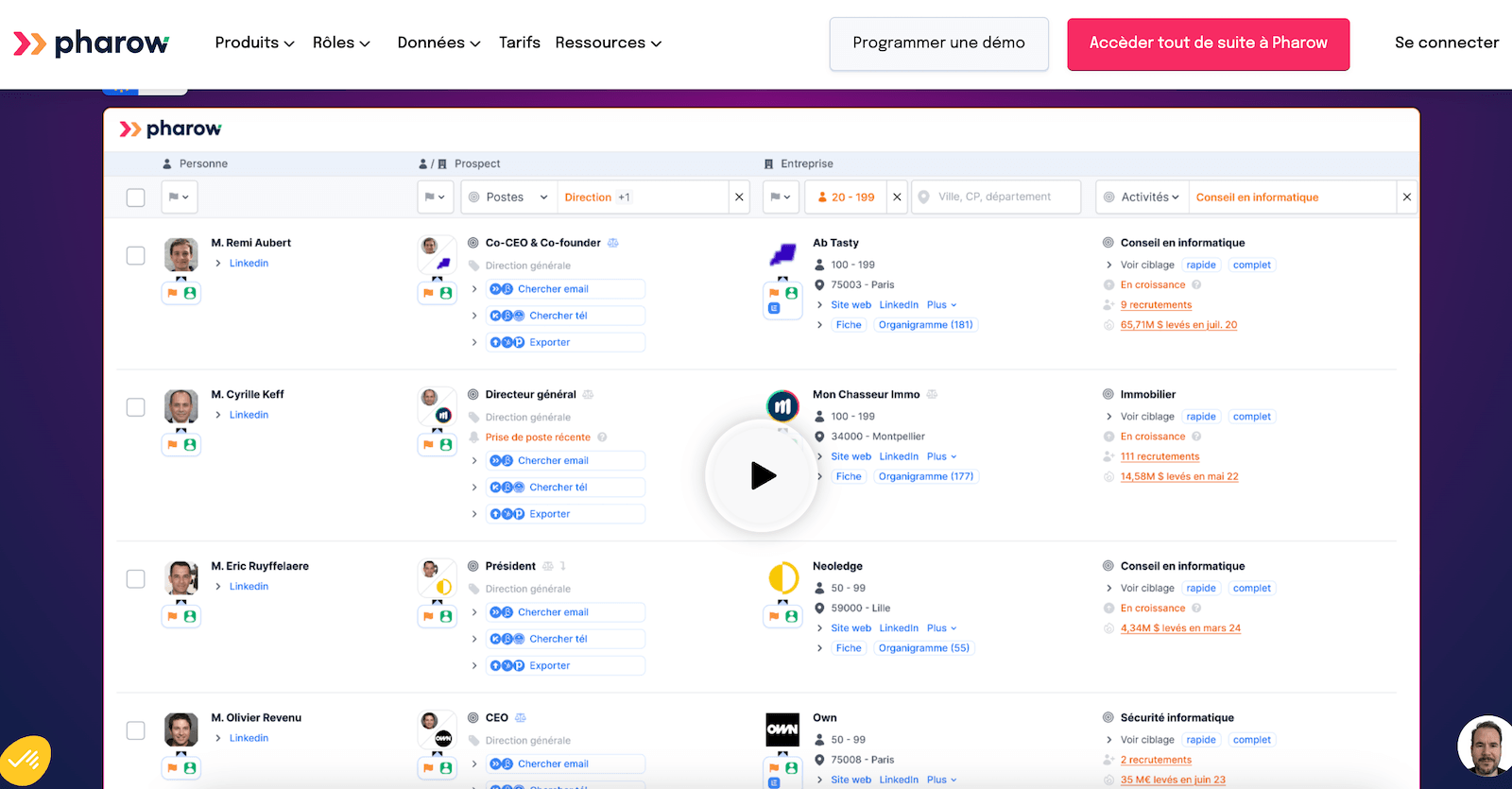
This matching job sounds obvious when you describe it, but it’s actually a technical nightmare. How do you know that the entreprise.fr website matches the SIREN 123456789 and the LinkedIn Entreprise SAS page? You have to deal with homonyms, subsidiaries, name changes, web redirections, mergers and liquidations. This is exactly where most tools give up, and why targeting is often disappointing elsewhere.
Once this reconciliation work is done, everything else becomes possible: filters that cross-reference legal data with LinkedIn data, reconstructed organization charts, multi-source signals, much more reliable email enrichment because the input data is consistent.
The platform provides access to over 4 million active French companies and 10 million prospects, with over 1,300 combinable filters.
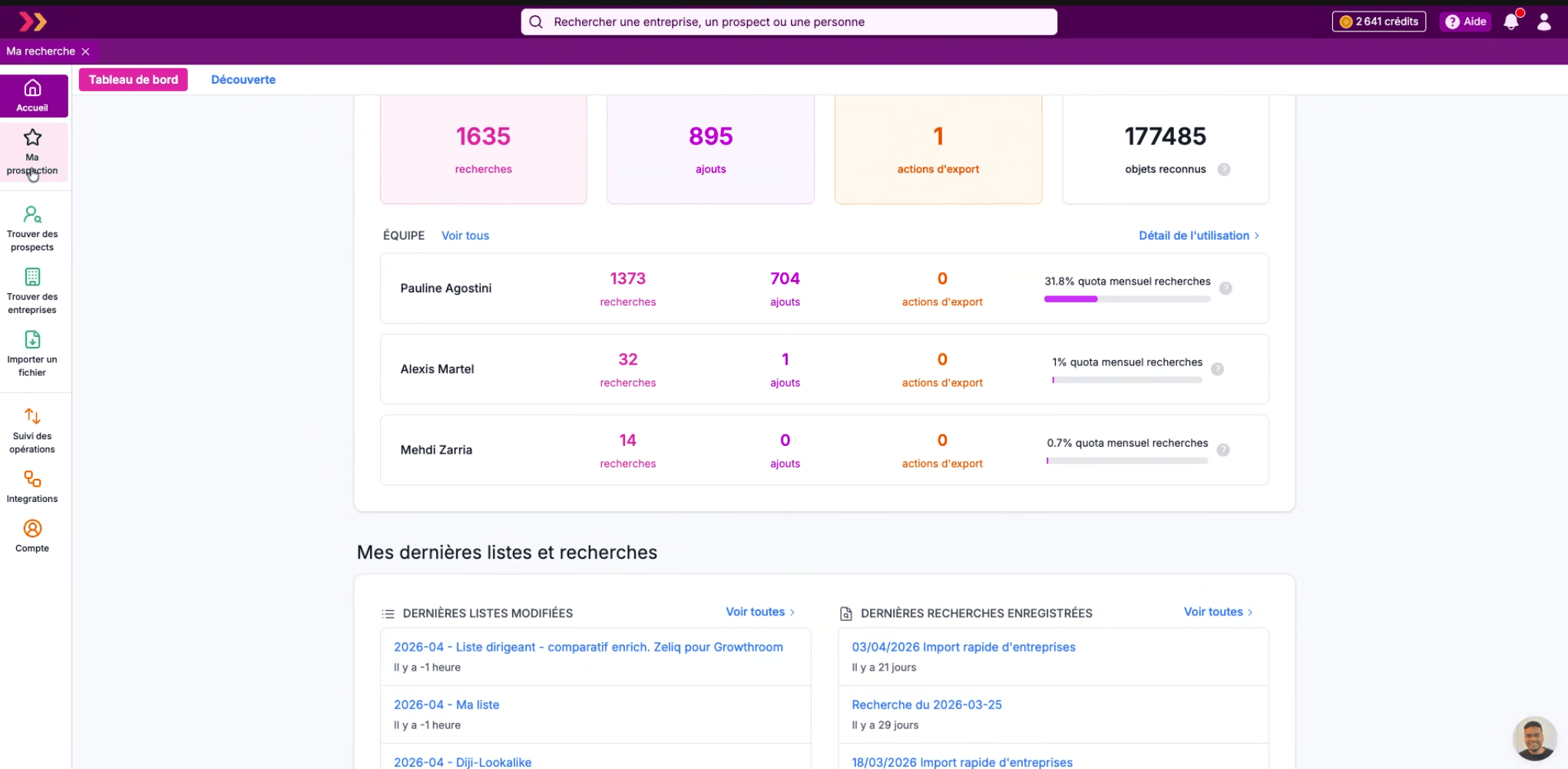
Three concepts to understand right from the start
Pharow rigorously distinguishes three objects, and this distinction structures the entire product:
- A company, identified by its SIREN, website and LinkedIn URL.
- A person, uniquely identified by his/her legal data or LinkedIn URL. The same person can hold several positions (e.g. social mandates).
- A prospect is the unique combination of a person and a company. When someone changes company, the old lead automatically disappears and a new lead is created.
Thanks to this level of granularity, Pharow never confuses Mary Smith at her previous employer with Mary Smith at her new one. This allows you to do things that most tools can’t, such as detecting that one of your CRM contacts is no longer working for the associated company.
Pharow’s 4-step prospecting workflow
Pharow has structured prospecting around an explicit workflow: Targeting → Adding to lists → Enrichment → Export. The entire interface is designed around this logic.
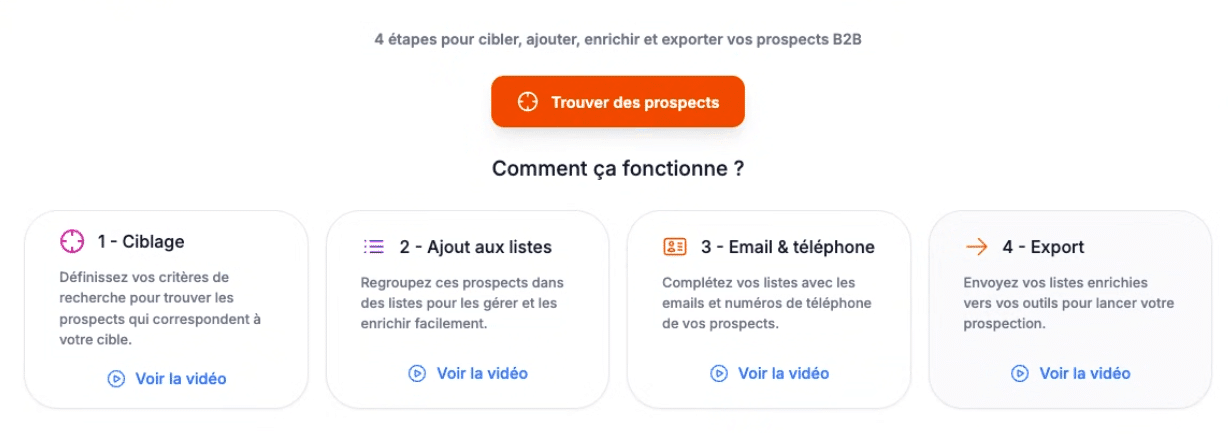
It’s not just a question of ergonomics. It’s also a question of the product’s economic logic: credit consumption is triggered at the moment of listing, not at the moment of searching. So you can explore as broadly as you like, test combinations of filters, see how many companies match this or that criterion, without spending anything. You only commit credits when you decide “OK, I want these prospects on my list”.
Pharow: targeting with a finesse rarely seen on the French market
This is clearly Pharow’s strong point, and the one that alone justifies this detailed review. Most tools stop at the NAF code on the company side and LinkedIn scraping on the prospect side. Pharow goes much further on both dimensions.
Companies: 3 classification systems + free search
The NAF code is an administrative nomenclature that was never intended for commercial targeting. A B2B SaaS and a digital agency often share the same 6201Z code, even though they are two completely different markets.
To solve this problem, Pharow provides three activity classification systems, which can be combined in a single query, plus a free expression search:
- NAF codes, organized by major INSEE sections (A – Agriculture, C – Manufacturing, F – Construction, G – Trade, J – Information and communication, K – Financial activities, M – Specialized scientific and technical activities, etc.). It’s a handy way of keeping in step with official nomenclatures.
- Pharow Activities, a proprietary classification based on several B2B sources. You’ll find categories designed with prospecting in mind: Consulting, Audit/Accounting, Retail, E-Commerce, Architecture/Urban Planning, Events, Publishing… This “in-house” classification covers sectors that are invisible or poorly classified in the INSEE nomenclature.
- Pharow Themes, which classify companies according to what they sell rather than their administrative activity: Aeronautics, Food, Cosmetics/Perfumes, Audiovisual, Jewelry/Watchmaking, Defense/Security, Education…This can be useful for isolating a market by end use.
- The free expression, which searches for a term in the website, the meta-description, the legal description of the business (declared at registration) and the legal and LinkedIn names of the company.
Free expression search is one of Pharow’s most interesting features. In concrete terms, it allows you to target companies that present themselves with a very specific vocabulary. If your product is aimed at consulting firms that position themselves as “data-driven” or “scale-up friendly”, you’ll never find that in an NAF code. But you will find it in their legal description or on their website.
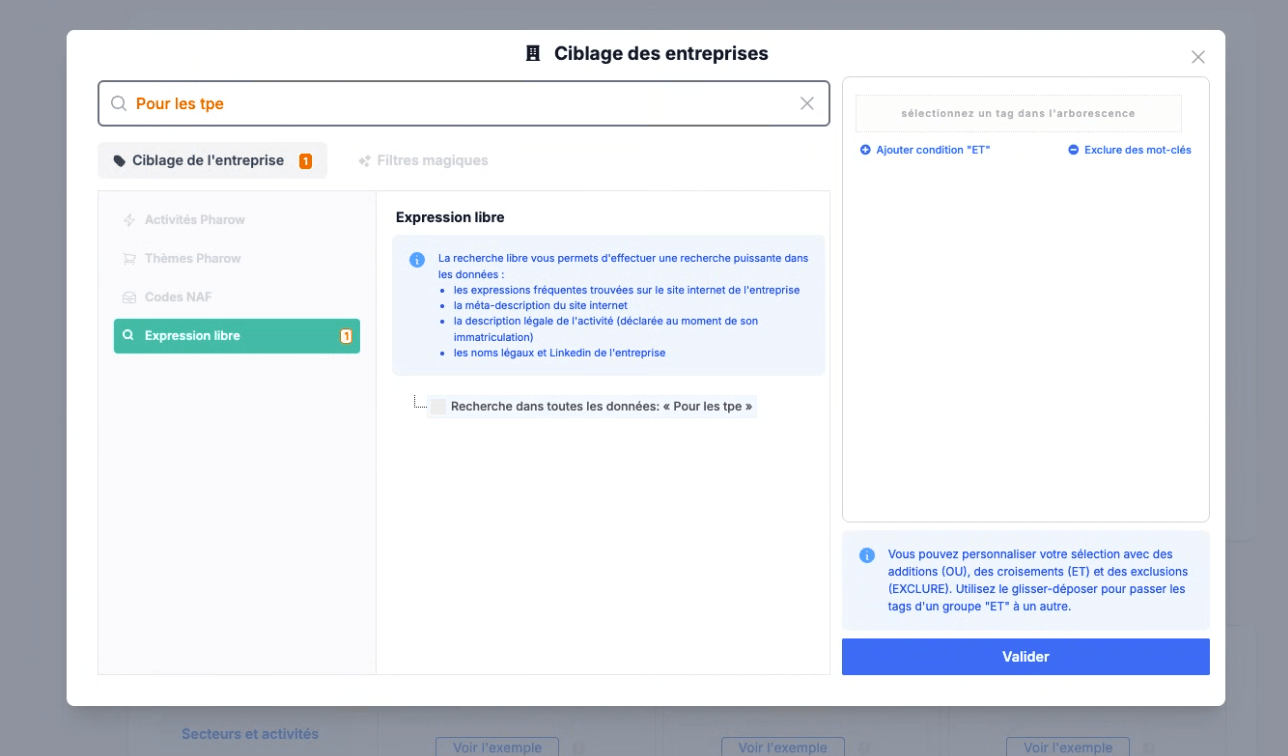
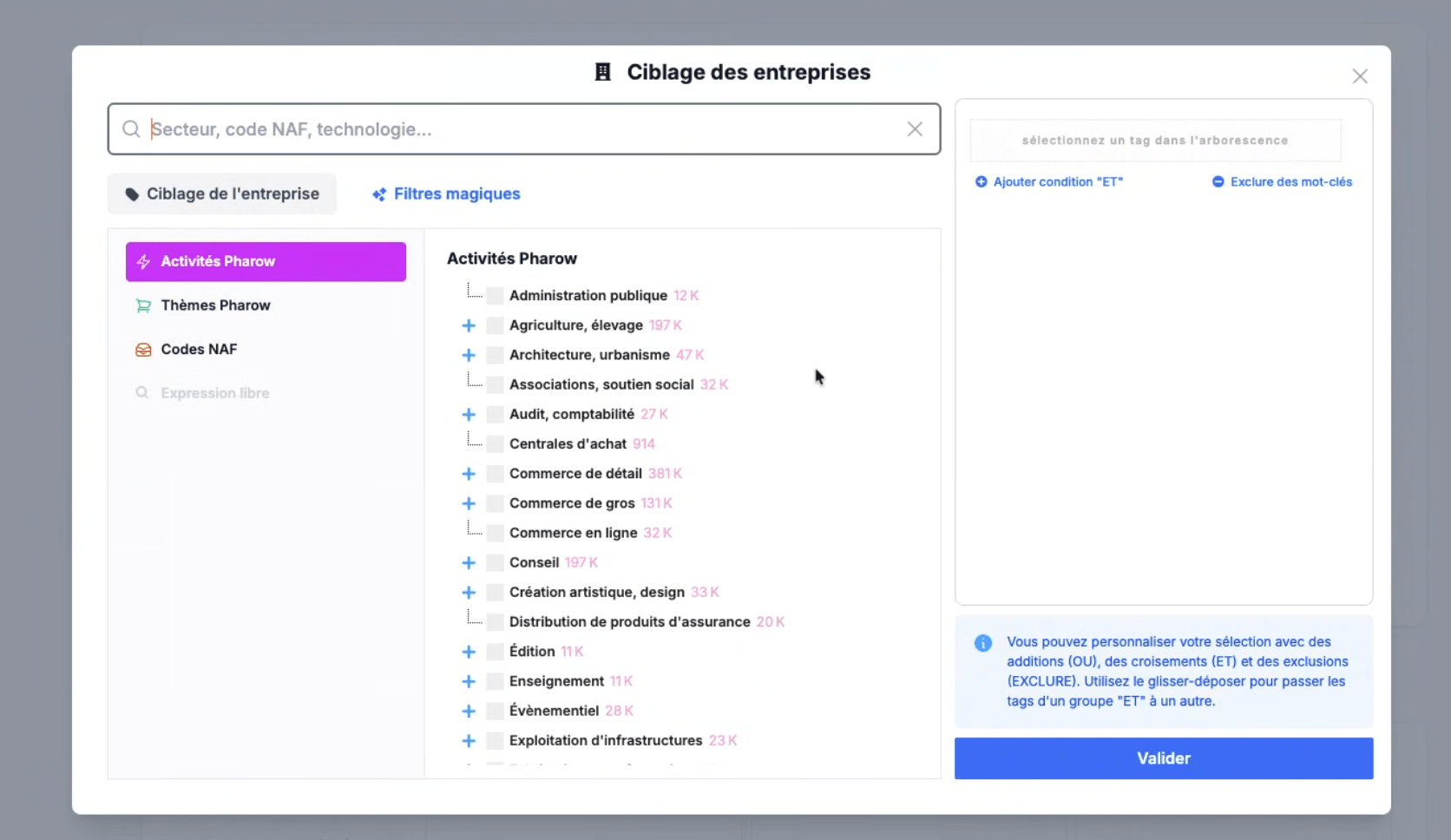
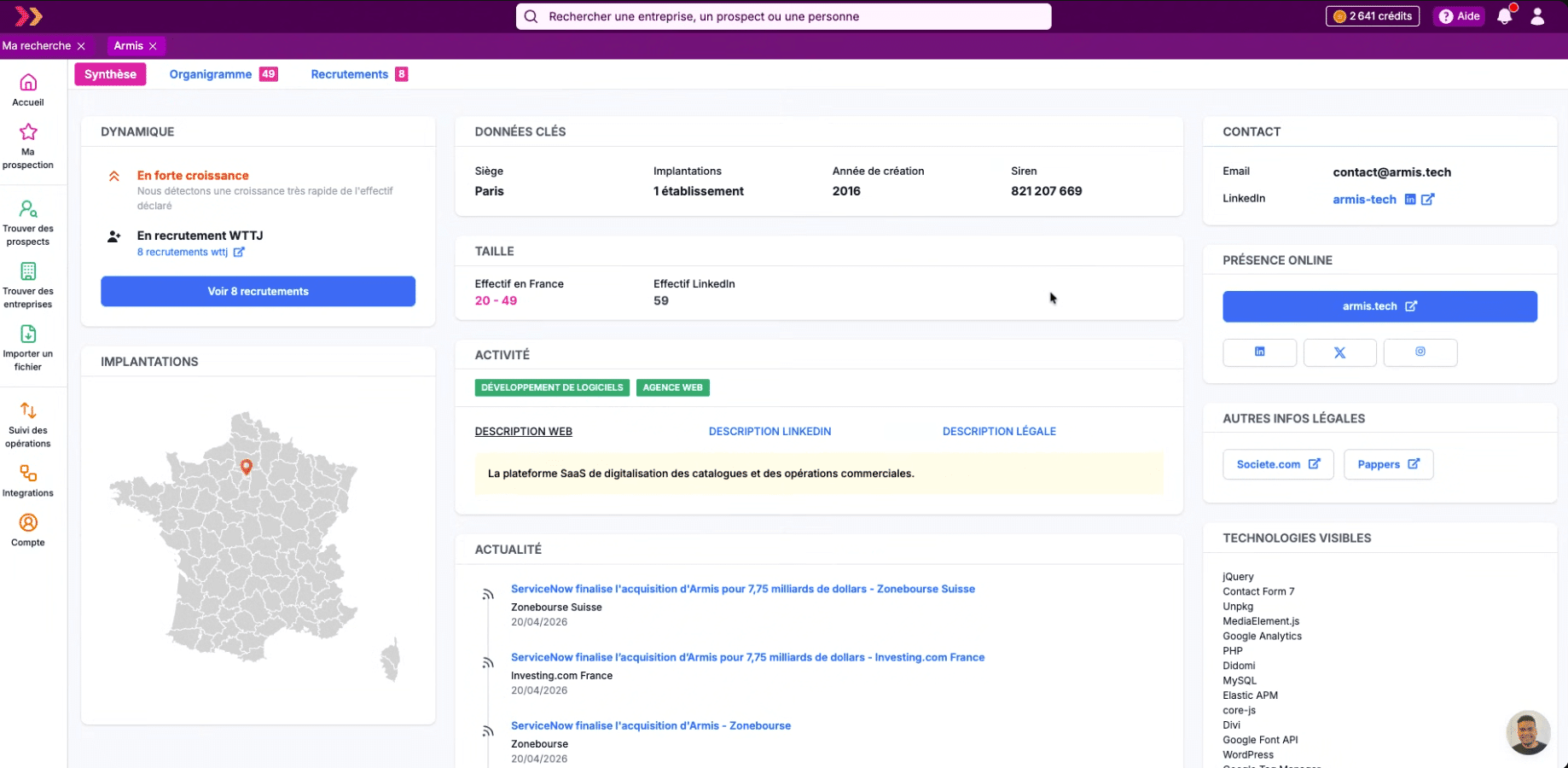
The combination of classification + free search is what makes Pharow really powerful for atypical KPIs. For example, you can cross-reference “NAF code 6201Z + Pharow B2B Software Theme + keyword ‘API’ in the legal description” to isolate technical SaaS publishers. Good luck doing the same thing in Sales Navigator or Apollo.
Filtering by company size
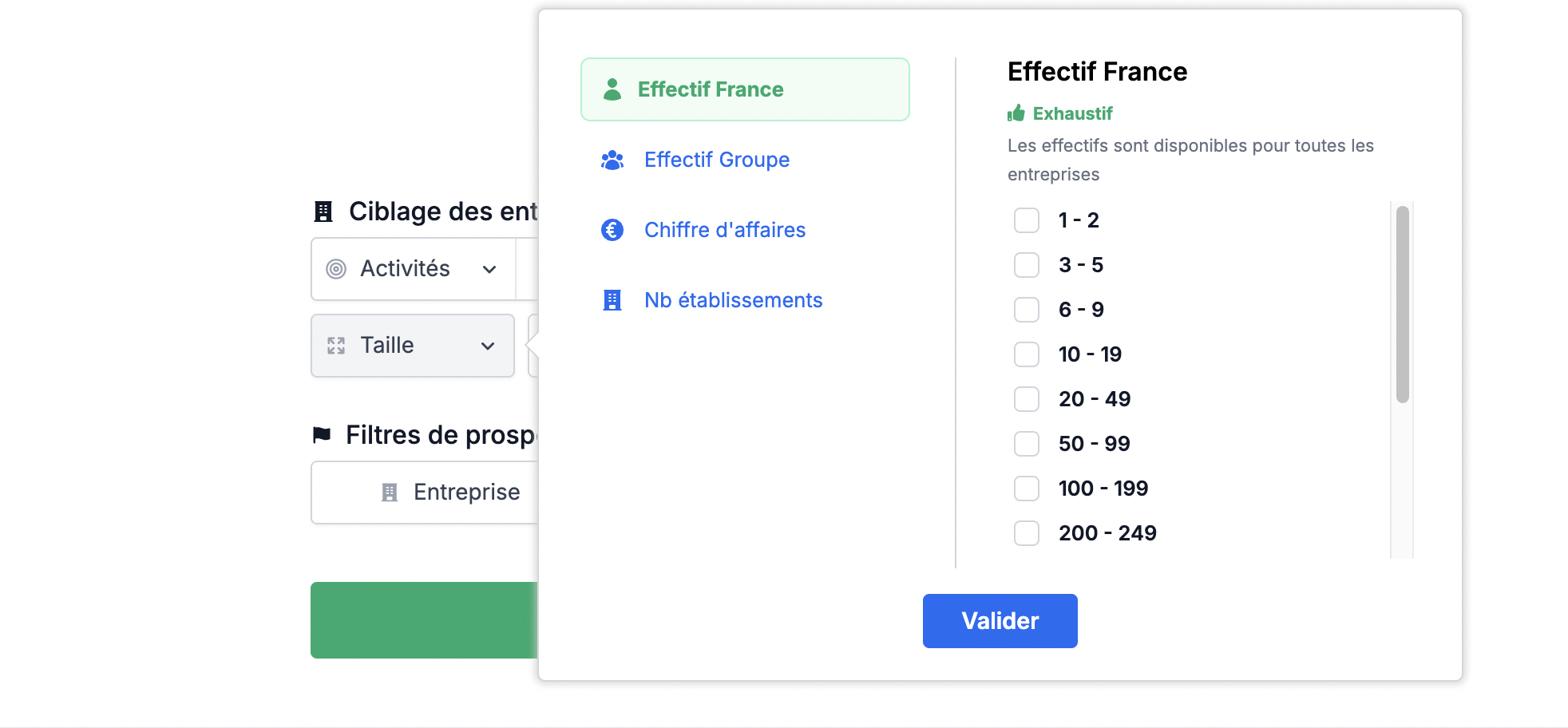
In addition to activity classifications, Pharow offers a module dedicated to targeting by size, with four distinct dimensions:
- Headcount France (exhaustive data, available for 100% of companies), with detailed breakdowns: 1-2, 3-5, 6-9, 10-19, 20-49, 50-99, 100-199, 200-249, etc.
- Group headcount, to target the size of the parent company rather than the subsidiary.
- Sales, by tranche.
- Number of establishments, useful for distinguishing a multi-site player from a single-site one.
The “Group headcount” detail is worth a look: most tools can’t tell the difference between an independent SME with 30 employees and a 30-strong subsidiary belonging to a 5,000-strong group. Pharow does, because the legal data is correctly reconciled.
Prospects: Pharow hierarchy + Job suggestions + Free search
To target a person, you have two main logics which are combined in the “Job targeting” module.
First, the Pharow Hierarchy, which organizes jobs along two complementary axes:
- By department: Management, Purchasing, Sales & Marketing, Marketing, IT, Human Resources, Communication, Media, Finance, Operations, Production/Logistics/Quality, Works/Architecture, After Sales, Medical/Care, R&D/Innovation, Engineering/Studies/Technical, etc.
- By hierarchical level: Directors, Managers, etc.
When you type “CMO”, the tool automatically identifies matches in these two axes (Marketing + Directors, for example) and suggests the combination directly. This avoids the false positives of keyword searches and enables conceptually clean targeting: “I want the Directors of the Marketing department”, rather than “I’m looking for people with ‘CMO’ in their title”.
Pharow offers a 15-day free trial with 100 free credits, no credit card required. This is more than enough time to test the filters, enrichment and CRM sync on your real-life use cases.
Then there’s Custom Search, which breaks down into two modes:
- Job suggestions: for a search like “CMO”, Pharow offers 30 variants of titles actually used on the market: Chief marketing officer, Marketing director, Marketing director, etc. You check the variants relevant to your target market. You tick the relevant variants for your target audience.
- Free search with Boolean operators: you can type “head of growth” OR “growth lead” NOT “intern” for surgical targeting. The search is performed either on job titles containing your term, or on identical job titles. Useful for atypical or very recent positions that the hierarchy has not yet integrated.
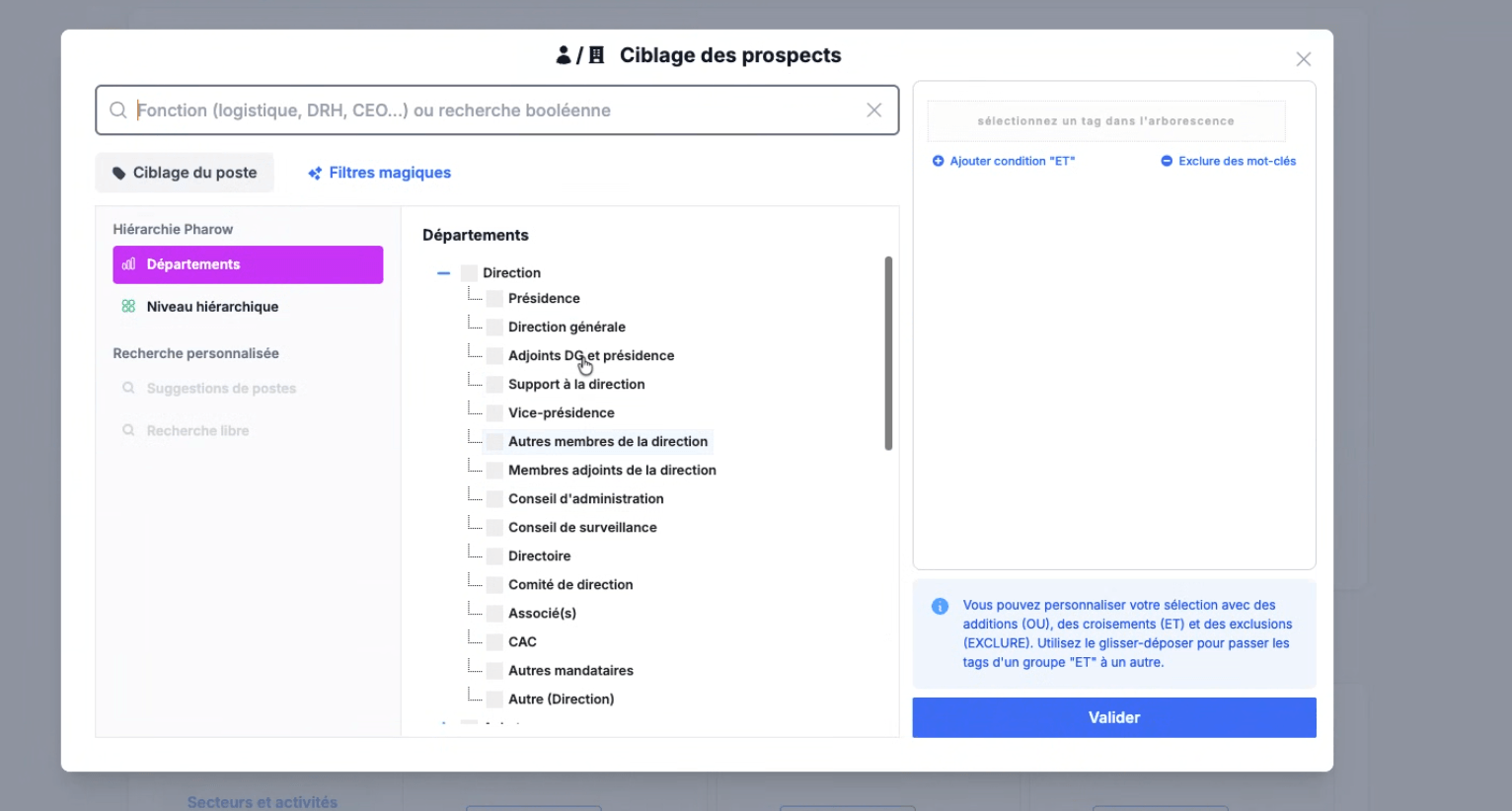
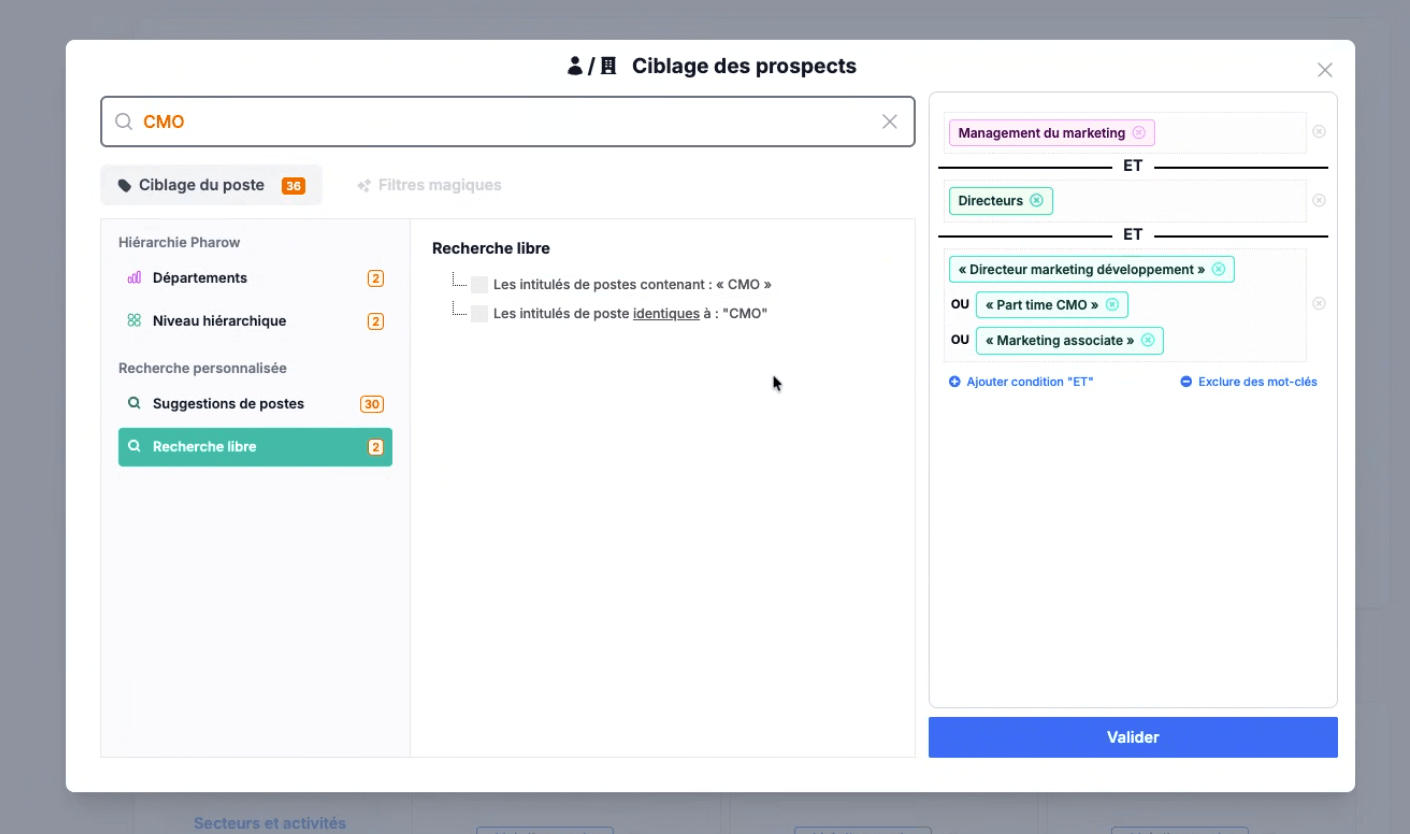
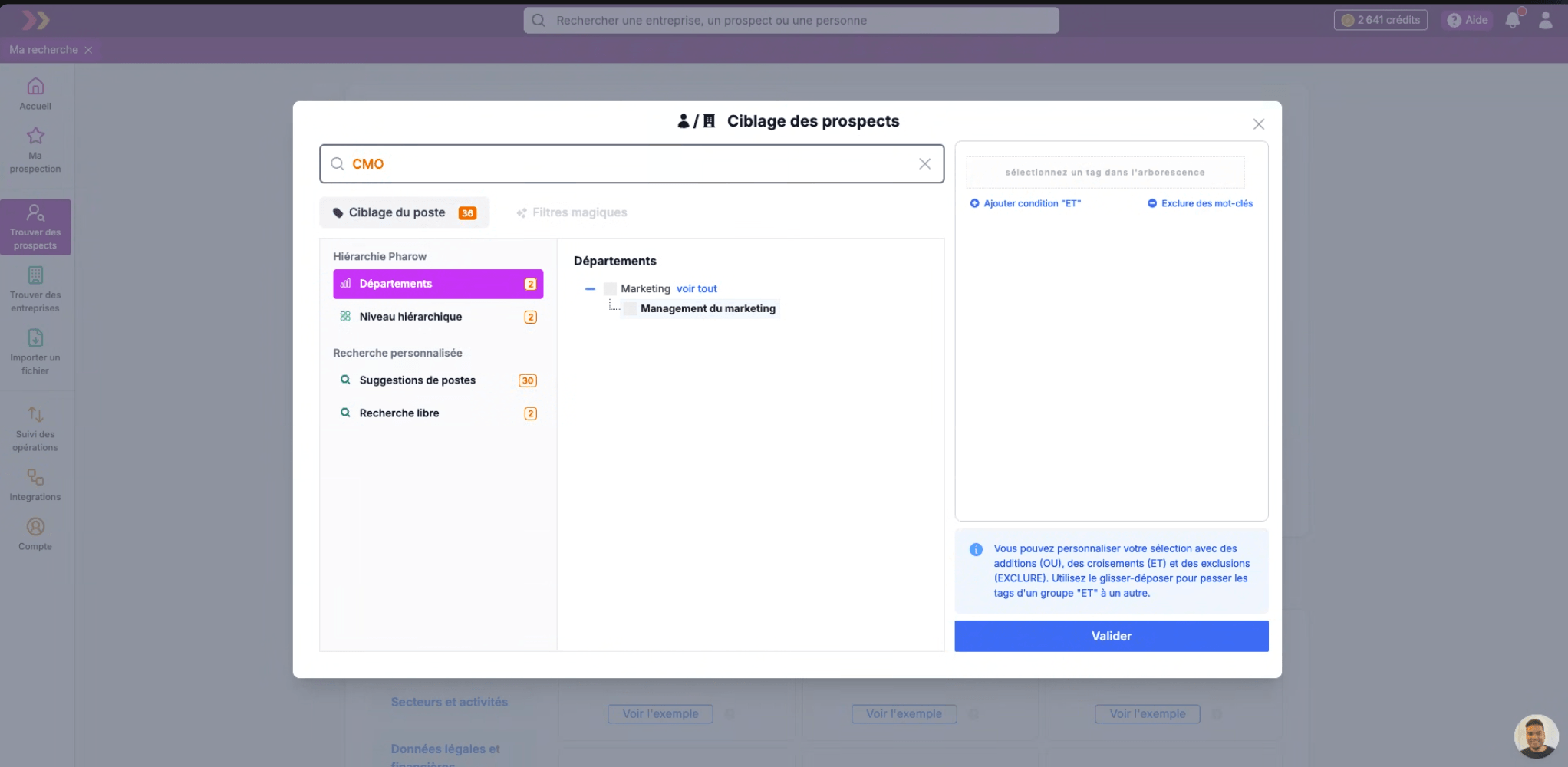
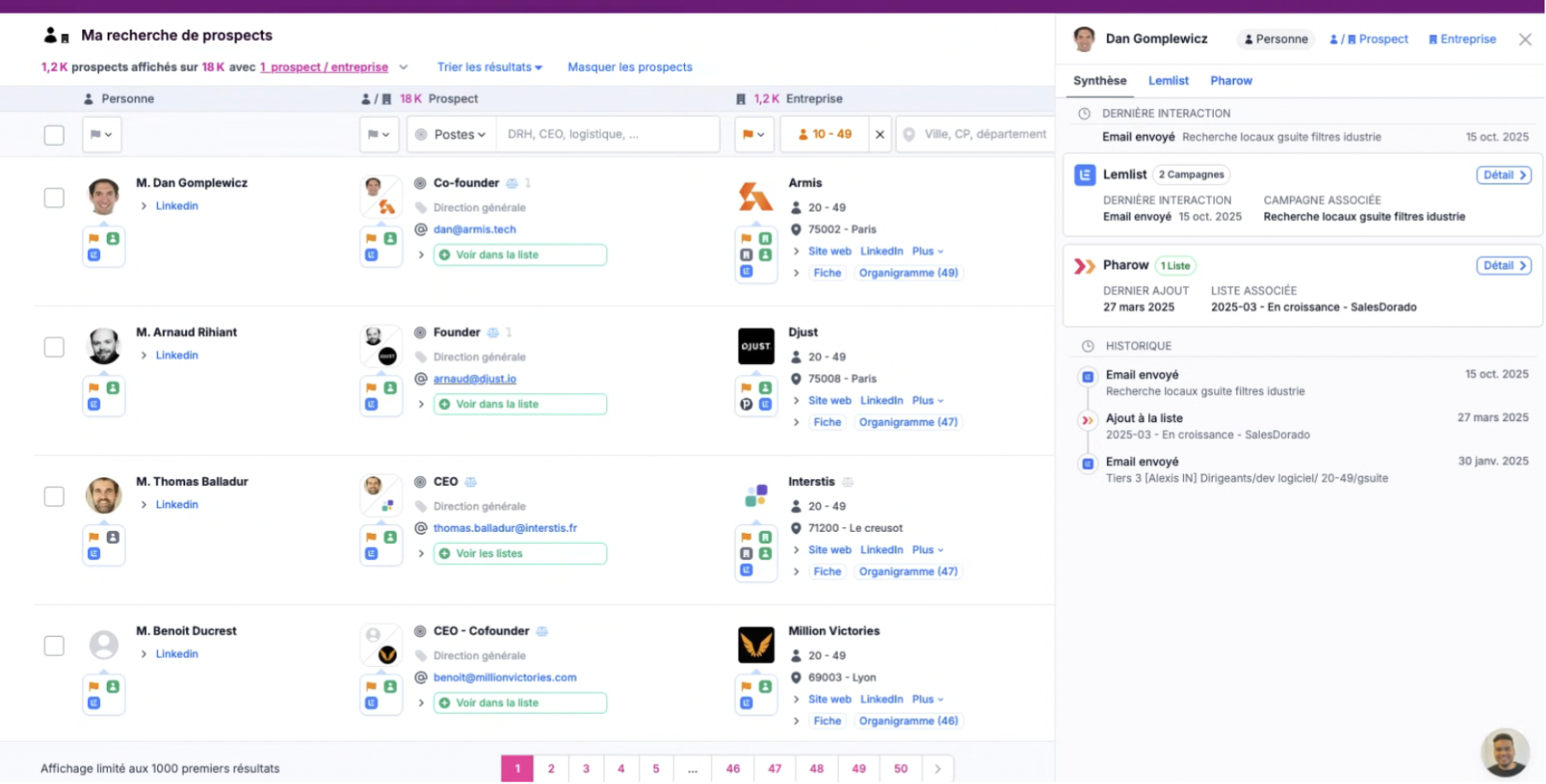
The Job Suggestions feature solves a classic problem in prospect targeting: “CMO” ↔ “Chief Marketing Officer” ↔ “Directeur marketing” ↔ “Head of marketing”… All these variants refer to the same person, but are rarely handled properly by the tools on the market. With just one click, Pharow provides you with a consolidated list of real variants observed in the database, with an aggregated counter by mode (Hierarchy / Suggestions / Free search). You can set up your targeting in a matter of seconds, instead of getting lost in regexes.
Magic filters for prospects
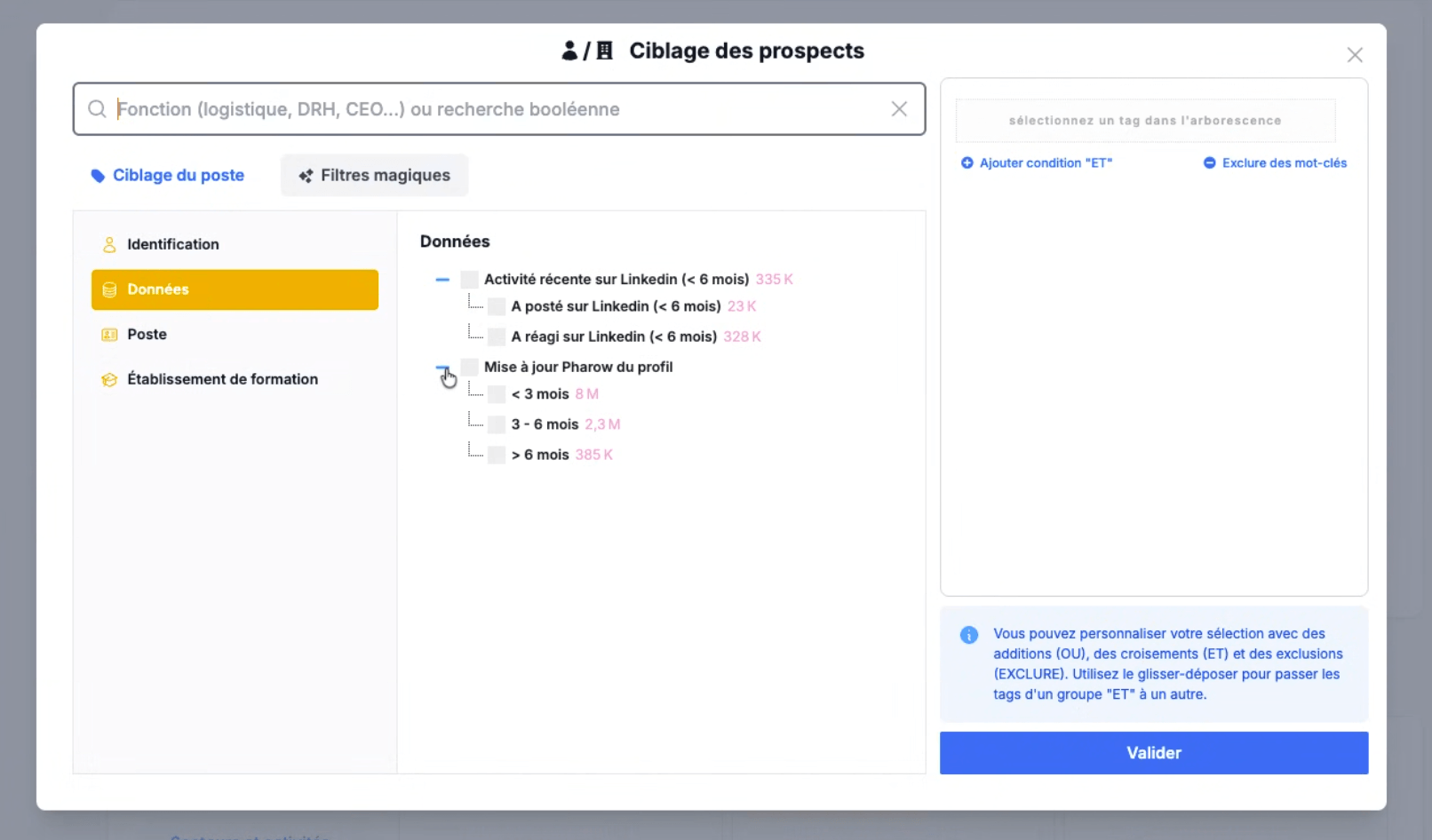
In addition to job targeting, magic filters refine according to behavior and profile:
- Recent LinkedIn activity (posted or reacted within the last 6 months)
- Fresh Pharow profile update
- Educational establishment (grandes écoles, universities, IAE, IUT, specialized schools)
Magic filters for business: 8 categories to go beyond activity
In addition to activity classification, Pharow offers a dedicated module of magic filters for the enterprise, organized into 8 categories:
- Marketing / Business Model: B2B / B2C, E-commerce and SaaS, Luxury, Made in France, International presence…
- Financial data: CAC 40 / SBF 120 membership, financial ratios (out of 3.3M companies). This filtering is useful for upstream qualification of financial strength.
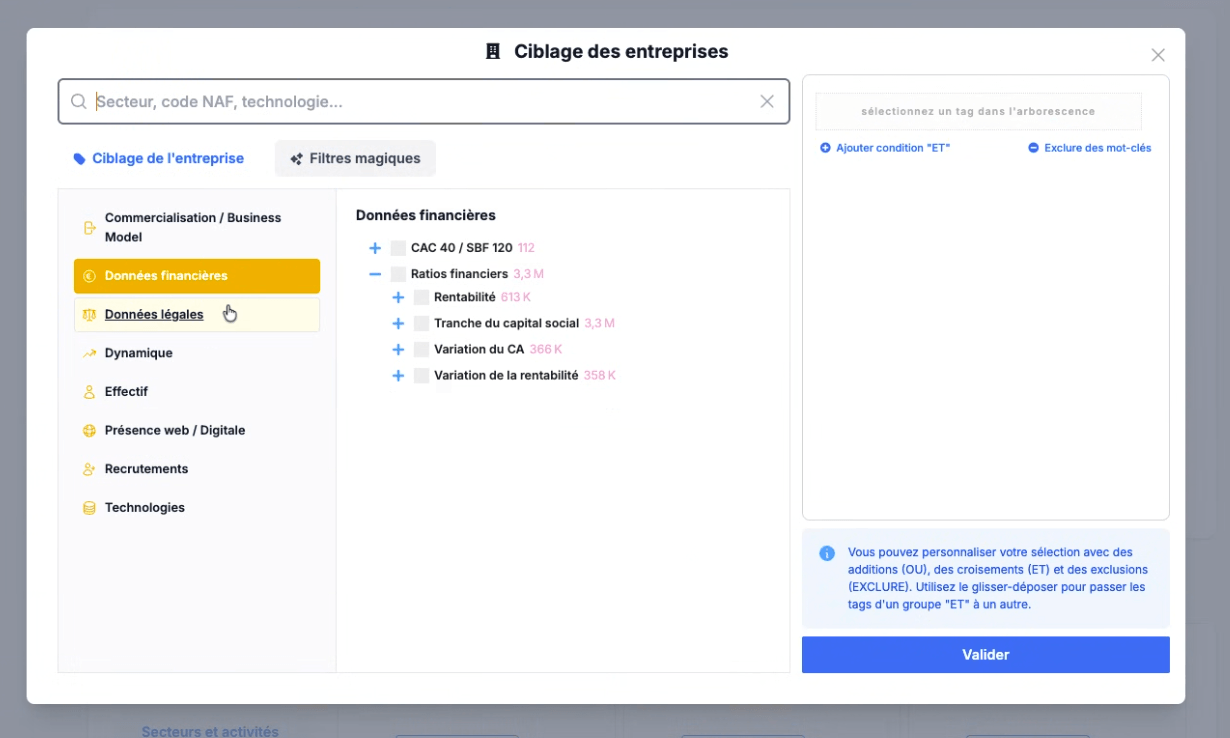
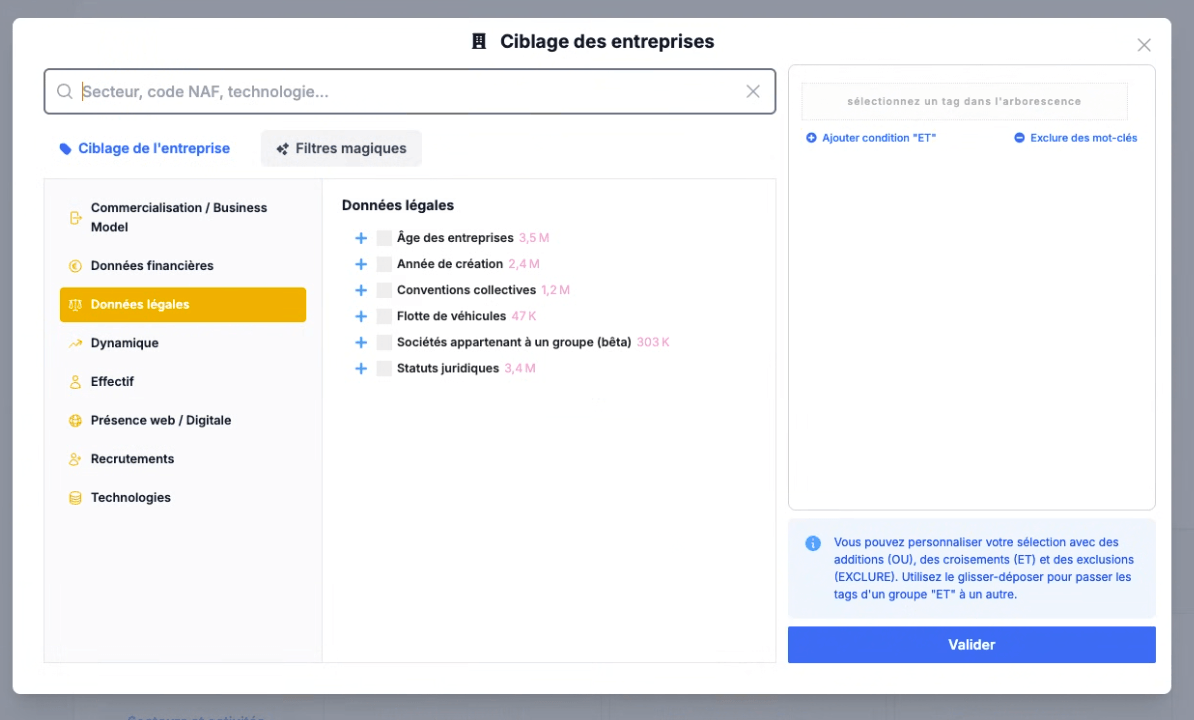
- Legal data: age of company, year of foundation, collective bargaining agreements (which makes it possible to isolate lawyers, notaries, chartered accountants and other regulated professions within the same NAF code), vehicle fleet, companies belonging to a group, legal status.
- Dynamic: growing companies, high-growth companies, detailed growth indicators.
- Workforce: team growth, workforce by department (FR).
- Web / Digital presence: mobile application, website traffic ranking, social networking presence…
- Recruitment: companies currently recruiting, sortable by platform (LinkedIn, Welcome to the Jungle), position type and recruitment volume.
- Technologies: 15+ sub-categories automatically detected from the website: Analytics, Web Development, Marketing, Content, Servers, Security, Add-ons, Commerce, Communication, etc. For example, you can isolate companies that use HubSpot, a chat solution or Webflow as a CMS.
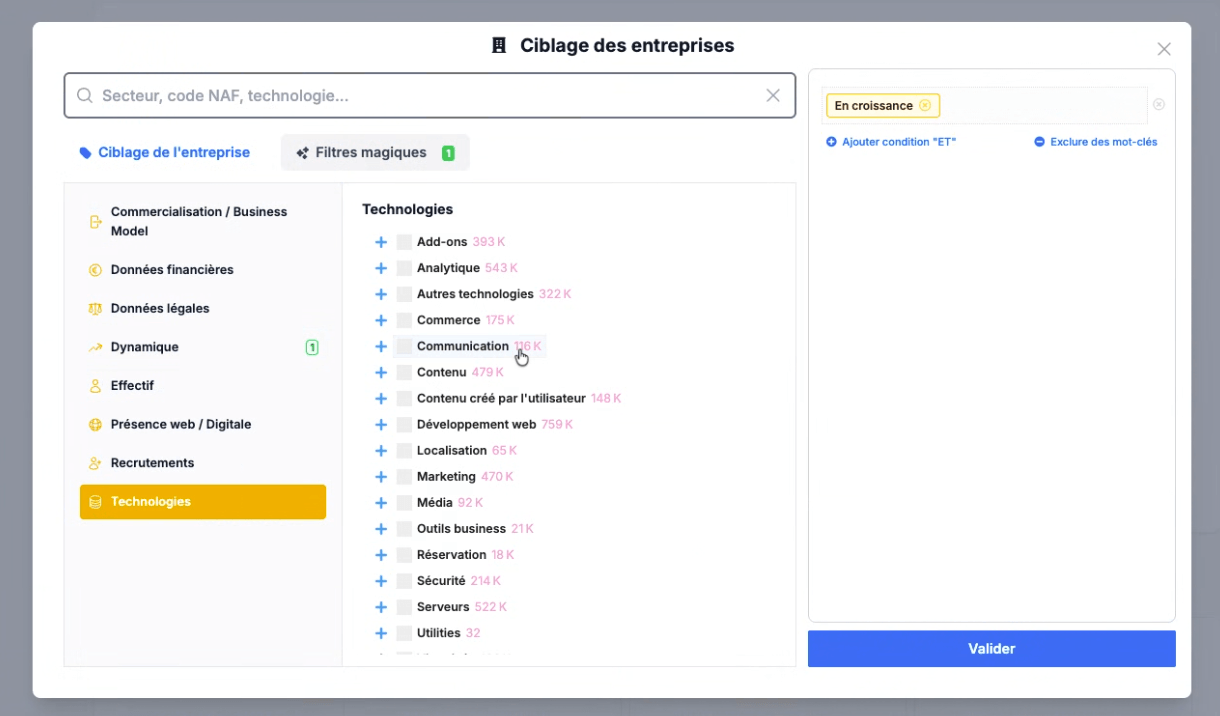
The real strength lies in the combination. Pharow puts forward a telling example: “growing companies, which are recruiting sales staff, use HubSpot and have just raised funds”. These are four signals that no other tool is able to cross-reference natively with such finesse in France. And you can cross-reference them with any of the three activity classification systems mentioned above, or with a free expression search.
The “Growing” filter looks simple on paper. In reality, it’s the fruit of a great deal of engineering. It crosses several signals: the evolution of sales over several years, the evolution of legal headcount, the evolution of LinkedIn headcount and recent fundraising… This is what separates a real prospecting tool from a simple Sales Navigator scrapper.
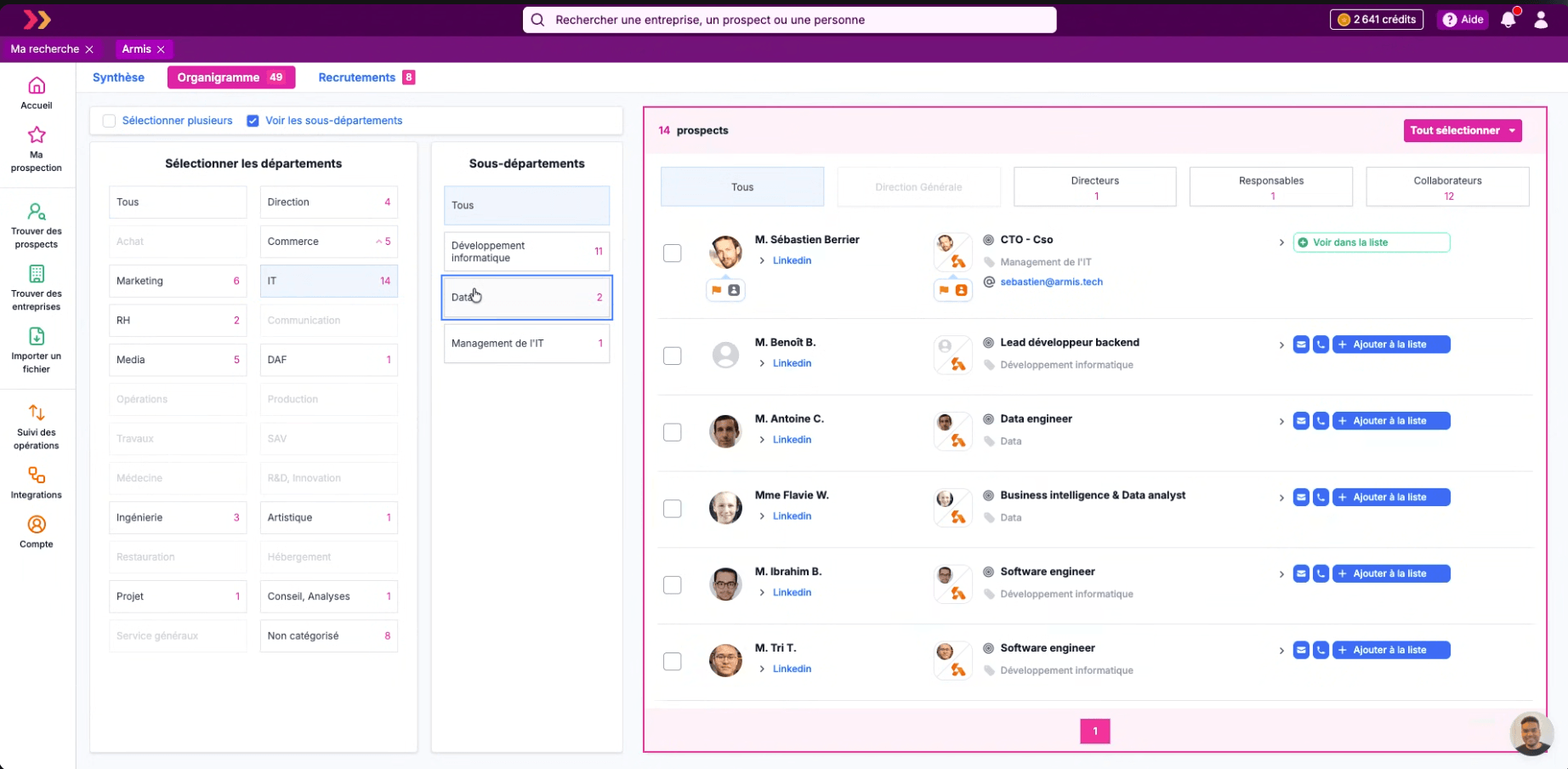
By the way, the company file gives access to a reconstituted organization chart that combines legal data (corporate officers) and LinkedIn data (positions, departments, hierarchical levels). This is useful for ABM approaches where you want to quickly map the decision-makers and influencers of a key account.
Several entry points to start a search
Pharow doesn’t offer just one targeting mode. Depending on how you attack the problem, you have four distinct entry points:
- Free targeting, the classic mode with all filters open.
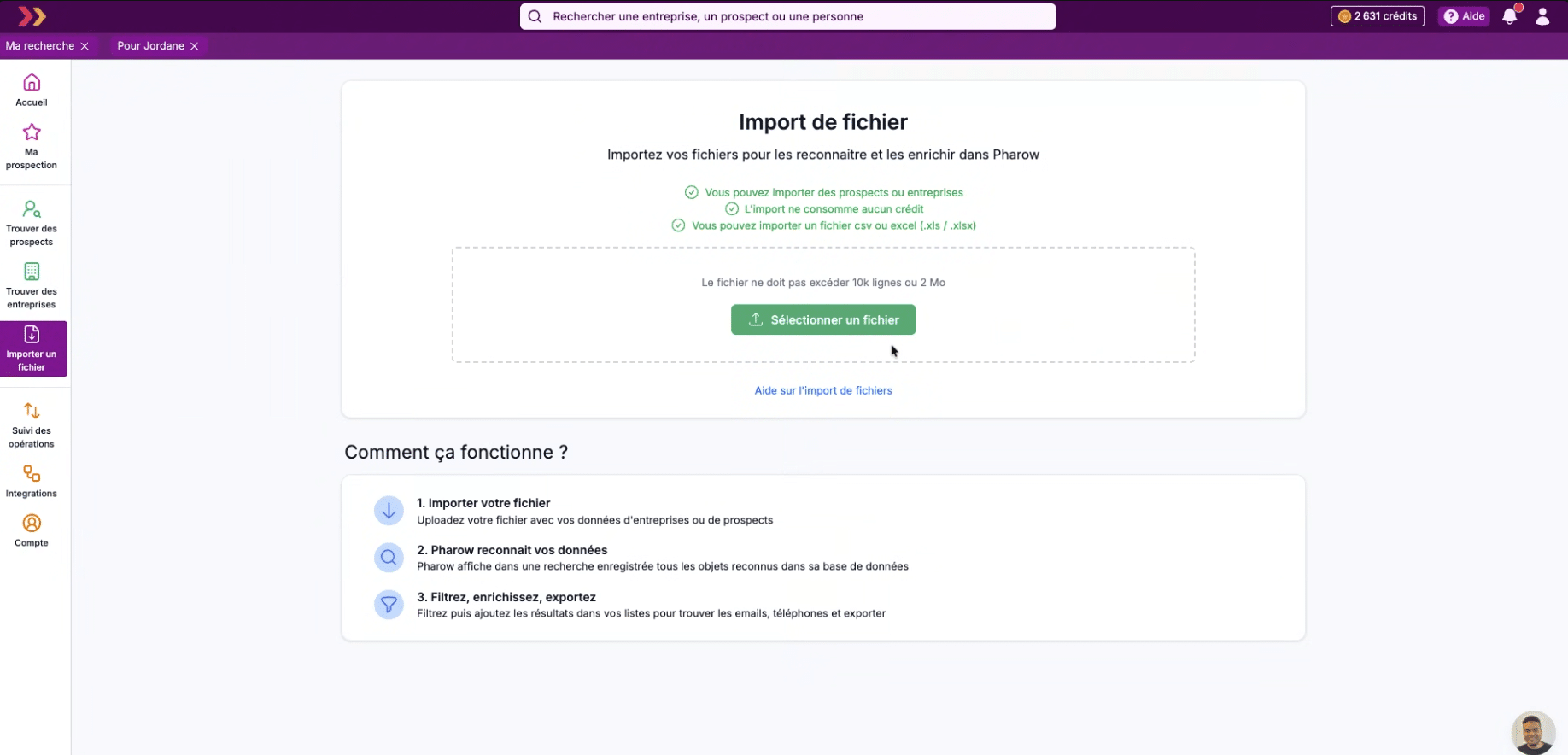
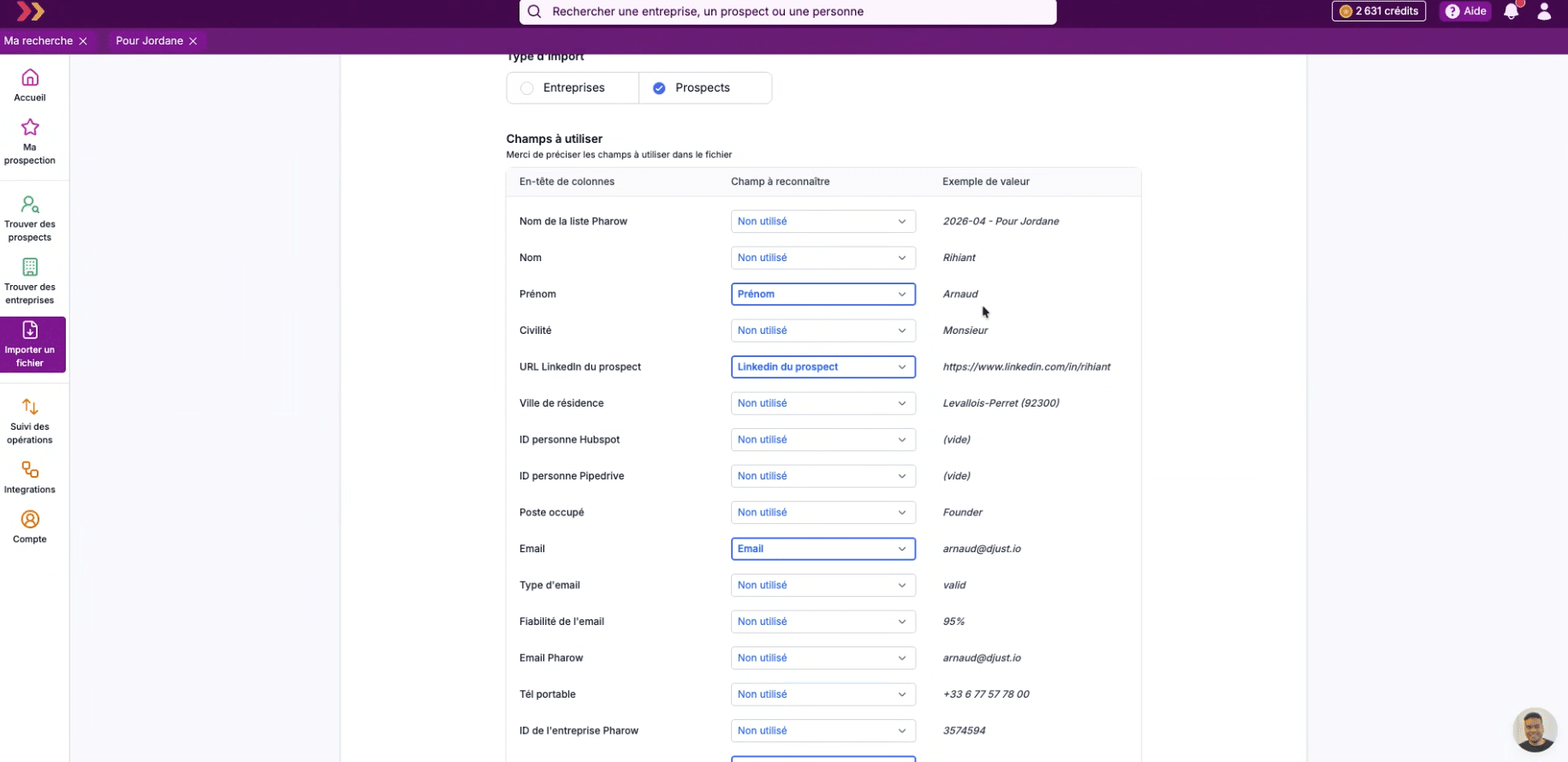
- Quick import: you upload a CSV or Excel file of up to 10,000 lines, and Pharow recognizes your data in its database and offers to enrich it. Importing does not consume any credits, only enrichment.
- Job ads, a dedicated module that lets you target companies according to the positions they are currently recruiting.
- Web Visits, which detects companies visiting your site and automatically enriches them to send them to your CRM.
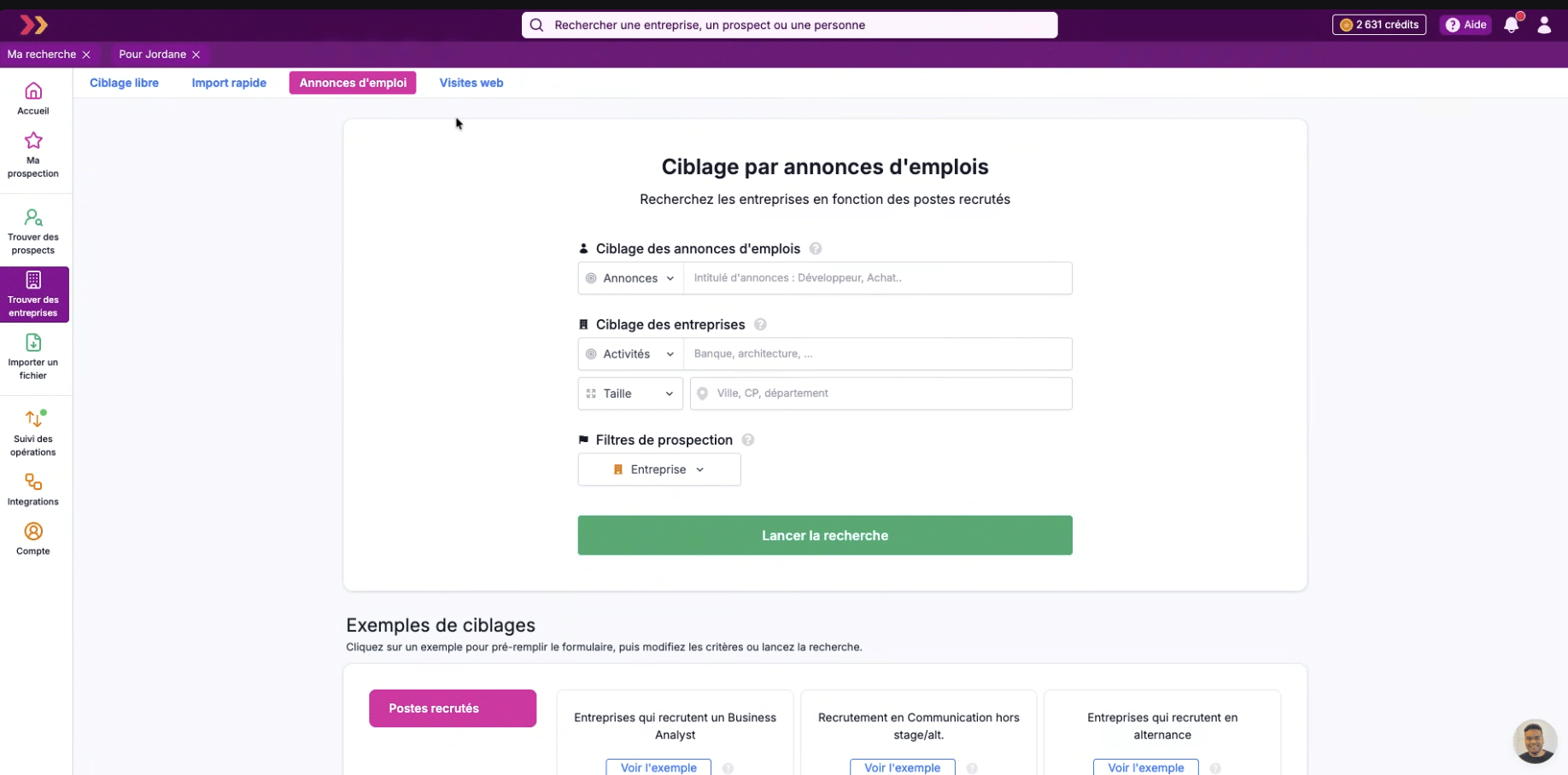
The Job Ads module is well worth a visit. Pharow scrapes LinkedIn and Welcome to the Jungle in near-real time, allowing you to target, for example, “all companies recruiting a Business Analyst in the Paris region” with just a few clicks. This is a powerful signal of intent that most tools fail to capture.
Enrichment: the Pharow waterfall
This is an important point to understand: Pharow does not store email or telephone databases. It’s a position that explains a lot. The platform fetches contact details in real time, on demand, via a cascade of partners.
Enrichment is based on an automatic cascade included in the subscription, which combines two distinct logics:
- For emails: Pharow first queries Dropcontact, the French reference for business emails and standard numbers. If Dropcontact can’t find it, FullEnrich takes over. And FullEnrich is not a single provider: it’s a meta-cascade that queries 15 different providers, which maximizes the chances of finding the email even when the first provider has failed.
- For mobiles: Pharow relies directly on FullEnrich.
- Verification: each email found then passes through Zerobounce, which filters out catch-alls and invalid addresses before they pollute your mailings. This is not a discovery stage, but a quality layer applied at the end of the cascade.
All this is included in the subscription, at no extra cost beyond the standard credits.
And if you already have a Kaspr or BetterContact subscription…
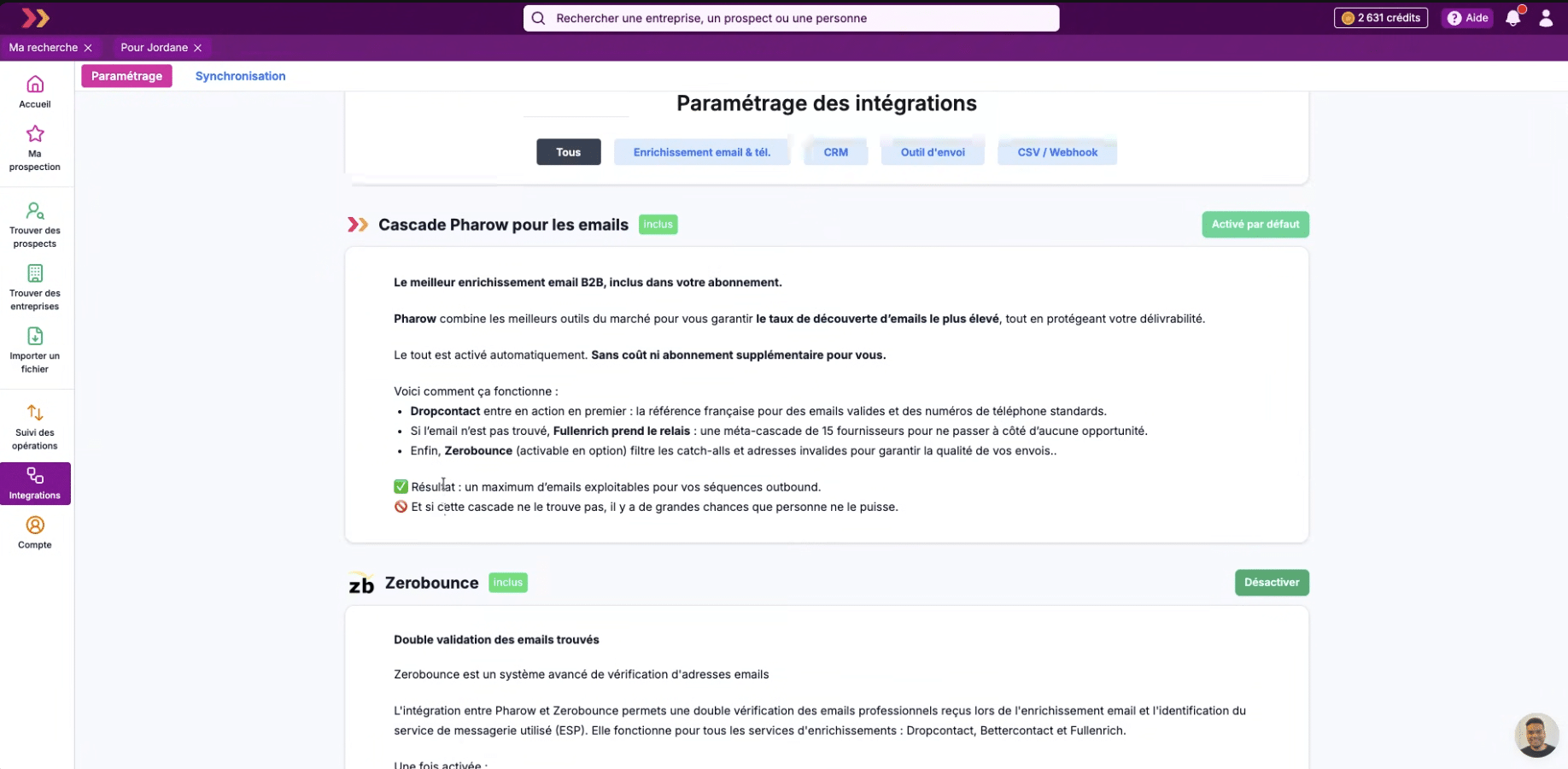
In addition to automatic cascading, Pharow offers native integrations with other enrichment providers, notably Kaspr and BetterContact. In concrete terms, on a prospect’s file, the “Search tel” option unfolds a menu that lets you choose between FullEnrich (the standard cascade) and the integrations you’ve added (Kaspr and/or BetterContact, for example):
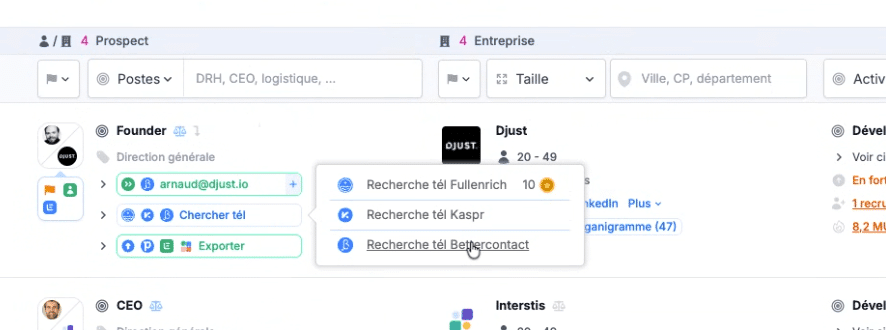
It’s a BYO (“bring your own account”) logic: you connect your Kaspr or BetterContact account and trigger enrichment from within Pharow, without having to juggle between several tabs. This is useful if you already have a subscription with one of them, or if you want to multiply sources on difficult profiles.
Why not a pre-stocked email database?
It’s a choice you have to understand:
The first reason is RGPD compliance. Maintaining a database of business emails and phone numbers in permanent storage is highly unpopular with the CNIL, which sees this type of practice as problematic on the grounds of purpose and retention period.
By querying sources on demand, Pharow does not store any personal data, considerably simplifying risk analysis for its customers.
The second reason is the freshness of the data. Pre-compiled e-mail databases don’t age well: an employee changes job, his professional e-mail becomes invalid, but he remains in the database for months or years. On-demand search, on the other hand, provides fresh data at any given moment, in line with the prospect’s actual situation.
Enrichment credit management
The system is deliberately protective:
- 1 credit = 1 prospect or 1 company added to a list
- Email enrichment included at no extra cost
- Cell phone enrichment = 10 credits if found, 0 credits if not found
- Option: if you activate the “only if email/phone found” filter, no credit is used up if enrichment fails.
This logic changes the cost structure compared with tools that charge per discovery, even when the result is “not found”. In practice, you only pay for records that can actually be used.
Prospecting filters: your sales activity becomes a filter
This is probably the feature that most distinguishes Pharow from its competitors, and the one that is least visible when you look at the tool from a distance. Beyond the classic targeting (job + company + size + magic filters), Pharow offers a third level of filters dedicated to the status of your prospecting. This logic applies both to Pharow lists themselves and to external tools (CRM, mailing platforms).
Pharow offers a 15-day free trial with 100 free credits, no credit card required. This is more than enough time to test the filters, enrichment and CRM synchro on your real-life use cases.
Three filter angles: Person, Prospect, Company
The module is consistent with the conceptual distinction Person / Prospect / Company presented above. You can filter according to the three angles:
- Person: Has the person already been prospected? Does he or she have a LinkedIn profile?
- Prospect (person + company combination): Is this specific prospect on one of my Pharow lists? In a list shared by a colleague? In a team list?
- Company: Has the company already been canvassed? Is it on one of our lists?
Each angle offers sub-tabs: Prospecting (status of Pharow lists), Data, Enrichment, Integrations (connected CRM), Campaigns (connected mailing tools). It’s this unification (native Pharow lists AND external tools processed in the same filter module) that makes the tool unique on the market.
#1 Filter on the status of Pharow lists themselves
Even before you’ve connected a CRM, you can already filter what’s going on in your Pharow team. For example, you can :
- Exclude prospects already on your own lists (to avoid re-prospecting)
- Exclude prospects from lists shared with you (to avoid stepping on a colleague’s toes)
- Exclude prospects present in any team list (total exclusion logic)
- Conversely, specifically targeting prospects on a shared list for team processing
This mechanism works on all three angles (Person / Prospect / Company), with an important finesse: Pharow distinguishes between “this contact is in my list” and “this company is in a list of prospects”. This is useful for a multi-touch approach to a key account without risking duplication.
#2 Filter on the status of your CRM and campaigns
When you connect Pharow to HubSpot, Pipedrive, Lemlist or La Growth Machine, the same filtering logic extends to your external tools. And synchronization is bidirectional in both directions: Pharow reads external data and transforms it into search criteria.
For example:
- Exclude contacts already in HubSpot or Pipedrive (to prospect new contacts only).
- Exclude people involved in a current deal (to avoid disrupting an active sales cycle).
- Exclude prospects contacted via Lemlist or La Growth Machine in the last 3 months, to avoid excessive marketing intensity on the same contact.
- Conversely, specifically target the accounts of a deal lost over 6 months ago (to reactivate them).
- Find new decision-makers in companies already in contact with each other.
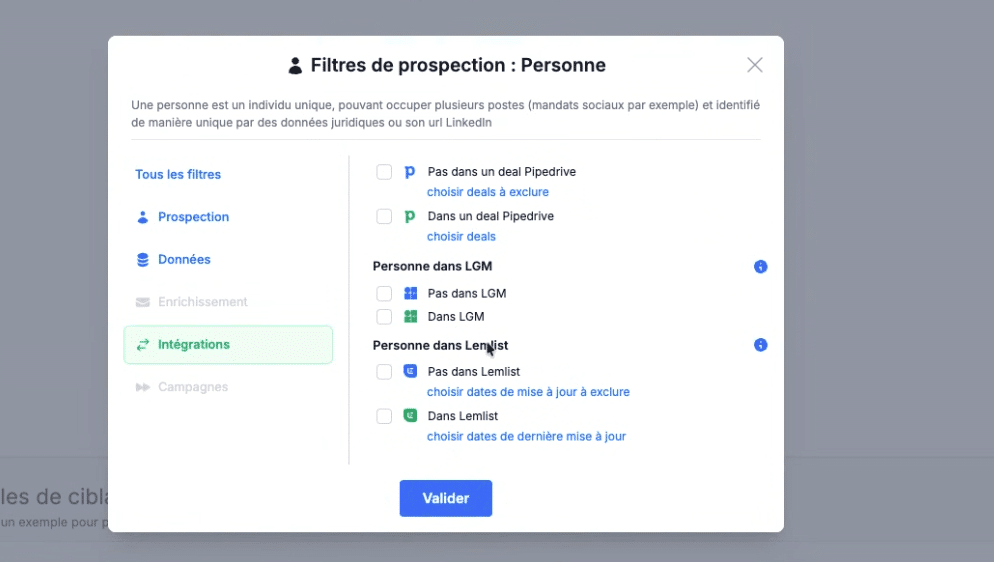
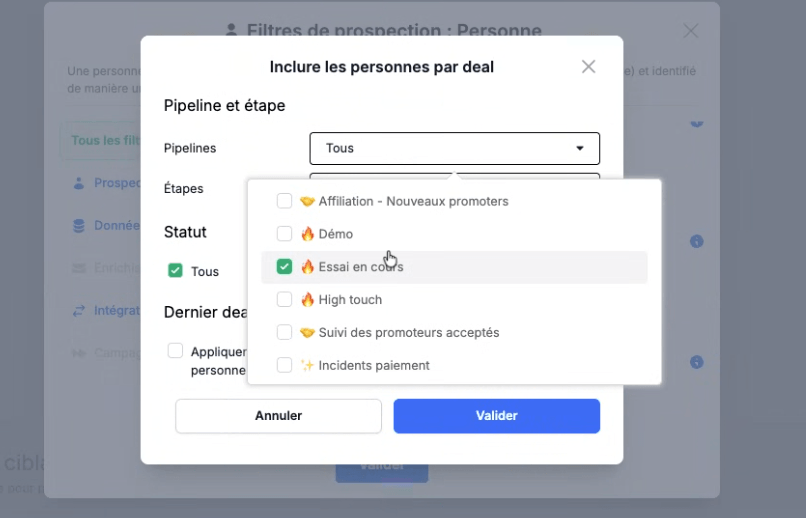
Sales Navigator + Apollo + Cognism all know how to export to a CRM, but none, to our knowledge, knows how to filter the search itself according to the state of the CRM or the team’s prospecting history. In concrete terms, this changes day-to-day productivity: you no longer spend 20 minutes after each search manually deduplicating against your CRM or against colleagues’ lists in Excel.
Integrations: CRM synchronization, exports and webhooks
Pharow has gone a long way in connecting to external tools. The logic is not that of a one-off export (although this is also possible), but of a bidirectional synchronization that maintains coherence between Pharow and your stack over time. Bidirectional in the truest sense of the word: Pharow doesn’t just send data to your tools, it also reads the status of your CRM and campaigns (Lemlist, La Growth Machine) and turns them into search criteria.
Native integrations available
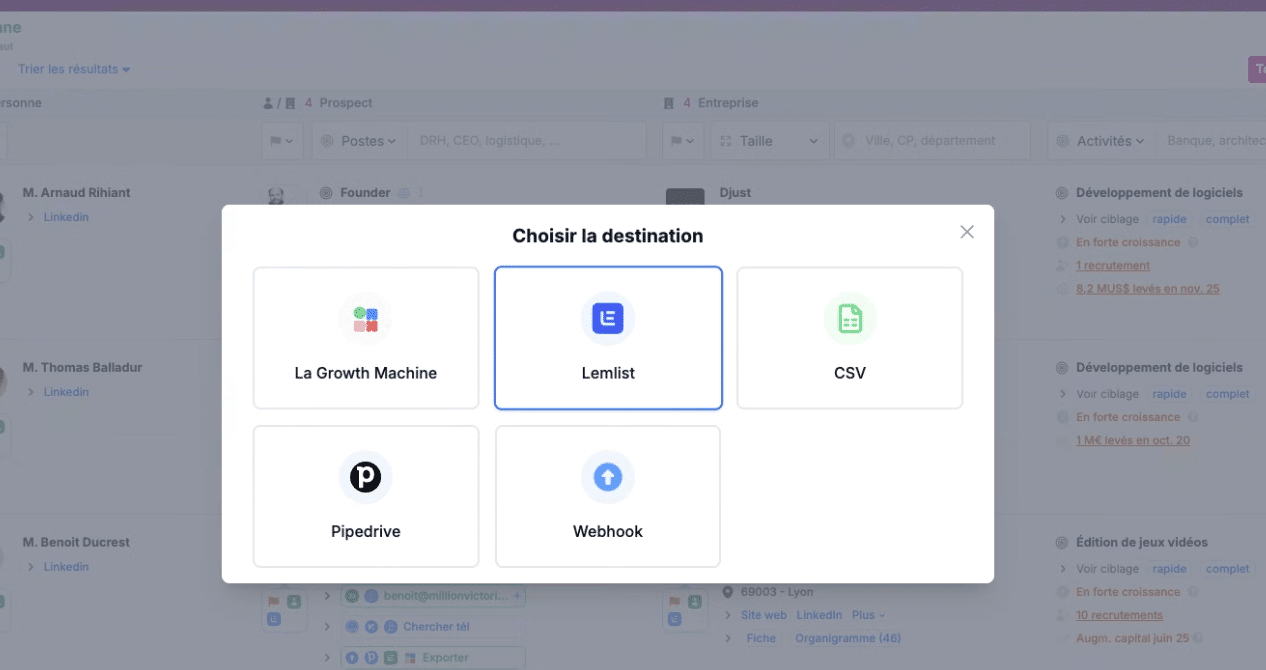
On the CRM and mailing tools side, the native integrations currently available :
- HubSpot: full bidirectional synchronization.
- Pipedrive: same logic, with deal filtering.
- Lemlist: bidirectional synchro. Direct export to campaigns, and filtering of Pharow results according to Lemlist campaign status (to exclude recently contacted prospects, for example).
- The Growth Machine: two-way synchro. Native integration for multi-channel sequences, with the same logic for filtering Pharow results according to the status of LGM campaigns.
Native Salesforce integration is scheduled for late 2026. In the meantime, Pharow and Salesforce communicate via webhook, which covers basic needs but doesn’t allow bi-directional synchronization or search filtering on CRM status. For 100% Salesforce teams, this is a real point to consider.
Synchronization as a quality diagnostic for your CRM database
When you connect Pharow to HubSpot, Pipedrive or Lemlist, you get a synchronization view that goes beyond simple counting:
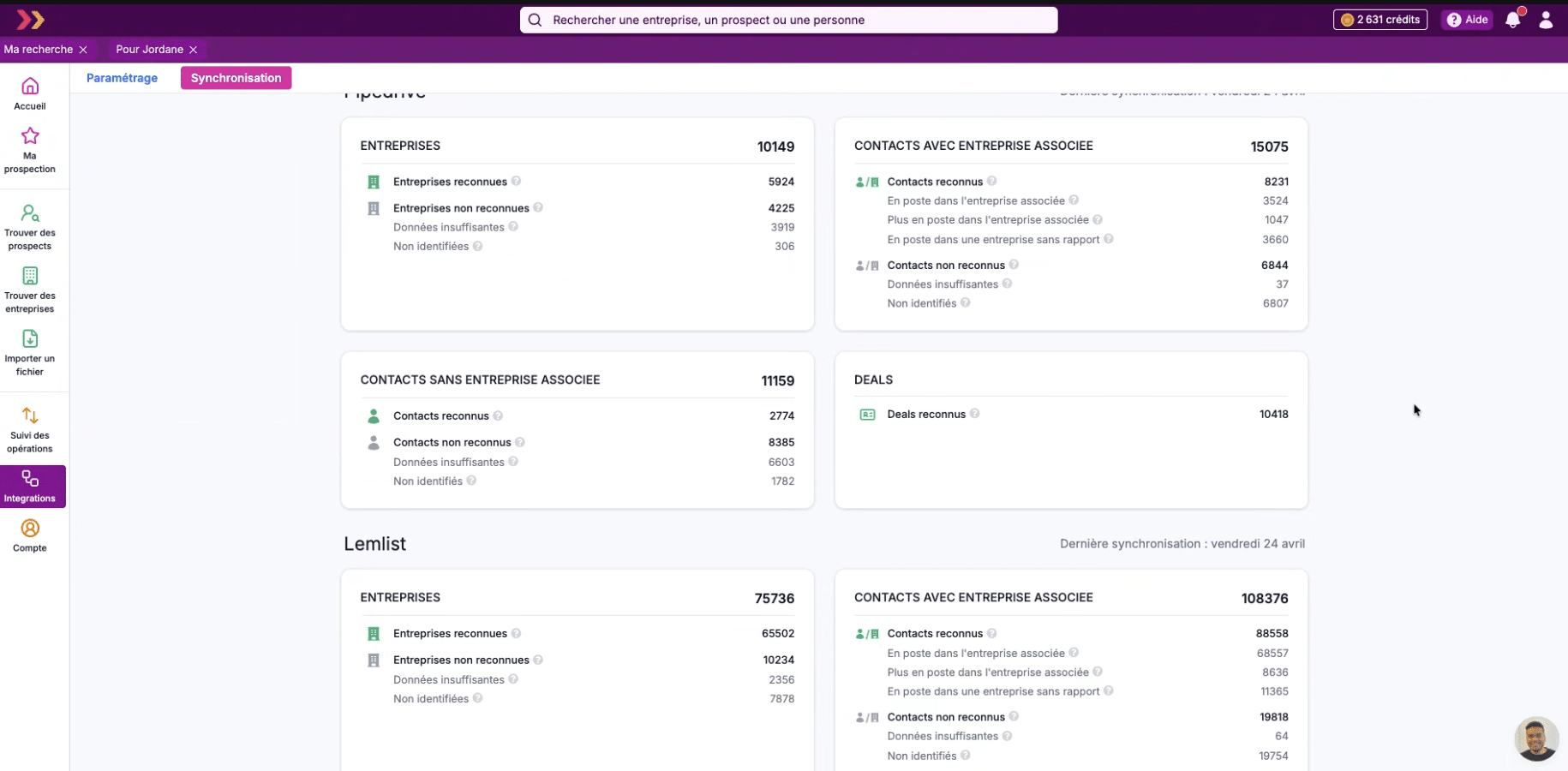
Pharow tells you not only how many companies and contacts it recognizes in your CRM, but also in what state. For Pipedrive contacts, for example, you can see how many are :
- Working for the associated company (the normal situation)
- No longer working for the associated company (= your contact has changed company without your knowledge)
- Working for an unrelated company (= even more problematic)
In concrete terms, it’s an automatic audit of the obsolescence of your CRM database. You immediately know how many contacts on your Pipedrive are no longer usable as they are.
Customizable field-by-field export
When you export a list to your CRM, you don’t just send all the data in a jumble. Pharow offers a dedicated 4-step parameterization module (Start / Prospects / Companies / Owners) that lets you map precisely which Pharow field goes into which CRM field:
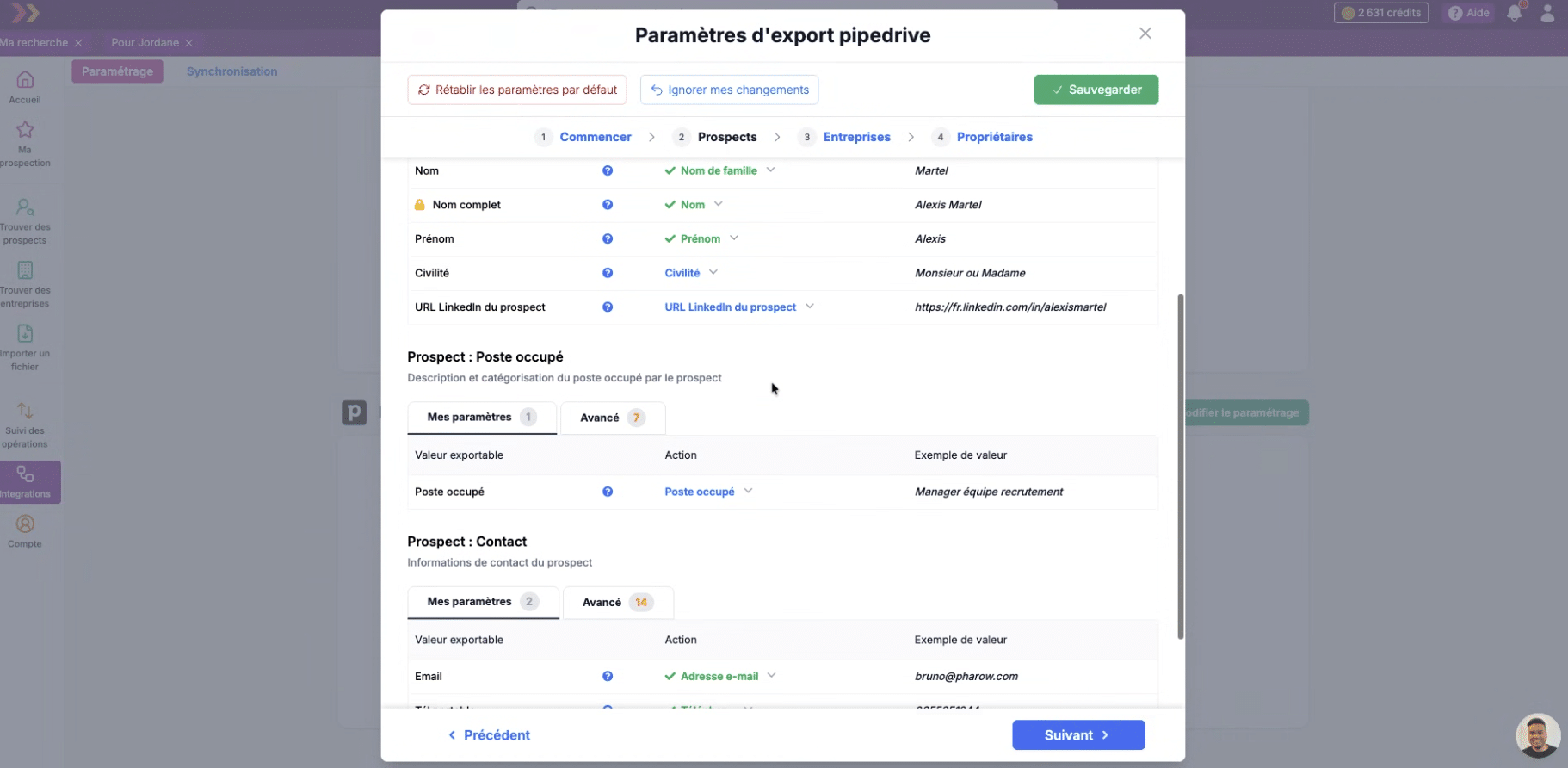
For each section (Identification, Contact, Activity, Position), you have two levels: “My settings” (basic fields) and “Advanced” (many more fields available). You can choose, for example, to send the Pharow “Business name” to the Pipedrive “Name” field, and the “Legal name” to a separate custom field. This level of granularity explains why synchronization remains clean over time.
Webhooks for custom scenarios
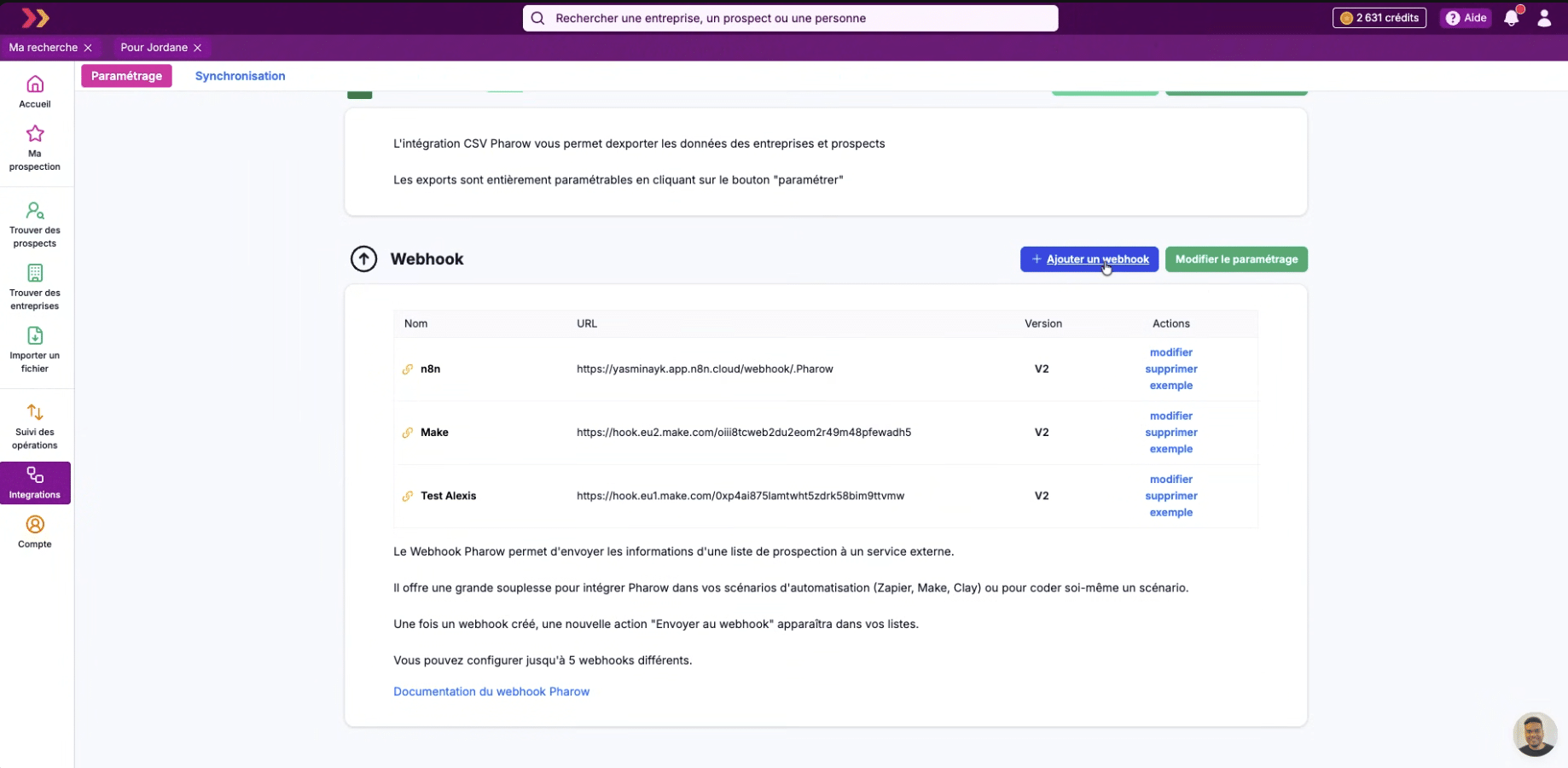
In addition to native integrations, Pharow lets you configure up to 5 webhooks, opening up the tool to more complex stacks: Make, n8n, Clay, Zapier or in-house scripts. Once a webhook has been created, a “Send to webhook” action appears directly in the list interface. This enables Pharow to integrate into advanced enrichment chains without having to develop each connector natively.
Team prospecting: a game-changing innovation
This has been Pharow’s major development in recent months. For structured sales teams, the feature solves a problem that all B2B tools have been dragging out for years: duplicate work.
Shared lists and searches
All lists and saved searches can be shared at the click of a button, or kept private. You decide on a case-by-case basis.
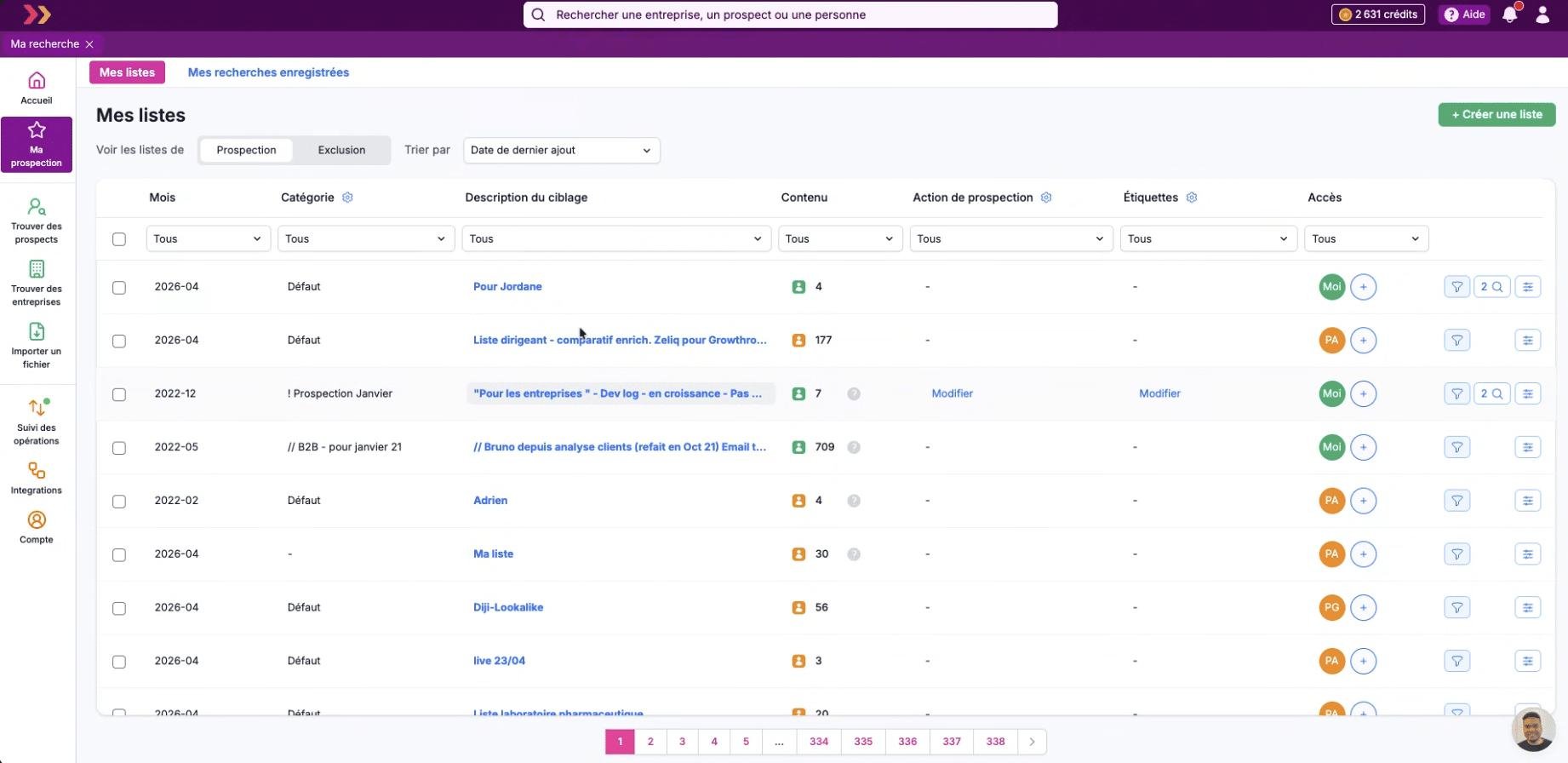
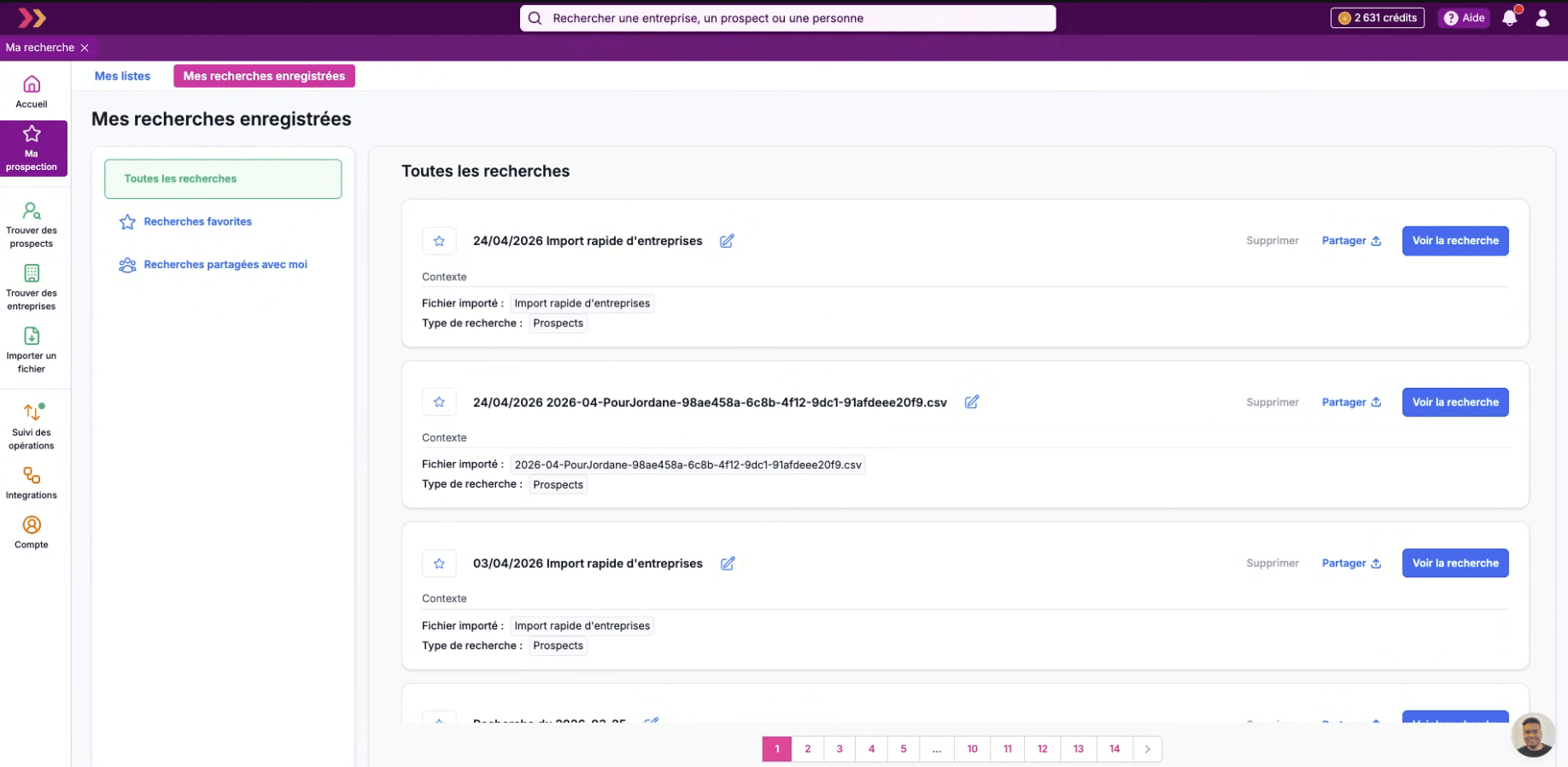
The benefits go beyond simply sharing files. In Pharow, a list is not fixed: it’s a set of prospects with their metadata, labels, prospecting actions and categories. When a sales rep shares a list built with fine-tuned targeting, the colleague recovers all the history and can continue working where he left off. No need to redo targeting that someone else has already built.
Shared exclusion lists
This is probably Pharow’s most useful innovation for teams. You create an exclusion list (active customers, permanently lost accounts, direct competitors, prohibited sectors) and it’s automatically applied to all searches by all team members.
In concrete terms, when a junior sales rep launches a prospect search in the retail sector, the accounts you’ve flagged as “competitors” or “active customers” are automatically excluded from his or her results. No one re-prospects a banned account, without you having to set up rules or train anyone.
Pharow offers a 15-day free trial with 100 free credits, no credit card required. This is more than enough time to test the filters, enrichment and CRM synchro on your real-life use cases.
Shared credit pool and managerial visibility
Where Sales Navigator, Apollo or Cognism invoice by seat (each salesperson has his or her own envelope), Pharow offers a pool of credits shared at team level. In concrete terms :
- The team draws from the same credit envelope
- You can monitor consumption by employee in real time from the dashboard.
- Granular permissions (view/modify/enrich/export/share) by member
- When a salesperson leaves, his or her lists can be transferred to another member.
- Pharow blocks automatically when the pool is depleted: no nasty surprises on the bill
Pharow can accommodate up to 10 members on standard plans, beyond that it’s a customized plan.
On costs, the gap is significant. For a team of 5 salespeople, Pharow advertises €241/month, compared with around €700 with Sales Navigator (€140 per seat). The shared pool also avoids under-utilized seats that continue to be paid for month after month. In this respect, it’s a real economic advantage for structured teams.
Pharow rates
Pharow displays its prices publicly, which is not always the case with the historical players in French B2B data (such as Nomination or Kompass, to name but a few):
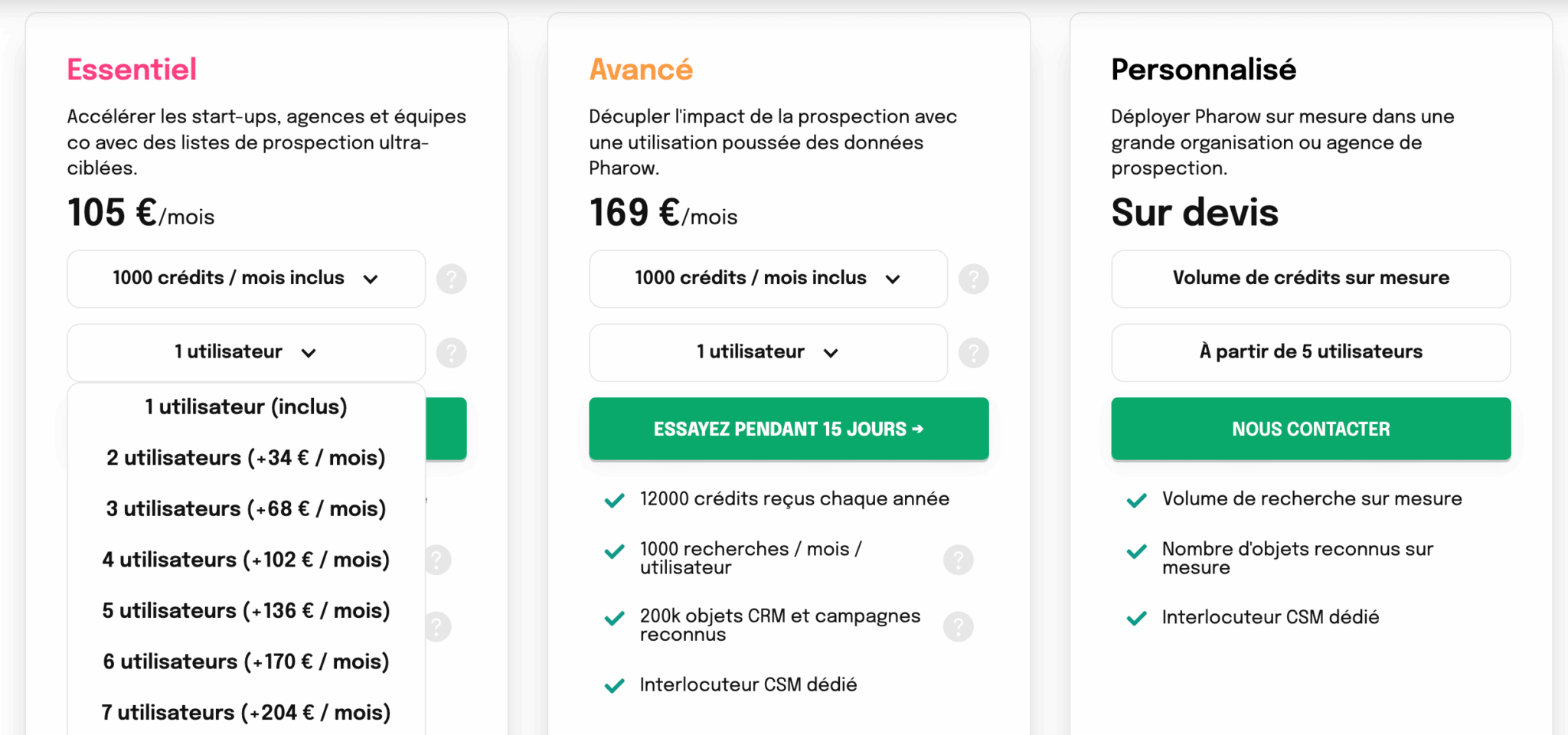
The system, based on credit consumption, is simple:
- 1 credit = 1 prospect or 1 company added to a list (which triggers automatic email enrichment)
- Email enrichment included at no extra cost
- Cell phone enrichment = 10 credits per number found, 0 credits if not found
- Credits accumulate from one month to the next and do not expire (with a maximum of 48,000).
- Additional credit packs are available for purchase (from €90 ex-VAT for 500 credits to €600 ex-VAT for 10,000 credits).
Before comparing prices, calculate your current stack. If you pay for a Sales Navigator Core + a Dropcontact subscription today, and spend 3 to 4 hours a week tinkering between your tools, the real cost of your prospecting far exceeds Pharow’s €105/month. And that’s not counting lost sales time. For a freelancer with a low volume of prospecting, on the other hand, 1,000 credits a month may not be fully exploited.
What we like (and don’t like)
- A reconciliation infrastructure unique on the French market. This work of matching SIREN, website, LinkedIn and recruitment explains everything else. Very few tools have taken this task seriously in France.
- Targeting that can’t be found anywhere else: three combinable classification systems (NAF, Pharow Activities, Pharow Themes), free search in legal and web data, magic filters organized into 8 categories (business model, financial and legal data, dynamics, workforce, digital presence, recruitment, technologies).
- Dropcontact + FullEnrich + Zerobounce enrichment cascade, all-inclusive.
- No stored email database: fresh data with each enrichment, native RGPD compliance.
- Protective credit logic: nothing is charged if enrichment fails, and email is included.
- The state of your prospecting becomes a filter. Prospecting Filters apply to both Pharow lists (my lists, team, shared) and external tools (HubSpot, Pipedrive, Lemlist, La Growth Machine), on three angles: Person, Prospect, Company.
- Field-by-field export mapping to maintain synchronization quality over time.
- Intelligent team prospecting: shared exclusions that apply to all, pooled credit pool, real-time manager visibility.
- Webhooks (up to 5) for integration into more complex stacks (Make, n8n, Clay).
- Rapidly evolving product: Salesforce integration announced for the end of 2026, detection of obsolete CRM data underway, etc.
- Transparent, public pricing, even for team plans.
- France only. It’s assumed, but if a significant proportion of your prospects are international, you need to supplement this with Apollo or Cognism.
- No native Salesforce integration before the end of 2026. In the meantime, the webhook works, but does not allow bidirectionality or search filtering on CRM status. A real brake for full Salesforce teams.
- No pre-stored email base. It’s a conscious choice, but some will prefer a tool that guarantees an immediately available email for 100% of records.
- No integrated mailing tool. Pharow stops at targeting and enrichment. You need a complementary tool (Lemlist, La Growth Machine, Smartlead) to execute campaigns.
- Phone enhancement to 10 credits/number. If phoning is central to your strategy, it can add to the volume bill.
- High entry fee for solos. At a minimum of €105/month, it’s a good size for a sales team, less so for a freelancer doing occasional prospecting.
Pharow offers a 15-day free trial with 100 credits, no credit card required. Test the filters, enrichment and CRM synchro on your real use cases before committing.
Our verdict: Who’s Pharow for?
Pharow is for you if :
- You are a B2B sales team prospecting in France (startups, SMEs, ETIs, agencies).
- You spend too much time tinkering with Sales Navigator, Dropcontact and Excel files.
- You want to make serious use of cross-filters (technologies + growth + recruitment + fund-raising) to time your approaches.
- You use HubSpot or Pipedrive as a CRM and bidirectional synchronization speaks to you.
- Your outbound campaigns go through Lemlist or La Growth Machine
- You’re a multiple prospector and want to avoid duplicate work and forbidden accounts.
- Data quality and deliverability take precedence over the raw volume of available contacts
Skip it if :
- You mainly prospect internationally. Pharow is France-only without exception.
- You’re 100% Salesforce and need native integration immediately. Wait until the end of 2026 or choose a tool that already has integration.
- You’re looking for a tool with integrated campaign sending (cold email, LinkedIn sequences). Pharow doesn’t do that, it stops at targeting and enrichment.
- You’re a freelancer with a low prospecting volume (less than 100 prospects/month). The price/use ratio will be hard to justify.
Final score: 4.7 / 5. Pharow has built something precious in the French B2B prospecting ecosystem: a tool that relies on a real technical infrastructure rather than on scraping or buying databases. The invisible work of reconciling French data explains the depth of filters, the quality of enrichment, the reliability of business signals, the low bounce rate and the richness of CRM synchronization. If you’re serious about prospecting on the French market, this is today’s benchmark.
Pharow is the most advanced B2B prospecting platform on the French market today. If your prospects are in France, this is the tool that will save you the most time and give the most depth to your outbound campaigns. Try it for free for 15 days and see for yourself.