50 million active subscriptions, authors generating seven-figure revenues and a simple promise: to enable independent authors and podcasters to share their content directly with their audience and earn money by offering subscriptions. On paper, Substack has it all.
Is Substack really the Eldorado for B2B content creators, or an inbound marketing tool that mainly benefits those who already have a massive audience? We’ve analyzed this newsletter tool in depth to give you an honest opinion, far removed from fanboy rhetoric and bad-faith reviews. Read our Substack review.
Sommaire
Our opinion of Substack in brief
| Perimeter | Score | Our opinion |
|---|---|---|
| Overall rating | 4,2 | Substack is probably the best tool for launching a paid B2B newsletter without technical skills. The all-in-one platform (publishing, email, payments, community) for 10% commission is a fair deal to get started. But the commission becomes painful as soon as the business really takes off. |
| Ease of use | 4,6 | Launch in 30 minutes, minimalist but efficient editor, zero technical configuration. This is Substack’s major strength: anyone can publish their first newsletter in less than an hour. |
| Monetization potential | 3,7 | The integrated payment system works well, but feedback from the field shows that converting free subscribers into paying ones remains difficult (often less than 2%). Substack is not an automatic cash machine. |
| Quality-price ratio | 3,4 | Free to publish, 10% commission on paid revenues (+3% Stripe). Correct to start with, but at €5,000/month revenue, you’re dropping €650 in commission. A self-hosted stack would be cheaper. |
Substack is free as long as you don’t monetize it. You can create your publication, publish content and build an audience without paying a cent. The 10% commission only applies to paid subscriptions.
What exactly is Substack?
Substack is a subscription publishing platform launched in 2017 in San Francisco by Chris Best, Hamish McKenzie and Jairaj Sethi. The founding idea: to enable creators to monetize their audience directly, without advertising intermediaries or technical skills.
In concrete terms, Substack combines in a single platform what would otherwise require several tools:
- A blog (WordPress type).
- An emailing service (such as Mailchimp or Brevo).
- A payment system (such as Stripe)
- Community features.
The figures speak for themselves: 50 million active subscriptions, including 5 million paying ones. Top creators generate seven-figure annual revenues.
Substack’s positioning is based on three pillars:
- Radical simplicity: creating a publication takes less than 30 minutes. The editor is deliberately minimalist, so that the creator concentrates on content, not technique.
- Total independence: no advertising, no algorithms dictating visibility. The creator owns his subscriber list and can export it at any time. Zero lock-in.
- Aligned business model: Substack only makes money if you make money (10% commission on paid revenues). No fixed costs, no monthly subscription to use the platform.
Substack’s model is smart: free to start, commission only on success. It eliminates the barrier to entry and aligns interests. But beware: 10% commission is still 10%. Over the long term and with significant volume, the bill can be high.
Substack’s key features
Multi-channel publishing
Substack’s core functionality enables you to publish simultaneously on three channels: the web (your publication accessible via a substack.com URL), by email (sent automatically to all your subscribers) and via the Substack Reader mobile application.
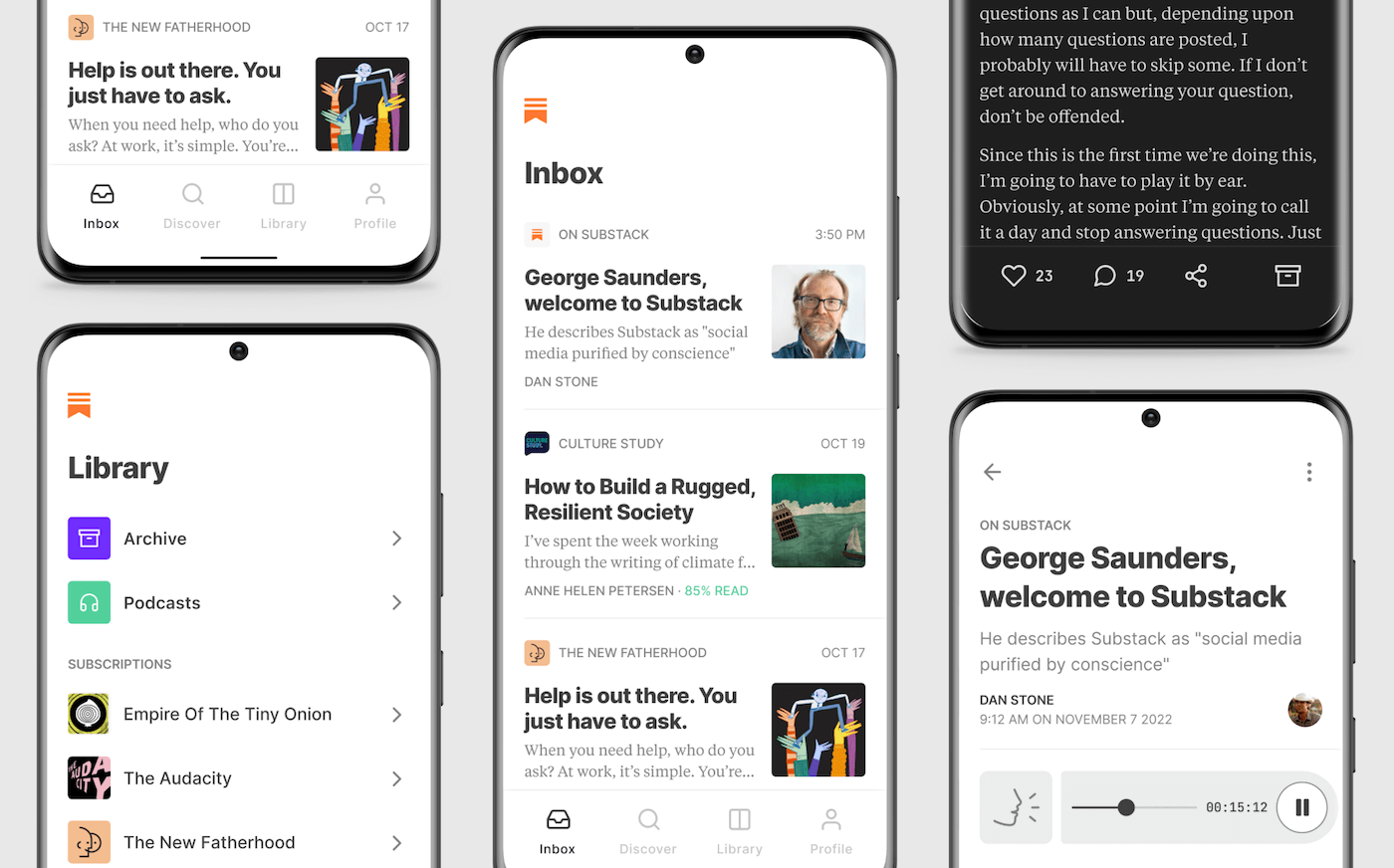
For each publication, you choose the access level:
- Free: accessible to all subscribers, to build your audience and demonstrate your expertise.
- Paid: reserved for paying subscribers, it’s your premium content that justifies the subscription.
- Paid preview: free subscribers see an extract with a call-to-action to upgrade to the paid subscription. This can be a good way to tease out your premium content.
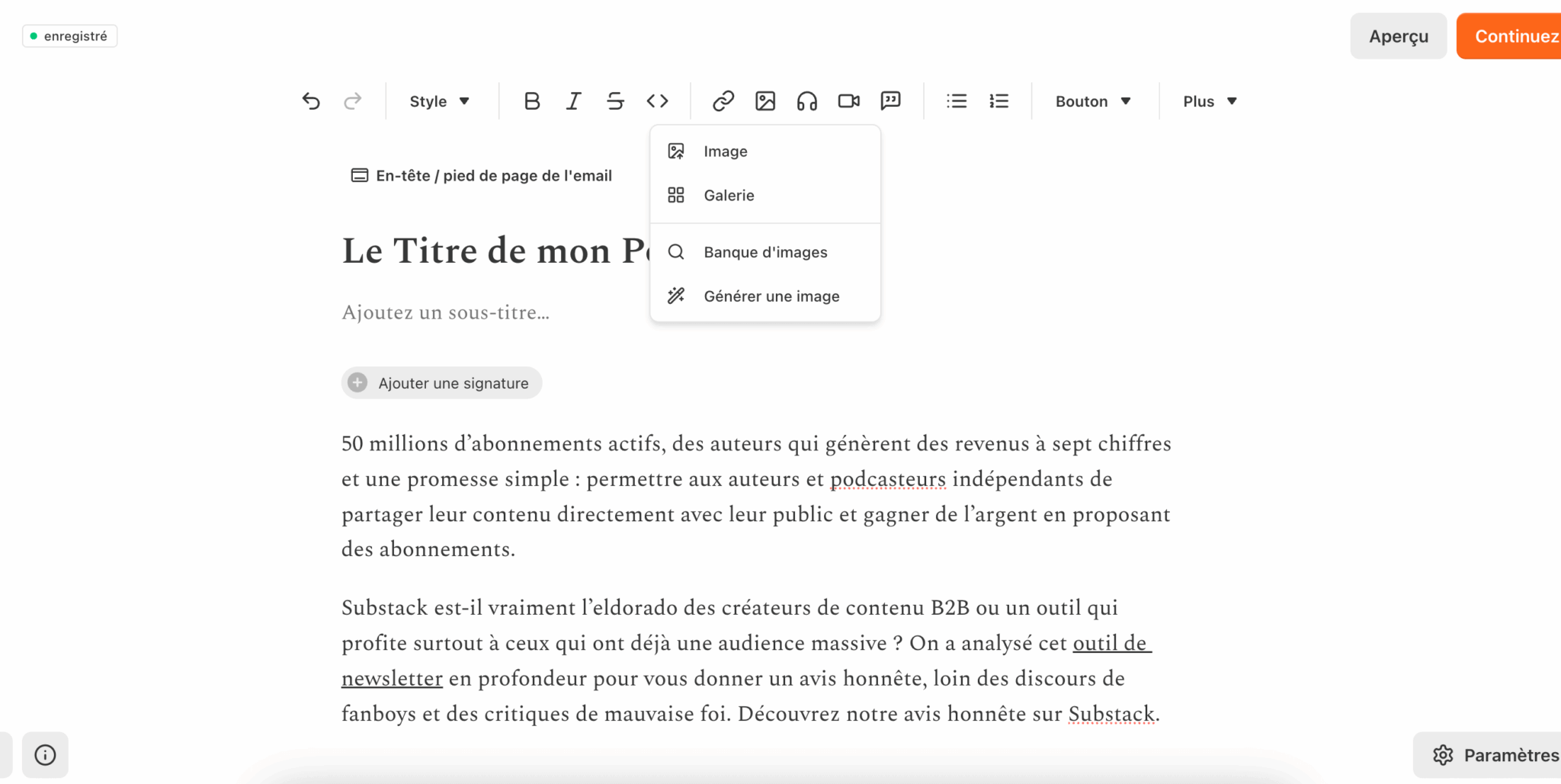
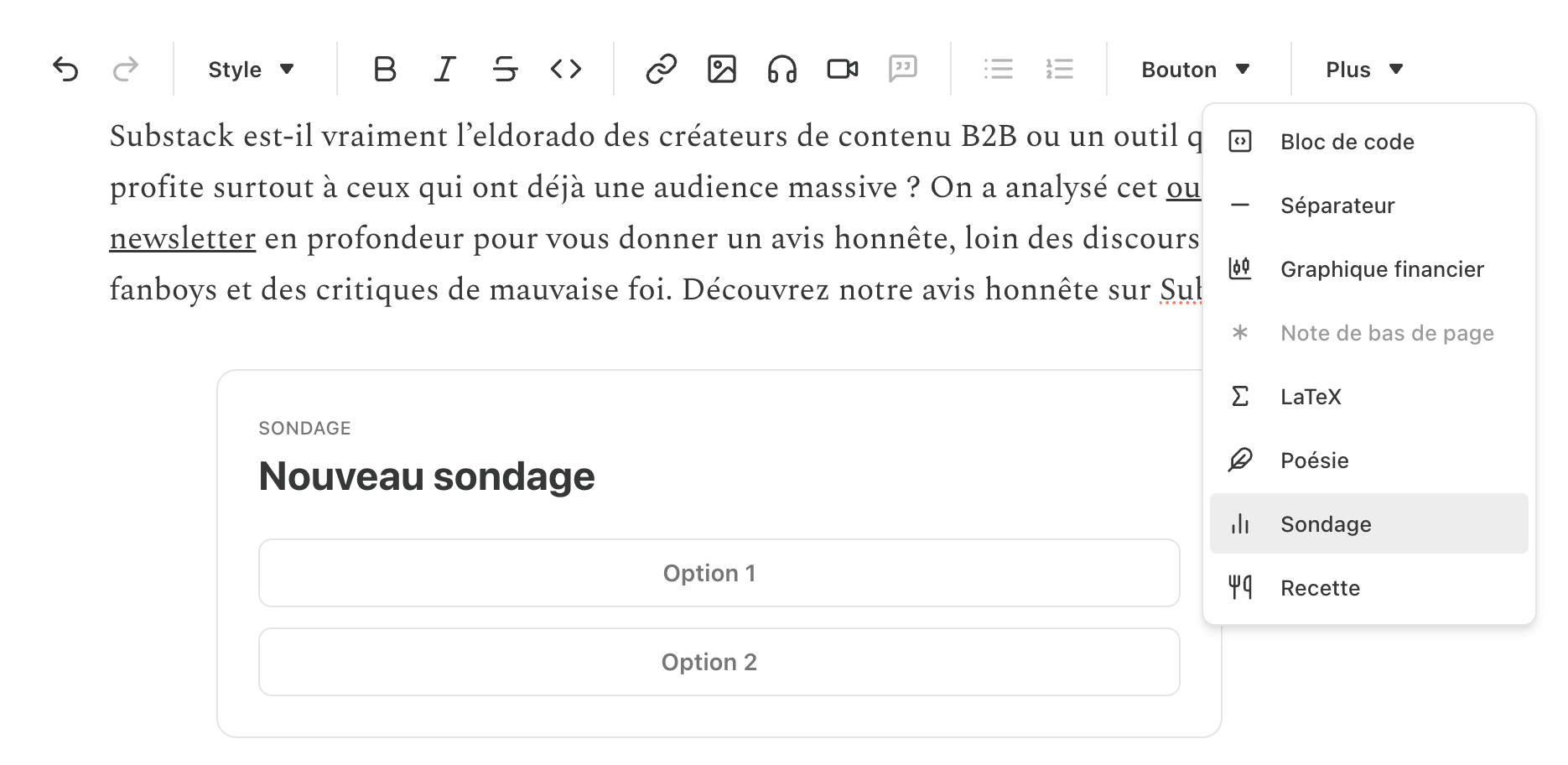
The text editor is deliberately minimalist: images, links, quotes, basic formatting (bold, italic, lists). No advanced layout features, no custom widgets. It’s a conscious choice that forces us to focus on content rather than form.
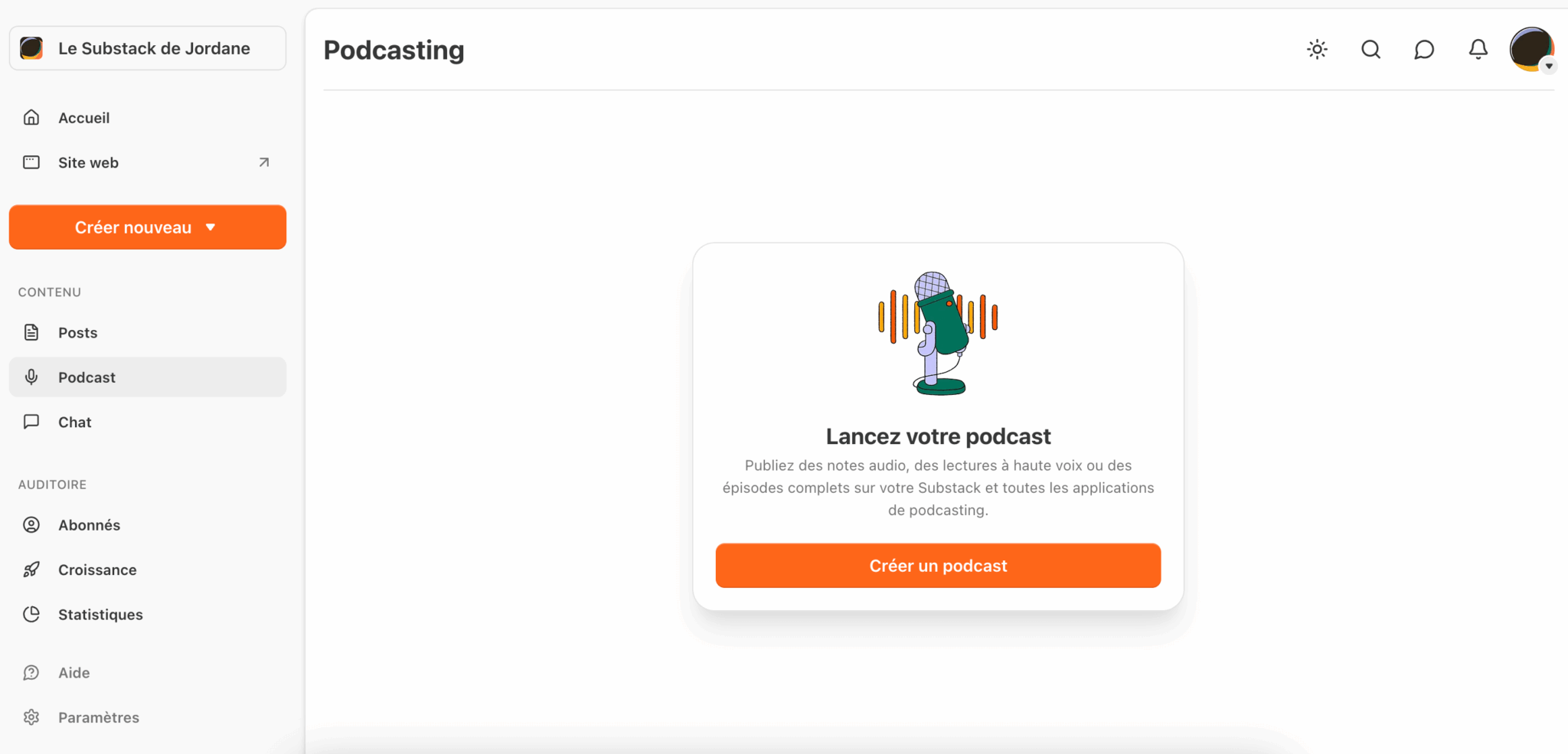
Podcasts and videos
Substack isn’t just about text. The platform lets you host and distribute podcasts to all the major platforms (Apple Podcasts, Spotify, Google Podcasts) in just a few clicks. Episodes can be free or reserved for paying subscribers.
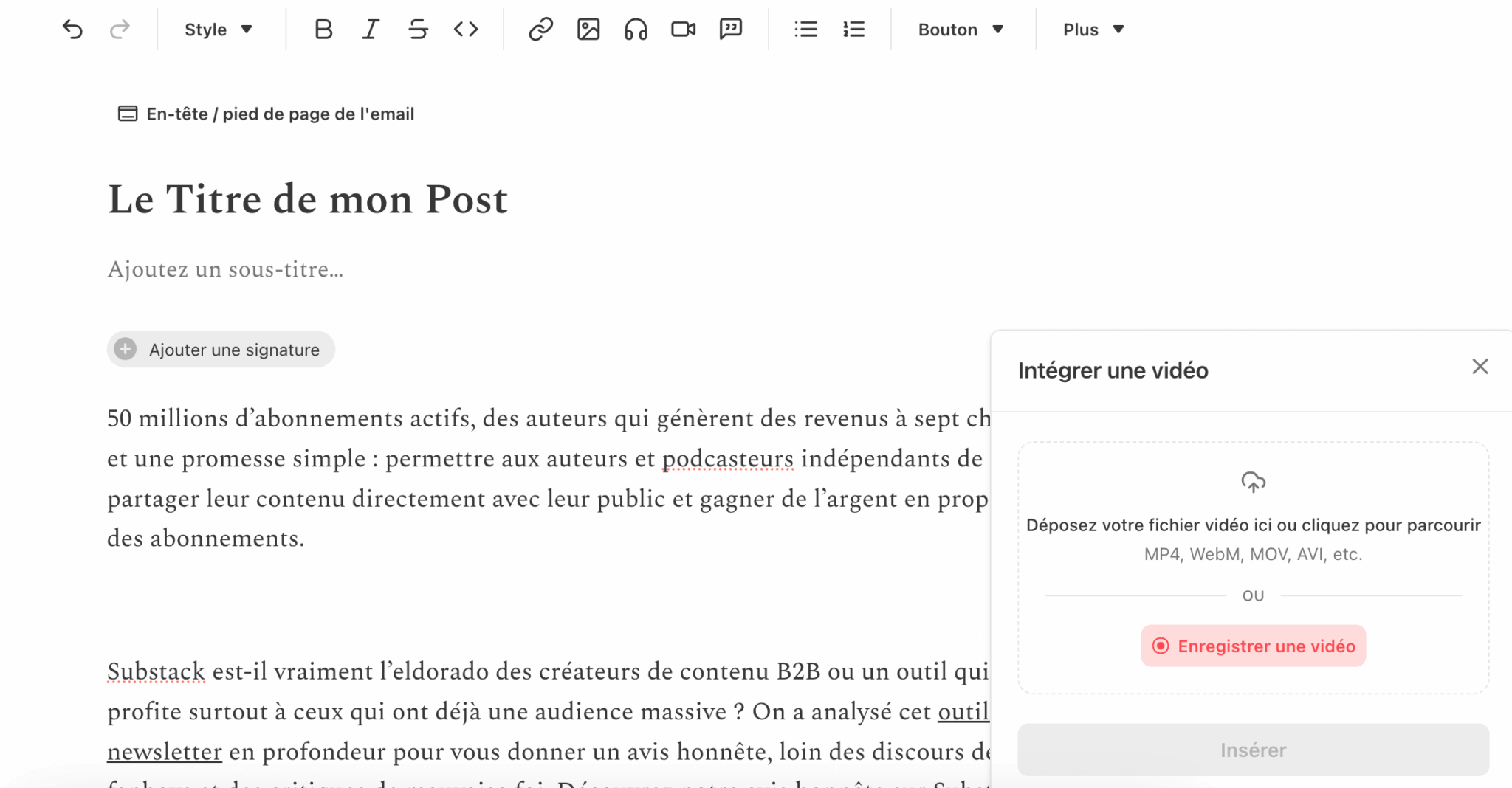
As for video, you can upload or record directly in your posts. Here too, this feature is restricted to paying subscribers. However, this feature remains basic compared to dedicated video platforms such as YouTube or Vimeo.
The podcast and video functionalities are a welcome addition, but don’t expect professional production tools. Substack is first and foremost a writing platform. If podcasting or video are at the heart of your strategy, you’ll probably need additional tools.
The referral network: Substack’s secret weapon
This may be Substack’s least obvious advantage, but it’s one of its most powerful. And it’s what really differentiates the platform from a simple blog with a newsletter.
The principle is simple: you recommend other publications to your subscribers, and other creators do the same for you. When a reader subscribes to a newsletter, Substack suggests other similar publications, potentially including yours.
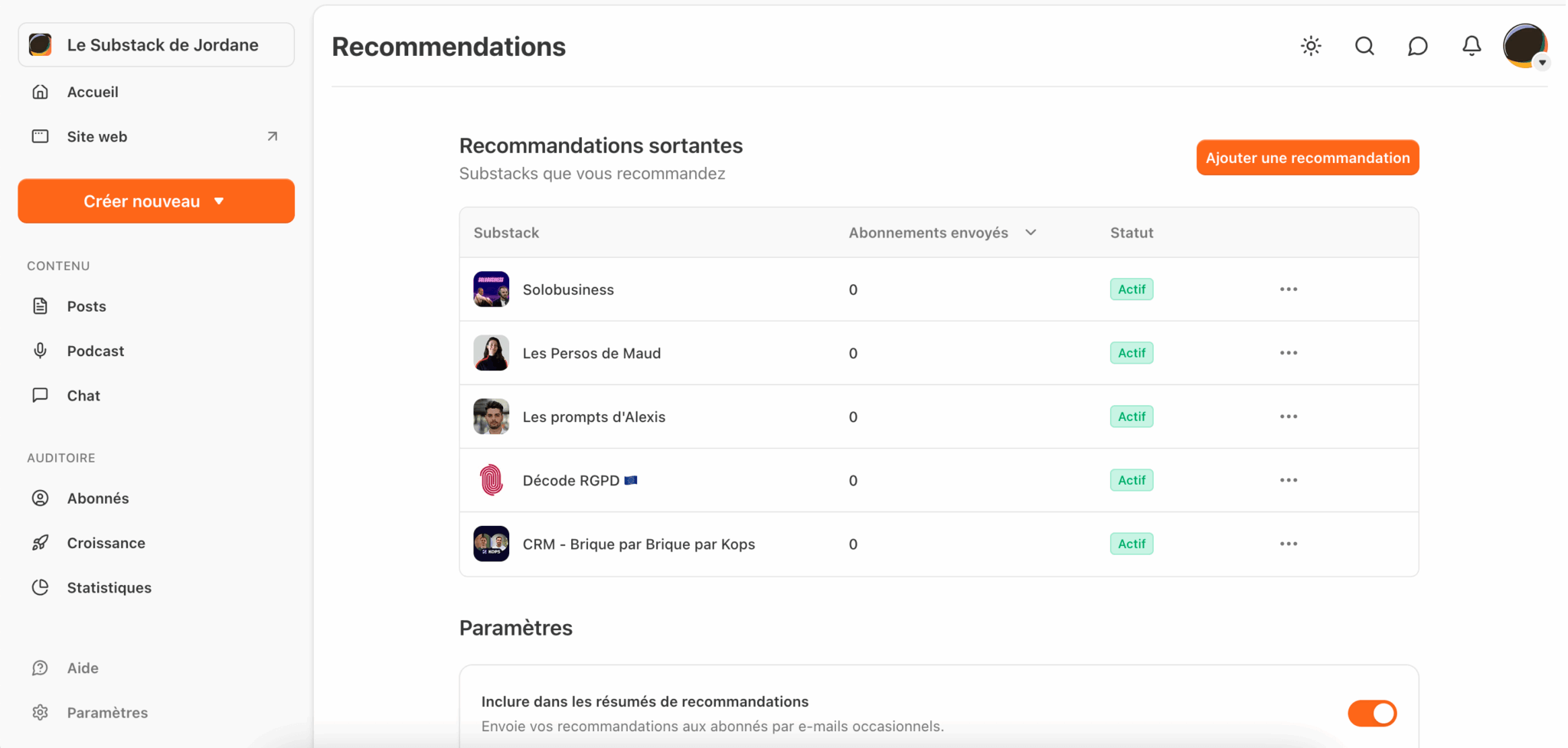
The figures speak for themselves: according to Substack, 40% of new free subscriptions and 15-20% of paid subscriptions come from this mechanism.
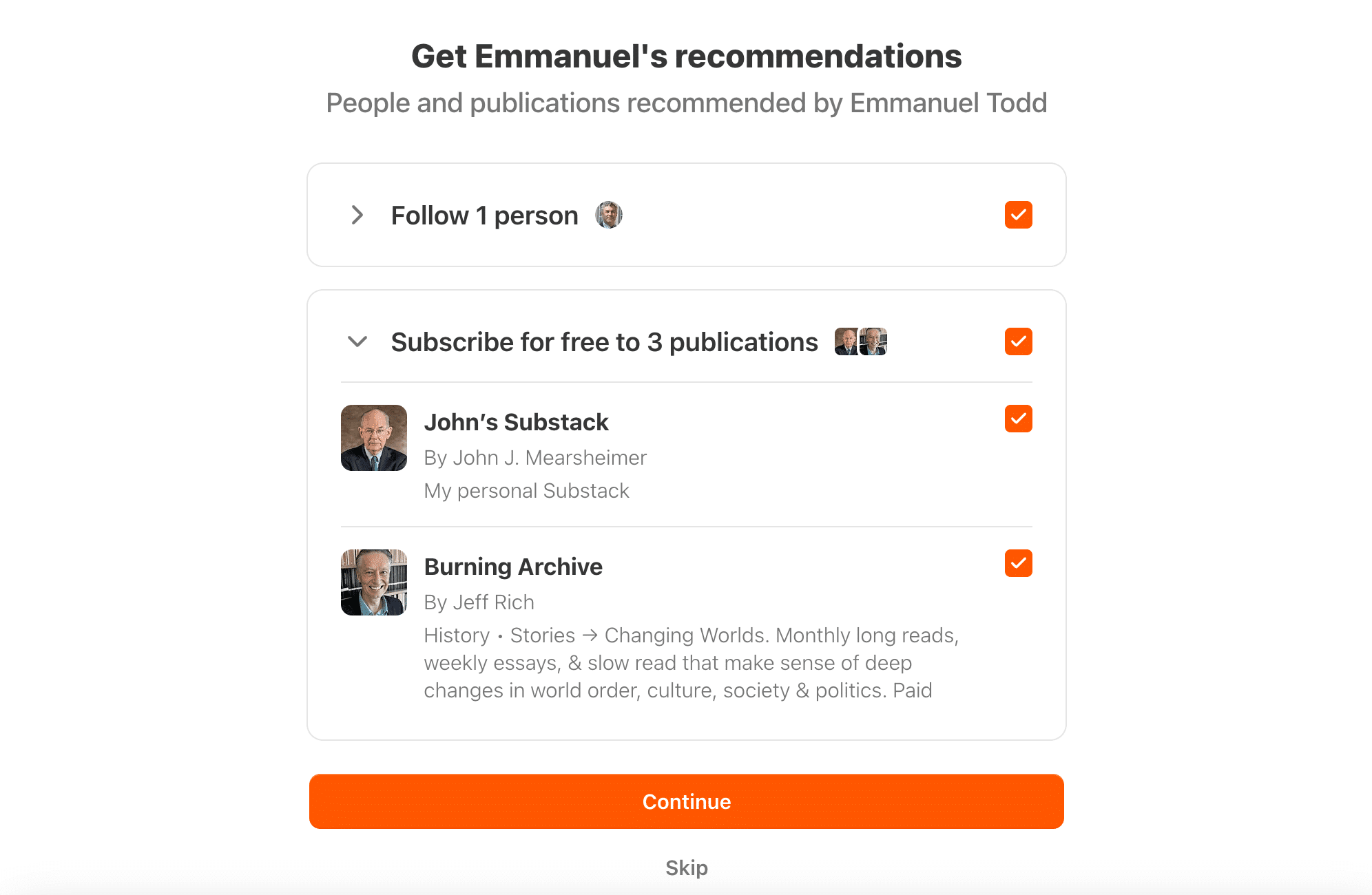
For a designer starting from scratch, this is a real advantage:
- On a classic blog, you need to generate 100% of your traffic yourself: SEO, social networks, advertising, partnerships…
- On Substack, part of the acquisition is “offered” by the ecosystem. Marie Vandoorne’s experience, which we’ll present to you in a moment, confirms this: 150 publications recommended her work, bringing her over 2,000 subscribers without any direct marketing effort.
Of course, it’s not magic. To be recommended, you first have to recommend. And to get other creators to notice you, you have to be active on the platform: commenting on their posts, interacting on Notes, creating links. It’s a real time investment, but one that can pay off handsomely when you play the game.
Integrated monetization
The payment system is managed entirely by Substack via Stripe. You have nothing to configure on the technical side.
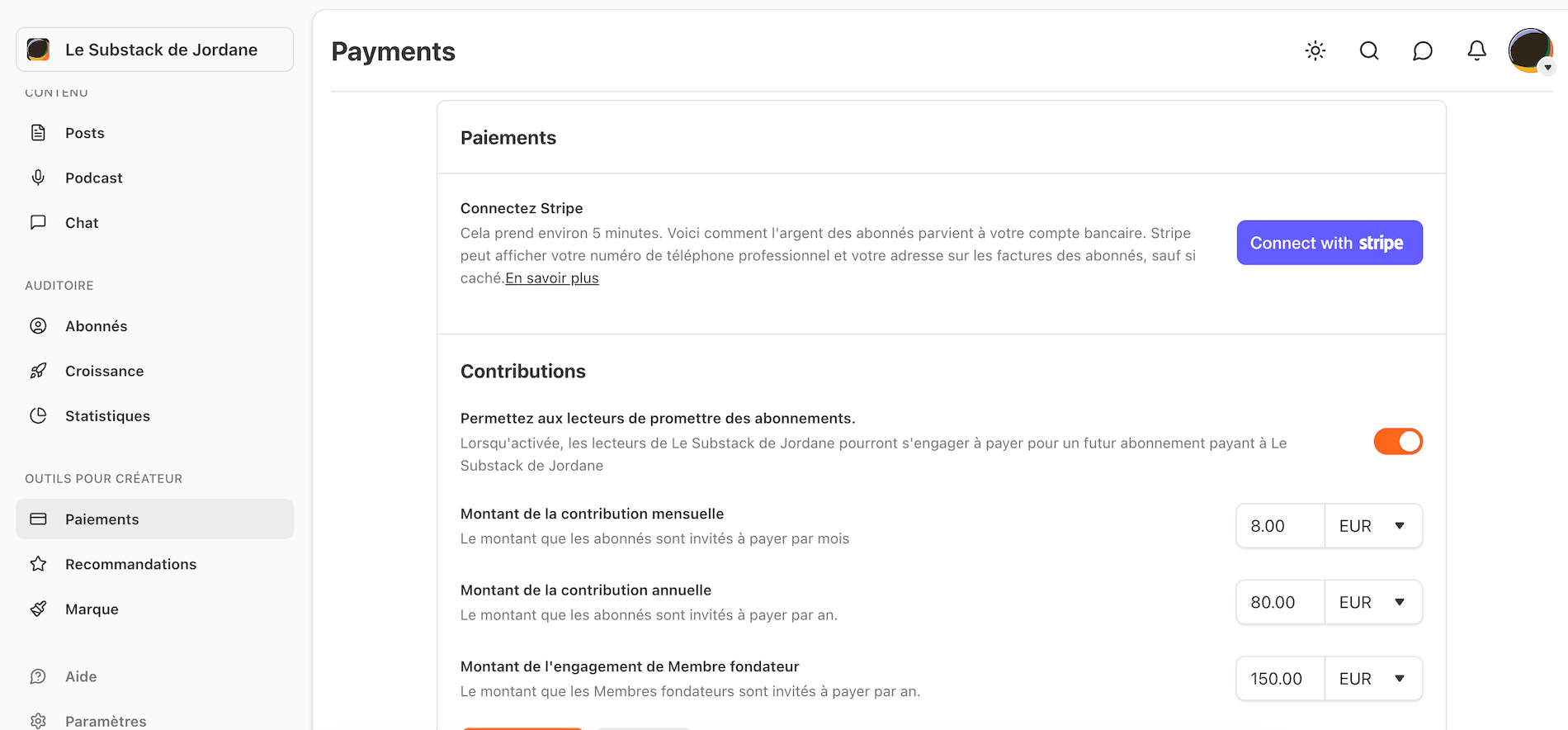
Flexible pricing options:
- Monthly or annual subscriptions: you’re free to set your own prices, with a minimum of $5/month or $30/year.
- Annual discount: typically 10-20% off to encourage long-term commitment.
- Multi-currency payment: your readers pay in their local currency (euro via SEPA, dollar, pound sterling, etc.).
- Paywalls and overviews Advanced tools for converting free readers. You can define a free preview of your paid articles, restrict comments to paid subscribers, or give progressive access to your archives.
Creating a Substack publication is free. You can test all the features, publish content and build an audience before deciding whether to activate paid subscriptions.
Substack pricing: how much does it really cost?
The commission model
Substack’s business model is simple and transparent: the platform is free as long as you don’t monetize. As soon as you activate paid subscriptions, Substack takes 10% of your revenues.
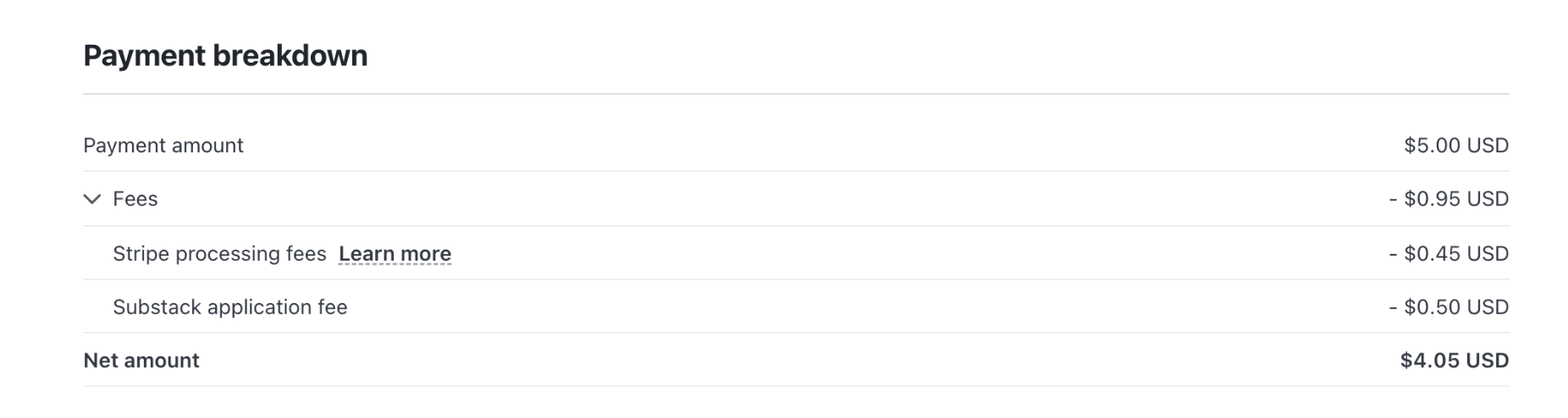
Added to this are Stripe processing fees (approx. 2.9% + €0.30 per transaction).
All in all, you can expect to pay a levy of around 13% on each payment.
| Component | Percentage | On €100 collected |
| Substack commission | 10% | 10,00 € |
| Stripe fees | ≈ 2,9% + 0,30 € | ≈ 3,20 € |
| Total withdrawn | ≈ 13% | ≈ 13,20 € |
| Net creator | ≈ 87% | ≈ 86,80 € |
Income simulations
Here’s what you can expect in net revenue, depending on your number of paying subscribers and your monthly rate:
| Paying subscribers | At €5/month | 10/month | 15 €/month |
| 50 | ≈ 217 € net/month | ≈ 435 € net/month | ≈ 652 € net/month |
| 100 | ≈ 435 € net/month | ≈ 870 € net/month | ≈ €1,305 net/month |
| 200 | ≈ 870 € net/month | ≈ 1 740 € net/month | ≈ 2 610 € net/month |
| 500 | ≈ €2,175 net/month | ≈ 4 350 € net/month | ≈ 6,525 € net/month |
| 1 000 | ≈ €4,350 net/month | ≈ 8,700 € net/month | ≈ 13,050 € net/month |
The Substack model is perfect for getting started: zero initial investment, you only pay on success. But as your business grows, commission becomes a significant cost item.
Let’s take a concrete example: you generate €5,000/month in subscription revenues. Substack charges €500/month, i.e. €6,000/year. At this level, a self-hosted stack (WordPress or Ghost + Brevo or Mailchimp + Stripe) would cost a few hundred euros a year maximum.
The tipping point is generally around €2,000-3,000/month in recurring revenue. Below that, Substack’s simplicity is more than worth the 10%. Above that, it becomes rational to consider migrating to a less commission-intensive solution. But beware: migrating an audience is never trivial.
Feedback from the field: the Substack reality
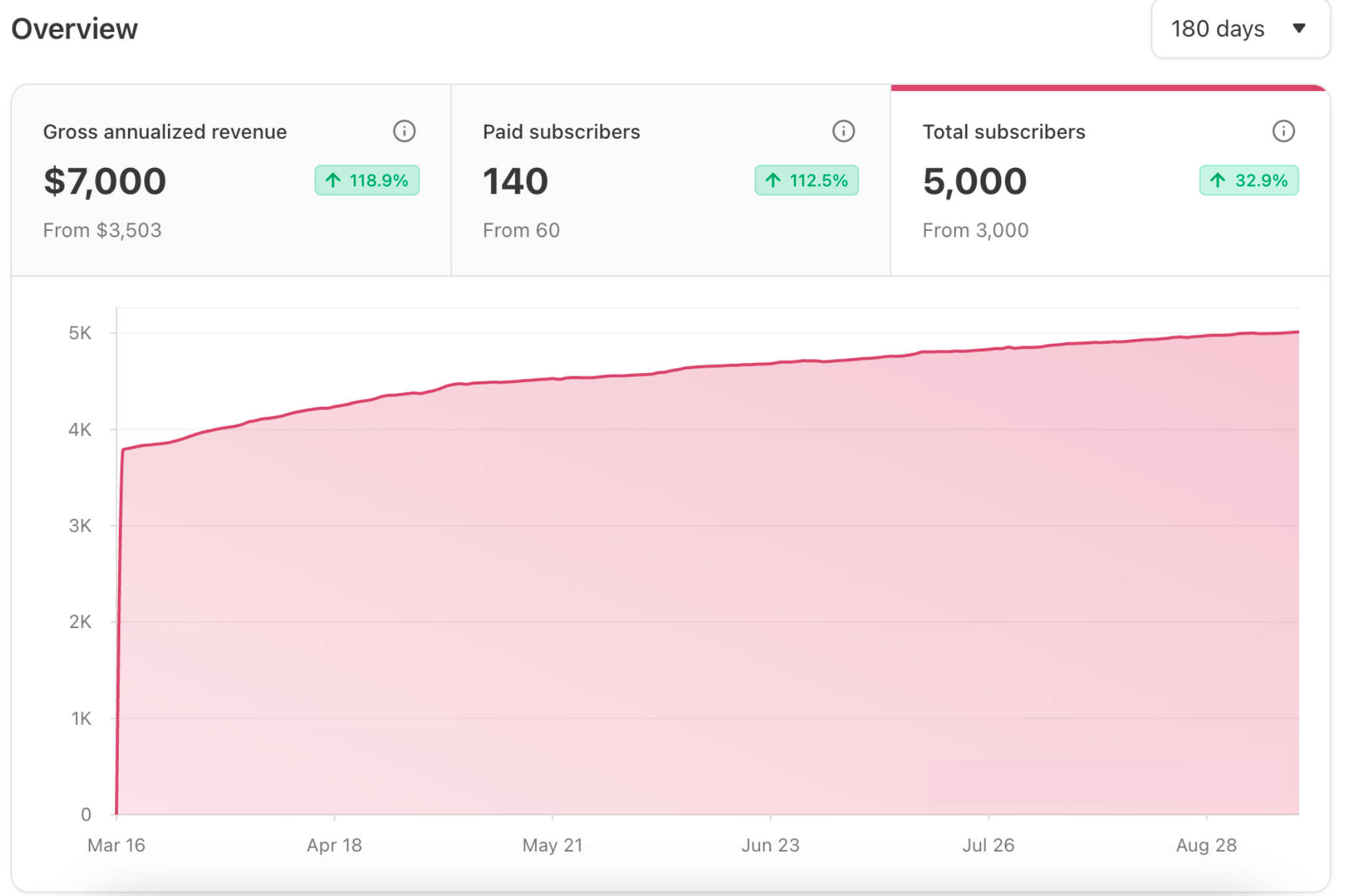
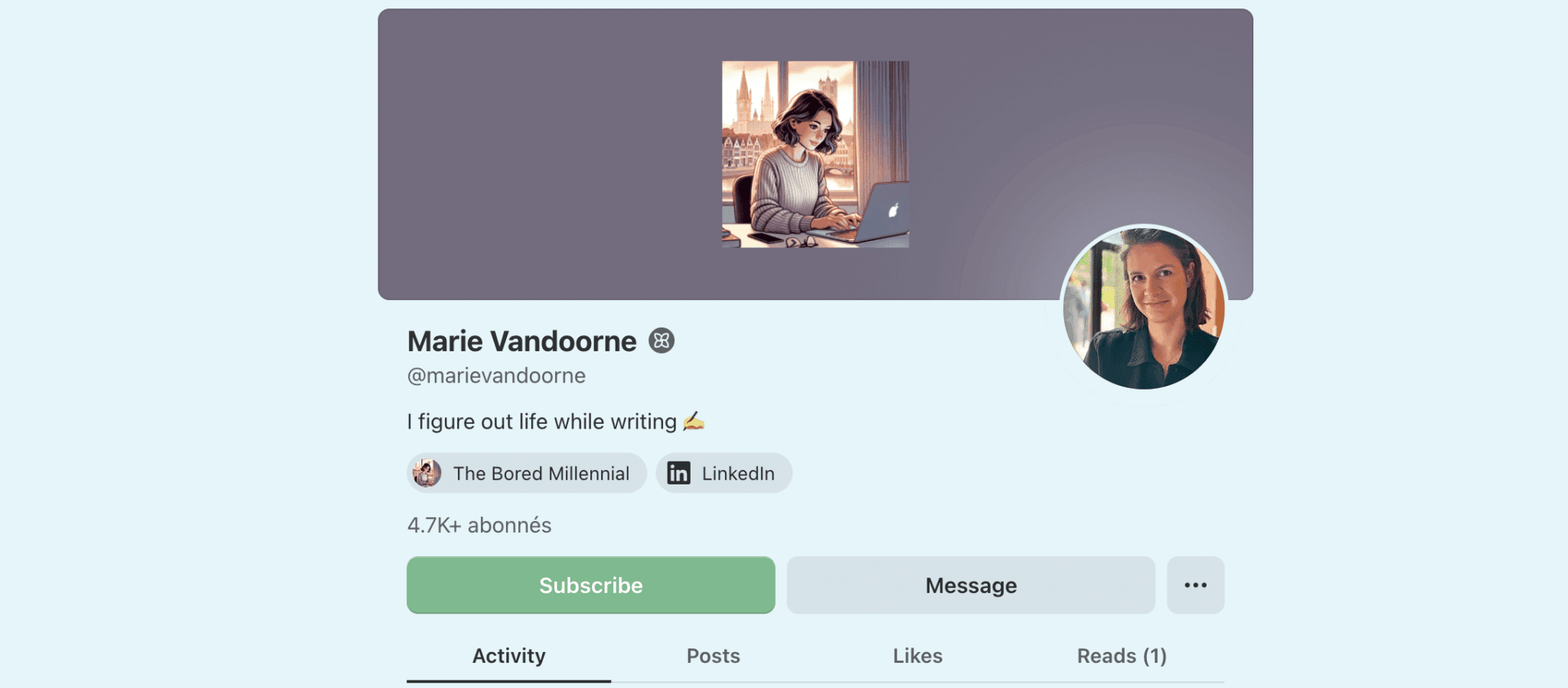
Substack’s marketing figures are impressive. But what about a French B2B designer starting from (almost) scratch? Marie Vandoorne’s experience offers a brutally honest look at reality.
Gross figures after one year
- Subscribers: from 41 to 4,620 (growth x112)
- Paid subscribers: peak at 50, then levelling off
- Net income: €903.50 for the full year
- Free > conversion rate: around 1%.
Real-time investment
- Launch phase (4 months): 8h/day of intensive work: writing, Notes, comments on other publications, networking, promotion.
- Cruising phase: 1 article per week, i.e. around 4-6h of work per week.
Key lessons learned from this feedback
- Growth isn’t magic. The 4,620 subscribers were not acquired passively. They are the result of hard work on Notes, comments and cross-referrals. Substack provides the tools, but you do the work.
- Monetization is difficult. 50 paying subscribers out of 4,620, that’s a conversion rate of around 1%. This is at the low end of the B2B newsletter spectrum. Converting free readers into paying customers remains the major challenge, with or without Substack.
- Consistency is non-negotiable. Publishing weekly for a year was the key retention factor. Creators who publish erratically see their audience erode rapidly.
- The Substack network is powerful. 150 publications have recommended Marie’s work, bringing her over 2,000 subscribers. It’s a real growth lever, but one that requires you to actively cultivate your network on the platform.
This feedback perfectly illustrates our position: Substack is an excellent tool for launching and testing a paid newsletter. But it’s not an automatic cash machine. Success depends very much on your ability to produce quality content, actively distribute it and convert a free audience into paying customers. Substack facilitates the process, not replaces it.
The best way to find out if Substack is right for you is to try it out. Creation is free, and you only pay commission if you generate revenue. Launch your publication, post a few articles, and see if the tool works for you.
What we like (and don’t like)
- Ultra-fast launch: in 30 minutes, your publication is online. No server configuration, no themes to choose, no plug-ins to install. You write, you publish. This is a major strength for designers who want to test an idea without investing weeks in technical know-how.
- Zero cost to get started: the platform is free as long as you don’t monetize. You can build an audience of 10,000 subscribers without paying a cent. The 10% commission only applies to paid revenues.
- Powerful discovery network: 40% of new free subscriptions come from the Substack network (recommendations, Notes, app Reader). For a creator starting from scratch, this is a considerable advantage over an isolated blog.
- Full exportability: you can export your subscriber list, archives and payment data at any time. No lock-ins, no hostage-taking. If you decide to leave, you leave with your audience.
- Editorial independence: no ads, no algorithms dictating what you have to publish to be visible. You write what you want, when you want. Your relationship with your readers is your own.
- All-in-one infrastructure: blog + newsletter + payments + community in a single platform. It replaces WordPress + Mailchimp + Stripe + Circle at a cost of 10%. For non-technical users, it’s a huge time and complexity saver.
- 10% commission: at €5,000/month revenue, you’ll give €500 to Substack + €150 to Stripe. That’s €7,800/year in commissions. A self-hosted stack would cost a fraction of that.
- Limited SEO: Substack publications have good domain authority, but technical SEO control (custom meta tags, URL structure, loading speed) is fairly limited. If SEO is at the heart of your acquisition strategy, WordPress remains superior.
- Editor too minimalist: no advanced layout, no custom widgets, no shortcodes. This is a conscious choice, but some designers will feel limited in their visual expression.
- Difficult to convert from free to paid: feedback from the field shows conversion rates often below 2%. Substack facilitates payment mechanics, but doesn’t solve the fundamental problem: convincing readers to pay for content.
- Dependence on a US platform: US servers, company subject to US laws. For organizations sensitive to issues of data sovereignty or strict RGPD compliance, this is a point of attention.
Summed up in one sentence: Substack is the best tool for launching a paid newsletter quickly and without technical skills, but it’s probably not the best tool for scaling it over the long term. It’s up to you to decide whether simplicity is worth the 10% commission.
Substack vs. the alternatives: which tool to choose?
Substack is not the only option for launching a paid newsletter. Here’s how it stacks up against the main alternatives.
Substack vs Ghost
Ghost is often presented as the “pro” alternative to Substack. It’s an open-source platform that offers much more control over design, SEO and integrations.
The advantages of Ghost :
- 0% commission on revenues (you only pay for hosting)
- Total control over design and SEO
- Self-hosting for total sovereignty
- Interface available in several languages
The disadvantages of Ghost :
- Requires technical skills or managed hosting (from $15/month at Ghost.org)
- No integrated discovery network, you’re on your own to acquire your audience
- More complex configuration than a simple Substack account
Our verdict: Ghost is superior for designers with technical skills (or the budget to delegate) who want total control. Substack is preferable for those who want to get started quickly and benefit from the discovery network.
Substack vs Brevo (ex-Sendinblue)
Brevo is a French email marketing solution that can be combined with a WordPress blog to create a newsletter stack.
The benefits of Brevo :
- French solution, native RGPD compliance, French support
- Competitive rates (free up to 300 emails/day)
- Advanced marketing automation (scenarios, scoring, segmentation)
- CRM and marketing tools integration
The disadvantages of Brevo :
- Requires a separate blog (WordPress, Ghost…) for web publishing
- No integrated payment system, so you’ll have to add Stripe or similar
- Less community-oriented than Substack
- More complex configuration (several tools to work together)
Our verdict: Brevo is preferable for SMEs that need advanced marketing automation and want a French solution. Substack is better suited to individual designers looking for simplicity.
Substack vs Mailchimp + WordPress
The classic newsletter stack: WordPress for blogging, Mailchimp for emailing, Stripe for payments.
The advantages of this stack :
- Total control over every component
- SEO optimized with WordPress
- Variable but potentially very low cost
- Huge ecosystem of plugins and integrations
Disadvantages:
- Complex configuration and maintenance
- Multiple tools to manage, multiple invoices, multiple interfaces
- Requires technical skills or budget to delegate
- No integrated discovery network
Our verdict: This stack is superior for established designers who are already generating significant revenues and want to optimize their costs. Substack is preferable for rapid testing and launch.
The best advice we can give you: test Substack for free for a few weeks. Publish some content, explore the features and evaluate whether the tool is right for you. You can always migrate to Ghost or another solution later, as Substack allows you to export all your data.
Our verdict: Who’s Substack for?
Substack is for you if :
- You’re a freelancer, consultant or expert and you’d like to try out a paid newsletter without any initial investment.
- You have no technical skills and want to publish your first article in less than an hour.
- You’re starting from scratch and want to take advantage of the Substack discovery network to acquire your first subscribers.
- You agree to pay 10% commission in exchange for total technical simplicity.
- You want to create an editorial side project (founder’s newsletter, industry column, niche media).
- You’re a freelance journalist seeking editorial and economic independence.
Skip it if :
- You’re already generating several thousand euros in monthly revenue (the 10% commission is painful).
- You need advanced marketing automation (scenarios, scoring, advanced segmentation).
- SEO is at the heart of your acquisition strategy (WordPress offers far greater control).
- You’re a small business looking to integrate the newsletter into an existing marketing stack (CRM, automation, analytics).
- Strict RGPD compliance and data sovereignty are non-negotiable criteria.
Final rating: 4.2/5. Substack deserves its reputation as the best tool for launching a paid newsletter quickly and without technical friction. The platform delivers on its promises: radical simplicity, powerful discovery network, aligned business model. But the 10% commission is a real deterrent. And above all, don’t expect miracles: the success of a newsletter depends above all on your content and your ability to build an audience, not on the tool you use.
Substack is the obvious choice for testing and launching a B2B paid newsletter on your own. Free to start with, easy to use, built-in discovery network. But keep in mind that it’s an excellent launch tool, not necessarily the best scaling tool. Try it out for free and make up your own mind.