If you’re reading this article, you already know that you need to make videos. So we’re not going to state the obvious. The real problem has never been getting started, but sticking with it past the third video .
The situation is changing for two reasons (which are not unrelated…):
- Producing has never been more accessible.
- Breaking through has never been this hard.
Should you focus on LinkedIn or YouTube if you’re a sales rep, marketer, or B2B executive? How can you produce enough content without spending all your time on it? Can AI really help without turning you into yet another soulless robot cluttering up news feeds (the infamous “AI slop” that LinkedIn recently cracked down on)?
Here is our take on the topic and the approach we recommend for building a personal brand that stands the test of time.
Sommaire
Video & Personal Branding: What Has Changed Today
Let’s start with the changes, not the generalities. Because most of the content you’ll find on this topic is based on strategies from 2024, and the algorithms have changed since then.
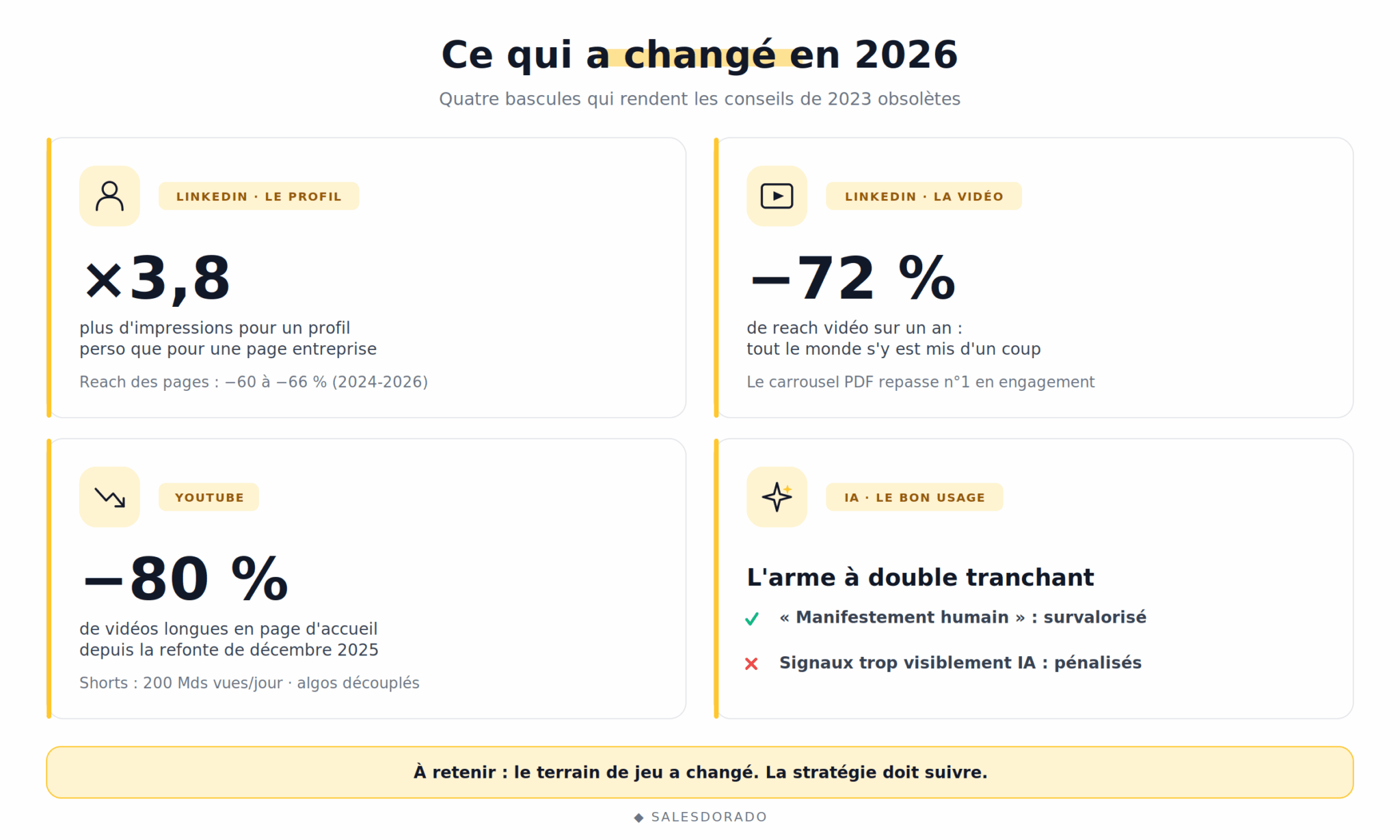
Four shifts—all of them counterintuitive—are changing the way we approach video today:
- Personal profiles have overtaken company pages. On LinkedIn, posts published by individuals generate, on average, nearly 3.8 times more impressions than company pages on identical topics, while the organic reach of these pages plummeted by 60 to 66% between 2024 and 2026. This is the very foundation of personal branding in B2B: it’s people who carry the brand—not logos.
- LinkedIn video faces a paradox that we need to address head-on. The algorithm consistently prioritizes native video and heavily penalizes any outbound link that directs users away from the platform. At the same time, however, video reach plummeted in 2026, according to an analysis that noted a year-over-year decline of about 72%, simply because everyone started doing it at the same time. A surprising detail: the PDF carousel has once again become the format with the highest engagement rate. The lesson isn’t to give up on video, but to stop treating it like a religion. It’s just one building block among many, and what makes the difference is those first three seconds and your consistency.
- YouTube shook things up in December 2025. The algorithm overhaul reduced the number of long-form videos on the homepage by about 80% and boosted Shorts (200 billion views per day) as the primary driver of discovery. Most importantly, the Shorts and long-form algorithms are now decoupled. Poor performance on Shorts no longer hurts your long-form videos, and vice versa. As a direct result, you can no longer rely solely on long-form content to reach new audiences.
- AI has become a double-edged sword. LinkedIn detects and penalizes It now filters out content that is too obviously AI-generated and prioritizes what it identifies as “clearly human.” The proper use of AI, therefore, is not to speak for you. It consists of removing all the friction surrounding your face and voice, so that you can post regularly.
Don’t confuse “posting a video” with “getting seen.” Setting the right dimensions and format is necessary, but it’s no longer enough. A perfectly encoded video will fail within an hour if the first three seconds don’t grab anyone’s attention. The algorithm tests your content on a small sample and cuts off distribution if the hook doesn’t work. Technical proficiency is a prerequisite, not an advantage.
These developments are not mere details. They explain why the advice from two years ago no longer works and why LinkedIn and YouTube have become the two platforms that AI models most frequently cite as reliable sources. The playing field has changed. Strategy must adapt.
YouTube or LinkedIn? A false dilemma
We’re constantly being asked which of the two platforms to choose.
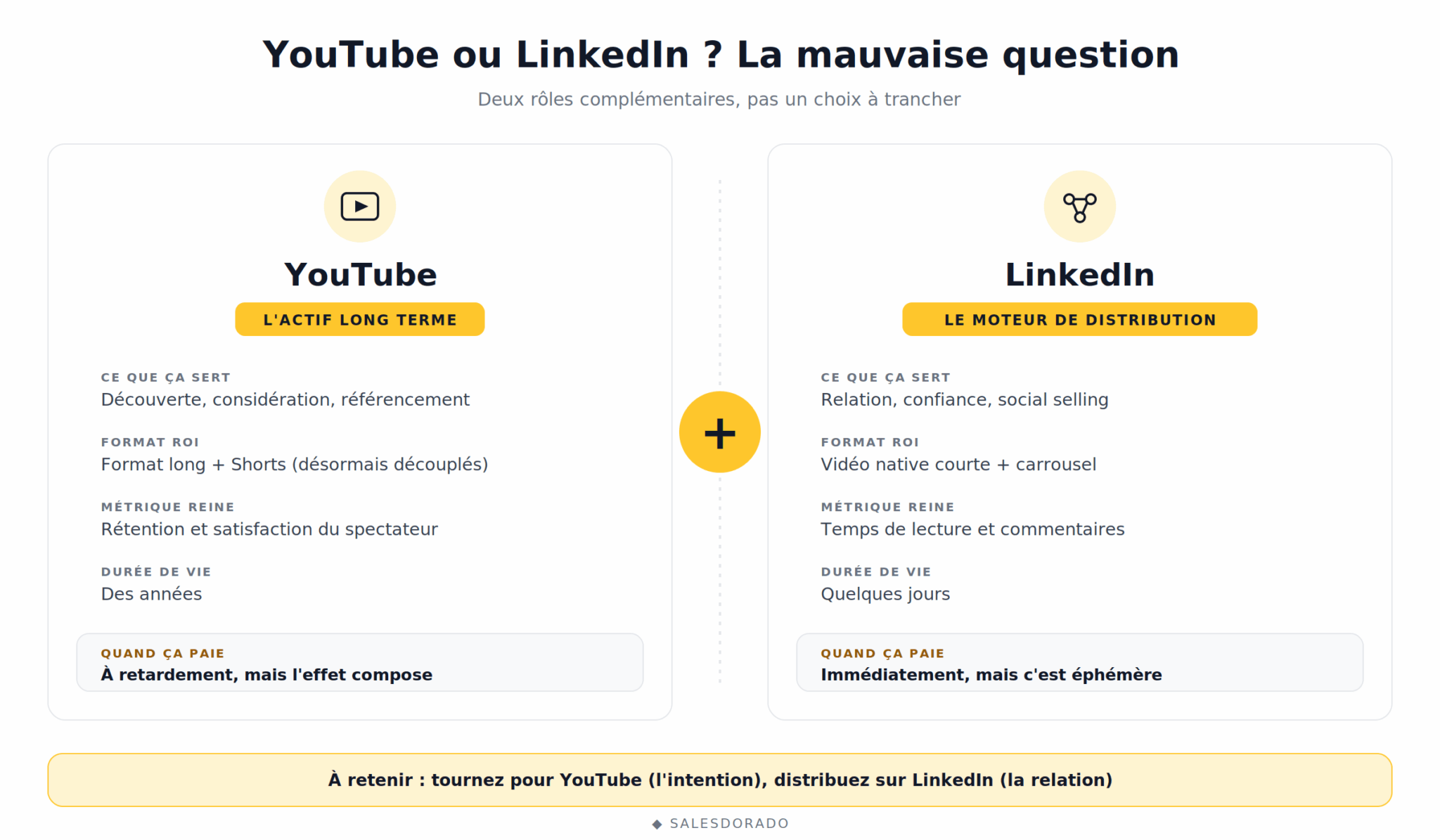
That’s not the right way to frame the issue: it’s not a matter of choosing between LinkedIn and YouTube. The two platforms complement each other:
- YouTube is your asset. It’s a library that works for you for years to come—the world’s second-largest search engine, the place where purchasing decisions are made when a prospect is actively seeking to understand a topic. A well-optimized long-form video continues to generate views, subscribers, and credibility long after it’s published.
- LinkedIn is your distribution channel. It’s where your decision-makers are already active, where conversations take place, and where social selling turns an audience into a pipeline. Content lives there for a few days, but it generates immediate interactions and builds relationships.
The figures support this breakdown: 70% of B2B buyers watch videos during their decision-making process, and the majority of them say they prefer video to any other format when evaluating a solution.
YouTube captures search intent; LinkedIn captures relationships.
| Criterion | YouTube | |
|---|---|---|
| Role | Long-Term Assets | The distribution engine |
| What It’s For | Discovery, engagement, search engine optimization | Relationships, trust, social selling |
| King Format | Long-form and Shorts (now separate) | Short native video and carousel |
| Lifespan of Content | Years | A few days |
| The Most Important Metric | Viewer Retention and Satisfaction | Reading Time and Comments |
| When It Pays Off | It takes time, but the effect builds up | Immediately, but it’s fleeting |
What about other platforms? TikTok, Instagram, or Snapchat can serve as a training ground to hone your on-camera skills or as a secondary distribution channel if your target audience is active there. But in B2B, these aren’t your top priorities. LinkedIn and YouTube remain the main players.
Authentic or Scalable? The False Dichotomy That’s Holding You Back
This brings us to the heart of the matter. In most people’s minds, there’s a dilemma: either you’re authentic, but you can only manage three videos before burning out, or you churn out content in bulk, but it sounds hollow—and people can tell. This false dichotomy has been holding you back for years. Let’s be clear: it’s a false dichotomy.
Here’s why.
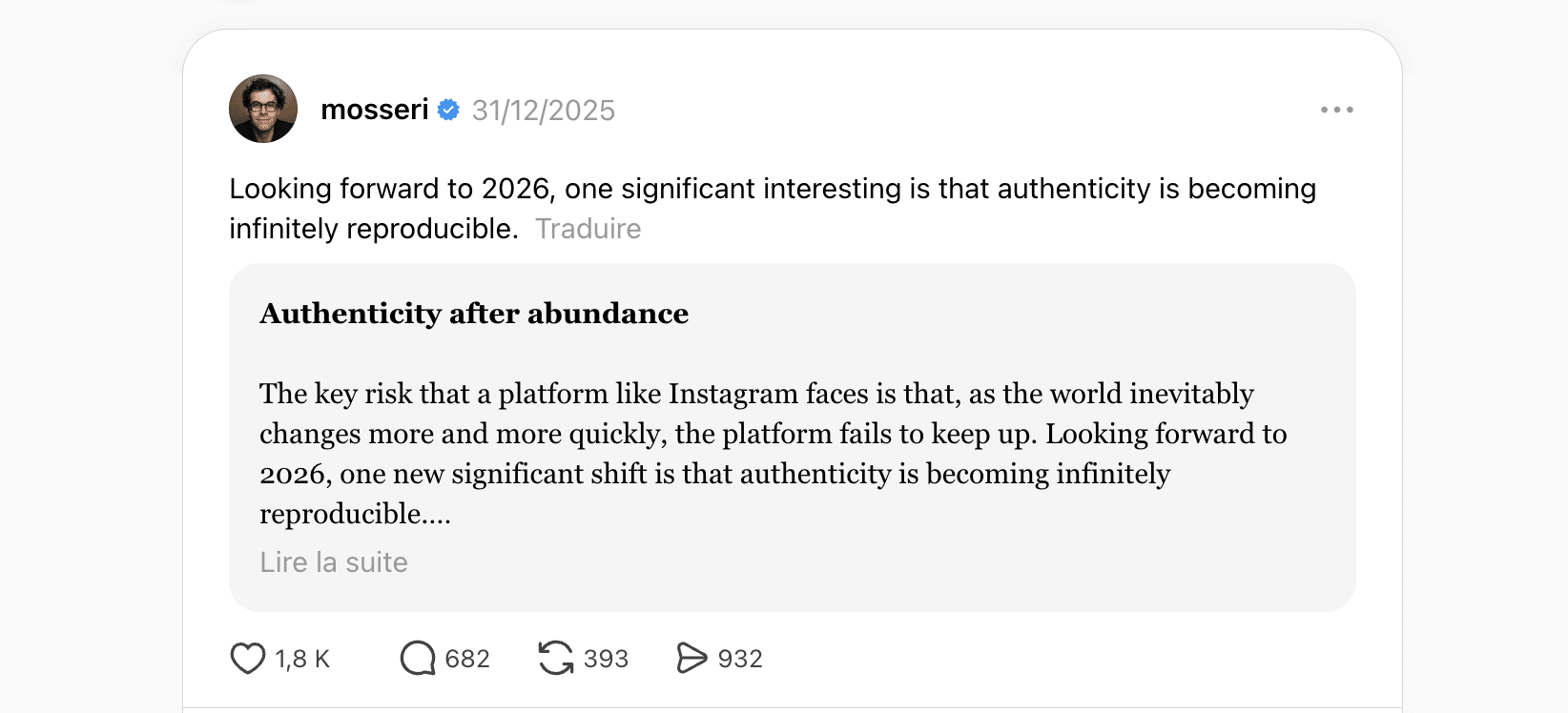
Imperfection has become proof. Instagram’s CEO himself, Adam Mosseri, put it this way recently: in a world where everything can be perfected by machines, imperfection becomes a sign of authenticity. It says, “This is authentic because it isn’t polished.” This is even more true in B2B. As AI-generated text floods news feeds, decision-makers are growing wary of it. A human face on camera cuts through that mistrust in a way that no text ever can. You can’t fake a face.
When everything can be made perfect, imperfection ceases to be a flaw and becomes a sign of authenticity.
This skepticism toward polished content isn’t just a stance—it’s backed by the numbers: 73% of B2B decision-makers consider an organization’s expert content to be more trustworthy than its traditional marketing materials, and 55% (same source) actually use it to evaluate a service provider before contacting them. Authentic video—imperfect but sincere—is the format that inspires this trust.
As for volume, it has become essential. 91% of companies now produce videos. Simply participating isn’t enough anymore; you have to stand out—and standing out means exploring multiple angles to find what truly resonates with your audience. This focus on quantity has long been the domain of B2C, but it’s gradually gaining ground in B2B as well. A single video per quarter isn’t enough to build a personal brand.
So how can we reconcile the two? That’s where AI changes everything.
Used properly, it doesn’t create something fake—it frees you from everything that used to prevent you from being consistent: editing, subtitling, cutting, and repurposing. You retain control over the content, your face, your voice, and your ideas. The machine takes care of the repetitive work. The result: authenticity and quantity—finally compatible.
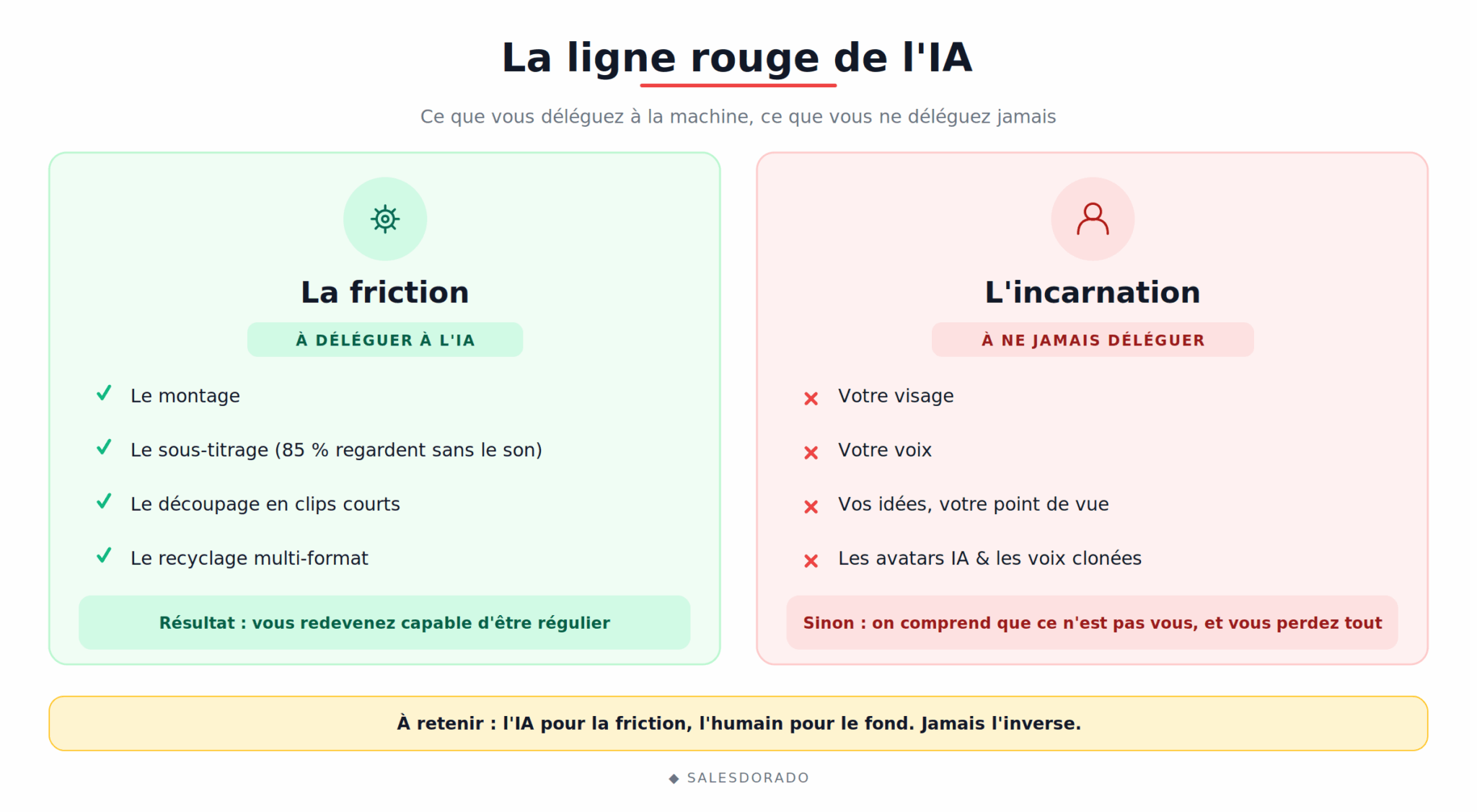
Our stance is clear: yes to AI for eliminating production friction, no to AI speaking on your behalf. Avatars that recite a script for you put you at a double risk: LinkedIn penalizes content that’s too obviously artificial, and—more importantly—personal branding relies entirely on authenticity. The day your audience realizes it’s not really you, you’ll lose exactly what you were trying to build.
The System: One Shoot, Ten Pieces of Content
Let’s get down to business.
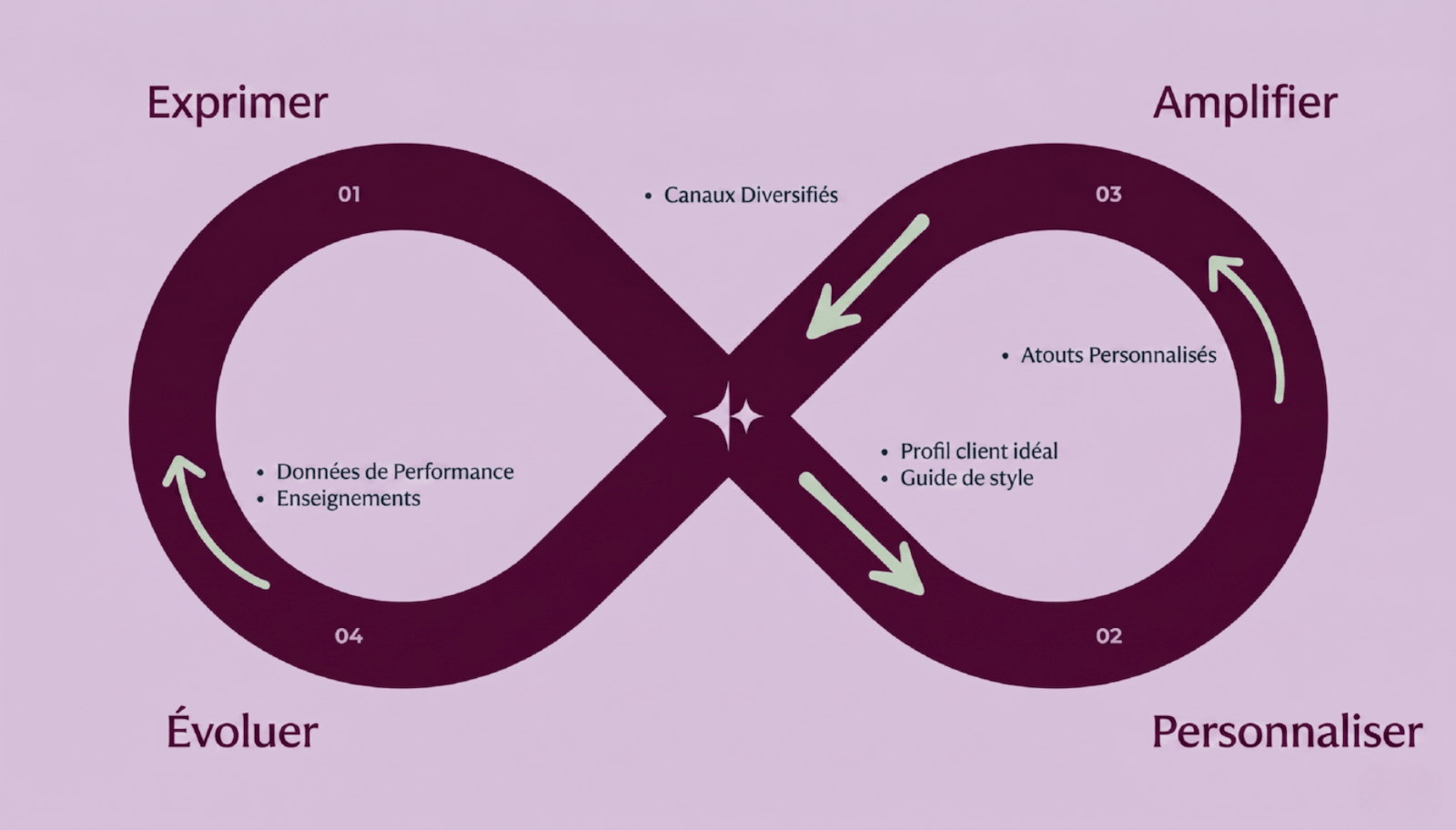
Consistency isn’t a matter of willpower; it’s a matter of system.
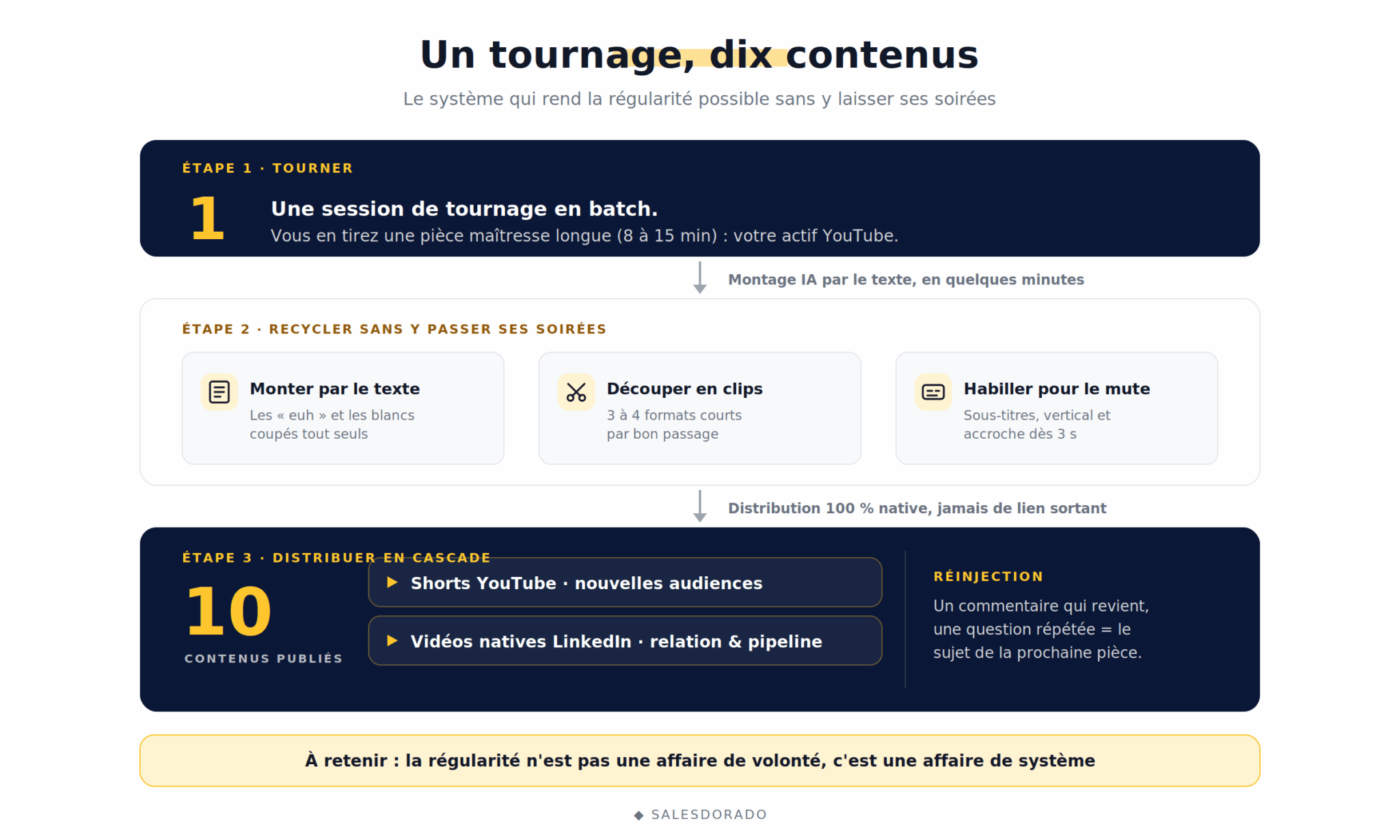
The system that works best today is based on a simple idea: you shoot once, you post ten times.
Here’s how it works, step by step:
- Reserve a filming slot. Instead of filming a video here and there, record several topics in a row during a single session. That’s the idea behind batch recording: one setup session, multiple clips in the can.
- Turn a long centerpiece. This is your YouTube asset: an interview, a demonstration, or an eight- to fifteen-minute opinion piece on a topic you know well. It’s the foundation for everything else.
- Clean and assemble according to the instructions. With today’s tools, you can edit a video by editing its transcript, and automatically remove hesitations and pauses. It takes just a few minutes instead of an entire evening.
- Cut into short pieces. Extract the highlights from your long-form video to create YouTube Shorts and native LinkedIn videos. A good two-minute segment can be turned into three or four standalone clips.
- Optimize for mute. Use closed captions (85% of people watch without sound), a vertical format, and a strong hook within the first three seconds. That’s what will keep viewers watching.
- Distribute in a cascade. Your short clips will appear on your personal LinkedIn profile and as Shorts on YouTube. One golden rule: never paste a YouTube link into a LinkedIn post—the algorithm will penalize you. The video must be uploaded natively.
- Reinject. A recurring comment, a question asked several times—and you’ve got the subject for your next full-length play. The cycle feeds on itself.
: Shoot in portrait mode for the mobile feed, always embed your captions directly into the image rather than relying on an imported transcript, make sure the first three seconds grab the viewer’s attention, and never send users off the platform in the body of the post. These four best practices cost very little and make a huge difference in distribution.
To effectively create content for your short-form formats, our guide to writing high-performing LinkedIn posts is a great place to start.
AI tools that save you time when building your personal brand through video
We’re not going to overwhelm you with thirty tools—we’ll just give you the right ones for each use.
The guiding principle remains the one stated above: AI for the mechanics, humans for the substance:
- To help you read your script while looking at the camera, Captions.ai offers a smart teleprompter and even eye-tracking correction that eliminates that “read-from-a-script” look that gives away an amateur.
- To turn a long video into several short clips, OpusClip and Vizard automatically identify the best moments in a video, reformat them for vertical viewing, and add captions. That’s the essence of repurposing content without spending hours on it.
- To edit without a timeline, Descript lets you edit the video by deleting text from the transcript and removes the “ums.”
- For adding subtitles, Submagic or CapCut’s built-in features—which are free—work perfectly.
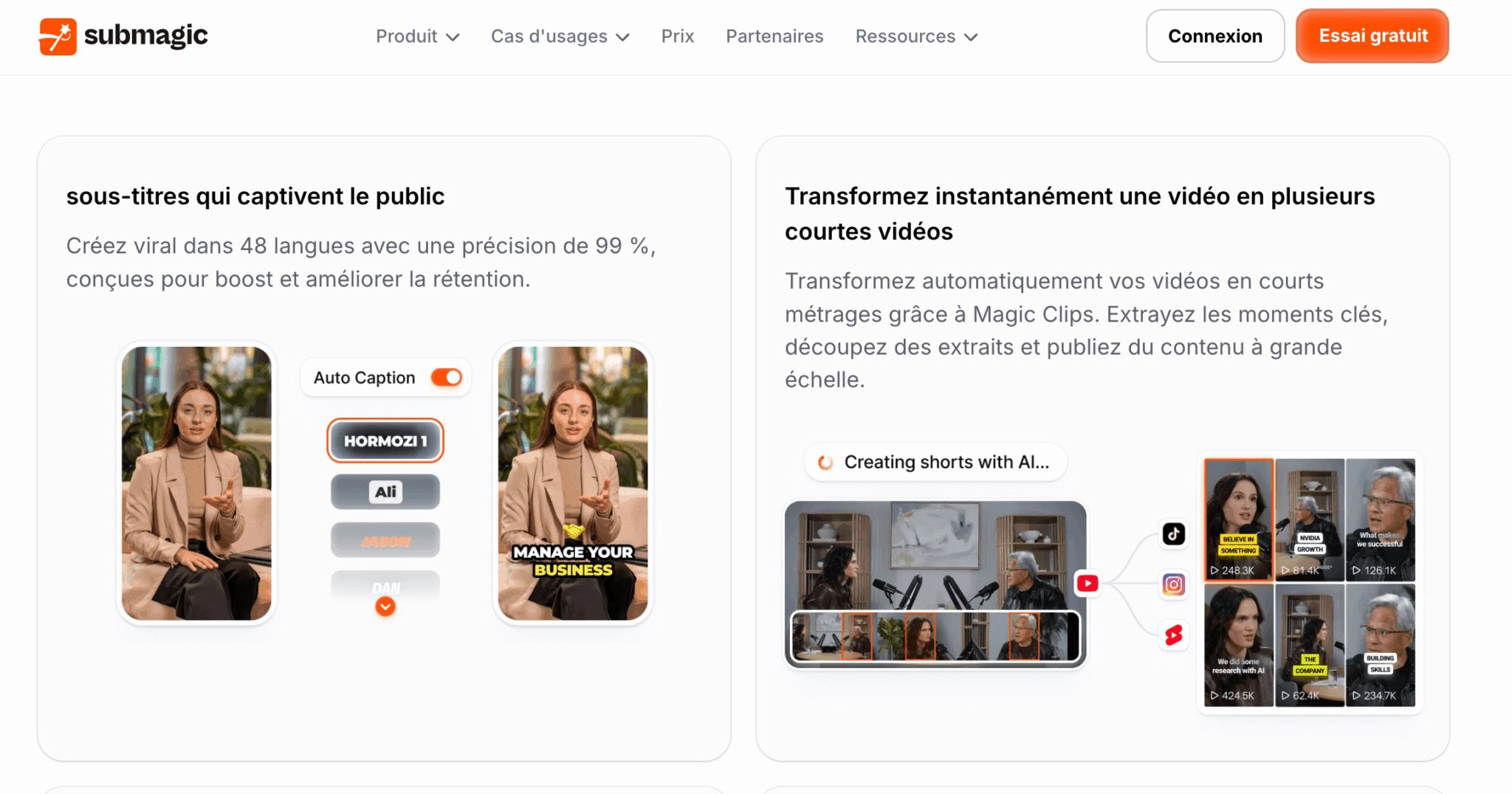
| Your needs | Tools | Why it’s useful |
|---|---|---|
| Read your script while looking at the camera | Captions.ai | Eliminates the “read-from-a-script” feel and maintains eye contact |
| Split a long video into ten clips | OpusClip, Vizard | Automatic repurposing—without spending hours on it |
| Scroll up by editing the text | Description | Cut out hesitations and clean up your text in just a few clicks |
| Add subtitles for silent viewing | Submagic, CapCut | 85% of viewers watch without sound |
Then there’s the issue of AI avatars, like HeyGen, which generate a digital version of you capable of reciting any script. The technology exists; it’s impressive and scalable. But when it comes to personal branding, you need to exercise extreme caution…
The avatar or cloned voice that speaks for you is a line you shouldn’t cross. On the one hand, LinkedIn penalizes content that’s too obviously AI-generated. On the other, your personal brand relies on the fact that it’s really you, with your hesitations and your perspective. Delegate the editing and trimming to the machine. Delegating the embodiment of yourself is at your own risk.
When (and with whom) should you seek guidance to develop your personal brand through video?
Let’s be honest: the system we just described works on its own, but it has its limitations.
An executive with a packed schedule won’t have time to edit their videos, even with AI. A brand aiming for high image quality won’t be able to get by with just a smartphone.
And some people simply have no desire to deal with the technical side of things. In those cases, delegating makes sense. The value of good support lies in guaranteed consistency and continuous improvement—all without you having to think about it.
A few French service providers have specialized in these areas, offering different approaches depending on your needs:
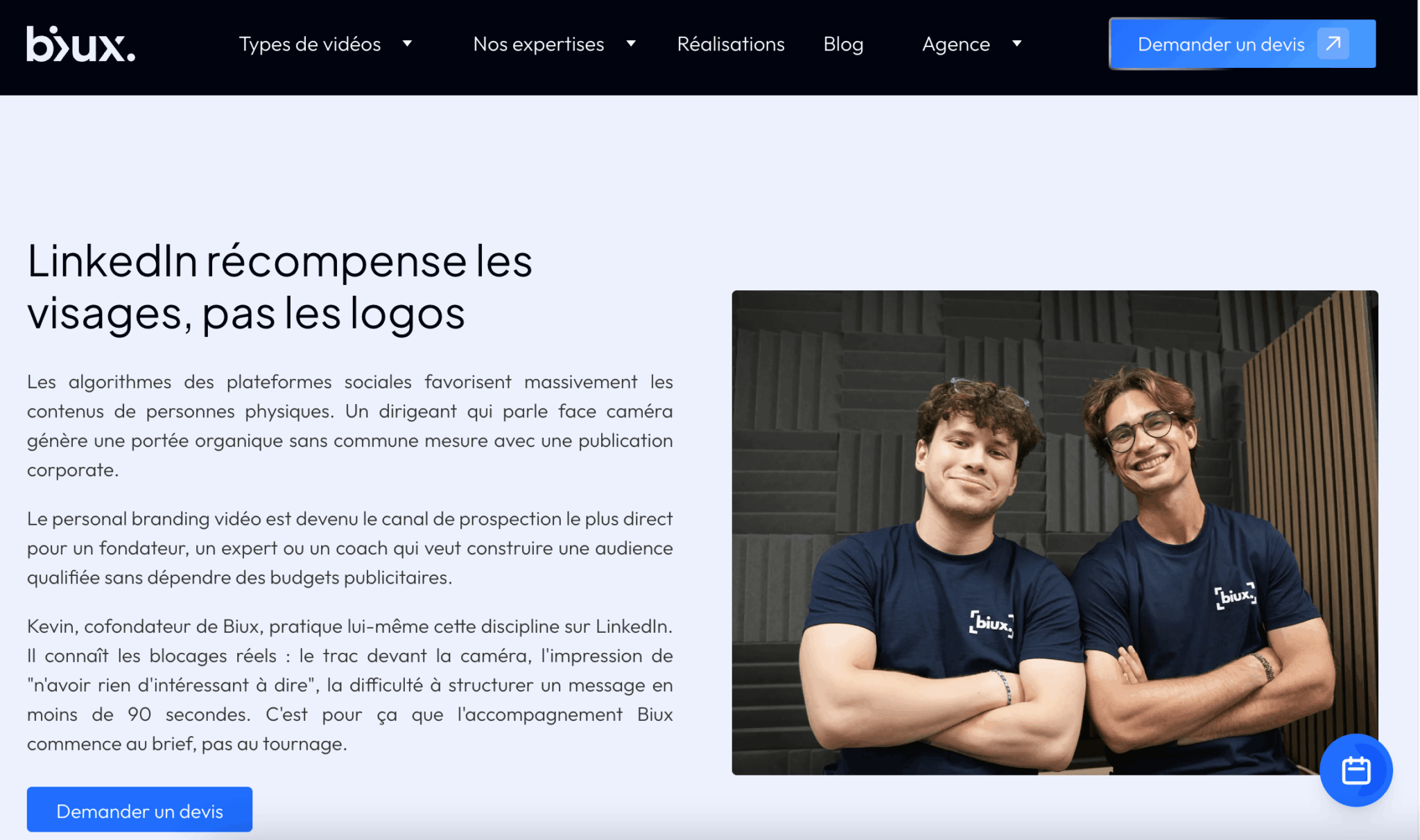
- Biux is a Paris-based video agency specializing in high-end production, with a strong focus on LinkedIn content and short-form videos, and even offering AI-assisted video production. For those seeking high-quality production.
- Teazit offers audiovisual solutions focused on giving executives a platform to speak, in a personal and direct format. We recommend this partner for a CEO who wants to fully delegate the recording process.
- Iconic Personal Brand specializes in executive branding and personal branding for executives. Their team supports you every step of the way.
If you want to broaden your search and compare other options, our selection of the best branding agencies will give you a more comprehensive overview.
Where should I start this week?
There’s no need to wait until you understand everything. The effect builds over time, and the only thing that really matters is getting started and sticking with it. .
Here’s a plan you can start following this week:
- Choose just one topic that you know inside and out. Not ten—just one.
- Shoot your first long-form video using your phone, a lavalier microphone, and a teleprompter.
- Cut it into three or four short pieces.
- Post on your personal LinkedIn profile—definitely not on the company page.
- Wait four weeks before making any judgments.
That’s all.
The difference between those who build a true personal brand and those who don’t isn’t about material possessions or on-camera talent. It’s about consistency. .
Going further
- Our Guide to Learning How to Use LinkedIn
- A Tutorial on How to Optimize Your LinkedIn Profile
- Our Method for Writing High-Performance Posts
FAQ: Video and B2B Personal Branding
Do you need good equipment to get started?
No. A recent smartphone, a lavalier mic, and a little light are more than enough. The real deal-breaker for your videos isn’t imperfect video quality (which viewers can tolerate) but poor audio, which drives them away instantly. Invest in the mic first and foremost.
LinkedIn or YouTube first?
LinkedIn for rapid growth and social selling; YouTube for building a sustainable asset that gains visibility over time. The ideal approach is to create content for YouTube and then share clips from it on LinkedIn. This way, you get the best of both worlds.
How many videos should you post each week?
It’s better to post one useful video a week for six months than five shallow videos published in a burst of enthusiasm. Algorithms now reward depth and consistency, not empty volume. Consistency beats frequency.
Does AI undermine authenticity?
Not if it’s limited to the technical aspects: editing, subtitles, cutting, and recycling. It starts to backfire as soon as it speaks for you through an avatar or a cloned voice. Your face and voice are non-negotiable. They’re what build trust.