At the end of 2025, HubSpot announced the death of the marketing funnel. In its place, a new framework called Loop Marketing, presented as the benchmark strategy for the AI era. Four phases, a learning loop, AI everywhere. On paper, it sounds like a revolution.
After a thorough reading, we honestly wonder whether this is a real break-up or a nice repackaging. The honest answer: a bit of both. There’s some real change (notably in AEO and the place of AI), there’s some concept already known under other names, and above all there’s a strong strategic stance that all your B2B marketing teams should understand, whether they use HubSpot or not.
In this article, we decipher the framework, identify what’s really changing, give you the concrete implementation phase by phase with the HubSpot tools mobilized and the plans required, and tell you honestly who it’s all aimed at.
HubSpot provides a comprehensive strategic guide to Loop Marketing, with over 100 free AI prompts, designed for each phase of the framework. A good introduction for those who want to try out the approach.
Sommaire
What is HubSpot Loop Marketing?
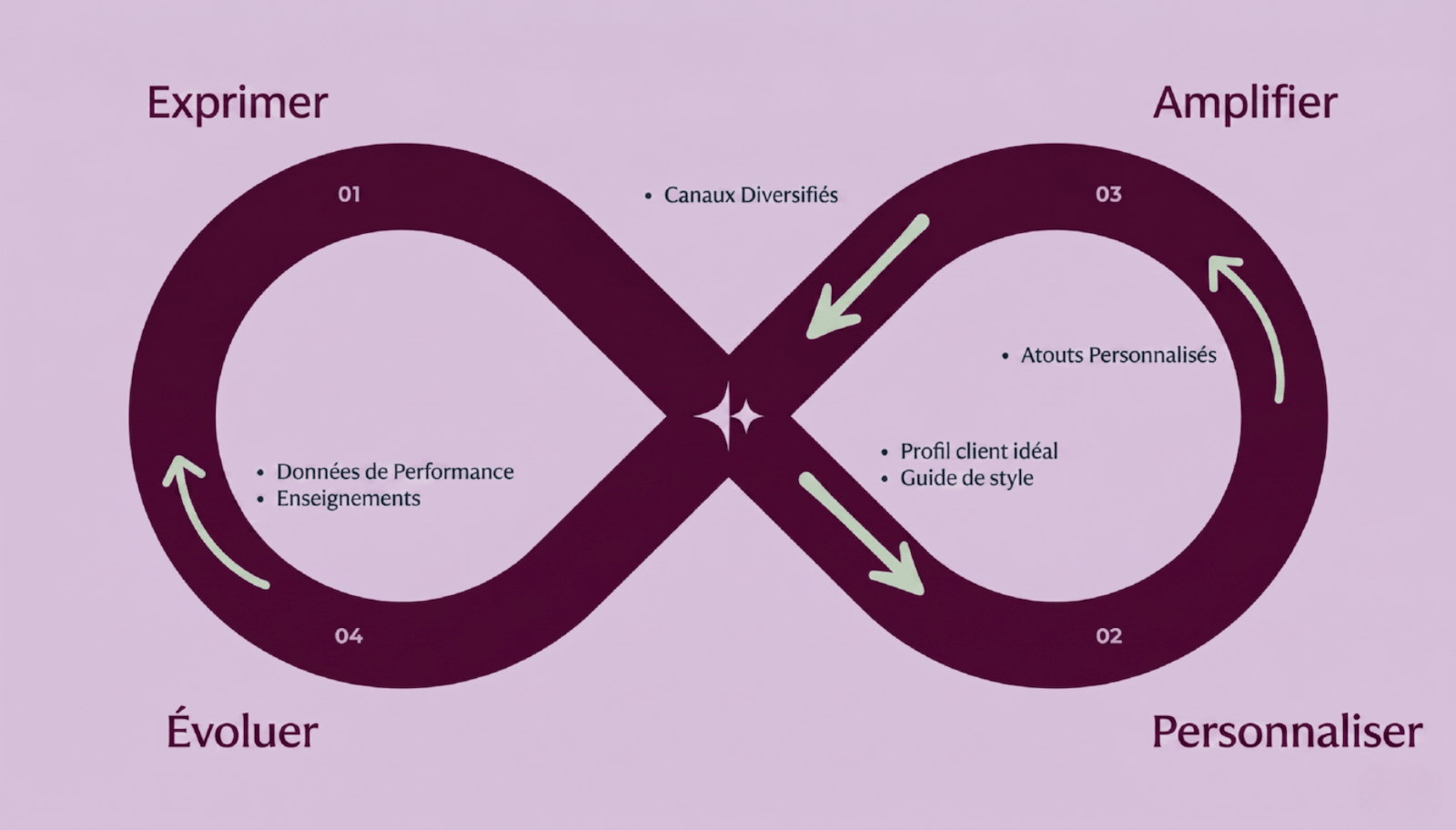
Loop Marketing is the 4-phase strategic framework that HubSpot launched at the end of 2025 to respond to the mutations of marketing in the AI era.
The 4 phases of the framework are as follows:
- Express > express brand identity.
- Adapt > adapt the message.
- Amplify > amplify multi-channel reach.
- Evolve > evolves in real time.
The whole thing forms a continuous loop that learns with each cycle, as opposed to the classic linear funnel.
The central idea: to combine human authenticity (strategy, creativity, judgment) with AI efficiency (execution, personalization, optimization). HubSpot insists that Loop Marketing is not a product or a feature, it’s a methodological infrastructure applicable with or without the platform.
As HubSpot writes: “The loop is turning. It learns. And everything gets more precise every time you use it.”
Why has HubSpot replaced the funnel with a loop?
To understand the relevance of HubSpot’s Loop Marketing, we need to understand the strategic diagnosis behind it.
It all starts with 3 facts:
- Buyers don’t click like they used to. In B2B as in B2C, a growing proportion of searches start on ChatGPT, Perplexity, Gemini or Claude rather than on Google. These answer engines respond directly to the question, without referring back to the sites. As a result, click-through rates on traditional SERPs are plummeting. Traditional SEO is still useful, but no longer sufficient.
- The channels have exploded. Websites and emails have been joined by YouTube, TikTok, Reddit, podcasts, Slack and Discord communities, vertical platforms like G2 or Capterra, and so on.
- Today, a B2B purchasing journey involves 7 to 10 different channels. So, to put it plainly, the linear funnel that presupposes an orderly path (awareness, consideration, decision) no longer captures reality.
AI speeds up execution cycles. What used to take a quarter is now done in a matter of days, thanks to AI agents. A strategy that revises itself every quarter is lagging behind the market. We need a much closer iterative logic.
Hence HubSpot’s response: replace the linear funnel with a continuous loop, integrate AEO as a strategic dimension on a par with SEO, and place AI at the heart of execution.
HubSpot’s diagnosis is correct, and goes far beyond HubSpot. Any B2B marketing team that hasn’t started integrating AEO into its strategy by 2026 is falling behind. Whether you adopt the Loop Marketing framework or not, thinking about these three mutations is a must.
The 4 phases of HubSpot Loop Marketing, explained simply
Here’s a breakdown of the 4 phases of Loop Marketing, including what we do at each stage, the HubSpot tools we mobilize and the minimum HubSpot subscription plan required to execute the end-to-end phase.
Phase 1, Express: expressing your brand’s unique identity
AI can generate content in seconds, but without a clearly defined brand voice, it produces flat, generic content. The Express phase involves giving AI a clear framework to reflect your identity, tone and point of view.
What we do:
- Define the ideal customer profile (ICP) by leveraging AI on customer reviews, call transcripts, comments and community discussions. See our article on how to create an actionable ICP.
- Develop a brand style guide that summarizes your mission, your tone, your do’s and don’ts, your imperatives.
- Generate campaign concepts aligned with your identity.
HubSpot tools used :
- Breeze Assistant to exploit CRM data and generate concepts and personas.
- Brand Identity Tool (Beta) to create an AI style guide that can be reused in all media.
- Marketing Studio (Beta) to transform a brief into multi-channel assets.
Plan required: Marketing Hub Pro at €880/month minimum for Marketing Studio and Brand Identity tool. Breeze Assistant is available earlier, but its full functionality requires Pro.
Phase 2, Adapt: tailor your message to each audience
Traditional personalization (“Dear {Firstname}”) is no longer enough. The Adapt phase aims to offer truly personal messages, based on behavioral data, intent signals and unified context.
What we do:
- Enrich data with behavioral signals, intent data and contextual information (company size, sector, technologies used, recruitment signals).
- Define audience segments by intent rather than pure demographics.
- Dynamically personalize content (landing pages, emails, CTAs, ads) according to sector, role and time.
- Maintain human quality control to ensure that customization remains accurate and that CTAs are aligned with the lifecycle.
HubSpot tools used :
- AI-based segmentation (Beta) to identify high-intent segments.
- Personalization tool (Beta) to create targeted content variants.
- AI-optimized emails (Beta) to generate personal emails from CRM data.
- Buyer Intent to target leads showing signals of active intent.
- Data Studio (Beta) and Agent Breeze for data to unify and enrich dispersed data.
Required plan: Marketing Hub Pro for personalization and AI emails. Buyer Intent and Agent Breeze for data needs Pro or Enterprise. Data Hub Pro or Enterprise for Data Studio.
The temptation is to personalize everything, everywhere, automatically. A bad idea. Poorly calibrated personalization (e.g., mentioning a prospect’s exact job title in a cold email) quickly tips over to the creepy side. Keep human control over AI-generated variants, especially on the first emails of a sequence.
Phase 3, Amplify: amplify your reach on all channels (including LLMs)
Publishing quality content is no longer enough. The Amplify phase pushes your message to all the channels your buyers are looking for (ChatGPT, YouTube, TikTok, Reddit, LinkedIn, Capterra, communities) and to the voices they trust (creators, peers, experts).
What we do:
- Optimize content for response engines (AEO) by tracking brand visibility on ChatGPT, Perplexity and Gemini, and adjusting content to be cited.
- Diversify channels and formats: the same main asset becomes an optimized ChatGPT article, a TikTok vertical video, a LinkedIn carousel, a podcast episode.
- Work with trusted designers in the target sector.
- Launch smart ads (Google Performance Max, Meta, LinkedIn).
- Optimize every point of contact with contextualized CTAs.
HubSpot tools used :
- Marketing Studio to plan and deploy multi-channel resources.
- AEO Grader for analyzing and improving visibility in AI engines.
- AI content reuse to transform an asset into multiple formats.
- Video clip agent to identify relevant clips in a video library.
- Customer support agent to engage visitors on high intent pages.
- Integrated Google Performance Max for intelligent ad distribution.
Required plan: Content Hub Pro or Enterprise for AI content reuse and video clip agent. Marketing Hub Pro or Enterprise for AEO. This is the most demanding phase in terms of plan.
Phase 4, Evolve: evolve your strategy in real time
The closing phase. The aim is to turn each campaign into a source of learning for the next, and to move from a quarterly to a short-cycle approach.
What we do:
- Anticipate before you publish by using AI to predict likely performance and spot weaknesses.
- Monitor performance in real time, highlighting anomalies automatically.
- Conduct rapid experiments (A/B tests on titles, offers, audiences).
- Document lessons for the next cycle.
HubSpot tools used :
- Marketing analytics for unified multi-channel reporting.
- Journey Reports to analyze customer journeys between contact points.
- Email engagement optimization (Beta) to predict the recipients most likely to engage.
- A/B testing AI to automatically generate page variants.
- ChatGPT connector to use HubSpot context in external analyses.
Plan required: Marketing Hub Enterprise for Journey Reports and Email Engagement Optimization. Pro for basic functionality. This is the most demanding phase in terms of plan.
AEO: what’s really changing in the HubSpot Marketing Loop
If we had to remember just one thing about Loop Marketing, it would be the serious integration of AEO as a strategic dimension. This is probably the framework’s most structuring new feature.
AEO (Answer Engine Optimization) stands for optimization for AI answer engines (ChatGPT, Perplexity, Claude, Gemini). Where SEO aims to appear in the top 5 of Google results, AEO aims to be cited in AI-generated answers. It’s a profound shift in logic.
| Dimension | SEO | AEO |
|---|---|---|
| Objective | To appear in the top 5 links | Be quoted in the answer presented |
| Key strategies | Keywords, backlinks, meta tags | Statistics, citations, authoritative sources |
| Reward | Domain reputation | Repeated mentions in reliable sources |
| Measure | Traffic and visitor volume | Visibility and conversion through AI |
HubSpot has released a tool dedicated to AEO called AEO Grader (free, accessible without a HubSpot account) which analyzes a brand’s visibility on IA response engines, compares performance to competitors and identifies cited sources.
In concrete terms, for a B2B marketing team, this means structuring content around precise questions (FAQs, guides, comparisons), favoring sourced statistics and authority citations, and taking care to maintain a presence on reliable third-party sources.
SEO is still useful, but must now be complemented by a dedicated AEO strategy.
Regardless of whether or not you’ve adopted Loop Marketing, AEO has become an unavoidable topic. If your marketing team hasn’t yet started structuring its content for AI response engines, now’s the time. It’s probably the only truly new strategic topic in Loop Marketing, and the one we believe will have the greatest impact on your visibility over the next 18 months.
Loop marketing vs. inbound marketing: what really changes?
HubSpot officially states that Loop Marketing doesn’t replace inbound marketing, but complements it in the age of AI.
It’s honest, and you have to distinguish between what’s really new and what’s repackaging:
- What’s really new: AEO as a strategic dimension in its own right (with dedicated tools and its own KPIs), the centrality of AI in execution (and not just in content production), the logic of a learning loop as opposed to a linear funnel, and the acceleration of the optimization cycle (days instead of quarters).
- What is repackaging KPIs and style guides were already part of any serious inbound strategy. Segmentation by intent and personalization have been dealt with by growth teams for years. Continuous optimization and A/B testing are part of classic growth marketing.
So the real value of the framework lies not in its conceptual originality, but in its ability to structure a coherent response to a paradigm shift that many marketing teams are undergoing without a framework. Loop Marketing offers a common vocabulary, an organized checklist and an integrated vision. It’s useful, even if it’s not revolutionary. For more on the fundamentals, see our inbound marketing guide and our content marketing examples.
Does Loop Marketing work without HubSpot?
A legitimate question. HubSpot’s official answer is clear: yes, the framework is applicable without the platform. It’s a methodological infrastructure, a “framework”, not a product. But unification in a single platform brings real value, especially for phases that rely on real-time cross-referenced data.
If you’re not with HubSpot, here are the functional equivalents by phase:
- Express: ChatGPT or Claude for generation, Notion for style guide.
- Adapt: Clay or Apollo for enrichment, your CRM for segmentation, Hyperise for landing page personalization.
- Amplify: Buffer or Hootsuite for distribution, specialized AEO tools, Opus Clip for video clips.
- Evolve: Google Analytics 4, VWO or AB Tasty for A/B testing.
The trade-off: you manage 10 to 15 different tools instead of a single platform. It’s doable, but it requires a RevOps team capable of orchestrating it all. This is precisely the tension between a best-of-breed approach and an integrated platform that HubSpot advocates. To explore this debate further, see our marketing automation software comparison and our alternatives to HubSpot.
How much does it cost to implement Loop Marketing in HubSpot?
For a broader analysis of HubSpot rates, see our complete guide to HubSpot costs.
| Loop Marketing phase | Minimum plan | Indicative monthly budget |
|---|---|---|
| Express (essential) | Marketing Hub Pro for Marketing Studio + Brand Identity | 880€ for 3 licenses |
| Adapt (essential) | Marketing Hub Pro + Data Hub Pro for Data Studio | 880€ + approx. 100 |
| Amplify (essential) | Marketing Hub Pro + Content Hub Pro | 880€ + approx. 450 |
| Evolve (complete) | Marketing Hub Enterprise for Journey Reports | 3,300€ for 5 licenses |
| Complete implementation | Complete Pro to Enterprise suite depending on depth | 1,500 to €5,000/month |
A full Loop Marketing implementation with HubSpot costs between €1,500 and €5,000/month, depending on depth. This investment is justified for structured B2B SMEs with a marketing team of 5 to 10 people. For smaller structures, the partial approach (Express + Adapt on Marketing Hub Pro at €880) remains relevant. For freelancers or very small businesses, the framework is still useful as a guide, without necessarily using the full HubSpot tools.
Is it time to adopt Loop Marketing?
Our verdict, by team profile:
- If you’re already with HubSpot Pro or Enterprise, yes, train yourself in Loop Marketing and test it phase by phase. You already have most of the tools, so the additional investment is minimal. Start with the phase you’re lacking most today (often Adapt or Amplify for B2B teams).
- If you are starting a structured marketing projectWith this framework, you can integrate AEO and loop logic right from the design stage. It will be easier to start with this framework than to migrate a linear strategy in 18 months’ time.
- If you are on a stack other than HubSpotYou can adopt the philosophy without the platform. In any case, the Amplify phase with AEO is a must today, regardless of your tool.
- If you don’t yet have a structured marketing strategyDon’t start with Loop Marketing. Lay the foundations first: KPIs, quality content, basic automation, alignment, and so on marketing-sales. Loop Marketing is an optimization framework, not a start-up framework.
A useful framework, provided you keep a critical eye
HubSpot’s Loop Marketing is a useful framework to know about, because it takes note of real transformations that every B2B marketing team needs to integrate today. The diagnosis is right, the structuring is pertinent, and the integration of AEO is probably the most structuring innovation of the decade for digital marketing.
That said, don’t be naive in adopting it. It’s a framework published by a vendor who has a vested interest in your adoption of its complete platform. Part of the model is a repackaging of ideas that already existed under other names. Full implementation is expensive, and many tools are still in beta.
Our recommendation: adopt the philosophy without necessarily adopting the platform in its entirety :
- Integrate AEO into your content strategy now.
- Think in terms of a learning loop rather than a linear funnel.
- Industrialize the use of AI in your execution cycles.
If you’re already with HubSpot, deploy phase by phase. Otherwise, think in coherence with your existing stack.
HubSpot offers a 14-day credit-card-free trial and a complete guide to Loop Marketing with 100+ free AI prompts. This is probably the best way to test the framework before committing to a paid plan.
FAQ: your questions about Loop Marketing HubSpot
What exactly is HubSpot Loop Marketing?
Loop Marketing is the 4-phase strategic framework that HubSpot launched at the end of 2025 to adapt marketing to the AI era. The phases are Express (brand identity), Adapt (personalization), Amplify (multi-channel and AEO), Evolve (real-time optimization). It’s a methodological infrastructure, not a product, applicable with or without the HubSpot platform.
Does loop marketing replace inbound marketing?
No, HubSpot Loop Marketing doesn’t replace inbound marketing, it complements it. The inbound principles (inform customers, create value, build relationships) remain valid. Loop Marketing adds the AI dimension and Answer Engine Optimization (AEO), while moving from a linear funnel logic to a continuous loop logic that learns.
How much does it cost to implement Loop Marketing in HubSpot?
A complete Loop Marketing implementation in HubSpot costs between €1,500 and €5,000/month, depending on depth. The operational minimum (Express and Adapt phases) requires Marketing Hub Pro at €880/month for 3 licenses. The Evolve phase, complete with Journey Reports, requires Marketing Hub Enterprise at €3,300/month for 5 licenses.
Can you do Loop Marketing without HubSpot?
Yes, Loop Marketing is applicable without HubSpot, and HubSpot officially recognizes this. The framework is a methodological infrastructure. You can use ChatGPT for the Express phase, Clay or Apollo for Adapt, specialized AEO tools for Amplify and Google Analytics 4 for Evolve. The trade-off: orchestrating 10-15 tools instead of a unified platform.
What’s the difference between SEO and AEO in Loop Marketing?
SEO aims to appear in the top 5 of Google links thanks to keywords, backlinks and meta tags. AEO (Answer Engine Optimization) aims to be cited in the answers of AI engines like ChatGPT, Perplexity or Gemini, relying on sourced statistics, citations and authoritative sources. Loop Marketing recommends combining the two in a coherent strategy.