HubSpot CRM and ActiveCampaign get almost identical ratings on customer review sites, and both feature in all the “best marketing automation tool” top lists. Yet choosing them means making a very different strategic gamble on how your business will grow.
HubSpot bets that CRM is the operating system for your growth. ActiveCampaign is betting that behavioral automation is the engine. It’s not the same bet, and getting it wrong could cost you a painful migration in two years’ time.
Rather than lining up features in a table, we ask you the 5 questions that really make the difference. The right answer depends on your situation, not on a score out of 10.
HubSpot offers the best free CRM on the market: unlimited contacts, sales pipeline, forms, email marketing and basic reporting. Enough to structure your sales activity without spending a cent.
Sommaire
HubSpot CRM vs ActiveCampaign: summary table
| Criteria | HubSpot | ActiveCampaign |
|---|---|---|
| Ideal for | B2B SMBs/SMEs who want a central CRM that aligns marketing, sales and customer service | Marketing teams who prioritize behavioral automation and cross-channel orchestration |
| Philosophy | CRM growth platform: everything converges on a single customer database (modular hubs) | Automation-first, AI-native: everything is based on actual contact behavior to orchestrate personalized paths |
| Our opinion | The best choice for French B2B SMEs looking to structure their revenue cycle. Unbeatable free CRM, solid French-speaking ecosystem, unrivalled functional depth. An investment that pays for itself as soon as you structure your sales processes. | The king of marketing automation at an affordable price. Powerful behavioral paths, excellent deliverability, 900+ automation templates. But lightweight CRM, English-language support and virtually absent from the French market. |
| Highlights |
|
|
| Weak points |
|
|
| Free trial | Free CRM with no time limit + 14-day trial of paid features | 14-day free trial (Pro plan) |
| Read more |
5 questions to help you choose between HubSpot and ActiveCampaign
#1 Is your priority CRM or automation?
That’s the fundamental question. Everything else flows from it.
If the answer is “CRM”, you’re looking for a system that centralizes all your customer relations: sales pipeline, interaction history, scoring, forecasting, reporting. You want your sales people, your marketers and your customer service to work with the same data. That’s the promise of HubSpot CRM.
The HubSpot platform is structured into modular hubs (Marketing, Sales, Service, Content, Operations) which revolve around a central CRM. Every interaction, whatever the channel, is displayed in a unified timeline for each contact. Native scoring, forecasting, personalized objects (in Enterprise) and Dashboard reporting make HubSpot a true enterprise management tool. HubSpot calls this the marketing loop: a virtuous cycle in which marketing, sales and customer service feed off each other.
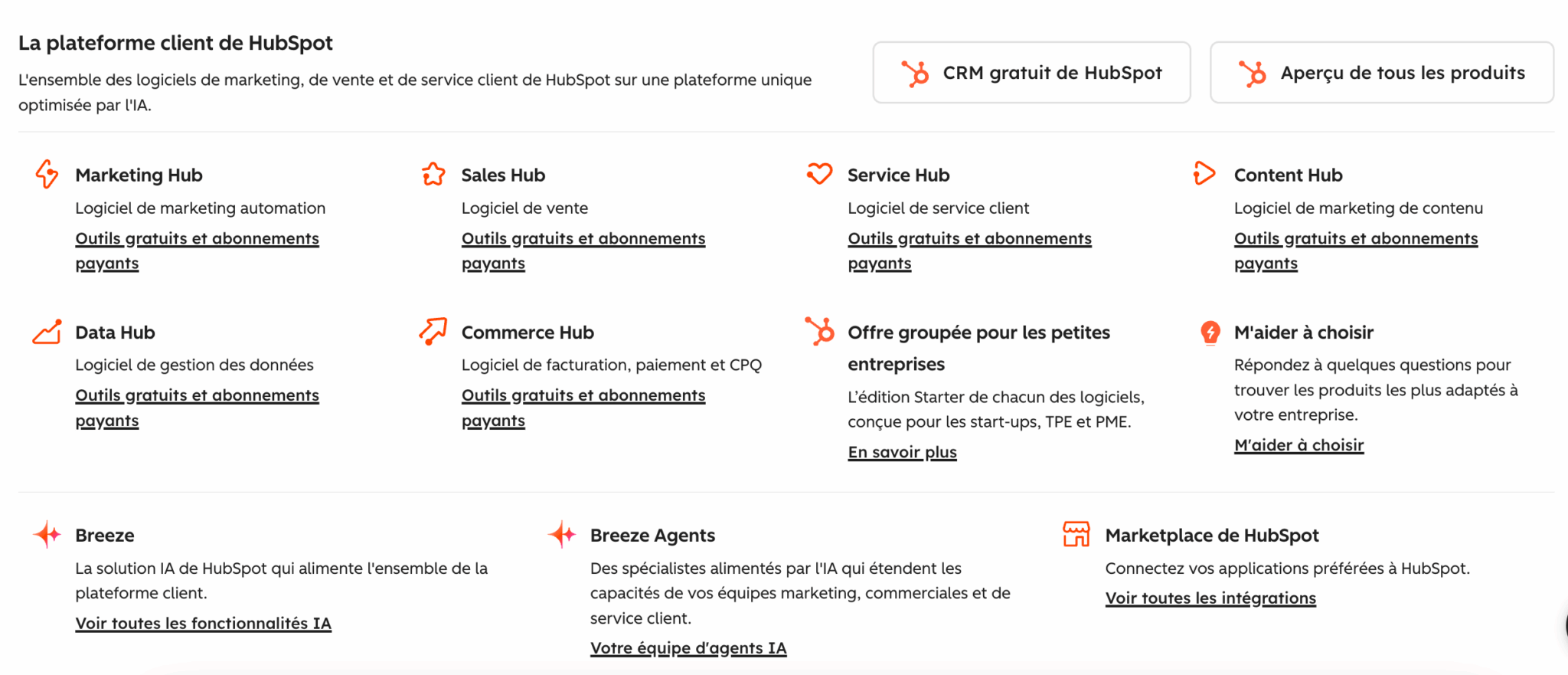
And the free CRM is a massive selling point. It includes unlimited contacts, a sales pipeline, email tracking, forms and basic email marketing. No competitor offers such a complete entry point for zero euros.
If the answer is “automation”, you’re looking for an engine that orchestrates sophisticated customer journeys based on your contacts’ actual behavior: clicks, page visits, purchases, inactivity, cross-channel interactions. That’s where ActiveCampaign comes in.
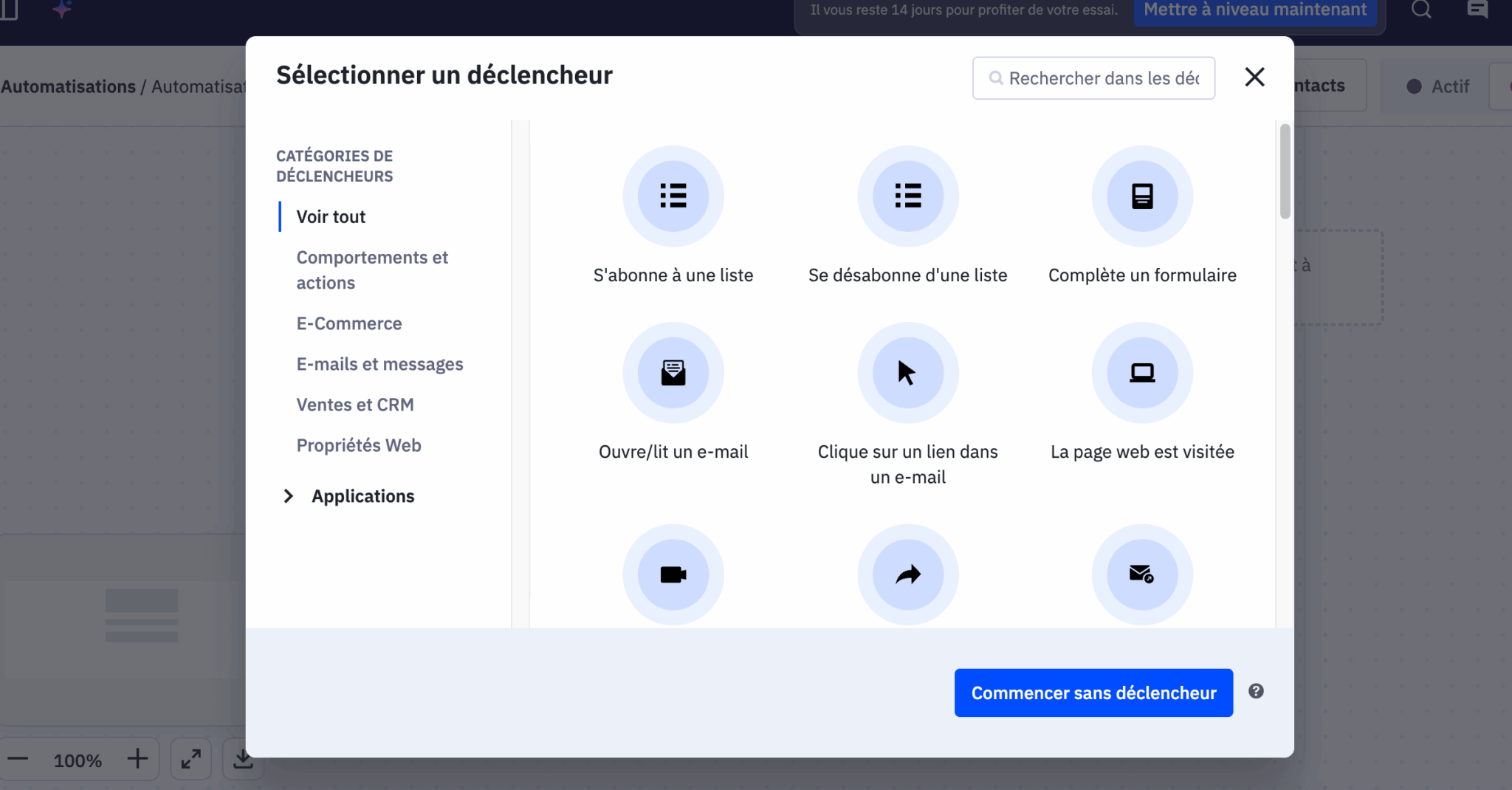
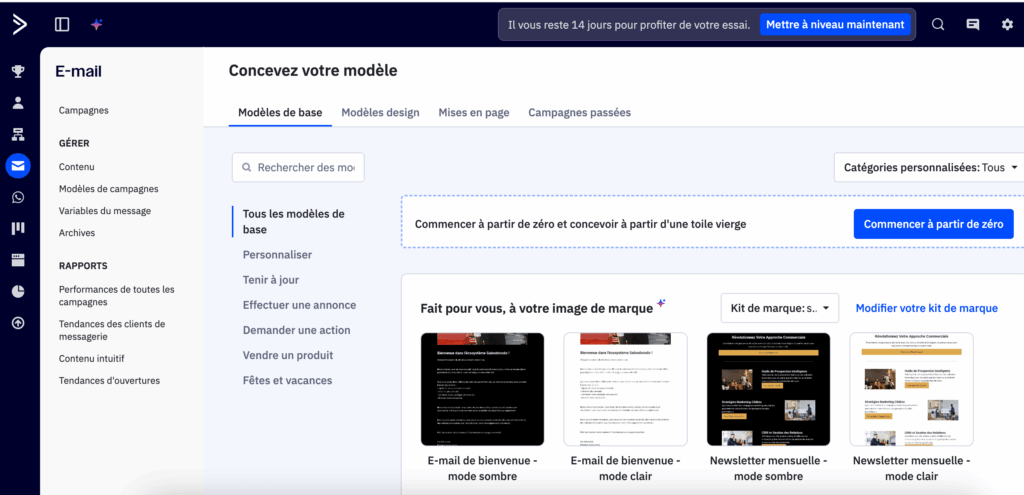
ActiveCampaign offers over 900 ready-to-use automation templates, 135+ behavioral triggers, multi-level conditional branches and an AI (“Active Intelligence”) capable of building automations from a natural language description.
All available from the Plus plan at $49/month. The integrated CRM exists (Kanban pipelines, unlimited deals, tasks), but it remains a building block for automation, not a fully-fledged sales management tool.
For a B2B SME with structured sales processes, automation without CRM is marketing in a vacuum. You can have the best behavioral journeys in the world: if you don’t know where each prospect is in your pipeline, who has followed them up and what their potential is, you’re flying blind. HubSpot CRM is the foundation. ActiveCampaign is suitable for autonomous marketing teams who already have a CRM, or for businesses (e-commerce, info-preneurs) where the sales pipeline is straightforward.
#2 Do your emails arrive in your inbox?
It’s the subject that no one digs into in the French comparisons, and yet it’s perhaps the most impactful criterion if email is an important revenue channel for you.
According to independent tests by EmailTooltester (the industry benchmark), ActiveCampaign boasts an inbox placement rate of 94.2%, making it the market leader across all solutions. HubSpot stands at 77.7%, 12th out of 16 tools tested.
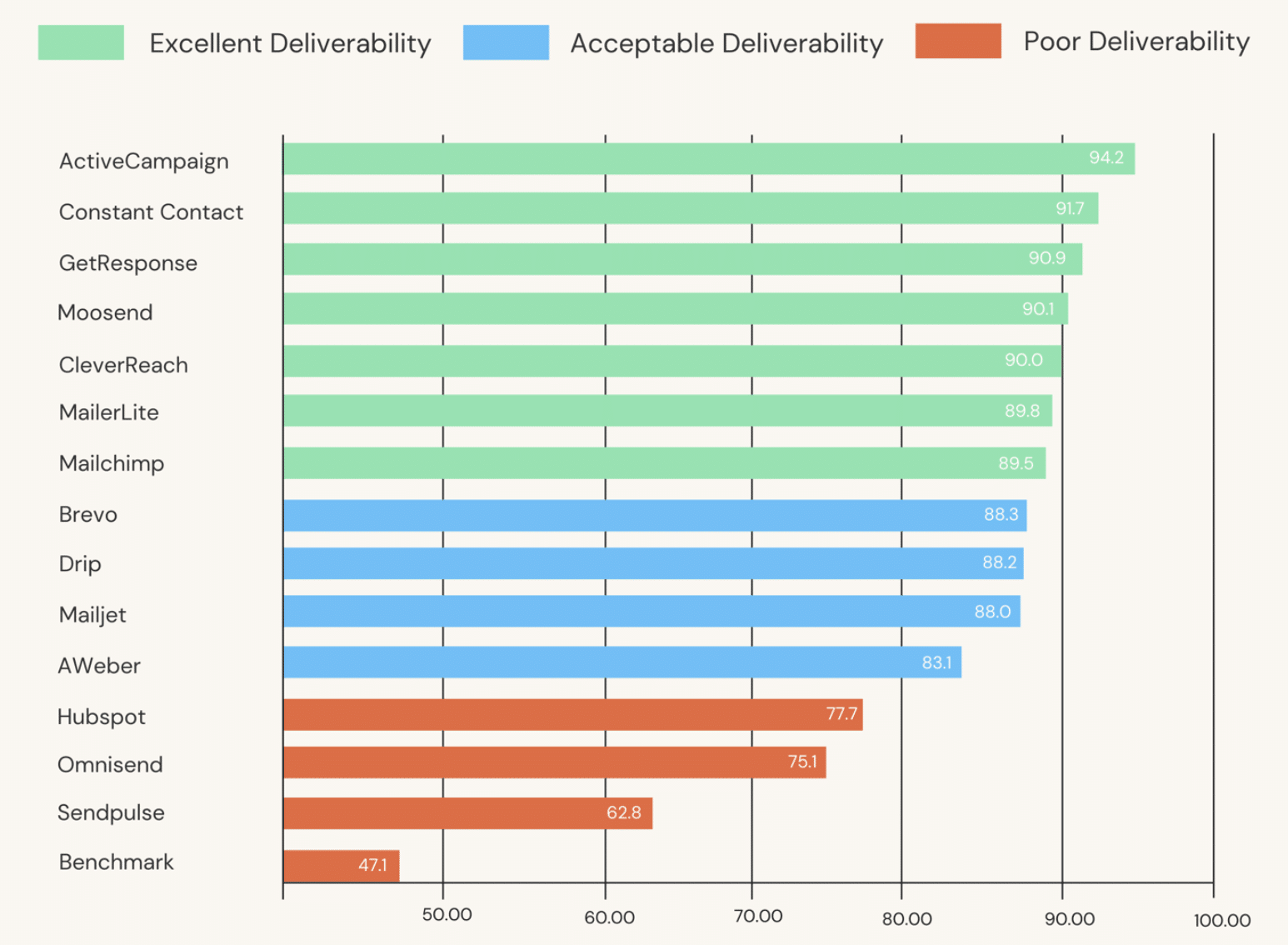
Translated into concrete terms: for every 10,000 emails sent, 1,650 more reach the inbox with ActiveCampaign. For a high-volume promotional campaign or a critical lead nurturing sequence, that’s a considerable difference.
Why is ActiveCampaign ahead? The tool invests heavily in list hygiene (automatic deletion of uncommitted contacts), authentication (DKIM/SPF configured at onboarding), strict IP reputation management and false-positive filtering in statistics (“BotSense” functionality that excludes clicks from bots, available on Pro plans). HubSpot is solid on the fundamentals (DKIM/SPF, IP warmup), but doesn’t reach the same high standards on deliverability.
Let’s be honest: this is one of HubSpot’s documented weaknesses. However, we must be careful. Deliverability also (and very much) depends on your own practices. The quality of the list, sending frequency, engagement rate and DNS configuration. A disciplined company will get good results with HubSpot. But on a level playing field, ActiveCampaign has a structural advantage.
If email is your main revenue channel (e-commerce, monetized newsletters, high-volume B2B campaigns), deliverability is a criterion that shouldn’t be ignored, and ActiveCampaign has an objective advantage here. For a B2B SME where emailing is just one channel alongside pipeline, telephone and appointments, HubSpot’s CRM depth and reporting weigh infinitely more than 15 deliverability points.
#3 How much are you willing to invest in automation?
This is where the gap between the two philosophies translates into euros.
| Bearing | HubSpot (Marketing Hub) | ActiveCampaign |
|---|---|---|
| Free | Full CRM, unlimited contacts, 1 pipeline, forms, 2,000 emails/month | No free plan (14-day trial) |
| Entry-level | Starter: €20/user/month, CRM + emailing + 2 pipelines | Starter: $15/month (1,000 contacts), email + 5 automations max, 1 user |
| Complete automation | Marketing Hub Pro: €880/month (3 users, 2,000 marketing contacts) + €2,930 onboarding, cross-object workflows, scoring, A/B testing, attribution, Smart Content | Plus: $49/month (1,000 contacts, 3 users), advanced automations, landing pages, advanced segmentation, CRM add-on |
| Premium | Enterprise: €3,300/month + €6,830 onboarding, custom objects, AI scoring (Breeze), partitioning, revenue attribution | Pro: $79/month (1,000 contacts), advanced AI, BotSense, predictive sending, scoring |
| Billing | Per user + per level of marketing contacts | Per total number of contacts (including inactive contacts since Nov. 2025) |
| Onboarding | Mandatory on Pro and Enterprise (€2,930 to €6,830) | Free, migration included |
The raw facts: ActiveCampaign gives access to advanced automations for $49-79/month, while HubSpot’s Marketing Hub Pro starts at €880/month.
But this observation is misleading if we stop there, because HubSpot’s Marketing Hub Pro isn’t “just” an automation tool: it’s a complete revenue system that integrates CRM, cross-object workflows, AI scoring, reporting with multi-touch attribution, landing pages, Smart Content and 2,000+ integrations into a single subscription.
To get a comparable functional scope from ActiveCampaign, you’d have to stack the CRM add-on ($77/month), the Custom Reporting add-on ($159/month), a third-party landing page tool, a sales reporting tool and integrate them all together, with the hidden costs of maintenance and fragmentation.
This is also a game-changer for ActiveCampaign: since November 2025, new accounts have been billed for all contacts (including unsubscribers, bounces and unconfirmed contacts). And prices rise quickly with volume: going from 1,000 to 5,000 contacts can almost double the bill. At 10,000 contacts with a Pro plan, you’re looking at $250-300/month.
Three profiles, three budgets
| Profile | HubSpot (estimated/month) | ActiveCampaign (estimated/month) |
|---|---|---|
| Startup (2 people, 1,000 contacts, basic automation) | Free CRM or Starter at €40 | Plus at $49 |
| SME (5 people, 10,000 contacts, automation + CRM) | Marketing Hub Pro: €1,100 | Pro + CRM add-on: $330-400 |
| ETI (15 people, 50,000 contacts, full stack) | Enterprise: €4,000-5,000 | Enterprise + add-ons: $900-1,200 |
ActiveCampaign is more affordable if your needs are limited to marketing automation, but the HubSpot Marketing Hub Pro platform is a complete revenue system: CRM + automation + reporting + attribution + AI scoring + lead capture in a single tool. The real calculation isn’t the price of the license: it’s the value generated. A company that accurately measures the ROI of its marketing actions, scores its leads automatically and aligns its teams with shared data will recoup this investment. If you’ve reached this stage of maturity, Marketing Hub Pro will pay for itself.
HubSpot’s free CRM includes unlimited contacts, pipeline, forms and basic Dashboard Reporting. Start for free and scale up as your business grows.
#4 Do your teams speak English?
It’s a question that Anglo-Saxon comparisons have no reason to ask. For a French SME, it is often decisive:
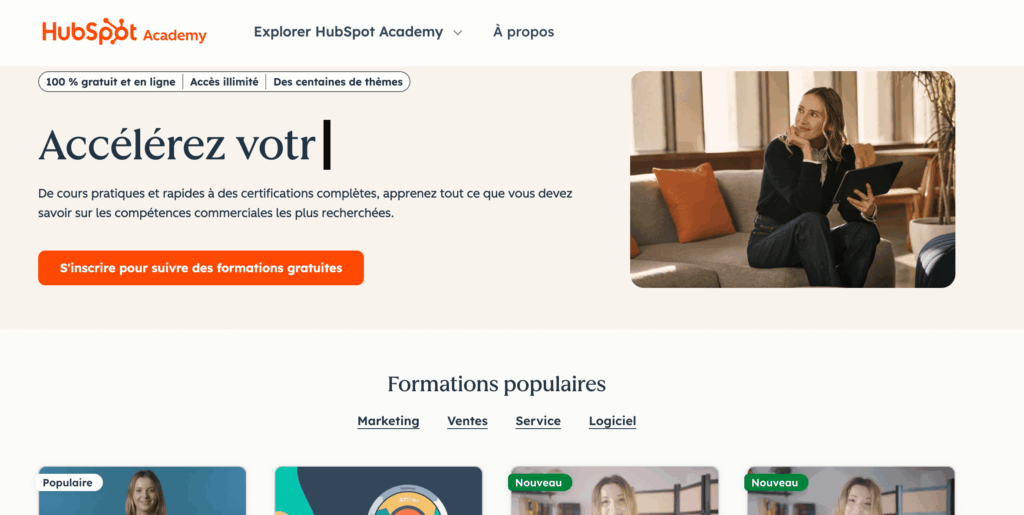
- As for HubSpot, the experience is “local”. The platform is fully translated into French. Customer support is available in French (chat, email, telephone on higher levels). There’s a dense network of French-speaking partner agencies capable of configuring, training and supporting you. Documentation, HubSpot Academy and training content are all available in French. If you need an integrator to structure your HubSpot CRM, you’ll find one in a matter of days.
- ActiveCampaign sideThe tool is designed for the English-speaking market. The interface offers partial French translation, but support is in English only (with automatic translation on the chat). There are virtually no ActiveCampaign partner agencies in France. If you need help configuring your automations, you’ll be on your own or dependent on specialized freelancers. Training resources (webinars, tutorials, community) are almost exclusively in English.
#5 Where will you be in two years?
You don’t change a marketing automation tool every six months. Workflows, integrations, historical data: all this creates inertia. The question of scalability therefore deserves to be asked before making a choice.
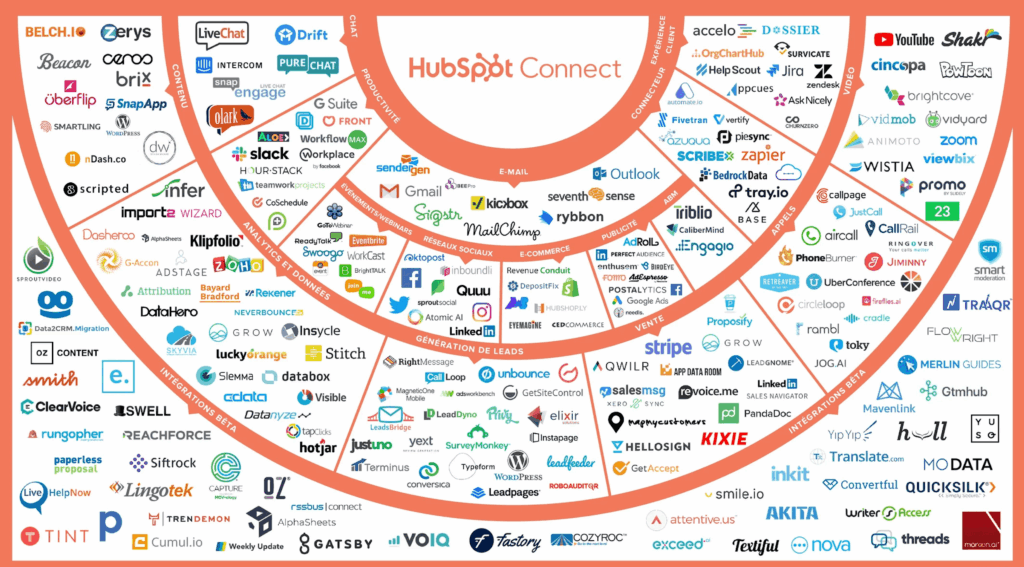
- HubSpot scale in width. Today you start with the free CRM and Marketing Hub Starter. In six months, you’ll add the Sales Hub to structure your pipeline. The following year, the Service Hub for your customer support. Then Content Hub for your website. Everything stays in a single system, with a single database, a single reporting system and workflows that cross all the Hubs. This is the strength of the platform model: each added brick reinforces the others. TheApp Marketplace (2,000+ integrations) ensures that HubSpot fits into any existing stack.
- ActiveCampaign scale in depth. The tool excels when you want increasingly sophisticated automations: complex conditional branches, advanced behavioral scoring, email/SMS/WhatsApp orchestration in a single workflow. But if tomorrow you need a robust sales CRM, structured customer service, CMS or organizational reporting, you’ll need to stack up other tools (Pipedrive or Salesforce for CRM, Zendesk for support, a separate CMS) and integrate them with each other. Each added tool creates fragmentation and maintenance costs.
A practical point to keep in mind: leaving HubSpot is costly (lots of data, workflows, integrations to migrate). But it’s also a sign that the tool has become central to your operations, which is precisely the objective. Leaving ActiveCampaign is technically simpler, but you lose your automations and their history, and rebuilding complex workflows on another tool takes time.
If you’re planning growth that will involve a structured sales team, managerial reporting and marketing-sales-service alignment, the HubSpot platform is the best long-term investment. The tool grows with you without fragmentation. If your growth is primarily driven by digital marketing and your organization remains lean, ActiveCampaign will serve you well for a long time, but keep in mind that one day, you may need a more robust CRM.
HubSpot vs ActiveCampaign: what customers say
| Platform | HubSpot | ActiveCampaign |
|---|---|---|
|
G2
|
4.4/5 (14,500+ reviews) | 4.4/5 (14,500+ reviews) |
|
Capterra
|
4.5/5 (6,200+ reviews) | 4.6/5 (2,550+ reviews) |
The scores are almost identical. The difference can be seen in the comments.
What HubSpot users emphasize most is the integrated ecosystem and CRM. The ability to follow a contact from the first advertising click to contract renewal in a single system is a decisive advantage, as is the quality of the Dashboard Reporting.
The recurring complaint is the price: the term “all-in-one tax” is frequently used, as is the idea that the completeness of the HubSpot platform comes at a high price. Rigid contracts and the difficulty of downgrading are also mentioned.
ActiveCampaign users highlight the depth of automation and flexibility of workflows. The ability to connect campaigns, segmentation and CRM actions in coordinated paths that “run themselves” is the most frequent compliment.
Criticisms include the learning curve (the tool is powerful, but takes time to master), successive price hikes in recent years, and the billing of all contacts (including inactive ones) since the end of 2025.
What’s revealing is the nature of the criticism. HubSpot is criticized for being expensive. ActiveCampaign is criticized for being too simple. In both cases, users recognize the quality of the tool on its own ground: HubSpot for its CRM and integrated platform, ActiveCampaign for its automation. The choice comes down to question #1: is your priority CRM or automation?
Salesdorado verdict: HubSpot or ActiveCampaign?
Having looked at both tools in depth, our conviction is clear.
For the typical Salesdorado reader (a French B2B SME structuring its sales growth) HubSpot CRM is the best place to start. The free CRM is unbeatable. The French-speaking ecosystem (support, agencies, training) is a real operational comfort. What’s more, the HubSpot platform has the rare quality of growing with you: from free CRM to Marketing Hub Starter, then to Pro when your maturity justifies it, then to Sales and Service Hubs as your teams become more structured. Everything stays in a single system. It’s an investment, not an expense.
ActiveCampaign is a remarkable tool that deserves its reputation. If your business is marketing-led (e-commerce, infoproducts, SaaS in PLG), if behavioral automation is your primary growth lever, if deliverability is critical and if you’re comfortable with an English-language tool without a local ecosystem: this is an excellent choice, probably the best on the market in its segment.
But to build a structured B2B business where marketing, sales and customer service work on the same data, the HubSpot platform has no equivalent.
Start with HubSpot’s free CRM. Structure your pipeline, centralize your contacts, test forms and email marketing. When your business justifies it, upgrade to Marketing Hub Starter and then Pro. This is the surest route to data-driven growth.