

- Get started right away
- Comprehensive Telemarketing
- Integrated Quotes and Invoices
Our review of noCRM
noCRM est un logiciel de prospection commerciale pensé pour les équipes qui vendent au téléphone. Fichiers de prospection, scripts d'appel, pipeline visuel et devis, l'outil couvre le cycle de vente sans la lourdeur de saisie des CRM traditionnels.
Last updated on
16
mn
My opinion
Customer reviews
- No AI features
- No marketing features
- Not well suited for ABM
Ideal for teams that make cold calls
From 22€ per user
15-day free trial


Sommaire
noCRM was built on a single value proposition: simplicity. Not feature-richness, not analytical power—simplicity. It has been at the heart of the software since 2014; it explains its name; and it’s also why you’ll still find no artificial intelligence features in it, even though all of its competitors make that their main selling point.
The trade-off is clear: no marketing, no scoring, and no data enrichment. You’ll need a second tool.
Acquired by the Positive Group in September 2023, noCRM has since updated its interface. We wanted to see what this integration had actually changed, and the initial response is reassuring: the three-part menu—Leads, Opportunities, and Customers—is still there, exactly where it should be.
So what has changed? Does the tool still live up to its promise? And who is its target audience today?
Don’t wait any longer—check out our full review of noCRM.
Sommaire
Our Review of noCRM at a Glance
| Perimeter | Score | Our opinion |
|---|---|---|
| Overall rating | 4,4 | noCRM remains one of the most effective tools on the market for teams that are actively prospecting. The product has expanded significantly since our last review, without sacrificing any of its speed. |
| Ease of use | 4,8 | That’s still its biggest strength. The account is up and running in just a few minutes, no prior setup is required, and the interface never shows you more than what you need at that moment. |
| Telephone prospecting | 4,7 | Prospecting lists, call script generators, call campaigns, and telephony integrations form a complete workflow. This is now the tool’s true specialty, and few general-purpose competitors venture into this area. |
| Functional scope | 4,2 | Quotes, invoices, customer files, and post-sales tasks are now included. The tool now covers the entire cycle through to invoicing. However, it does not include any AI features, which is consistent with its philosophy. |
| Team Leadership | 4,1 | The team features are well-designed, particularly the activity goals, which allow you to focus on actions rather than results. They center on the Dream plan, which should be factored into your budget if you’re working with others. |
| Quality-price ratio | 4,1 | Excellent for a freelancer on the Expert plan. Decent for a team on the Dream plan, provided you agree to the annual commitment—the discount on which decreases as you move up to higher tiers. |
Try noCRM for free at
. noCRM offers a 15-day free trial with no credit card required. If you add your payment information, the trial is extended to 30 days. At the end of the trial, your account is paused rather than deleted, so you can return to it later.
. noCRM offers a 15-day free trial with no credit card required. If you add your payment information, the trial is extended to 30 days. At the end of the trial, your account is paused rather than deleted, so you can return to it later.
The Anti-CRM, Twelve Years Later
The product’s original name said it all: “You Don’t Need A CRM.” It remained the website address for years.
This story is worth telling because it explains the product. Sunny Paris and Güven Urganci founded the company in 2013 and launched the tool in early 2014. Before that, they were selling Yoolink, their enterprise social network, using a traditional CRM system. The conclusion they drew was stark: the tool took up a considerable amount of their time for data entry and didn’t help them win business.
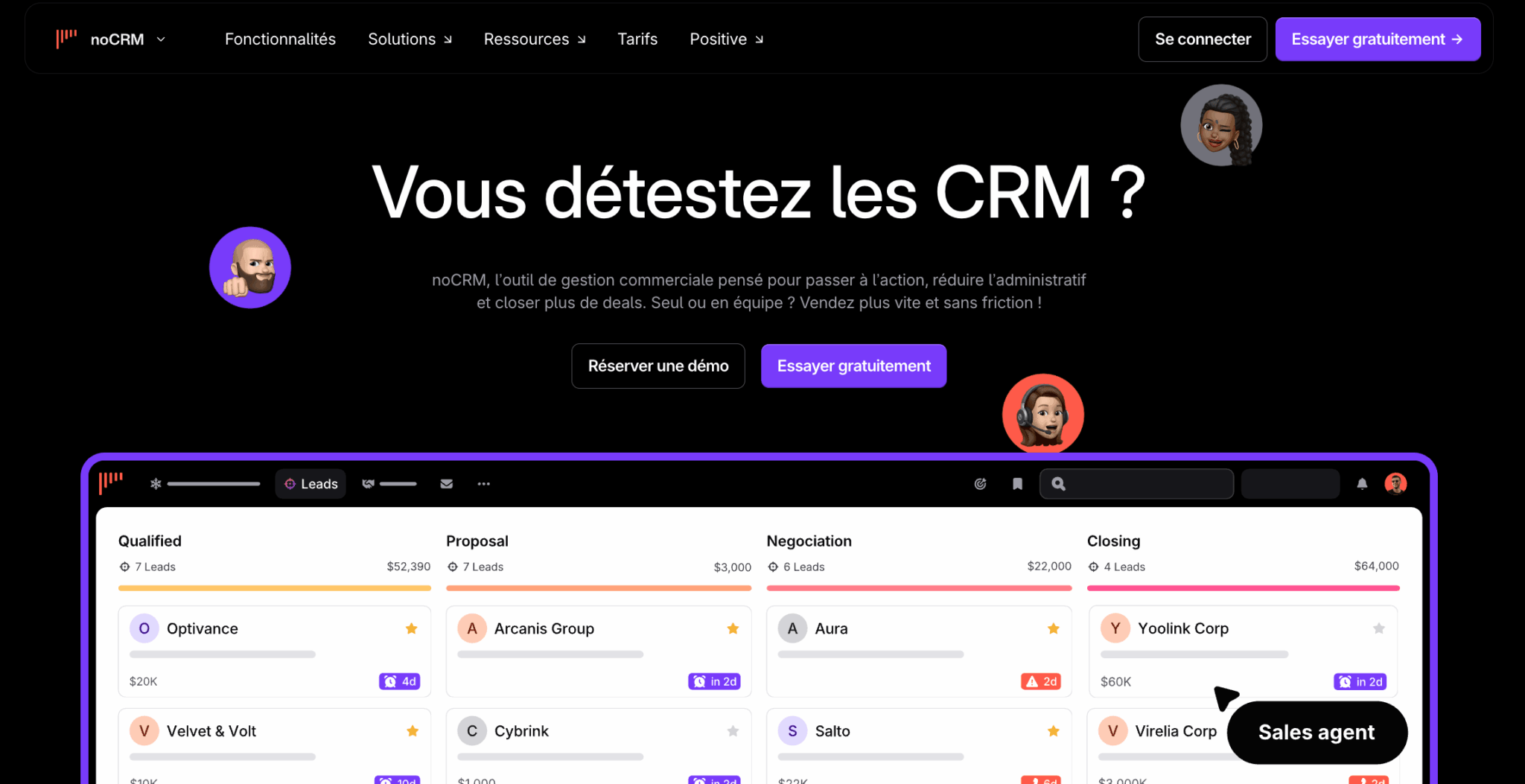
Hence our stance—one we’ve championed for twelve years—in opposition to CRM systems that slow down salespeople.
A detail that is rarely mentioned, yet telling: noCRM has grown over the past ten years without raising a single euro. It has opened offices in New York, Milan, and Berlin, translated its app into seven languages, and established a presence in more than eighty countries—all using its own capital.
Then, in September 2023, the company was acquired by the Positive Group, a Lille-based software publisher that had just raised 110 million euros.
How the acquisition Has Changed Things
It’s mostly just a facelift. The brand is now called Positive noCRM, the legal entity is now known as Positive Group France, and the headquarters has moved from Paris to Hem, in the Lille metropolitan area, to the group’s address.
The plans have been renamed—several times, in fact. Expert and Dream subscribers also enjoy cross-promotional discounts on other products in the Positive family.
What Hasn’t Changed
The product itself—and that’s the good news. noCRM hasn’t been merged, restricted, or turned into a module of a larger suite.
The interface has indeed been refreshed, with a dark navigation bar and screens that are more spacious than before. But the architecture hasn’t changed one bit. The three-part menu—Prospects, Opportunities, and Customers—still organizes the tool in the same way, and long-time users can find their way around in just a few seconds.
noCRM is not included in the Positive Suite commercial bundle, which comprises four other solutions from the group, and it has not (yet) been equipped with Uma, the AI assistant that the publisher is rolling out everywhere else, notably in Positive User (formerly Sarbacane).
So it’s kept separate from the group’s strategy. For a tool whose appeal lies in avoiding feature overload, that’s actually quite reassuring.
The question noCRM asks you before any others
Creating an account takes just two screens. The second screen does not ask for your industry, the size of your company, or your average sales cycle.
He asks how you get in touch with your prospects.
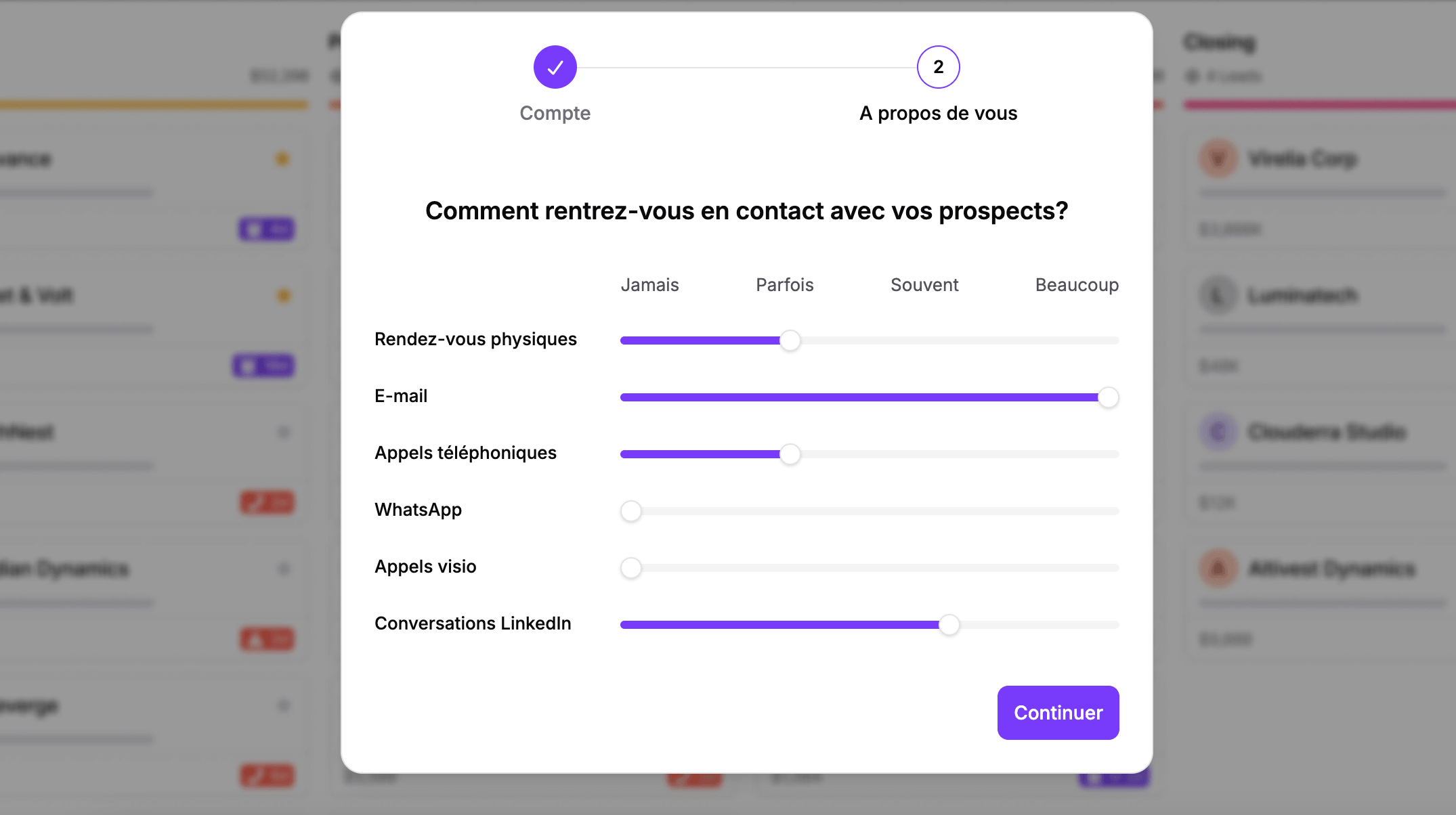
Six sliders to rate on a scale from “never” to “a lot”: in-person meetings, emails, phone calls, WhatsApp, video calls, and LinkedIn conversations. The tool is configured based on this response.
You’ll then see an empty pipeline, with just one invitation on the screen.
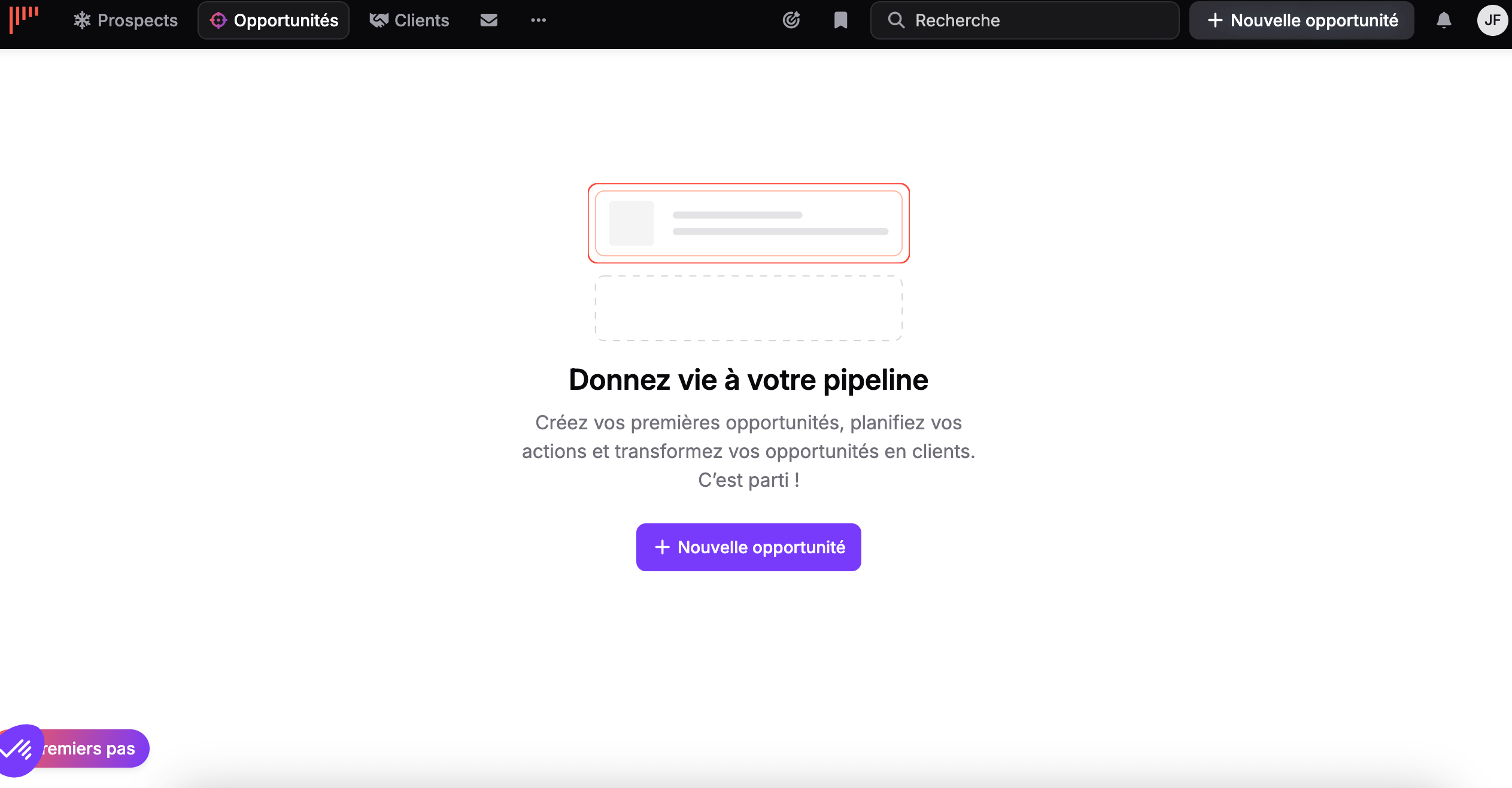
No dashboard to set up, no fields to create, no 15-step wizard. Just one button.
Salesdorado’s review
This onboarding screen is worth more than any sales pitch. Software that asks for your contact channel rather than your industry isn’t a customer data management tool. It’s a sales execution tool, and that’s the perspective you need to keep in mind going forward.
This onboarding screen is worth more than any sales pitch. Software that asks for your contact channel rather than your industry isn’t a customer data management tool. It’s a sales execution tool, and that’s the perspective you need to keep in mind going forward.
Step 1: The Prospecting File
This is the first building block. At noCRM, it is intentionally separated from the pipeline.
A prospecting file is a list of cold contacts that you’ll qualify before deciding whether they’re worth adding to your sales funnel. There are two ways to create one:
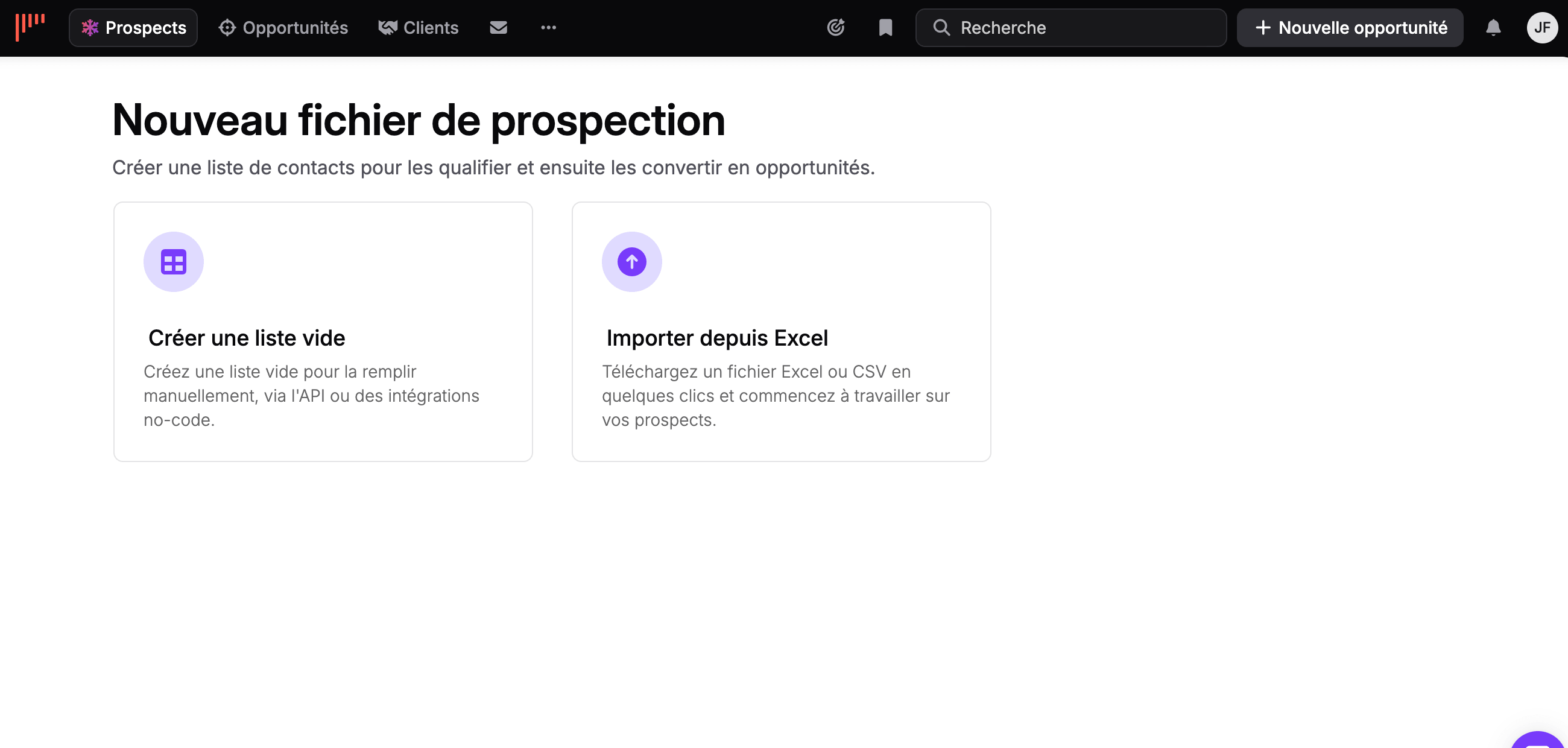
The empty list can be populated manually, via the API, or through no-code integrations. Importing from Excel or CSV covers the most common scenario.
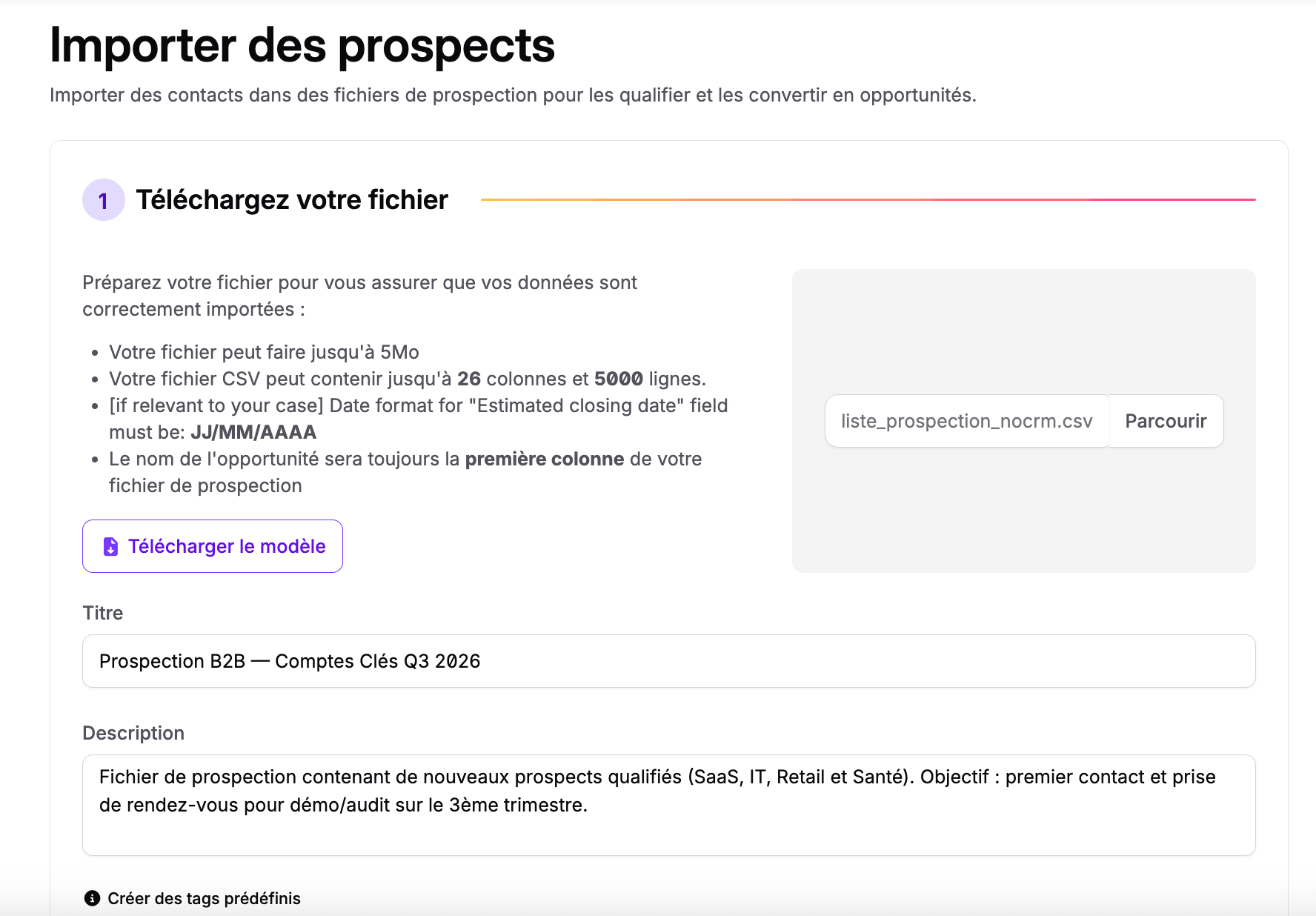
The import screen clearly states its limitations, which helps avoid unpleasant surprises: 5 MB per file, 26 columns, and a maximum of 5,000 rows. A template is available for download, and the first column is always set to the opportunity name.
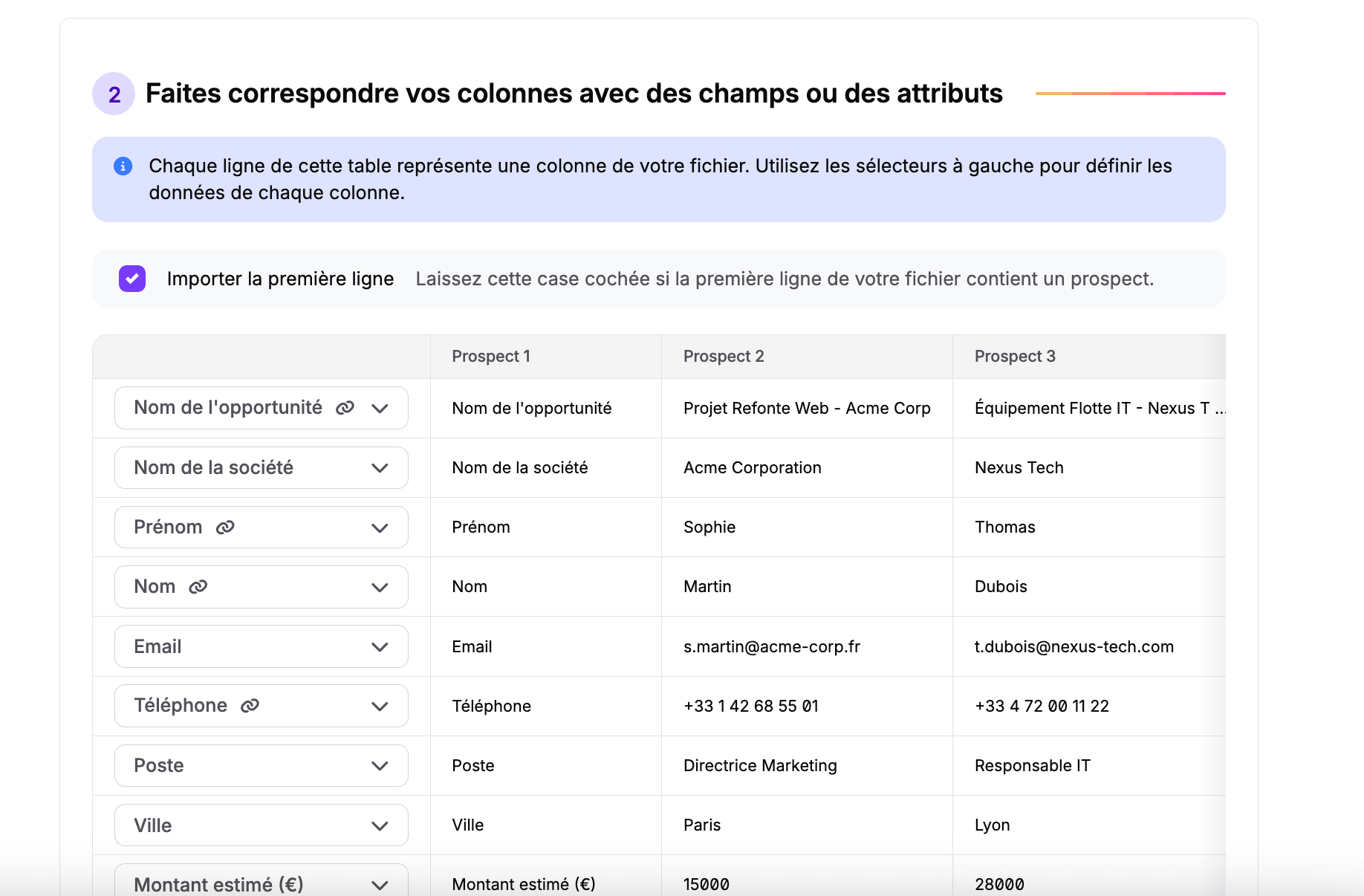
Next comes the process of mapping the columns, with a preview of the first three leads to verify that nothing is misaligned.
The result is a spreadsheet. It embraces that role, and that’s exactly what makes it work.
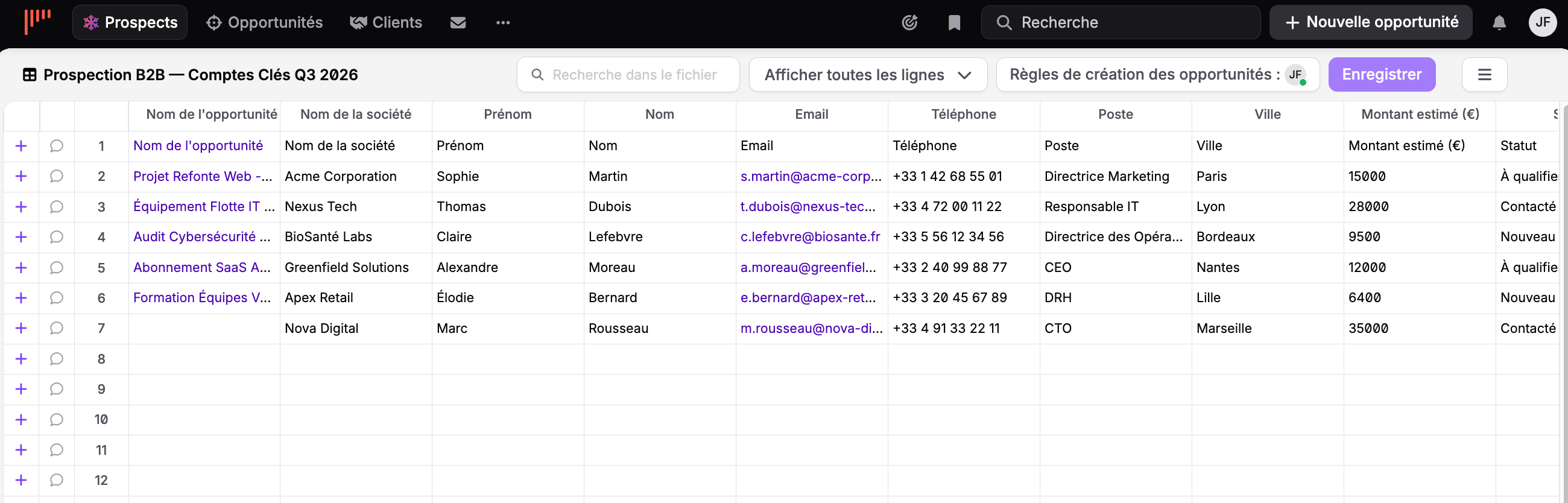
Each row has its own status, such as “New,” “To Qualify,” or “Contacted.” You can search the file, filter it, and add comments line by line. A discreet button at the top of the screen is worth noting: the opportunity creation rules, which determine how a qualified lead moves through the pipeline and to whom it is assigned.
It’s like an Excel file—only much better and without the versioning issues that all teams still working this way face.
The Call Center: Scripts, Campaigns, and Telephony
This is what noCRM has quietly built—and it’s what truly sets it apart today. Kanban no longer sets anyone apart. The call queue does.
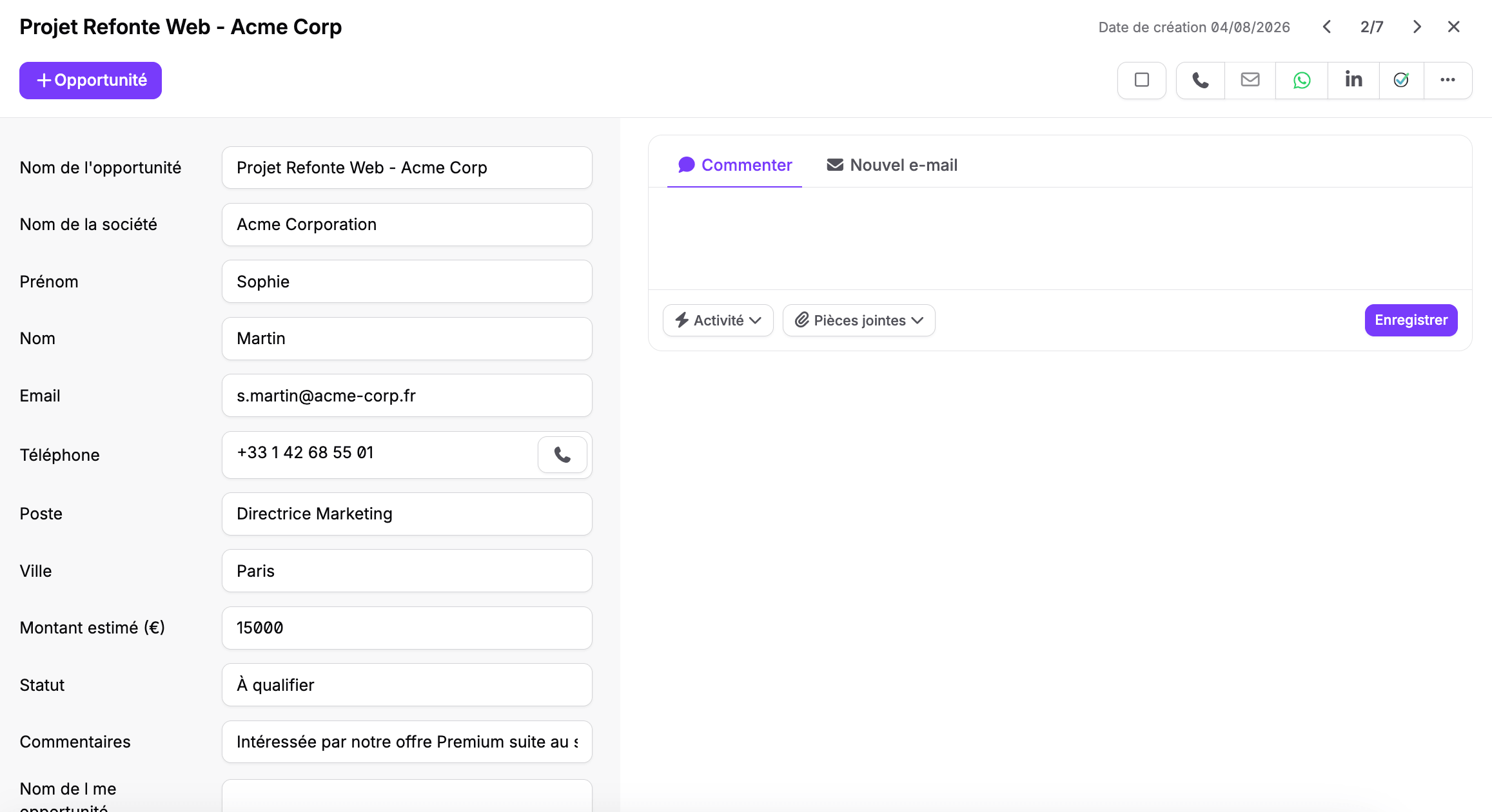
Look at the counter in the upper right corner of the contact card. Two out of seven, with arrows. You’re moving from one prospect to the next without ever having to go back to the list. For someone who makes sixty calls a day, this detail is worth more than ten features.
The action bar provides access to the phone, email, WhatsApp, and LinkedIn. The “Opportunity” button converts a qualified lead into a pipeline entry.
The Call Script Generator
You build your script by dragging and dropping blocks, either from scratch or using industry-specific templates covering B2B, real estate, insurance, and web and media agencies.
The script is then displayed in the prospect’s profile during the call, along with the qualifying questions to ask. Responses are entered as the conversation progresses.
It’s worth noting that the tool is free and accessible even without a noCRM account. However, it is not available on mobile devices. To help you create your templates, our sample sales scripts will save you time.
Call campaigns
Exclusive to the Dream plan, these features distribute leads one by one from a prospecting database to your agents, based on filters and calling rules. Sales representatives no longer choose who to call; they receive their assigned queue.
This is how telemarketing and lead generation teams operate. Few tools in this category offer this feature.
Telephony
noCRM doesn’t provide the phone line; it connects to it. Integrations include CloudTalk, JustCall, Aircall, RingCentral, Ringover, and KrispCall.
With the Dream plan, you can make calls with a single click from the contact card, record conversations, and access summaries and transcripts. Note that these features are provided by the telecommunications partner, not by noCRM. Our review of Aircall details one of these solutions.
Step 2: The Opportunity
A qualified lead becomes an opportunity. The creation process fits on a single screen.
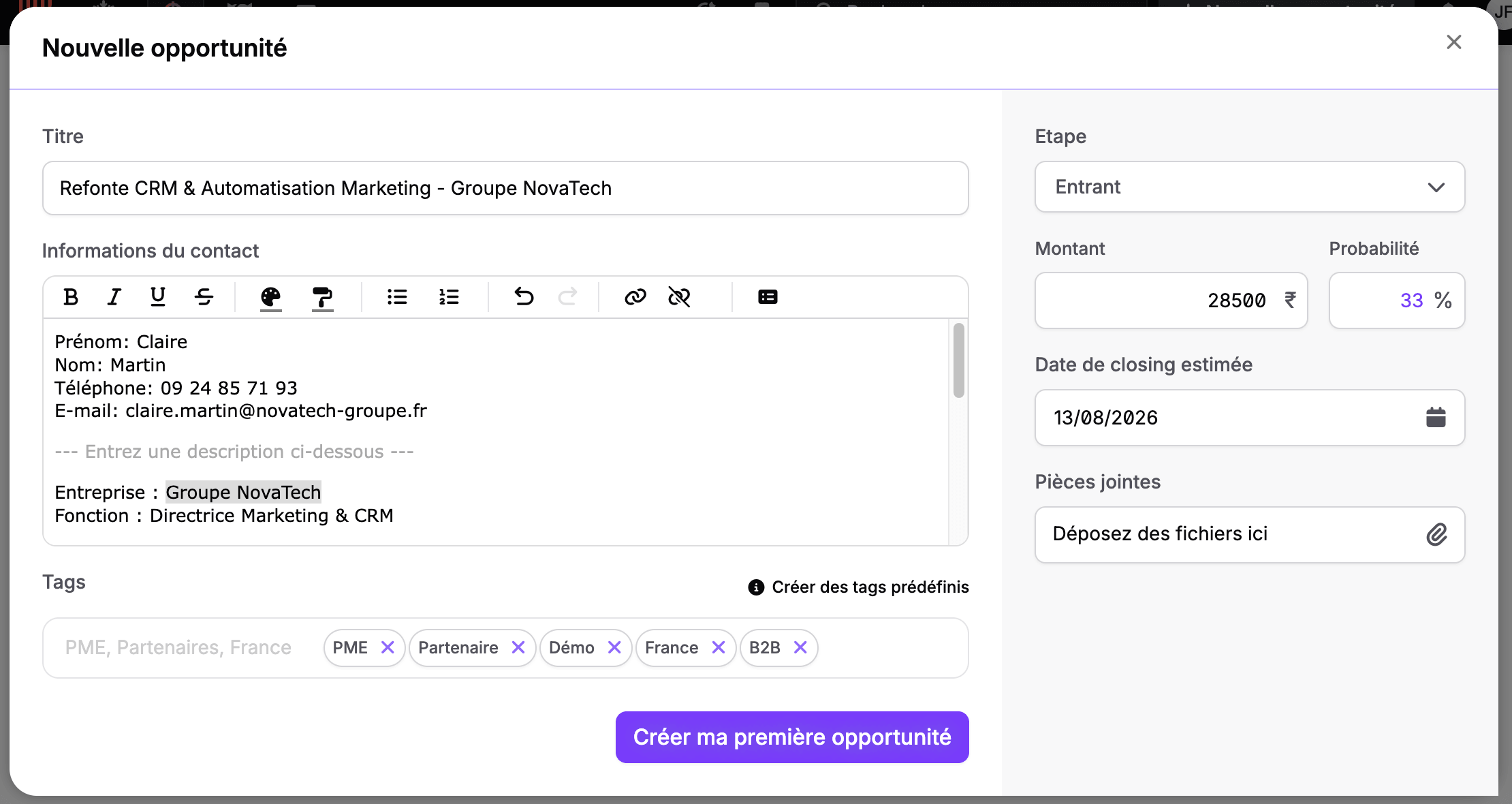
On the right, the project management data: tunnel phase, amount, probability, estimated closing date, and attachments. On the left, the title, tags, and contact information.
And this is where a design decision comes into play that you need to understand before choosing this tool. The contact information isn’t stored in structured fields; it’s a block of free-form text with a rich-text editor. You paste an email signature, format it if you feel like it, and move on to something else.
It’s incredibly fast to enter data. That’s also why you’ll never be able to segment your opportunities by contact role or company size. Structured fields exist at the prospecting file level, not at the opportunity level.
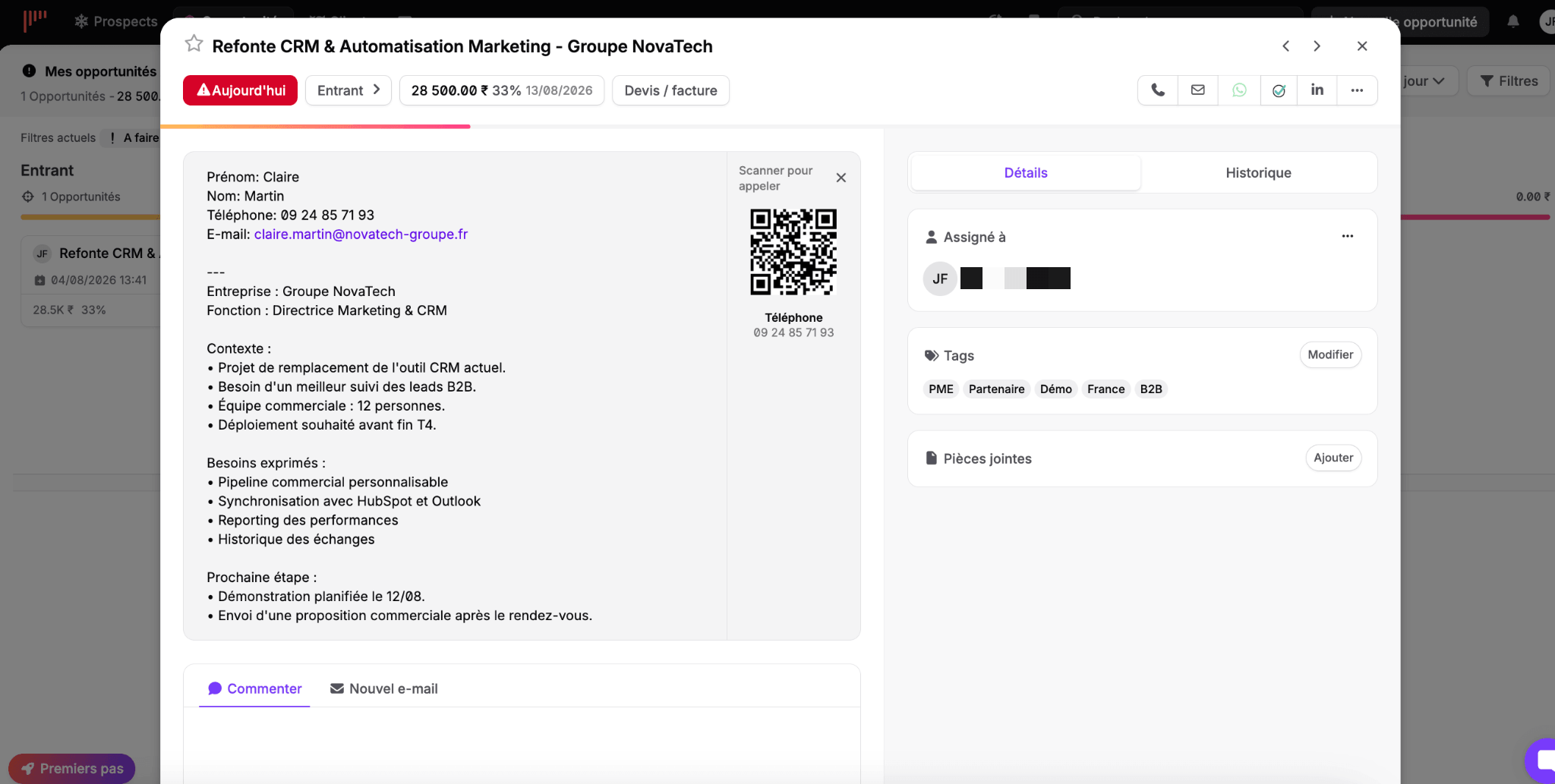
The created record brings together everything you need to move forward. The red due date badge stands out on the screen, even more prominently than the amount. A QR code lets you dial the number from your cell phone. The “Details” and “History” tabs separate the current status from past transactions, and a “Quote” or “Invoice” button is located in the middle of the header.
The downside of free-form text
: If your sales strategy relies on detailed analysis by segment, persona, or vertical, the lack of structured fields at the opportunity level will be a major obstacle. Be sure to check this during the trial period, before importing your database. This is a design decision, not a shortcoming that will be addressed in a future version.
: If your sales strategy relies on detailed analysis by segment, persona, or vertical, the lack of structured fields at the opportunity level will be a major obstacle. Be sure to check this during the trial period, before importing your database. This is a design decision, not a shortcoming that will be addressed in a future version.
Step 3: The Pipeline and the Next Step
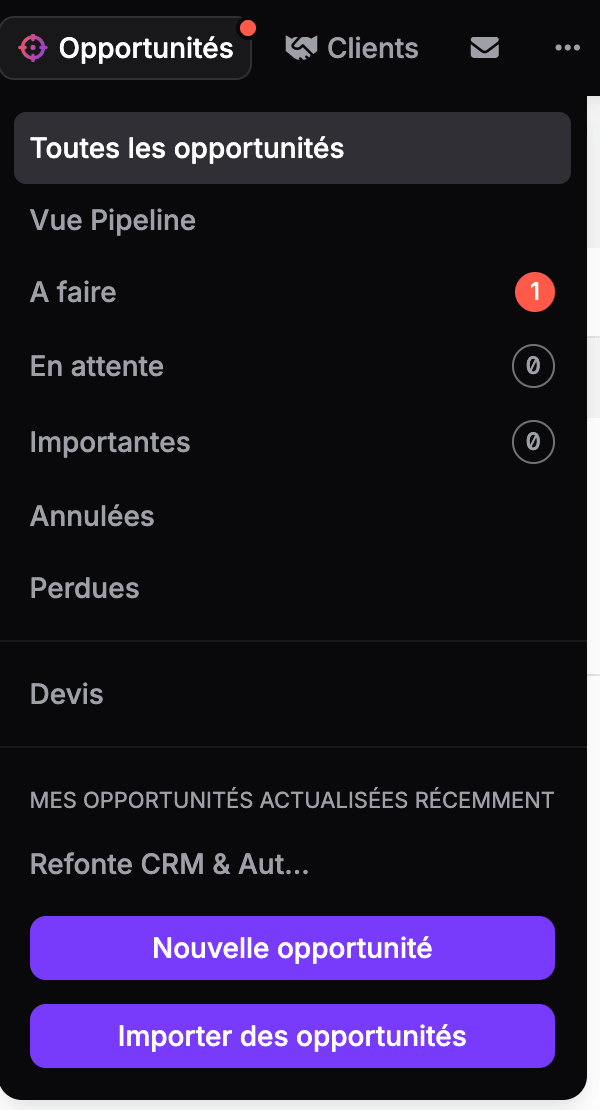
The Opportunities menu sets the tone. Even before the pipeline view, it lists action statuses.
To-do, pending, important, canceled, lost. With a red counter for items that require action today.
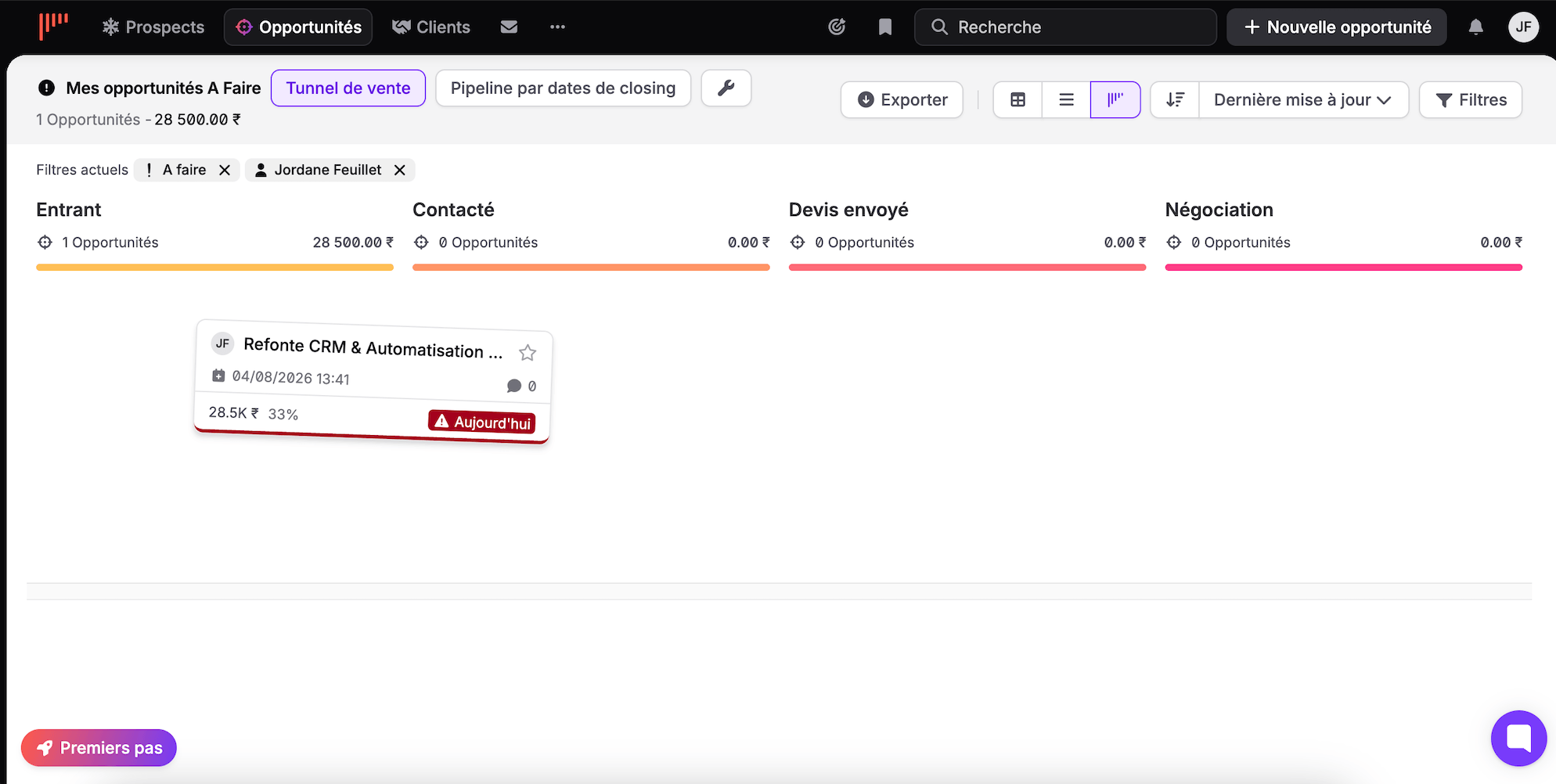
The sales funnel is based on the kanban principle, with customizable stages, a counter, and a cumulative total for each column. Each card displays its due date. Three view modes are available—table, list, and columns—and the entire dataset can be exported.
The second view is more interesting and much less common.
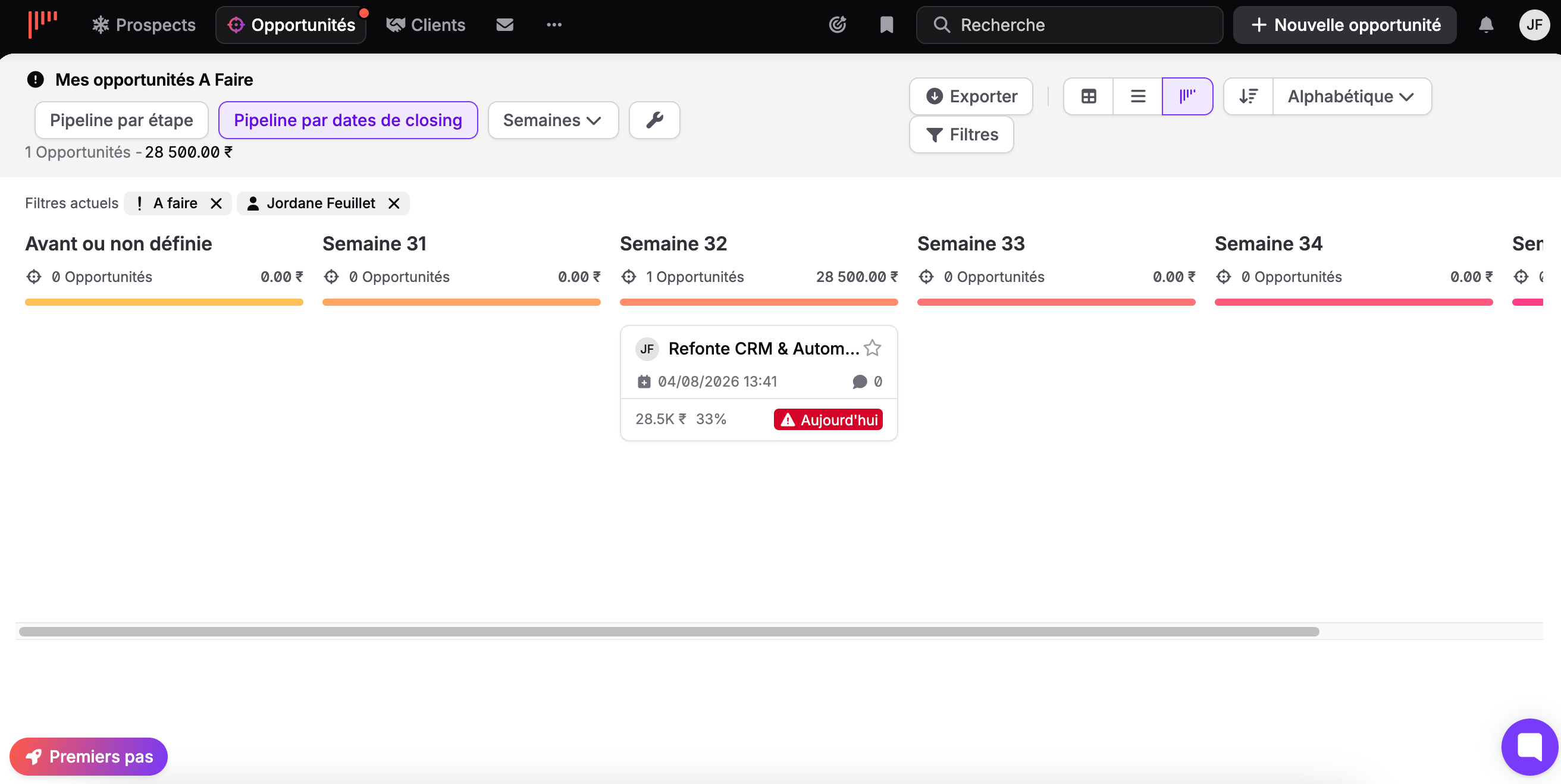
Here, the columns no longer represent stages but calendar weeks, with a first column for deals without a specific date. You’re no longer looking at the status of your deals; you’re looking at when they’re due. This makes it much easier to build a forecast or prepare a monthly update. Our sales pipeline guide explains this approach in detail.
The filters round out the set.
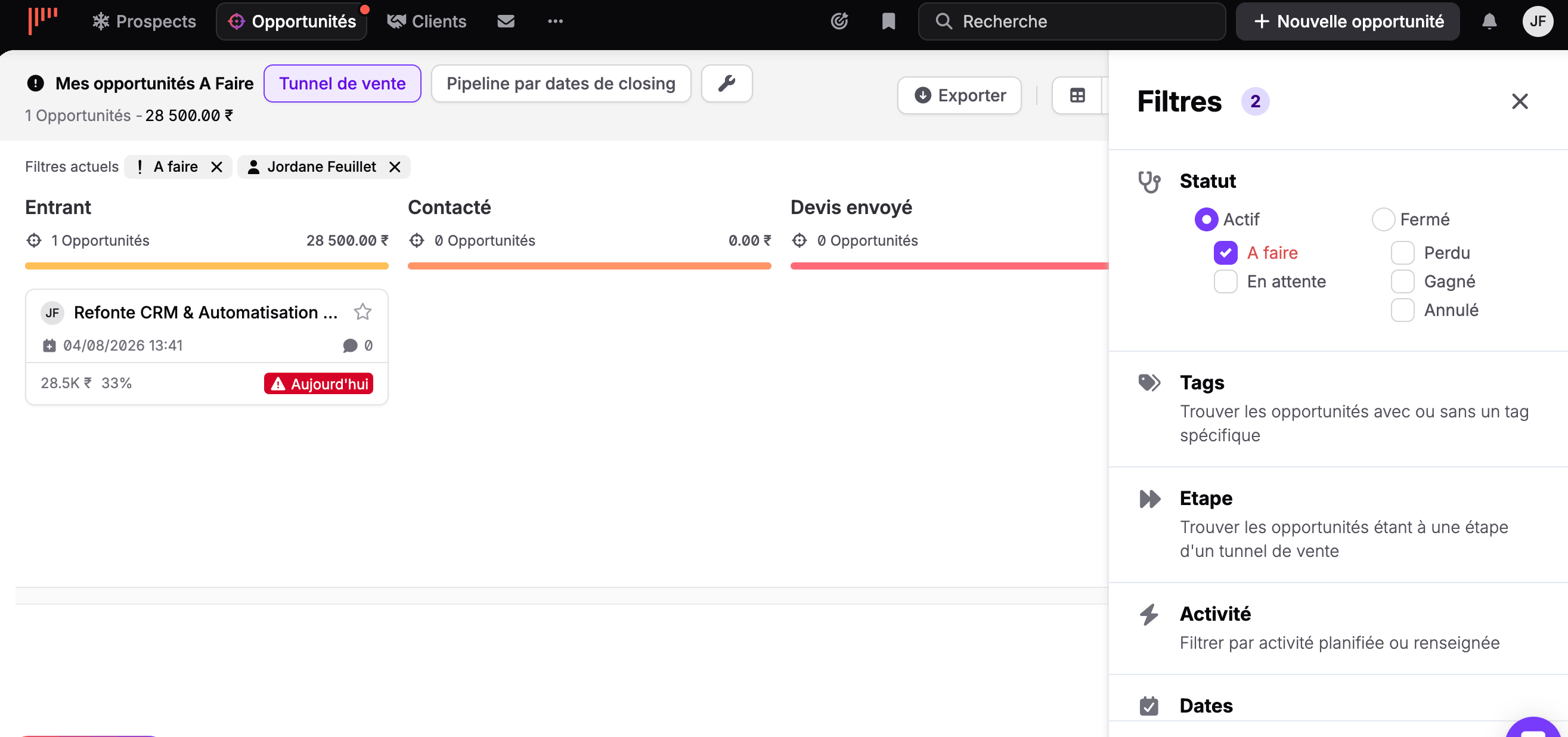
Status first, with the distinction between “active” and “closed,” followed by “to do,” “pending,” “won,” “lost,” and “canceled.” Next come the tags, the stage, the planned or entered activity, and the dates. Active filters remain displayed as dots above the pipeline, which prevents you from wondering why the total doesn’t add up.
See for yourself
Fifteen days are more than enough to evaluate noCRM’s usability. Import a real prospecting file—not a demo dataset—and see how long it takes you to process ten prospects.
Fifteen days are more than enough to evaluate noCRM’s usability. Import a real prospecting file—not a demo dataset—and see how long it takes you to process ten prospects.
The Morning Briefing, or Discipline as a System
If there were only one screen to highlight to understand noCRM’s philosophy, it would be the notifications screen.
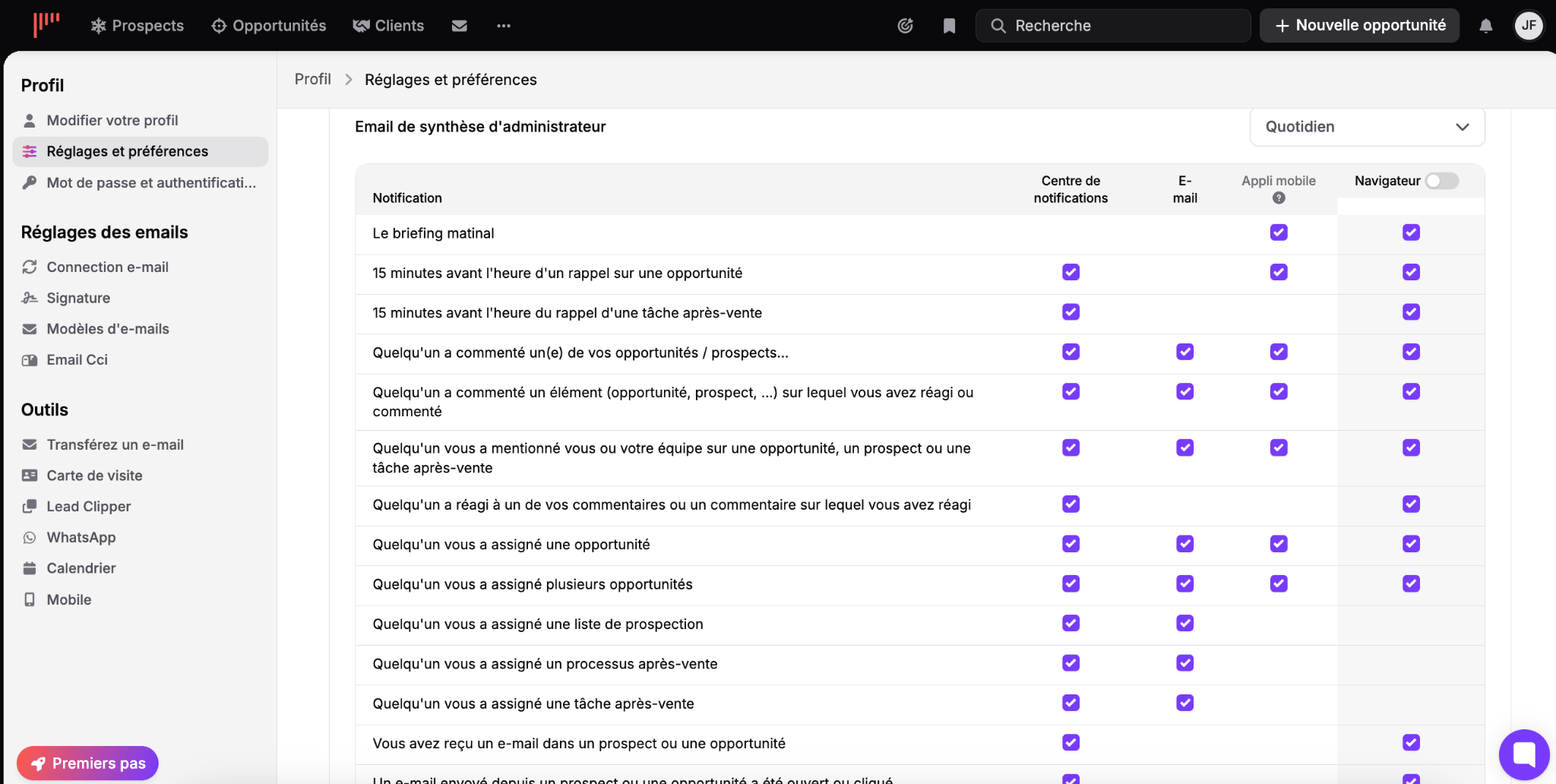
Fourteen types of events, each of which can be enabled independently across four channels: notification center, email, mobile app, and browser. Plus a daily summary email for the administrator.
And right at the top of the list, before the reminders and notes, is a line that sums up the entire product: the morning briefing.
Software that wakes you up with your list of calls for the day isn’t a customer relationship management tool. It’s a taskmaster.
The rest of the system follows the same logic:
- A reminder 15 minutes before an opportunity expires.
- A reminder 15 minutes before an after-sales service appointment.
- Notification when an email sent from a record is opened or clicked.
- Receive alerts for every assignment, whether it’s an opportunity, a prospecting list, or an after-sales process.
Added to this is a subtle but real layer of collaboration: comments, mentions of a person or team, and reactions.
Step 4: Quote, Invoice, and Customer File
This is what has changed the most since our last test. noCRM no longer stops at the signature.
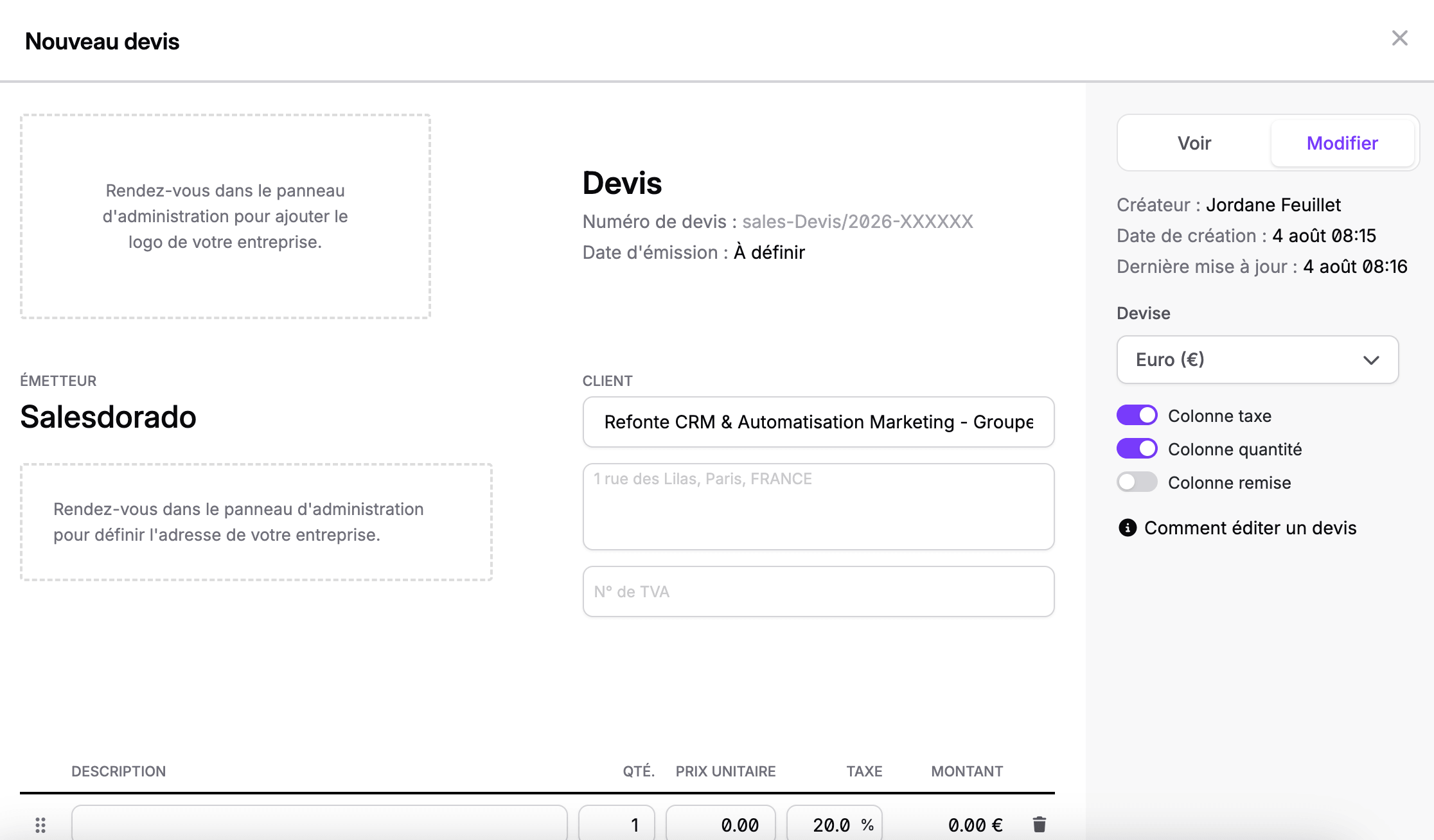
The quote is created directly from the opportunity header. It includes automatic numbering, sender and customer sections with VAT numbers, a currency selector, and columns that you can enable as needed depending on whether you’re invoicing with tax, quantity, or a discount.
The system covers quotes, invoices, down payments, and credit memos. A dashboard tracks statuses, and automated actions can be triggered based on a document’s status. If you’re looking to compare options, our free quoting software provides a good point of reference.
Above the opportunities, a third level emerged: the customer file.
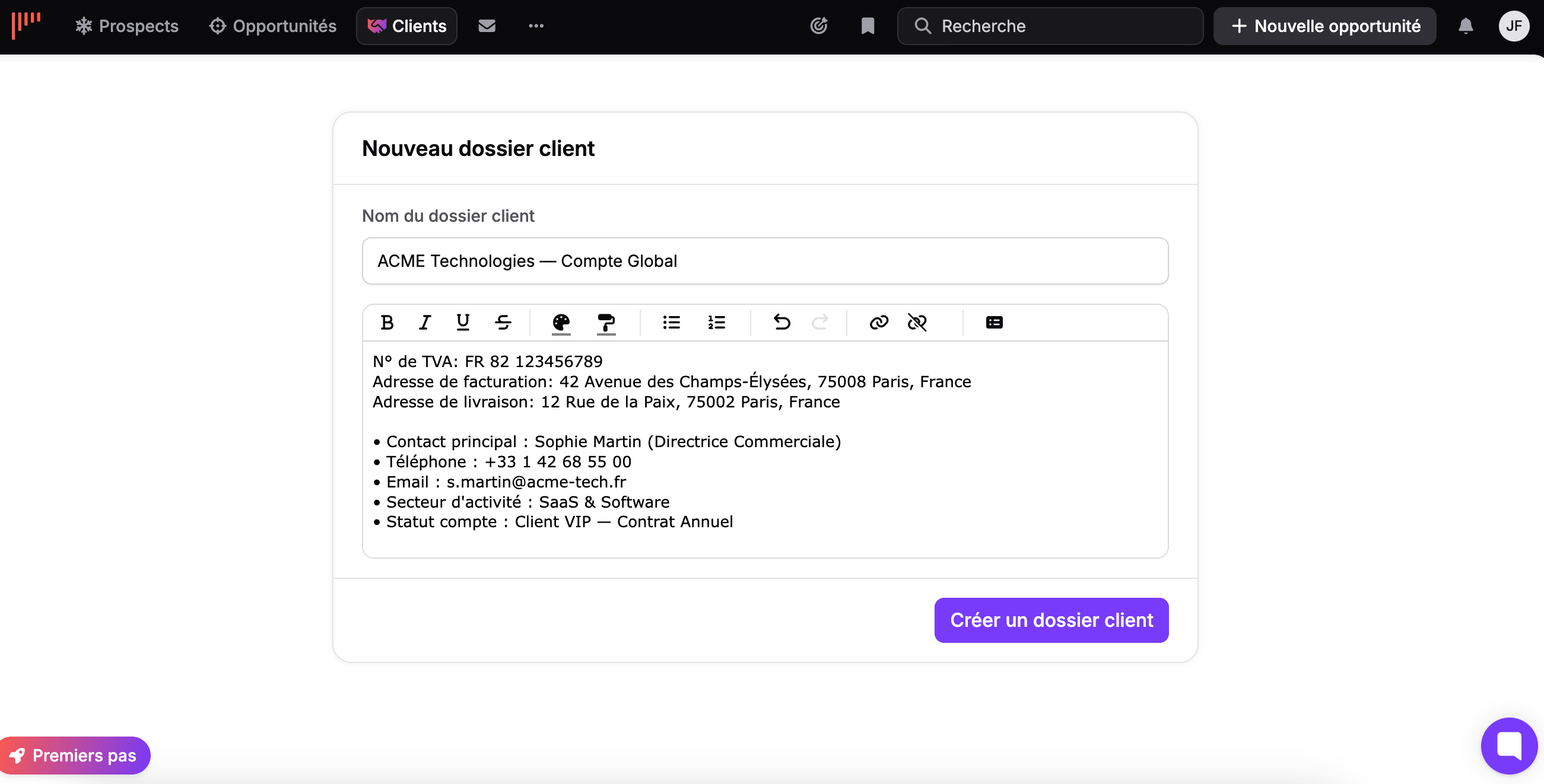
It groups several orders under a single account, including the VAT number, billing and shipping addresses, and the primary contact’s information.
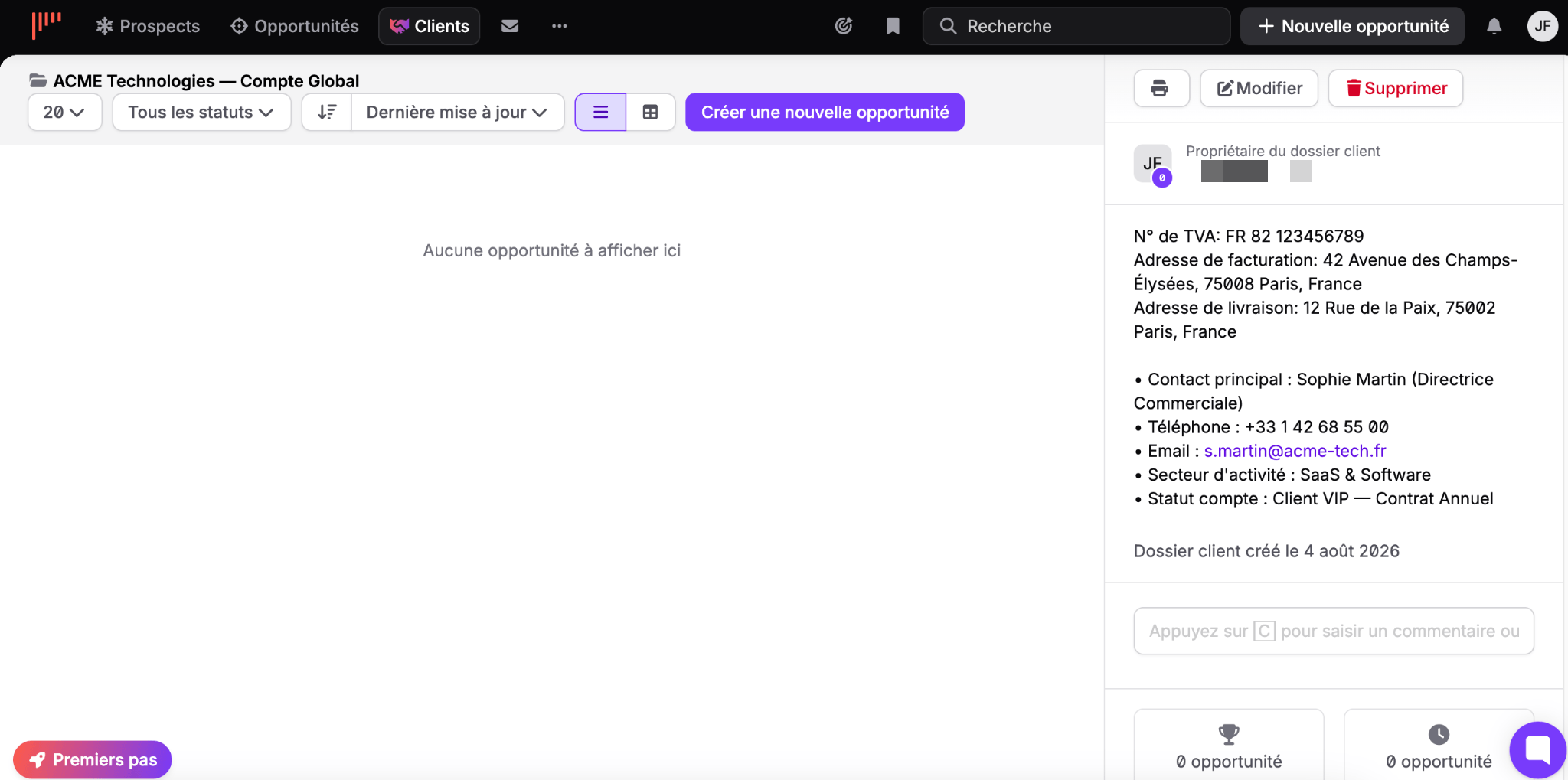
The view displays the folder owner, the counts of won and pending opportunities, and allows you to open a new deal without leaving the screen. For a company that makes multiple sales to the same customer, this is the missing piece.
Once again, the file’s content is a block of free-form text. It is consistent with the rest, with the same result.
Reporting: Ten Reports in Three Categories
We were expecting a brief section on statistics. It’s much more extensive than that.
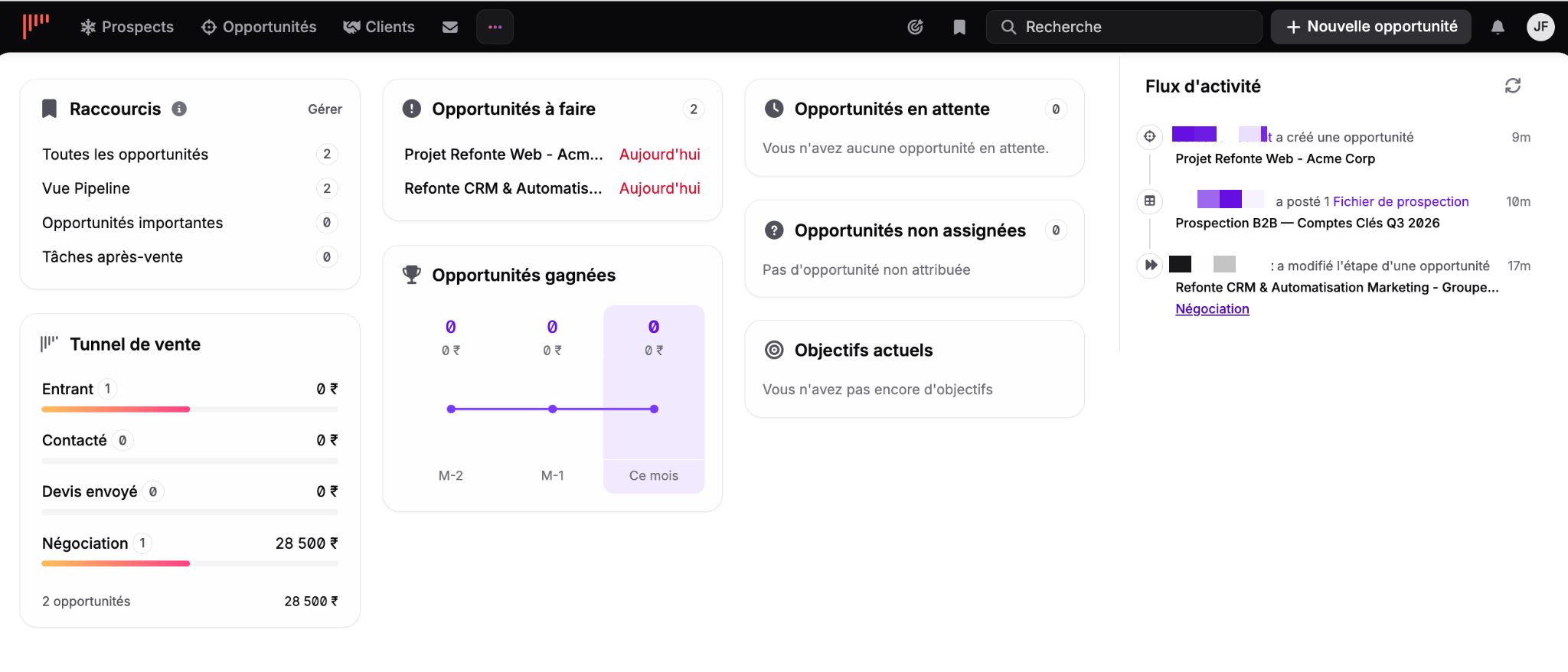
The dashboard fits on a single screen without scrolling. The sales pipeline is on the left, showing amounts by stage; upcoming opportunities are in the center, with their due dates highlighted in red; and the team’s activity feed is on the right.
There’s one widget managers should be aware of: unassigned opportunities. It’s the safety net that ensures no lead is left unassigned.
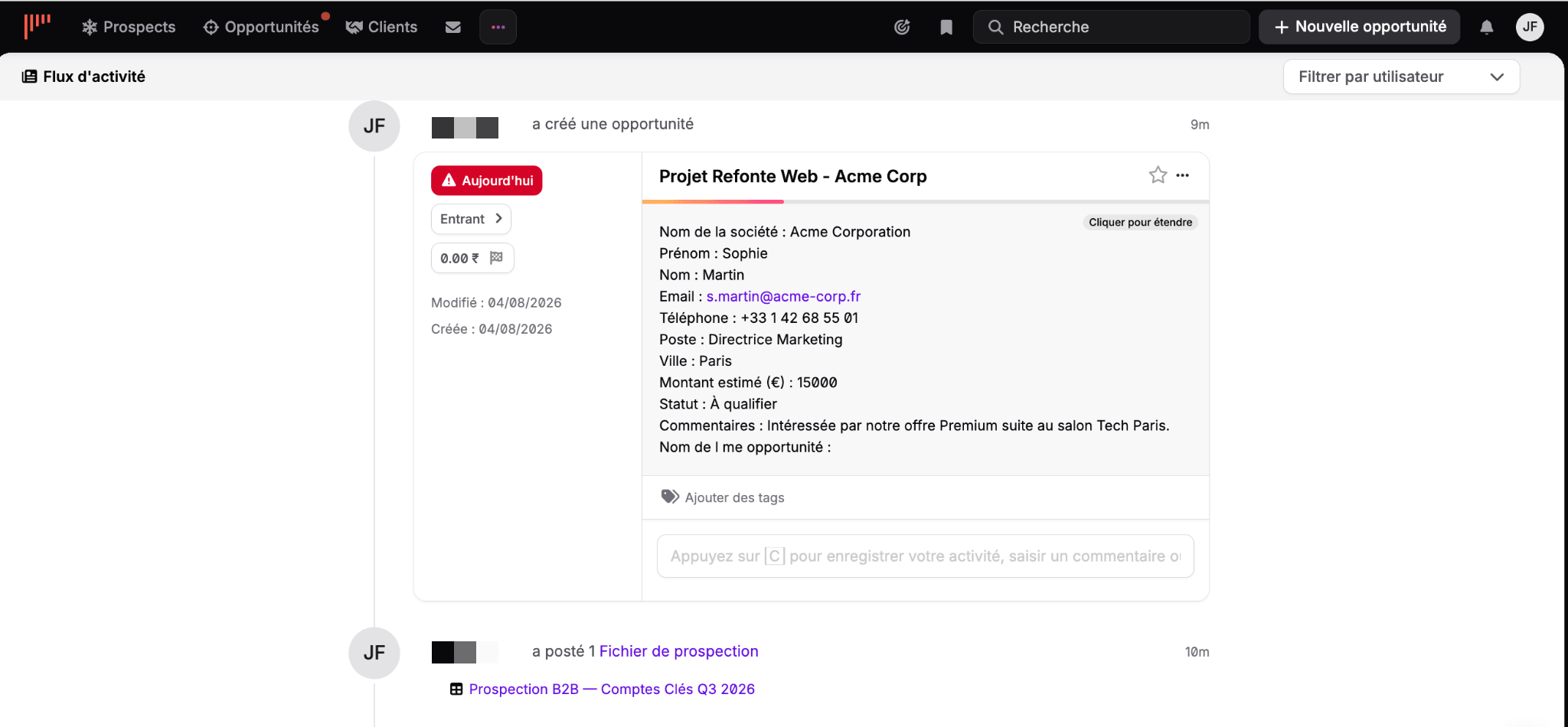
The activity feed is displayed in full-page view and can be filtered by user. Each action is time-stamped, and the card for the relevant item can be viewed directly.
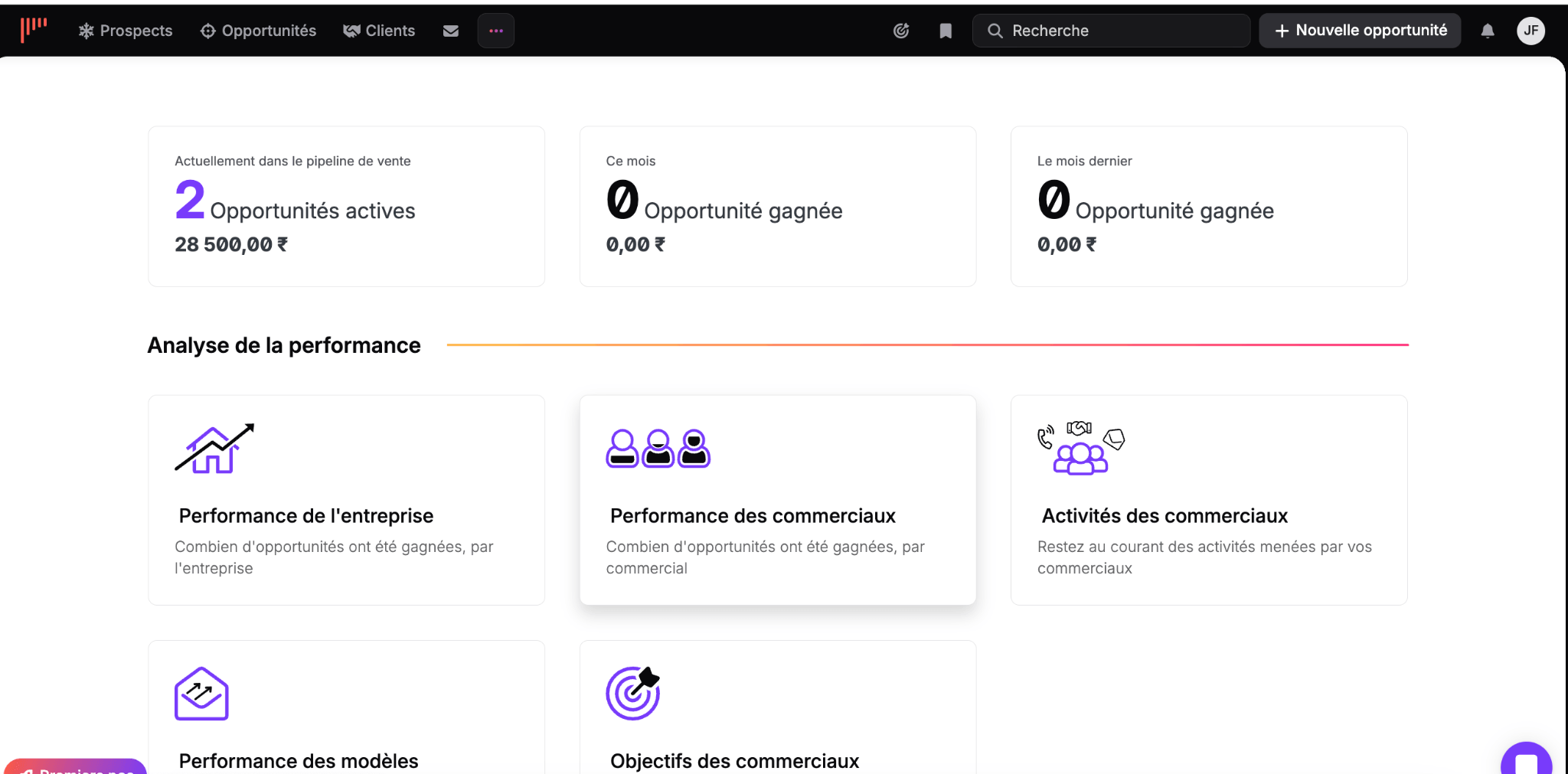
Statistics are divided into three categories:
- The performance analysis covers the company, the sales reps, their activities, their goals, and their email templates. This latest report is a pleasant surprise: it tells you which template converts best.
- The pipeline analysis covers active opportunities, pipeline performance, forecasts, and opportunity performance.
- Finally, the prospecting analysis measures the performance of each list.
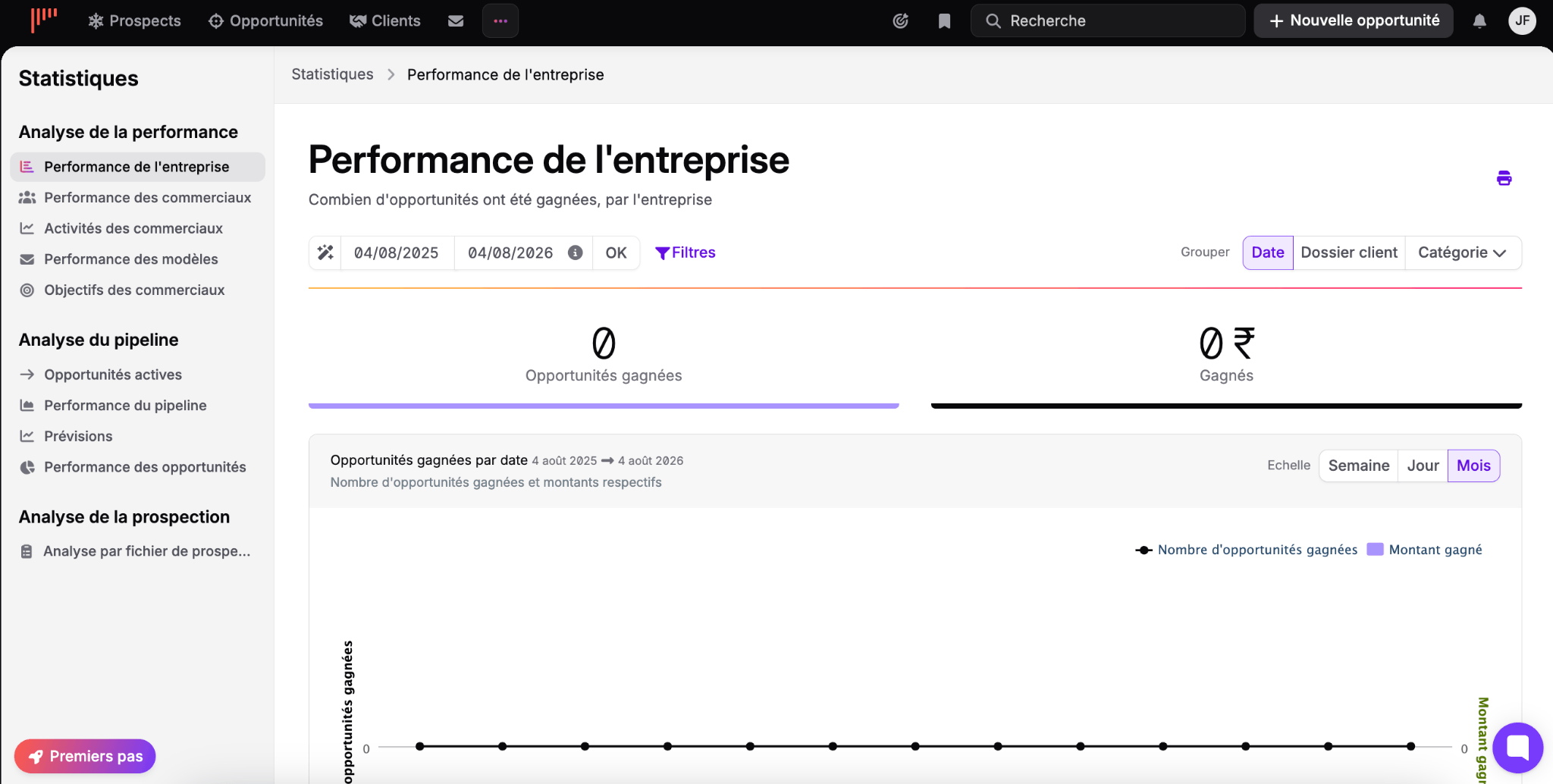
Each report can be filtered by a date range, grouped by date, client file, or category, and displayed on a daily, weekly, or monthly basis. Printing is supported, which is useful for executive committee meetings. Our sales reporting tools bring these functions back into the picture.
Related Tools and Integrations
noCRM automates almost nothing. There is one exception.
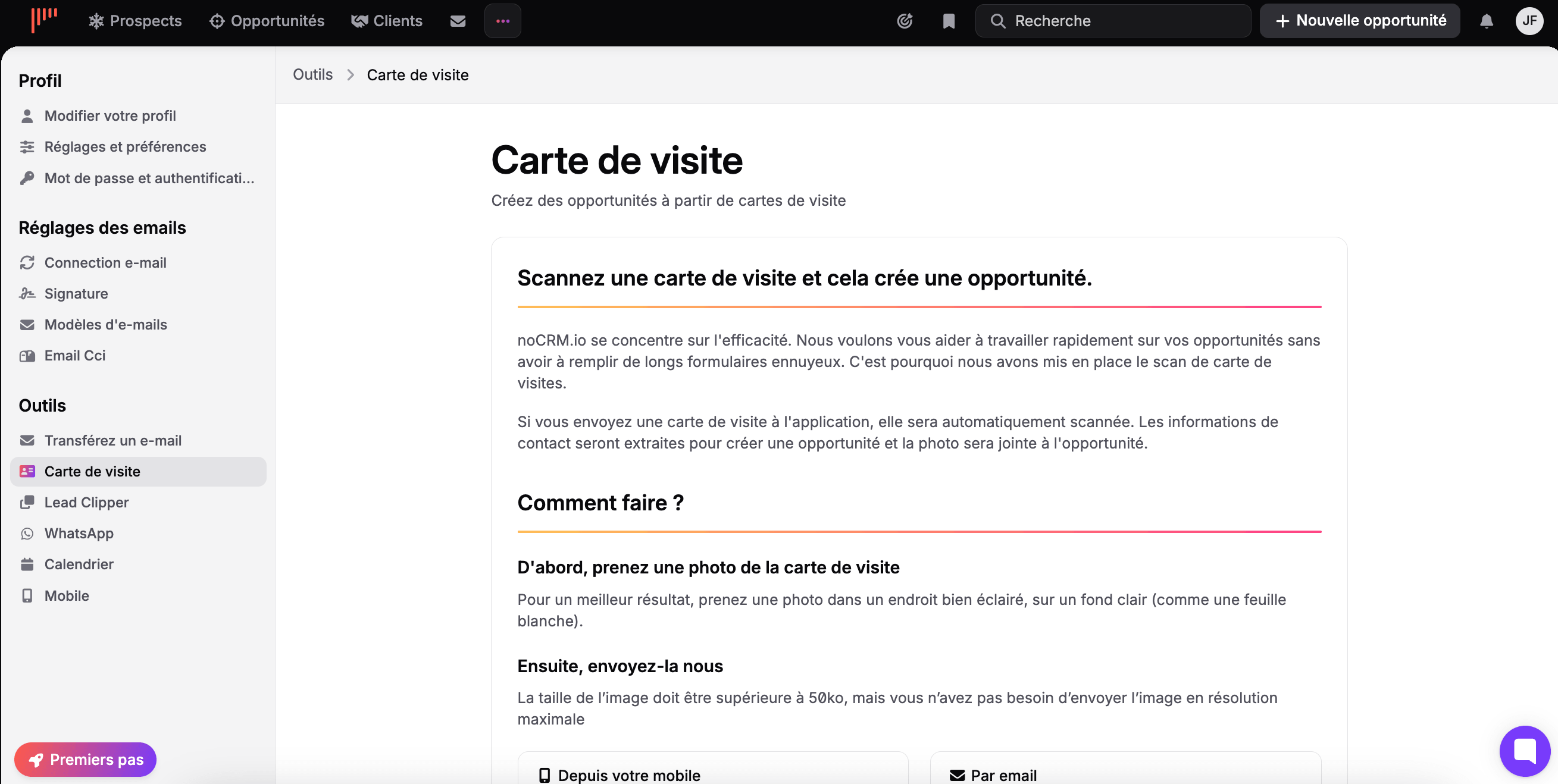
You take a photo of a business card, send it from your phone or via email, and the app extracts the contact information, creates the lead, and attaches the photo. The reason given by the developer is clear: to work quickly on leads without having to fill out long, tedious forms.
The only thing noCRM automates is data entry. It never automates sales.
The other tools serve the same purpose:
- Lead Clipper captures a lead directly from the browser.
- Email forwarding creates an opportunity by forwarding a message.
- The “blind copy” email feature effortlessly archives your correspondence.
- The mobile app works offline, which is important for salespeople on the go.
When it comes to integrations, the old criticism about their lack of robustness is no longer valid. Telephony is well covered; email integration supports Sarbacane, RapidMail, Waalaxy, and ActiveCampaign, among others; and accounting is handled through QuickBooks or FreshBooks. Beyond that, Zapier and Make provide access to several thousand automations, and the API remains well-documented.
Managing a Team with noCRM
Collective functions are worth considering, because they determine the choice of offerings.
By default, noCRM has only two user levels: administrator and user. The intermediate “team manager” level is available only on the Dream plan, and it must still be enabled manually in the admin panel.
With this offer alone, you get the ability to create teams—with the option to belong to multiple teams—privacy settings that determine who can view and reassign other users’ leads, and statistics that can be filtered by team.
Sales goals deserve special mention. You can choose between a revenue goal—such as closing fifty thousand euros in sales for the quarter—and an activity goal—such as ten calls per day and eight appointments per week.
This second model encapsulates the entire philosophy behind the product. You don’t control the outcome; you control the actions that lead to it. It’s also the most reliable way to coach a junior sales rep.
Salesdorado’s advice
Ask yourself this question early on rather than when it’s time to pay the bill: Do you need a middle management layer, automatic lead assignment, and team-based reports? If so, the Dream plan is right for you, and you’ll need to budget for it from the start. If you have two or three independent salespeople, the Expert plan is more than enough.
Ask yourself this question early on rather than when it’s time to pay the bill: Do you need a middle management layer, automatic lead assignment, and team-based reports? If so, the Dream plan is right for you, and you’ll need to budget for it from the start. If you have two or three independent salespeople, the Expert plan is more than enough.
noCRM Pricing
Three plans, billed per user:
| Offer | Starter | Expert | Dream |
|---|---|---|---|
| No commitment | €19 per user per month | €29 per user per month | €39 per user per month |
| Annual subscription | €11 per user per month | €22 per user per month | €33 per user per month |
| Real Economy | 42% | 24% | 15% |
| Leads and Pipelines | 500 leads, 1 pipeline | Unlimited | Unlimited |
| Custom Fields | Up to 4 | Unlimited | Unlimited |
| Quotes and Invoices | No | Yes | Yes |
| Email Synchronization | Bcc | Blind Carbon Copy | Two-way |
| WhatsApp and VoIP | No | No | Yes |
| Team Management and Automation | No | No | Yes |
Two comments on this table:
- The Starter plan is reserved for new customers and is limited to 500 leads in a single pipeline, with no quotes or integrations. It’s not really an entry-level option—it’s more of an extended trial. The first plan that’s truly usable on your own is Expert.
- The annual discount then decreases progressively, which is counterintuitive. It reaches 42% on the most limited plan, but drops to 15% on the Dream plan. In other words, the one-year commitment yields the least benefit where it costs the most.
Do the math before you commit:
For a team of four sales reps using Dream, the annual cost is €1,584, compared to €1,872 on a monthly basis. The €288 difference over the course of a year doesn’t necessarily justify locking yourself into a twelve-month commitment if you’re still getting to know the tool. Also note that all users on the same account must be on the same plan, and that for more than thirty users, pricing is available upon request.
For a team of four sales reps using Dream, the annual cost is €1,584, compared to €1,872 on a monthly basis. The €288 difference over the course of a year doesn’t necessarily justify locking yourself into a twelve-month commitment if you’re still getting to know the tool. Also note that all users on the same account must be on the same plan, and that for more than thirty users, pricing is available upon request.
In terms of security, the provider states that its software is developed and hosted in the European Union, is GDPR-compliant, features encryption of connections and data at rest, includes real-time replication with daily backups, and undergoes an annual security audit conducted by a third party.
Support is included in all plans, with a knowledge base, tutorials, chat, and email. Dream adds priority support, phone support, and personalized assistance for plans with five or more users. To put these figures into perspective, our analysis of the actual cost of a CRM provides some ballpark figures.
What we like, what we don’t like
- Get started right away: your account is up and running in just a few minutes, with no mandatory setup required. That’s what makes the difference when it comes to actual adoption by sales reps.
- The telemarketing process —customer lists, scripts, call campaigns, and telephony—forms a cohesive package that few competitors offer at this price point.
- Staying on track for the next task: due date badges, morning briefings, and reminders across four channels. The tool makes sure you never miss a follow-up.
- The reporting was much more comprehensive than expected: ten reports, including the performance of email templates and an analysis by prospecting file.
- The goal of the activity is to focus on the process rather than the result—that’s the right way to coach a junior team.
- Quotes, invoices, and customer files: the entire process is covered up to the invoicing stage, which wasn’t the case a few years ago.
- European hosting and annual audits: a settled matter for companies subject to compliance requirements.
- No AI features: no assistant, no predictive scoring, no assisted writing. This is a logical choice, but it stands out compared to competitors who make these features their main selling point.
- No structured fields for opportunities: the free-text field is quick to fill out but impossible to segment. This is a deal-breaker for certain analyses.
- The call script generator isn’t available on mobile devices: this is inconvenient for field sales reps who screen leads over the phone between appointments.
- The Starter plan isn’t really a plan: 500 leads, a pipeline, and four custom fields—all reserved for new customers.
- An annual sliding-scale discount: only 15% on the offer with the highest commitment.
- No marketing: no email campaigns, no lead nurturing, and no lead scoring. We’ll need a second tool, and we’ve been prepared for that from day one.
Our verdict: Who is noCRM designed for?
noCRM is right for you if:
- Your sales representatives spend a significant portion of their day on the phone
- Are you still managing your leads using Excel spreadsheets that get sent back and forth via email?
- Have you ever tried to implement a traditional CRM system, only to find that your teams never entered any data into it?
- You want a tool that sends reminder notifications rather than one that just stores data
- Whether you’re a freelancer or part of a structured team—in the latter case, with the Dream plan budget—
Skip it if :
- Are you looking for a platform that also covers marketing and customer service?
- Your analyses are based on a detailed segmentation of opportunities by structured attributes
- You expect a modern tool to include artificial intelligence features
- Your process relies on a few lengthy meetings rather than on the volume of contacts to handle
Final rating: 4.4 out of 5. noCRM hasn’t been diluted by its acquisition, and that’s already good news. Better yet, the tool has expanded in areas where it was really lacking—specifically in quotes and customer files—without compromising on what made it strong.
While the entire market is embracing smart assistants, noCRM continues to sell a method: the next step for each deal, and software that reminds you of it every morning. It’s not trendy. It’s effective—and those are two different things.
If your salespeople answer the phone, give it a try. If you’re looking for an artificial intelligence to do your selling for you, look elsewhere.
Our final verdict
: noCRM remains the gold standard for teams that are actively prospecting and want a tool that’s truly adopted in the field. Try it for 15 days without a credit card by importing a real prospecting file, and judge it based on its speed of execution rather than its list of features.
: noCRM remains the gold standard for teams that are actively prospecting and want a tool that’s truly adopted in the field. Try it for 15 days without a credit card by importing a real prospecting file, and judge it based on its speed of execution rather than its list of features.