GenSpark is one of the few AI tools to have achieved unicorn status in less than 6 months, surpassed $100 million in ARR and simultaneously posted a score of 1.9/5 on Trustpilot (on a volume of reviews (49) that admittedly lacks representativeness).
These two realities coexist because GenSpark does something that few tools do: it really delivers on some uses and completely misses the mark on others. The mistake in the articles devoted to it is to sell the platform as a “stack killer” that replaces ChatGPT, Canva, Perplexity, Notion and your no-code tool. This is technically possible and, in practice, false.
GenSpark is not a universal substitute, but a powerful tool for researching and producing deliverables, provided you know exactly what you’re not asking it to do.
We’ve analyzed the platform in depth (features, technical architecture, pricing, user red flags) to give you an honest answer to the only question that matters: is it for you?
Sommaire
Our opinion of GenSpark in brief
| Perimeter | Score | Our opinion |
|---|---|---|
| Overall rating | 4,0 / 5 | A remarkable tool for its core use cases (in-depth research, Sparkpages, deliverable production), but one that clearly oversells its “all-in-one” positioning. Billing problems reported by some users and virtually non-existent support weigh heavily on the final score. |
| Sparkpages & AI research | 4,7 / 5 | The flagship feature by far. Sparkpages turn a query into an interactive structured page, complete with quotes, tables, visuals and integrated co-pilot. Far superior to Perplexity or ChatGPT’s search mode for in-depth B2B research. |
| Quality of deliverables (slides, sheets) | 3,8 / 5 | The slides and spreadsheets generated are excellent first drafts. Clean, structured, with integrated fact-check. But they require ironing (the designs are less polished than on Beautiful.ai or Canva) and the data needs systematic verification. |
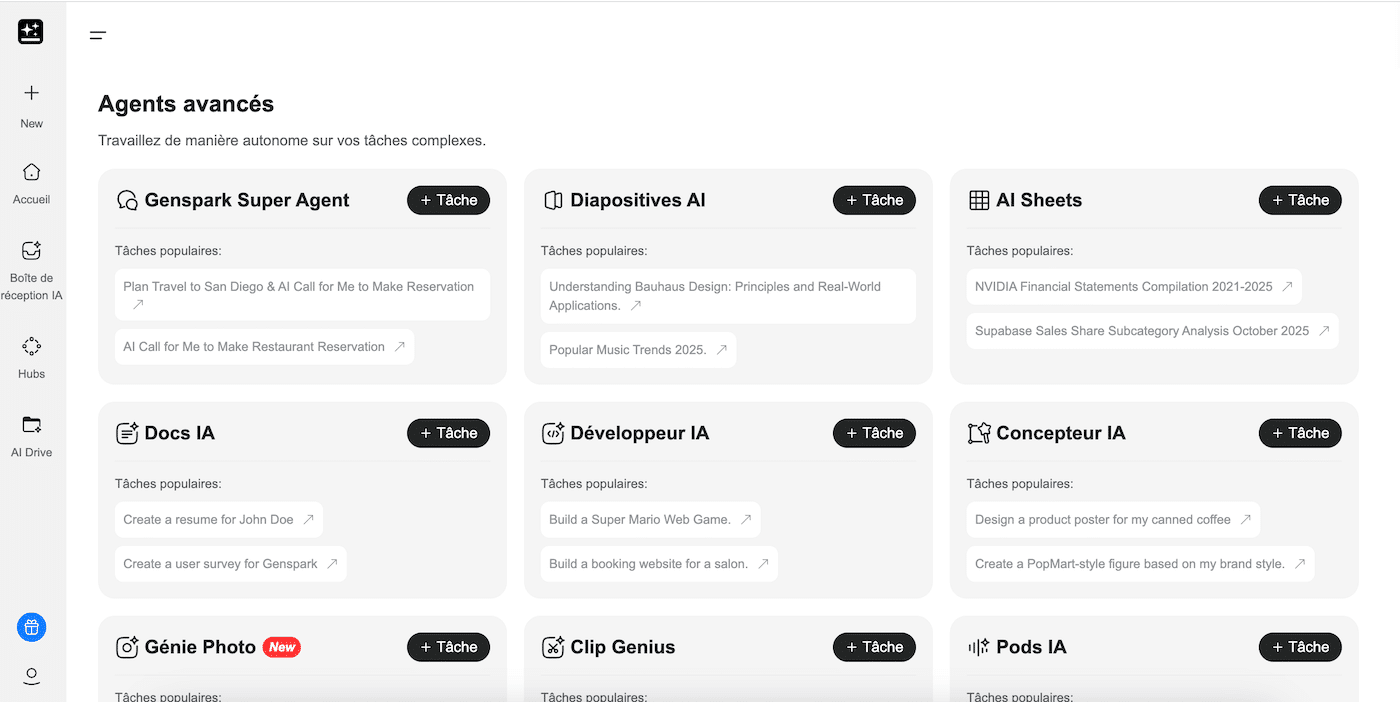
| Super Agent & autonomy | 3,5 / 5 | Calling agent and complex autonomous agents are impressive in demo, less reliable in daily production. Latency is quite variable, regional availability limited and credits debited even on failed tasks (too bad…). |
| Quality-price ratio | 3,7 / 5 | The Plus plan at $24.99 is reasonable for the use it offers. The Pro plan at $249.99 is hard to justify outside of intensive business use. |
| Reliability & support | 2,5 / 5 | Structural weakness. We haven’t had to deal with it directly, but users have been reporting non-consensual annual billing, hard-to-reach support and lost credits on failed tasks. For a tool that positions itself as an enterprise, this is a serious problem. |
Try GenSpark for free
GenSpark offers a free plan with 100 monthly credits, which is enough to test Sparkpages and basic functionality. No credit card required to get started.
What exactly is GenSpark?
GenSpark was founded in 2023 by an unusual team. Eric Jing, CEO, is a former founding member of Microsoft Bing. Kay Zhu, CTO, has led AI ranking technologies at Google since 2011. Notably, he launched the first deep neural network ranking model into production in 2013. Wen Sang, COO, previously founded and sold Smarking, a SaaS startup backed by Y Combinator. This is the kind of team that raises money before it even has a product.
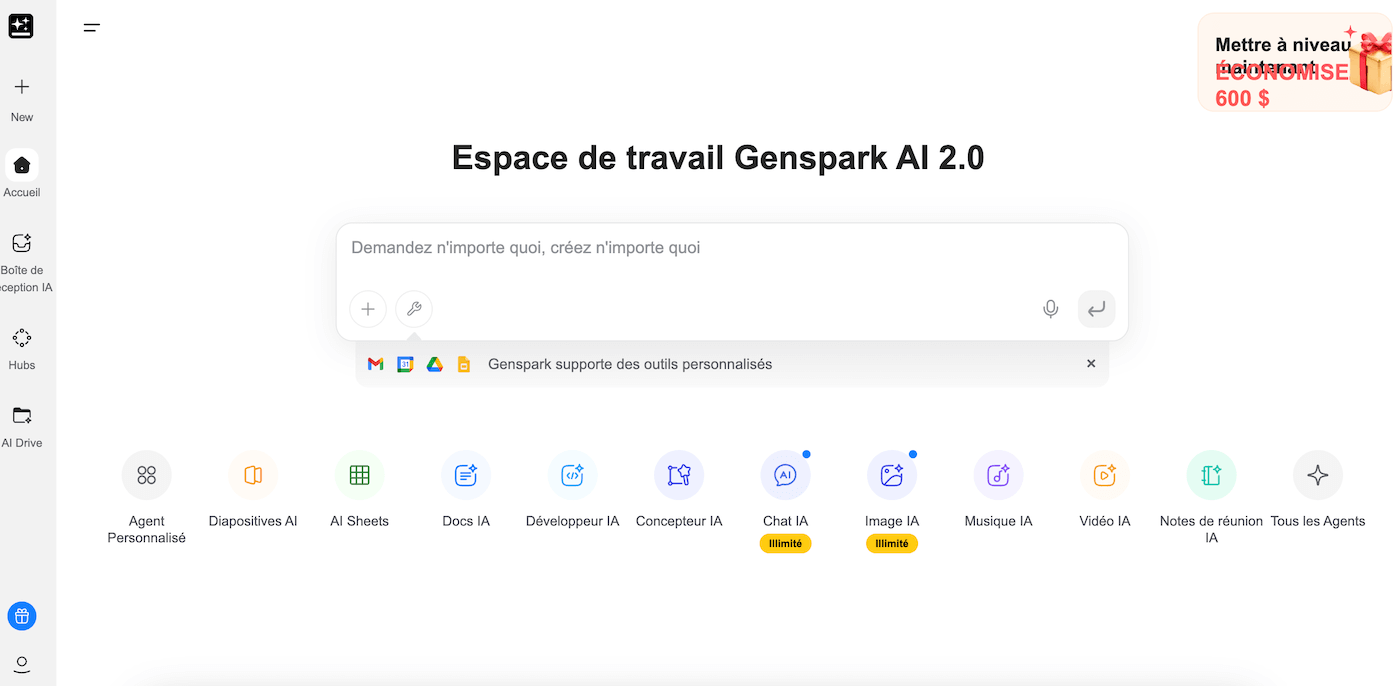
The financial trajectory confirms the ambition: $50 million in ARR within five months of launch, $100 million ARR four months later, and a $300 million Series B by the end of 2025, valuing the company at $1.25 billion. Less than a year of existence, unicorn status. On paper, it’s dizzying.
The strategic pivot is important to understand. GenSpark started out as a personalized search engine for individuals (consultants, analysts, developers), before pivoting to an enterprise solution in the face of demand that exceeded expectations.
What sets GenSpark apart architecturally is what its founders call a “Context System”. The idea: a language model alone is a reasoning engine. What it lacks is the scaffolding to transform this reasoning into specific, verifiable results. GenSpark embeds over 30 foundation models, 150 internal tools and 20 premium datasets to provide this context. Each complex query triggers the collaboration of 6 to 14 specialized agents, what they call Mixture-of-Agents (MoA).
Salesdorado’s opinionGenSpark is not an enhanced chatbot. It’s an agent infrastructure that breaks down your requests into sub-tasks, routes them to the right specialists and returns a finished deliverable.
GenSpark’s key features
Multi-agent chat: the best answer without choosing the model
If you’re used to “LLM ping-pong” (ask a question on ChatGPT, compare with Claude, check on Perplexity) GenSpark solves this problem at the root. Rather than choosing your model from a drop-down menu, you prompt once and the platform automatically routes to the most relevant models: GPT-5.2, Claude Sonnet 4.6, Gemini 3, depending on the nature of the query.
A “reflection” mechanism then analyzes the outputs and selects the best answer or synthesizes complementary perspectives. The result is often better than what you’d get by going to a single model, especially for complex questions where different models have different strengths.
This is the most immediately useful feature for teams already juggling multiple AI subscriptions. You reduce the need to go back and forth, and get a more robust response without having to manually compare.
Sparkpages: AI search reinvented
This is where GenSpark really justifies its existence. Sparkpages are the feature that has been missing from all AI search engines, and they are superior to what Perplexity or ChatGPT’s Search mode does.
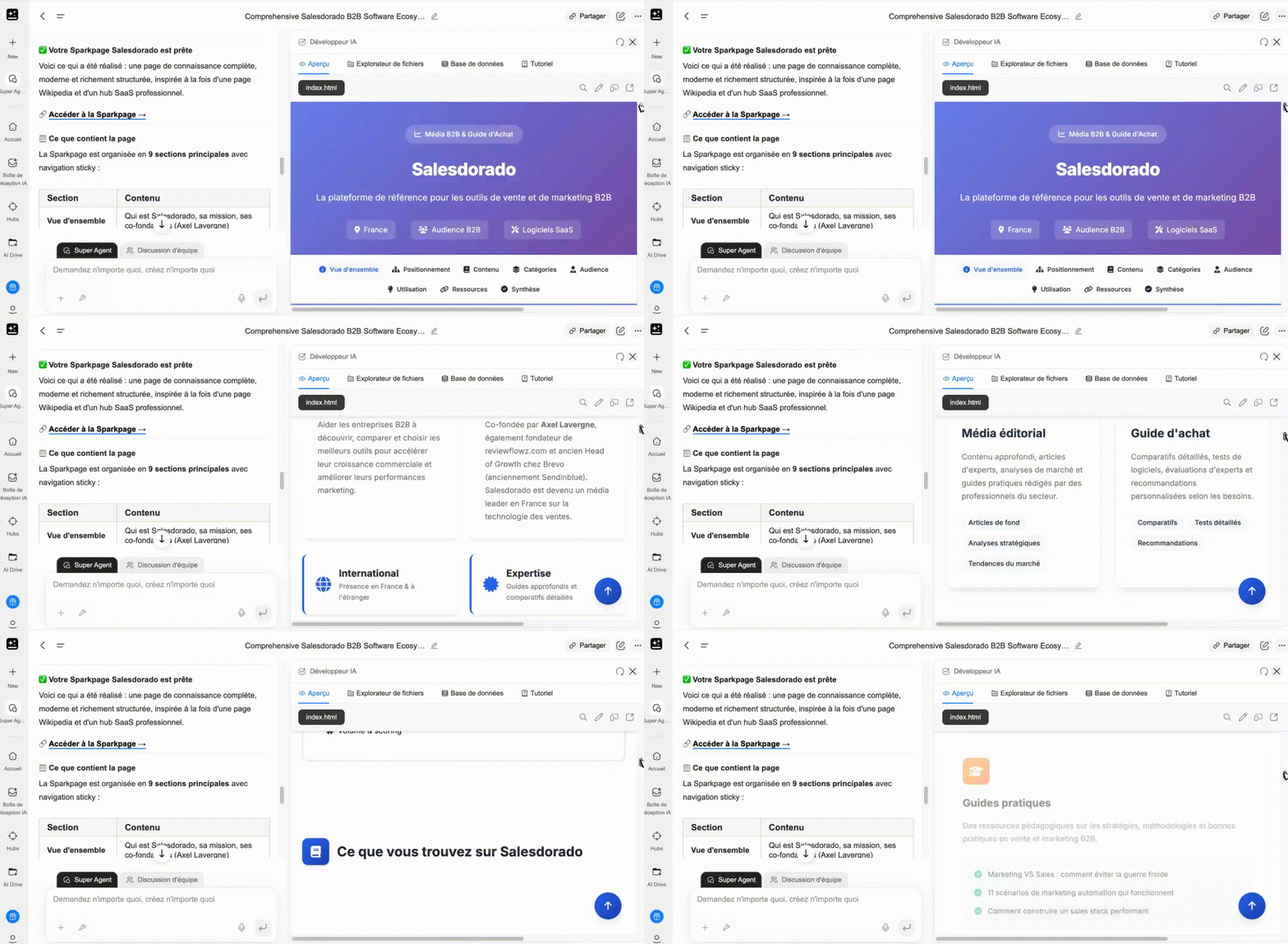
In concrete terms: instead of returning a list of summarized links, a search query generates a structured page that resembles an interactive mini-wiki, with sections organized by topic, clear and verifiable citations referring to the original sources, visuals generated to illustrate key points, automatically constructed comparison tables and, icing on the cake, an integrated co-pilot to ask follow-up questions directly on the page content.
Salesdorado’s opinionIf you’ve only got one use case to test for free, this is it. Enter a complex search question (“Best B2B prospecting tools for French SMEs in 2026” or “Comparative analysis of data enrichment solutions”) and compare the result with Perplexity. The difference in depth and format is immediately apparent. Sparkpages don’t replace an analyst, but they easily replace 2 hours of manual Google research.
AI Slides: from idea to deck in minutes
Presentation generation is one of GenSpark’s most popular use cases…and for good reason. From a prompt or brief, the tool generates a complete deck of 10 to 15 slides in just a few minutes: title, narrative structure, content per slide, speaker notes, visuals. You can export to PDF, PPT or directly to Google Slides.
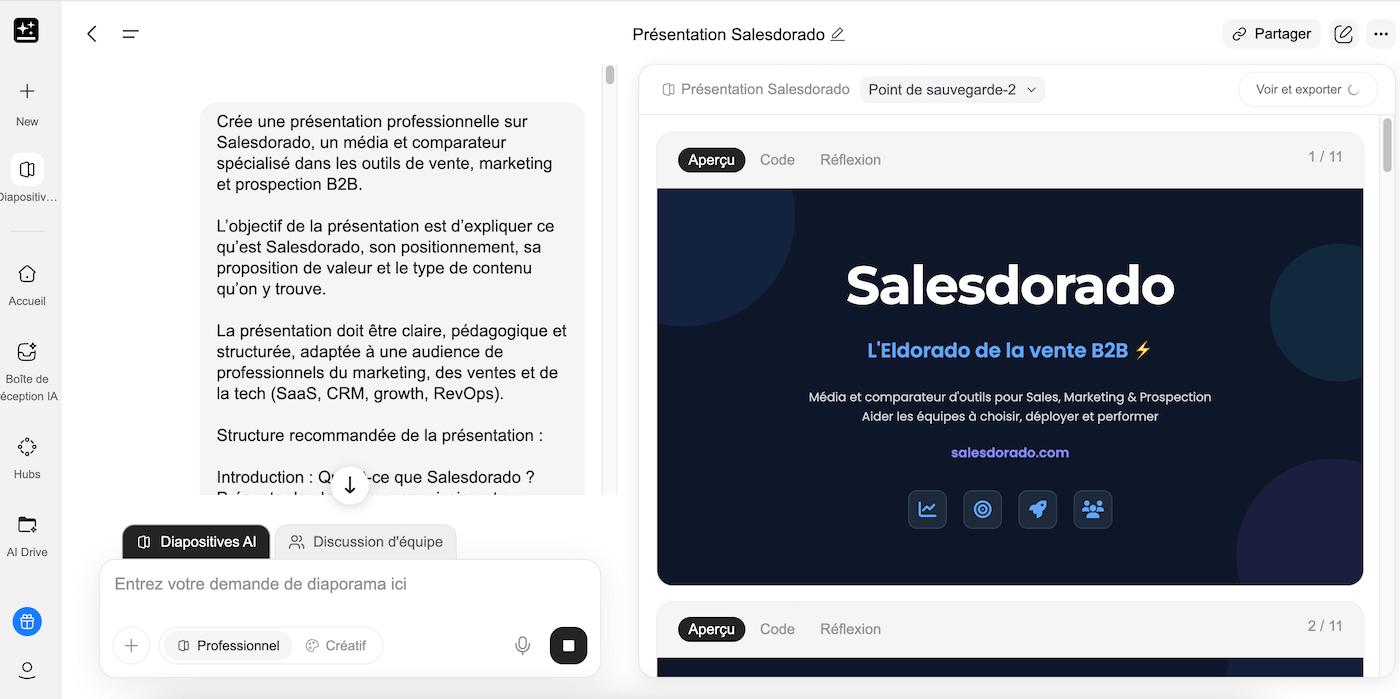
Beware, the limit is real: the designs are clean and functional, but clearly not as polished as Beautiful.ai or Canva. GenSpark slides look like a good wireframe: the content is there, the structure is solid, but you’ll often need a formatting pass before sharing externally. Think “first draft” rather than “final deliverable”.
The real gain: you go from “blank sheet of paper” to “solid work base” in 5 minutes rather than 2 hours. The value isn’t in the end result, it’s in eliminating the start-up phase.
AI Sheets: formulas replaced by natural language
AI Sheets offers a simple paradigm: describe what you want in your spreadsheet rather than building the formulas. “Create an editorial schedule for the next 30 days with columns for status, priority, ratings and performance” generates a structured sheet with the right columns, basic formulas and even aggregated summaries at the head of the table.

The most relevant B2B use cases: solution comparison tables (CRM, marketing tools, service providers), recruitment pipelines, sales performance trackers, campaign planning. You can also ask the tool to draw data directly from the web to feed the table (for example, a list of competitors with their characteristics).
Everything can still be edited manually afterwards: GenSpark generates a normal spreadsheet, not a proprietary tool. The “natural language description → structured spreadsheet” workflow is much faster than starting from scratch, especially for teams not very comfortable with Excel or Google Sheets.
AI Inbox: manage your emails by prompt
AI Inbox connects your Gmail or Outlook and allows you to control your email by natural language query. “Summarizes the last 7 days of emails, groups them by subject, flags what needs action, and returns an overview in less than a minute: emergencies, follow-ups, informative messages, trends.
The tool can also write contextualized responses for you, based on the complete conversation thread. The generated response is fully editable before sending.
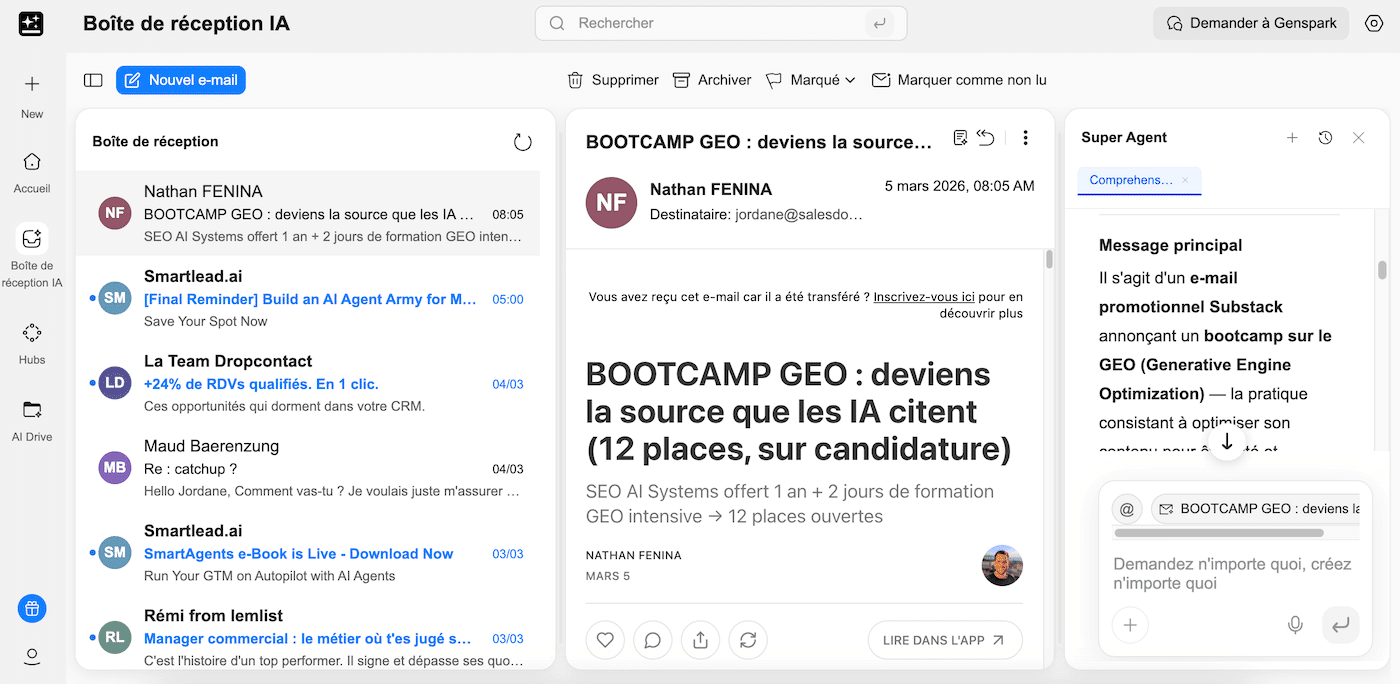
AttentionConnecting your professional messaging system to a third-party tool means giving it access to all your communications. Be sure to check GenSpark’s confidentiality policy, and make sure that this connection is compatible with your company’s security rules, particularly in enterprise environments or regulated sectors.
AI Developer: applications and websites without writing a line of code
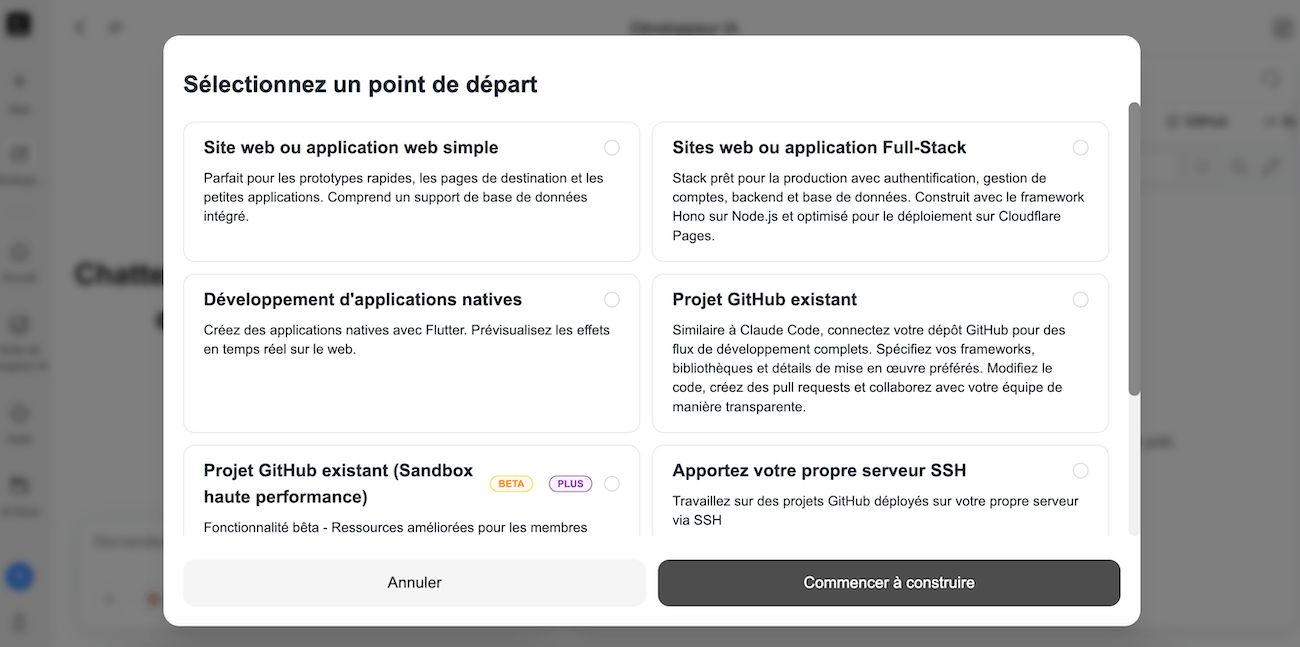
AI Developer lets you create landing pages, internal tools and complete applications from a natural language description. The workflow is simple: you describe what you want (sections, functionalities, design, stack), the tool chooses the best available code model, generates the project and proposes one-click deployment on Vercel or Cloudflare.
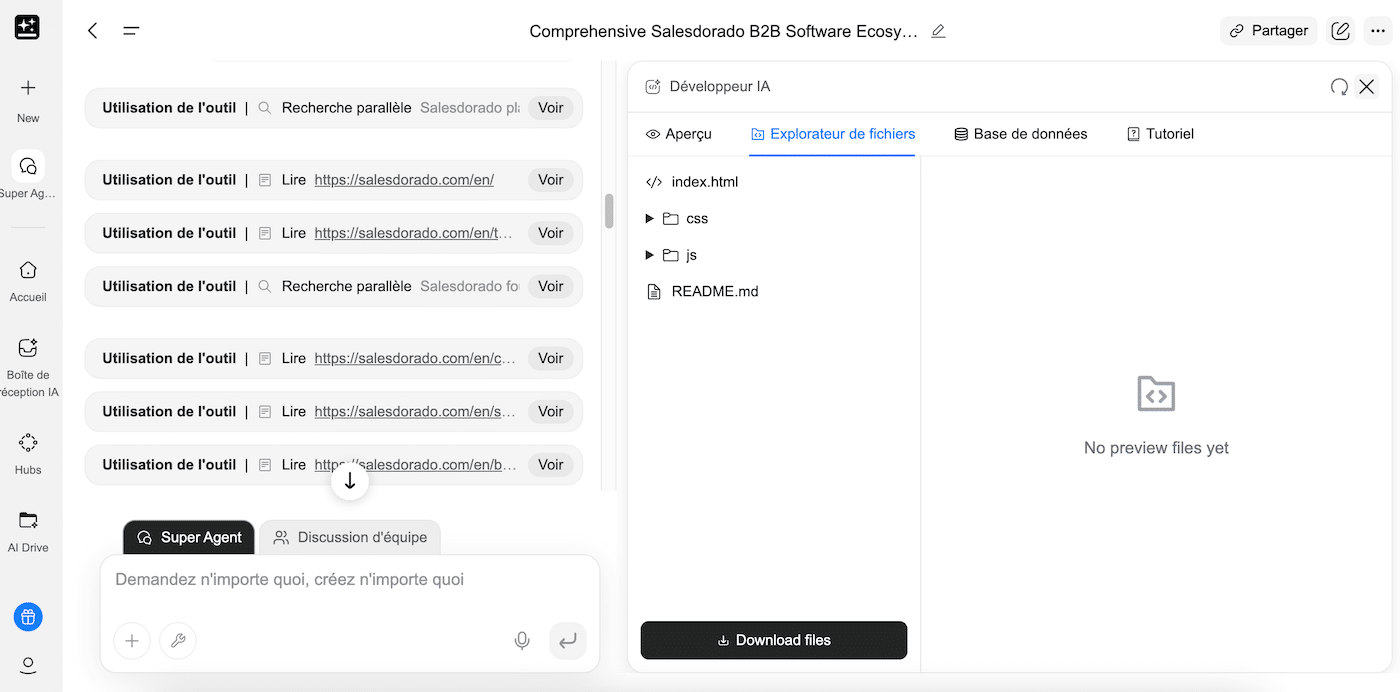
For MVPs, capture pages, simple internal tools or prototypes to be quickly presented to a customer: GenSpark Developer does the job. For applications with complex backend logic, advanced authentication or multiple API integrations: Lovable, Bolt or Replit are more suitable. That’s about as far as it goes.
“Call For Me”: the agent who makes your phone calls
It’s the most talked-about feature, for good and bad reasons. “Call For Me” is a voice agent that makes real phone calls for you, powered by Twilio. You give it an instruction (“Call this restaurant and book a table for 4 on Friday night”, “Call this prospect and ask if he’s received our proposal”), it calls, navigates the phone menus, talks to the caller, manages holds, and sends you a full transcript with a summary of the result.
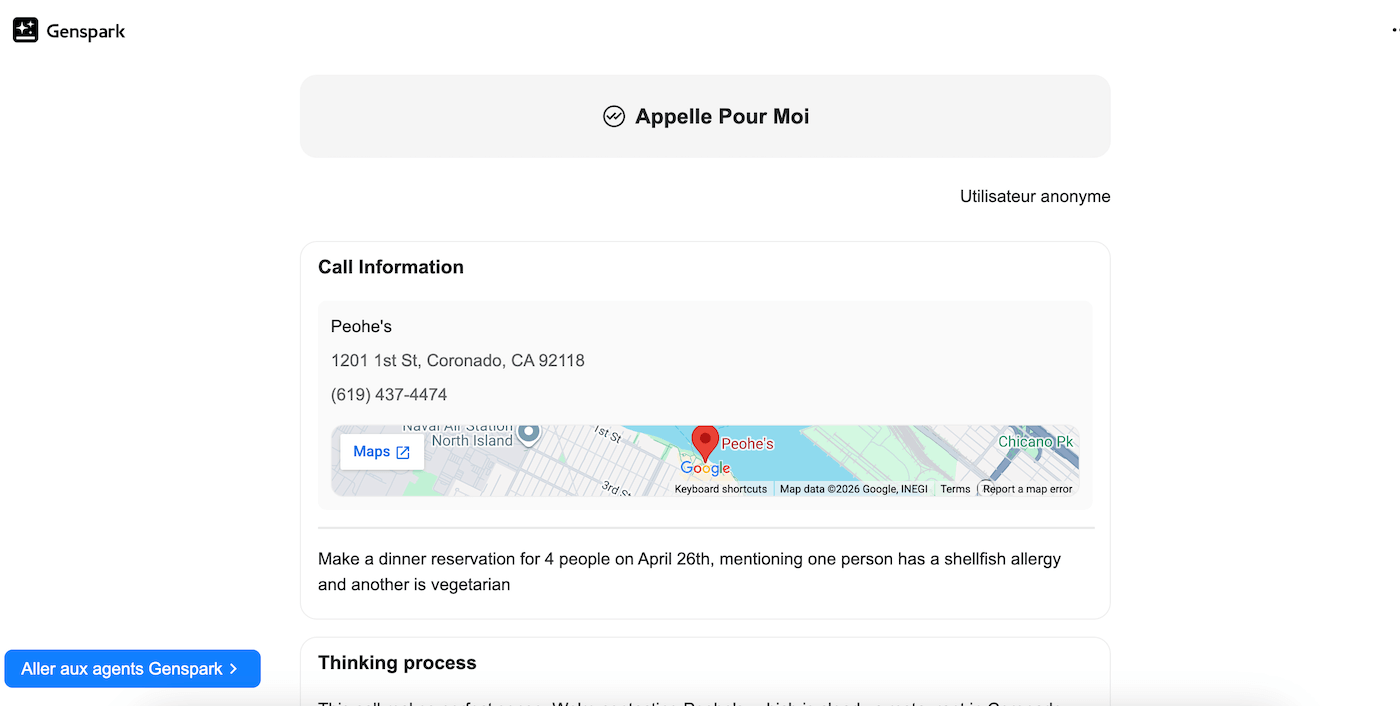
An ethical point to be noted positively: the agent presents itself from the outset as an AI. GenSpark does not try to pass the bot off as human, unlike some of its competitors.
The limits are real in 2026: latency is noticeable, pauses can be awkward in a fluid conversation, and availability varies by region…
AttentionThe “Call For Me” agent consumes 1 credit per second of call. A 3-minute call = 180 credits. With 10,000 credits included in the Plus plan, you have around 55 3-minute calls, which can go fast if you use it intensively. Calculate your usage before committing to a plan.
GenSpark rates: what it really costs
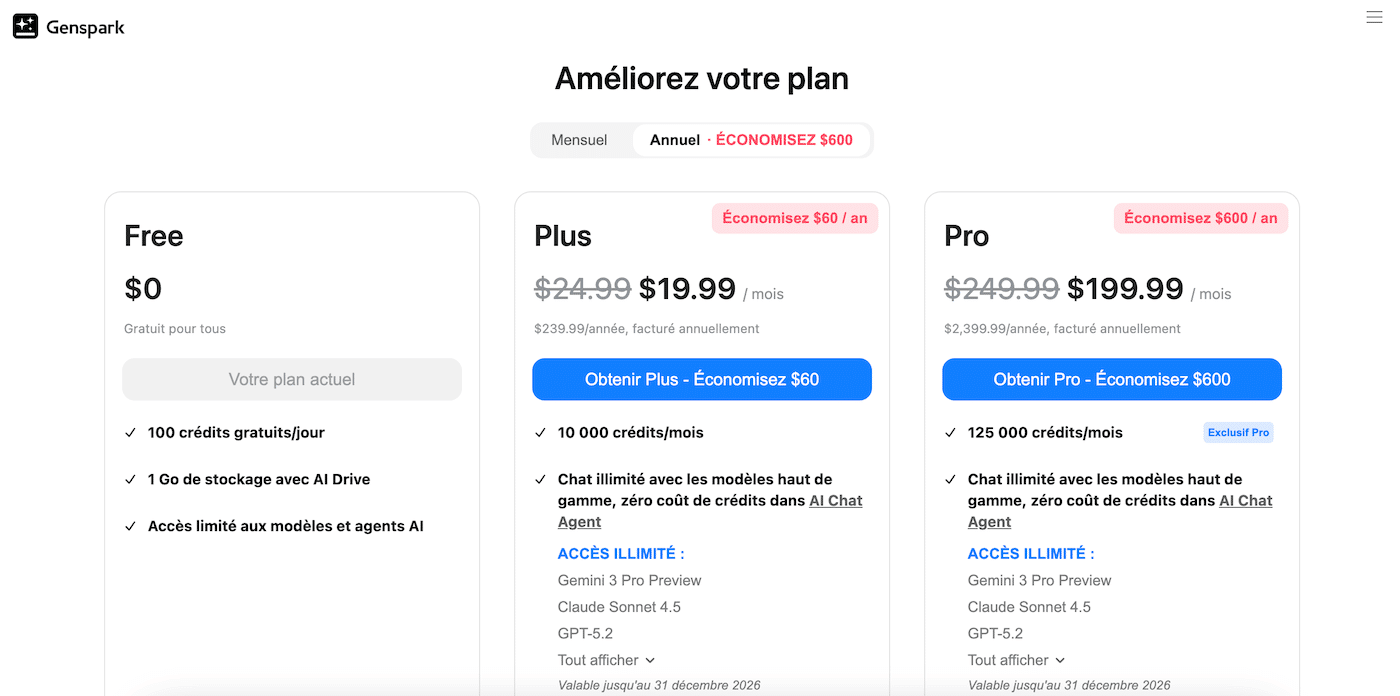
GenSpark does not display its rates publicly without logging in to an account. What you find on third-party sites may differ from reality at the time you read this article. Always check directly on the platform after logging in, and read the subscription conditions carefully before validating, especially the billing cycle (monthly vs. yearly).
| Plan | Monthly price | Credits included | What’s included | Who it’s for |
|---|---|---|---|---|
| Free | 0 $ | 100 / month | Access to basic agents, Sparkpages, Docs, Sheets, Slides (limited access) | Platform test, very occasional use |
| Plus | 24,99 $ | 10,000 / month | Premium agents (Deep Research, Sparkpages with quotes), 50 GB storage, advanced exports | Solo professionals, consultants, content managers |
| Pro | 249,99 $ | 125,000 / month | All Plus + Call For Me, advanced deep research, extended exports, 1 TB storage, priority access | Agencies, teams with very intensive use |
| Team | 30 / seat | 12 000 / seat / month | Admin controls, unlimited AI chat (no credits), multi-model access, collaboration | Teams from 2 to 150 users |
What each task costs in credits
| Type of task | Estimated consumption | With 10,000 credits (Plus plan) |
|---|---|---|
| AI chat (standard queries) | Free on Team plan / low on Plus | Virtually unlimited use |
| Sparkpage (standard research) | ~50-200 credits | 50 to 200 Sparkpages / month |
| Deep Research | ~500-1,000 credits | 10 to 20 deep researches / month |
| Slides generation (10-15 slides) | 300-500 credits | 20 to 33 decks / month |
| Application generation (AI Developer) | 500-800 credits | 12 to 20 projects / month |
| Phone call (Call For Me) | 1 credit / second | ~55 3-minute calls / month |
Salesdorado’s opinionThe Plus plan at $24.99 is the right entry point for regular professional use. The 10,000 credits allow comfortable use for research and slide production, without running out mid-month. The $249.99 Pro is hard to justify except for agencies with very intensive production. Please note: unused credits cannot be carried over to the following month.
What we like (and don’t like)
- Sparkpages : the ability to transform a search question into an interactive structured page with citations and co-pilot is a real advance over anything else out there. Perplexity doesn’t do that.
- Serious multi-agent architecture: 6 to 14 agents in parallel on each complex query, mutual verification of outputs. This is not marketing: this is real engineering, designed by ex-Bing and ex-Google.
- Remarkable speed of execution: a 15-slide deck in 4 minutes, a structured spreadsheet in 2 minutes, an in-depth research Sparkpage in a few minutes. Time-to-output is very low.
- Frictionless multi-modeling: access GPT, Claude and Gemini in the same interface, without switching tabs or managing multiple subscriptions.
- Testable free plan: 100 credits/month are enough to explore Sparkpages and get a real idea of the value before committing.
- Trustpilot at 1.9/5: a serious red flag…Criticisms converge on three specific problems: non-consensual annual billing, credits debited on failed tasks, hard-to-reach customer support. For a $249/month tool, this is unacceptable.
- “All-in-one” overstates reality. The slides are less beautiful than Canva. The app builder is less robust than Lovable. The calling agent is less reliable than a real phoning tool. Every feature is inferior to its dedicated equivalent.
- Non-redeemable credits: credits expire at the end of the month. If your usage is irregular (peak at the end of the quarter, trough in summer), you pay for credits you don’t use.
- Insufficient pricing transparency. Prices are not displayed without connection. We should also point out that some users have been surprised by annual billing when they thought they were subscribing on a monthly basis.
- No credible enterprise support. For a tool that competes with enterprise solutions, the lack of response from support to refund requests is a worrying sign.
Who is GenSpark really for?
GenSpark is for you if :
- You do a lot of in-depth research (market analyses, competitive intelligence, tool benchmarks, briefings for customers or investors).
- You regularly produce presentations and working documents (briefs, reports, decks) and need quick first drafts on which to iterate.
- Are you a consultant, freelancer or solopreneur who wants to consolidate several IA subscriptions into a single interface without losing quality?
- You work in content marketing and want to speed up the research and structuring phase, not the final writing phase.
- You are part of a sales or business development team that prepares account analyses, customer one-pagers or presentation decks on a regular basis.
Skip it if :
- You need enterprise reliability on critical deliverables (hallucinations and inconsistencies in outputs always require human verification…).
- You have serious no-code projects with complex backend logic (Lovable or Bolt would be more suitable)
- You’re in a highly regulated sector (legal, medical, financial) where connecting your emails and communications to a third-party tool raises compliance issues
Our verdict on GenSpark
GenSpark has done something rare: built a serious multi-agent architecture, made it freemium accessible, and surrounded it with a marketing promise seductive enough to achieve unicorn status in less than a year. On its core use cases (Sparkpages, in-depth research, production of first draft deliverables), the platform delivers better than most of its competitors.
But the positioning “replaces 5 subscriptions” is too broad a promise. GenSpark is excellent for searching and structuring (it’s okay for producing slides and sheets), it’s uneven on complex autonomous agents. This isn’t an insurmountable flaw: it’s simply the reality of an ambitious platform that does many things without mastering any of them perfectly.
What really tarnishes the evaluation is Trustpilot’s 1.9/5 rating. Problems with non-consensual billing and hard-to-reach support are not trivial bugs for a tool that positions itself against enterprise solutions. These signals deserve to be taken seriously before any paying commitment is made.
The recommendation is simple: test it out with the free plan. If Sparkpages transform your search workflow, the $24.99 Plus plan is reasonable. But read the terms and conditions carefully before committing yourself, and prefer monthly billing to annual billing until GenSpark resolves its support issues.
Our final verdict
GenSpark is the most powerful tool on the market for turning a complex research question into a structured deliverable. Start with the free plan to validate the fit with your use cases, and commit to a paid plan only after you’ve tested the features that matter to you.