Every article on B2B acquisition strategy says that the sales funnel isn’t what it used to be. But here is one stat that shows just how much different it is. According to Gartner, 67% of B2B buyers prefer a rep-free experience. Sure, we knew it all along: people don’t like being sold to.
But 67% of customers skipping your sales team altogether? Well, that’s a real shift. That’s why you may need a solid B2B SEO strategy. It can fill in gaps throughout the entire sales funnel, even in the moments when your team can’t track a potential buyer yet. So, let’s figure out how you can use it practically to actually strengthen your acquisition.
Sommaire
The problem with many B2B acquisition strategies
When it comes to B2B acquisition, you often see two scenarios where companies are:
- Relying heavily on one acquisition channel that has worked for them historically.
- Underestimating the overall brand visibility, which influences prospects long before you have them on your radar.
In B2B, we often talk about long sales cycles. And of course, it’s important. During this time, you have to make sure that your leads get enough information, support, and social proof to choose you over your competition.
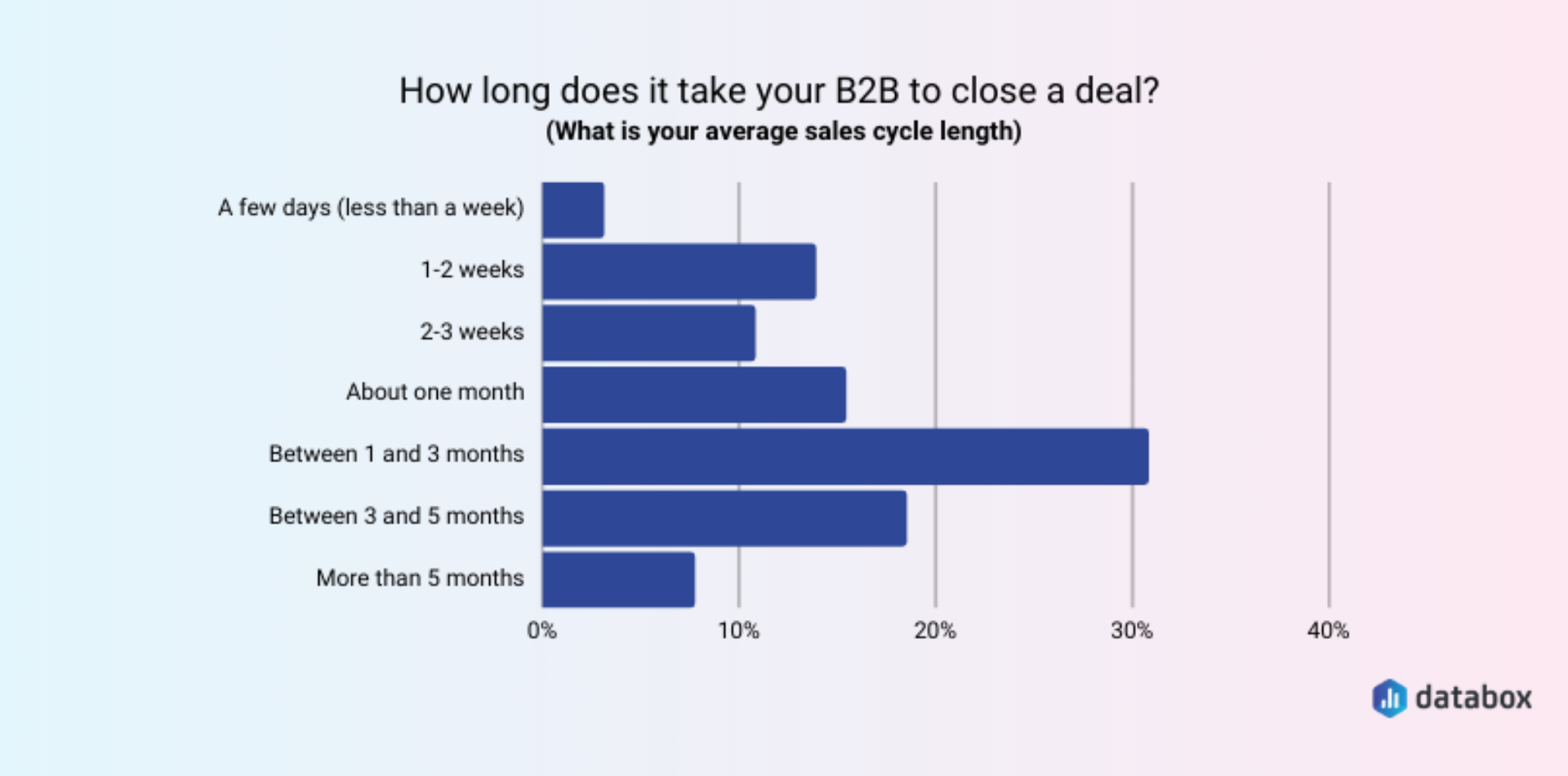
But we don’t talk enough about the selection stage that happens before a lead contacts your sales team. Before the trackable sales cycle even begins. And that selection/research phase takes nearly two-thirds of the buying journey. This means that you need something that can influence your potential customers’ decisions before your sales reps engage. And one of the strategies that can help is SEO, used for lead generation and beyond.
The missing layer: SEO isn’t just about traffic
There is a huge misconception around SEO. Many treat it as a traffic-generating tactic only. But a well-built SEO strategy can do much more than that. Even by simply posting actually valuable content and getting contextual backlinks from credible websites, you can improve your search rankings, authority signals, and even AI visibility. Overall, SEO supports customer acquisition in many ways :
- Attracts specific leads : When you write content around the problems your business solves, most of the users who read it are the ones who actually need a solution.
- Helps at every stage : Funnels aren’t linear, and it’s hard to predict what a prospect needs at any given moment. But when they literally google for what interests them, you can be there, offering an answer. It works at any stage, whether they look for advice or compare different vendors.
- Prequalifies leads : As you’re the one writing your content, you can choose angles, proficiency levels, topics, industries, budget ranges, etc. And that will help you “filter out” those who don’t align with your ICP.
- Gives research information : As most (if not all) prospects do their research before contacting you or even considering you, you can influence what they learn. At least partially. SEO can help you do that through content on your own website and across external sources through link building.
B2B SEO strategy : How to use it for your funnel in 6 steps
Now, let’s see how to build an actual SEO-driven sales funnel in B2B step by step.
Step 1 : Audit the content you already have to identify gaps
Before you start writing any new pieces or testing any new tactics, you have to understand how your website is currently doing. Start by checking the content you have already published and note what funnel stage it belongs to. A typical SEO sales funnel consists of ToFu (awareness), MoFu (consideration), and BoFu (decision). So, to understand how your strategy looks so far, create a Google Sheet (or any other format) and list :
- ToFu : X, Y, Z articles
- MoFu : X, Y, Z customer success stories
- BoFu : X, Y, Z landing pages
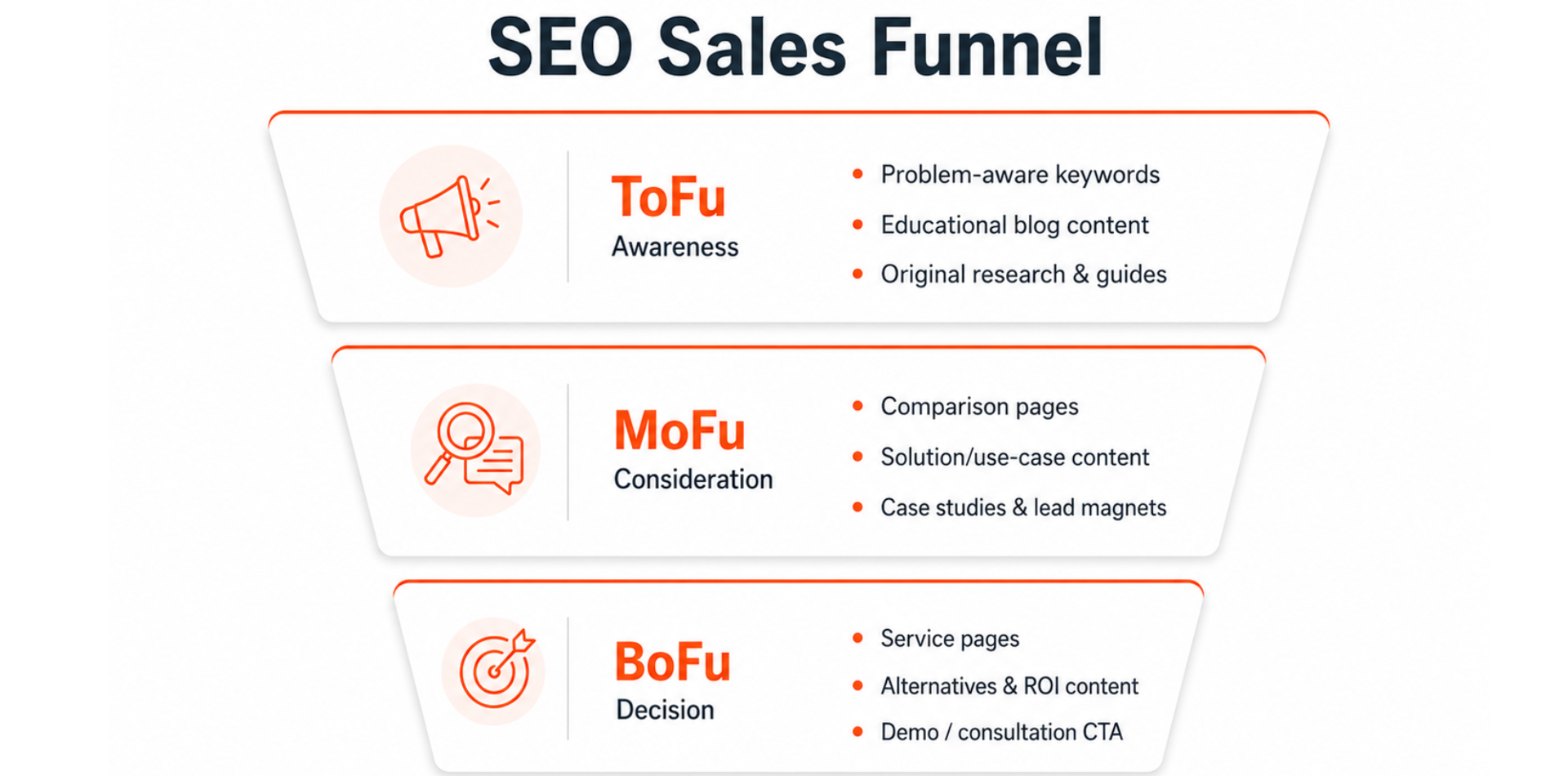
At this point, notice whether you have good coverage of all three groups of content. If you don’t, fixing that would be the first step. When auditing your content, also pay attention to whether you’re guiding people through their journeys. We’ll get into this in more detail in Step 5.
Step 2 : Understand what your audience needs
You can publish thousands of pieces of optimized content. But if that’s not what your prospects need, it makes no sense. That’s why knowing your ICP is so important. When we say ICP, we aren’t talking about basic demographics or names you give them. What really matters is their struggles, frustrations, objections, goals, etc.
You have to know their challenges and desires and clearly show your prospects that you can help them. That’s something your content has to communicate again and again.
But here is one important detail. Make sure your potential customers can both feel what you mean and can logically justify your offer.
Why does this matter? According to the Nobel Prize winner, Daniel Kahneman, we have two systems responsible for our decision-making. System 1 is where all the emotional purchases come from. And System 2 is the logical and intentional one, taking care of justification.
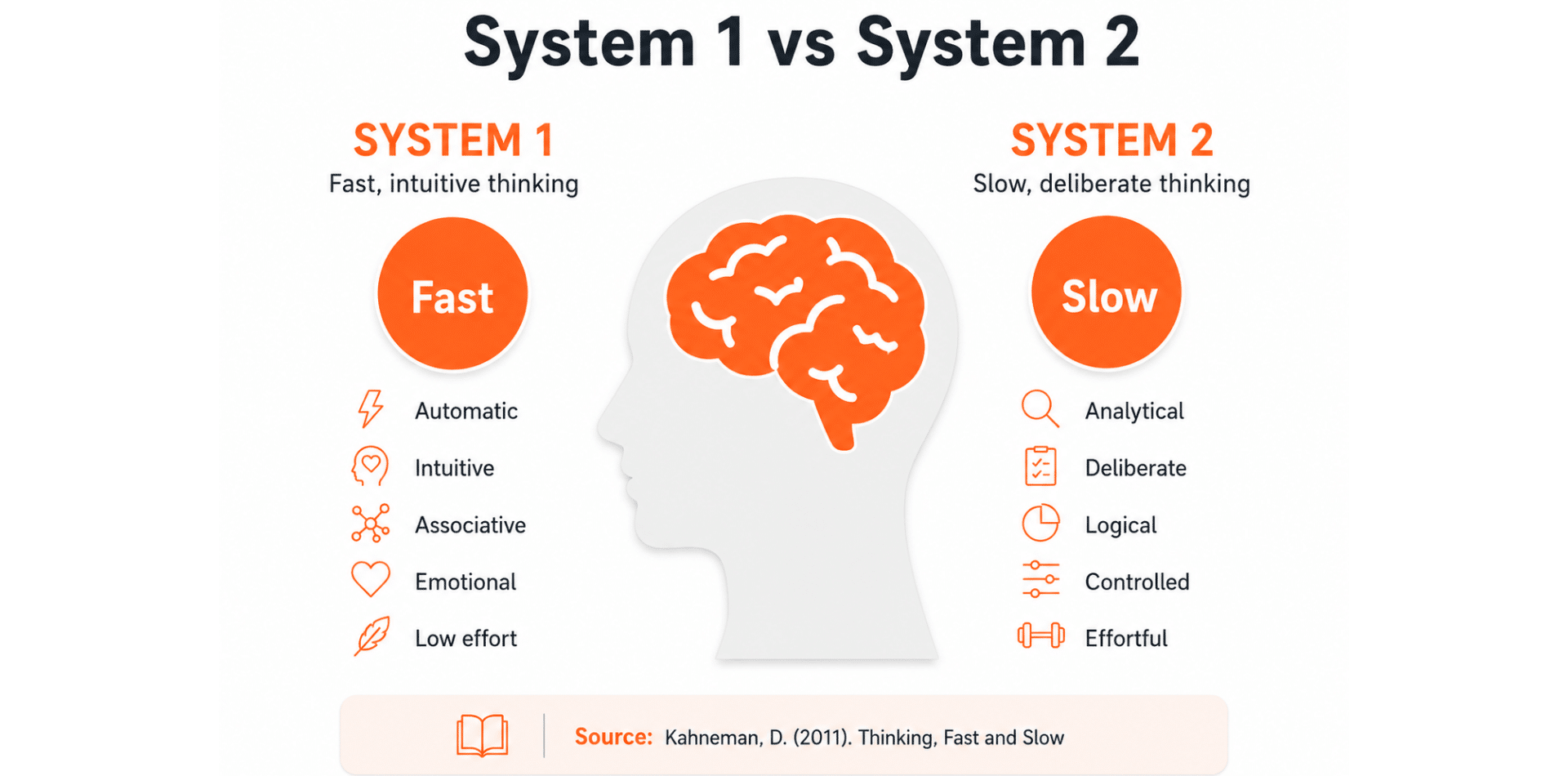
And sure, when it comes to B2B, you’ll mostly deal with System 2. But the issue is that by the time System 2 starts to analyze everything, your System 1 will already have that strong first impression about you. That’s why you need both systems to actually make it work. Because even in B2B, humans are still humans, and they can justify their emotional decisions with logic post factum.
Step 3 : Do keyword research and map the search intent
Once you know what your prospects need and what content you already have, you can start adding new pieces to your SEO funnel strategy. First, do keyword research and understand the search intent behind each query. For this, take any SEO tool you prefer, and do the following:
-
- Search for the major seed keywords that your business targets (like “referral software” in the example below). Any SEO tool will offer you some related terms. List the ones that make sense for you and pay attention to intent, search volume, and keyword difficulty.
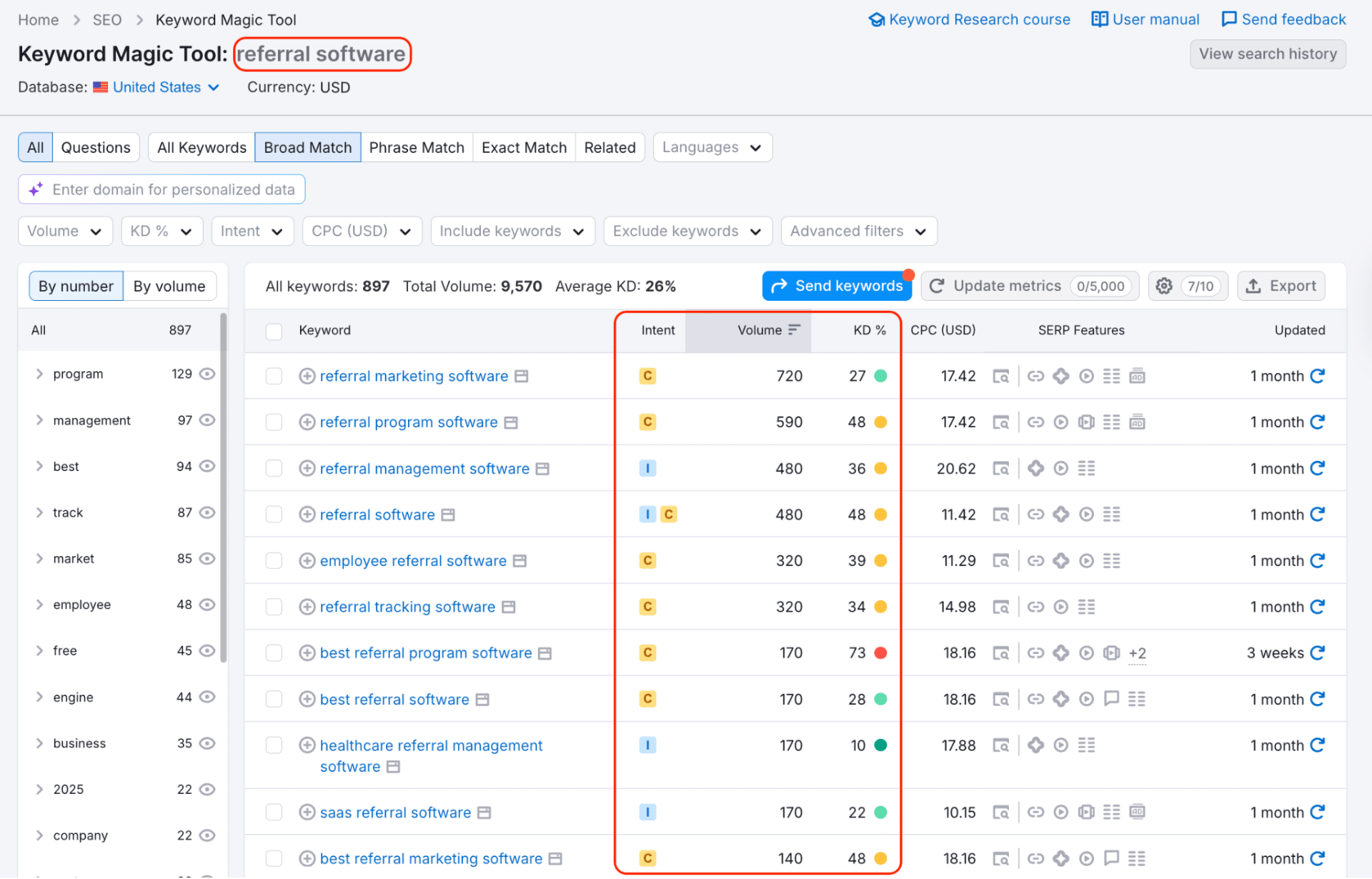
- Then, analyze your competitors’ keywords and your gaps. This will help you add even more keywords to your list.
After you have a list of queries you didn’t target before, define the ones you need to prioritize based on the gaps you’ve found in your audit (Step 1). For example, if you need more BoFu content, focus on commercial keywords. Also, before writing the actual piece, check what already ranks for your target search term. If you see blog posts, you have to write a blog post for that keyword, not a landing page.
This is important because Google always does its best to satisfy search intent. And if it thinks that a blog post does it better than a landing page, you don’t want to get into a fight with the major search engine. Jokes aside, it will simply help your content perform better. So, double-check this.
Step 4 : Create a content system that covers each stage
After you have the keywords you want to target, split them into groups for each funnel stage. This is a crucial step, as it will help you :
- Cover each stage systematically, instead of creating new gaps.
- Choose the best format, style, and angle for each piece.
- Understand who you’re targeting with that content and what worries people at that stage.
- Write with an actual person in mind, instead of blindly optimizing for keywords.
This is essentially how you make your content more effective. After all, SEO lead generation only works when you give your prospects exactly what they need when they need it.
It’s also very useful to track whether users are actually moving down the funnel and where you have bottlenecks. A healthy funnel doesn’t just attract visitors to your site. It guides them to the next logical step in their buyer journey. If that’s not the case, the issue might be that there is no clear next step at all. Let’s see what it means.
Step 5 : Focus on guiding users through the buyer journey
Simply posting content for each stage doesn’t create an actual system. Ideally, you want to go from the basic “SEO-friendly content” to a full-scale SEO conversion funnel. To do that, every time you post anything, ask yourself: What’s the next logical step? What may a reader need to go down the funnel ? It won’t be “Schedule a demo” or “Book a call” every time.
Your next step has to be tailored to each funnel stage and content type. For example, a pricing page or a case study could have a “Contact us” button. But it makes no sense for an average informational blog post. Overall, you can consider the following elements to guide your prospects through the buyer journey :
- Internal links : The easiest (and probably least effective) thing. It’s important for SEO, but not many readers actually get down this rabbit hole.
- Suggested content : This is often more effective, especially when you offer relevant content, not just your latest articles.
- CTAs : These can range from people downloading your lead magnet to an actual “Book a demo”. This will depend on the content itself. HubSpot does this really well. They suggest a downloadable asset in almost every blog post.

Step 6 : Connect SEO Data to CRM
While this step is optional, it’s extremely useful. Of course, you can simply track your performance in Google Analytics and other optimization tools. But SEO for B2B companies can be much more informative once you connect your SEO data to your CRM software.
The idea behind this is to give you more information about what actually works. So, for example, instead of simply saying that a lead came from organic traffic, you can be more precise. You can track the content piece they first interacted with and the one that made them convert (if you have a proper setup). This way, you can adjust your SEO strategy to make it even more effective.
Practically, it could look like this :
- First, you set up the technical side of things. You’ll need to connect GA4 with your CRM, configure your forms and hidden fields, and potentially use other elements to pass SEO data into your CRM.
- GA4 tracks sessions where someone lands on your product page, for example.
- When that person converts, hidden fields in your form can send SEO data to your CRM. Some of the fields you could use are first_touch_source, conversion_page, and so on.
- Next comes the sales qualification phase, where your team evaluates the prospect.
- Later, you can attach the deal status and other details.
With this simple workflow, you can clearly track which content generates unqualified leads that never go from MQL to SQL, or which landing pages bring in the most revenue. This is how you can directly connect your SEO efforts to your business outcomes.
It’s more than just content for different funnel stages
As you can see, SEO is the missing layer because it isn’t just about content. It’s about connecting to your target audience exactly when they need answers. It’s harder to do that with most other channels because you can’t know what your prospects have on their mind at any given moment. With SEO, their searches give you that context.
That’s why SEO matters for B2B sales funnels, not just as a traffic source, but as a way to show up as a possible solution when your prospects are doing their research. Still, it can only work when you rank well and have good search visibility. To get there, your technical SEO has to be great (speed, mobile optimization, security, web architecture, etc.), you need to have a strong backlink profile, and your content has to be unique and human-written.
A strong SEO foundation is the only way to be visible not only in Google or other search engines, but also in LLMs. So, this is the best first step if you really want to use SEO for lead generation.