If you’re hesitating between HubSpot and Brevo, you’re probably asking the wrong question. Because these two tools are not at all on the same playing field, and comparing them feature by feature is a trap into which most comparisons fall.
The real question is: where is the center of gravity of your customer relations: in CRM or in emailing? If it’s CRM, HubSpot is the obvious choice. If it’s emailing and multi-channel, Brevo deserves your serious attention.
But there’s a third answer that nobody gives: for SMEs just starting out, using both together can be a smart step. HubSpot CRM as the central foundation, Brevo as the emailing brick while you mature. We explain why in this article and, above all, how to choose according to your stage of growth.
HubSpot offers a free CRM with unlimited contacts, sales pipeline, forms and email marketing. It’s the best free plan on the market for getting started with a real CRM.
Sommaire
HubSpot VS Brevo – Summary table
| Criterion | 
|

|
|---|---|---|
| Ideal for | B2B SMEs looking for a central CRM that aligns marketing, sales and customer service | SMBs looking for a powerful, affordable multi-channel email marketing platform |
| Philosophy | CRM growth platform: everything converges on a single customer database | marketing-first platform: emailing at the core, CRM and pipeline to complement it |
| Our opinion | The best CRM on the market for B2B SMEs who want to industrialize their growth. Unrivalled functional depth, solid French-speaking ecosystem. An investment that pays off as soon as you structure your sales processes. | Unbeatable value for money in emailing and multi-channel. We use it ourselves at Salesdorado. Less deep in CRM, but formidable in its field. |
| Highlights |
|
|
| Weak points |
|
|
| Free trial | Free unlimited CRM + 14-day trial of paid features | Free plan (300 emails/day) with no time limit |
| Read more |
HubSpot: our analysis in brief
HubSpot CRM is a platform built to centralize the entire customer lifecycle. Marketing, sales, customer service: everything converges on a single database with a unified timeline per contact. The free plan is the best on the market for getting started with a true CRM. It offers unlimited contacts, a pipeline, email tracking, forms and basic email marketing.
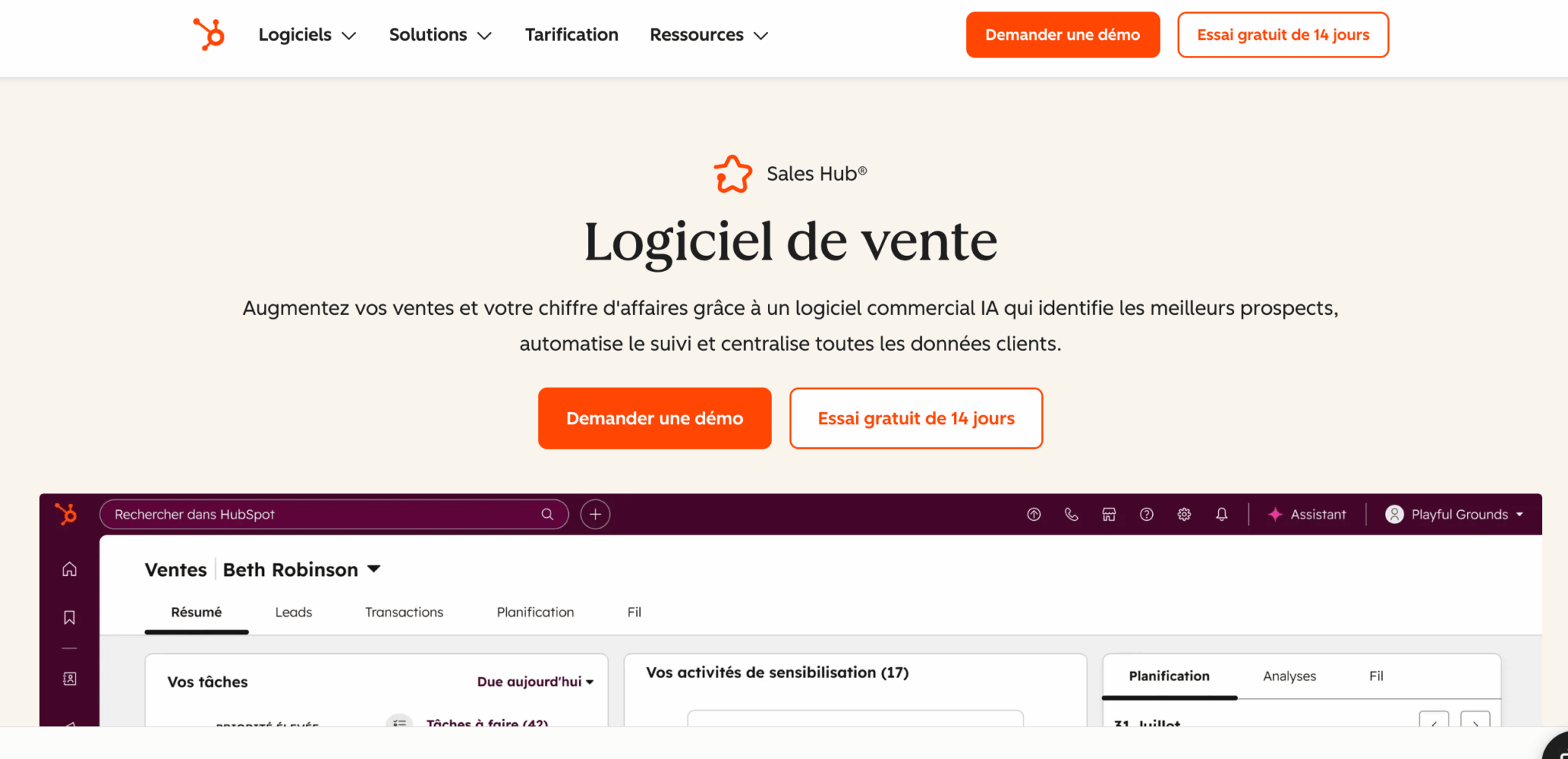
Functional depth is excellent as soon as you move on to the paid plans: Multi-step workflows, lead scoring, sales sequences, reporting with multi-touch attribution, personalized objects, etc. The HubSpot platform is particularly strong at aligning marketing and sales teams around the same system, what HubSpot calls the marketing loop.
The point to watch out for: price escalation. Marketing Hub Starter (€20/user/month) is very affordable. But Marketing Hub Pro starts at €880/month (3 users + 2,000 marketing contacts included), with compulsory onboarding at €2,930. Many advanced functionalities (complex workflows, A/B testing, attribution reporting) are locked behind this tier. We discuss this in detail in our article on HubSpot pricing.
Brevo: our analysis in brief
At Salesdorado, we’re no strangers to Brevo, a tool we use and recommend regularly. Formerly Sendinblue, it’s primarily an email marketing and relationship marketing platform, enriched with a CRM, a conversation module (chat, WhatsApp, telephone) and a simple sales pipeline.
The price/performance ratio is probably the best on the market. Brevo charges by volume of emails sent (not by number of contacts), which completely changes the economic equation for companies with large databases.
The Starter plan starts at 7€/month for 5,000 emails, and the Standard plan at 15€/month with access to landing pages, A/B testing and marketing automation. Native multi-channel (email, SMS, WhatsApp Business, online chat, push, Brevo Phone) is a real asset, accessible without multiplying subscriptions.
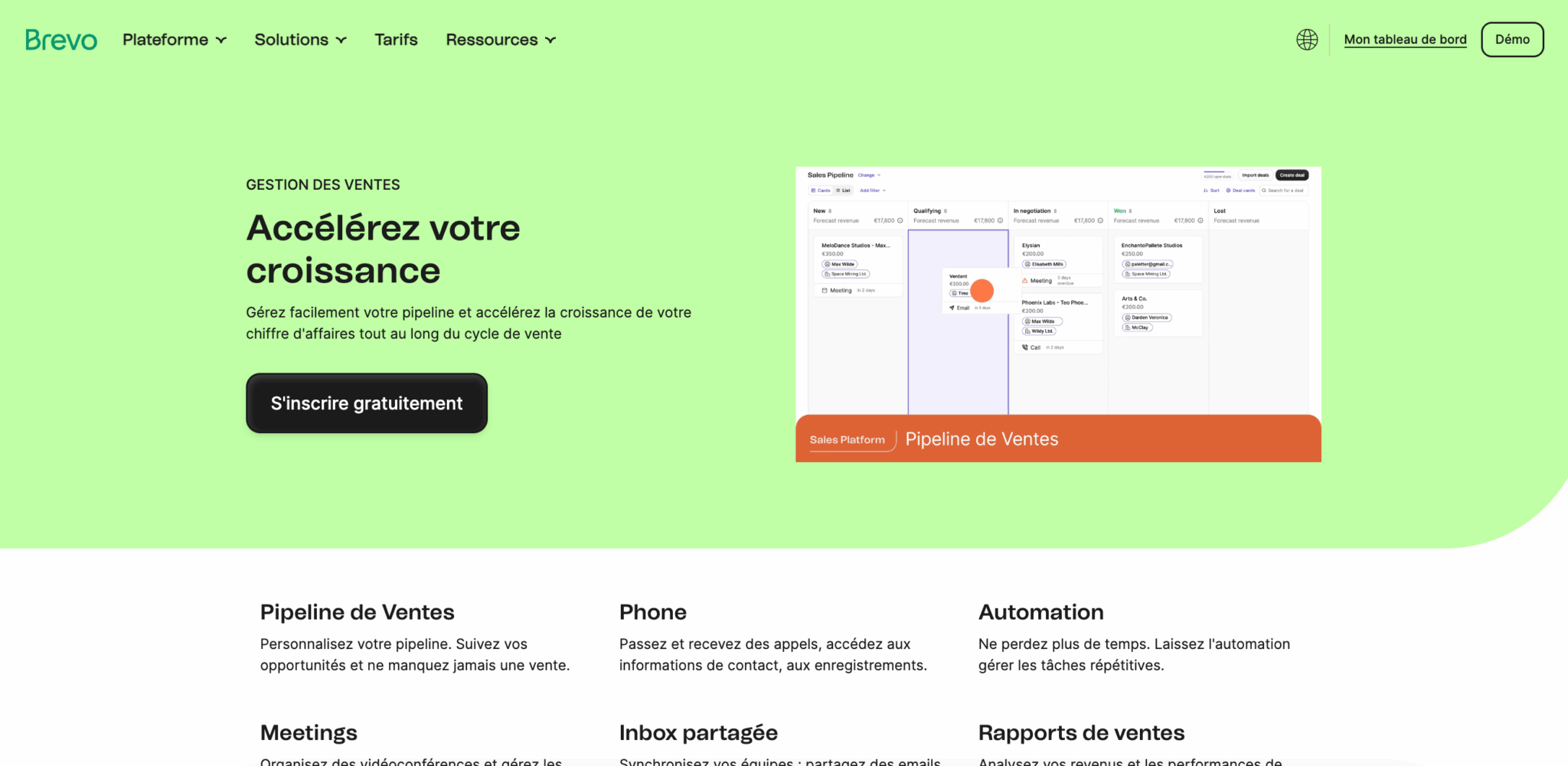
The limitations are well known: CRM remains lightweight for complex B2B sales cycles (no native scoring, no timeline as rich as HubSpot) and lead capture (forms and landing pages) has historically been the platform’s weakest link.
HubSpot VS Brevo: functional scope
#1 Email marketing & campaigns
This is Brevo’s historic territory, and it shows. The drag & drop editor is fluid, campaign statistics are detailed (heatmaps, click-per-link ratio, geolocation of openers) and automation scenarios for classic email paths (welcome series, reminders, welcome emails, re-engagement) can be set up in just a few clicks.
The HubSpot platform also offers solid email marketing, but with a different logic: email is a CRM brick, not the core of the product. Personalization tokens, Smart Content (dynamic content based on contact properties) and sales sequences are powerful, but pure emailing (campaign creation, list management, sending statistics) is no richer than what Brevo offers.
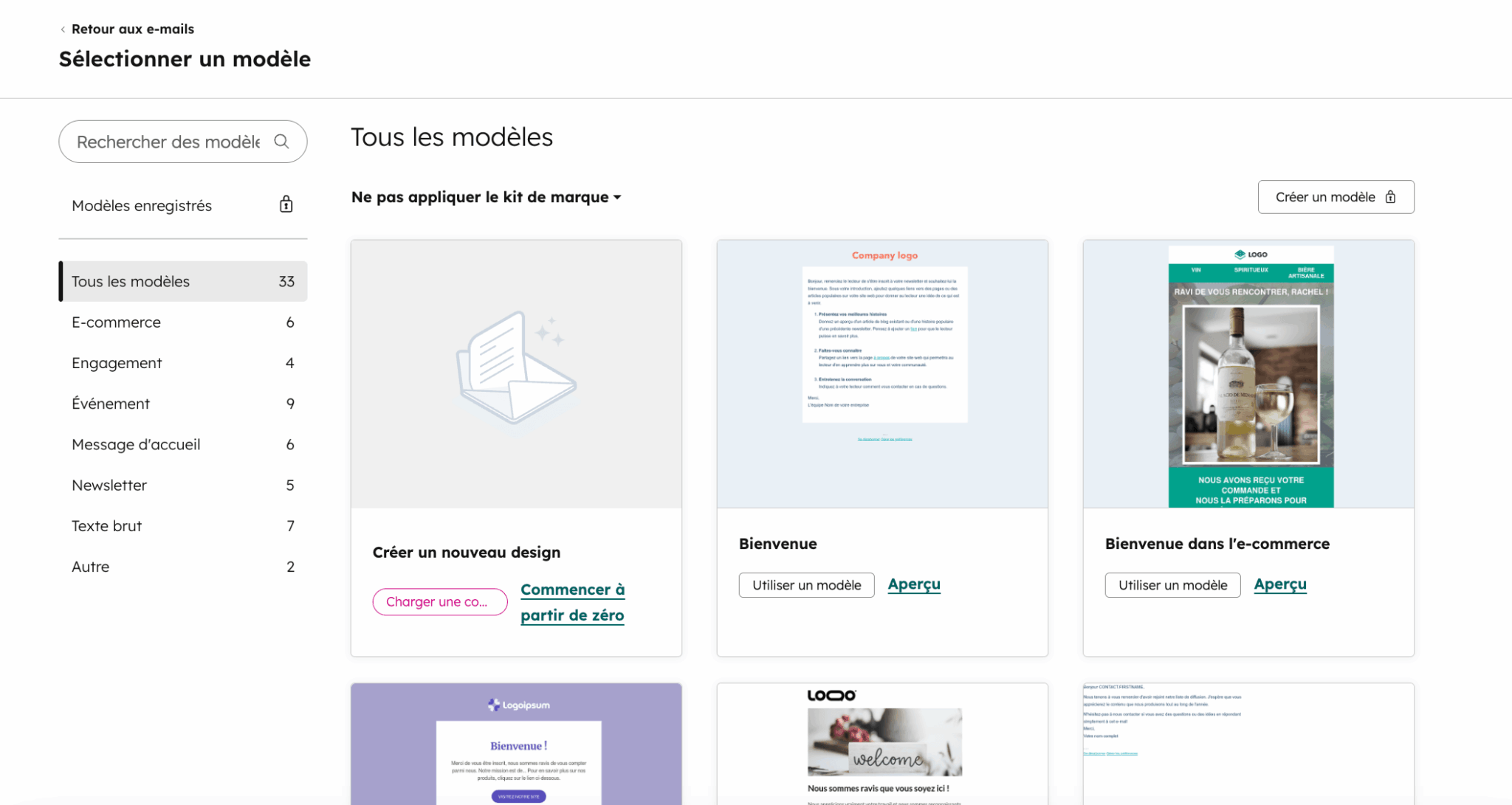
For pure emailing (newsletters, promotional campaigns), Brevo is very competitive. But as soon as email becomes part of a complete customer journey (personalization based on CRM data, Smart Content, sales sequences integrated into the pipeline, multi-touch attribution) the HubSpot platform offers a value that no standalone emailing tool can replicate. It’s the difference between sending emails and driving an email revenue strategy.
#2 CRM & sales pipeline
This is HubSpot’s home turf, and here the gap is clear. HubSpot CRM offers mature standard objects (contacts, companies, deals, tickets) with a unified timeline that centralizes all interactions (emails, calls, page visits, form submissions). Mandatory properties by pipeline stage, lead scoring, customized objects (in Enterprise) and Dashboard Reporting make it a true sales management tool.
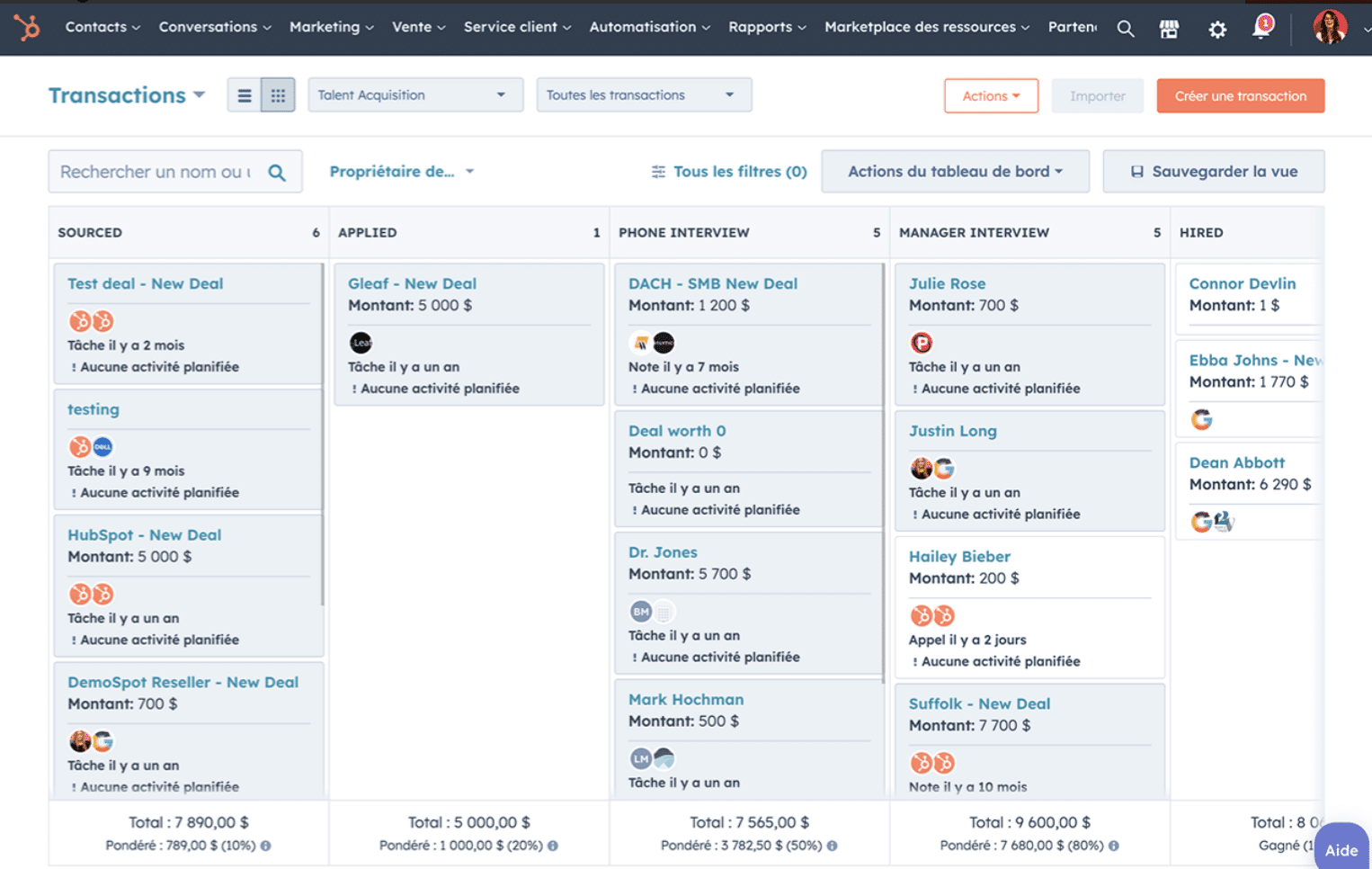
Brevo offers a simple, functional visual pipeline, sufficient for short sales or transactional sales. But for scoring, you have to get around the problem by using a contact attribute updated by automation… which, between you and me, is still DIY. The contact timeline is not as rich, and sales reporting is too basic to manage a structured sales team.
If you’re managing B2B sales cycles with multiple contacts, quotations and negotiation phases, Brevo will soon show its limitations.
If you have a structured sales team or B2B sales cycles, HubSpot CRM is in a different league. But if your sales are short and transactional (e-commerce, simple services), the Brevo pipeline may well suffice.
HubSpot’s free CRM includes unlimited contacts, sales pipeline, tasks and forms. Ideal for seeing if the platform’s depth matches your sales cycles.
#3 Marketing automation & workflows
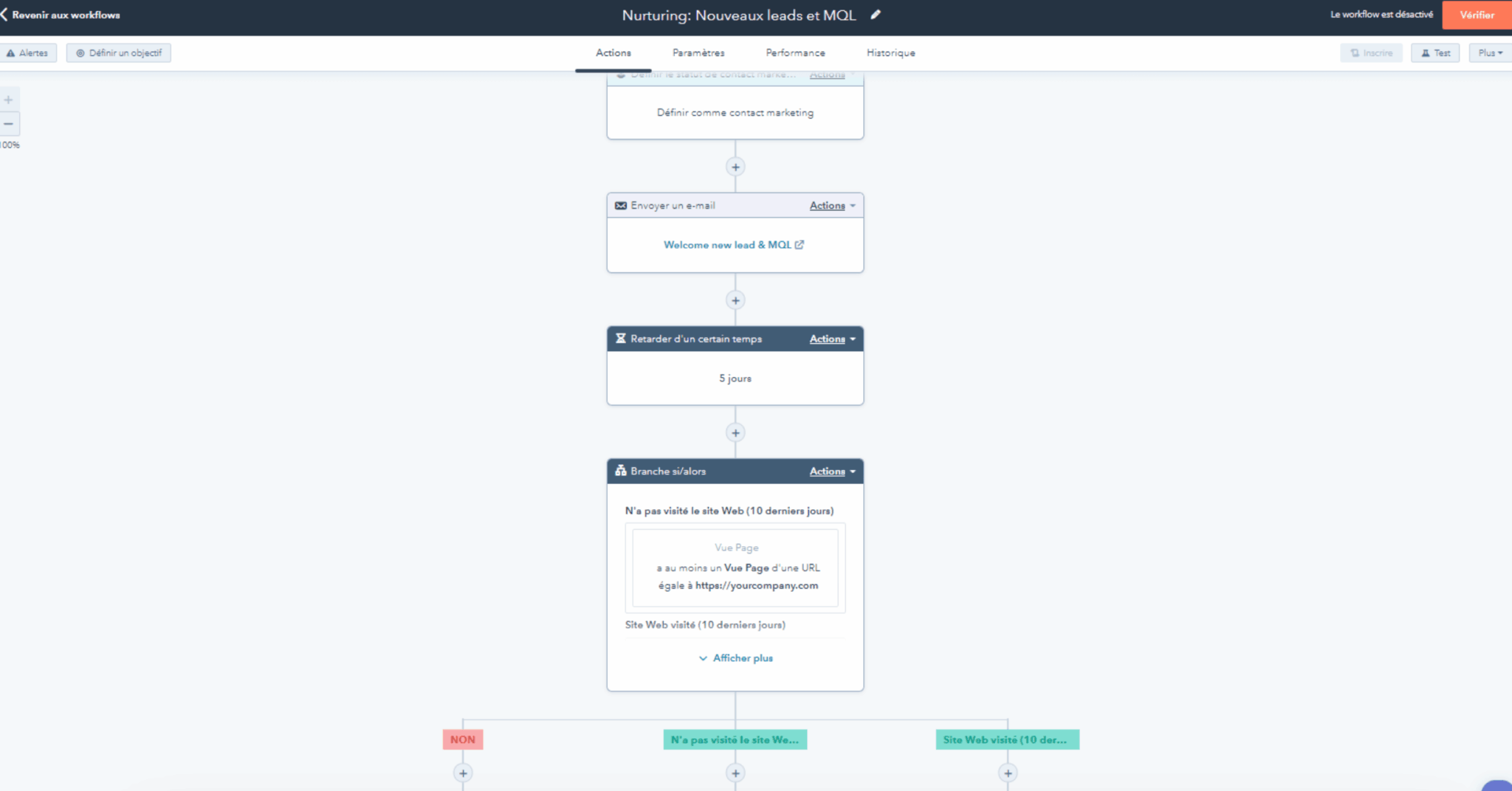
HubSpot software sees marketing automation as a global orchestrator. A single workflow can take into account email interactions, form submissions, page views, CRM properties, deal stage changes, support tickets and contact score, and trigger actions in multiple Hubs simultaneously.
It’s a machine for building very fine lead nurturing paths (MQL → SQL → customer), but one that takes time and skill to set up correctly.
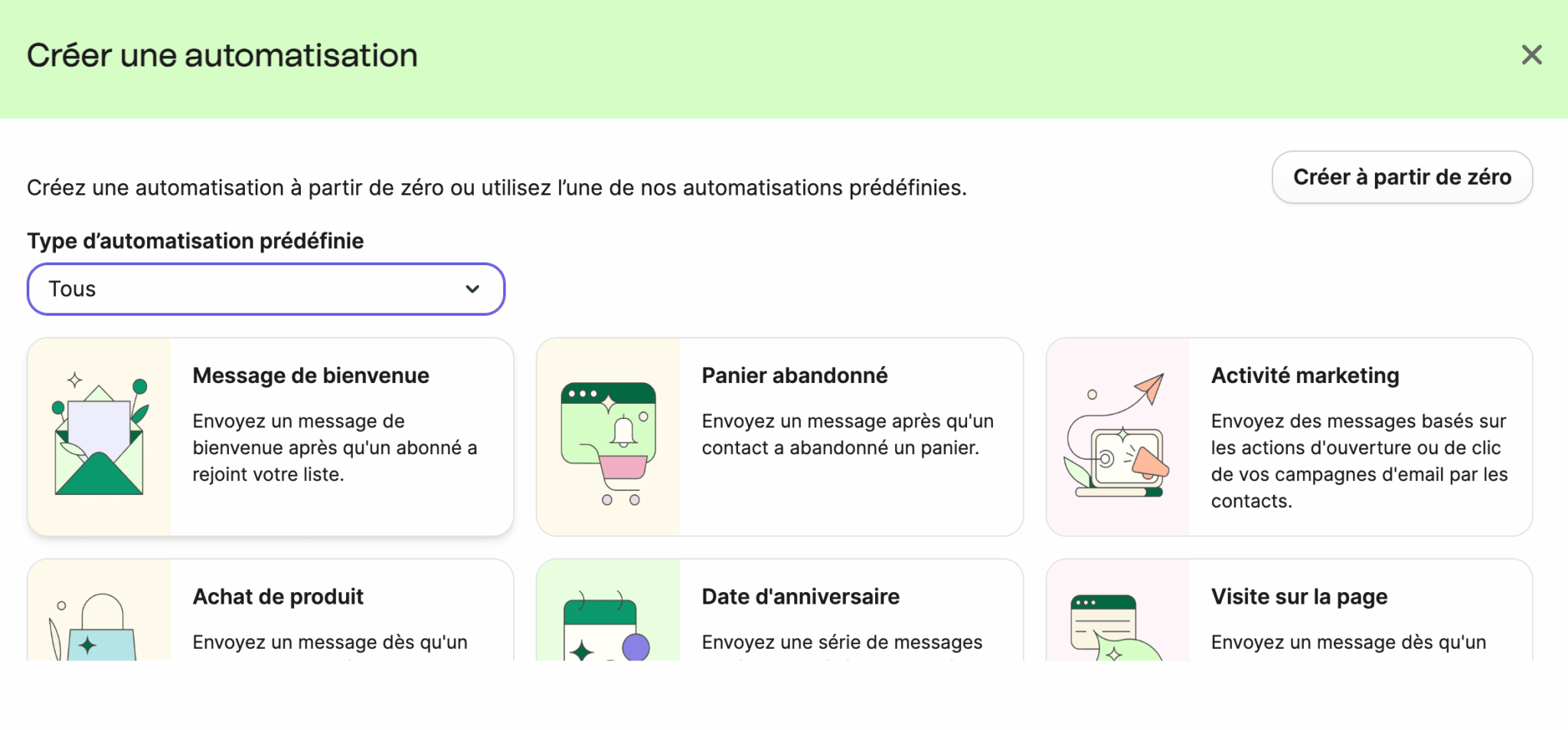
Brevo favors simpler, quicker-to-assemble scenarios. Automations are based on events (registration, click, inactivity, birthday, purchase, page visit) with conditions and branches. With 10+ ready-to-use scenario templates, you can get started very quickly. On the other hand, the link with the pipeline is lighter and cross-object workflow possibilities remain limited.
HubSpot’s marketing automation is the most powerful on the market in terms of depth: cross-object workflows, AI scoring (Breeze AI), A/B testing on workflows, custom-coded actions. If you’re a marketing team of 1 to 3 people just starting out, Brevo scenarios can cover your initial needs. But as soon as you’re looking to align marketing and sales in a single automated process, the Marketing Hub Pro is an investment that pays for itself.
#4 Multichannel: email, SMS, WhatsApp, chat, phone
This is a criterion where Brevo surprises and objectively leads. Email, SMS, WhatsApp Business, online chat, push notifications, Brevo Phone: everything is native and accessible in the standard plans. For an SME that wants to activate several communication channels without piling up subscriptions, this is a very tangible advantage.
HubSpot also covers multichannel, but with a more fragmented and expensive approach. Chatbot and forms are in the free CRM, emailing in the Marketing Hub, phone in the Sales Hub or Service Hub, and WhatsApp requires third-party integrations or an advanced plan. Data consistency is excellent (everything goes back into the contact’s timeline), but activating all channels requires the cumulation of several paid Hubs.
Brevo is pragmatic about multi-channel at a controlled price, that’s undeniable. But the real question is what you do with the data generated by these interactions. At HubSpot, each exchange (email, chat, telephone) automatically enriches the contact’s CRM profile, feeds scoring and improves attribution. At Brevo, channels work well together, but data remains more compartmentalized. If multi-channel is a cost center, Brevo wins. If it’s a customer knowledge lever, HubSpot has the advantage.
#5 Reporting & analytics
HubSpot is clearly ahead of the pack when it comes to reporting. Multi-object dashboards, personalized reports, multi-touch attribution, pipeline forecasts, performance reports by sales rep – the whole package is complete and well thought-out. The Reporting Dashboard makes it possible to cross-reference marketing and sales data, which very few competitors do so well. However, the most advanced functions (attribution, custom reports) are reserved for Pro and Enterprise plans.

Brevo is solid on email reporting: open rates, clicks, heatmaps, geolocation, engagement timeline. This is more than enough to manage marketing campaigns. But when it comes to sales management and ROI measurement, it’s not enough. If you need to know which channel is generating your best leads, or forecast your pipeline, you’ll need a more advanced sales reporting tool.
HubSpot reporting is indispensable for teams who manage a pipeline and want to measure the ROI of their marketing actions. If your needs are limited to tracking the performance of your email and SMS campaigns, Brevo’s analytics do the job very well.
#6 Lead capture: forms & landing pages
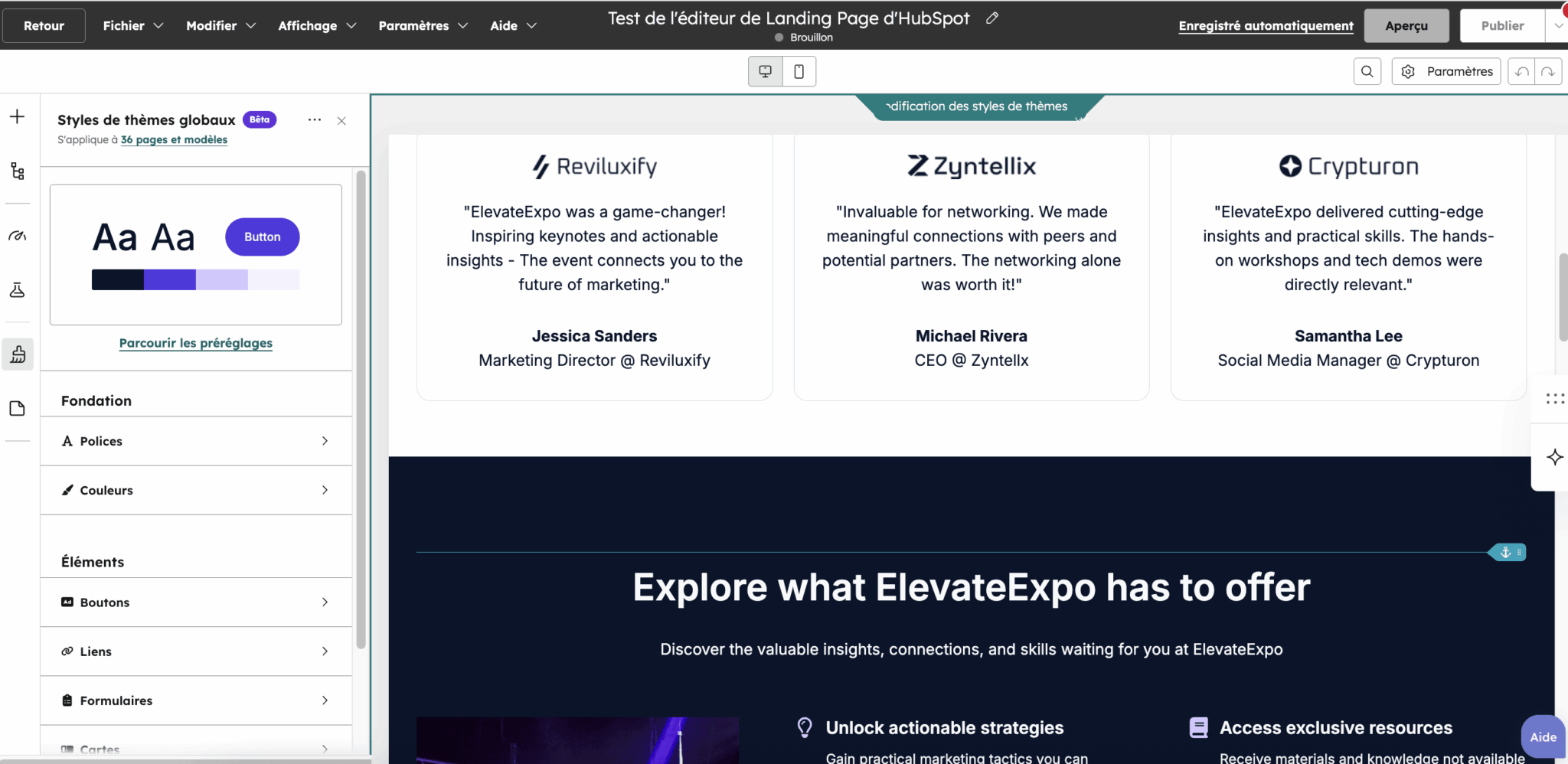
HubSpot offers intelligent forms (progressive, dependent), CRM-integrated landing pages with A/B testing and pop-ups, all natively connected to the pipeline and workflows. It’s objectively one of the best tools on the market for transforming traffic into qualified leads.
Brevo also offers forms and landing pages, but this has always been the platform’s weak point. Templates are limited, you often have to build from scratch, and constraints on email validation (mandatory captcha to avoid hard-bounces) penalize the user experience and conversion rates. This is an issue we identified in our detailed test of Brevo, and which has not fundamentally changed.
This is probably Brevo’s biggest weakness in a B2B context. For serious lead capture, HubSpot is far superior. If you’re using Brevo for emailing, combine it with a dedicated capture tool or HubSpot forms, it works very well as a combo (discussed below).
HubSpot VS Brevo: integrations & ecosystem
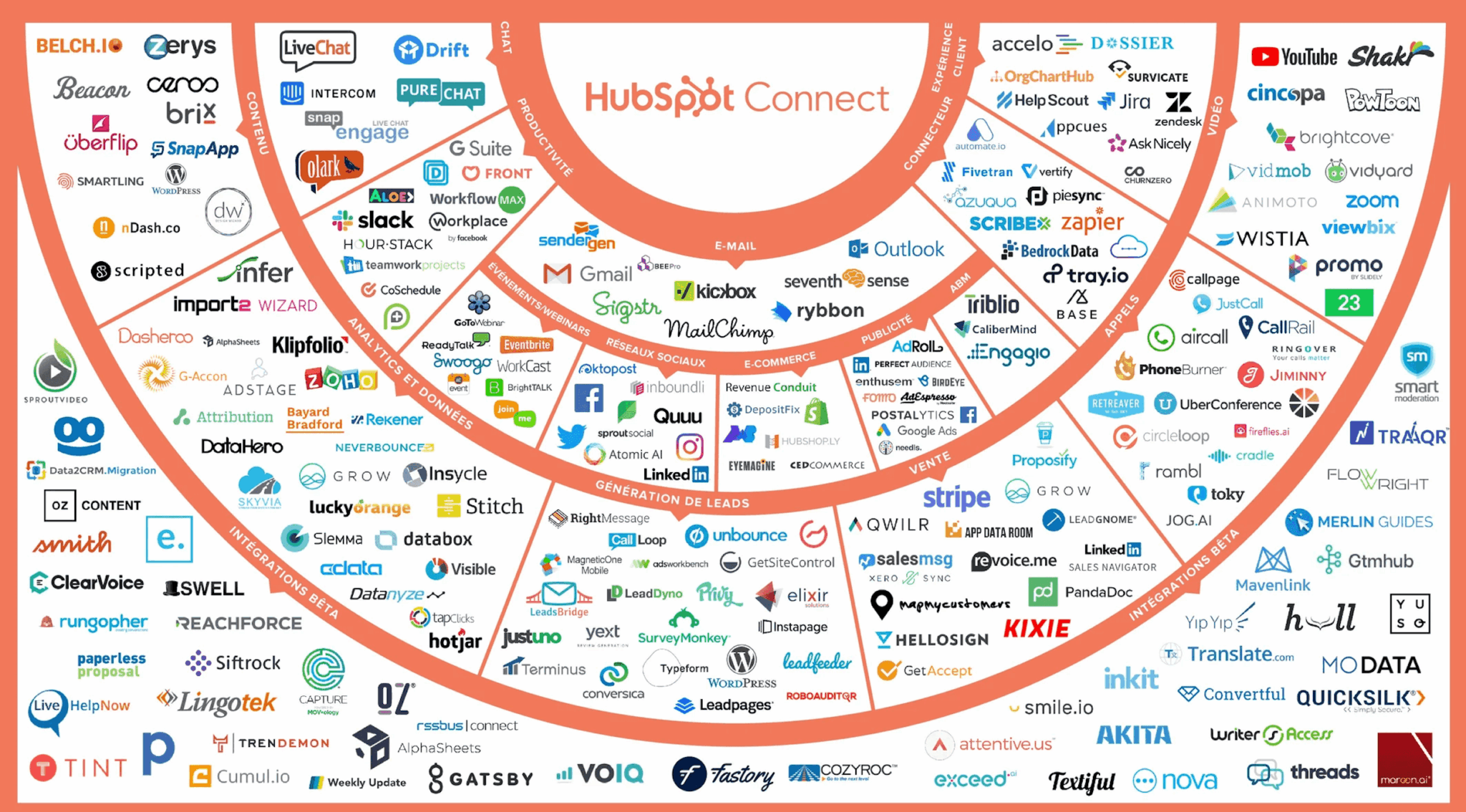
The difference here is structural, not just quantitative. HubSpot positions itself as the central hub of your stack: over 2,000 integrations on the App Marketplace (Salesforce, Shopify, Stripe, Slack, Zoom, etc.), a rich API and deep connectors linking marketing, sales and customer service.
The idea is that HubSpot becomes the single source of truth for all customer data. It’s a mature ecosystem that covers most current stacks: HubSpot + Slack + Shopify for e-commerce, HubSpot + Salesforce + Zoom for sales-driven teams, etc.
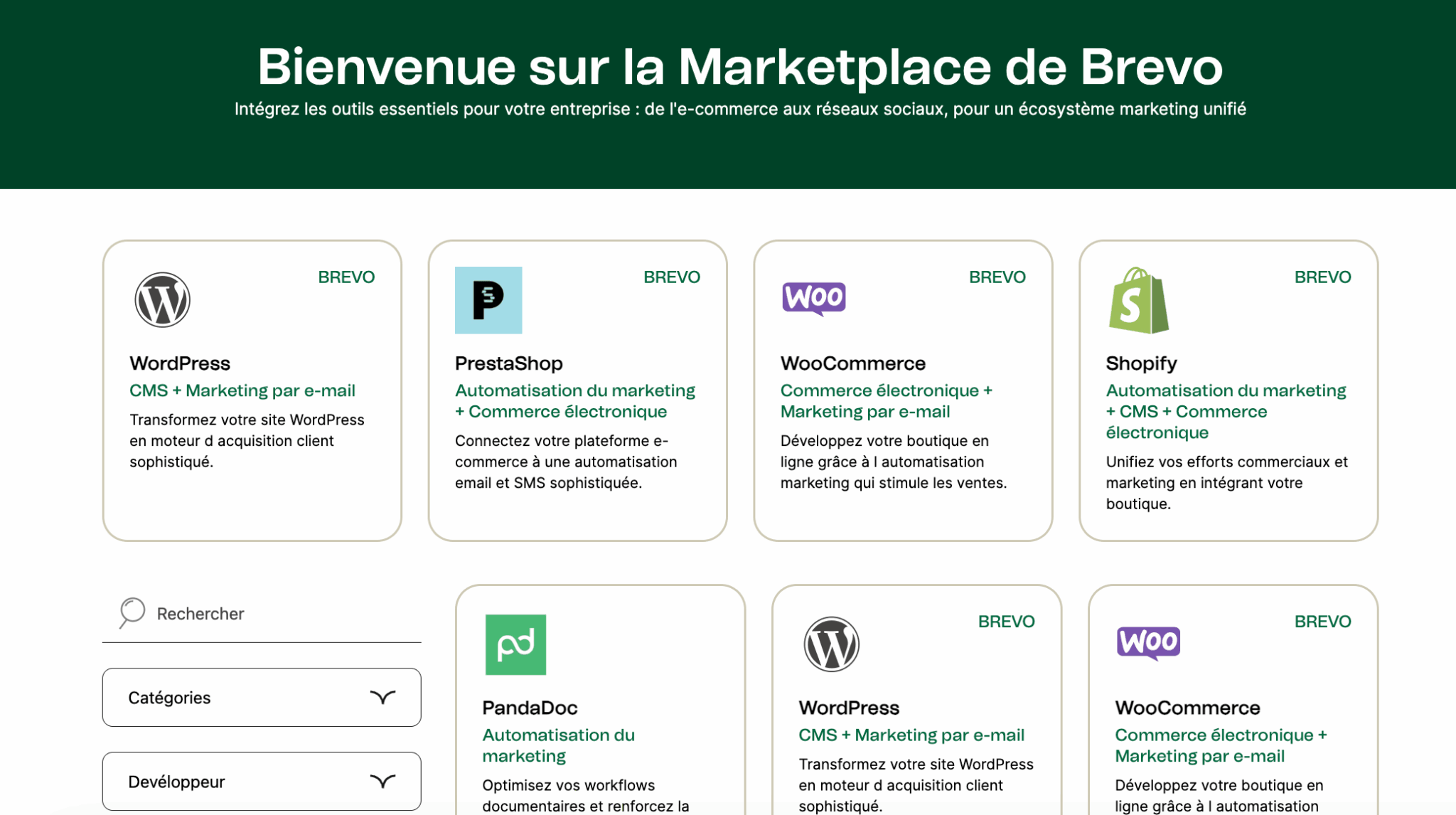
Brevo integrates well with major CMS and e-commerce solutions (WordPress, WooCommerce, Shopify, PrestaShop) and offers around 150 native integrations + Zapier. The API is well documented.
But the ecosystem is tighter: Brevo is positioned as a specialized brick plugged into your existing stack: typically Brevo + PrestaShop + WooCommerce for French e-tailers, or Brevo + WordPress for SMEs looking for a lightweight setup.
An important point: the two integrate well together. HubSpot-Brevo integration is native, allowing you to use Brevo as an email/multichannel brick while keeping HubSpot as your core CRM. We’ll develop this point in the next section.
If you want a single integration point for your entire marketing/sales/service stack, HubSpot is the logical choice. If you’re looking for a high-performance email/marketing brick to plug into an existing CRM (including HubSpot), Brevo fills this role perfectly.
HubSpot VS Brevo: pricing
This is where the comparison gets really interesting, and where the DNA of the two tools becomes apparent.
| Plan | HubSpot (Marketing Hub) | Brevo (Marketing Platform) |
|---|---|---|
| Free | Full CRM, unlimited contacts, 1 pipeline, forms, basic email marketing (2,000 sends/month) | 300 emails/day, up to 100,000 contacts, basic CRM, limited automation (2,000 contacts) |
| Entry-level | Marketing Hub Starter: €20/user/month, 2 pipelines, no branding, 1,000 marketing contacts included | Starter: from 7€/month (5,000 emails/month), no daily limit, advanced segmentation, basic reporting |
| Mid-range | Marketing Hub Pro: €880/month (3 users + 2,000 marketing contacts included) + ~€1,470 mandatory onboarding, advanced workflows, A/B testing, attribution, custom Dashboard reporting | Standard: from €15/month (5,000 emails), marketing automation, A/B testing, landing pages, heatmaps, web tracking |
| High-end | Marketing Hub Enterprise: €3,300/month + €3,420 onboarding: custom objects, AI scoring (Breeze), partitioning, revenue attribution | Pro: from €499/month (150,000 emails), WhatsApp, push, multi-user (10 seats), scoring, telephone support |
| Billing model | Per user + per level of marketing contacts | By volume of emails sent (unlimited or capped contacts depending on plan) |
| Onboarding mandatory | Yes, on Pro and Enterprise plans (€1,470 to €3,420) | No |
The business model is fundamentally different. HubSpot charges per user and per number of marketing contacts: as your base of active contacts grows, so does your invoice, regardless of the volume of mailings.
Brevo charges by volume of e-mails sent: you can have 50,000 contacts in your database at no extra cost, as long as you stay within your monthly dispatch limit.
Three concrete scenarios for comparison
| Company profile | HubSpot (estimated/month) | Brevo (estimated/month) |
|---|---|---|
| Startup (2 people, 2,000 contacts, 4 emails/month) | Free CRM or Starter at €40/month | Starter €7/month (8,000 emails) |
| SME (5 people, 20,000 contacts, 4 emails/month) | Marketing Hub Pro: €1,100-1,300/month (base + additional contacts) | Standard at €39/month (80,000 emails) |
| ETI (15 people, 50,000 contacts, 4 emails/month) | Marketing Hub Enterprise: €4,000-5,000/month | Pro €499/month (200,000 emails) |
Brevo is cheaper than HubSpot on emailing, that’s a fact. But direct comparison is misleading: Marketing Hub Pro includes CRM, advanced automation, attribution reporting, landing pages, AI scoring and support for the entire HubSpot platform in a single subscription. To achieve an equivalent functional scope with Brevo, you’d have to stack several tools and integrate them with each other, with the hidden costs of maintenance and fragmentation that this implies. The real calculation is total cost of ownership versus value generated.
HubSpot VS Brevo: RGPD compliance & sovereignty
Both solutions are RGPD-compliant, but the arguments are not the same.
- Brevo is a French company (founded in Paris in 2012), with data hosted exclusively in the European Union (France and Germany). For French organizations sensitive to digital sovereignty (particularly in regulated sectors) this is a strong argument: no exposure to the American Cloud Act, legal proximity, French-speaking support.
- HubSpot is an American player, but now offers EU data residency options, a comprehensive DPA and robust security certifications (ISO 27001, SOC 2). RGPD compliance is ensured by integrated tools (double opt-in, consent management, data deletion). Strong presence in France (office, partner network French-language content).
For most SMEs, both are perfectly acceptable on the RGPD side. Brevo has an objective advantage on data sovereignty (100% French company and hosting), which can be a decisive criterion if you’re working with local authorities, healthcare players or organizations that require guaranteed EU hosting.
HubSpot + Brevo: the hybrid setup to get you started
This setup is ideally suited to small and medium-sized businesses that are just starting out with their sales structure and don’t yet need the power of Marketing Hub Pro. It’s a smart way to get started with HubSpot CRM without blowing your marketing budget. But let’s be clear: this combo has its limits, which become apparent as your marketing strategy becomes more sophisticated.
The idea is simple: use HubSpot as your central CRM (free or Starter plan) and Brevo as your emailing and multi-channel engine. You benefit from HubSpot’s CRM depth, pipeline and reporting to drive your sales activity, and Brevo’s value and multi-channel for your marketing campaigns.
Why it works:
- Native HubSpot-Brevo integration synchronizes contacts and data in real time.
- You avoid the Marketing Hub Pro (€880/month) while keeping the HubSpot CRM, which is the platform’s real core value.
- Brevo handles emailing, SMS, WhatsApp and chat for a fraction of the price.
- You retain the option of migrating to Marketing Hub Pro at a later date if your needs change.
Let’s take a concrete example. A 10-person B2B SME with 15,000 contacts, which sends out 4 newsletters a month and manages 3 sales representatives on a CRM pipeline:
- Option A, Full HubSpot: Marketing Hub Pro (~€880/month) + Sales Hub Starter (3 × €20) = €940/month, not including €2,930 mandatory onboarding.
- Option B, HubSpot + Brevo Combo: Free HubSpot CRM + Sales Hub Starter (3 × €20) + Brevo Standard (€39/month for 60,000 emails) = €99/month. That’s €840 in monthly savings.
Option B loses access to HubSpot cross-object workflows, IA Breeze scoring, multi-touch attribution and Smart Content. These are precisely the features that transform a marketing tool into a measurable revenue-generating machine. For many start-up SMEs, the combo is enough. But as soon as you’re looking to measure the ROI of your marketing actions, score your leads automatically or align marketing and sales on shared data, the Marketing Hub Pro becomes a worthwhile investment.
The best place to start: HubSpot’s free CRM to centralize your contacts and manage your pipeline. If your marketing budget is tight to start with, you can plug in Brevo for your email campaigns until you upgrade to Marketing Hub Pro.
Salesdorado verdict: which tool for which profile?
Choose HubSpot if :
- You want a central CRM that aligns marketing, sales and customer service around a single database.
- You have a structured sales team with B2B sales cycles (several contacts, quotations, negotiation).
- You intend to leverage advanced marketing automation: scoring, cross-object workflows, multi-touch attribution, Breeze AI.
- Sales reporting is essential to your management (forecast, performance by rep, attribution).
- You’re ready to invest in a tool that scales with your growth, even if it means accepting the higher price of Pro plans.
Choose Brevo if :
- Emailing is your main customer relationschannel (newsletters, transactional emails, promotional campaigns).
- You’re looking for a tool that’s simple, affordable and quick to deploy, without mandatory onboarding or a long learning curve.
- You want native multi-channel (email + SMS + WhatsApp + chat) without blowing your budget.
- Your sales cycles are short or transactional, and you don’t need a highly advanced CRM.
- If you have a large contact base with moderate marketing pressure, the per-email model will be much more advantageous.
Choose both if :
- You need a solid CRM, but not a Marketing Hub Pro.
- You want the best of both worlds: HubSpot pipeline and reporting + Brevo emailing and multichannel.
- You want to keep your budget under control while maintaining a coherent marketing/commercial stack.
Our recommendation: start with HubSpot. Free CRM gives you a solid foundation for structuring your customer relationships. If your emailing needs go beyond what the free plan offers, Brevo is an excellent complement at a controlled price. But as your business grows, the HubSpot platform, with its advanced Workflows, Breeze AI scoring and attribution reporting, is the tool that will enable you to move from artisanal marketing to a true data-driven growth machine.