Today, it’s hard toimagine a company performing well without a powerful CRM to structure its customer management, track every prospect, automate its processes, and guide its sales teams on a daily basis. Whether you’re a VSE, SME or fast-growing organization, the right software can transform the way you sell, collaborate, analyze data and even build customer loyalty. Between giants like HubSpot and Salesforce, and solutions like noCRM, Attio or even newer cloud platforms, the choice quickly becomes complex.
This comparison helps you sort through the features, prices, automation, integrations, interface, marketing options and lead tracking, so you can choose the solution that’s really right for your business. The aim is to help you improve your efficiency, optimize every stage of the sales cycle, accelerate your growth and select the CRM that will play a key role in your strategy.
Sommaire
Table of contents
Discover our vision of the top 10 best CRMs in table form, to understand at a glance what they offer. This gives you a quick overview before going into detail platform by platform, to help you find the CRM solution that’s right for you.
| CRM | Starting price | Free version | Overall rating* (%) | Worldwide users | Target company size | Main strength |
|---|---|---|---|---|---|---|
| Sellsy | 29€/user/month | 15-day trial | ⭐⭐⭐⭐ 4.5/5 | 20,000+ companies | French SMEs | Solution with exceptional support |
| Monday CRM | 12€/user/month | No | ⭐⭐⭐⭐ 4.3/5 | 180,000+ companies | Agile SMEs | Ultra-intuitive visual interface |
| Salesforce Marketing Cloud | 14€/user/month | 30-day trial | ⭐⭐⭐⭐⭐ 4.6/5 | 100,000+ companies | Commercial SMEs | Exceptional pipeline management, loved by salespeople |
| noCRM | 22€/user/month | 14-day trial | ⭐⭐⭐⭐ 4.4/5 | 15,000+ companies | Action-oriented VSEs | Radical simplicity, focus on sales action |
| HubSpot | 0 then €90/user/month | Yes (unlimited) | ⭐⭐⭐⭐⭐ 4.7/5 | 200,000+ companies | SME marketing+sales | Best free CRM, all-in-one platform |
| Attio | 29€/user/month | Yes (3 users max) | ⭐⭐⭐⭐ 4.2/5 | 10,000+ companies | Tech startups | Powerful AI and Notion-style next-gen interface |
| Salesforce | 25€/user/month | No | ⭐⭐⭐⭐⭐ 4.8/5 | 150,000+ companies | VSEs → Key accounts | Global leader, complete ecosystem and native Einstein AI |
| Microsoft Dynamics 365 | 60 to 80€/user/month | 30-day trial | ⭐⭐⭐⭐ 4.3/5 | 40,000+ companies | ETI/Large companies | Seamless integration with the Microsoft ecosystem |
| Folk | 20/user/month | Free trial | ⭐⭐⭐⭐ 4.1/5 | 5,000+ companies | Microenterprises | Invisible CRM integrated into Gmail/Slack |
| Creatio | 35€/user/month | 14-day trial | ⭐⭐⭐⭐ 4.4/5 | 8,000+ companies | SME specific processes | Ultra-customizable no-code platform |
*Rating legend: Based on aggregated user reviews (G2, Capterra, TrustRadius,…) and our in-depth analysis of each solution.
#1 Sellsy, the all-in-one CRM that speaks your language
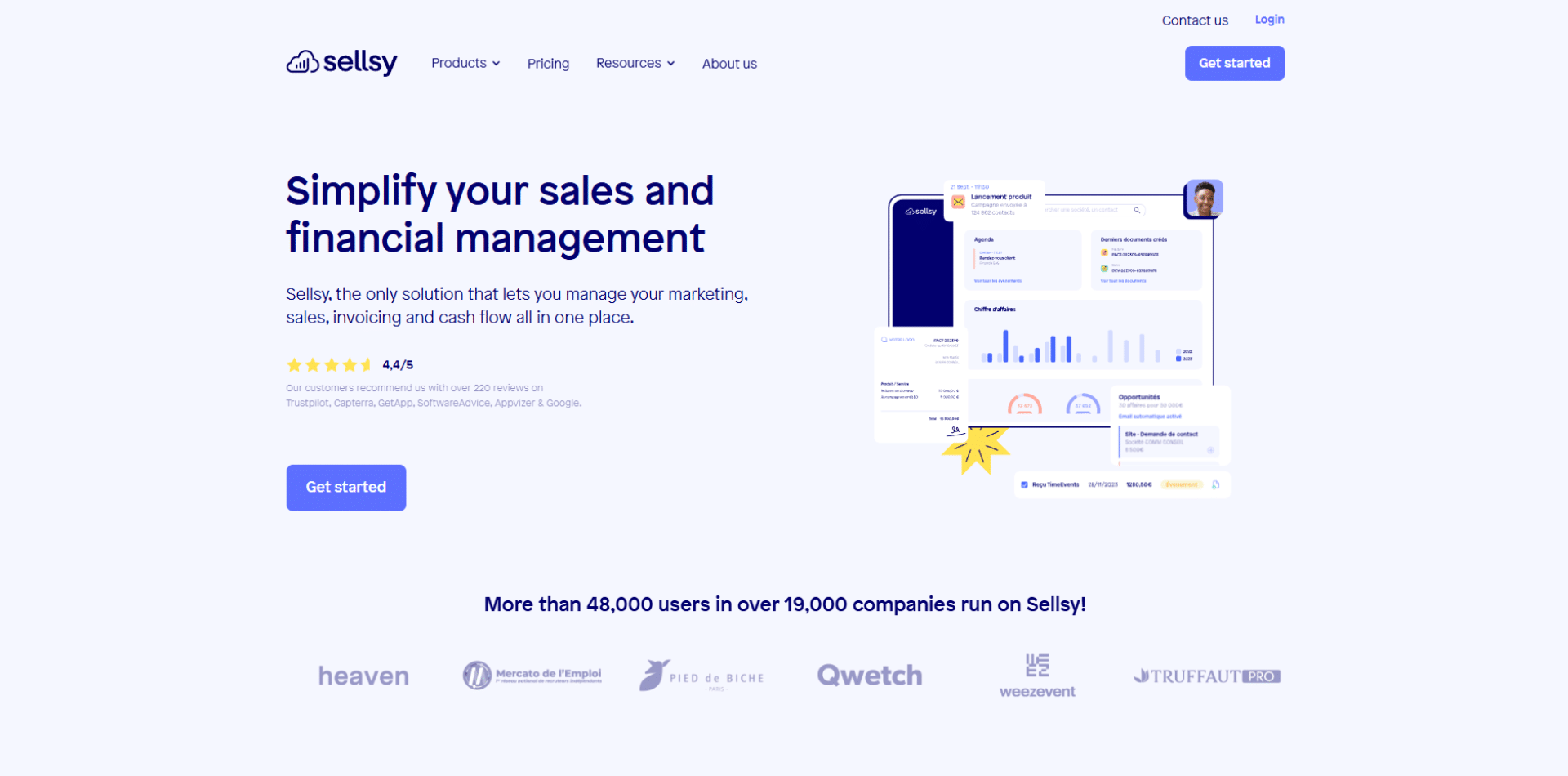
Sellsy is the quintessential CRM solution, designed by and for companies. Beyond the language, it’s a whole business approach adapted to specificities: compliant invoicing, management of quotations according to local customs, integrations with all tools.
The Sellsy platform goes far beyond traditional CRM. It’s a true ERP for SMEs, with functionalities for prospecting, quotations, invoicing, reminders, accounting, project management, customer support… A company can literally manage everything from Sellsy, from the first contact to the final payment. The business approach makes all the difference.
Customer support changes everything. Direct call, responsive chat, a team that understands your issues. Training is in French, english and spanish, documentation is clear, webinars are tailored to your needs. For an SME, this is incomparable comfort. The ecosystem of integrations completes the package: synchronization with your chartered accountant, connection to banks, payroll tools, etc. Sellsy fits perfectly into the French software landscape.
Typical targets :
- Multi-activity SMEs (10-100 employees) : Companies looking for a unified tool
- Service companies: ESN, agencies, consultants with customer project management
- B2B companies with quote/invoice cycles: construction, industry, trade, distribution
- Structures favoring local support: VSEs/SMEs looking for support
Advantages and disadvantages of Sellsy :
- All-in-one platform: CRM + Billing + Project + Support = a single tool
- Support among the best: responsive team, training included, real proximity
- Complete sales management: quotations, purchase orders, invoices, credit notes, reminders.
- Integrations : Banking, accounting, payroll, signatures
- High prices: Plans from €29 to €69/user/month more expensive than the competition
- Limited customization : Less flexible than leaders for specific needs
Try Sellsy for free
Sellsy offers a 15-day free trial and a free demo to discover their offers.
#2 Monday CRM, the visual CRM revolution for agile teams
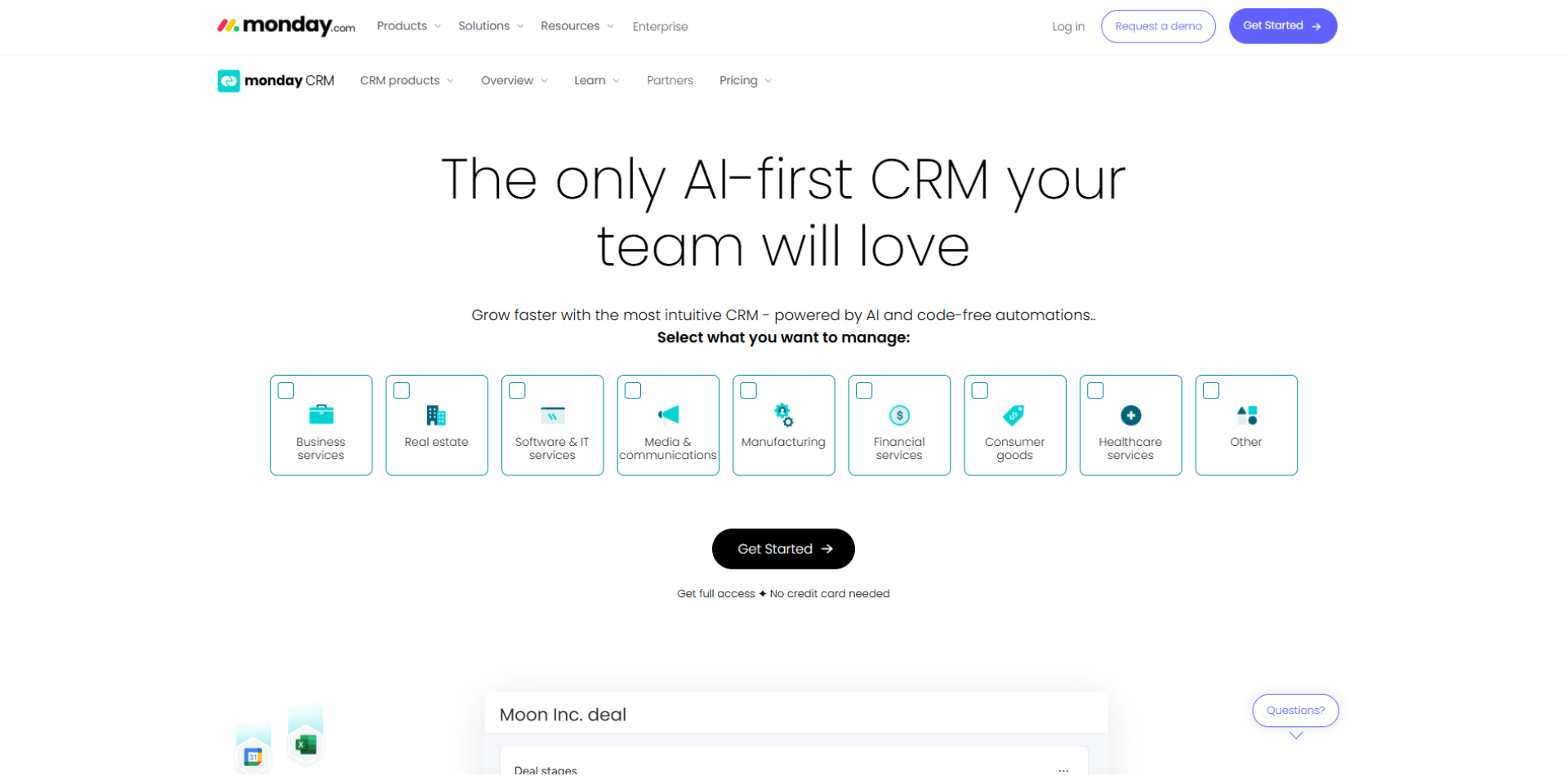
Monday CRM transforms customer relationship management into a visual and intuitive experience. Born of Monday’s expertise in project management, this next-generation CRM abandons complex interfaces for colorful charts and visual workflows that make prospecting almost playful. Imagine a sales pipeline where each opportunity is a card that you move from column to column: “First contact”, “Planned demo”, “Negotiation”, “Won”. Each move triggers automations such as emailing, task creation and team notification. Sales people love it, because it’s all visual and immediate.
The platform offers total flexibility. Unlike traditional, rigid CRMs, Monday adapts to your processes. Do you sell B2B with long cycles? Create detailed stages. Doing e-commerce? Set up a fast pipeline. Managing after-sales projects? Connect CRM and project management directly.
The tool integrates naturally with Gmail, Outlook, Slack, and dozens of other applications. Data synchronizes automatically: an e-mail sent from Gmail appears in the customer’s chronology, and a signature on DocuSign updates the status of the opportunity. Starting at just €12 per user per month, Monday CRM offers the best simplicity/price ratio on the market, particularly for teams just starting out in their sales structuring.
Typical targets :
- Seed-stage startups (3-15 people): Young teams favoring agility and visual collaboration
- Creative and digital agencies: Studios, marketing agencies, consultants who appreciate modern interfaces
- SMEs undergoing transformation: Companies abandoning Excel for a first true CRM
- Mobile sales teams: Field sales forces using mainly cell phones
Advantages and disadvantages of Monday CRM :
- Revolutionary visual interface: Kanban tables, chronological views, real-time graphs
- Set up in hours, not days: pre-designed templates, easy Excel import
- Code-free automation: create complex workflows with drag-and-drop ease
- Native collaboration: comments, mentions, file sharing directly on each deal
- Ultra-competitive pricing: Free version available soon, pay-as-you-go plans very affordable
- Limited reporting: basic analyses compared to established CRMs, few forecasts
- No advanced features: No AI scoring, basic marketing automation
- Perfect support: Answers lack flexibility
- Product youth: Less experience than other players, frequent changes
Try Monday CRM for free
You can test Monday CRM free of charge for 14 days. The tool then costs from €12 per user per month. A 100% free version is in preparation…
Essayez notre moteur de recommendation pour shortlister les 3 logiciels les plus adaptés à votre besoin
#3 Pipedrive, the CRM for salespeople, by salespeople
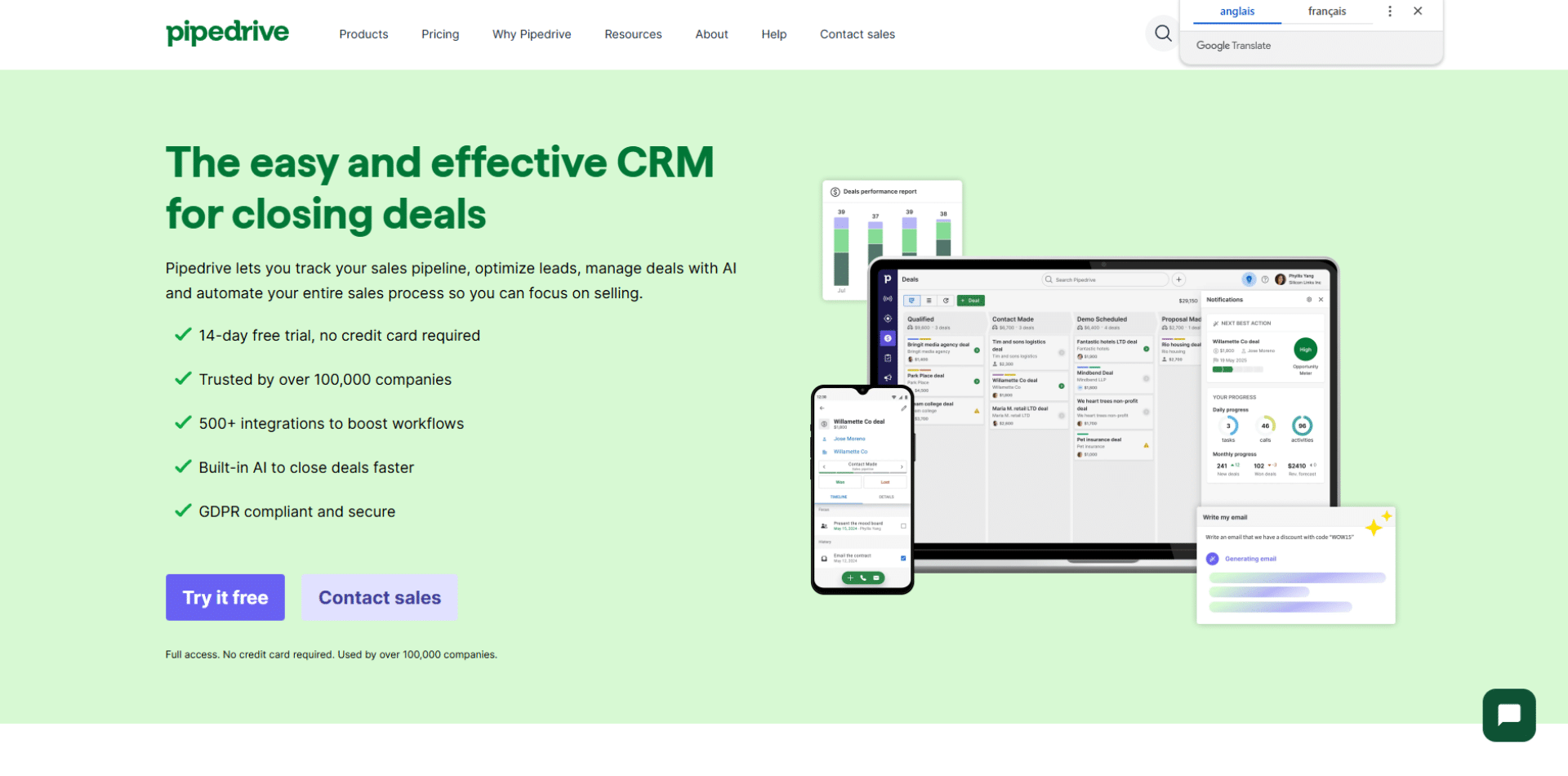
Pipedrive was born out of frustration: traditional CRMs are designed for managers, not for salespeople in the field. The result? Software where every feature is aimed at winning sales, not filling out reports.
Pipedrive’s interface focuses on the visual pipeline. Your deals progress from left to right through your sales stages. Color coding instantly indicates hot, lukewarm or cold opportunities. Activities to do today are highlighted. It’s impossible to forget to follow up with a prospect. The magic is in the details that make day-to-day sales easier. The tool automatically detects contacts from your e-mails. It records telephone calls. It programs intelligent follow-ups based on your habits. Sales reps save 30% in administrative time (according to studies).
Pipedrive excels in integration with prospecting tools: LinkedIn synchronization, automatic enrichment of prospect data, opportunity detection from email signatures. More than 400 available applications turn Pipedrive into a veritable sales command center. Teams particularly appreciate the coaching features, such as step-by-step analysis of conversion rates, identification of bottlenecks, and suggestions for improvement based on the team’s best performance.
Typical targets :
- SME B2B with structured sales force (5-50 salespeople): Service, software, distribution companies
- Companies with short/medium sales cycles: Deals closing in a few weeks/months
- Performance-oriented sales teams: Organizations with a results and reporting culture
- Sectors: Consulting, IT solutions, commercial real estate, professional training, industry
Advantages and disadvantages of Pipedrive :
- Top-notch pipeline management: clear visual view, drag & drop, automatic forecasts
- Designed for sales productivity: intelligent automations, reminders, email templates
- Excellent 24/7 support
- Benchmark mobile app: 100% desktop functionality, offline mode, geolocation
- 24/7 multilingual support: chat, call, e-mail with less-than-fast response times
- Sales integrations : Native connectors for prospecting, signature and VoIP tools
- Limited marketing: no native automation, basic campaign management
- No permanent free version: Only 14-30 day trial
- Rapidly escalating pricing: essential features in costly plans (Lead Booster +32€/month)
- Limited customization: less flexible than competitors for complex processes
Try Pipedrive for free
Take advantage of a free trial extended to 30 days (instead of 14) by following the link below.
#4 noCRM, the anti-CRM that puts sales action back at the center
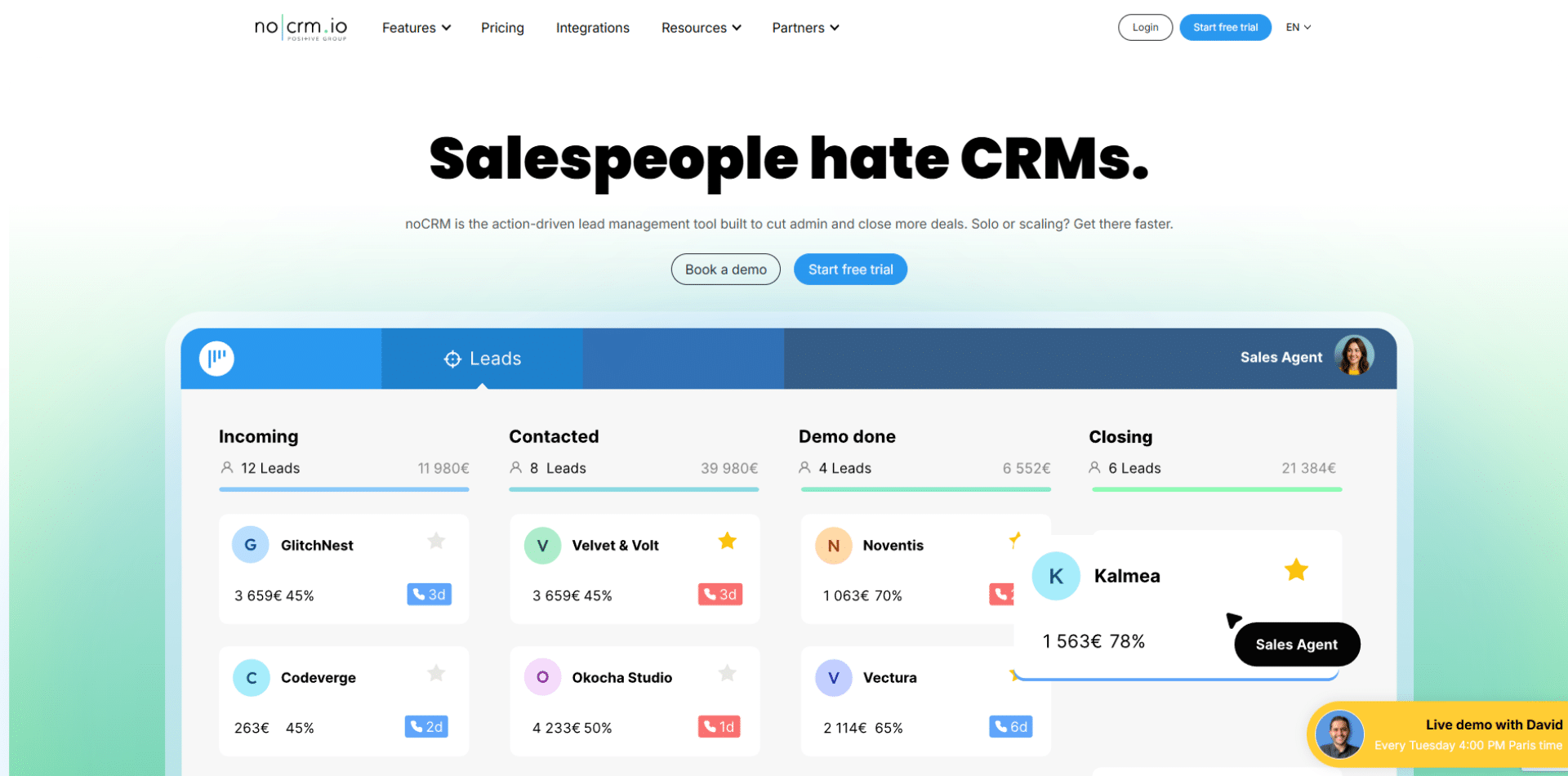
noCRM is based on the observation that 65% of salespeople’s time is wasted on administration in conventional CRM systems. This French solution changes the approach by eliminating everything that isn’t directly used to sell more. Forget endless contact sheets and useless data. noCRM focuses on hot leads and the actions to be taken. Each lead is a simple card with the essentials: name, identified need, next action, potential amount. The ultra-clean interface avoids distractions.
Lead capture becomes instantaneous: LinkedIn extension to import a profile in 1 click, web form that automatically creates an opportunity, WhatsApp Business integration for prospects who prefer this channel. Even the most technology-averse sales reps adopt the tool in a matter of hours.
noCRM features a “next action” tracking system. Rather than complex tasks, each lead simply has a clear action: “Call Tuesday”, “Send quote”, “Follow up after vacation”. Every morning, the tool presents the day’s action list. Impossible to let a prospect go cold . The complete sales management aspect is the cornerstone of the software: 2-click quote creation with your product catalog, invoice conversion after signature, payment tracking. VSEs appreciate this end-to-end vision, which means they don’t have to juggle several software packages.
Typical targets :
- Field sales teams (2-20 people): Mobile sales forces, teleprospecting, BtoB sales representatives
- Action-oriented VSEs: Companies favoring rapid execution over in-depth analysis
- Freelancers and consultants : Professionals who manage their own prospecting and invoicing
- Short-cycle sectors: business services, trade, events, training
Advantages and disadvantages of noCRM :
- Radical simplicity: 30-minute learning curve, zero training required
- Focus action: Unique “next action” system boosts productivity
- Multi-channel lead capture: LinkedIn, web, email, WhatsApp, 1-click calls
- Integrated sales management: quotations, invoices, reminders in the same tool
- Minimalist reporting: basic dashboards, few predictive analyses
- No marketing CRM: No automation or campaign functionality
- Limited customization: fixed processes, few custom fields
- No free plan : Rates from €22 to €33/month without discovery option
Try noCRM for free
noCRM offers a 14-day free trial. Rates vary from €22 to €33 per user per month (based on annual payment), depending on the profile: solopreneurs, growing or well-established sales teams, or telesales teams.
#5 HubSpot, the all-in-one platform that unifies marketing and sales
HubSpot revolutionized the market by creating the concept of Inbound Marketing. Today, their CRM is much more than a tool, it’s a complete platform that aligns marketing, sales and customer service around a single vision of the customer. HubSpot CRM is free in its simplest version: unlimited contact management, visual pipeline, e-mail integration, live chat, forms… Enough to effectively manage your vision without spending a single euro.
The real power comes with the paid versions. Marketing Hub turns your site into a lead generation machine (landing pages, intelligent forms, lead scoring, automation workflows). Sales Hub arms your sales force with automated e-mail sequences, CRM calls, personalized videos and electronic signatures. The system’s intelligence lies in the unification of data. A visitor fills in a form? He instantly becomes a contact with a score, assigned to the right sales rep. The sales rep sees everything: pages visited, e-mails opened, content downloaded. Marketing knows which campaigns generate the best opportunities.
The HubSpot ecosystem includes over 1,000 native integrations. Your Quickbooks accounting, your Zendesk support, your social networks, everything connects. Companies appreciate this centralization, which eliminates silos between departments.
Typical targets :
- Growing SMEs (20-200 employees) : B2B companies looking to scale their customer acquisition
- Inbound companies: Organizations creating content to attract prospects
- Aligned marketing/sales teams: Structures that want to break down silos between departments
- Sectors: SaaS, e-learning, professional services, B2B e-commerce, agencies
Advantages and disadvantages of Hubspot :
- The most generous free CRM: unlimited contacts, full functionality, really usable
- Powerful marketing automation: visual workflows, lead nurturing, automatic scoring
- Truly unified platform: Marketing + Sales + Service talk together
- Free Academy: Training, certifications, best practices included
- Modern, intuitive interface: rapid adoption by teams
- Explosive costs at scale: Price per contact + user = 5-figure budgets quickly
- Progressive lock-in: the more you use it, the more difficult/costly it is to change.
- Customization sometimes limited: Less flexible than the big players in the market for tailor-made needs
Try HubSpot free of charge
HubSpot offers a free plan with no time limit. The free plan can go a long way if you’re just starting out. After that, you will have to switch directly to a paid plan.
Essayez notre moteur de recommendation pour shortlister les 3 logiciels les plus adaptés à votre besoin
#6 Attio, Notion’s next-generation CRM for startups
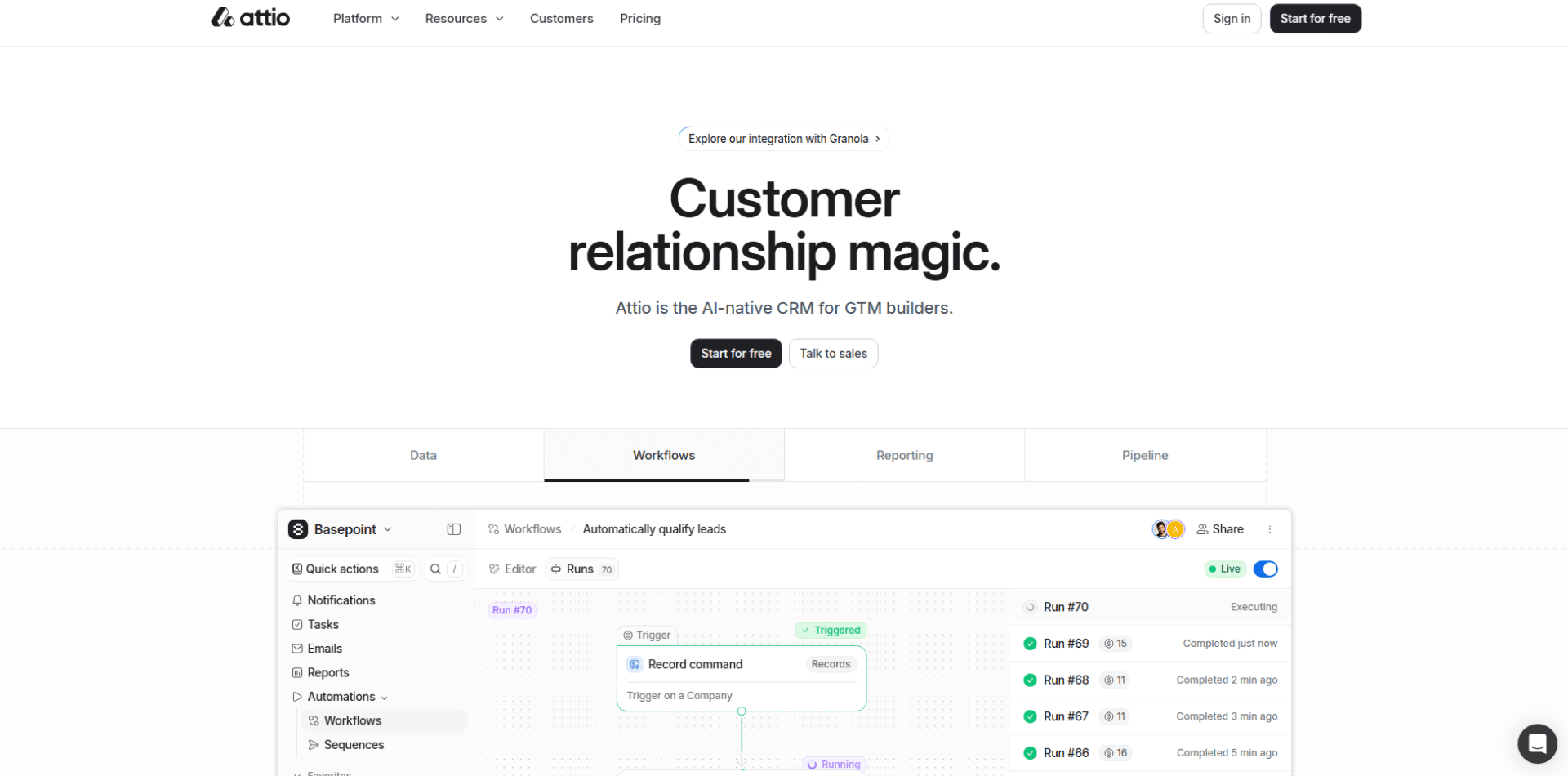
Attio embodies the new wave of CRM. Ultra-flexible, collaborative and intelligent. If Salesforce were Excel, Attio would be Notion, with a radically different approach to customer relationship management.
The interface features a clean design, fluid navigation and drag-and-drop customization. Create your own views with classic sales pipeline, kanban board for support, timeline for customer projects. Each team configures its space according to its needs. Artificial intelligence is not a gadget, but the heart of the product. Attio automatically enriches your contacts, finding company information, the latest news and common connections. It suggests the best people to contact, the best time to follow up, and similar successful opportunities.
The collaborative philosophy is a game-changer. No more siloed data. All e-mail exchanges, call notes and shared documents are centralized for each contact. Teams truly work together, with contextual discussion spaces on each deal. Attio features all the latest integrations: Slack for notifications, Linear for product management, Figma for design… It’s the CRM for digital-first companies using best-in-class tools. The free plan for up to 3 users lets you test this innovative approach in real-life conditions, with no limits on contacts or functionalities.
Typical targets :
- Early-stage tech startups: Hypergrowth teams of 3-50 people
- Modern digital agencies: design studios, development, digital marketing
- Remote-first enterprises: Distributed organizations based on asynchronous collaboration
- Venture professionals: VCs, incubators, gas pedals managing portfolios
Advantages and disadvantages of Attio :
- Next-gen interface: Design and UX at Notion or Figma level
- Truly useful AI: Self-enrichment, relevant suggestions, actionable insights
- Total flexibility: Build YOUR CRM, not the other way around
- Generous free plan: 3 users with no time or contact limit
- Modern integrations: Tools that startups really use
- Very young product: Constant evolution, occasional bugs
- Missing features : No marketing automation, basic reporting
- Limited ecosystem: 50+ integrations vs. 1000+ for leaders
- English-speaking support: Documentation and assistance mainly in English
Try Attio free of charge
Attio offers a generous free plan for up to 3 users. This is the ideal opportunity to test this new-generation CRM and see if it suits your needs.
#7 Salesforce, the world’s leading CRM solution for companies of all sizes
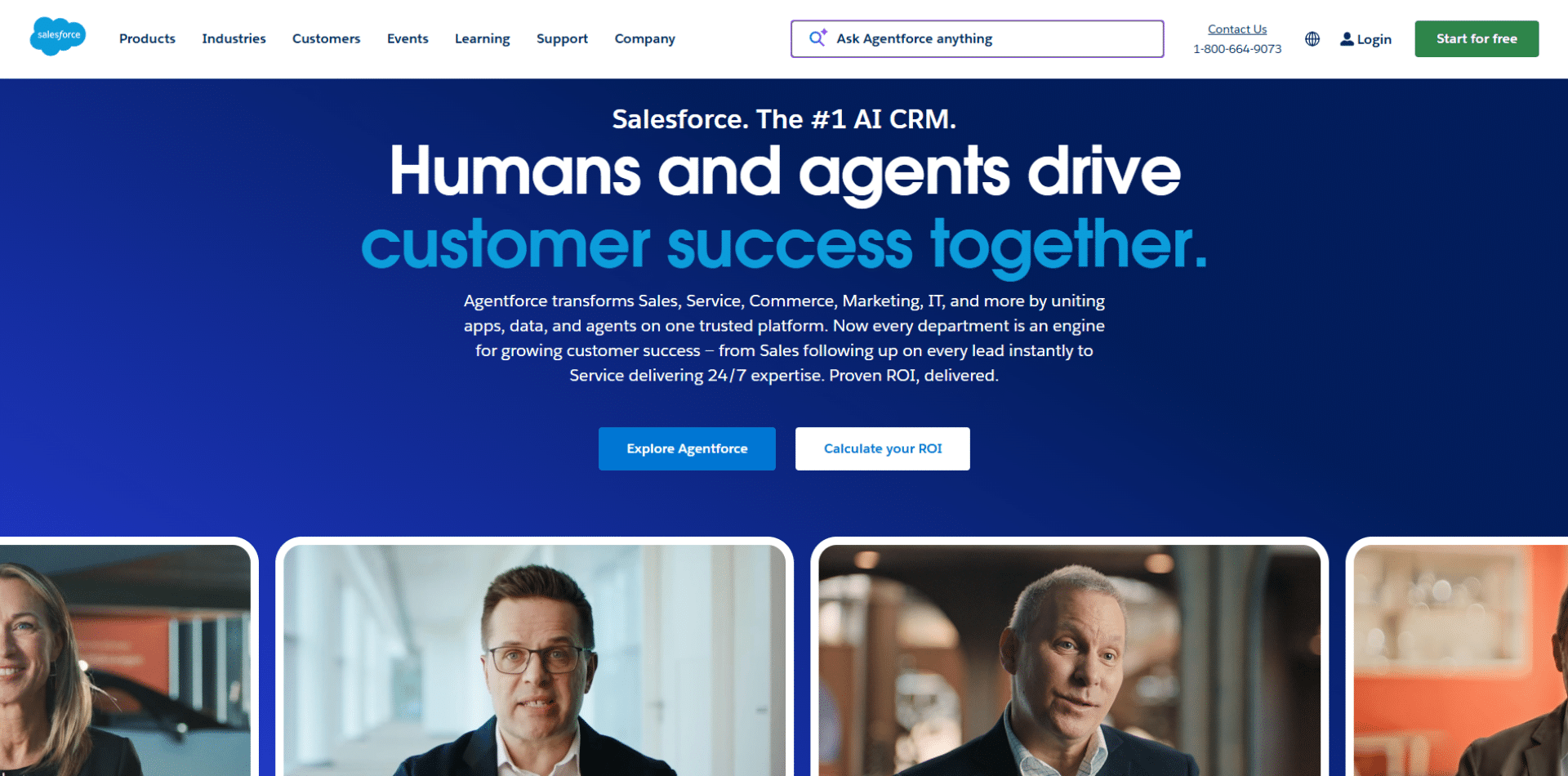
Salesforce dominates the CRM software market , with a worldwide market share of 20% and over 150,000 enterprise customers. Initially reserved for large corporations, Salesforce has democratized access with its Starter offer at just €25 per user per month, opening its doors to VSEs and SMEs.
The Salesforce platform operates as a modular ecosystem, enabling each company to build its own tailor-made solution. Salesforce Sales Cloud manages your sales processes, from first contact to signature. Service Cloud transforms your customer support with real-time ticketing and chat tools. Marketing Cloud automates your multi-channel campaigns and nurtures your leads.
Einstein’s artificial intelligence analyzes your data to predict which prospects are most likely to close, suggest next sales actions and identify high-risk opportunities. With over 3,000 applications on the AppExchange, you can integrate all your existing tools (accounting, e-mail, social networks, telephony…).
Salesforce’s strength lies in its ability to grow with your business. Starting out with 5 sales reps? Starter is enough. Growing to 50 users with complex needs? Migrate to Professional without losing your data. It’s this flexibility that makes Salesforce the benchmark choice, from startups to multinationals.
Typical targets :
- Fast-growing VSEs (5-20 employees): SaaS startups, digital agencies, consulting firms anticipating rapid expansion
- Structured SMEs (20-250 employees): B2B companies with long sales cycles, multiple sales teams, extensive reporting requirements
- ETI and large accounts (250+ employees): Organizations with subsidiaries, complex processes, compliance requirements
- Preferred sectors: Tech/software, financial services, manufacturing, healthcare, commercial real estate
Advantages and disadvantages of Salesforce :
- Complete, scalable suite: A single tool that grows with your business, from startup to multinational.
- Native Einstein artificial intelligence: sales predictions, lead scoring, action recommendations included
- Limitless ecosystem: +3000 applications to connect accounting, marketing automation, telephony, e-signature, etc.
- Infinite customization: create your own fields, workflows and dashboards without limits
- Recognized leader: worldwide community, events, certifications, guaranteed sustainability
- A demanding learning curve: Allow plenty of time to master the basics and get to grips with CRM
- High real costs: Beyond Starter, Professional at 75€ + implementation costs (5-50k€) + training courses
- Possible over-engineering: Risk of making simple processes unnecessarily complex
- Ecosystem dependency: Once you’re in, it’s difficult and costly to move elsewhere
Learn more about Salesforce
Salesforce offers two types of customized demos. The first type of demo focuses on the entire Salesforce suite, tailored to the needs of VSEs & SMEs. The second focuses on the Salesforce Sales suite itself, for more established companies looking for a dedicated sales management tool.
#8 Microsoft Dynamics 365 Sales, Microsoft power for demanding businesses
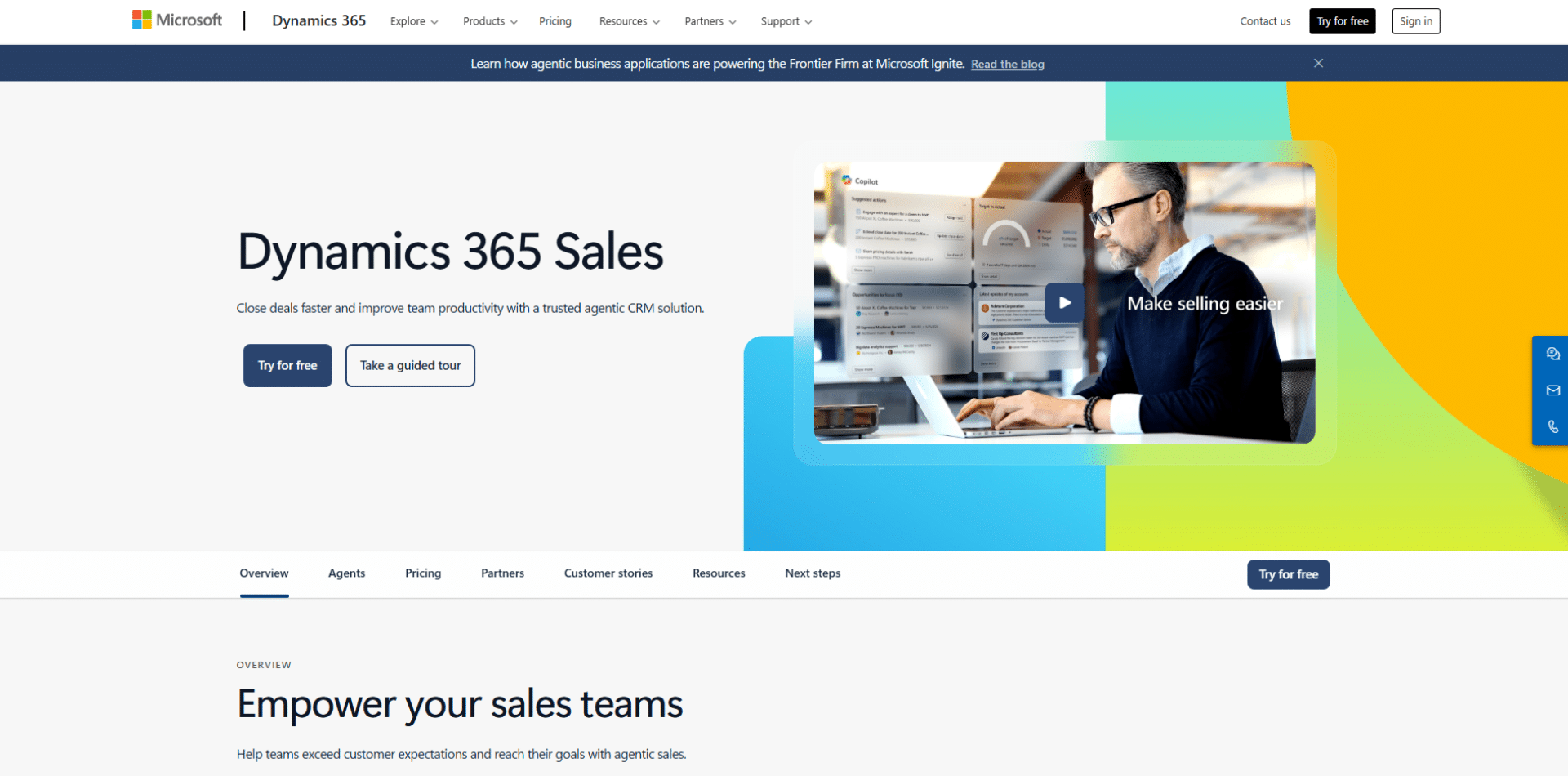
Microsoft Dynamics 365 is much more than a CRM; it’s a unified enterprise application platform, where Sales is just one module among many. For organizations already invested in the Microsoft ecosystem, it’s the natural choice that maximizes synergies. Native integration with Office 365 transforms the experience. Outlook e-mails automatically synchronize with CRM contacts. SharePoint documents attach to opportunities. Teams meetings display customer history. Excel pulls data directly for your reports. This fluidity eliminates everyday friction.
Dynamics 365 features powerful analytical capabilities. Integrated Power BI offers infinitely customizable real-time dashboards. Dynamics 365 Sales Insights AI analyzes interactions to score leads, predict revenues and identify at-risk deals. Managers have a crystal-clear view of their pipeline. The platform excels in complex processes. Do you sell industrial solutions with long cycles, multiple contacts and technical validations? Dynamics manages these sophisticated workflows. Product configuration, dynamic pricing, multi-level approvals – everything is native.
For companies already on Azure, the benefits are multiplying. Enterprise security, RGPD compliance, guaranteed performance, automatic backup… IT professionals appreciate this integration, which simplifies infrastructure management.
Typical targets :
- ETI and large companies (100+ employees): Organizations with Microsoft-based IT
- Complex industries : Manufacturing, distribution, financial services, healthcare
- Multi-site companies : Groups requiring consolidation and centralized reporting
- Regulated organizations: Sectors with compliance and traceability requirements
Advantages and disadvantages of Microsoft Dynamics 365 :
- Native Office 365 integration: Outlook, Teams, SharePoint work together
- Outstanding analytics: integrated Power BI, predictive AI, unlimited reporting
- Sophisticated processes: complex workflows, validations, product configurations
- Enterprise infrastructure: Security, performance and compliance guaranteed by Microsoft
- Unified ecosystem : CRM + ERP + HR + Finance in one platform
- Dated interface: old-school UX compared to modern CRMs
- Technical complexity: consultants needed for implementation
- Hidden costs: Licenses + customization + training = substantial budgets
- Weak marketing: expensive separate module, not as good as direct competitors (HubSpot/Salesforce)
Learn more about Microsoft Dynamics CRM
Microsoft offers a 30-day free trial. There are also a number of interesting demo videos on the Internet to get a feel for this CRM software.
#9 Folk, the invisible CRM that lives in your everyday tools
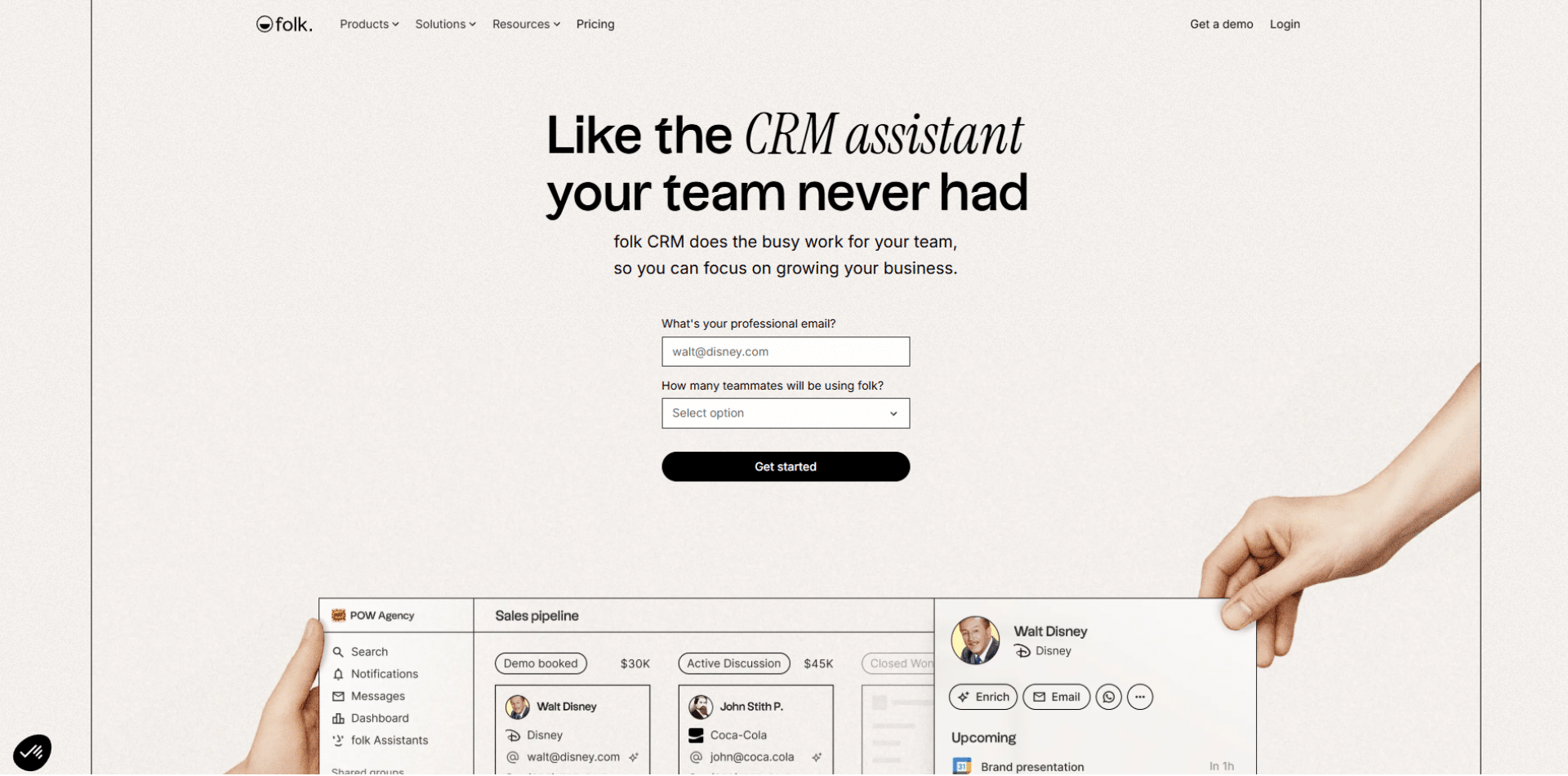
Folk is reinventing CRM with a simple philosophy: why force teams to use yet another tool when you can integrate contact management right where they already work? This “invisible CRM” approach appeals to small teams allergic to gas plants. In concrete terms, Folk is installed as an extension to Gmail/Outlook and a Slack app. Each e-mail sent automatically enriches the contact record. Important conversations are tagged with a click. Reminders arrive in Slack. Your contacts become collaborative, with everyone seeing what their colleagues are up to.
The magic is in the simplicity of use. No double entry. Folk automatically captures new contacts from your e-mails. It detects companies, finds public information and suggests connections. Your database builds itself as you work.
The collaborative aspect sets Folk apart. Contacts become workspaces: shared notes, assigned tasks, unified history. Perfect for teams where several people interact with the same customers. No more “who spoke to this prospect last?”. Integrations remain minimalist but well thought-out: calendars to view availability, Typeform for forms, Stripe for payments… Folk doesn’t try to be all things to all people, but does the essentials well.
Typical targets :
- Micro-companies (2-10 people) : Early-stage startups, boutique agencies, consultants
- Non-sales teams: Product managers, customer success, partnerships
- Relationship professionals: recruiters, investors, business developers
- Remote teams: Distributed teams communicating mainly by e-mail/Slack
Advantages and disadvantages of Folk :
- Invisible CRM: Works in Gmail/Slack, no need to open anything else
- Zero friction: automatic contact capture, intelligent enrichment
- Truly collaborative: everyone sees everything, teamwork made easy
- Simple design: no superfluous features, focus on the essentials
- Immediate onboarding: operational in 5 minutes, literally.
- Minimalist functionality: No visual pipeline, basic automation
- Virtually non-existent reporting : No analysis, forecast or metrics
- Very limited integrations: ~50 apps vs. hundreds of others
- Complex scalability: perfect up to 10 users, complicated beyond that
Try Folk for free
With its free trial, Folk lets you test a simple, versatile CRM with no obligation. The ideal opportunity to see if this tool meets your needs.
#10 Creatio, the no-code platform for truly customized CRMs
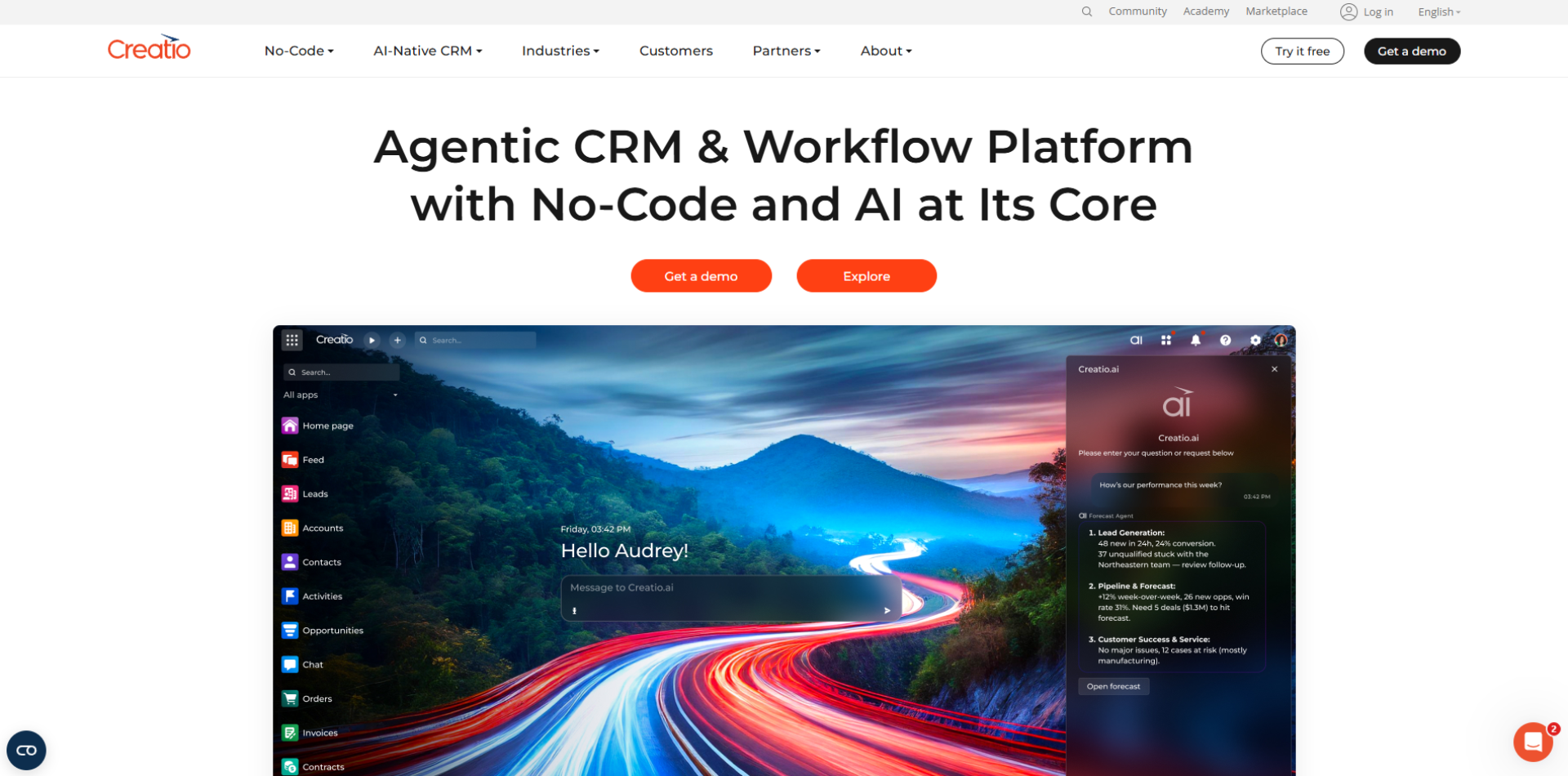
Creatio represents a unique approach to the CRM market. Instead of imposing predefined processes, the platform gives you the tools to build your ideal solution, without writing a line of code. It’s the Lego of enterprise CRM.
The no-code studio impresses with its power. Drag and drop to create your interfaces, draw your workflows on a visual canvas, configure your business rules with simple conditions. A service company can model its process from A to Z: lead qualification, multi-stage quotation, hierarchical validation, post-sales project. Creatio naturally unifies Sales, Marketing and Service. No need to juggle between modules. A marketing campaign generates leads that feed the sales pipeline and then switch to after-sales support tickets. Everything is seamless and connected.
This approach is particularly attractive to companies with specific business processes. Do you sell complex solutions requiring configuration? Model your configurator. Does your sales cycle include technical validations? Integrate them into your workflow. Do your sales reps follow a particular method? Adapt the screens. The platform remains surprisingly affordable (€35/user/month) considering its flexibility. Companies especially save on customization, which would require costly development elsewhere is visually configured here.
Typical targets :
- SMEs with unique processes (20-200 employees) : Companies for which no standard CRM is suitable
- Specialized industries: Industrial equipment, complex services, engineering
- Enterprises in transformation: Organizations redesigning their business processes
- Multi-activities: Groups with subsidiaries with different needs
Advantages and disadvantages of Creatio :
- Powerful no-code: Create complex apps visually, without a developer
- Tailor-made processes: Model your specific business workflows
- Unified platform: CRM + Marketing + Service + native BPM
- Competitive pricing: Enterprise solution at the price of a mid-market CRM
- Scalability: Modify your processes in real time as needed
- Learning curve: Flexibility comes at a price, with training required
- Small community : Few users/resources vs. leaders
- Perfectible interface: Powerful but less modern than the competition
Try Creatio free of charge
Creatio is offering a 14-day free trial to test all the features of its highly customizable CRM. A great opportunity to see if this tool matches your specific business processes.
Download the CRM Benchmark by Salesdorado
Are you looking for your ideal CRM tool? You’ve already spent hours scouring software vendors’ websites, poring over comparisons each more indigestible or hollow than the last, canvassing the opinions of your network…but you’re still not sure what to choose? We’ve got just what you need. At Salesdorado, we’ve been analyzing the CRM software market in depth for over 8 years. And today, we’re putting all that expertise at your service with this CRM Benchmark.
The objective? To help you find the CRM perfectly suited to your needs and budget. Thanks to this CRM Benchmark, you’ll be able to :
-
-
- Compare over 30 CRM software products, from the biggest names to little-known nuggets.
- Get an objective, detailed opinion on each solution, with its strengths and limitations
- Evaluate each CRM according to the criteria that are most important to you: functionality, pricing, customer service, integrations, etc.
- Make an informed choice
-
By choosing to download this CRM Benchmark now, you’re giving yourself the means to make the best decision for the future of your business. This comprehensive, accessible guide is packed with answers to all your CRM questions. So don’t wait any longer! Click on the link below to receive your free copy in your mailbox.
Our FAQ to help you choose the right CRM
What’s the best CRM for a small team?
If you’re looking for a simple tool that’s not too expensive and quick to learn, noCRM, Attio or even Hubspot are good candidates. Folk, too, if you work mainly with Gmail. Forget Salesforce at this stage, it would be like buying a 38-ton truck to deliver flowers.
Which CRM should I choose if I do both marketing and sales?
HubSpot is often cited first, and for good reason: its suite is ultra-integrated and you can get started for free. But it’s not the only one. Salesforce (via Starter) is just as suitable, especially if you want to go far in automation and analysis.
Which CRM offers the best free version?
HubSpot remains the benchmark, with a comprehensive free plan to get you started. But Salesforce has responded well with its €25/month Starter offer, which already ticks quite a few boxes. Attio and Zoho also offer interesting free versions, but more limited in functional depth.
What’s the difference between Salesforce and HubSpot?
Salesforce is an ultra-modular platform designed to adapt to complex processes. It covers the entire customer cycle, from marketing to loyalty, with an almost unlimited level of personalization, but which requires technical skills or an integrator. HubSpot, on the other hand, focuses on the user experience: everything is integrated, fluid and much more accessible for SMEs. On the other hand, as soon as you move away from standard uses or get a little bigger, HubSpot’s limits quickly become apparent…and so do its prices.
Which CRMs are best suited to startups?
Attio, Folk, Monday or even Pipedrive are great choices for young, agile and not too formal teams. They’re quick to set up and highly flexible.
Is it absolutely necessary to integrate your CRM with other tools?
Yes. If your CRM is isolated, it becomes just an address book. The good thing is that it communicates with your emails, your calendar, your billing tool, your marketing… If you have to import/export by hand, you’ll get nowhere.
How do I know if a CRM is right for me?
Make a demo. Test the tool for a few days with a real use case. And above all: involve the teams who will be using it. If nobody opens the CRM once it’s in production, you’ve made a bad choice.