

- Five Truly Unified Channels
- Advanced Automation and Customization
- Data hosted in France and Germany

Our review of Positive User (formerly Sarbacane)
Positive User is the platform that replaced Sarbacane in late May 2026. It combines email, SMS, WhatsApp, web push notifications, and a loyalty program into a single interface, complete with an automation engine and a customer database.
Last updated on
23
mn
My opinion
Customer reviews
- Additional seat: €99 per month
- Free trial reduced to 7 days
- A confusing interface for users of the original Sarbacane
Ideal for marketers who manage multiple channels and want their data hosted in Europe
From 69€ per user
7-day free trial

Sommaire
By the end of May 2026, Sarbacane had disappeared. This wasn’t just a simple name change: the Lille-based brand, founded in 2001, was replaced by Positive User—which is actually User.com, a Polish platform acquired by the group in 2023 and subsequently rebranded with the company’s colors.
The subscription price hasn’t changed; it’s still listed at €69 per month. The billing model, however, has changed completely: you no longer pay based on the volume of messages sent, but rather by seat and channel.
Is your Sarbacane account going to be closed? Should you migrate now or wait a while? And how does this platform really compare to what Sarbacane used to offer?
Here is our full review of Positive User, the new Sarbacane.
Sommaire
Our Review of Positive User: A Summary
| Perimeter | Score | Our opinion |
|---|---|---|
| Overall rating | 4,3 | Positive User is a customer engagement platform that is significantly more ambitious than Sarbacane was. The product is solid and consistent. However, the pricing structure could be more transparent, ranging from an additional seat for €99 to the lack of publicly listed pricing tiers beyond 60,000 emails per year. |
| Functional scope | 4,8 | Email, SMS, WhatsApp, web push notifications, and wallet notifications—all in a single interface, backed by a real customer database. This goes far beyond traditional email marketing. The introduction of a “Business” feature—which is missing from Sarbacane—makes a big difference in B2B. |
| Automation | 4,6 | A true visual canvas, with conditional branches and A/B testing built into the flow. The trigger library covers web behavior, mobile activity, and product events. The number of active workflows is capped based on the plan. |
| Business Continuity for Sarbacane Customers | 4,5 | No forced migration, no imposed timeline, and frozen rates. The group prioritized business continuity over making a splash. The downside is that the interface is completely different now, and switching over will require you to retrain your teams. |
| Support | 4,6 | This is the true link to Sarbacane. The help panel displays a named representative—not an anonymous chatbot—and the teams are based in France, Germany, Italy, Spain, and Poland. A dedicated CSM from the Data & Activation Suite. |
| Quality-price ratio | 3,7 | Excellent for a single marketer who wants to manage multiple channels. It’s much less straightforward once there are three or four of you, since each additional seat costs more than the basic subscription. |
Try Positive User for free
Positive User offers a 7-day free trial with no credit card required, including access to all features and optional modules. It’s a short trial, but it’s enough to get a feel for the interface if you prepare your datasets in advance.
Positive User offers a 7-day free trial with no credit card required, including access to all features and optional modules. It’s a short trial, but it’s enough to get a feel for the interface if you prepare your datasets in advance.
Sarbacane hasn’t been updated; it has been replaced
The distinction seems theoretical. It isn’t at all.
On May 26, 2026, Mathieu Tarnus announced on LinkedIn the end of the brand he had founded twenty-five years earlier in Hem, in the Lille metropolitan area. The group’s announcement refers to a merger between User.com v2 and Sarbacane v8. In reality, what you access today when you create an account is User.com.
The interface confirms this right away. A black column of icons on the left, module-based navigation, a drag-and-drop automation canvas: none of these elements come from Sarbacane. The application’s URLs themselves are built on the user.com domain. And sarbacane.com now redirects to user.com.
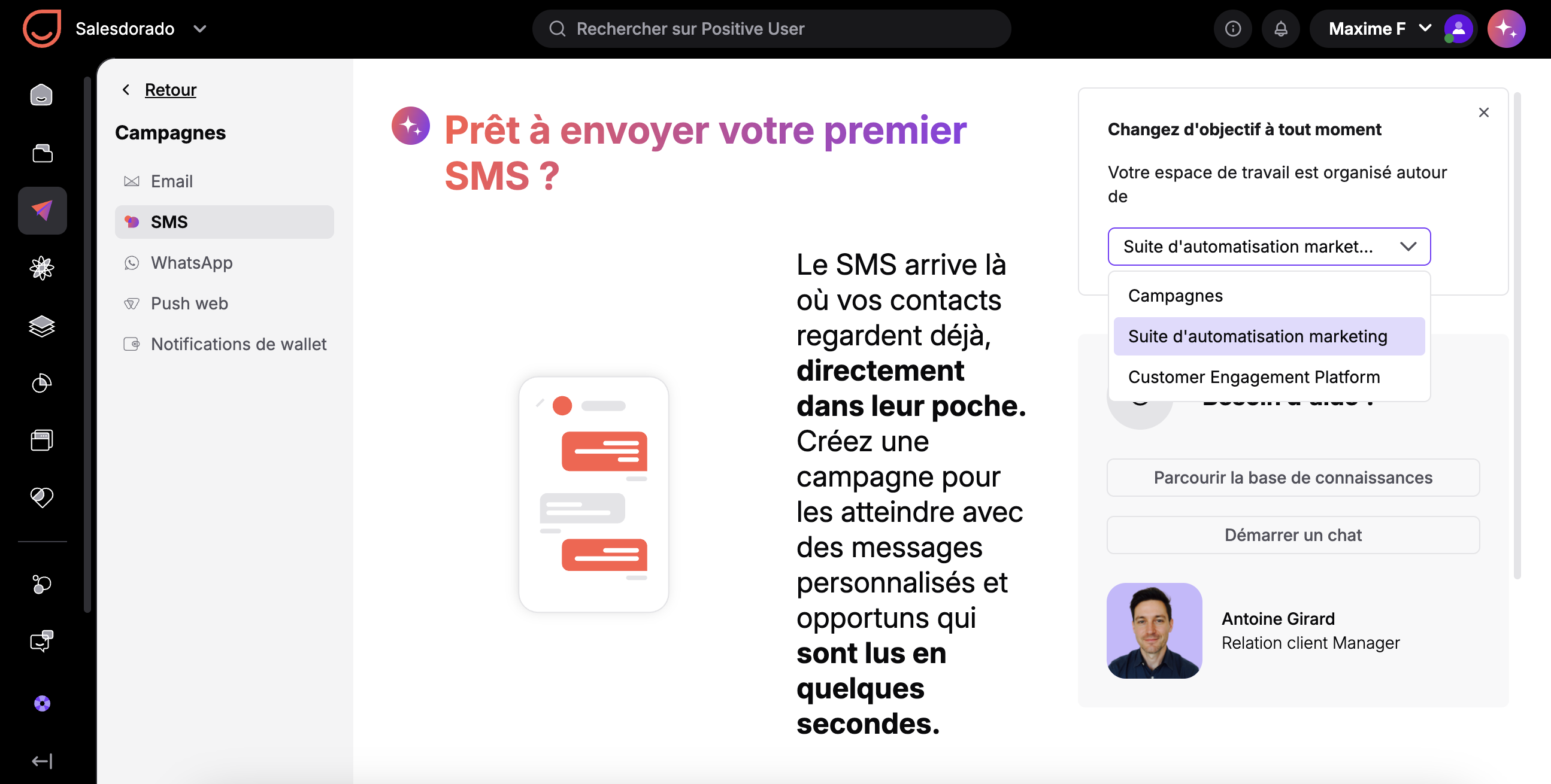
The drop-down menu in the upper-right corner reveals an interesting product approach. Your subscription doesn’t just unlock features within a single interface—it reconfigures the entire workspace. Campaigns, Marketing Automation Suite, Customer Engagement Platform: these are the exact names of the three pricing tiers.
That way, you don’t have to spend your time looking at grayed-out menus, and you can switch between different sections to see what a higher-tier plan would look like.
Salesdorado’s review
If you’re a Sarbacane customer and are considering switching, don’t think of it as an upgrade. Think of it as a change in tools. Your teams won’t have any familiar points of reference, and you’ll need to budget for the time it takes to relearn the system just as you would for the subscription.
If you’re a Sarbacane customer and are considering switching, don’t think of it as an upgrade. Think of it as a change in tools. Your teams won’t have any familiar points of reference, and you’ll need to budget for the time it takes to relearn the system just as you would for the subscription.
Are you a Sarbacane customer? What’s changing and what’s staying the same
That’s the first question the 40,000 companies still using the old app are asking themselves. Here are the answers, in the order that matters to them.
Will my Sarbacane account be closed?
No. Sarbacane is still in operation and continues to be fully supported for current customers. You log in as before, using the same credentials, and you’ll find your data, settings, and campaigns.
Only the front end has changed. The redirect from sarbacane.com to user.com applies to the website, not the app.
Will I be forced to migrate?
No, and that is the point the company has emphasized the most. Existing customers are not required to take any action, no timeline has been set, and the migration details will be provided at a later date.
The transition will be voluntary, and campaign history, contacts, and segmentation will be carried over.
Will my rate go up?
No. Current Sarbacane subscriptions remain unchanged. Positive User uses a different pricing structure while maintaining the same listed starting price.
For many multi-user accounts, sticking with Sarbacane is therefore not a matter of nostalgia. It’s a rational decision, and we’ll come back to this in the pricing section.
Can I try out Positive User without affecting my current account?
Yes. You create a separate Positive User account, and the two environments coexist without interfering with each other. That’s the right way to do it: you measure the usability gap under real-world conditions before making any decisions.
Please note the renewal terms for the
: Automatic renewal is enabled by default, and you must contact your CSM to disable it. Please allow 30 days’ notice before the annual renewal date for the Marketing Suite, 90 days for the Data & Activation Suite, and 3 business days for a monthly subscription. No refunds are provided; you simply retain access until the end of the current period. Be sure to mark the 90-day notice period on your calendar on the day you sign the contract.
: Automatic renewal is enabled by default, and you must contact your CSM to disable it. Please allow 30 days’ notice before the annual renewal date for the Marketing Suite, 90 days for the Data & Activation Suite, and 3 business days for a monthly subscription. No refunds are provided; you simply retain access until the end of the current period. Be sure to mark the 90-day notice period on your calendar on the day you sign the contract.
Sarbacane and Positive User: A Point-by-Point Comparison
Before going into detail about the modules, here’s what actually sets the old tool apart from the new one.
| Criterion | Blowgun | Positive User |
|---|---|---|
| Origin of the Software | Developed in Lille, successor to the desktop application launched in 2001 | Code base from User.com, a Polish software company acquired in 2023 |
| Channels | Email and SMS | Email, SMS, WhatsApp, web push, wallet notifications |
| Data Structure | Contact Lists | Contacts, Companies, and Products |
| Automation | Campaign sequences, A/B testing as an extension | User journey canvas with conditional branches and built-in A/B split |
| Customization | Merge Fields and Segmentation by Attributes | Dynamic content drawn from six attribute sources |
| Email Templates | About 70 | 138 |
| Billing Model | Based on shipment volume, with published tiers | By headquarters and channel, with a common shipping base for all three plans |
| Free Trial | 30 days | 7 days without a credit card |
| Accommodations | France | France and Germany |
Read line by line, the table reveals a clear move upmarket for the product and stricter commercial terms. You gain three channels, a robust database, and an automation engine that’s in a league of its own. You lose twenty-three days of the trial period and the clarity of the volume tiers.
Positive User in the Positive Group ecosystem
To understand what has become of Sarbacane, one must look at the building that houses it.
The group was known as Groupe Sarbacane until the end of 2022. A €110 million funding round changed the game; the holding company rebranded itself as Groupe Positive and has been making acquisitions at a rapid pace. It acquired six companies in three years, then accelerated its growth in 2026 with the launch of a new brand platform in February and the acquisition of Iconosquare in May.
Today, the ecosystem consists of six products, all of which bear the group’s prefix.
- Positive User(formerly Sarbacane), for customer engagement and marketing automation
- Positive Surfer, for search engine optimization and visibility in AI-generated responses
- Positive Signitic, for managing email signatures
- Positive Iconosquare, for social media management and analytics
- Positive Rapidmail, the German email marketing expert
- Positive noCRM, for sales prospecting
The company reports €70 million in recurring revenue, 45,000 customers, and 800,000 active users on the continent. It is ISO 27001-certified and is part of the French Tech 120 program.
Two practical implications for you:
- The first relates to sovereignty, and this is not a hollow argument in this specific case. The platform is designed, developed, and hosted in Europe, with data stored in France and Germany and teams spread across five countries. If you work in a regulated industry or participate in public tenders, this simplifies the risk analysis process. This is the key differentiator compared to U.S. software suites.
- The six products remain six separate subscriptions. The group does offer bundled packages and a shared AI assistant, but deep integration between the individual components has yet to be fully developed. Don’t expect advanced native synchronization between Positive User and noCRM, for example, even though they’re both part of the same company.
Communication channels managed by Positive User
Sarbacane could handle email and text messaging. Positive User combines all five into a single interface, all connected to the same contact database and controllable from the same automation engine.
This point alone justifies the change in category. You no longer compare Positive User to email marketing software; you compare it to a customer engagement platform.
#1 The Email
The core functionality remains robust. The editor uses a drag-and-drop interface and draws on a library of 138 built-in templates, compared to about 60 in Sarbacane. You can create your own template folders, which quickly becomes essential when multiple brands or entities share the same account.
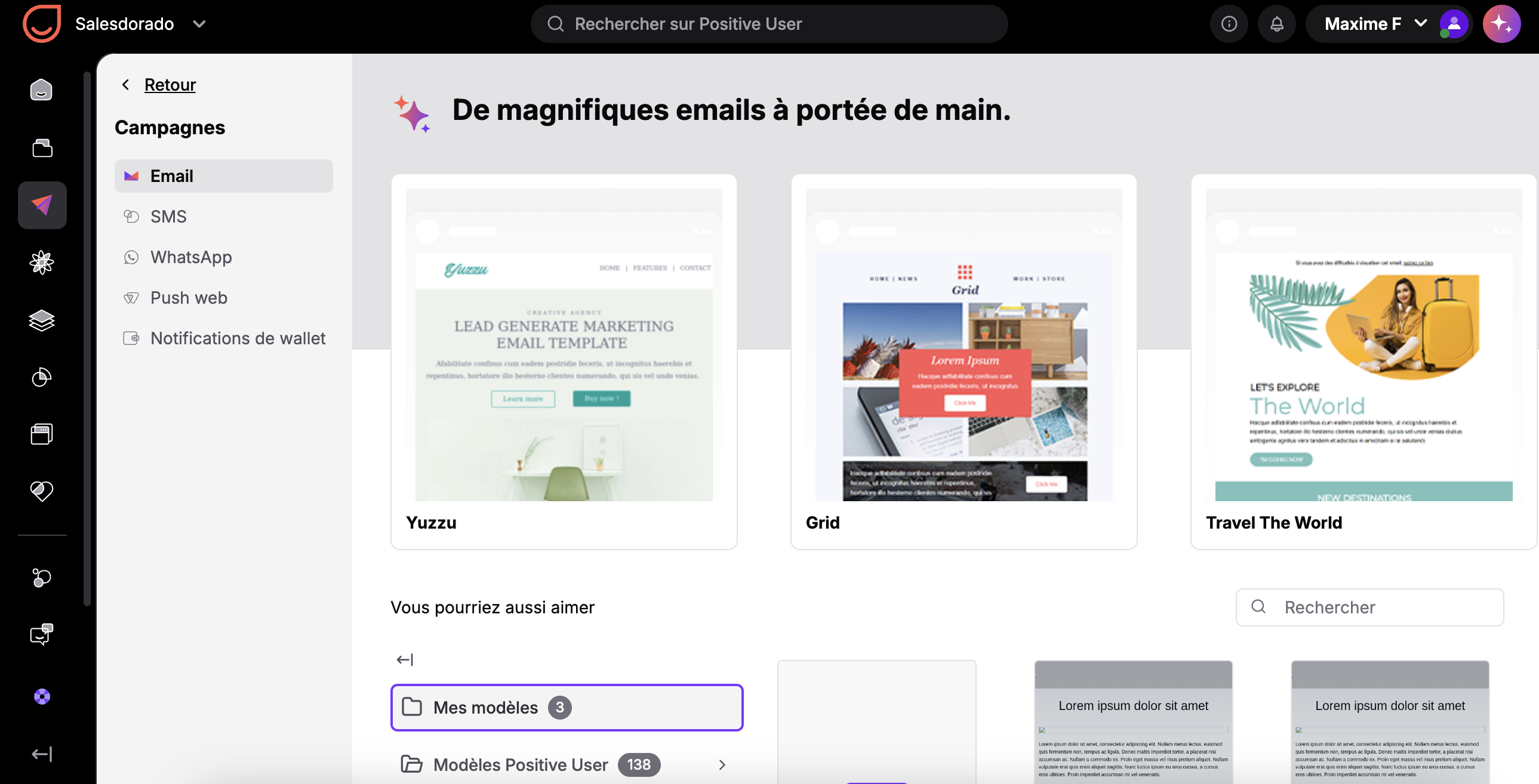
Three features are worth noting because they did not exist in this form in the previous tool:
- Reusable content sections first. You build a block—whether it’s a header or a promotional insert—just once, and any change you make is applied across all your campaigns.
- Next is dynamic content, which we’ll cover in more detail below in the Studio section. It’s no longer just a matter of inserting a first name, but of varying entire blocks based on the recipient’s attributes.
- The AI content creation agent is finally available starting with the first plan; it writes subject lines and message bodies based on a brief prompt.
In terms of volume, the baseline is 60,000 emails per year, or 5,000 per month. And this baseline is the same across all three Marketing Suite plans, which is the most confusing aspect of the pricing structure.
#2 Text Messages
SMS campaigns follow the same process as email campaigns: importing recipients, drafting the message, testing it, and then sending it. You should distinguish between marketing campaigns and transactional notifications, which is important for complying with opt-in rules.
Sarbacane had already made this a key differentiator in the French market. The channel hasn’t declined; it has simply become part of a larger whole.
#3 WhatsApp
This is the truly new channel, and it’s also the one where the product line stands out the most.
The included volumes range from 6,000 messages per year for the Campaigns plan to 24,000 for the Marketing Automation Suite, and then to 120,000 for the Customer Engagement Platform. That’s a twentyfold increase between the first and last tiers, while the email volume remains unchanged by even a single byte.
This trend clearly shows what the publisher is selling. It’s no longer about reach; it’s about engagement.
WhatsApp integrates with the automation engine just like other channels. This means you can build a workflow that starts with an email, switches to WhatsApp if the email isn’t opened, and then triggers an alert to a sales representative. This is exactly the kind of scenario that Sarbacane didn’t support.
#4 Web Push and Wallet Notifications
A web push sends a notification to the browser of a visitor who has opted in to your alerts. This is useful in e-commerce for stock updates, but less so in B2B.
Wallet notifications are more interesting: they’re sent to contacts who have added one of your cards to their phone’s wallet, and a message pops up on the lock screen. This is a natural extension of the loyalty program, which is discussed below.
Automation: The Module That Has Made the Most Progress
If you had to pick just one difference between Sarbacane and Positive User, this would be it. We’ve gone from a campaign sequencer to a true journey editor.
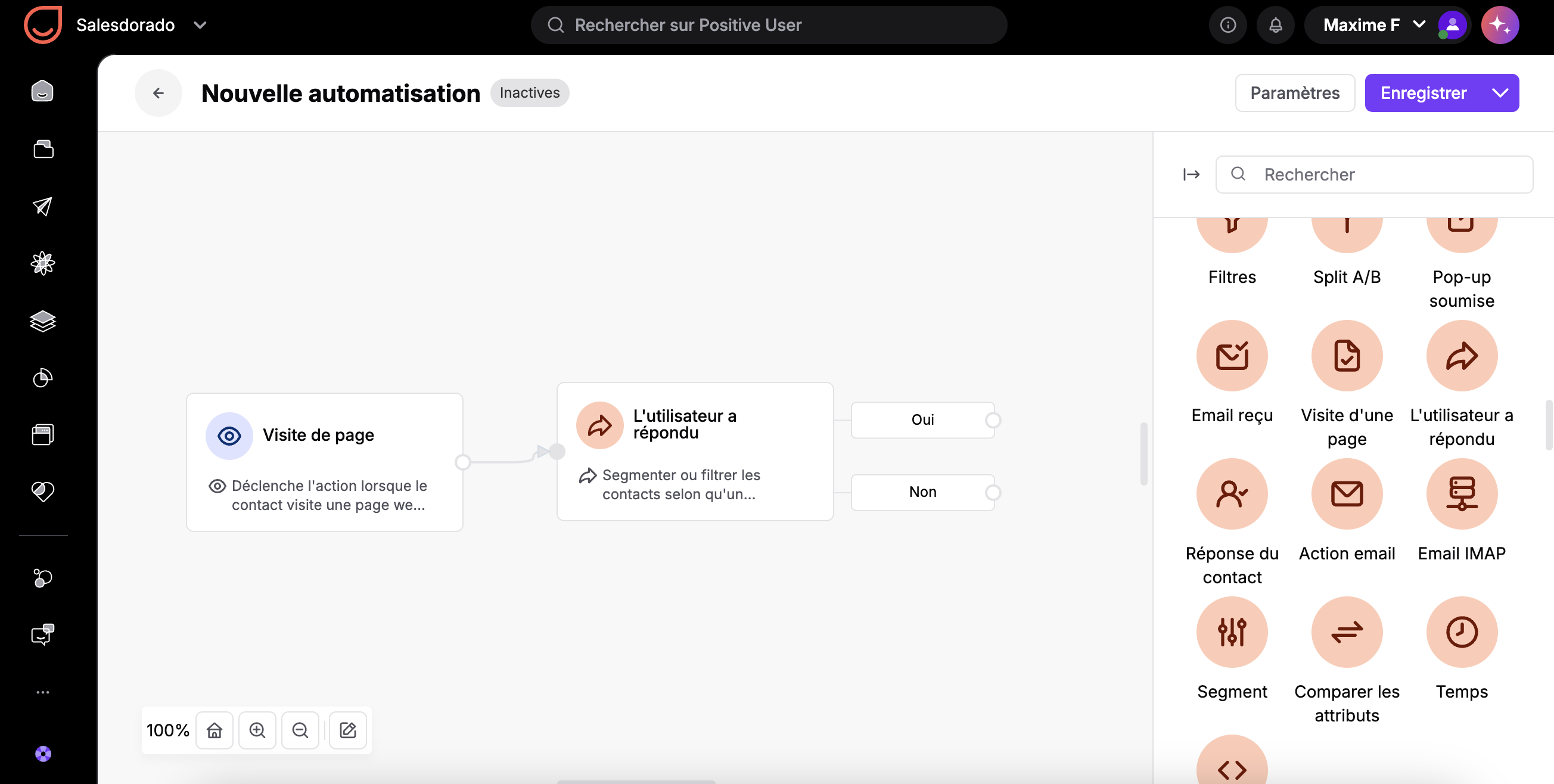
The interface is a canvas where you drag and drop blocks from the panel on the right; it includes a zoom feature, an overview, and connectors between steps. The blocks are divided into three categories.
Triggers
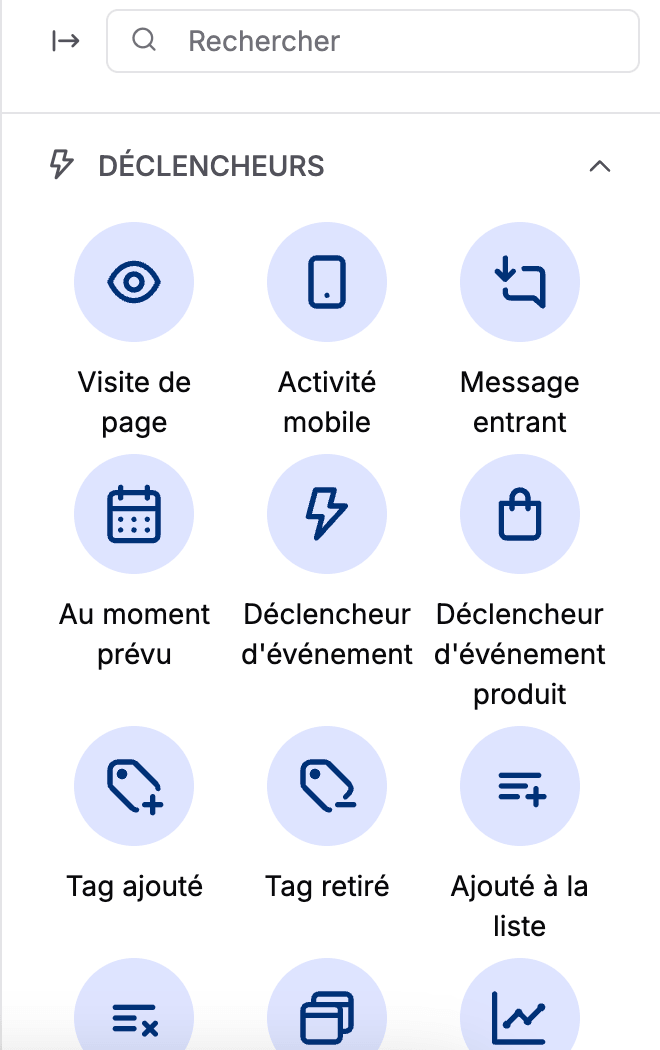
They define the starting point of the journey, and the library is extensive.
You’ll find page views, mobile activity, incoming messages, scheduled events, event-based triggers, product-based event triggers, adding or removing a tag, and being added to a list.
The product-based event trigger offers the most possibilities in e-commerce: it responds to an action involving a specific product, which makes it possible to create abandoned cart follow-ups. The scheduled trigger covers more traditional use cases, from contract anniversaries to renewal reminders.
Conditions and Actions
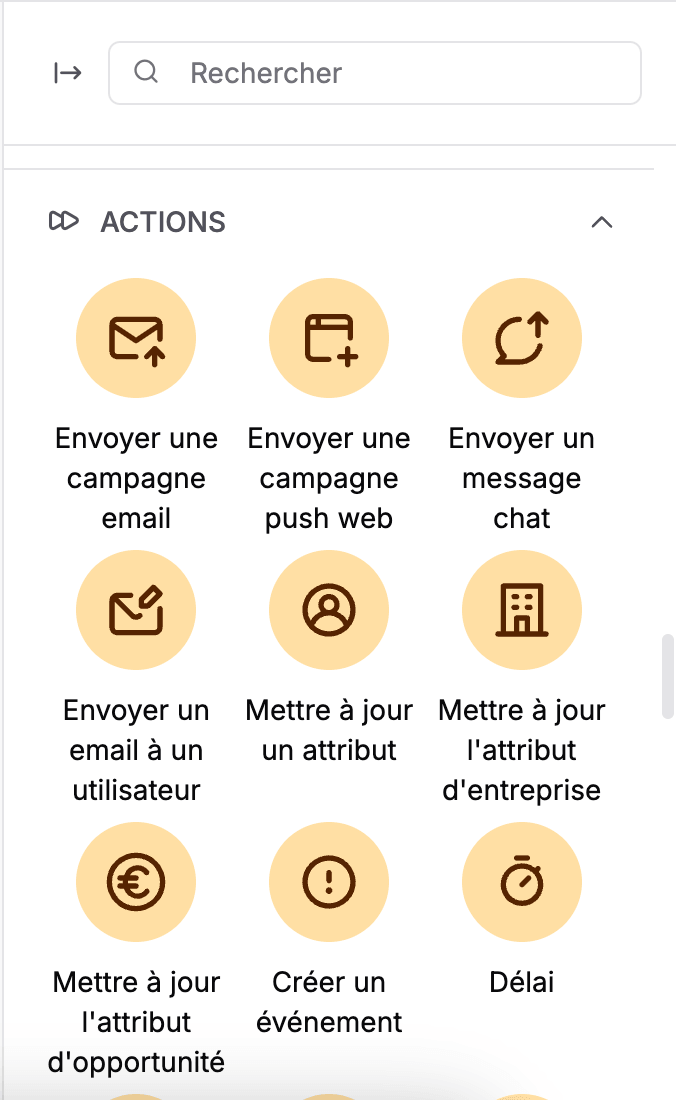
Between each step, you set conditions that guide the flow. These include standard filters based on attributes, submitting a form or a pop-up, receiving an email, visiting a page, a contact’s response, belonging to a segment, comparing two attributes, or simply waiting.
Two blocks stand out from the rest:
- First, the A/B split, which in this case is a block in the user journey rather than a campaign extension. This is a fundamental difference. With Sarbacane, you were testing two versions of an email. Here, you’re testing two entirely separate branches of a scenario, each with different channels and timelines.
- Next is the IMAP Email condition, which lets you connect a real inbox to the workflow. You can trigger a scenario based on a prospect’s actual response—not just an open or a click.
When it comes to actions, the options go beyond just sending messages. You can trigger an email campaign, a web push campaign, or a chat message; send an internal notification to a user on your team; update a contact attribute, a company attribute, or an opportunity attribute; create an event; or set a deadline.
The action of updating an opportunity attribute best reflects the product’s ambition. It connects marketing to the sales pipeline within the same engine.
Configuring Scenarios
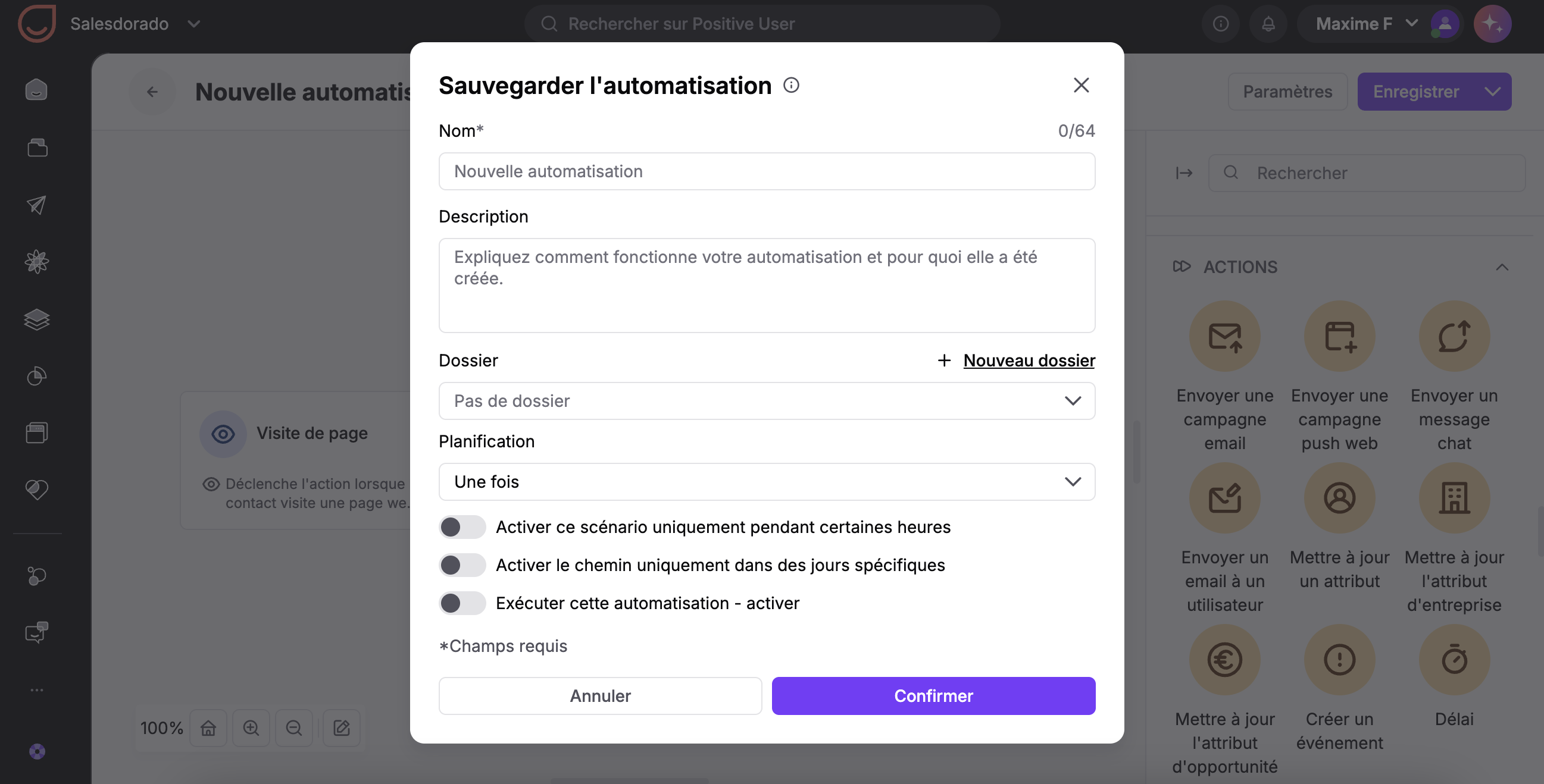
Each automation is stored in a folder, which helps prevent clutter after a few months. You then choose a schedule, and you can restrict execution to certain time slots or specific days of the week.
This setting may seem trivial. It isn’t: it’s what prevents an automatic reminder from being sent at 6:00 a.m. on a Sunday.
One reassuring detail is that a script is inactive by default. You must explicitly toggle the execution switch, which helps prevent accidents during the development phase.
The limit applies to the number of workflows that can be active at the same time: 5 in Campaigns, 20 in the Marketing Automation Suite, and 100 in the Customer Engagement Platform. A library of ready-to-use scenarios is provided to help you get started faster.
Salesdorado Tip
: Five active workflows aren’t enough once you scale up. Count one for onboarding new sign-ups, one for re-engaging inactive users, and one for each sales campaign—and you’ll hit the Campaigns plan’s limit in just a few weeks. Take stock of your existing scenarios before choosing your plan, not after.
: Five active workflows aren’t enough once you scale up. Count one for onboarding new sign-ups, one for re-engaging inactive users, and one for each sales campaign—and you’ll hit the Campaigns plan’s limit in just a few weeks. Take stock of your existing scenarios before choosing your plan, not after.
The data layer: contacts, companies, and products
This is the most profound change—and the least visible one.
Sarbacane organized data into contact lists. This logic, inherited from the B2C model, required users to improvise whenever they needed to address multiple contacts within the same company. Positive User structures the database around three distinct objects.
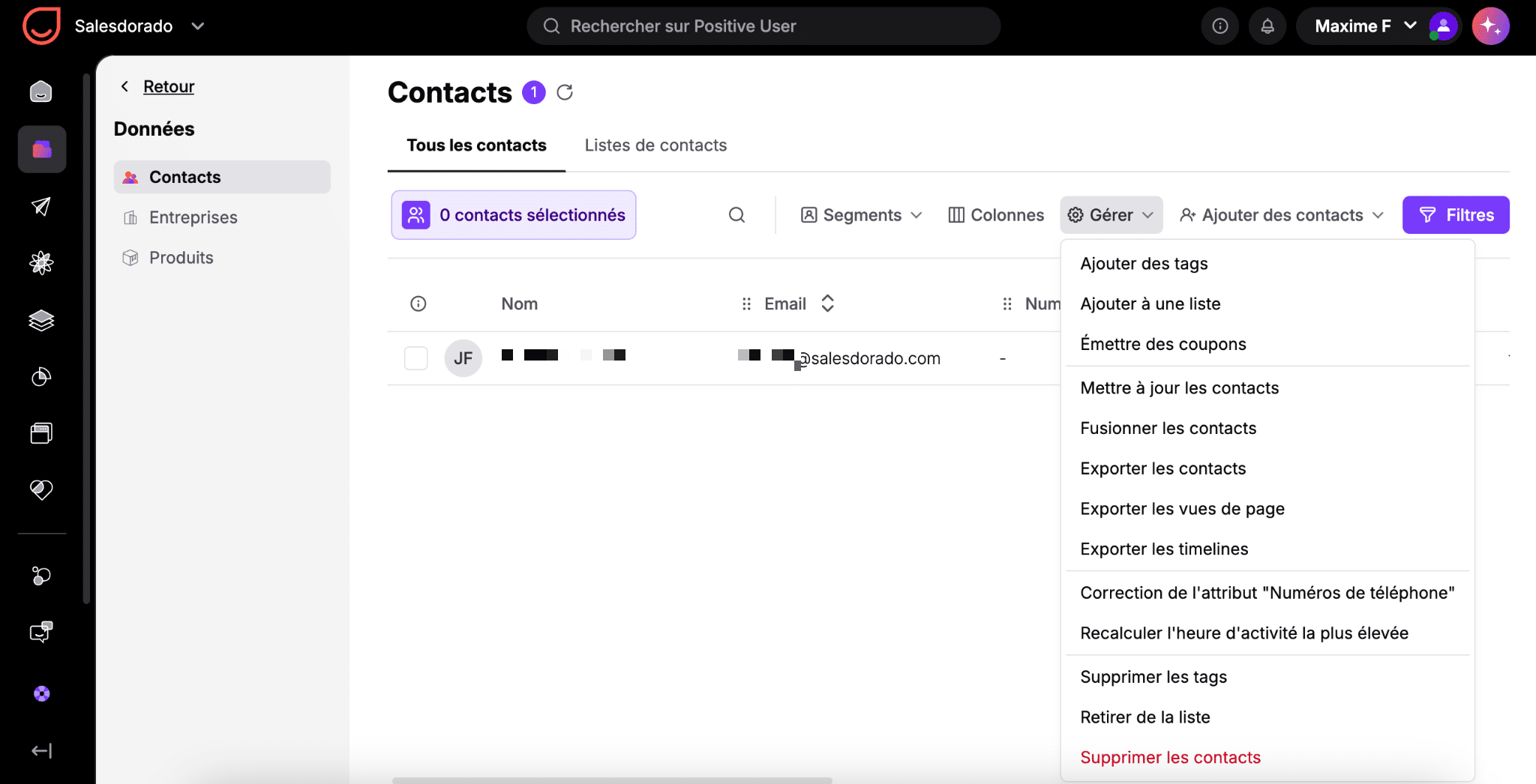
The three items in the database
- Contacts are the building blocks, with their custom attributes, tags, and activity timelines.
- Companies group contacts together and have their own attributes. This finally makes it possible to segment by industry, size, or account status without duplicating the information on each individual record.
- Products allow you to link a catalog to the database and feed both recommendations and product event triggers.
In addition, there are global variables and calculated attributes, which eliminate the need to create numerous manual fields. An engagement score or last order date is calculated automatically rather than being populated via import.
Bulk Management
The “Manage” menu is particularly extensive, and several of its options are worth exploring:
- Merging contacts and detecting duplicates are part of routine data cleanup. Automatic correction of the phone number attribute ensures that formats are correct, which is essential for the deliverability of your SMS and WhatsApp campaigns.
- The “Recalculate Peak Activity Time” entry deserves special mention: it involves optimizing send times, calculated for each contact based on their history.
- The export includes contacts, page views, and timelines. This last point is useful for responding to a request for access to data under the GDPR.
- Finally, the ability to issue coupons directly from the contact list clearly illustrates how the modules communicate with each other.
Marketing contacts and non-marketing contacts
This is a distinction that Sarbacane did not make, and one that has direct economic consequences:
- With the Marketing Suite, you get unlimited contacts. You don’t pay to store inactive contacts, unlike the model used by most U.S. providers, which charge based on the base plan size.
- On the Data & Activation Suite, non-marketing contacts remain unlimited, while marketing contacts are capped at 100,000 on the Performance plan. This means you only pay for the people you actually reach out to.
Retention also varies by product: the visibility period on a contact’s timeline ranges from 30 days on Campaigns to 99 days on the Customer Engagement Platform, and three years on Limitless. Be sure to check this if your sales cycles are long.
The Studio and Dynamic Content
The Studio centralizes three things: templates, the media library, and dynamic content.
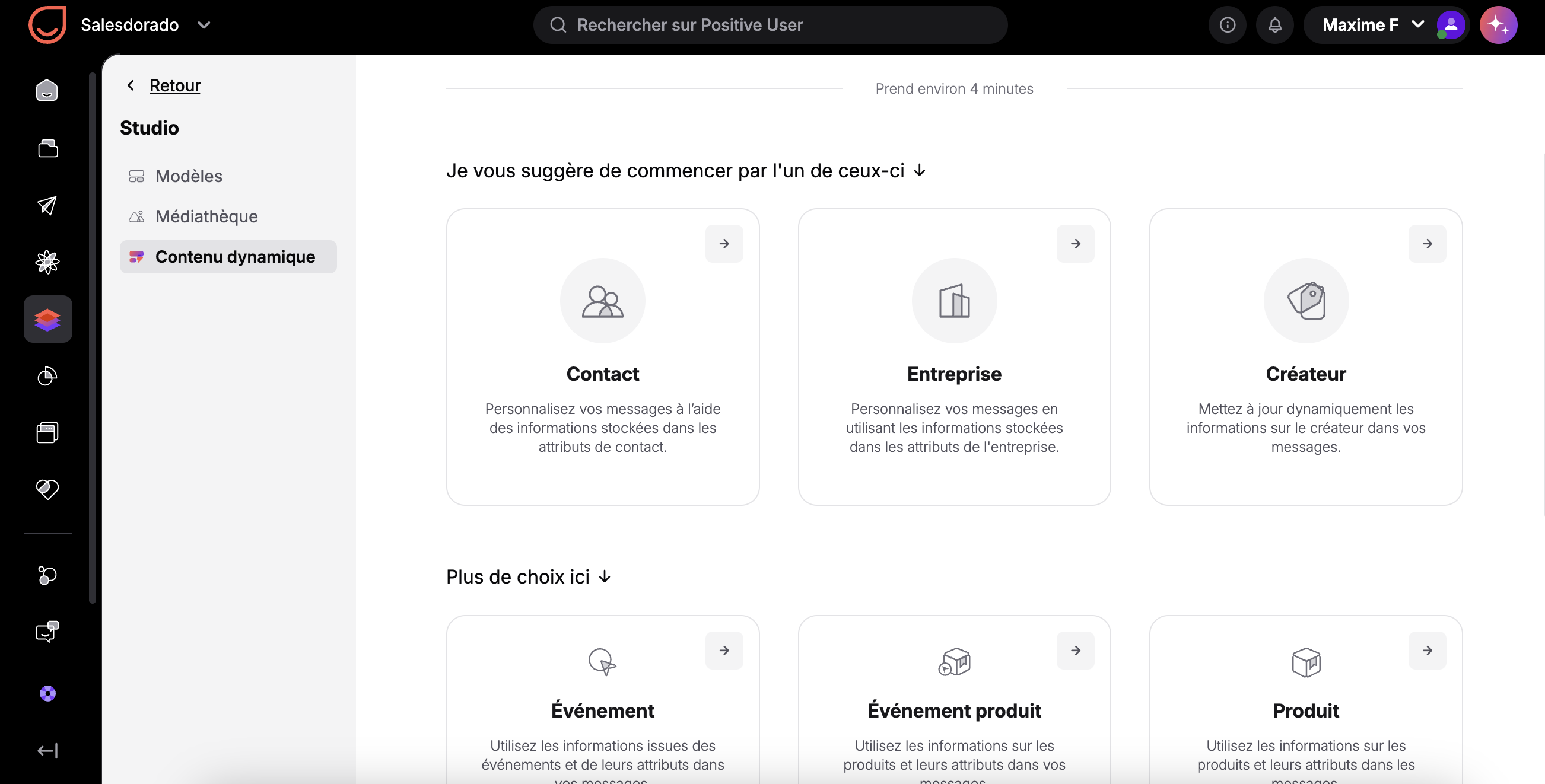
It’s the dynamic content feature that really makes a difference. You’re no longer just personalizing with a first name—you can draw from six sources of attributes:
- The contact andthe company cover both standard personalization and B2B personalization. You can display a different sales pitch depending on the recipient company’s industry or its number of employees.
- The Designer refers to the sender. In practice, this allows you to customize the signature, photo, and contact information based on the sales representative in charge of the account, without duplicating the email template.
- Products andproduct-related events enable e-commerce personalization: most recently viewed items, items left in the shopping cart, and favorite categories.
- Finally,the event allows you to respond to a specific action recorded in the contact’s timeline.
An AI design agent rounds out the suite as part of the Marketing Automation Suite. It suggests layouts and visual variations without the need to involve a graphic designer.
In this area, we’re moving away from email marketing once and for all toward behavioral personalization. This is precisely the territory that American suites are targeting, and Positive User is making its mark there with an advantage that the others don’t have: data hosted in France and Germany.
The Website Experience
This module transforms your website into a data source and a conversion driver. It consists of six components.
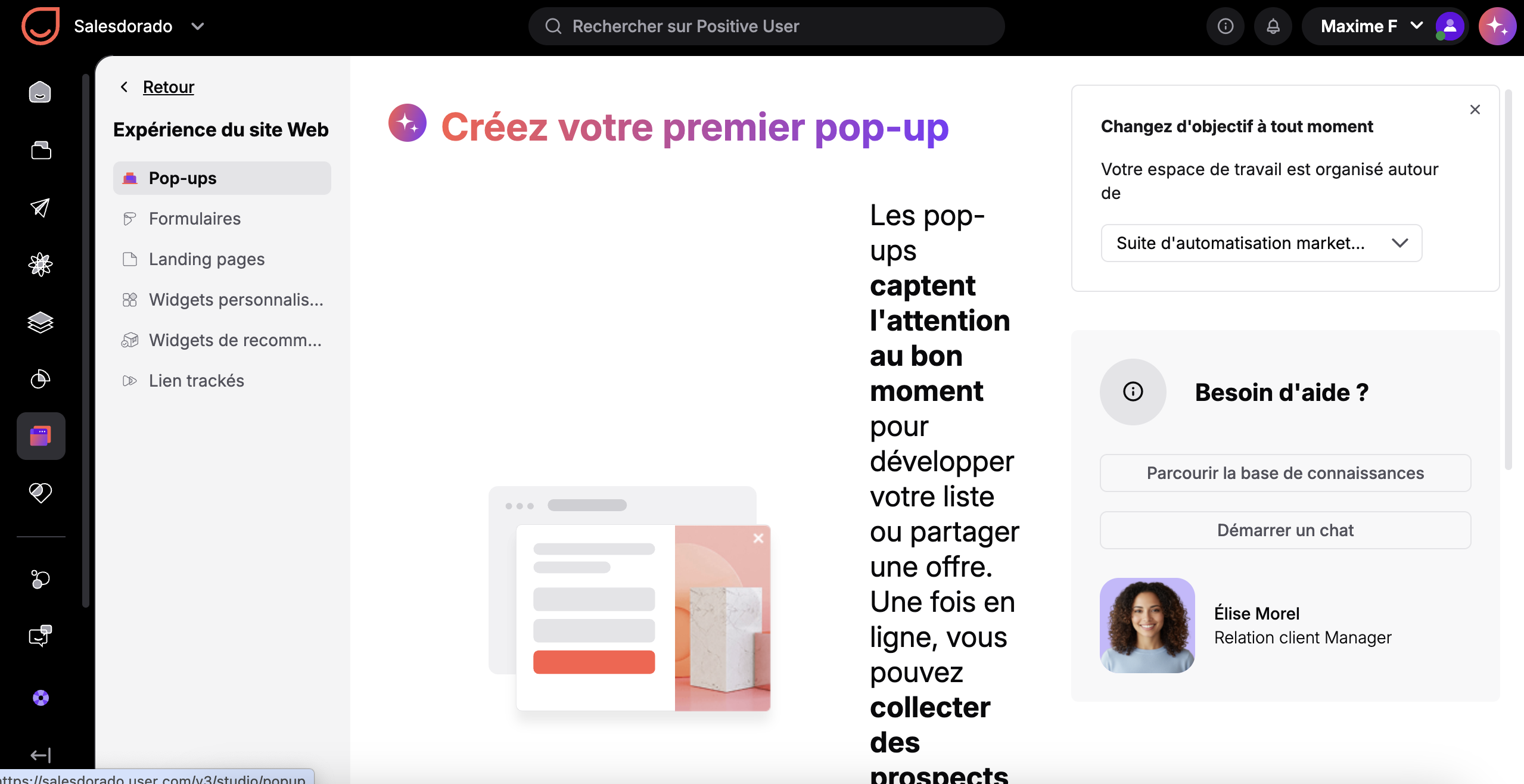
Pop-ups, forms, and landing pages
- Pop-ups are created in a visual editor and triggered based on visitor behavior. They directly populate the contact database, and a submission can serve as a condition in an automation workflow.
- Forms integrate with your existing pages and send their data using the same attributes as the rest of the platform. No connectors to configure, no synchronization to monitor.
- Landing Pages allow you to set up a campaign page without making any changes to your website. Useful for a webinar, a white paper, or a seasonal offer.
The scope of features varies by plan. On Campaigns, forms and landing pages are available as an optional add-on for €29 per month. They are included starting with the Marketing Automation Suite, which offers 50 published forms and 50 published landing pages, and 100 of each on the next-tier plan. Our landing page creation tools remain a useful reference if you want to compare this scope to dedicated solutions.
Widgets and Product Recommendations
Custom widgets display content specific to a given segment. A visitor identified as an existing customer does not see the same message as an unknown visitor.
Recommendation widgets go a step further by suggesting products based on browsing behavior. This is a built-in recommendation engine, available exclusively through the Customer Engagement Platform.
Visitor Tracking and Tracked Links
Visitor tracking operates in real time and feeds into each contact’s timeline. This is what enables page-visit triggers in the automation engine. The loop is complete: the website feeds the database, the database triggers workflows, and the workflows drive traffic back to the site.
Tracked links are tracked redirects that you can place anywhere you want, including outside your campaigns.
See for yourself
The 7-day trial gives you access to all modules, including optional features. Take this opportunity to see which ones you’d actually use before choosing your plan.
The 7-day trial gives you access to all modules, including optional features. Take this opportunity to see which ones you’d actually use before choosing your plan.
Three modules that set Positive User apart in the marketing world
Beyond campaigns and automation, the platform offers three modules that extend its scope to sales, customer service, and customer loyalty. These modules are available as optional add-ons to the Marketing Suite and are included by default in the Data & Activation Suite.
This is where Positive User stands out most clearly from traditional email marketing software.
Sales
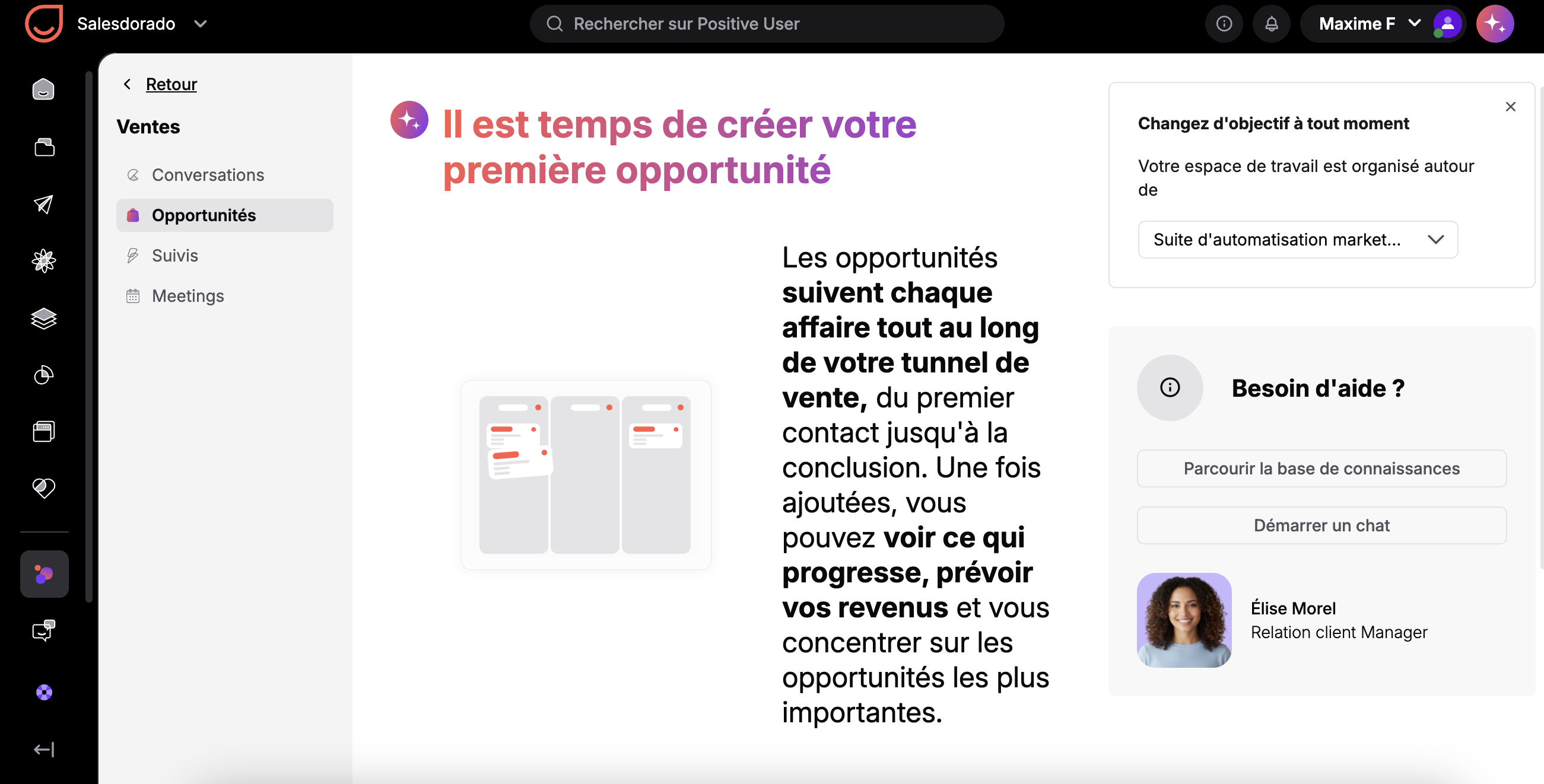
The module is organized around four sections: conversations, opportunities, follow-ups, and meetings:
- Opportunities track each deal from initial contact through to closure, with progress tracking and revenue projections.
- Follow-ups ensure that no reminder falls through the cracks.
- The meetings handle appointment scheduling.
The module’s value does not lie in its feature set, which is modest compared to a dedicated CRM. Rather, it lies in the fact that the pipeline resides in the same database as your campaigns: a scenario can update an opportunity attribute, and an opportunity can trigger a marketing sequence.
This makes sense for a team that manages its pipeline from the marketing side, using behavioral signals from the website. For a sales team that spends its days on the phone, however, it won’t replace a lead generation tool: instead, check out our review of noCRM, the other solution from the Positive Group, designed specifically for this role.
The Sales module costs €59 per month with an annual commitment.
Customer Relations
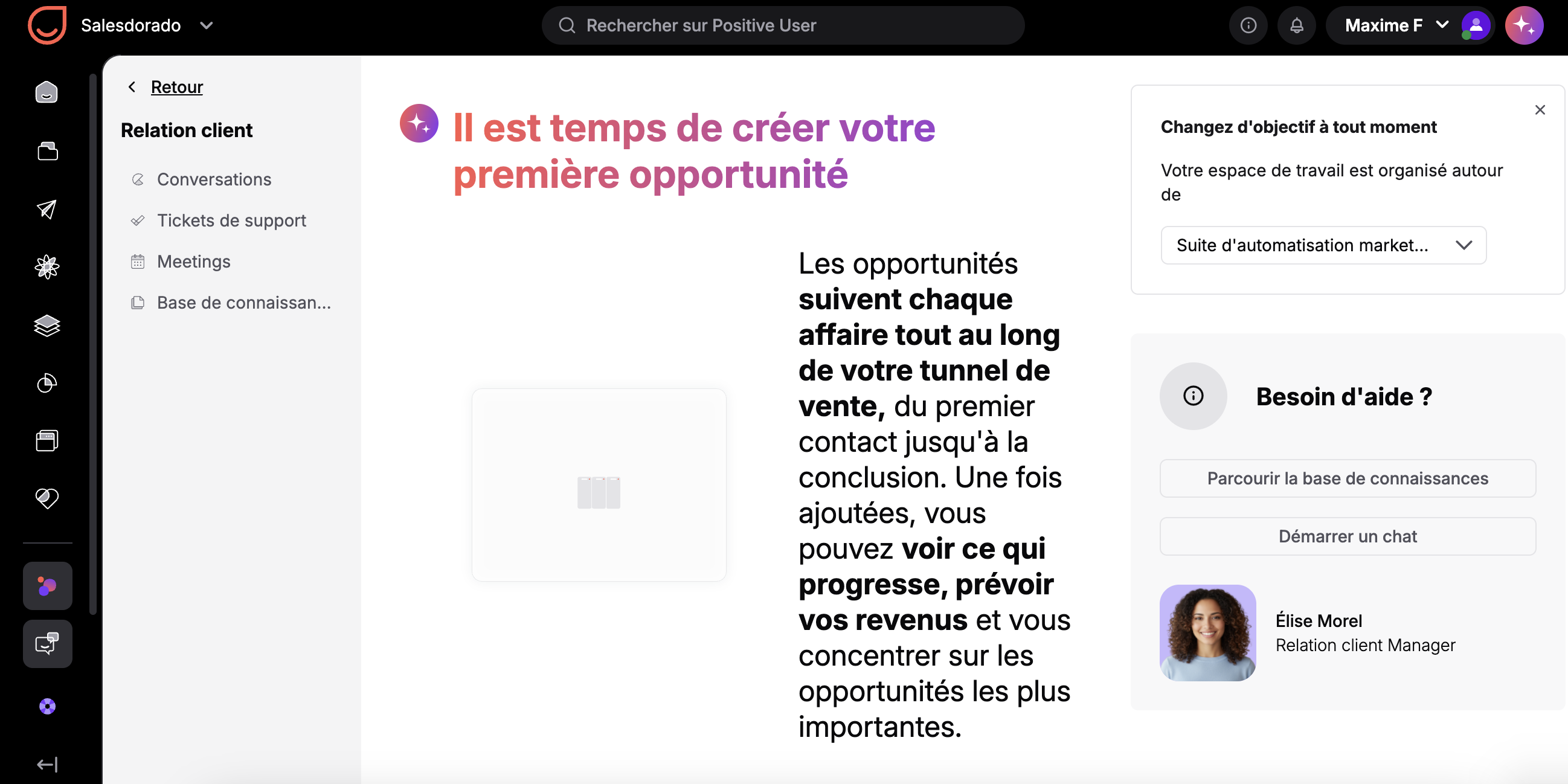
There are four building blocks here as well: conversations, support tickets, meetings, and the knowledge base:
- Live chat and the chatbot feed the contact’s timeline, which has a useful result: a question asked of support becomes segmentation data. A customer who has opened three tickets on the same topic is not a good candidate for an upsell follow-up.
- The knowledge base is published on the client side and handles some of the first-level support requests.
- The ticketing system handles the rest, including assignment and tracking.
This isn’t an enterprise-level customer service tool. It’s a module that saves an SME from having to add a third subscription to its stack.
The Customer Service module is also available for €59 per month.
Loyalty Program
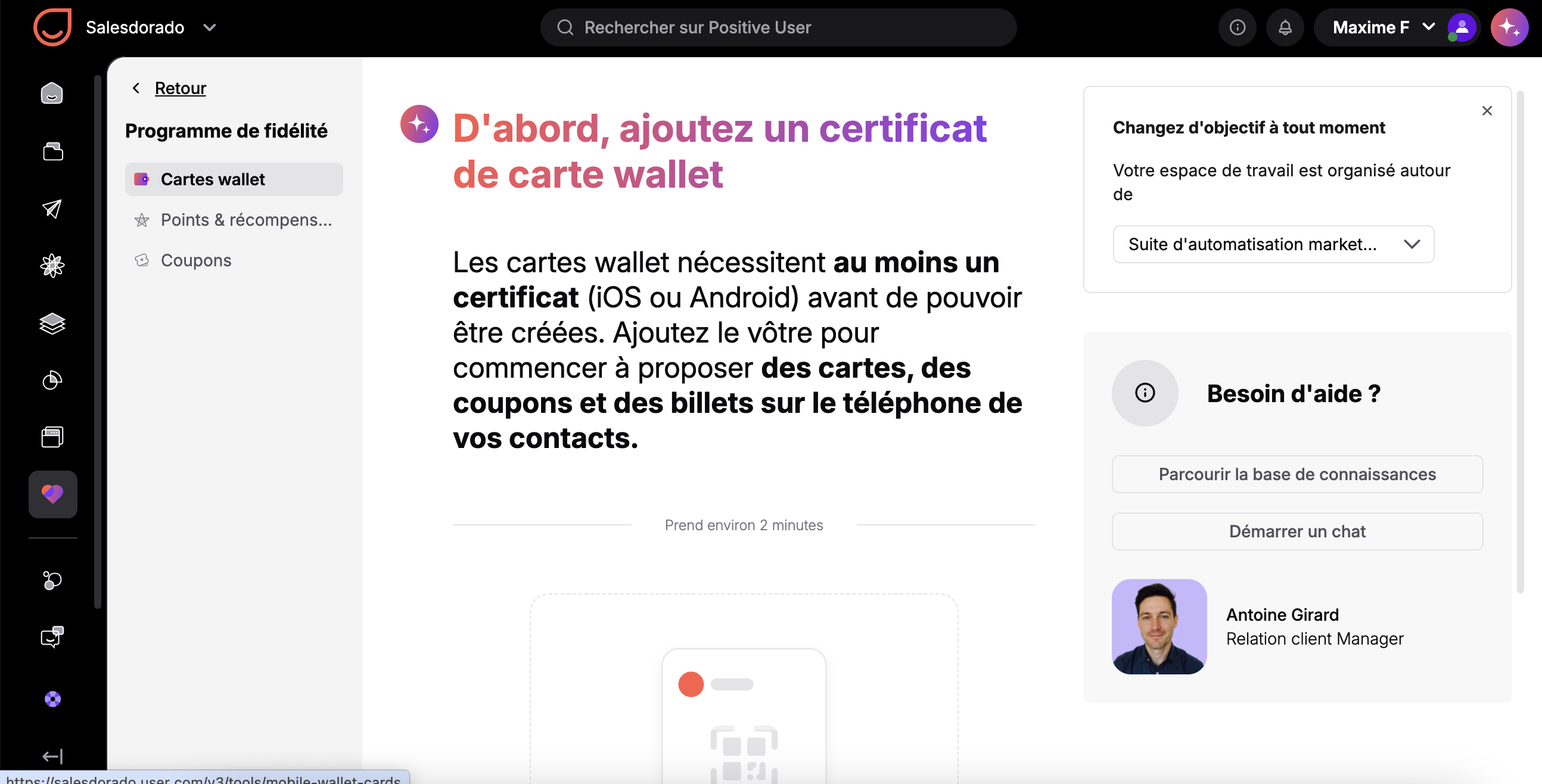
This is the module that strays furthest from Sarbacane’s core DNA and best reflects the group’s ambition. It includes wallet cards, a points and rewards system, and coupon management:
- The wallet card isn’t just a gimmick. Once added to the phone’s wallet, it updates remotely and becomes a full-fledged communication channel thanks to the wallet notifications mentioned above. As your point balance changes, the card updates, and you can push a message to the lock screen.
- Coupons are generated in bulk and issued directly from the contact list, which shows just how closely integrated the modules really are.
One technical prerequisite is worth noting: creating wallet cards requires at least one iOS or Android certificate. This isn’t just a box to check—it’s a process you’ll need to go through with Apple or Google. The screen indicates that setup takes two minutes, assuming you already have the certificate on hand.
The Loyalty Program module costs €199 per month with an annual commitment. It is the most expensive of the three and is clearly aimed at the retail and e-commerce sectors.
Performance Reporting and Analysis
This is where Sarbacane was solid without being outstanding, offering standard but well-crafted email reports. Positive User takes things to a whole new level in one specific area.
The basics are all there: open and click-through rates, comparisons between tested versions, and the ability to export data for further analysis in your analytics tool. Nothing revolutionary—and that’s just fine.
An interesting addition is the revenue statistics. The platform links revenue to campaigns, which requires that the “Products” and “Product Events” fields be properly populated. In short, you’re no longer just measuring open rates but also the revenue generated by a campaign. That’s the difference between a simple email sending tool and an engagement platform—and Sarbacane didn’t offer that capability.
Custom dashboards appear in the Customer Engagement Platform offering and throughout the Data & Activation Suite. Below that, you can work with the reports provided.
One important point to keep in mind: the depth of your analyses depends directly on data retention, which varies by plan. With 30 days of visibility into a contact’s timeline on the Campaigns plan, you won’t be able to reconstruct a purchase journey that spans a quarter. If your sales cycles are long, this factor carries more weight in your choice of plan than the number of available channels.
Salesdorado Tip
Before signing, measure the average time between the first contact and the signing of the deal in your business. If it exceeds the retention window for the target offer, you’ll lose the early stages of your customer journeys in your analytics. This is the kind of detail you discover six months too late.
Before signing, measure the average time between the first contact and the signing of the deal in your business. If it exceeds the retention window for the target offer, you’ll lose the early stages of your customer journeys in your analytics. This is the kind of detail you discover six months too late.
Uma and the AI Agents
Uma is the cross-functional AI assistant for the Positive Group. It is available in Positive User, as well as in the group’s other solutions, such as Surfer, Signitic, and Iconosquare.
The stated approach is not to require any expertise in writing prompts. The AI operates directly within the workflow rather than in a separate module that users would have to access via a submenu.
Four agents divide up the roles:
- The content creation role involves writing subject lines and message bodies, starting with the initial proposal.
- The design section features layouts and visual variations.
- The onboarding process guides users through the initial setup, which is important when the trial lasts only seven days.
- The training specialist answers questions about the tool itself and takes over from first-level support.
This approach makes sense. Most marketing teams have neither the time nor the desire to become prompt engineers.
Support and Guidance
Sarbacane had built a reputation in this field. Responsive French customer support, regular webinars, and training coaches who reviewed their clients’ email marketing strategies. That was the selling point that justified its above-market rates.
Good news—the promise has been kept. In fact, it’s the main thread of continuity between the two products.
What’s Included in All Offers
You have access to a knowledge base with smart search, a self-service chat available 24/7 and powered by an AI agent, email support, and live chat with a human representative.
One reassuring detail (which appears on every screen of the app) is the help panel, which displays the name of a specific person along with their role. Not an anonymous form, not a ticket number. The teams are based in France, Germany, Italy, Spain, and Poland, which takes care of language and time zone issues.
When it comes to getting started, two AI agents round out the system. One guides users through the onboarding process step by step, while the other answers questions about the tool itself. In addition, there are on-demand video tutorials, access to recurring topic-specific training sessions, and a newsletter featuring best practices.
What’s included in the higher-tier plans
With the Marketing Automation Suite, you’ll receive an onboarding session with a CSM, adoption tracking, and regular progress updates.
The Customer Engagement Platform offering provides access to priority email support within eight business hours, a priority queue for live chat and phone support, personalized operational recommendations, as well as assistance with Google Tag Manager configuration and support for standard integrations.
Support for the Data & Activation Suite
That’s where the Sarbacane legacy is most clearly evident.
From day one, you’ll have a dedicated CSM, a personal success coach, a customized onboarding strategy, strategic planning, and regular performance reviews. In addition, you’ll benefit from proactive risk monitoring, dedicated technical escalation support, and, most importantly, advanced deliverability expertise.
This last point is worth emphasizing. Deliverability has long been one of Sarbacane’s core areas of expertise, with its address analyzer and undeliverable mail management. The fact that it is highlighted as a specific area of expertise in the support offering shows that this aspect has not been lost in the merger.
Salesdorado’s review
The 7-day trial isn’t enough to seriously evaluate the quality of the support, which was actually the main reason for choosing Sarbacane over a cheaper competitor. If this is a key factor for you, request a guided demo rather than settling for the trial account.
The 7-day trial isn’t enough to seriously evaluate the quality of the support, which was actually the main reason for choosing Sarbacane over a cheaper competitor. If this is a key factor for you, request a guided demo rather than settling for the trial account.
Positive User’s Rates
The pricing plan is divided into two suites. The Marketing Suite is designed for organizations with up to about ten people, while the Data & Activation Suite covers organizations with more than that.
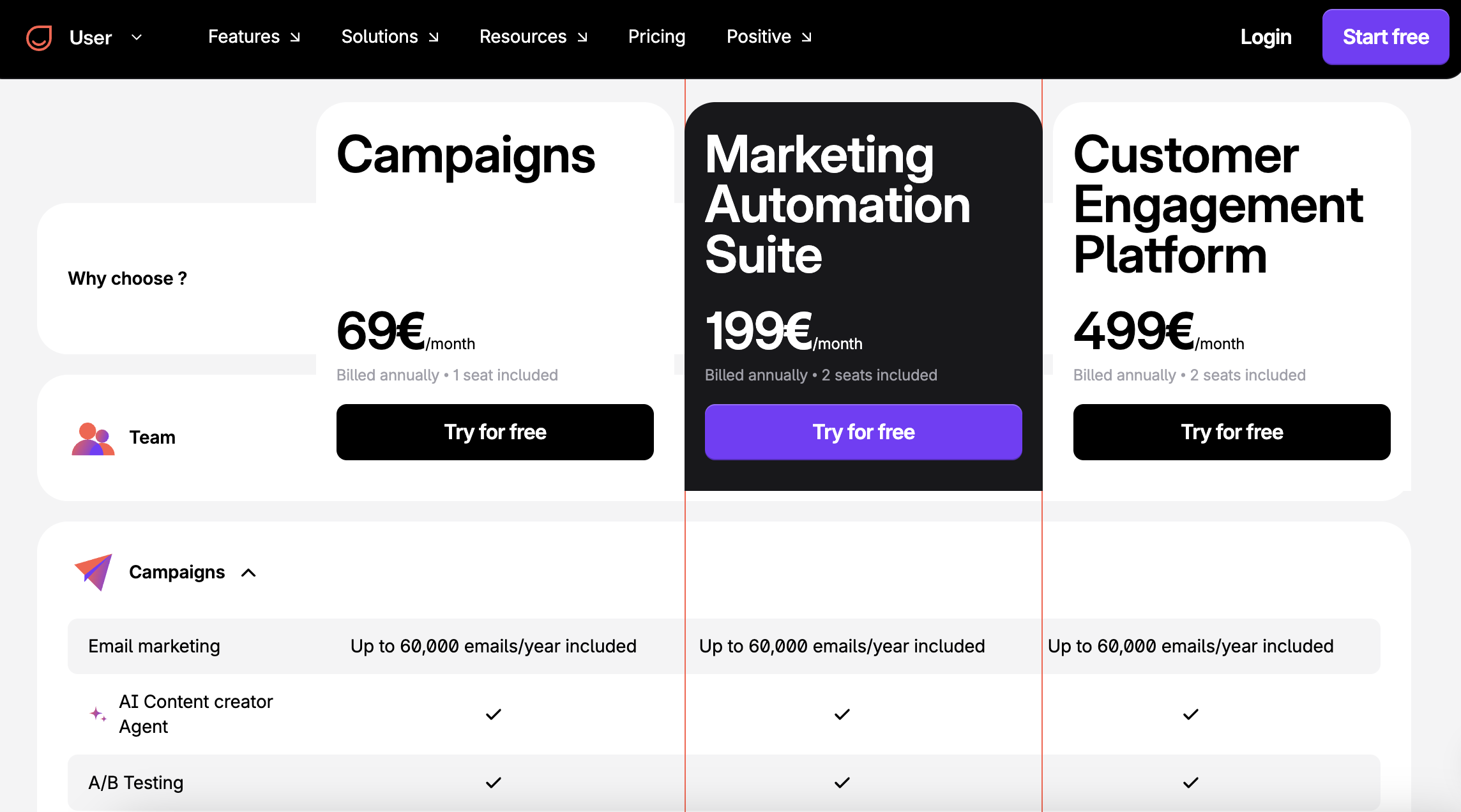
The Marketing Suite
All rates listed below are based on annual billing.
| Offer | Campaigns | Marketing Automation Suite | Customer Engagement Platform |
|---|---|---|---|
| Monthly price | €69 | €199 | €499 |
| Seats included | 1 | 2 | 2 |
| Additional seat | €99/month | €99 / month | €99 / month |
| Emails included | 60,000 / year | 60,000 per year | 60,000 per year |
| Contacts | Unlimited | Unlimited | Unlimited |
| 6,000 messages per year | 24,000 messages per year | 120,000 messages per year | |
| Active Workflows | 5 | 20 | 100 |
| Forms and Landing Pages | Option for €29/month | 50 + 50 published | 100 + 100 published |
| Timeline Visibility | 30 days | 60 days | 99 days |
One thing is immediately clear: The volume of emails is the same across all three plans. You don’t upgrade to send more emails; you upgrade to open up new channels and gain more advanced automation capabilities.
These 60,000 annual emails serve as a baseline. The provider notes that the plan is customizable and that you should contact them to adjust the volume of emails sent.
The contrast with the old pricing structure is striking. A Sarbacane Premium subscriber paid €269 per month for 25,000 monthly emails, and the Exclusive plan cost €449 for 50,000. These pricing tiers used to be publicly listed; now they’re handled by a sales representative. Yet Sarbacane had previously touted pricing transparency as a key selling point in contrast to the opacity of corporate contracts.
Optional Modules
Four modules are available as add-ons to the Marketing Suite, all on an annual subscription basis.
- Loyalty Program: €199 per month
- Price: 59 € per month
- Customer Service: 59 € per month
- Mobile App Marketing: €59 per month
An important point to keep in mind when planning your budget: the publisher’s FAQ states that these modules are billed to the main office. Once activated, all users in the workspace have access to them, and the invoice is based on the number of users.
The Data & Activation Suite
This second package is designed for teams of ten or more users, with high sending volumes and enhanced support.
- Performance: €999 per month, 18 seats included, additional seats at €59 per month. Up to 1,500,000 emails per year, unlimited non-marketing contacts, and up to 100,000 marketing contacts. The Sales, Customer Relations, Loyalty, and Mobile App Marketing modules are included this time, as is a dedicated CSM.
- Limitless: Based on a quote. Unlimited seats, unlimited emails, unlimited contacts, unlimited workflows. Data retention extended to three years.
What the Marketing Suite sells à la carte, the Data & Activation Suite includes by default. The price jump is steep, but the per-seat rate becomes significantly more affordable.
Salesdorado’s review
The real deciding factor isn’t the number of features or the volume of emails sent. It’s the number of people who need access to the tool. For fewer than two users, the Marketing Suite is a solid choice and well-priced. Between three and ten users, the cost of adding seats at €99 per seat becomes a significant burden. Beyond that, the Data & Activation Suite becomes a sensible option again, with 18 seats included and each additional seat at €59.
The real deciding factor isn’t the number of features or the volume of emails sent. It’s the number of people who need access to the tool. For fewer than two users, the Marketing Suite is a solid choice and well-priced. Between three and ten users, the cost of adding seats at €99 per seat becomes a significant burden. Beyond that, the Data & Activation Suite becomes a sensible option again, with 18 seats included and each additional seat at €59.
What we like, what we don’t like
- A truly omnichannel approach: email, SMS, WhatsApp, web push notifications, and wallet features—all in a single interface and connected to the same database. Fragmented marketing tools are costly, and Positive User provides a comprehensive solution to this challenge.
- Platform-level automation: visual canvas, conditional branches, A/B splits integrated into the user journey, and behavioral triggers. Sarbacane has never competed in this category.
- The “Company” object: the data structure is finally available in B2B, with segmentation by company rather than just by contact.
- Unlimited contacts across the entire Marketing Suite: you don’t pay to store inactive contacts, unlike the model used by most U.S. competitors.
- Customization that goes the extra mile: six sources of attributes for dynamic content, including the company and the product.
- Revenue reporting: The statistics link revenue to campaigns, whereas Sarbacane only tracked open and click-through rates.
- Sovereignty is not just an empty slogan: designed and hosted in Europe, with data stored in France and Germany, and ISO 27001 certification. For a regulated industry, this simplifies risk analysis.
- Personal support has been preserved: a designated contact person in the help panel, and local teams in five countries. This has historically been Sarbacane’s strength, and it has not been sacrificed.
- Complete interface break: no Sarbacane references remain. A switch requires rebuilding the teams, not updating software.
- The cost per user is high: €99 for an additional seat on the Marketing Suite, which is more than the entry-level subscription. This is a deterrent for a marketing team of three or four people.
- End of volume-based pricing transparency: for more than 60,000 emails per year, there are no publicly listed tiers. You must contact a sales representative.
- Five active workflows for the entry-level offering: you quickly hit the ceiling once you scale up your scenarios.
- A short data retention period for entry-level plans: 30 days of visibility on a contact’s timeline, which is insufficient if your sales cycles span several months.
- The trial period has been reduced from 30 to 7 days: that’s not enough time to evaluate a platform of this scale, especially if you have to import and clean up a database.
- A technical requirement for wallet cards —the need to obtain an iOS or Android certificate in advance—somewhat contradicts the promise of a tool designed for marketers rather than developers.
Our verdict: Who is Positive User designed for?
Positive User is right for you if:
- You manage multiple channels and want to stop juggling between tools that don’t share their data
- Whether you’re one or two people using the tool, or a team of ten or more switching to the Data & Activation Suite
- Your email volume is around 5,000 emails per month, or you’re open to negotiating your pricing structure
- Are you looking for behavioral personalization—not just mass mailings?
- Your sales cycles are short, or you operate in a high-end enough market to have sufficient data retention
- Data sovereignty and European hosting are key factors in your decision
Skip it if :
- If you’re looking for basic email marketing without advanced automation, you’ll end up paying for a lot of features you’ll never use
- You ship large volumes and would prefer a published rate rather than a quote
- Your marketing team has three to eight members: this is the range where the per-seat model is least cost-effective
- You are a satisfied Sarbacane customer, and none of the new modules meet a need you have identified
Final rating: 4.3 out of 5. Positive User is a much better product than Sarbacane, and that needs to be made clear. The platform holds its own against American suites in terms of automation, data structure, and channel coverage, with a European foothold that the others lack. The sticking point remains on the business side: a high cost per user for the Marketing Suite and the elimination of publicly available volume tiers.
If you’re a Sarbacane customer, the fact that migration isn’t mandatory gives you time to decide. Take advantage of it. Create a trial account at the same time, encrypt your actual configuration, and compare it to the rate you’re paying today. For some multi-user accounts, the best decision is still to do nothing.
Our final verdict
Positive User is worth checking out if you want to manage multiple channels from a single tool, with data hosted in Europe. Try it out for 7 days by activating the modules that really interest you, then request a full quote—including seats and options—before signing up.
Positive User is worth checking out if you want to manage multiple channels from a single tool, with data hosted in Europe. Try it out for 7 days by activating the modules that really interest you, then request a full quote—including seats and options—before signing up.