You’ve probably seen Clay on LinkedIn. GTM Engineers who swear they’ve tripled their response rates. Influencers hailing the tool as the revolution in B2B prospecting. Impressive case studies from OpenAI, Anthropic and Canva, and credit pricing that promises to replace 4 or 5 separate subscriptions.
Except that when you dig a little deeper (and we did) the reality is more nuanced. We scoured the feedback from over 500 users (G2, Reddit, LinkedIn), analyzed case studies, dissected the credit system and tested the platform. Our verdict: Clay is probably the most powerful data enrichment tool on the market. But there’s a “but”, and it’s a big one.
In this article, we give you our full and honest opinion: features, real prices (with hidden costs), limitations, and above all, who Clay is really worth it for.
Sommaire
Our opinion of Clay in a nutshell
| Perimeter | Score | Our opinion |
|---|---|---|
| Overall rating | 4,0 | Clay is a B2B data orchestrator of rare power. The tool aggregates 150+ data providers, applies AI to qualify and personalize, and pushes the result into your CRM. The downside: a steep learning curve, unpredictable pricing and a high entry ticket for essential features (CRM integrations from $720/month). |
| Enrichment power | 4,7 | Waterfall enrichment is Clay’s fundamental innovation: the tool sequentially queries multiple data providers for the same field, tripling coverage compared to a single provider. Combined with Claygent (a web search AI agent), it’s simply the best on the market. |
| Ease of use | 3,2 | The spreadsheet interface is modern and well thought-out, but make no mistake: Clay is not a plug-and-play tool. Building advanced workflows requires algorithmic thinking and a RevOps or Growth Engineer profile. Allow several weeks to master the advanced features. |
| Quality-price ratio | 3,5 | The per-credit (not per-user) model looks attractive on paper. In practice, the “learning tax” is brutal: hundreds of dollars can go up in smoke during the learning phase. And CRM integrations are locked behind the $720/month Pro plan. |
| Integrations | 3,8 | 150+ data providers in marketplace, native integrations with Salesforce, HubSpot, Pipedrive, and major outreach tools. The downside: CRM integrations are only available with the Pro plan. |
| Relevance to the French market | 3,0 | The 150+ data providers are mainly oriented towards the US/English-speaking market. Coverage of French SMEs (telephone numbers, precise firmographic data) will be inferior to that offered by European solutions such as Societeinfo or Dropcontact. |
| Support & community | 4,2 | Clay University, certifications, a very active Slack community and an ecosystem of specialized consultants. The investment in training is impressive, and goes some way to compensating for the complexity of the tool. Customer support is generally responsive. |
Clay offers a 14-day free trial with 1,000 credits and access to Pro features (webhooks, CRM integrations, HTTP API). Enough to test advanced workflows before you commit. The permanent free plan offers 100 credits/month.
What exactly is Clay?
First misunderstanding to clear up: Clay is not a CRM, nor an emailing tool, nor a simple ZoomInfo-type data provider. Clay is a Go-To-Market data orchestrator, a layer of intelligence that sits between your data sources and your execution tools (CRM, sequencers, ads).
In concrete terms, imagine a super-powered spreadsheet that can query 150+ databases, apply AI to qualify, score and personalize each row, then push the result into your HubSpot or Salesforce automatically. All without writing a line of code…at least in theory.
The company was founded in 2017 in New York by Kareem Amin and Nicolae Rusan. For six years, Clay searched for its product-market fit, moving from a generalist data automation tool to a “personal CRM” before finding its niche in 2021: data enrichment and orchestration for B2B sales and marketing teams.
The pivot was spectacular: revenues multiplied by 10 between 2022 and 2024, then grew by 600% in 2024. In June 2025, a $100 million Series C led by CapitalG (Alphabet’s fund) propelled the valuation to $3.1 billion. Customers include OpenAI, Anthropic, Canva, Intercom, Rippling and Vanta.
Clay’s trajectory is impressive, but keep in mind that the majority of the customer cases highlighted are American tech scale-ups with dedicated RevOps teams. The transfer of value to a French SME with 20 sales people is not automatic.
Clay’s key features
Waterfall enrichment (fundamental innovation)
This is the heart of the reactor. The principle is simple but formidably effective: rather than relying on a single data provider (which is bound to have gaps in its coverage), Clay sequentially queries several providers for the same field.
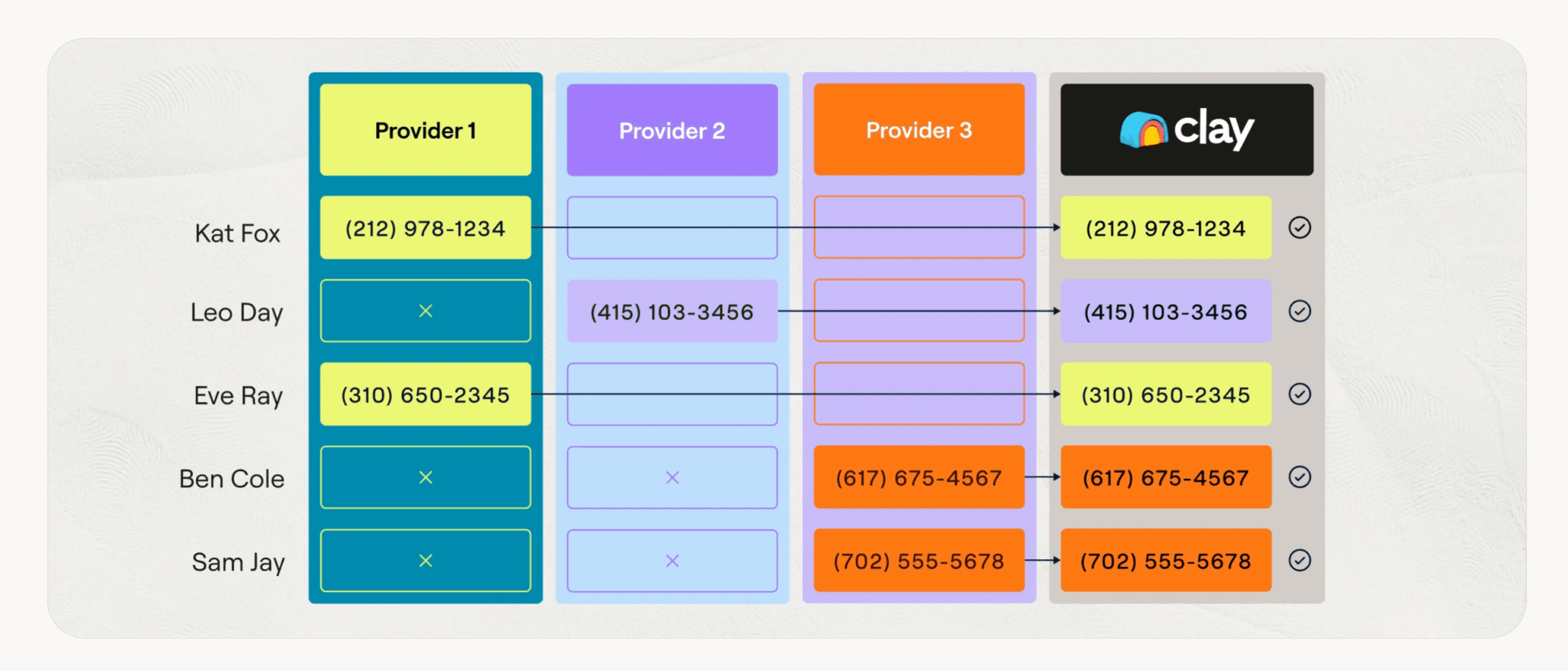
For example, you’re looking for a prospect’s professional e-mail address. Clay will first query Hunter (the cheapest), then Dropcontact if Hunter doesn’t find anything, then People Data Labs, then ContactOut, and so on. As soon as a provider returns a valid result, the cascade stops. The email found can then be automatically verified via NeverBounce or ZeroBounce to protect your deliverability.
The results speak for themselves: several documented customer cases report a tripling of data coverage compared to a single supplier. OpenAI, for example, went from 40% to 80% enrichment coverage on its inbound leads using Clay workflows.
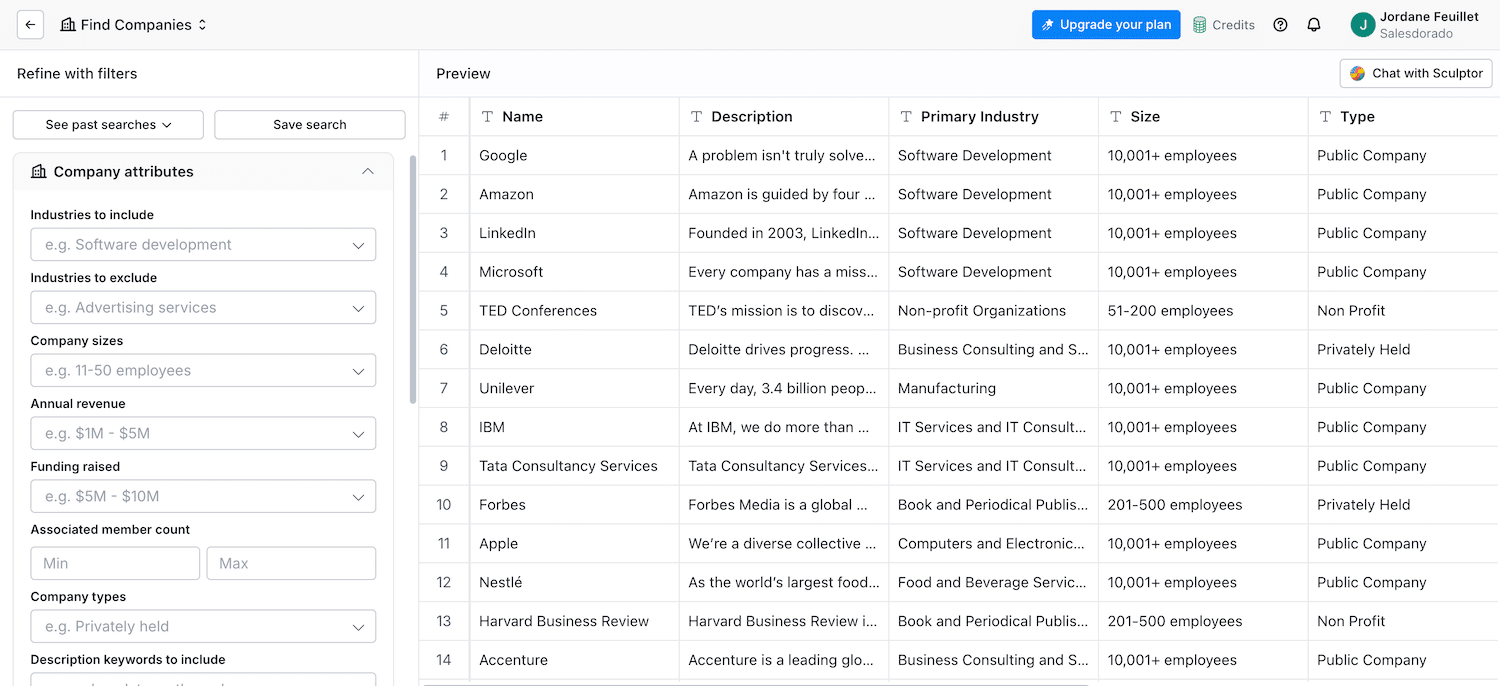
Enrichment is not limited to contact details. We can aggregate firmographic data (size, fundraising, sector), technographic data (stack used by the target company), recruitment trends, web traffic and much more. By combining these signals, we can then build a truly relevant lead scoring.
Claygent, the AI agent for web search
Claygent is an artificial intelligence agent capable of navigating the web autonomously to extract information that structured databases don’t contain. We’re talking here about unstructured signals: recent content published by a prospect, the brand tone of a target company, the existence of a specific blog or recruitment page, mentions in the press…
Claygent passed the milestone of one billion cumulative executions in June 2025. Powered by state-of-the-art language models, it can summarize news articles, synthesize a competitor’s value proposition, analyze recruitment pages to deduce a company’s priorities, or generate personalized hooks for your prospecting emails.
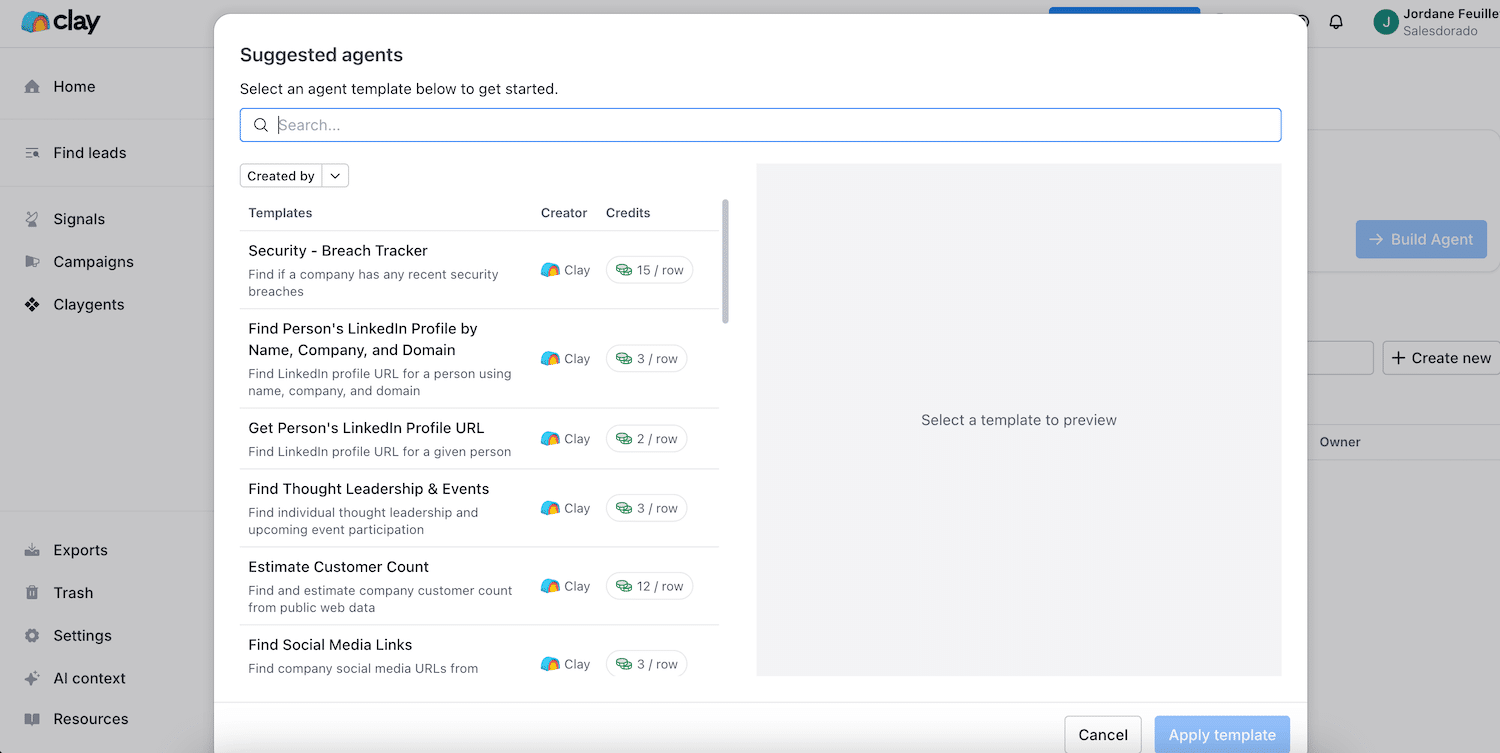
This is probably the feature that creates the most value for teams involved inlarge-scale hyper-personalization: instead of spending 15 minutes manually searching for each prospect, Claygent does the job in a matter of seconds. The result isn’t always perfect (hallucinations are possible), but on large volumes, the time saved is massive.
Signals of intent and triggers
The relevance of a sales action depends as much on the quality of the data as on the timing. Clay integrates a business signal tracking engine that automatically detects the right moment to contact a prospect.
Signals to keep an eye on include job changes (a new VP Sales arriving = a likely overhaul of tools), fund-raising (more budget = more purchasing), job offers (recruiting a “Head of RevOps” often signals a need for tools) or even mentions of competitors on social networks (a customer unhappy with a competitor = opportunity).
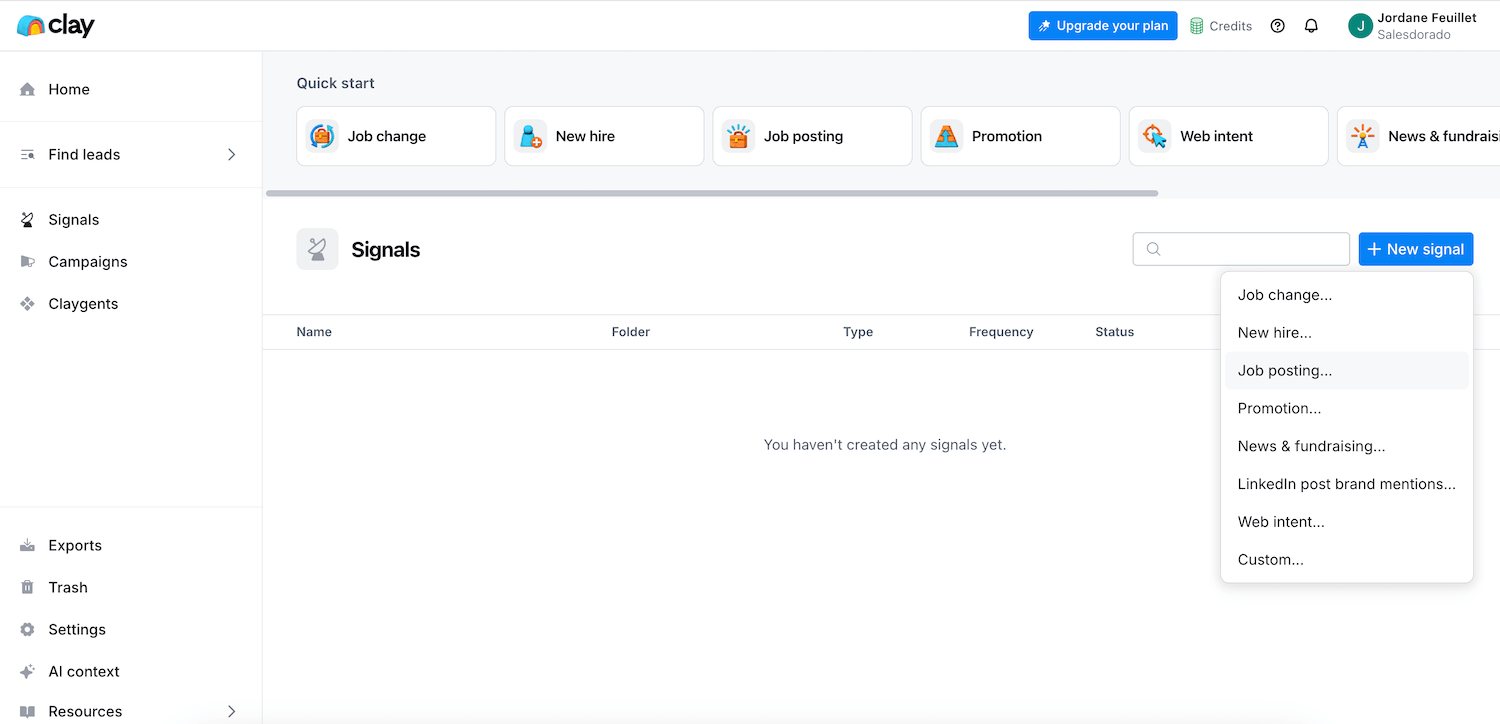
This approach is directly linked to the logic ofEvent-Based Marketing: rather than prospecting “cold” on static lists, we trigger targeted actions based on actual events. It’s an approach that the most advanced sales teams are increasingly adopting, and Clay makes it accessible without custom development.
Orchestration and no-code workflows
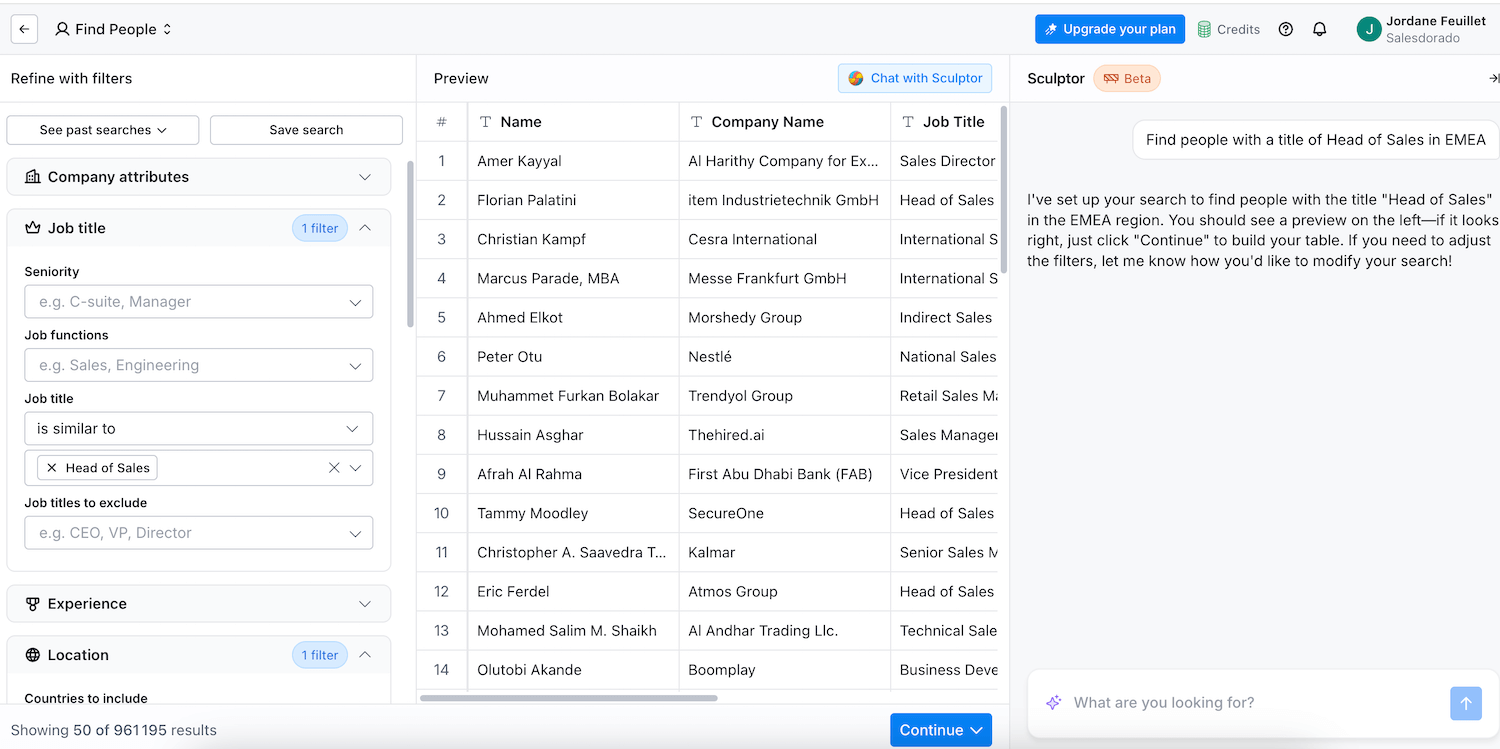
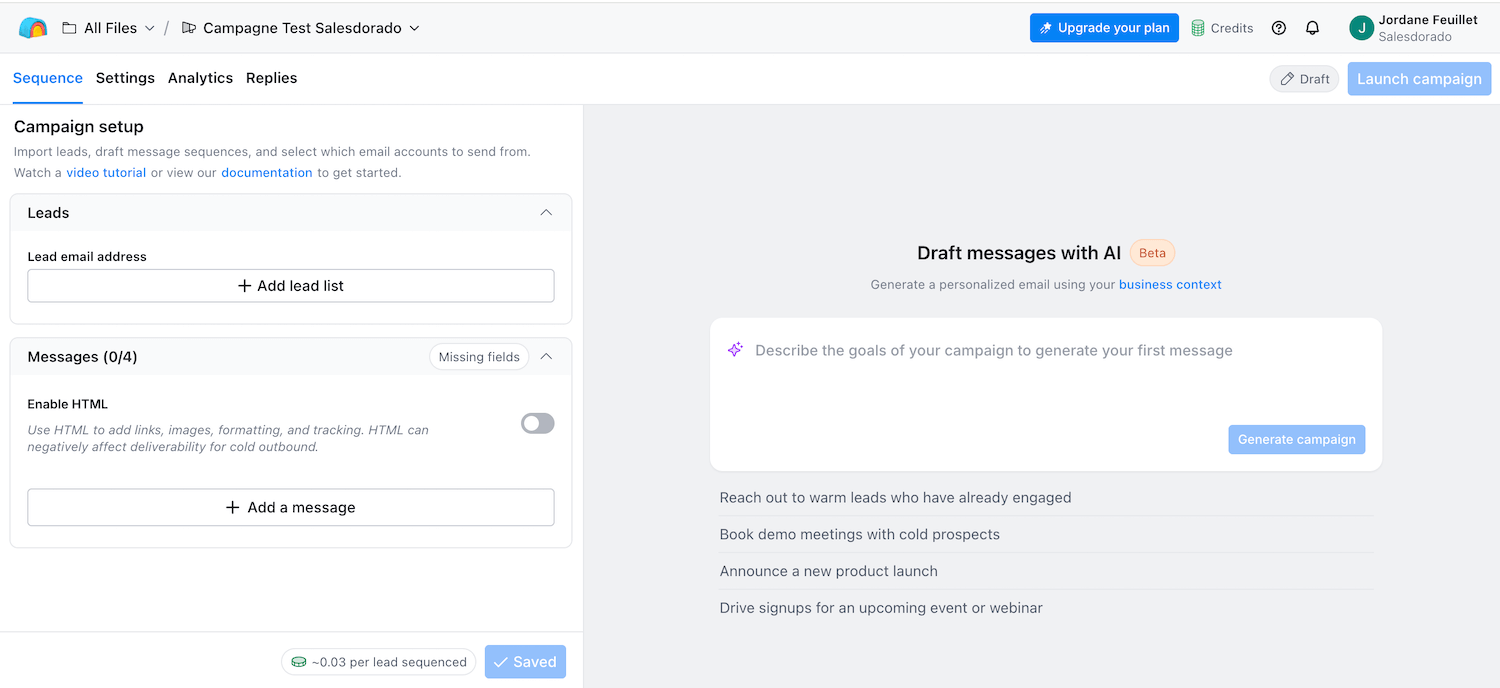
Clay’s interface looks like a spreadsheet, but it’s a spreadsheet on steroids. Each column can be an action: enrich a field, apply a filter, launch an AI search, score a lead, send data to a CRM. Dozens of actions can be cascaded, with conditional logic (if X then Y), loops, deduplications…
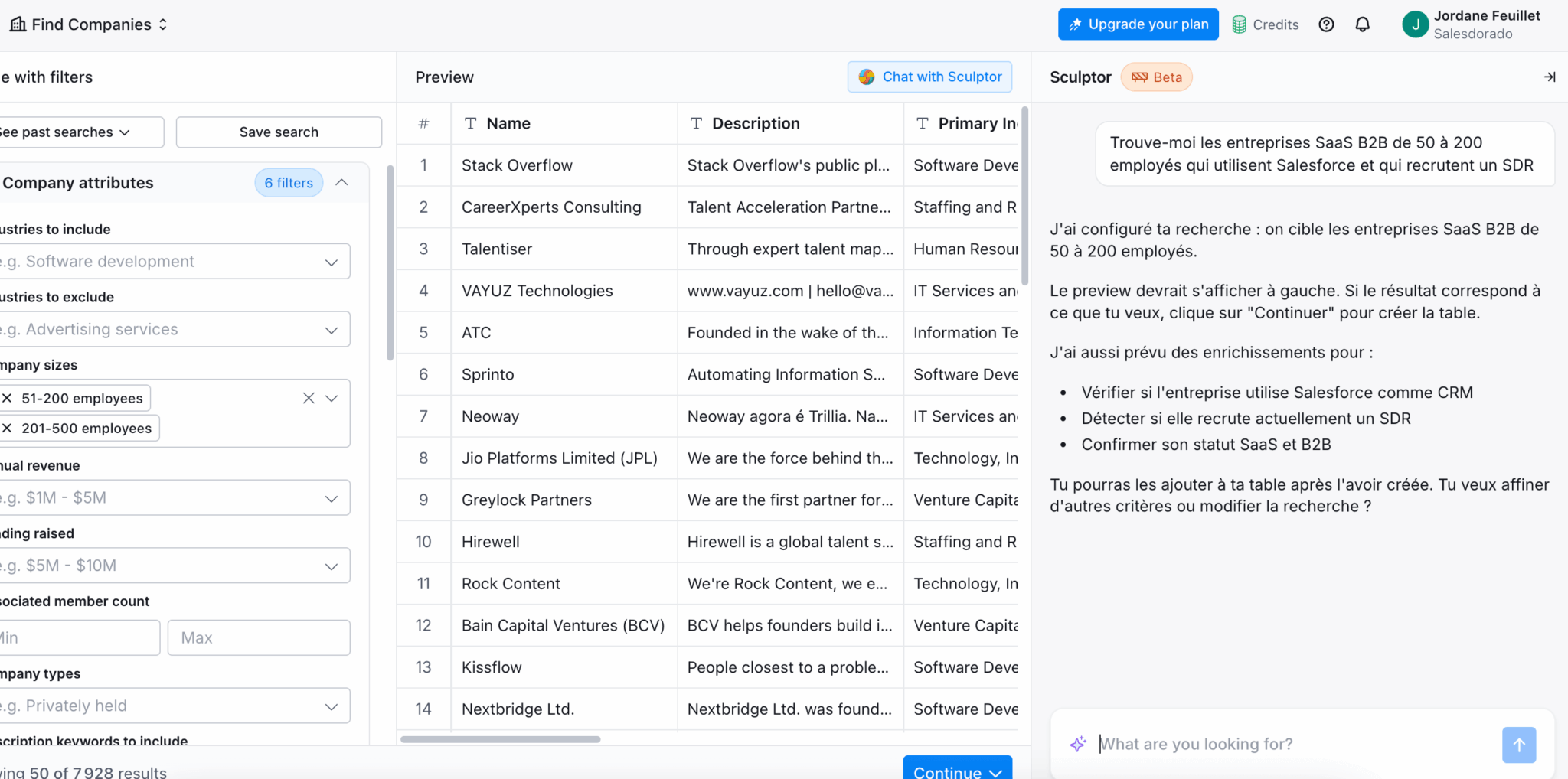
Two features stand out:
- Sculptor, a conversational agent that lets you describe a workflow in natural language (for example: “Find me B2B SaaS companies with 50 to 200 employees that use Salesforce and are recruiting an SDR”) and Clay automatically generates the table and the necessary enrichments.
- Native Sequencer, which lets you launch email campaigns directly from Clay, even if most teams prefer to use a dedicated tool like Lemlist, Smartlead or Instantly as a complement.
Integrations
Clay connects natively to the market’s leading CRMs (Salesforce, HubSpot, Pipedrive), email sequencers (Outreach, Salesloft, Smartlead) and offers a marketplace of 150+ data providers accessible directly via Clay credits without separate subscription.
For more advanced cases, the Explorer and higher plans can integrate any HTTP API and configure webhooks, turning Clay into a true integration hub. The platform can also push enriched audiences to LinkedIn Ads, Meta Ads or Google Ads for ABM campaigns.
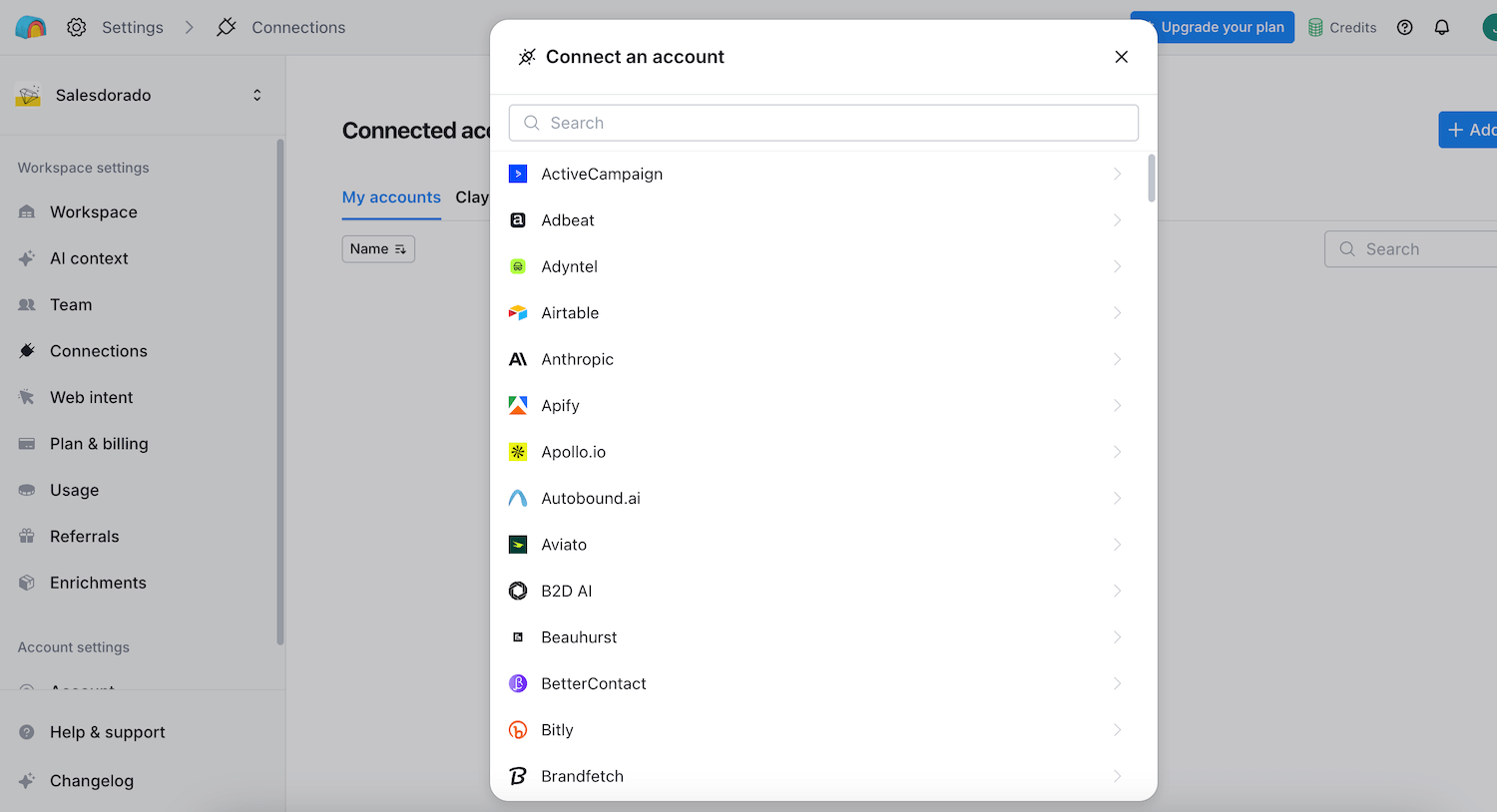
The major sticking point: native CRM integrations (Salesforce, HubSpot) are only accessible from the Pro plan, billed at a minimum of $720/month on an annual basis. For Starter and Explorer plans, you need to use workarounds (CSV exports, Zapier, webhooks) to synchronize data with your CRM. This is a commercial choice that many users find frustrating.
Clay offers a 14-day free trial with access to Pro features, including CRM integrations. Take advantage of this opportunity to test synchronization with your CRM before committing to a plan.
Clay rates: how much does it really cost?
Plans and credits
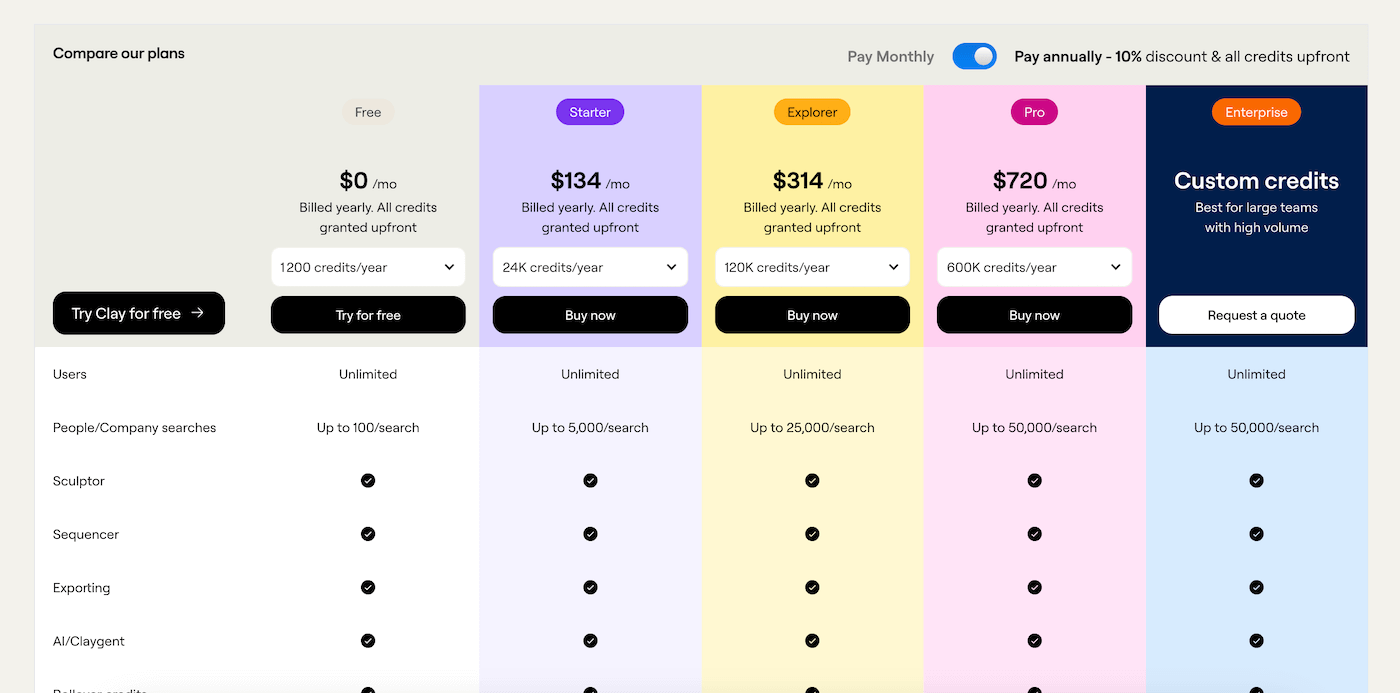
Clay operates on a per-credit model , not a per-user model. All plans include an unlimited number of users: it’s the volume of enrichment that determines your bill. Each action (finding an email, enriching a record, launching an AI search) consumes a variable number of credits, depending on the provider and the type of data.
| Plan | Monthly price | Yearly price | Credits / month | Key features |
|---|---|---|---|---|
| Free | 0$ | 0$ | 100 | 100+ providers, AI/Claygent, export, Chrome extension |
| Starter | 149$ | 134/month | 2 000 à 3 000 | + Own phone numbers, API keys |
| Explorer | 349$ | 314/month | 10 000 à 20 000 | + Webhooks, HTTP API, email sequencing integrations |
| Pro | 800$ | 720/month | 50 000 à 150 000 | + CRM integrations (Salesforce, HubSpot) |
| Enterprise | On quotation | On quotation (~$30,000+/year) | Custom | + SSO, Snowflake, dedicated Slack support, analytics credits |
Each plan offers several tiers of credits. The cost per credit falls sharply as you move up the range: around $75 for 1,000 credits on the Starter plan, compared with $16 for 1,000 credits on the higher tiers of the Pro plan. Basic enrichment (finding an email) costs 1 to 2 credits, while a verified cell phone number can cost from 5 to 25 credits, depending on the provider.
Anticipating hidden costs
This is where things get complicated, and is the point most criticized by the community. Several sources of extra cost often fly under the radar:
- The “apprenticeship tax” is the first trap. Every enhancement, however unsuccessful, consumes credits. Queries launched by mistake, workflow tests, experiments to understand the tool: everything is billed. A survey of 500 GTM professionals revealed that 42% of complaints concerned the uncontrollable consumption of credits. Users report having burned $500 and more simply by learning to use the interface.
- Limited rollover Unused credits can be carried over to the following month, subject to a strict ceiling of 2x your monthly allowance. If your activity is irregular (for example, occasional enrichment campaigns), you risk losing credits.
- Top-ups with surcharges: if you use up your credits before the end of the month, top-ups are billed at a surcharge of 50% on top of your plan rate.
- API throttling To respect the limits of third-party providers, Clay imposes throughput limits on requests. Some users report caps of 400 registrations per hour on certain providers. As a result, you’re paying for credits that you can’t always use up in a month.
Clay vs. classic stack: cost comparison
To put things in perspective, here’s a schematic comparison.
A “classic” B2B enrichment and prospecting stack might include a ZoomInfo subscription (~$15,000/year minimum), an automation tool like Zapier or Make, and a cold emailing tool. That’s an annual budget of $20,000 to $30,000.
With Clay Pro ($720/month = ~$8,600/year), you centralize enrichment, workflows and 150+ data providers. But beware: you’ll often need to add a dedicated outreach tool and potentially a LinkedIn Sales Navigator subscription (~$1,200/year). The real total cost is closer to $12,000 to $15,000/year for serious use.
The real advantage of Clay is that when you use multiple data providers in waterfall, you pay just one platform subscription instead of 3 or 4 separate data subscriptions.
But for a French SME prospecting only on the national market, solutions such as Societeinfo or Dropcontact often offer a better coverage/price ratio on the French market.
Clay’s credit-based model is attractive when compared to the per-user licenses of ZoomInfo or Cognism. But without strict governance of consumption (qualifying leads before enriching them, capping credits per campaign, aggressive filtering), the bill can double in a month. As one LinkedIn user sums up: “Clay should come with a seatbelt”.
What we like (and don’t like)
- Unrivalled enrichment power: waterfall enrichment on 150+ sources is simply the best there is. Data coverage is 2 to 3 times greater than that of a single provider. No competitor offers such broad access to so many providers in a single interface.
- Hyper-personalization on a massive scale: by combining Claygent (web AI search), intent signals and enrichment data, we can generate truly personalized messages for thousands of prospects. Recharge has documented a 20% increase in its response rate thanks to this approach.
- Unlimited users across the board: unlike almost all B2B tools, Clay doesn’t charge per seat. The whole team can access it, which is a game-changer for teams of 10+ people.
- Modern, flexible interface: the spreadsheet format is familiar, and no-code workflows enable sophisticated automation to be built without a developer. The Sculptor AI agent further lowers the barrier to entry.
- Enterprise-ready compliance: SOC 2 Type II, ISO 27001, RGPD, CCPA. Clay ticks all the boxes for companies sensitive to data security. This is clearly a reassuring point for European teams…
- Impressive educational ecosystem: Clay University, recognized certifications, active Slack community, specialized consultants. It’s rare for a software publisher to invest so much in training its users.
- Steep learning curve: this is the most critical point. Clay is not a tool for field salespeople; it needs to be driven by a RevOps or Growth Engineer profile. Without this expertise, the tool becomes a money pit.
- Unpredictable pricing: the credit system makes budget forecasting very difficult. Failed enrichments are billed, testing is expensive, and the actual cost per credit varies widely depending on the providers used. Many users compare the experience to “paying to learn to drive on an F1 circuit”.
- CRM integrations locked behind the Pro plan: not being able to synchronize natively with HubSpot or Salesforce without paying $720/month is a major stumbling block for SMBs. It’s a fundamental feature, not a premium.
- Uneven coverage of European markets: the 150+ providers are predominantly US-centric. When prospecting on the French market, contact data (especially telephone numbers) will be less reliable than with European specialists.
- Not a complete outreach tool: native Sequencer exists but remains basic. Most teams have to couple Clay with a dedicated cold mailing tool, which adds cost and complexity.
- Data quality at times uncertain: some G2 and Reddit feedback points to significant discrepancies between Clay’s estimated cost and the actual cost of enrichment (up to 100% discrepancy), as well as obsolete or erroneous contact data depending on sectors and geographical areas.
Clay vs. the alternatives: how to position it?
Clay is not in the same league as all other prospecting tools. To clarify matters, here’s a comparative positioning of the main alternatives.
| Tool | Type | Admission ticket | Complexity | Cover FR | For whom? |
|---|---|---|---|---|---|
| Clay | Data Orchestrator + AI | 134/month ($720 for CRM) | High | Average | Advanced RevOps teams, tech scale-ups |
| Apollo | All-in-one (data + outreach) | 49/month/user | Low | Average | Startups and SMEs going outbound |
| ZoomInfo | Enterprise database | ~$15,000/year | Average | Low | Key accounts, US market |
| Cognism | Europe database | On quotation (~$1,000/month) | Low | Good | SMEs/ETIs prospecting in Europe |
| The Growth Machine | Multi-channel outreach | 60/month | Low | Good | French SMEs, multi-channel approach |
| Lemlist | Cold email + LinkedIn | 39/month | Low | Good | Small teams, personalized approach |
Clay’s positioning is unique: it doesn’t replace Apollo or ZoomInfo, it orchestrates them. A robust workflow on Clay can query the Apollo API for cost, fall back on ZoomInfo if the first query fails, and complete with targeted web scraping. The result: data coverage in excess of 90%, where each provider individually caps at between 60% and 80%.
But this combinatorial power comes at a much higher total cost: the Clay layer adds to the costs of the underlying providers (even if Clay doesn’t overcharge for them). And for French teams who don’t need this heavy artillery, tools like La Growth Machine, Waalaxy or Lemlist offer a much simpler approach for a result that is often sufficient.
If you prospect mainly in the French market and send less than 10,000 emails per month, Clay is probably over-designed for your needs. French solutions like Societeinfo (for corporate data) combined with a cold mailing tool will be more effective and much less expensive. Clay really comes into its own when you’re tackling large-scale international markets.
Our verdict: who’s Clay for?
Clay is for you if :
- You have a significant volume of leads to enrich (over 5,000 per month) and prospecting is at the heart of your business.
- You have a RevOps or Growth Engineer profile on the team, capable of designing and maintaining complex workflows
- Your CRM is already clean and structured: Clay enriches data, but does not solve quality problems upstream.
- You canvass international markets (US, UK, English-speaking Europe) where data provider coverage is optimal.
- You already use several enrichment tools (Apollo, Clearbit, Lusha, etc.) and want to centralize and automate via a single platform.
- You have the budget for the Pro plan ($720/month minimum), without which Clay loses much of its appeal (no native CRM integrations).
Skip it if :
- You’re a French SME with fewer than 10 salespeople and a limited tooling budget (simpler, less expensive alternatives exist).
- Your team doesn’t have the technical skills to configure and maintain workflows: without GTM Engineer, Clay becomes a credit crunch.
- You are prospecting mainly on the French market: data coverage will be inferior to that of local specialists.
- You’re looking for a plug-and-play prospecting tool: Clay is an automation engine, not turnkey prospecting software.
- You don’t have a CRM in place, or your data is in bulk: start by structuring your CRM before investing in an orchestrator.
- You send fewer than 10,000 emails a month: the cost per enriched lead is unlikely to be justified by simpler solutions.
Clay is the obvious choice for advanced GTM teams who want to centralize their data enrichment, automate their workflows and customize their outbound on a large scale. The 14-day free trial (1,000 credits, Pro access) allows you to check that the tool matches your needs and technical level before making a commitment.