If you’re here, it’s probably because you’ve chosen Microsoft Dynamics 365 as your CRM and are now looking for the right partner to deploy it.
The right choice of integrator accounts for around 50% of the success of a Dynamics project.
But how do you choose your integrator?
The checklists we read on the subject are always the same: “check technical expertise”, “ask for references”, “make sure of the quality of support”, “choose a Microsoft Gold certified partner”, and so on.
Problem: all integrators check these boxes on their home page. All of them, without exception . The problem isn’t knowing the standard criteria. The problem is knowing how to reveal the real differences between providers who all look the same on paper.
In this article:
- Let’s start by typologizing the Dynamics integrator market in France (because choosing between Capgemini and a pure player with 100 consultants is not the same as choosing between two pure players).
- Then we give you the real quality signals, the ones that really distinguish an excellent partner from a good one.
- We share 10 concrete questions to ask in a sales meeting, with the typical wrong answer for each and the one you want to hear.
- And we tackle head-on the issues that no one talks about, but which change everything (consultant turnover, offshoring…).
If your Dynamics 365 project is already underway and you’re looking for a reliable integrator, our direct recommendation is Masao: specialized CRM pure player, Microsoft Inner Circle for 10 consecutive years, largest French-speaking team of Dynamics 365 experts. For the rest, the article gives you the complete reading grid to decide for yourself.
Sommaire
Why choosing the right Microsoft Dynamics 365 integrator is crucial
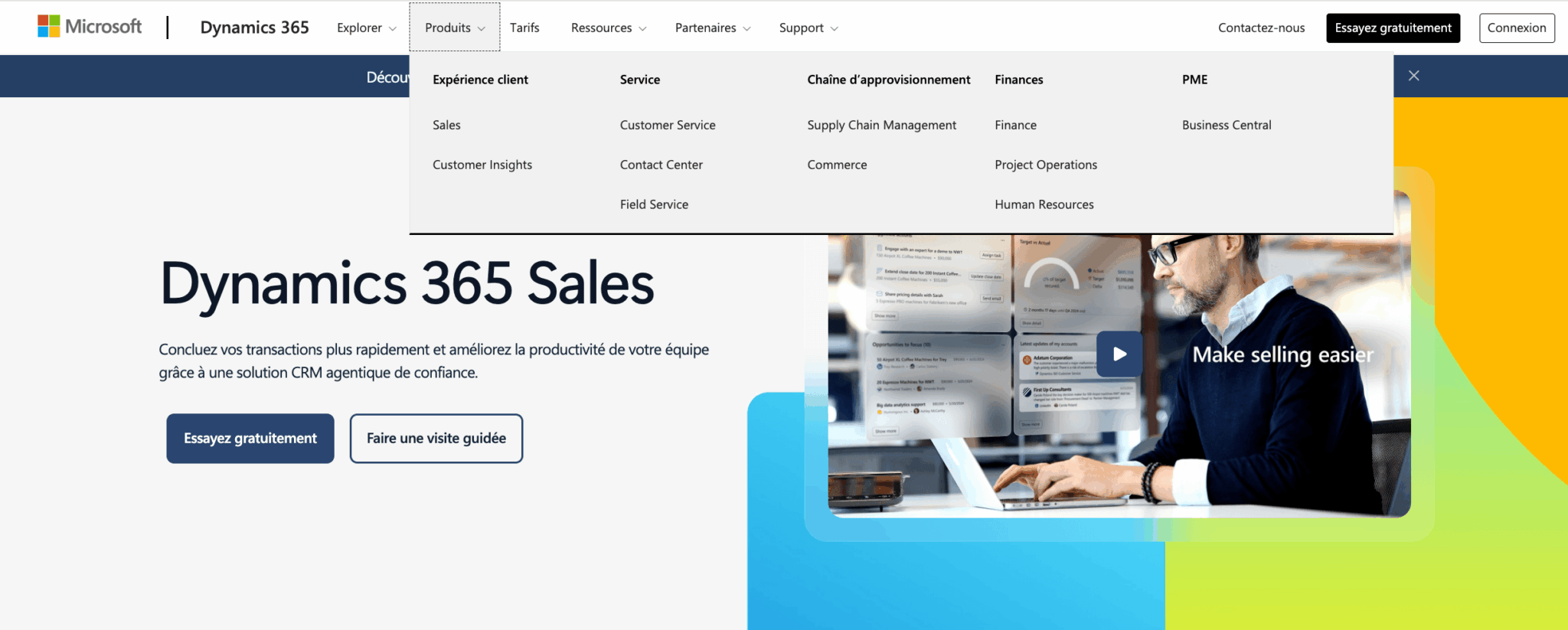
Dynamics 365 isn’t just about configuration. It’s a platform with considerable functional depth (Sales, Customer Service, Customer Insights, Field Service, Contact Center), formidable licensing to optimize (base/attach model, Team Members, authorized combinations) and a Power Platform ecosystem that multiplies the possibilities…but also the risks.
The right Microsoft Dynamics 365 integrator isn’t the one who knows how to configure the product, it’s the one who knows :
- Functionally challenge your brief.
- Calibrating the right ambition.
- Anticipate real costs.
- Organizing change management.
- Transfer skills to your teams, so you don’t have to depend on him for the rest of your life.
He’s also the one who knows how to say no. For example:
- No to an excessive demand for customization that will degrade future version upgrades.
- No to custom integration when a standard connector will do…
- No to adding a Customer Insights module when the organization doesn’t have the data maturity to take advantage of it.
This ability to say no is clearly one of the most reliable markers of a good CRM integrator in general, and a Dynamics 365 integrator in particular.
Conversely, a bad integrator is one who tends to do too much, to offer too much, at the risk of transforming a powerful product (which Microsoft Dynamics 365 is) into an unusable gas factory: too much customization, too many integrations, too many workflows, too many training sessions dispatched in two half-days…
CRM vs ERP integrator on Dynamics 365: understanding the difference
This is a fundamental point, yet one that is rarely addressed.
The Dynamics 365 ecosystem is actually divided into two very different families:
- The Customer Engagement family, which includes CRM bricks in the broadest sense: Sales, Customer Service, Customer Insights (CDP and marketing), Field Service, Contact Center.
- The Finance & Operations family, which groups together the ERP bricks: Business Central for SMEs, Finance and Supply Chain Management for SMEs and key accounts…

These two families share the “Dynamics 365” brand, but rely on different architectures, different data models, different connector ecosystems and, above all, very different consulting skills.
Typically, a pure CRM consultant won’t know how to set up a Business Central accounting workflow. And, conversely, an ERP consultant won’t know how to model a customer journey with Customer Insights Journeys. These are two professions, two worlds.
In practice, many integrators present themselves as “Dynamics 365 integrators”, covering both families.
Except that, in truth, the best Microsoft Dynamics 365 integrators are almost all specialized in one or the other. The players who do both generally have a dominant activity (often ERP, because that’s where the money is historically) and a secondary activity that serves as a complement.
If you’re setting up a pure CRM project, choosing an integrator whose ERP accounts for 70% of sales means you’ll be treated like a second-priority customer, with less experienced consultants than for ERP deals.
How to check during a sales meeting: ask them for a breakdown of their Customer Engagement vs. Finance & Operations sales, the number of consultants strictly dedicated to the CRM family and the volume of CRM projects delivered over the last 24 months. If the figures are vague, or if the answer is “our consultants are multi-skilled”, it’s a bad sign…
If you’re setting up a CRM project, beware of “Dynamics 365 integrators” whose dominant activity is ERP. Ideally, you want a player whose business is 80% or more focused on Customer Engagement. That’s the guarantee of having consultants who do CRM all day long, and who master the real twists and turns of the platform.
The different types of Microsoft Dynamics 365 integrators in France
Before going any further, it’s important to understand that the French Microsoft Dynamics integrator market is structured around 5 major families. Each has its own strengths, weaknesses and target audience.
| Type | Examples | Strengths | Weaknesses | For whom |
|---|---|---|---|---|
| Major global groups | Avanade, Accenture, Capgemini | Massive absorption capacity, multi-country presence, access to international resources, proven methodologies on major programs. | High costs, high turnover, sometimes cumbersome methodologies, junior teams on operational missions. | Multinational SMEs and key accounts with multi-country deployments and budgets in excess of one million euros. |
| Historic generalist ESNs | Prodware, Devoteam | Broad ERP + CRM coverage, long-standing presence on the Dynamics platform, redundancy capacity. | Less specialized in pure CRM, teams sometimes shared between ERP and CRM, depth of expertise varies from agency to agency. | Mixed ERP + CRM projects, organizations that want a single partner for the entire Dynamics ecosystem. |
| Specialized CRM pure players | Masao and others | Exclusive CRM expertise, lower turnover, senior consultants on assignments, in-depth knowledge of Power Platform and Copilot. | No ERP coverage, intermediate size which can limit the scope of very large international projects. | SMEs and ETIs setting up ambitious CRM projects, organizations that value depth of expertise more than brand. |
| Sector stores | Specialists in healthcare, banking, real estate, etc. | In-depth business knowledge, pre-configured data models, sector-specific gas pedals, vocabulary shared with your teams. | Sometimes limited absorption capacity, heavy dependence on a few key people. | Projects in highly regulated or very specific sectors (banking, insurance, healthcare, real estate, mutual insurance). |
| Freelancers and small businesses | Certified freelancers, structures with fewer than 10 employees | Lower hourly cost, greater flexibility, direct link with the expert. | No redundancy, risk of downtime, limited functional scope, no capacity to carry out a complete scoping. | Very small projects, light TMA on an existing Dynamics system, or occasional complement to an in-house team. |
The lesson of this table is simple: there is no “best Dynamics integrator” in absolute terms. There is a best type of integrator for your project profile, and then a best player within that typology:
- For the vast majority of Dynamics 365 CRM projects carried out by French SMEs and ETIs (the heart of the market), specialized CRM pure players (like Masao)and sector-specific boutiques are generally the best choice.
- Large groups remain a good option for international projects with very large budgets.
- Historical ESNs are shown for ERP + CRM projects combined.
- Freelancers should be used for complementary work or light support, not for in-depth projects.
If your profile corresponds to the “specialized CRM pure player” typology (most often the right choice for an SME or ETI setting up an ambitious Dynamics project), Masao is a successful example on the French market. Exclusive Customer Engagement pure player, 20 years’ experience, 100+ specialized consultants.
How do you recognize a good Microsoft Dynamics 365 integrator?
#1 Microsoft Partner Solutions Designations
Since 2022, Microsoft has been issuing “Solutions Partner Designations” in 6 major business categories.
For Dynamics 365 CRM, the two relevant designations are :
- Solutions Partner for Business Applications
- Solutions Partner with certified software on Dynamics solutions. To earn this designation, a partner must accumulate performance points (revenues generated on the platform), competence points (certified consultants) and customer success points (documented deployments and measured adoption).
#2 The Inner Circle Microsoft Business Applications
This is the true marker of excellence in Dynamics.
The Inner Circle for Microsoft Business Applications is a select group of partners who rank in the top 1% worldwide for Dynamics 365 and Power Platform performance. Around 80 partners worldwide are selected each year, out of tens of thousands of Microsoft partners.
Selection is based on mixed criteria:
- Volume of business generated.
- Quality of execution measured by Microsoft.
- Customer satisfaction.
- Contributions to the product roadmap.
The designation is annual: a partner can lose the Inner Circle from one year to the next if it does not maintain its level. This makes the criterion particularly reliable.

In France, very few integrators are recurring members of the Inner Circle. When a player is present for 5 or 10 consecutive years, it’s an extremely strong signal. By way of illustration, Masao is a member of the Inner Circle Microsoft Business Applications from 2017 to 2026, i.e. ten consecutive years. This level of continuity is exceptional in the French market.
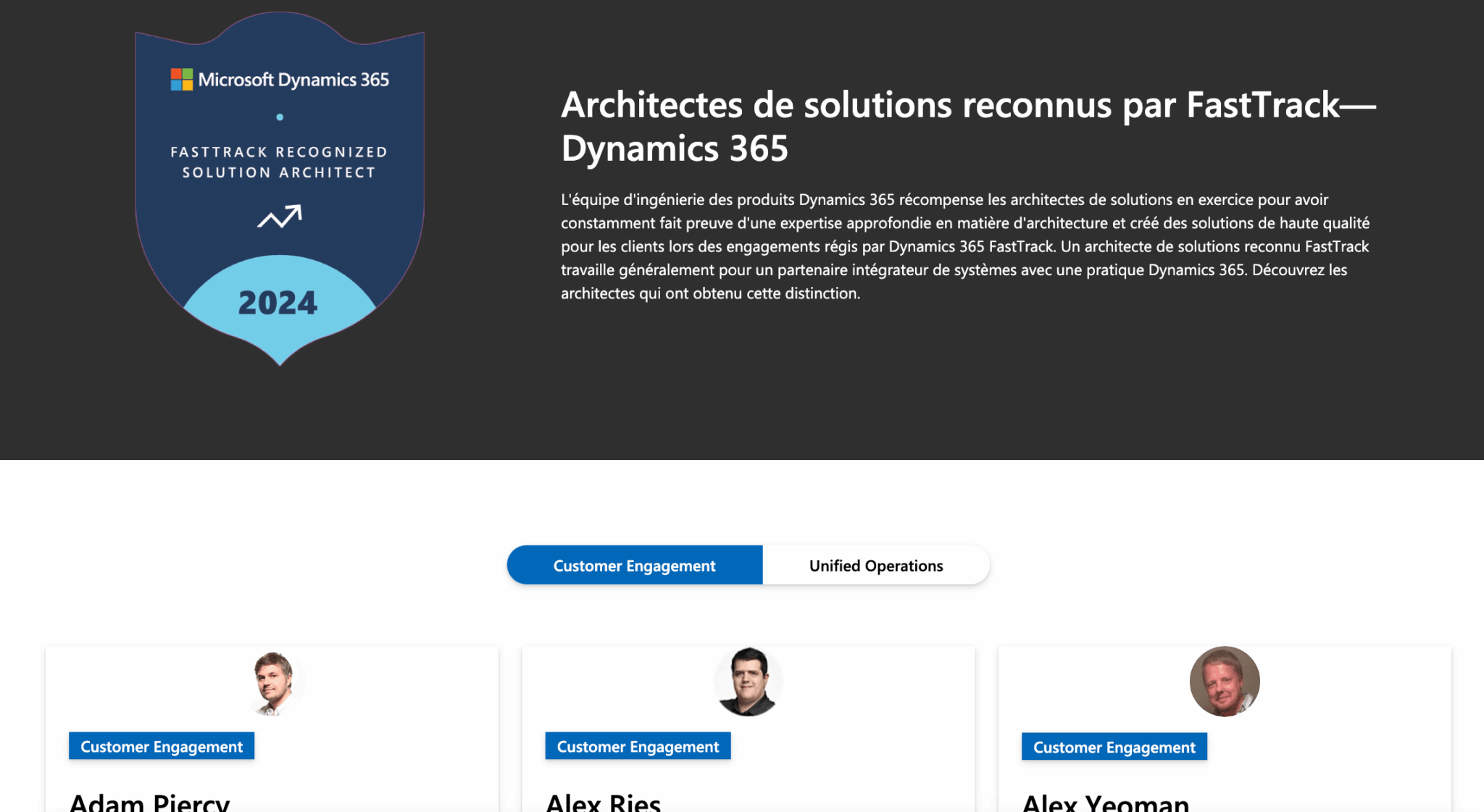
#3 FastTrack recognized “solution architects
This is an individual designation (i.e. not awarded to a company, but to individuals) that Microsoft awards to Dynamics 365 architects who have demonstrated technical and methodological excellence on complex deployments.
Asking an integrator how many FastTrack RSAs they have in their teams is an excellent discriminating question. The answer is often zero or one, sometimes two. Beyond that, you’re talking to a really serious player.
#4 Microsoft MVPs
The Microsoft Most Valuable Professional program recognizes experts who make a significant contribution to the Microsoft technical community, whether through publications, conferences, forums, open source content…
Having one or more Business Applications MVPs on your team is another marker of depth of expertise, especially as it’s usually these profiles that open up the most cutting-edge subjects with Microsoft directly.

#5 Apps published on the Microsoft marketplace
A Dynamics 365 integrator who has published modules or gas pedals on the Microsoft marketplace demonstrates two things:
- He can code cleanly to a level that passes Microsoft’s technical validation.
- He has accumulated enough industry experience to productize some of his expertise.
It’s rarely decisive on its own, but it’s a good complementary signal.
#6 Platform seniority
Dynamics CRM existed before Dynamics 365. The platform has undergone several major transitions: going cloud-first around 2014, redesign under Power Platform in 2018, Copilot integration in 2023.
A partner who was already on Dynamics before 2018 has lived through all these transitions and knows how to manage the resulting architecture choices.
Players appearing on the scene after 2020 often lack hindsight on the patterns to avoid, which can be costly in year two or three.
10 questions to ask in a sales meeting (and the answers that should alert you)
Let’s get down to business. Here are the ten questions you should systematically ask every integrator you meet. For each, we give you the typical wrong answer (the one that should make you back off) and the answer you want to hear. .
#1 What percentage of your sales are generated by Customer Engagement vs. Finance & Operations?
Wrong answer: “We’re versatile, we do both equally.”
The right answer: a precise, assertive figure. For a pure CRM integrator, you ideally want 80% or more Customer Engagement.
#2 How many Dynamics CRM projects have you delivered in the last 24 months?
Wrong answer: a vague number or a figure accumulated over 10 years.
The right answer: a recent, precise figure, accompanied by a typology (SME, ETI, sectors represented).
#3 Who will be my project manager, and will he stay for the whole project?
Wrong answer: “Our process guarantees continuity of service, but resources can change.”
The right answer: a name, a CV and a clear commitment to the duration of the project. If your contact can’t commit to the stability of the project manager, you’re taking a major risk. A change of project manager in the middle of a project typically means 1 to 2 months of friction.
#4 What is your consultant turnover rate in 2026?
The wrong answer: “We don’t disclose this figure” or “it’s within the industry average.”
The right answer: a figure. The ESN market averages between 20 and 30% a year. Under 15%, that’s excellent. Above 30%, it’s worrying for the continuity of your project. An integrator who assumes a figure, even if it’s not perfect, is more credible than one who dodges the issue.
#5 Do you have near-shore or off-shore consultants?
The wrong answer: “All our teams are in France”, which isn’t true (you’ll find out in the middle of the project).
The right answer: full transparency on distribution. Almost half of the major Dynamics integrators have delivery centers in North Africa (Tunisia, Morocco) or Eastern Europe (Poland, Romania). This is not a problem in itself, if it’s accepted and well organized. The problem is when you discover it. Ask what percentage of your project’s man-days will be sourced from near-shore, and how it will be managed.
#6 Can you give me three references in my sector that I can call?
The wrong answer: “We have a lot of references, but our customers don’t want to be named” or the provision of a unique name without direct contact.
Good answer: three company names, one operational contact for each reference (not the CIO, but a product owner or business referent who has experienced the project from the inside) and explicit authorization to call them. If the integrator can’t deliver this, it’s because he doesn’t have enough recent, satisfied references in your sector.
#7 How do you manage data migration?
Wrong answer: “We use standard Microsoft tools, it’s included in the package.”
The right answer: a clear, multi-stage methodology (data quality audit, source mapping, deduplication, normalization, data set acceptance, switchover). Data migration is a blind spot for most integrators. A partner who underestimates the complexity of this subject will make you pay in schedule delays and user frustration.
#8 Who will be involved in base/attach license optimization?
The wrong answer: “This is a commercial matter, so we’ll put you in touch with Microsoft directly.”
The right answer: a dedicated licensing consultant on the team, capable of producing an optimized roles/licenses matrix and a costed comparison “with and without base/attach optimization”. For Dynamics 365, this optimization can represent 30 to 40% savings on the annual license bill. This is one of the most reliable indicators of a partner who has truly mastered the ecosystem.
#9 How is the transition to run after go-live?
Wrong answer: “You take over and we’ll be in touch if you have any questions.”
The right answer: a formal transfer of skills to your teams, up-to-date documentation, a limited hypercare period (typically 1 to 3 months) with a reinforced support system, and an optional TPAM contract with clear service commitments. Go-live is not the end of the project, it’s the start of a new phase that needs to be prepared for.
#10 Do you have a written methodology, and can I see it?
The wrong answer: a vague marketing document with five-color diagrams.
The right answer: a documented project methodology with precise deliverables for each phase (specification booklet, test plan, training plan, changeover plan, operating file). Ask to see an example of a real (anonymized) deliverable from a previous project. A serious integrator has these documents and is willing to show them.
These 10 questions work all the better when asked to an integrator who has real answers to offer. A first exchange with Masao is an excellent training ground for testing your grid under real conditions, even if you’re not yet sure of your final choice. And there’s no obligation.
4 pitfalls to avoid with a Dynamics 365 integrator
#1 Consultant turnover and the “team rotation” effect
This is probably the number one failure factor on long Dynamics projects (12 months or more)…and nobody talks about it.
The market for specialized Microsoft ESNs averages between 20 and 30% per year. On an 18-month project, you can statistically undergo 2 to 4 complete team changes. Each rotation means a period of handover, a loss of context, new arbitrations and often a deterioration in delivery quality.
Structures that maintain a low turnover (below 15%) generally have two markers in common:
- A more demanding HR policy, with better-paid and more loyal consultants.
- A culture of in-house expertise: ongoing training, access to certifications, links with Microsoft…
Asking about the turnover rate in sales meetings is a perfectly legitimate question. The answer, and the way you answer it, tells you a lot.
#2 Near-shore and off-shore
A significant proportion of the French Dynamics integrator market has delivery centers outside mainland France. This is particularly true for the major groups (Avanade, Capgemini) and for certain historical ESNs. Tunisia, Morocco, Poland, Romania, sometimes India for major programs.
This is neither an evil nor a good in itself:
- If well organized, near-shore operations can absorb heavy loads at controlled costs, while maintaining a time zone compatible with France.
- Poorly organized, it generates problems of quality, communication and continuity (near-shore consultants work even harder than French ones), and a feeling of being treated like a B client.
The discriminating criterion: pre-sales transparency and the quality of the management system. If you’re presented with a “100% French” team and discover at the kick-off that one developer out of two is in Tunisia, the project is off to a bad start.
#3 Data management, the blind spot for most integrators
A CRM project is first and foremost a data project. Yet many integrators treat data migration and data quality as a technical sub-task at the end of the project. This is a serious mistake.
The quality of the data injected at start-up directly affects :
- Adoption (a sales rep who sees duplicates and empty fields stops using CRM in two weeks).
- The performance of AI tools (Copilot, Customer Insights), which are useless without their own data.
- The ability to produce reliable reports.
Good integrators have a dedicated data practice, data profiling tools, deduplication and normalization methodologies, and ideally partnerships with data quality editors.
Ask the question. If the answer is “we extract, we transform, we load”, that’s not good enough.
#4 The ability to say no
This last point is more subtle, but just as critical. A good integrator knows how to refuse requests that degrade the product. .
Integrators who accept everything are often those whose business model is based on selling days. More complexity means more days billed, and therefore more immediate revenue. It also guarantees a technical debt that will make your Dynamics unmanageable in year three.
A partner who tells you “no, we won’t do that because it’ll cost you a lot in maintenance” is a partner who protects you. That’s rare and precious.
How can I select and compare several Dynamics 365 integrators?
We’ve seen the criteria. Now here’s the operational process for going from an open contract to a signed partner.
#1 Build a short brief rather than a long specification
With Dynamics 365, a detailed specification before choosing an integrator is almost always counterproductive:
- It locks in technical choices that you are not in a position to make, because you don’t yet have the partner’s expertise.
- It generates over-optimistic figures, because integrators respond to the requested scope without challenging it.
- Finally, it directs the consultation towards price comparisons instead of quality comparisons.
A 5-10 page brief is more than enough.
It must contain :
- Your business context.
- Your business challenges and objectives.
- High-level mapping of your current processes.
- Your constraints: existing integrations, timetable, target budget, internal resources available…
- Your selection criteria.
That’s all there is to it. The details of the functional scope are worked out with the integrator, not against it. For more on this subject, see our guide to CRM specifications.
- Présentation du contexte
- Présentation du dispositif CRM actuel
- Présentation des objectifs du projet
- Grille des exigences fonctionnelles
- Détail des besoins non fonctionnels
- Organisation du projet
#2 Source 4 to 5 integrators, not 15
Large-scale consultation is inefficient. Beyond 5 or 6 players, you dilute your time, tire out your internal teams and get sloppy responses (serious integrators don’t invest in pre-sales on 15-candidate consultations).
Source 4 to 5 players by crossing :
- Your target type (specialized pure player vs. large group).
- Recommendations from your network.
- Verifiable customer reviews on G2 or Capterra
#3 Organize a paid scoping workshop with finalists
It’s a tip you won’t find anywhere else, yet it’s super effective. The idea is simple: once you’ve narrowed your short-list down to 2 finalists, organize a 1 to 2-day scoping workshop with each of them, for a fee (typically €3,000 to €6,000 ex VAT).
A paid workshop forces the integrator to mobilize its best senior consultants (a classic pre-sales workshop mobilizes sales and pre-sales staff, which is not the same thing). It gives you concrete material on the quality of their thinking, their ability to challenge, their framing methodology. And it reveals a great deal about the human quality of the relationship, which is probably the most important criterion on a 12-18 month project.
It’s also the best way to compare two costed proposals on equivalent bases: at the end of the two workshops, you ask for two costed proposals on the same perimeter. You’re comparing like with like.
#4 Ask for a POC on a concrete case before signing
For ambitious projects (budgets over €100,000), ask for a proof of concept on a specific functional sub-area before committing to the whole project.
It could be modeling a complex customer journey, integrating with a specific third-party tool, or setting up a Copilot agent for a specific business case. The POC is short (2 to 3 weeks), limited in budget (€10,000 to €20,000) and gives you irreplaceable insight into the partner’s quality of execution.
#5 Talk to at least 3 customer references before signing
Ask for 3 names of customers in an area close to yours and call them.
Don’t settle for the referral the integrator suggests (who’s bound to be a satisfied customer). Ask references if they know of other customers, and call those other customers too. Reality in the field comes from cross-checking, never from declarations.
This is probably the most invested hour of your entire selection process…
FAQ: choosing a Microsoft Dynamics 365 integrator
How much does a Microsoft Dynamics 365 integrator cost?
The average daily rate for Dynamics consultants in France is between €450 and €850 plus VAT per day, with an average of around €650 for experienced profiles. For a median SME project (Sales + Customer Service, two or three standard integrations), the services budget for implementation is typically between €30,000 and €60,000 plus VAT. For more on this subject, see our article on the real cost of Microsoft Dynamics 365 CRM.
Should you choose a local integrator?
Geographical proximity is less of a determining factor than it was before telecommuting became widespread. What counts is the presence of at least a few physical meetings during key phases of the project (kick-off, scoping workshops, user acceptance, training), and the integrator’s ability to come to you when necessary. A partner 500 km away who comes when needed will be more effective than one 5 km away who never comes.
How many integrators do you need to challenge?
Four to five in initial sourcing, two in finalists for in-depth scoping workshops. Any more and you dilute your time, resulting in sloppy responses. Anything less and you risk missing out on relevant options.
What’s the difference between Microsoft integrators, partners and resellers?
The three terms partly overlap. A Microsoft reseller (CSP, Cloud Solution Provider) is authorized to sell Dynamics 365 licenses. A Microsoft partner has a formal status recognized by Microsoft (Solutions Partner Designation, Inner Circle, etc.), attesting to verified skills. An integrator is a player who provides deployment, configuration and support services. Most good Dynamics integrators are both Microsoft resellers and partners.
How long does a Dynamics 365 integration project take?
For an MVP Pack or quick start, allow 2 to 4 months. For a medium-sized project (Sales + Service, standard integrations), 4 to 8 months. For an ambitious multi-module project with ERP integrations and several countries, 12 to 24 months. The duration depends as much on functional complexity as on the availability of in-house teams and the quality of the initial framework.
Can I change integrators during the course of a project?
Technically, yes, but it’s always painful. A changeover to a new partner typically involves 2 to 4 months of “recovery” (auditing the existing system, getting to grips with the configuration, rewriting the documentation), which can represent 30 to 50% more cost than the initial remaining budget. It’s better to invest upstream in the right choice than to undergo a change along the way. If the situation becomes untenable, change is still possible, but must be carefully prepared.
Should I sign a maintenance contract with my integrator after the go-live?
In the vast majority of cases, yes. A TMA (Third-Party Application Maintenance) contract, with a monthly credit of days or a fixed price, enables you to manage current upgrades, Microsoft wave 1 and wave 2, adjustments following user feedback, and level 2 or 3 support. Typically, 10 to 20% of the initial project budget is spent on annual TMA. Some organizations prefer to separate the integrator from TMA, but this requires real internal expertise to manage two distinct players.
Things to remember
The generic checklist you find on 90% of articles (technical expertise, certifications, training, ongoing support) won’t help you choose. All integrators check these boxes. What will help you choose is to typologize the market to identify the right partner profile for your project, to know the real quality signals, to ask the discriminating questions in sales meetings, and to tackle head-on the subjects that no one else brings up.
The right operational process can be summed up as follows: a short brief of 5 to 10 pages, 4 to 5 sourced integrators, 2 finalists in a paid scoping workshop, and a POC before signature on ambitious projects. This process takes 2 to 3 months. It’s probably the best 2 to 3 months of your entire Dynamics 365 project.
If your project fits the profile we describe (French SME or ETI, ambitious Dynamics 365 CRM project, looking for a specialized pure player with real continuity), Masao is probably one of the best possible choices on the French market. They offer a no-obligation initial discussion to challenge your brief and calibrate the right ambition.