For years, “free CRM” has been a simple loss leader. That may be enough to get you started, but it’s clearly useless beyond that. The simple result was that almost all SMBs who opted for a free version found themselves switching to a paid version after six months. This is exactly what the publishers wanted, and is the basis of the so-called “freemium” model, omnipresent in the SaaS world.
But things are moving a little in this direction, and some CRM players are now offering really generous free packages. A player like Bitrix24, for example, offers a free CRM with unlimited users, full CRM, integrated telephony, automations and even AI. At this stage, it’s no longer a loss leader, but a real tool that can be sufficient for a small business for several years.
As a result, the question “Free CRM or paid CRM? The real questions are:
- What’s really free today (and what’s fake free)?
- When do you really need to switch to pay-as-you-go?
- How can you avoid the classic pitfalls of exploding per-user pricing as you grow?
We answer your questions.
Sommaire
The myth of the “real” free CRM (and today’s reality)
The 4 main types of free CRM
Before comparing, it’s important to understand. Not all free CRMs are created equal. There are four families, with very different rationales.
- The freemium loss leader. This is the dominant model: HubSpot, Zoho, Brevo, Freshsales. The publisher offers a free version that’s attractive enough to draw you into its ecosystem, with limits that are frustrating enough to push you into paying. It works for them. Not always for you.
- Open source (vTiger, EspoCRM, SuiteCRM). The code is free, it’s free on paper, but open source CRM solutions require solid technical skills for self-hosting, maintenance and security. It’s often free on the surface, but expensive in reality when you add up the cost of the server, technical time and upgrades.
- Truly generous freemium. It’s what’s new in recent years. Bitrix24 is the most striking example: unlimited users, complete CRM, enterprise features in the free version. The business model is based on the gradual conversion of a proportion of users to paid plans, without sabotaging the free version. We could also mention Brevo, whose free offer is also generous, even if the product is more marketing-oriented than CRM sales-oriented.
- Templates on general-purpose tools. For example, a Notion, an Airtable or Trello transformed into a CRM via templates. That’s fine for a freelance activity or a small project, but they’re not real CRMs, let’s be honest. You won’t find structured sales pipelines, native automations, telephony, scoring…
The classic freemium trap
Here’s what the major publishers’ free offers really look like today:
| Editor | Users | Contacts | The real limit |
|---|---|---|---|
| HubSpot CRM Free | Unlimited (CRM only) | 1 million | No automation workflow, no scoring, almost no support. As soon as you reach the Marketing/Sales/Service Hubs, you’re limited to 2-5 users. |
| Zoho CRM Free | 3 | 5 000 | Zia (Zoho AI) is disabled. No automation, no webhooks, no advanced personalization. |
| Brevo Free | 1 | Unlimited | 300 emails per day maximum, no customizable logo, Brevo branding mandatory. |
| Freshsales Free | 3 | Unlimited | No Freddy AI, no automation, no email sequences, limited support. |
| Salesforce Marketing Cloud | 0 (no freebies!) | – | 14-day free trial only. No freemium plan. |
So the pattern is clear:
- Either the number of users is ridiculously low for an SME (1 to 3 people).
- Either the “free” CRM is in reality an empty shell, lacking essential functionalities (automation, AI, integrations).
- Or both.
Logically, classic freemium isn’t designed to accompany you, it’s designed to convert you!
One notable exception (and a smart choice): Bitrix24
Bitrix24 has made a radically different choice. Instead of amputating the free version, the publisher has filled it up.
The Free plan includes :
- Unlimited users. Not an empty shell with 2 or 3 seats. You can add your whole team.
- Complete CRM: unlimited prospects, transactions, contacts, companies, quotes and invoices.
- Sales tunnels with configurable pipeline and customizable fields.
- CRM-integrated telephony (number rental, call recording, integration with contact records).
- Omnichannel contact center: web forms, chat widget, WhatsApp, Facebook, Instagram, Telegram integration.
- Unlimited electronic signature via Bitrix24 Sign.
- CoPilot AI in chat, news feed and certain CRM actions (within reasonable limits).
- Website and landing page builder with hosting included.
- Unlimited tasks and projects, with Kanban views, lists and calendar.
- 5 GB of cloud storage for files and documents.
- Complete mobile application on iOS and Android.
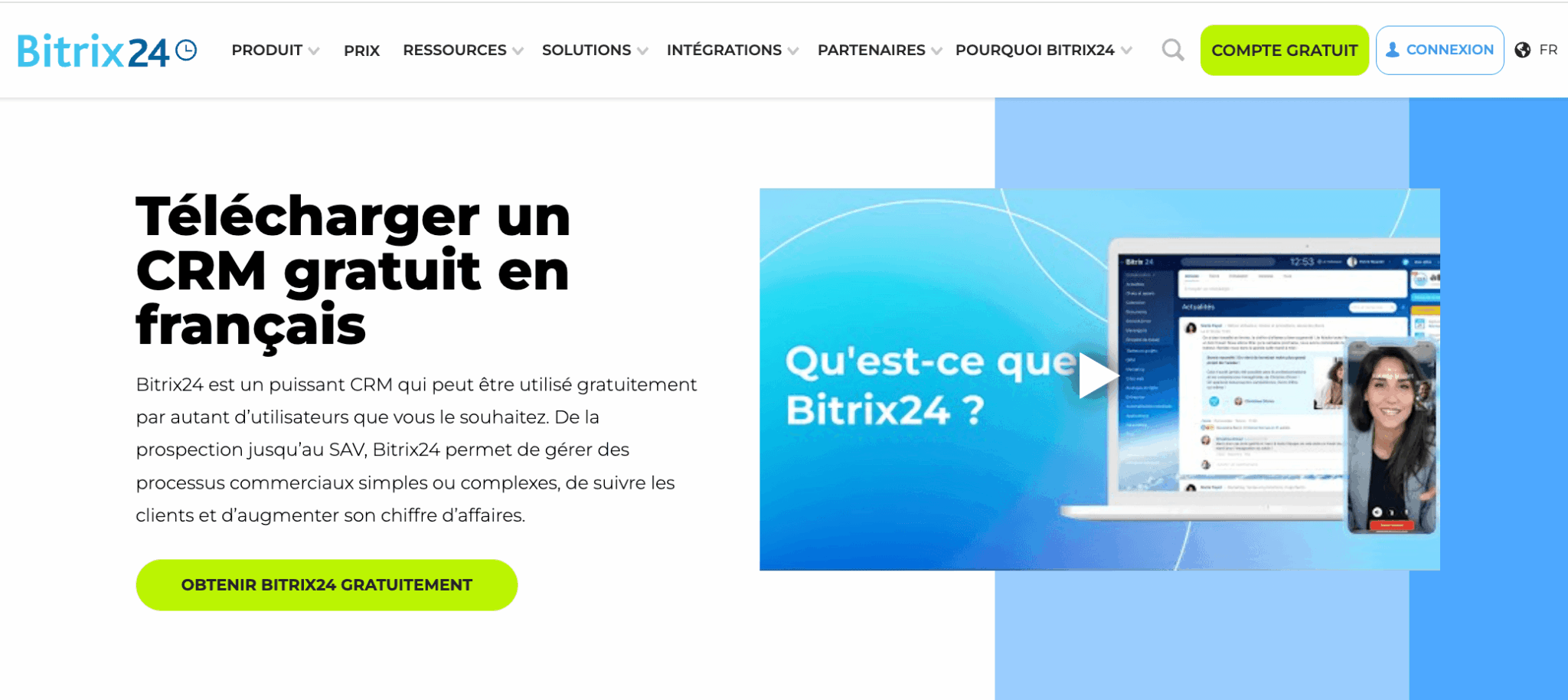
To put it in perspective: no other CRM on the market offers this level of functionality in a free version. In fact, it’s probably the most generous free offer ever published on this market. .
What you won’ t find with Bitrix24 free of charge: advanced automation (rules and triggers beyond the basics), integrated marketing functionalities (mass e-mail marketing, SMS), Sales Intelligence (customer journey tracking, advertising ROI), fine-tuned access rights management, speech analytics functionalities and advanced CoPilot roles. For these needs, you’ll need to upgrade to a paid plan. But this doesn’t apply to the majority of small and medium-sized businesses.
Test Bitrix24 for free
Bitrix24 offers a free plan with no limit on the number of users and no expiry date, complete with CRM, telephony, electronic signature and CoPilot AI. Enough to equip an entire VSE-SME, without having to break out the bank card. We recommend you give it a try.
The illusion of gratuity (hidden costs)
Scoop: no CRM is totally “free”, not even Bitrix24.
There are always costs that don’t show up on the bill.
Here are the main ones:
- Set-up costs. Setting up a CRM, even a free one, takes time. You need to define custom fields, configure pipeline steps, import existing contacts, train the team, and so on. Depending on the size and complexity of the project, it can take anywhere from 2 days to 2 weeks of actual work.
- The cost of future migration. This is the classic trap. You start out with a free CRM that only partially covers your needs. After a year or two, you need to migrate to another tool. Migration is expensive: exporting/importing data, re-engineering processes, re-training, temporary loss of productivity. We’ve seen CRM migrations costing 30-person SMEs over €20,000.
- The cost of integration. A CRM alone isn’t enough. It needs to communicate with your billing tool, your messaging system, your website and your marketing solution. Native integrations are sometimes limited in free plans, and going through Zapier or Make adds a monthly cost.
- The cost of reaching the limit. The day you exceed the free plan’s quota (users, contacts, emails), you’re obliged to pay or cut your activity short. And the publisher knows it: that’s why classic freemium imposes such low thresholds…
When a free CRM is really enough (the 4 typical profiles)
Free CRM is not a compromise. For some profiles, it’s simply the right choice. Here are four situations where a free version more than covers your needs .
#1 VSE start-ups (1 to 3 people)
If you’ve just launched your business, you need to centralize your contacts, track your opportunities and keep track of exchanges.
You don’t yet have a mature sales process, a team to manage or reporting to produce. You want a simple, free tool that can grow with you.
Do you recognize yourself in this presentation? Then you’re the right person for a free Bitrix24, a free HubSpot CRM or a Zoho CRM Standard trial plan.
#2 Customer-focused services (craftsmen, consultants, freelancers)
For an independent consultant, a craftsman or a service business, the volume of prospects is low, but the depth of the relationship is high. What’s important is not to forget anything: keeping track of exchanges, scheduling follow-ups, keeping track of a customer you met 8 months ago.
For this profile, a free CRM does the job. No need for complex automation, no need for predictive scoring, no need for marketing automation. What you really need if you’re in this situation is :
- Centralize contacts.
- Follow opportunities.
- Schedule tasks.
#3 The distributed team that wants to centralize without paying for everything
There are about ten of you, maybe fifteen. You work remotely or on a hybrid basis. Your need is to share sales information with each other, without everyone having their own Excel file or Trello. CRM isn’t your most critical day-to-day sales tool; it’s more like a team memory.
For this situation, the vast majority of paid CRMs will charge you €10 to €30 per user per month, i.e. €100 to €450 per month just to have a shared tool. A free tool like Bitrix24 is more than sufficient for this purpose.
#4 The pre-investment evaluation phase
You’ve identified that you need a CRM, but you don’t yet know exactly what you need it for. You want to test and understand what a CRM can do, before investing in a tool and implementation project.
This is a perfectly legitimate use of free plans. With one nuance: don’t test a CRM “loss leader” for 6 months and then realize that it doesn’t cover your needs. Test two or three options in parallel for 2 to 4 weeks, on a concrete use case, and then decide.
Salesdorado’s opinion
The rule is simple: a free CRM is enough if your needs are really basic (centralizing contacts, tracking a few opportunities, not forgetting anything) and if your tool won’t waste time as you grow.
6 signals to switch to paid CRM
Free has its limits. At some point, switching to pay becomes the right choice.
Here are the six concrete signals we observe in SMEs.
#1 You exceed the limits of the free plan
This is clearly the most obvious signal. You reach 5 sales reps and your HubSpot Free Sales Hub caps out at 2 users. Or you exceed 5,000 contacts in your free Zoho. Or you want to create a second pipeline to manage two separate activities, but your plan limits it to just one. At that point, you have a choice: pay up, or switch to another tool.
#2 You need advanced automation
Multi-step workflows (automatic sequenced follow-ups, predictive scoring, automatic lead allocation according to complex rules) are almost systematically blocked in the free plan. This is the clearest boundary between free CRM and paid CRM.
If you’re serious about automating your sales pipeline, you’re going to have to go pay-as-you-go. At Bitrix24, these features are available in the Standard plan at €124/month for 50 users. HubSpot’s Sales Hub Pro plan costs €90 per user per month.
#3 You want integrated marketing automation
If your sales strategy is based on inbound marketing (blogging, landing pages, automated email sequences, nurturing), CRM needs to be linked to a real marketing automation tool. And it’s rarely free. HubSpot Marketing Hub starts at €15/month, and goes up quickly if you want serious workflows. To understand what marketing automation can do for you, it’s often worth investing in a full-featured paid CRM.
#4 You need responsive customer support
On the free side, forget about real-time support. You’ll have a knowledge base and a community forum. If you encounter a bug or an urgent question, you’re on your own. For many SMEs, this is manageable. For others (especially when there’s a strong commercial element at stake), it’s unacceptable.
Upgrading to a paid plan usually unlocks responsive email support, and sometimes telephone support on higher plans.
#5 You want advanced AI
The most useful AI features (predictive scoring, call transcription with CRM auto-fill, speech analysis, AI agents) are often available in paid plans.
Bitrix24 makes an exception by including CoPilot in its free plan for basic usage, but advanced features (speech analytics, post-call recommendations) are reserved for premium plans.
#6 You reach a volume that requires enterprise features
Multi-pipelines, granular access rights, advanced BI reporting, customized integrations. These are needs that emerge around 30-50 employees. At this level, free CRM is no longer enough, no matter how generous it may be.
What you really gain by paying (and what hasn’t changed)
Let’s move on to the often embellished part: what do you actually gain by going from free to paid?
What really changes :
- Automation. Once again, this is the clearest differentiator. Paid plans give you access to multi-step workflows, conditional automation rules and sophisticated triggers. This allows you to structure a truly automated sales pipeline, where follow-ups are triggered automatically, leads are allocated automatically, and transitions between stages are made without human intervention. This is often where the ROI lies.
- Advanced AI. Call transcription with automatic CRM populating (CoPilot Bitrix24, Breeze HubSpot), predictive scoring (Einstein Salesforce, Zia Zoho), specialized AI agents. These functionalities really come into their own when you pay for them, and they really transform the day-to-day life of a sales team.
- The support. It’s underestimated, but real. Having someone on the other end of the phone or in the chat room when you’re stuck is a huge time-saver for an SME without in-house IT.
- Team features access rights, BI reports, multi-pipelines, dedicated team areas. Indispensable once you exceed a certain size.
What does NOT change : the fundamental quality of the CRM. Bitrix24’s basic contact, deal and pipeline management works very well free of charge. There’s no need to pay for a “better” basic CRM. You’re paying for new features, not for a better version of existing ones.
This is important, because a lot of SMEs switch to payware thinking “payware must be better everywhere”. Wrong! Paid solutions are better in specific areas (automation, AI, support). If you don’t need these dimensions, free is just as good.
Comparison of free CRM plans
Here’s an overview of the main free CRMs on the market.
| CRM | Free users | Complete CRM | Integrated telephony | Free AI | Verdict |
|---|---|---|---|---|---|
| Bitrix24 | Unlimited | Yes (unlimited transactions, quotes, invoices) | Yes | Yes (basic CoPilot) | The CRM with the most generous free plan to date |
| HubSpot | Unlimited on CRM only | Partial (1M contacts, no automation) | No | Very basic (Breeze Assistant) | Getting started in inbound marketing |
| Zoho CRM | 3 | Yes (limited to 5000 contacts) | No | No (Zia deactivated) | Premium product for very small teams |
| Brevo | 1 | Marketing/email focused | No | No | Good for email marketing, but not a true CRM |
| Freshsales | 3 | Partial (no automation) | No (pay telephony) | No (Freddy AI disabled) | Product to discover |
| Salesforce Marketing Cloud | 0 | – | – | – | No free plan (14-day trial only)…Pipedrive is disqualified if you’re looking for a free CRM. |
We’re convinced
Bitrix24 stands out in the free CRM landscape. It’s the only one to offer a product that isn’t a disguised trial or a loss leader. If you’re a small business looking for a free CRM that can really support you over the long term, this is our recommendation. HubSpot Free remains relevant if your needs are more oriented towards inbound marketing than pure sales CRM. And if you want to focus on marketing, take a look at Brevo’s free offer.
CRM Payant: the different pricing logics
When you switch to pay-as-you-go, rates vary enormously from one publisher to another, and the billing method changes everything.
Here are the main players and their pricing logic.
Per-user pricing (the classic trap)
Most CRMs charge per user, per month. This is the dominant model: HubSpot, Pipedrive, Salesforce, Zoho, Freshsales. At first glance, it looks attractive: “Pipedrive Lite at €14/month? Cheap! Except that for 20 users, that’s 280€/month. For 50, 700€/month.
And these are the entry-level prices (with annual commitment, we might add). As soon as you need useful functionalities (workflows, scoring, AI), you need to switch to the Pro plans, which start at €90/month per user for HubSpot Sales Hub Pro, for example. For 20 users, that’s €1,800/month. Over the year, that’s €21,600. For 50 users, that’s €54,000 a year. Just for the CRM.
This mechanism means that the cost of a CRM can skyrocket as soon as you start to grow. The initial bill seems reasonable, then explodes with growth.
Flat-rate pricing (the Bitrix24 model)
Bitrix24 has made a radically different choice: billing by company, with a number of users included. Price does not depend on number of users .
| Plan Bitrix24 | Monthly price | Annual price (-30%) | Users included | Cost per user |
|---|---|---|---|---|
| Free | 0€ | 0€ | Unlimited | 0€ |
| Basic | 61€ | 40€ | 5 | 12,20€ |
| Standard | 124€ | 87€ | 50 | 2,48€ |
| Professional | 249€ | 175€ | 100 | 2,49€ |
| Enterprise | from €499 | from €350 | 250 à 10 000 | 2€ and less |
The Standard plan at €124/month for 50 users comes to €2.48 per user per month. For a complete CRM with telephony, AI, automation, electronic signature, project management, team communication and site builder. There‘ s simply no equivalent on the market.
In concrete terms: Pipedrive Growth for 50 users costs €1,950/month (€39 x 50). The same requirement at Bitrix24 is 124€/month. The ratio is 1 to 15.
That’s why Bitrix24’s price/performance ratio is considered one of the best on the market. Not because the tool, taken module by module, is the best on every dimension, but because the ratio between what’s included and the price paid is unrivalled for a very small business.
Test Bitrix24 in real-life conditions
The Bitrix24 free plan has no expiry date. You can install it with your team, test it for 1 or 2 months, and switch to the paid plan only if you really need the advanced features.
The special case of HubSpot
HubSpot deserves a special mention. It has probably the best CRM + inbound marketing + customer service ecosystem on the market. If your sales strategy is based on content, inbound marketing and sophisticated marketing automation, HubSpot is a very solid choice.
The downside is the price. The free plan is excellent for getting started (CRM only, unlimited users), but as soon as you get into the paid Hubs (Marketing, Sales, Service), you’re in for a steep price. Sales Hub Pro at €90/user/month, Marketing Hub Pro at €800/month for 2,000 contacts, that’s a steep price to climb. For an SME looking for a complete sales and marketing suite from HubSpot, you’re looking at a minimum of €2,000/month.
This is why HubSpot remains relevant, especially for inbound marketing profiles with a substantial budget. For a pure sales CRM without an advanced marketing dimension, the price-performance ratio is less favorable.
Salesforce, Pipedrive and others
- Salesforce remains the world leader, but is clearly oversized for 90% of French SMEs. Starter plan at €25/user/month, but to access AI functionalities, you need the Enterprise plan at €175/user/month. For 20 users, we’re talking about €3,500/month, or nearly €42,000 a year. Unless you have very specific needs, this is rarely justified for an SME!
- Pipedrive is more affordable: €14/user/month on the Lite plan, €59 on the Premium plan for access to IA functionalities. It’s an excellent pure sales CRM, focused on the visual pipeline, but without the internal communications, project management and telephony modules found in Bitrix24.
- Zoho CRM offers the best features/price compromise after Bitrix24 in the per-user tools segment. Standard plan at €14/user/month, Enterprise at €40/user/month. Very complete, but the UX is less fluid.
Our verdict and recommendations by profile
At the end of this analysis, here are our concrete recommendations for your situation.
You are a small business with 1 to 5 employees
Bitrix24 Free is our default recommendation. You’ve got a true CRM, with no user limits, telephony and basic AI, that will be with you for years before you need to switch to paid.
Alternative: free HubSpot CRM if your strategy is very marketing-inbound from the outset and you plan to switch quickly to Marketing Hub.
You are a small business with 5 to 20 employees and moderate needs
Bitrix24 Free or Basic. As long as you don’t need sophisticated automation, the Free plan is all you need. When the need for automation arises, the Basic plan at 61€/month for 5 users (or 124€/month for 50 in Standard) remains unbeatable on the budget side.
Alternative: HubSpot Sales Hub Starter if the HubSpot ecosystem appeals to you (€15/user/month, but it goes up fast).
You are an SME with 20 to 50 employees
Bitrix24 Standard at €124/month for 50 users remains, in our opinion, the best value on the market at this size. You’ve got automation, AI CoPilot, integrated marketing, project management, team communication.
If your business relies heavily on inbound and advanced marketing automation, HubSpot Pro is still justified despite the cost.
You are a marketing and inbound-oriented SME
HubSpot with Marketing Hub + Sales Hub. This is where the HubSpot ecosystem really comes into its own, and where the extra cost is justified by the advanced marketing features and impeccable UX.
You have complex processes and a substantial budget
Salesforce remains relevant for fast-growing organizations with sophisticated sales processes (multi-pipelines, multi-markets, specialized teams), but be prepared for a significant investment in setup and subscriptions.
Salesdorado’s advice
The best approach is to start by testing a free CRM on a real-life use case for 2 to 4 weeks. Not by reading comparisons, but by using it. You’ll quickly find out whether the tool suits your way of working. And whether the free plan is sufficient or whether you’re missing something. It’s much more efficient than trying to anticipate everything on paper.
Get started with Bitrix24 Free
No credit card required, no expiration date. Create an account, invite your team, import your contacts, set up your pipeline. Within a few weeks you’ll know whether Bitrix24 is right for you, and whether the free plan is enough.