When you’re a freelancer or head of a small sales team, choosing a professional telephony solution means systematically banging your head against the same wall. The established players – Aircall, Ringover, RingCentral, JustCall – all sell pretty much the same thing: a basic plan at around €30 to €50/user, a minimum of 3 licenses and AI relegated to a paid option or reserved for Enterprise plans. For a solo or 2-person team, the entry ticket is around €90 per month, without AI. B2B VoIP stopped innovating its business model a good ten years ago.
Allo takes all these codes in its stride: the possibility of subscribing to a single-user license, the 24/7 AI receptionist, call summaries and transcriptions included right from the start. The app is clearly designed first for the smartphone, then for the desktop.
We took the time to test Allo and run the numbers plan by plan. In the field, the promise of “AI included, simple, inexpensive” holds up remarkably well: at €14 per month for a solo caller and €25 per license for a team, Allo is less expensive than Aircall, while incorporating AI that Aircall charges extra for. We explain where Allo is particularly relevant, where the product shows its limitations, and who we recommend it to without reservation.
Sommaire
Our review of Allo in a nutshell
| Perimeter | Score | Our opinion |
|---|---|---|
| Overall rating | 4,4 | Allo is the first B2B VoIP solution to truly combine cloud telephony and AI in a single product, with no options to stack. The price/performance ratio is excellent, from solos to teams of thirty or so people. The real limitations lie elsewhere: basic reporting, absent call center functions and a product that’s still young in some respects. |
| Ease of use | 4,7 | The interface is clear and the experience is clearly designed for the smartphone. The learning curve is almost non-existent for basic functions. |
| Functional depth | 4,4 | The VoIP core is solid (local numbers, unlimited national calls, SMS, routing, IVR) and the AI is exceptional for the price. The downside concerns analytics and reporting, which are simpler than on call center solutions. |
| Integrated AI | 4,7 | Where Aircall or Ringover charge for AI as an option, Allo includes it in all plans. In use, the AI receptionist correctly handles the vast majority of simple requests, and the ElevenLabs-generated voice comes across well in everyday conversation. |
| CRM integrations | 4,5 | The catalog is extensive for such a young player: HubSpot, Salesforce, Pipedrive, Attio, Odoo, Sellsy, Streak, at no extra cost. Calls are automatically logged in the contact record, with recording and AI summary. Over 1,000 tools are also accessible via Zapier and Make. |
| Quality-price ratio | 4,3 | Excellent value for money, given the features included: €14/month for the Starter solo plan, €25/month/license for the Business plan (rates with annual commitment). The cost per license remains fixed regardless of team size, but as AI is billed on a per-license basis, the total bill quickly climbs if part of the team doesn’t use it. |
| Customer support | 4,0 | Reactive and personalized, in both French and English. What’s surprising at this price level is that there’s no live chat on the Business plan, and telephone support is limited to office hours for a solution that sells a “24/7” receptionist. |
Allo offers a free 7-day trial with access to all Business Plan features, including the unlimited AI receptionist. A great way to test the solution before committing yourself.
Allo, what exactly is this?
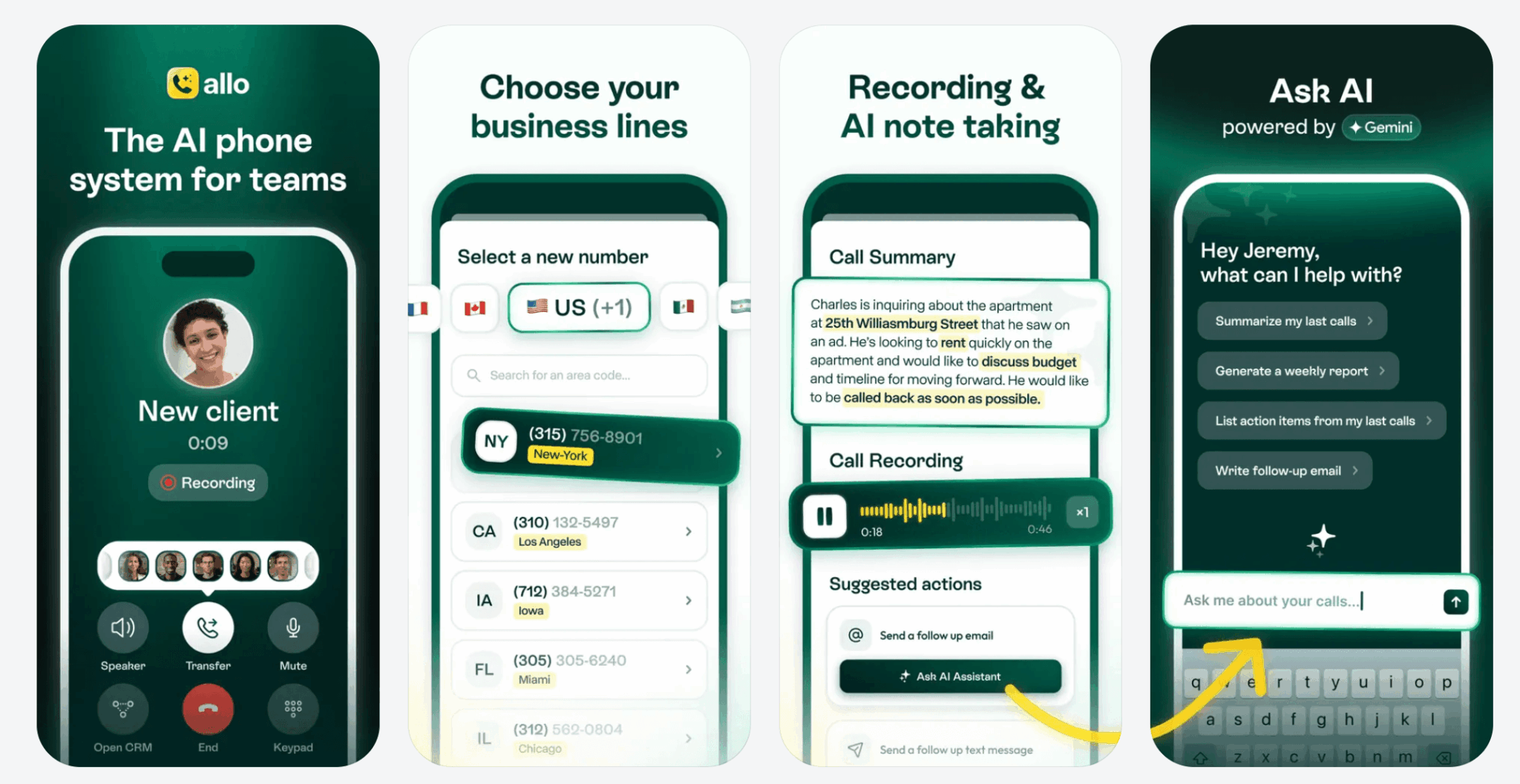
In practical terms, Allo replaces your switchboard. You install an app on your smartphone and computer, get a business number and make your calls via the Internet rather than a conventional line. So far, so simple: that’s the definition of a cloud telephony solution.
The uniqueness of Allo lies in what it has grafted onto the call.
Every conversation is recorded, transcribed and summarized by an AI, without you having to activate anything. When you can’t pick up the phone, a virtual receptionist takes over, asks the right questions and reports back to you. Where most publishers sell telephony on the one hand, and charge extra for AI on the other, Allo has chosen to merge everything into a single product. It’s this approach that gives the tool its structure.
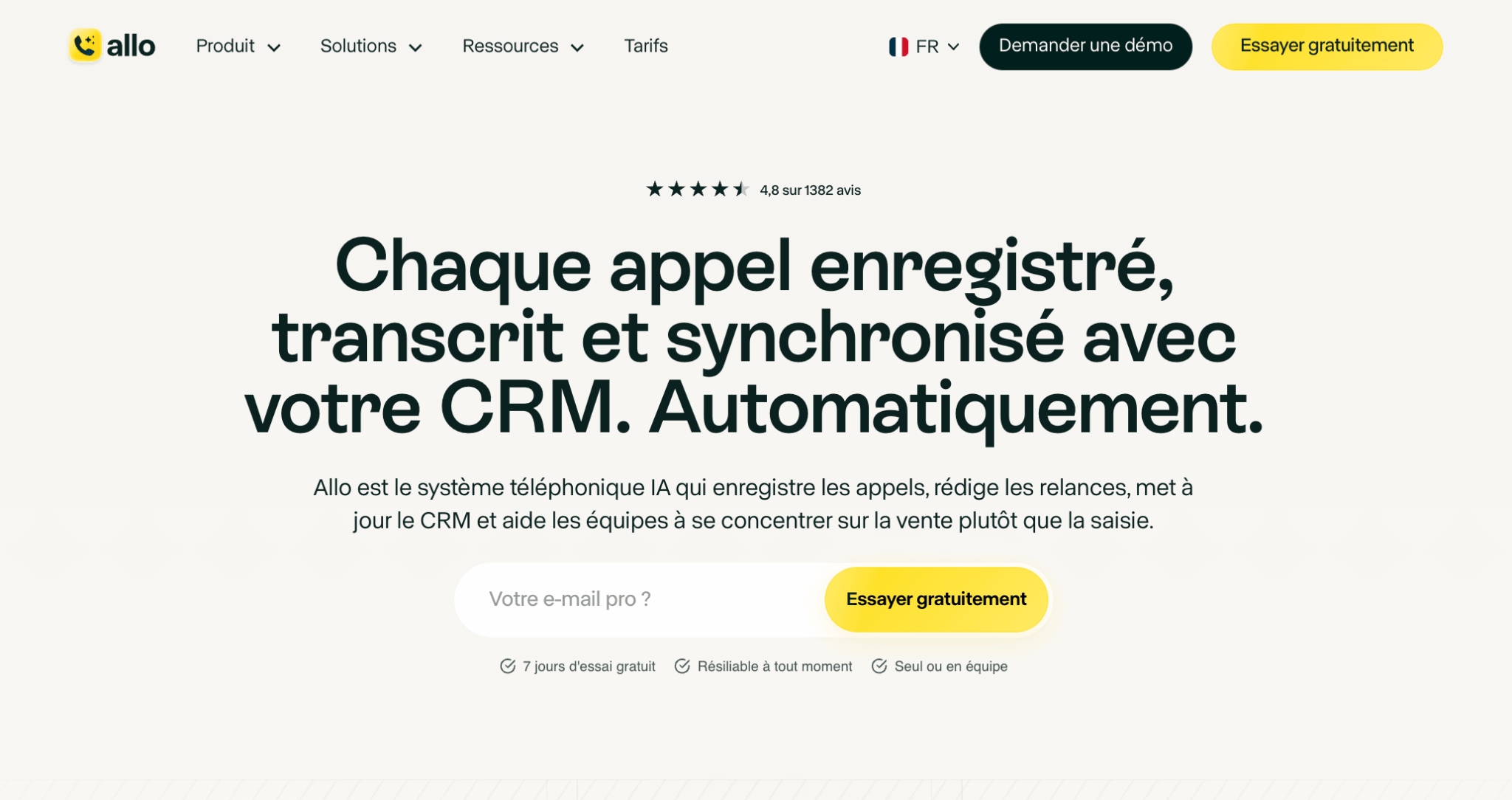
The other fundamental choice is mobile. Aircall, Ringover and RingCentral all offer a smartphone application, but in addition to a dashboard designed for the desktop. Allo reverses the logic: the mobile app is the main experience, the computer version comes next. This is no cosmetic detail. The ergonomics are geared towards the salesperson on the move, the craftsman between two sites, the freelancer who doesn’t have a fixed workstation. On the other hand, a sedentary team accustomed to controlling its telephony from a large screen may find the approach confusing at first contact.
Behind the product is The Mobile-First Company, a studio founded in 2023 by Jérémy Goillot, who grew Spendesk, and Franco Pinto on the technical side. After an initial seed round, the publisher raised $12 million from American funds at the end of 2025, with several well-known figures from the French tech world, including Xavier Niel and Thibaud Elzière.
The most important question before testing anything is: is this a tool for you? Allo has a narrow target. It is aimed at freelancers and sales teams of up to 30 people. and is particularly at home in contexts where the telephone is a central sales or appointment-making channel, such as agencies, consultancies or SDR teams just starting out. On the other hand, a sales department that manages fifty agents over several campaigns won’t find much use for it, and the publisher is not trying to sell itself in this field.
Allo’s key features
A complete VoIP telephone system, without the complexity
At its core, Allo ticks all the boxes expected of a modern IP telephony solution. You get a business number in just a few minutes (landline 01-05/09 or mobile 06/07 in France, US/CA and European numbers for international teams). National calls are unlimited on all plans. International calls are unlimited to 40 to 110 destinations, depending on the country of origin, with public rates for other destinations.
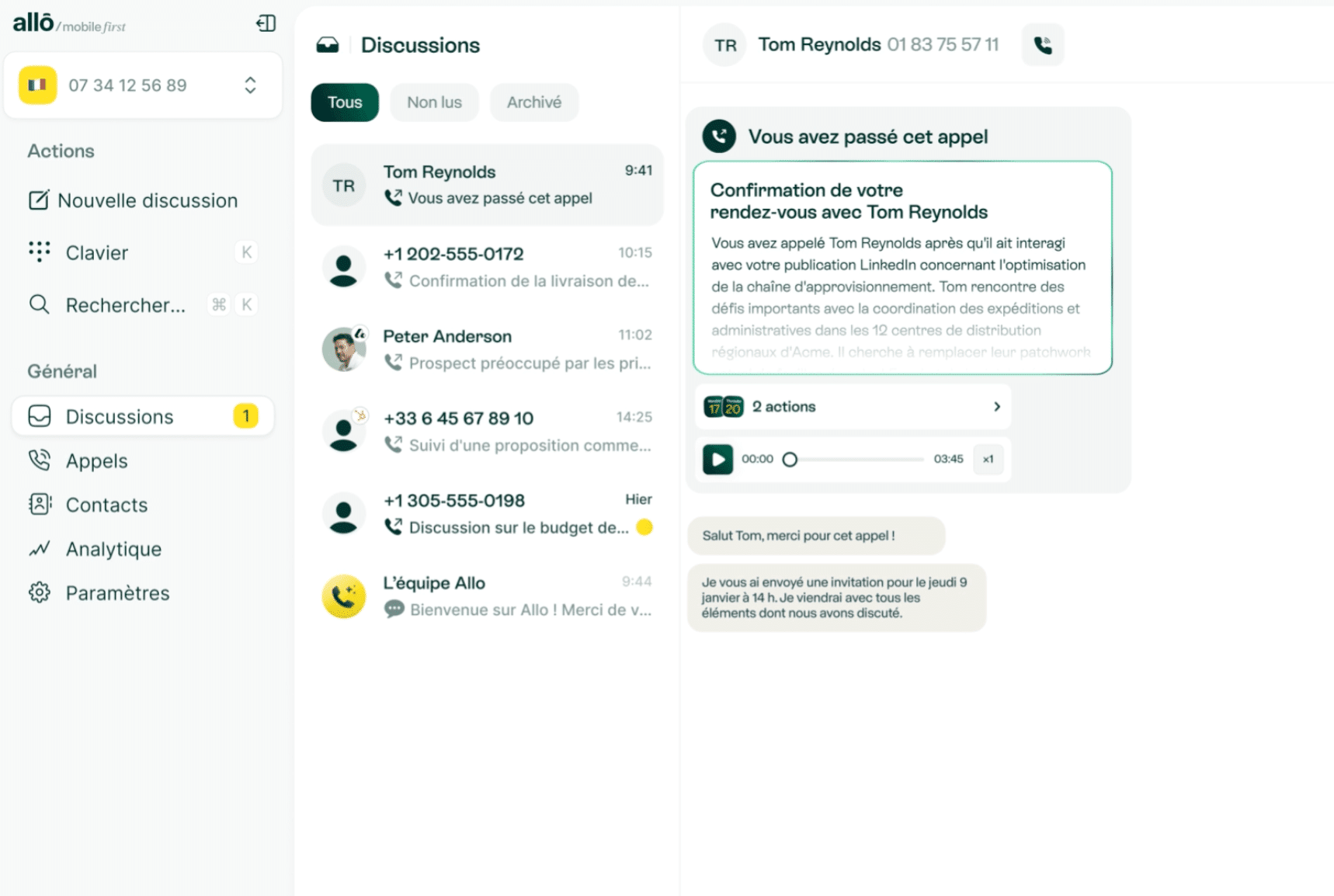
On the team side, the tool offers cascading ringing, shared numbers, collaborative inboxes and intelligent routing. You can also configure an IVR (greeting menu with touch-tone selection), define opening hours with distinct out-of-hours scenarios, and create transfer rules by tags or VIP segments. All this can be configured without IT and without the need for paid onboarding.
The app is available on iOS, Android, macOS, Windows and web browser. Click-to-call works from within the CRM, and WebRTC technology ensures correct call quality over a stable connection (although, as with any VoIP solution, quality is of course directly dependent on your network).
The 24/7 IA receptionist: the real differentiator
This is the feature that alone justifies Allo’s existence in the VoIP landscape. The AI receptionist answers calls when you’re busy, identifies the caller’s intention, collects their contact details and sends a summary. This feature is only available in the Business plan.
Setup is surprisingly simple:
- You define the greeting message, the questions to be asked (name, reason, urgency, desired time slot), the actions to be triggered (transfer to a sales rep, take message, SMS reminder, Calendly link).
- The voice is generated by ElevenLabs and remains natural in everyday conversations.
In practice, the receptionist correctly handles the vast majority of simple requests such as “I’d like to speak to sales” or “I’d like an appointment”. For more ambiguous requests or very specific business vocabulary, fallback options (systematic transfer to a human) must be provided, which can be easily configured in the interface.
AI filtering also does a real job on unwanted calls. The Whisper feature indicates the caller’s intention before you pick up, so you can decide in a second whether to take the call or let it go to voicemail. For a small sales team that doesn’t want to hire an assistant, this is a game-changer.
Automatic transcription, summarization and follow-up
All calls are automatically recorded, transcribed and summarized, with no options to activate. The summary arrives within 30 seconds of the end of the call, and captures the essential points discussed. On long, technical calls, it may be necessary to cross-check with the full transcript to retrieve a precise detail, but in the vast majority of cases the summary is sufficient to call a prospect back with the context in mind.
The transcript is full-text searchable, and the “Ask AI about your calls” function lets you query the history in natural language (“which prospects mentioned a budget of over €50,000 this month?”).
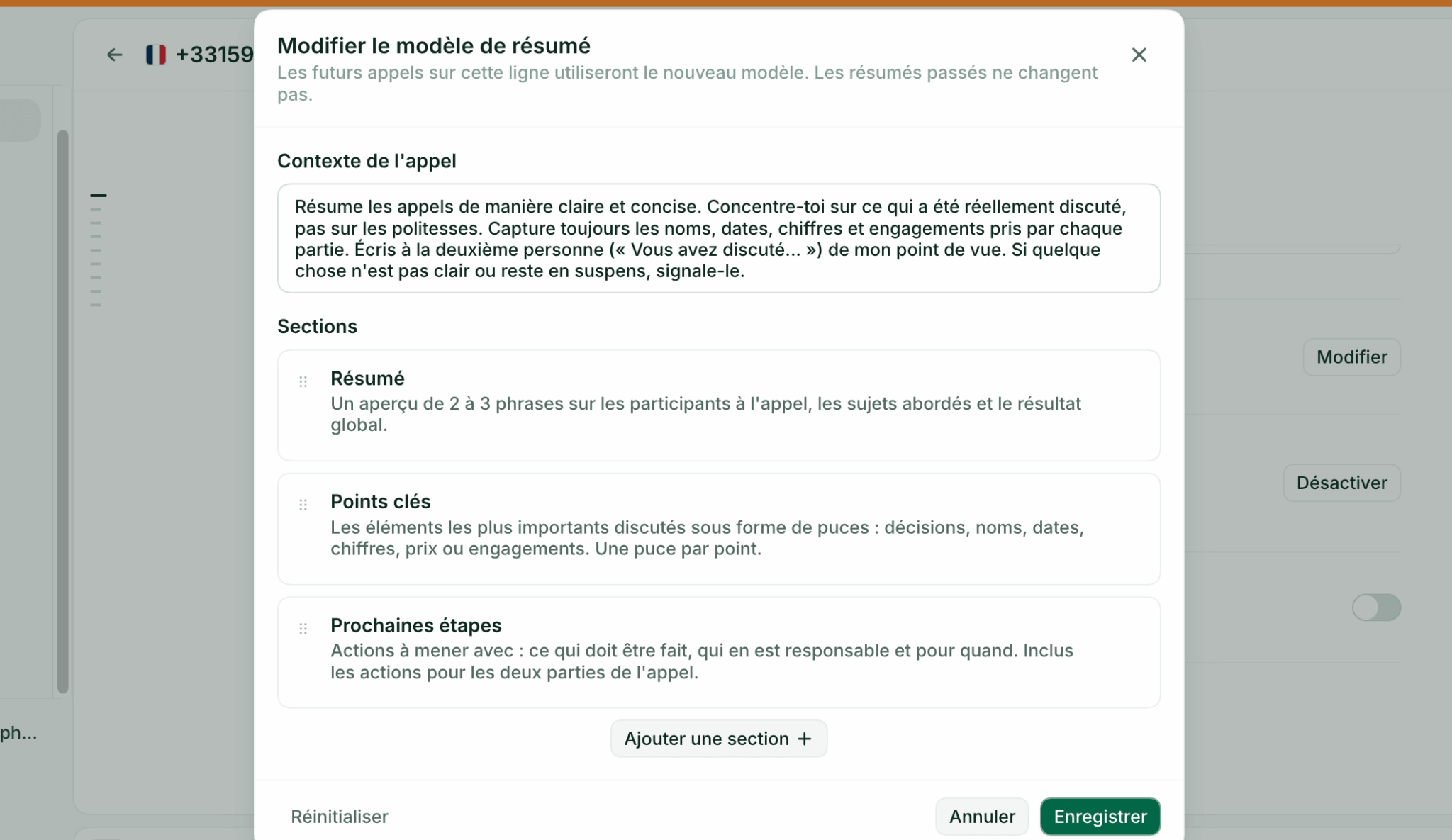
Allo also generates personalized follow-up e-mails and SMS messages based on the transcript: name of prospect, subject discussed, suggested next steps.
A particularly useful use case: automatic SMS on missed calls. Each time a call is missed, Allo sends a personalized SMS (configurable template) proposing a reminder or an appointment slot.
Allo’s AI features are not marketing gimmicks. In real-life sales use, the AI receptionist and automatic summaries save a salesperson who makes 8 to 12 calls a day around 30 to 45 minutes a day. That’s the equivalent of a quarter of an SDR position, excluding recruitment.
Routing, IVR and shared boxes
For the team dimension, Allo offers the building blocks you’d expect without falling into the complexity of a call center. You configure opening hours, a multi-level IVR, routing rules by skill or user, and numbers shared between several team members. Conversations are visible in a collaborative inbox, where each call, SMS or voice message can be assigned, commented on or picked up by a colleague.
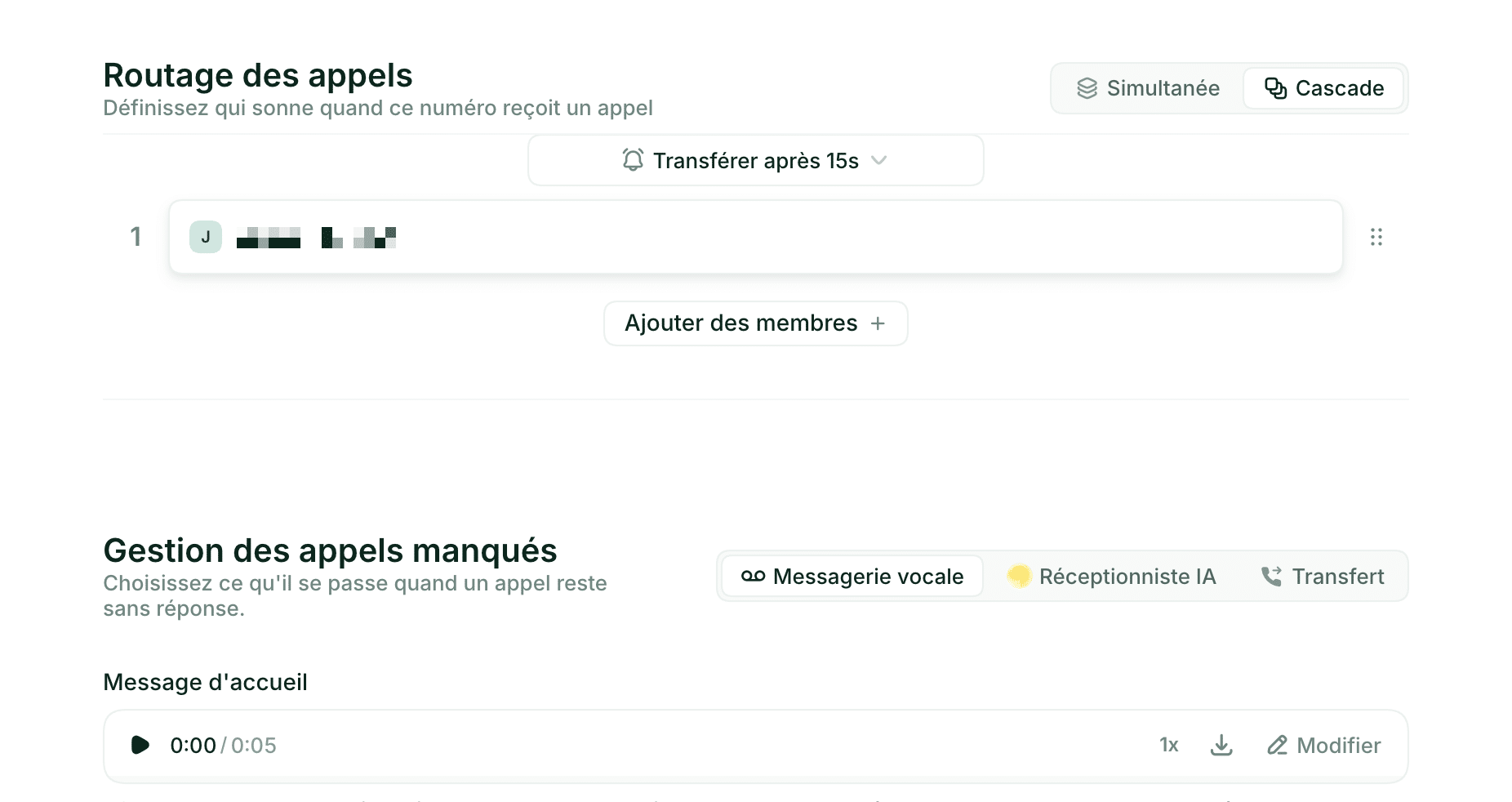
Call sharing also makes it possible to transfer a conversation and its context to another sales rep, without the latter having to ask the customer to repeat the conversation.
What Allo doesn’t offer, and it’s fair to point out, is that there’s no real-time multi-waiting queue monitoring, no complex wallboards, and no IVR scenarios with advanced conditional branches. If you’re managing 50 agents in parallel over several campaigns, look instead to Aircall, CloudTalk or real call center software.
CRM integrations
This is the most impressive aspect of Allo, given the product’s age (launch 2024). The catalog of native integrations already covers almost all serious B2B CRMs: HubSpot, Salesforce, Pipedrive, Attio, Folk, Sellsy, Streak, Zoho. And for everything else, Zapier, Make and webhooks provide access to over 1,000 tools.
In concrete terms, with each call, Allo automatically displays the following information in the contact file:
- Audio recording.
- Transcription.
- The AI summary.
- Call duration.
- Next steps identified.
In addition, real-time caller ID displays contact info during the call: stage in the sales pipeline, last exchange, deal in progress.
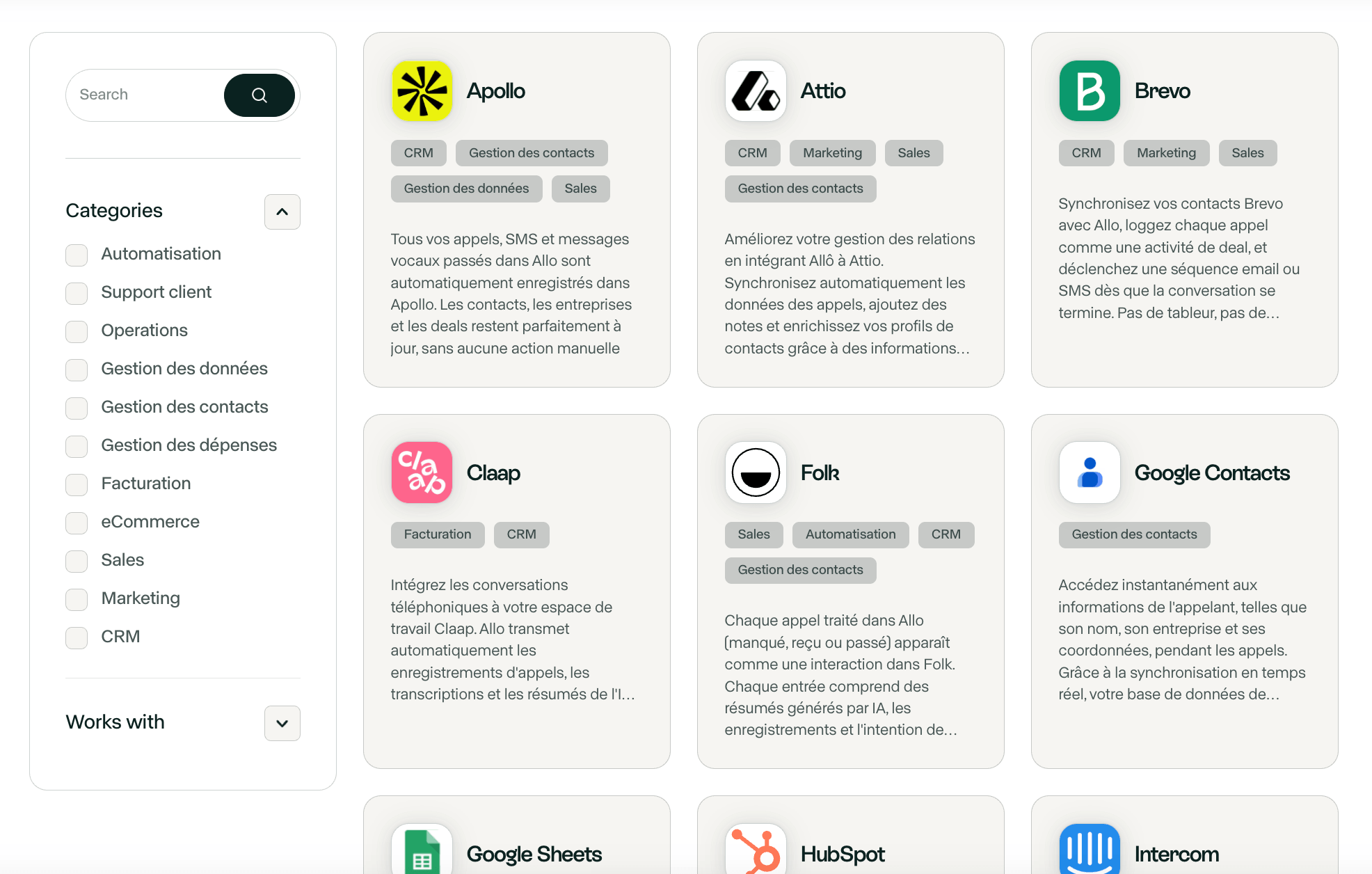
On HubSpot and Pipedrive, logging is almost immediate, on the order of a few seconds after the end of the call. On Salesforce, it’s just as clean. On less common CRMs, or for very specific custom fields, you may need to use Zapier, which adds a layer of configuration but poses no fundamental problem.
If you’re already using HubSpot, Pipedrive, Salesforce or Attio, the 7-day free trial is enough to check that automatic logging is working as expected on your instance. Connect your CRM as soon as you sign up, and make two or three test calls to validate.
Allo rates: how much does it really cost?
Two plans and transparent pricing
Allo’s pricing structure is deliberately minimalist: two plans, two billing modes (monthly or annual), no intermediate options, no paid add-ons. Important point to know before comparing: the Starter plan is limited to 1 user. As soon as there are two users, the Business plan becomes compulsory.
| Plan | Annual price (monthly) | Monthly price | Target | Main inclusions |
|---|---|---|---|---|
| Starter | 14/month | 20 €/month | Solo, freelance | 1 user only, local landline, unlimited national calls, recording, AI summaries, IVR, 30 min AI receptionist/month |
| Business | 25 €/month/licence | 35 €/month/license | Teams of 2 or more | All Starter + mobile numbers, multi-device, unlimited SMS, 24/7 unlimited IA receptionist, 1,000+ integrations, international calls (110 destinations included), web and desktop |
The free trial lasts 7 days, with full access to the Business plan functionalities. There’s no long-term free plan like with Google Voice, but the entry fee of €14/month is still very affordable for serious business use.
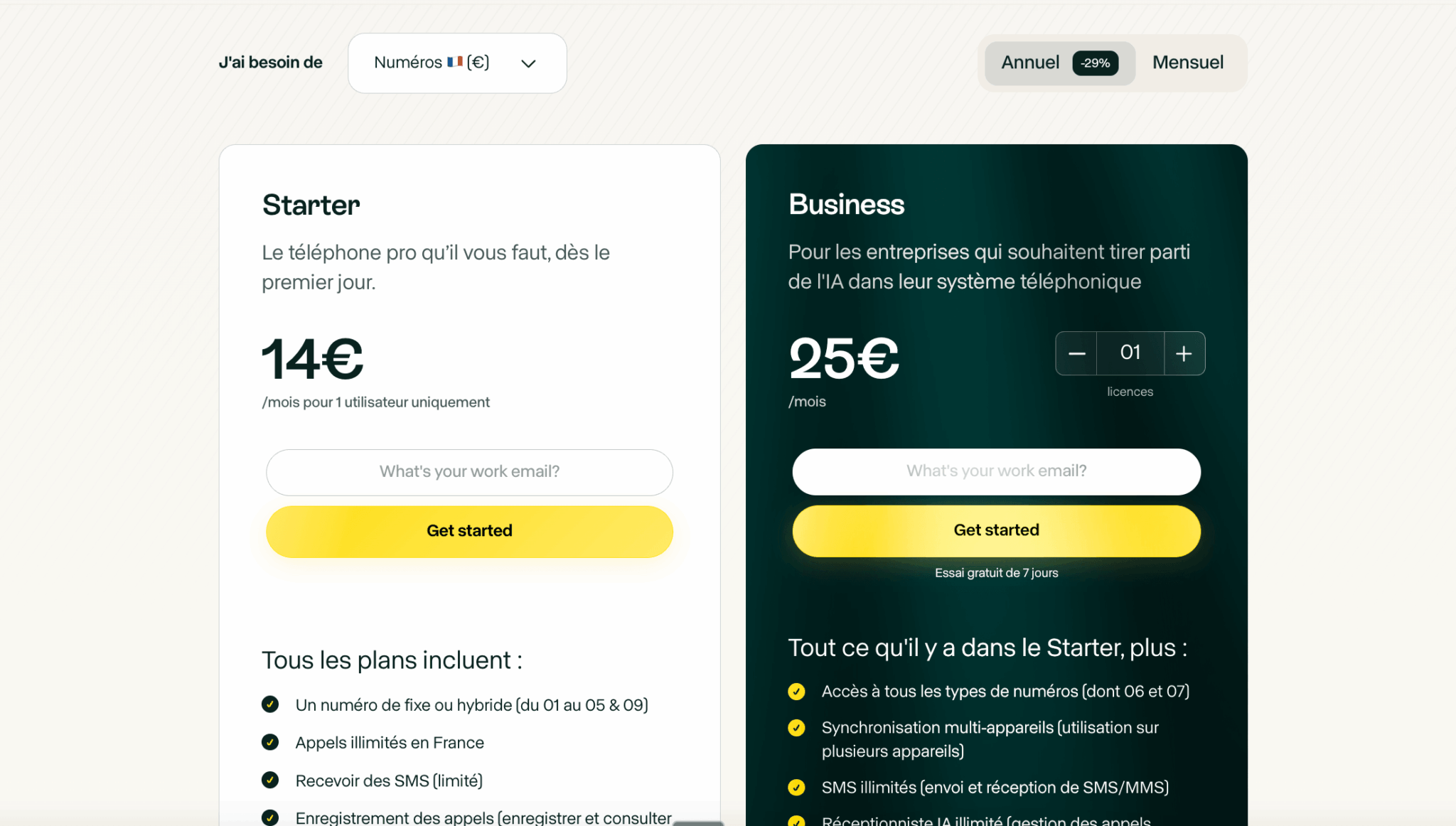
How much does Allo really cost, depending on the size of the team?
Here’s the real cost according to team size, on an annual basis (the most economical). From 2 users upwards, the Business plan at €25/month/license is the obvious choice.
| Team size | Allo Plan | Total Allo cost | Aircall Essentials comparison |
|---|---|---|---|
| 1 user | Starter | 14 €/month (168 €/year) | Aircall impossible (min. 3 licenses = €90/month) |
| 3 users | Business | 75 €/month (900 €/year) | 90/month without AI |
| 5 users | Business | 125/month (€1,500/year) | 150/month without AI |
| 10 users | Business | 250/month (€3,000/year) | 300/month without AI |
In all respects, Allo is cheaper than Aircall, and includes AI while Aircall charges extra for it. For the record, on Aircall, AI features are billed extra, as this screenshot shows:
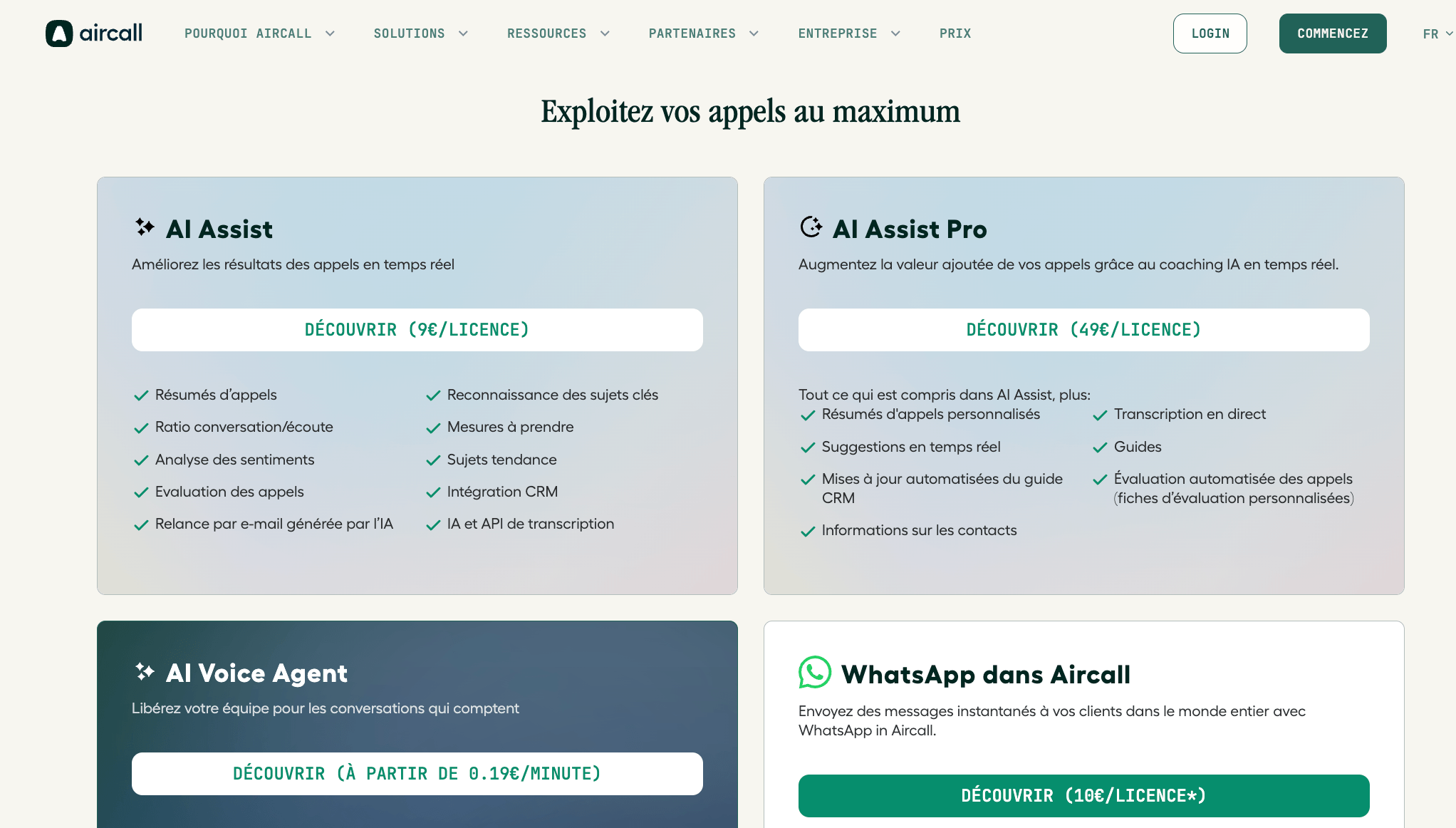
For a solo user, the comparison is even irrelevant, since Aircall requires a minimum of 3 licenses, or €90/month to get started. Ringover and Quicktalk have lower entry prices, but without AI.
The cost per license does not change: whether you are 3 or 30, it’s €25/month per person on an annual basis. There is no tiering, degressivity or surcharges. The only real point of vigilance is the all-inclusive model itself: each Business license pays for the AI, the 24/7 receptionist and the 1,000+ integrations, whether the user uses them or not. For a team of 10 salespeople, only 4 of whom make outbound calls regularly, you’re financing a premium AI for 6 people who won’t use it.
This is where a modular solution can become more rational. Aircall or Ringover allow you to reserve AI functions for the profiles that need them, and keep a basic plan for the others. You lose the simplicity of all-inclusivity, and the bill per head climbs for equipped users, but on a large team with heterogeneous usage, the calculation is worth doing. For a team where everyone telephones, Allo remains the simplest and most advantageous choice.
Hidden costs to be aware of
Allo’s pricing transparency is genuine, but there are a few additional costs worth anticipating:
- The most visible is the 10DLC registration fee for sending SMS to the US market, which costs around €22 once you register. If you’re targeting France only, this fee doesn’t apply.
- Additional numbers are billed at around €5/month per additional number beyond your basic license. Useful for a team that wants a local number for each city, or a dedicated number for each campaign.
- Finally, international calls outside the bundle are billed by the minute, with a public schedule that can be consulted in real time on rates.withallo.com. A credit of a few euros is offered to get you started. For a team that makes a lot of international calls, check which destinations are covered by unlimited calling before committing.
What we like (and don’t like)
- AI really included in all plans: that’s the big plus. 24/7 AI receptionist, summaries in under 30 seconds, automatic follow-ups, full transcription. Where Aircall and Ringover charge €15-20/month extra for AI as an option, Allo includes it from €14/month.
- One user only, no contract: Allo is one of the very few pro phone systems to accept 1 license. For a freelancer or solo consultant, this is a financial game-changer.
- Mobile-first really: the iOS and Android app is the main experience, not a degraded copy of the desktop. For field sales reps, craftsmen, real estate agents or freelancers on the move, this is rare and appreciated. Click-to-call also works from the CRM.
- Exceptional integration catalog for a young product: HubSpot, Salesforce, Pipedrive, Attio, Folk, Sellsy, Odoo, Streak native. Over 1,000 tools accessible via Zapier and Make. Automatic call logging in the CRM with AI summary is top-notch.
- The all-inclusive model charges AI on a per-license basis: the price per license doesn’t change, but on a large, heterogeneously-used team, you’re financing the AI receptionist and premium integrations for users who won’t use them. A modular solution can therefore be less expensive.
- Basic analytics and reporting: Allo provides the essential indicators (durations, missed calls, response times) but not the real-time wallboards or detailed reports of call center solutions. This is not enough to manage a customer service department with 30 agents.
- Miami headquarters and undocumented hosting: the company is RGPD compliant and uses AES-256 encryption, but doesn’t publicly commit to EU data localization or SecNumCloud-type certifications. Not a topic for most SMEs, critical for regulated sectors.
- No live chat on the business side: at €25/month/license, that’s surprising. Support works by email and telephone during office hours, which is unusual for a solution that sells a “24/7 IA receptionist”.
- Still a young product: launched in 2024, Allo is evolving fast, which is good news, but certain functions (advanced analytics, depth of custom CRM fields) are still under construction. A wise choice if you need full product maturity right now.
Allo vs Aircall: which telephony solution should you choose?
That’s the real question for most Salesdorado readers. Aircall is the historic French reference in B2B cloud telephony, present in thousands of sales and support teams. Allo is the challenger that wants to reinvent the category for small teams.
The fundamental difference can be summed up in one sentence: Aircall was designed for structured teams of 10 to 200 agents, Allo for teams of 1 to 30 people. This orientation is reflected throughout the product, from the pricing model to the interface philosophy.
In terms of pricing, Aircall starts at €30/user/month for the Essentials plan, with a minimum of 3 licenses required, i.e. €90/month to get started. Allo accepts 1 user at €14/month on an annual basis, and its Business plan at €25/license remains under Aircall for all team sizes. For a freelancer or a team of 2, Aircall is simply not an option. Allo is, and with AI to boot.
When it comes to AI, the gap is even wider. At Aircall, AI features (transcription, summaries, conversational analytics) are only available on the Professional plan at €50/user/month, with some advanced functions available as additional add-ons. At Allo, everything is included in the basic plan. The unlimited 24/7 IA receptionist is a feature that no one else offers at this price.
But Aircall still has strong arguments for more structured teams. The catalog of native integrations is deeper. Analytics are far more comprehensive: real-time wallboards, detailed reports by agent and campaign, multi-file monitoring. Enterprise support is better structured. For a 30-strong customer service department or a 50-strong SDR team, Aircall remains the rational choice.
| Criteria | Allo | Aircall |
|---|---|---|
| Ideal target | Solos, freelancers, small teams 1-30 | Structured sales and support teams 10-200 |
| Entry price | 14/month (1 user), then €25/license | 30 €/month/user (min. 3 = 90 €/month) |
| AI included | Yes, from the basic plan | No, Professional plan at €50/month minimum + addons |
| Philosophy | Mobile-first, all-inclusive, self-service | Web-first, modular, sales support |
| Integrations |
|
|
| Analytics and reporting |
|
|
| Data Sovereignty | RGPD, Miami headquarters, undocumented hosting | RGPD, SOC2 Type II, AWS infrastructure |
| Free trial | 7 days without credit card, full business access | 7 days, commercial demo generally required |
The real criterion for choice is not so much functionality as team size and trajectory. If you’re 1 to 4 people strong and want to get a serious start in pro telephony with AI today, Allo is the right choice. If you’re 10+ and see your team doubling within the year, Aircall will be more stable over time.
Our verdict: Who’s Allo for?
Allo is for you if :
- You’re a freelancer, consultant or solopreneur and you want a serious pro number with AI and registration, without paying €90/month for 3 licenses you won’t use.
- You’re a small sales team of 2 to 8 people just starting out, and you want AI, CRM integrations and automatic tracking without an IT project.
- You’re a small or medium-sized service provider (consulting firm, agency, craftsman, real estate agent, local structure) whose telephone is a critical appointment-setting channel, and you want to professionalize your reception desk without hiring.
- Your team is mobile (field sales representatives, freelancers, multi-sites) and you want a telephone system that works primarily on smartphones.
Skip it if :
- You are a mid-market call center or an organization with 30+ agents: Aircall or Ringover will be more appropriate for analytics, monitoring and scalability.
- You need advanced call center features (live wallboards, complex multi-file scenarios, detailed reporting, real-time multi-team supervision).
- Your organization is ultra-sensitive to data sovereignty (regulated sector, government, SecNumCloud requirement): Allo ticks RGPD but is not positioned as a sovereign solution.
- You’re a large team with very heterogeneous usage, where only a minority make calls: paying the all-inclusive Business license for profiles that won’t use AI or integrations makes less sense, look at Ringover or Aircall with user-targeted options.
Final score: 4.4/5. Allo has succeeded in its gamble of reinventing business telephony for solos and small teams, with a real value proposition based on AI and mobile-first, all at a price below that of Aircall. The product is young, but already solid in its fundamentals, and the publisher’s dynamic approach suggests rapid progress on current weak points (analytics, SSO, support). Try it out for 7 days free of charge, and see how much time you’ll save on your own business.
For a single person or a team of 1 to 5 people who want a pro phone system with AI today, with no IT project and no commitment, Allo is the most rational option on the market. The 7-day free trial gives you a concrete idea of how much time you’ll save on call summaries and automatic follow-ups before you commit.