



- On November 24, Instantly launched PULSE-1, an in-house AI model that predicts which prospects will reply positively.
- It writes nothing: it ranks leads, and Instantly’s AI Sales Agent contacts the highest-scored ones first.
- Instantly claims 2.2 times more positive replies at the top of the ranking, based on a test it ran itself on past data.
- Free until December 1, then 1 more credit per lead, so 6 credits instead of 5.
- Instantly is also launching newsletters, a website chat and a sign-up follow-up agent: it is moving beyond cold email.
On November 24, Instantly unveiled PULSE-1, its first in-house AI model. It doesn’t write a single email. It does one thing: for each prospect, it predicts how likely they are to reply positively. Instantly’s AI sales agent then uses that prediction to contact the best leads first.
The cold email vendor, which claims more than 50,000 customers, promises up to 2.2 times more positive replies. The model is free until December 1. The same livestream also launched five other features, including a newsletter module that puts Instantly on Brevo and Mailchimp’s turf.
So what does PULSE-1 actually do?
PULSE-1 scores leads. For each contact, it estimates the probability of a positive reply, then ranks the list from most to least promising. The AI Sales Agent, the Instantly agent that finds prospects, writes sequences and follows up, starts at the top of that list.
On its product page, Instantly breaks the process into four steps:
- the model gives each lead a score,
- leads are ranked by their likelihood of replying positively, and only verified contacts are kept,
- the agent follows that ranking to decide who to write to first,
- the list goes into an Instantly campaign or into the CRM.
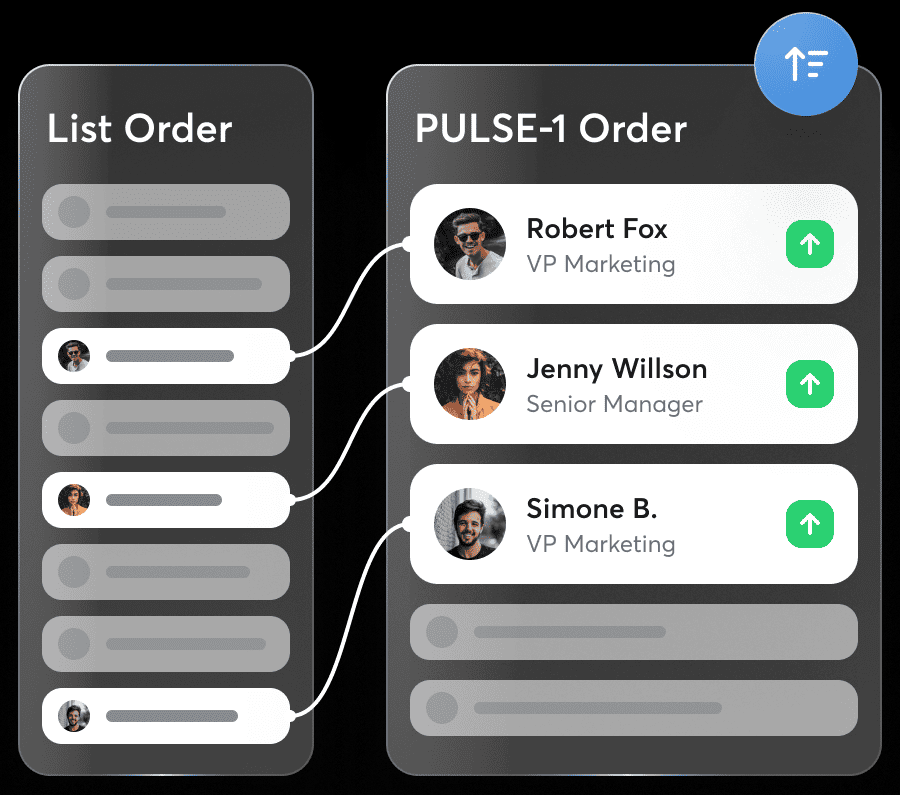
During the livestream, Thibault Imbert, Instantly’s chief product officer, explained why the company trained its own model. Large AI models can research a prospect and write an email, but they are « too general » to predict who will reply. And running them on thousands of leads « could get expensive at scale ». Hence a smaller, specialized model built around one question: who is most likely to say yes?
That’s where the name comes from. It’s Instantly’s first model, and it focuses on the start of the journey: getting a reply. Thibault Imbert said more models would follow, without giving a date.
Where does the 2.2x figure come from?
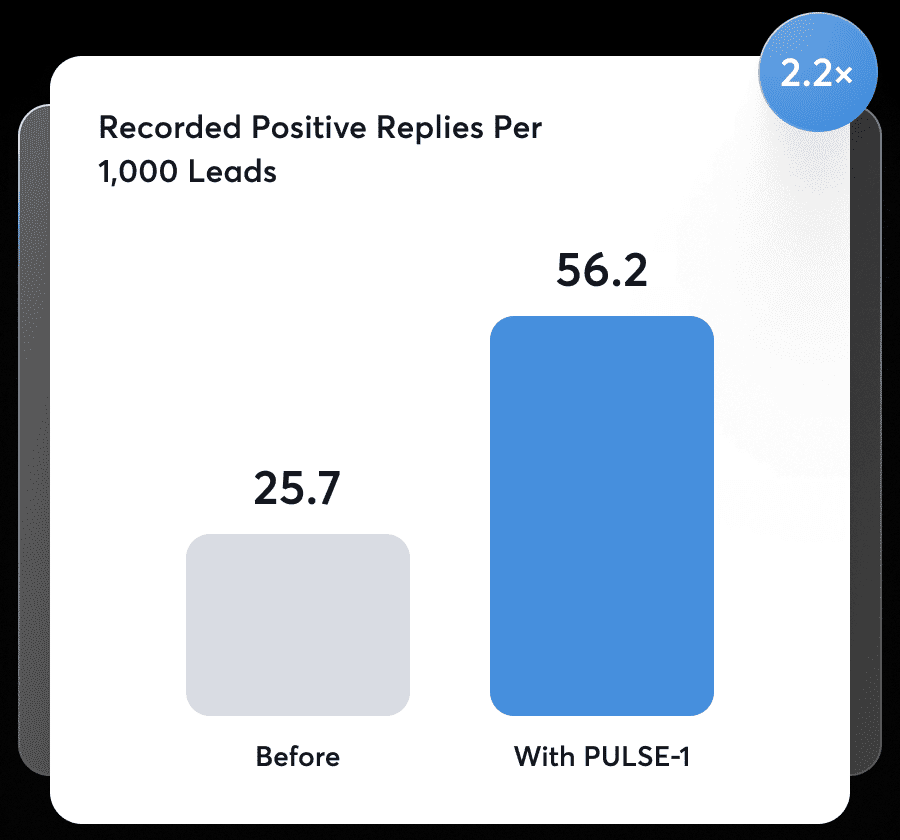
From a test run by Instantly itself. The company took the history of 123 customer workspaces, excluded from the model’s training, and looked at what would have happened if the leads had been ranked by PULSE-1. The top 20% of leads produced 56.2 positive replies per 1,000 contacts, versus 25.7 without ranking. The ratio does come out at 2.2.
Instantly also pitted its model against two general-purpose models on the same task:
| Model | Positive replies from the leads it picked | Time to score one lead |
|---|---|---|
| PULSE-1 | Baseline | 0.6 seconds |
| Fable 5.1 | 9% fewer than PULSE-1 | 4.9 seconds |
| GPT-6 Astra | 18% fewer than PULSE-1 | 2 seconds |
These figures deserve a careful read, for three reasons.
- The test is retrospective. It looks at replies already received, not at new campaigns sent with and without PULSE-1.
- Nobody outside the company has checked it. Instantly publishes neither the sample size, nor the period, nor its definition of a positive reply, nor the instructions given to the competing models.
- The « 2.2 times » compares the top of the ranking with an unsorted list. It doesn’t say your campaigns will double their replies. It says the leads contacted first will be better than the list average.
During the livestream, Thibault Imbert alternately spoke of « 2.2x » and « 2x ». The principle still holds: sorting prospects before writing to them is what lead scoring already does. What’s new is that Instantly does it with a model trained on its customers’ real results, rather than with hand-written rules.
What data was it trained on?
Instantly talks about « billions of signals from historical sales interactions ». During the livestream, Thibault Imbert said this is Instantly’s own sending data. The fact that the test covers workspaces « excluded from training » suggests the others were used to train the model.
For a team prospecting in Europe, this raises a question Instantly leaves open. Its privacy policy, updated on November 2, does say the company collects email usage data (delivery, opens, replies) and uses it to develop new products. It says nothing about training AI models, and no option to keep your campaigns out of training is documented. If your prospects are in Europe, ask Instantly before committing.
We also don’t know whether PULSE-1 scores a sales director in Lyon as well as a founder in California. Instantly says nothing about the country breakdown of its training data.
How much does it cost, and how do you turn it on?
PULSE-1 isn’t sold separately. It only runs inside Instantly’s AI Sales Agent, where it is on by default. The setting sits in the lead quality section of the agent’s configuration. An animation at the top of the screen shows when it’s working.
On pricing, Instantly’s help center gives the following rules:
- until December 1, PULSE-1 costs nothing extra,
- after that, it adds 1 credit per lead found,
- the AI Sales Agent already uses 5 credits per lead, plus 1 credit per buying signal found.
So a lead goes from 5 to 6 credits, 20% more. If the announced gain holds up even partly, the math still works out. The AI Sales Agent is included in the Starter bundle, listed at $94 a month. Sending alone starts at $47 a month with the Growth plan.
What else did Instantly announce on November 24?
PULSE-1 only took up the first fifteen minutes of the livestream. The rest shows a vendor that wants to move beyond cold email.
A knowledge base connected to your tools. The agents’ former « memory » becomes a knowledge base linked to Granola, Notion and soon Google Drive. Meeting notes, win and loss reviews and the manager’s guidance flow in automatically, and the agents use them when writing. The content is now visible and editable, as text files.
Three inbound tools.
- A website chat agent: it talks to visitors, guides them toward booking a meeting or signing up, and enriches the contact as soon as they leave their email.
- A sign-up follow-up agent: it pulls sign-ups from Intercom, Typeform or a Mailchimp list, enriches each contact and sends a personalized message, including to older sign-ups who never got a follow-up. According to Instantly’s help center, it’s free until December 1, then costs 5 credits per sign-up processed.
- Newsletters and automated journeys for contacts who have opted in. You describe the email you want, the AI writes it in the brand’s style, and you fine-tune it in a standard editor.
That last point is the most unexpected. Instantly is moving onto the ground of classic email tools, with event-triggered journeys, such as the start of a free trial.
Personalized landing pages. The new « Build » area generates a page for a target account, based on the knowledge base and what Instantly knows about the prospect. It’s the ABM principle, without going through the marketing team.
An agent in Slack. You mention Instantly in a Slack thread to ask for a review of the last three months of campaigns, or to enrich a CSV file dropped into the conversation. Connectors for ChatGPT and Claude are also available, in line with ChatGPT for Sales.
Send.io, the sending infrastructure sold separately. Instantly is opening up the sending technology it uses for its own customers to developers and AI agents: mailboxes, domains, templates, automations, with an MCP server and a command-line tool.
The livestream ended with a reminder of the Black Friday deals launched the day before: 20% off all subscriptions, for new accounts and upgrades alike, 30% off ready-to-use mailboxes and free domains. Instantly gave no end date.
Should you turn it on?
If you already use the AI Sales Agent, PULSE-1 is probably already active. Let it run until December 1, since it costs nothing until then. The best test is a simple one: two agents on the same target, one with PULSE-1 and one without, then compare the positive reply rate over a few hundred leads.
If you run your campaigns by hand, without the agent, PULSE-1 changes nothing for you today. Instantly only presents it inside the AI Sales Agent, not in its lead database or in standard campaigns.
If you’re still choosing between tools, our full Instantly review and our Smartlead vs Instantly comparison cover what the platform is worth beyond this announcement. PULSE-1 helps you choose who to write to. It replaces neither good targeting, nor good deliverability, nor a message that makes people want to reply.
The questions we get over and over.
Does PULSE-1 write the prospecting emails?
No. PULSE-1 only scores and ranks leads by their chances of replying positively. Prospect research and sequence writing are still done by Instantly's AI Sales Agent, with other models.
Can you use PULSE-1 outside Instantly?
No. Instantly says PULSE-1 is only available in its platform, inside the AI Sales Agent. No API or standalone version had been announced as of November 26, 2026.
How do you turn PULSE-1 off?
PULSE-1 is on by default in the AI Sales Agent. You can switch it off in the agent's settings, in the lead quality section. Turning it off avoids the extra credit per lead charged from December 1, 2026.
Are my team's campaigns used to train PULSE-1?
Instantly doesn't say. The company says it trained the model on its own sending data, and its privacy policy allows open and reply data to be used to develop new products. No opt-out from training is documented, so it's best to ask Instantly.
Who is Instantly?
Instantly is an American cold email platform: campaigns sent from multiple mailboxes, warm-up, lead database, built-in CRM and AI agents. The company claims more than 50,000 customers, B2B companies and sales teams.

What the community says.