


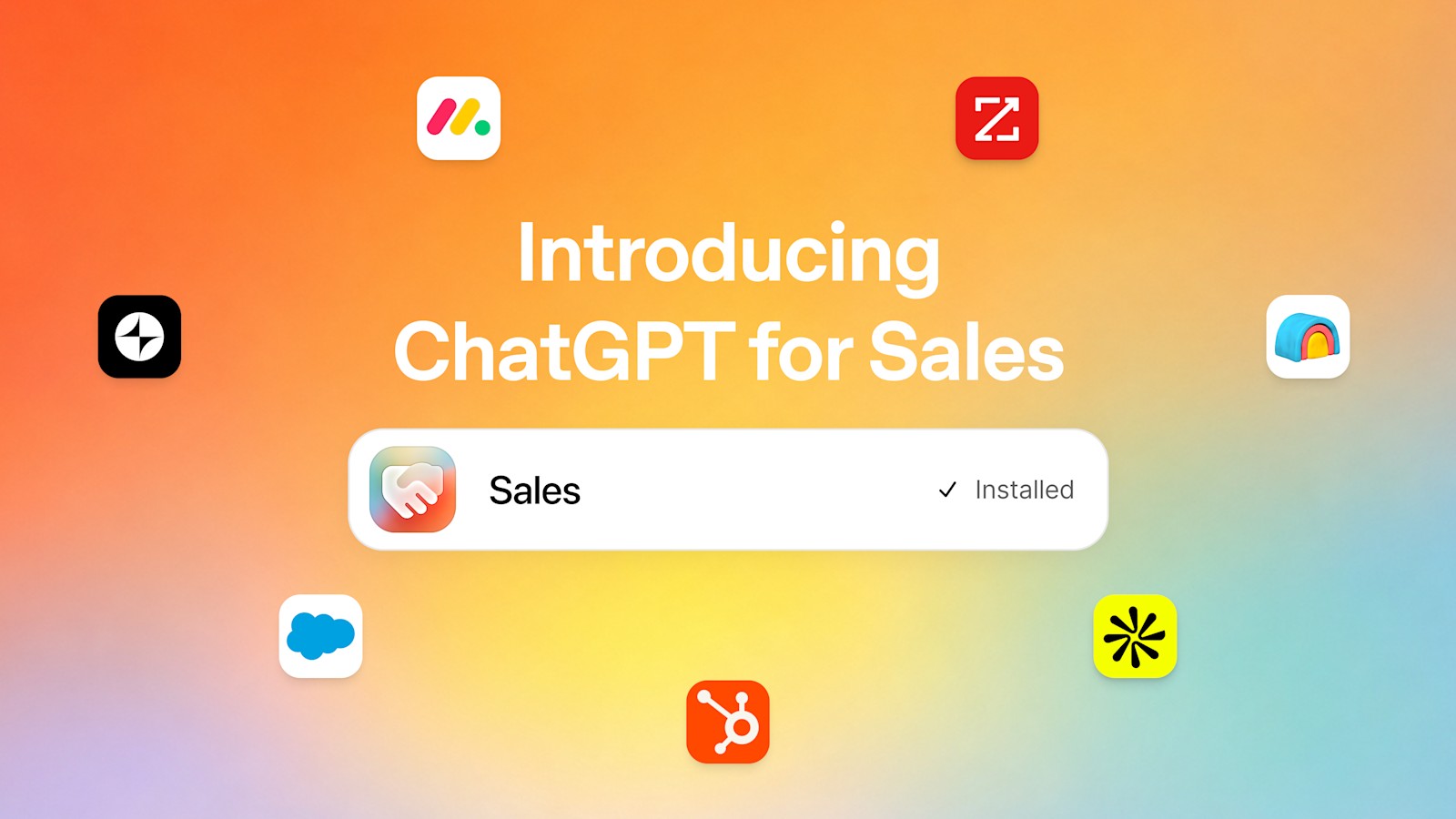
- On November 17, OpenAI launched ChatGPT for Sales: a Sales plugin and more than 30 connectors to sales reps’ tools.
- You use it to prepare meetings, follow-ups, prospect account lists, pipeline reviews and quotes.
- The plugin is free and open to every ChatGPT plan. Partner tools are still paid separately.
- Salesforce, HubSpot, Apollo, Clay and Gong are connected. Pipedrive, Zoho, Brevo and lemlist are not.
- Try it on one specific use first, with a Business or Enterprise account to keep control of access.
OpenAI launched ChatGPT for Sales on November 17. Behind the name are two things: a “Sales” plugin that adds ready-made tasks for sales reps to ChatGPT, and more than 30 new or updated connectors to the tools they already use. Salesforce, HubSpot, Apollo, Clay, Gong and Docusign are among them. The plugin is open to every ChatGPT plan, the free one included.
The idea: instead of jumping from the CRM to the prospecting tool and then to the inbox, the rep asks ChatGPT, which pulls the information from each connected tool.
So what can you actually do with it?
OpenAI splits a sales rep’s work into six uses:
- Prospecting: build a prioritized list of accounts from the CRM and prospect databases, and find a good reason to reach out.
- Preparing a meeting: a brief that pulls together the account history, past calls and the buyer’s priorities.
- Following up: from call notes, draft the follow-up message, capture next steps and prepare the CRM update.
- Watching the pipeline: spot deals that have stalled and understand what changed.
- Closing: prepare the quote and the contract once the buyer is ready.
- Delegating: an always-on agent prepares meeting briefs, tracks deals and suggests next steps.
The plugin also comes with named tasks, such as analyzing account signals, building a competitive brief, writing a business case or following up after a call. OpenAI’s help center gives the example of a meeting brief pulled from HubSpot: account history, open deals, next steps, links to the records and questions to ask the customer.
ChatGPT prepares, the rep approves. Follow-ups and CRM changes are submitted to them before anything goes out.
Which tools does it work with?
Here are the partners OpenAI announced on launch day:
| Use | Connected tools |
|---|---|
| CRM | Salesforce, HubSpot, Close, monday CRM, Attio |
| Prospecting and data | Apollo, Clay, ZoomInfo, Common Room |
| Sequences | Outreach, Salesloft |
| Calls and meetings | Gong, Otter.ai, Granola |
| Deal tracking | Rox, Backstory, Hex |
| Quotes and contracts | Docusign, PandaDoc, Ironclad, ServiceNow CPQ |
| Content and enablement | Confluence, Guru, Seismic, Gamma, Canva, Figma |
The list leans heavily American. Pipedrive, Zoho, Brevo and lemlist aren’t on it, nor are European CRMs like Sellsy or Axonaut. A team running one of these tools has no connector planned for now.
Who can use it, and what does it cost?
The Sales plugin is available “on all ChatGPT plans globally, including Free”, according to OpenAI’s help center. No extra charge has been announced. There are two caveats, though:
- Not every connector is open everywhere. Availability depends on the plan, the country and the workspace settings, and OpenAI doesn’t give a country-by-country breakdown.
- Installing the plugin doesn’t give you access to the partner tools. You need a Salesforce, Apollo or Gong account to use them in ChatGPT, and each rep connects their own account.
On the Business and Enterprise plans, the admin decides from the admin console: the plugin is either offered to members or installed by default for the whole team. The admin also sees which actions each connector is allowed to take.
Only one figure came with the announcement. At NeoBid, a customer quoted by OpenAI, the tool reportedly cuts manual work on these tasks “by around 65%”. It’s a customer figure put forward by the vendor, so take it as such.
What does this change for CRM vendors?
Until now, each vendor pushed its own assistant: Breeze at HubSpot, Agentforce at Salesforce. With ChatGPT for Sales, the rep works in ChatGPT and the CRM becomes the database behind it.
Vendors are going along with it rather than fighting it. HubSpot announced the same day that work done in its CRM from Claude or ChatGPT stays included in the seat price, with no extra credits. We covered this when HubSpot arrived inside Claude. Salesforce, for its part, is opening its data to outside agents with Headless 360.
Should you try it?
If your team works in Salesforce or HubSpot, yes, since the plugin costs nothing extra. Start with one specific use, the pre-meeting brief for example, and compare it with what your CRM’s own assistant already does.
Two precautions, though. Connecting the company CRM to a personal ChatGPT account is no small thing: go through the Business or Enterprise plan instead, where the admin keeps control of access. And reread what ChatGPT suggests before approving it, because a botched follow-up or a badly updated CRM record shows up fast on the customer’s side.
If you’re on Pipedrive, Zoho or another tool missing from the list, you’ll have to wait for new connectors. In the meantime, our guide to AI CRMs for small businesses compares the assistants already built into CRMs.
The questions we get over and over.
Does ChatGPT for Sales replace the CRM?
No. ChatGPT for Sales reads CRM data and prepares actions, such as a follow-up or a record update, that the rep approves. The data stays in Salesforce, HubSpot or whichever CRM is connected, which is still needed.
Can ChatGPT message prospects on its own?
No. According to OpenAI’s help center, follow-up messages and CRM changes must be reviewed and approved by the rep before any action. What can be done also depends on each connector and on the account’s permissions.
How is it different from HubSpot Breeze or Salesforce Agentforce?
Breeze and Agentforce work inside their own CRM. ChatGPT for Sales works from ChatGPT and pulls information from several tools at once: the CRM, the prospecting tool, the call recorder or the e-signature software.
Can you connect Pipedrive or Zoho to ChatGPT for Sales?
Not at launch. The CRMs announced on November 17, 2026 are Salesforce, HubSpot, Close, monday CRM and Attio. OpenAI has not given a timeline for other connectors.
Who decides on connectors in a company?
On ChatGPT Business and Enterprise, the admin chooses from the admin console which plugins are offered to members or installed for the whole team, and sees the actions allowed for each connector. Each rep then connects their own account.

What the community says.