



- Three types of newsletters: pure player, media and company, with open rates of 50 to 65% for pure players and 20 to 30% for media.
- Sponsor value-added content rather than direct selling: in the author’s tests, CTR goes from 0.26% to 1%.
- For awareness, you track impressions; for ROI, leads.
- Carry estimates through to the CPL: a newsletter with a very high CPM can still be the most profitable.
- Four sponsoring formats: written paragraph, native ads, logo, dedicated email.
Newsletters are a very good way to reach new customers in B2B and get people talking about your products: not only are you recommended by a content creator whom readers trust, but on top of that it lets you reach a very precise audience.
But pulling off a newsletter sponsoring campaign takes experience, even expertise, to decide which type of newsletter interests you, which type of sponsoring, and how much budget to put into it.
In this article, I give you the keys to getting the most out of your newsletter sponsoring campaigns.
4 things to know before sponsoring a newsletter
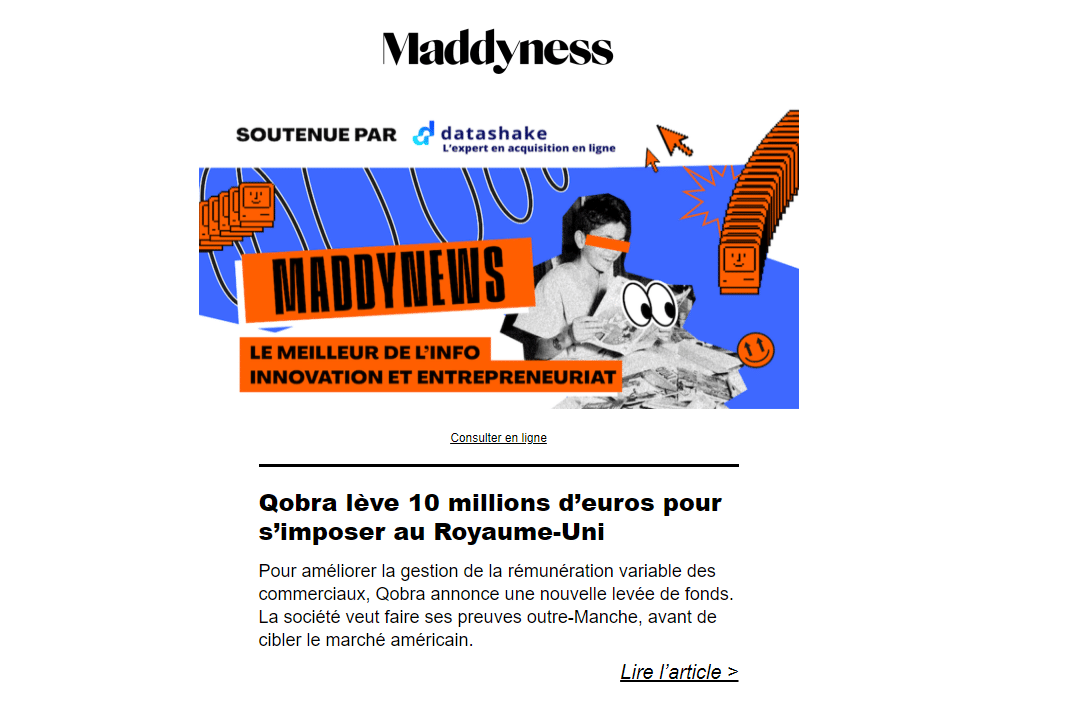
The newsletter of the French media outlet Maddyness: a compilation of their articles of the week, sponsored by Datashake
1. The different types of newsletters
- The pure player newsletter
A pure player is a content creator who writes a newsletter on one topic, and it’s their main activity. The bond between the creator and their subscribers is very strong and the newsletter is of very high quality.
Subscribers usually read these newsletters to get advice and keep up with what’s new. The power of recommendation is very strong. These newsletters have open rates between 50 and 65%.
- The media newsletter
Media newsletters are often compilations of the week’s articles. The appeal for subscribers is getting the important news pushed to their inbox to keep a watch on their field. These newsletters have open rates between 20 and 30%.
- The company newsletter
Every company has its own newsletter. Usually, the goal is to send news and new offers to its members.
But more and more companies write non-promotional newsletters, with content that brings information about the industry, to subscribers who are not (yet) customers.
The goal is to build a community around your industry. These newsletters look like the “pure player” ones. The quality is similar, and so are the open rates.
Going furtherTo target “developers” in France, for example, you have the following newsletters:
- Pure players: Le courrier du Hacker, Craft Academy
- Media: Développez.com, IT Espresso
- Company: Talent.io, Co-fondateur.fr
2. Favor value-added newsletters
Above all, subscribers want to learn more about the topic they follow. To generate more clicks, it’s better to sponsor content they’ll find interesting: webinar, white paper, blog post, etc.
You can go for direct selling, but it all depends on the goal: in my tests, my CTR went from 0.26% (direct selling) to 1% (white paper).
In my tests, I took the example of a Spencer ad doing direct selling in the newsletter of the French company Emarketing: 18 clicks for 6,793 impressions, a CTR of 0.26%.
And you can compare this ad with another value-added Spencer ad, still in the same Emarketing newsletter: 155 clicks for 16,064 impressions, a CTR of 1%.
3. Diversify newsletters and messages
It comes back to the rule of 7: as with any communication, you need to avoid the one-shot effect that goes nowhere.
Whether for acquisition or awareness, repeating the message several times to the same audience increases the campaign’s performance. It’s better to concentrate several sponsorships on a single campaign, with a strong message or offer, than to sponsor all year long, as things come, through small campaigns.
And so target as many newsletters as possible that are read by a precise community, and always offer them new content.
4. Target small and precise before broadening
If you sell an invoicing SaaS, first target a newsletter that gives advice to 6,000 SMEs going digital (Bravo PME in France, for example), before broadening to newsletters like Forbes, which are read by many companies.
How much does it cost to sponsor a newsletter?
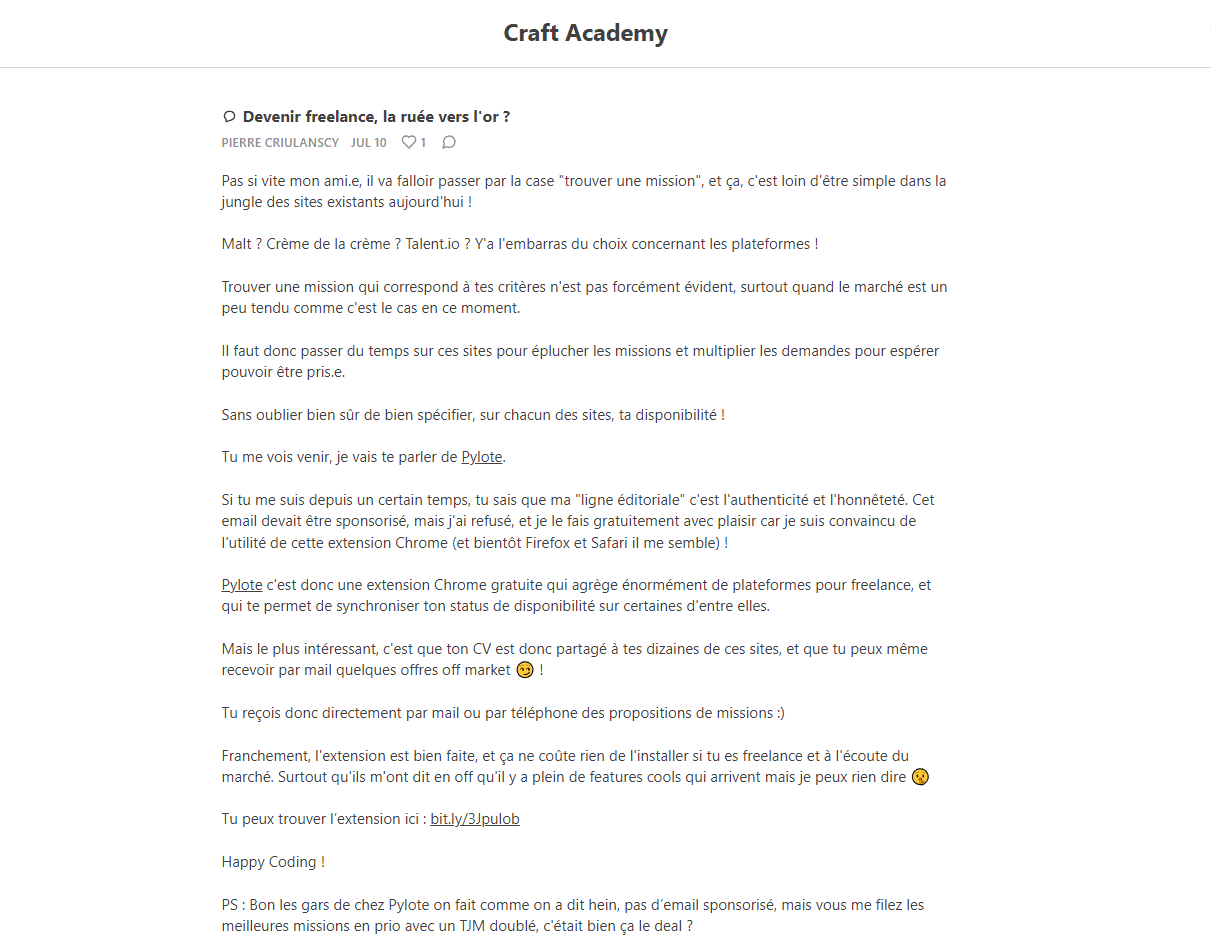
Pierre Criulanscy’s newsletter from Craft Academy: over 4,000 subscribers, and a high engagement rate
Awareness or ROI goal?
To know whether your campaign is a success, you start by clearly defining its goal upfront.
If you’re looking to increase your brand awareness, you need to track the number of impressions. To estimate it, you can multiply the number of subscribers by the open rate. Then you track opens to follow the actual performance.
To build awareness, you generally avoid multiplying newsletters, focusing instead on two or three publications, and you keep at it for several weeks / months on those publications.
If you’re aiming for ROI above all, it’s better to track the number of leads. You estimate it by multiplying the number of clicks by the LP conversion rate. Then you track conversions to follow the actual performance.
For an effective ROI campaign, it’s better to multiply publications to get real click-through & conversion rates. You’re buying learning, a bit like with SEA. Once that’s done, you can target more precisely and repeat the most profitable operations.
Read alsoTop 10 lead generation agencies
Pricing models
When you sponsor a newsletter, there are different pricing models:
- Flat fee: this is the most common. For each newsletter, the nature of the sponsoring is defined and the price announced. So it’s a fixed amount you pay for the service. Advantages: choice of newsletter, guaranteed placement, possibility of a custom creative, or a text written by the newsletter.
- CPM: The advertiser and the publisher agree on a rate per 1,000 actual views (opens). It’s very uncommon, but it can happen on long-term, high-volume commitments (a bit like a display campaign). Be careful though, email clients are waging war on open tracking, so the metric is less and less reliable.
- CPC: The advertiser and the publisher agree on a rate per click. It only really makes sense on fairly long commitments, where you want to let the publisher create content and run tests to generate performance. The campaign is on autopilot, and the budget under control. You also see this model emerging with newsletter advertising “networks”. We offer CPC at Spencer, for example.
In every case, the price has to take several criteria into account:
- Reach: The number of actual readers of the newsletter
- Audience homogeneity: A very precise and homogeneous audience (example: CSMs at SaaS companies) is worth more than a broader, heterogeneous audience (example: Marketing)
- Audience quality: An audience with power and money (example: managers of French SARL limited companies with more than 10 employees) is worth more than an audience with little power and / or little money (example: French micro-entrepreneurs registered less than 6 months ago).
- Sponsoring placement: Not all placements are equal, and placement dictates the click-through rate, but also the number of conversions downstream.
The calculationPublishers generally reason in CPM, or even in revenue per subscriber, which is the metric closest to what they control.
They set this target CPM or price per subscriber based on 3 criteria: awareness, quality, placement.
For example:
- Target CPM: 100 euros
- Reach = 10,000 subscribers * 20% open rate
- Rate = Reach / 1000 * CPM
This newsletter, which reaches 10K subscribers with a 20% open rate, costs 200 euros for 2,000 impressions.
If we take the concrete example of 3 different newsletters:
| Criteria | Newsletter 1 | Newsletter 2 | Newsletter 3 |
|---|---|---|---|
| Rate | €1,300 | €1,100 | €500 |
| Type of sponsoring | Written text | Written text | Native ad |
| Type of audience | Marketing managers | SaaS CSMs | Marketing |
| Number of subscribers | 20K | 6K | 60K |
| Open rate | 50% | 35% | 20% |
| Impressions | 10,000 | 2,100 | 12,000 |
| CPM | €130 | €523 | €41 |
| Click-through rate | 2% | 3% | 1% |
| Clicks | 200 | 63 | 120 |
| CPC | €6.5 | €17.4 | €4.1 |
| LP conversion rate | 20% | 40% | 8% |
| Leads | 40 | 25 | 10 |
| CPL | €32.5 | €44 | €50 |
For their part, the advertiser has to estimate the value, depending on their goal:
- Awareness: how many impressions are possible, for what price, in a newsletter of what prestige.
- ROI: how many leads are possible, for what price.
This very schematic example still shows that you should always carry estimates through to the end, all the more so if the newsletters you’re targeting are different. In our example, newsletter 2 has extremely high CPM and CPC, but if the conversion estimate is right, it’s more profitable than newsletter 3.
It’s common to see very niche, very targeted, and therefore very “efficient” newsletters, meaning with very high CPMs but much lower CPLs: the publisher monetizes their audience or community very effectively.
If we compare LinkedIn Ads with newsletter sponsoring:
For LinkedIn Ads, the screenshot below shows that advertisers pay between 5 and 18 euros per click to reach a target of marketing managers in France. That is a fairly broad target.
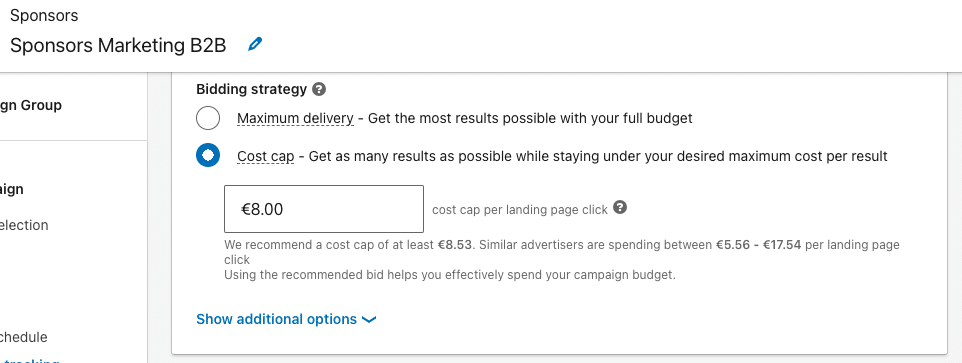
For 18 euros per click, you can sponsor a newsletter on an ultra-precise and attractive target (example: marketing directors with teams of more than 10 people), in an ultra-qualified newsletter, with serious work on the sponsoring copy.
Let’s go back to the example of a newsletter with the following characteristics:
- 10,000 subscribers
- Open rate: 50%
- Click-through rate: 3%
- LP conversion rate: 30%.
Then, depending on the goals, the price is calculated from the CPM, the CPC or the CPL.
| Criterion | Values | Formula | Cost |
|---|---|---|---|
| CPM | €100 |
| €500 for 5,000 impressions |
| CPC | €4 |
| €600 for 150 clicks |
| CPL | €15 |
| €675 for 45 leads |
For this example, you pay €500 for 5,000 impressions, €600 for 150 clicks or €675 for 45 leads.
With a flat fee, you set a price based on the previous calculations.
Newsletter sponsoring models
There are several sponsoring models:
1. The written paragraph
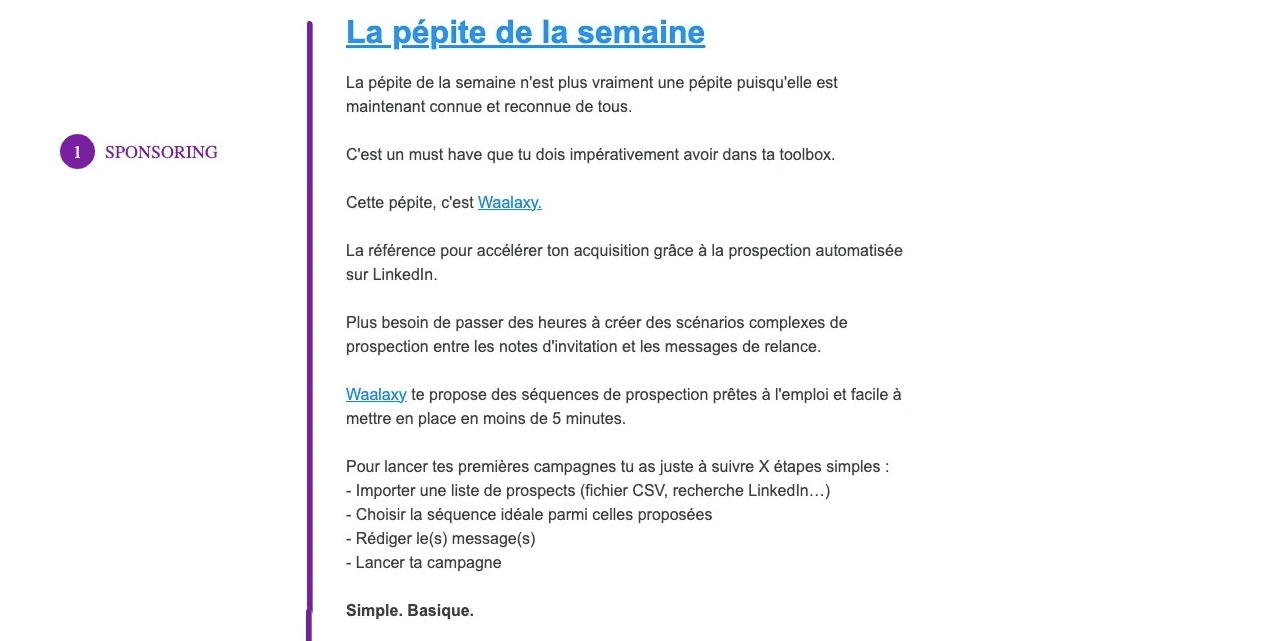
This is a paragraph written by the newsletter to showcase the sponsor’s content. This sponsoring is very high quality, and very common in “pure player” or corporate newsletters, which are ready to roll up their sleeves to put your offer forward.
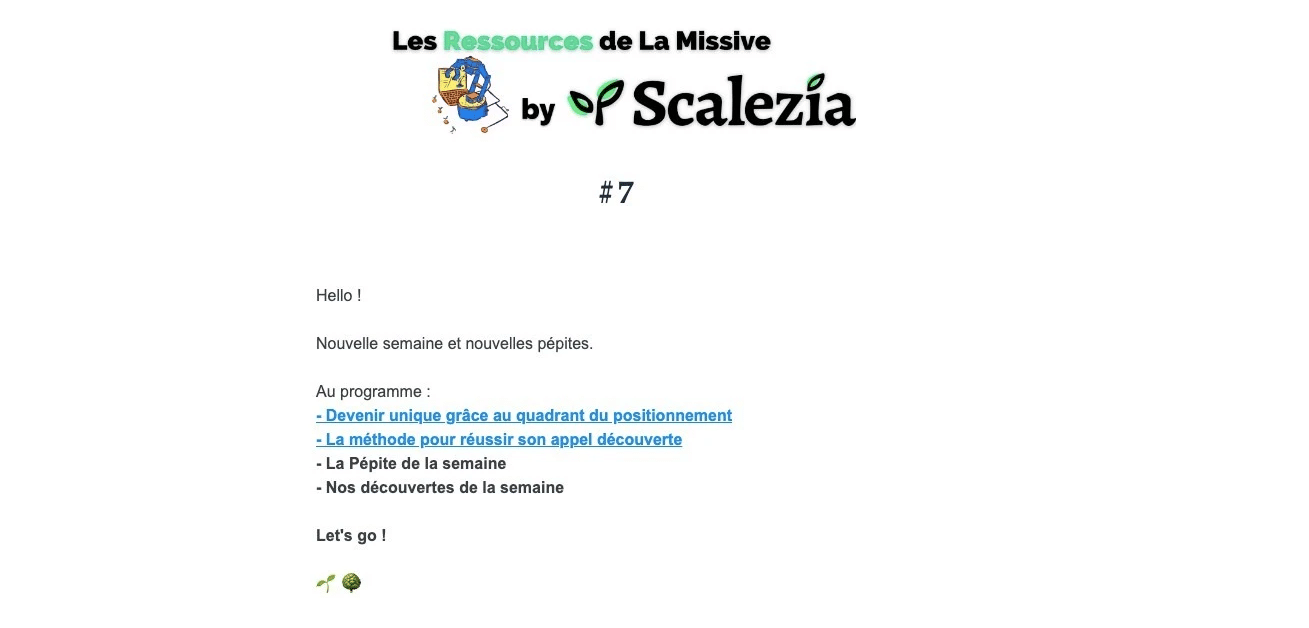
If we take this newsletter from the French publication Scalezia as an example, we find
- non-sponsored content blocks with value for the reader (the first 2 bullet points here)
- then a sponsored written paragraph (the gem of the week)
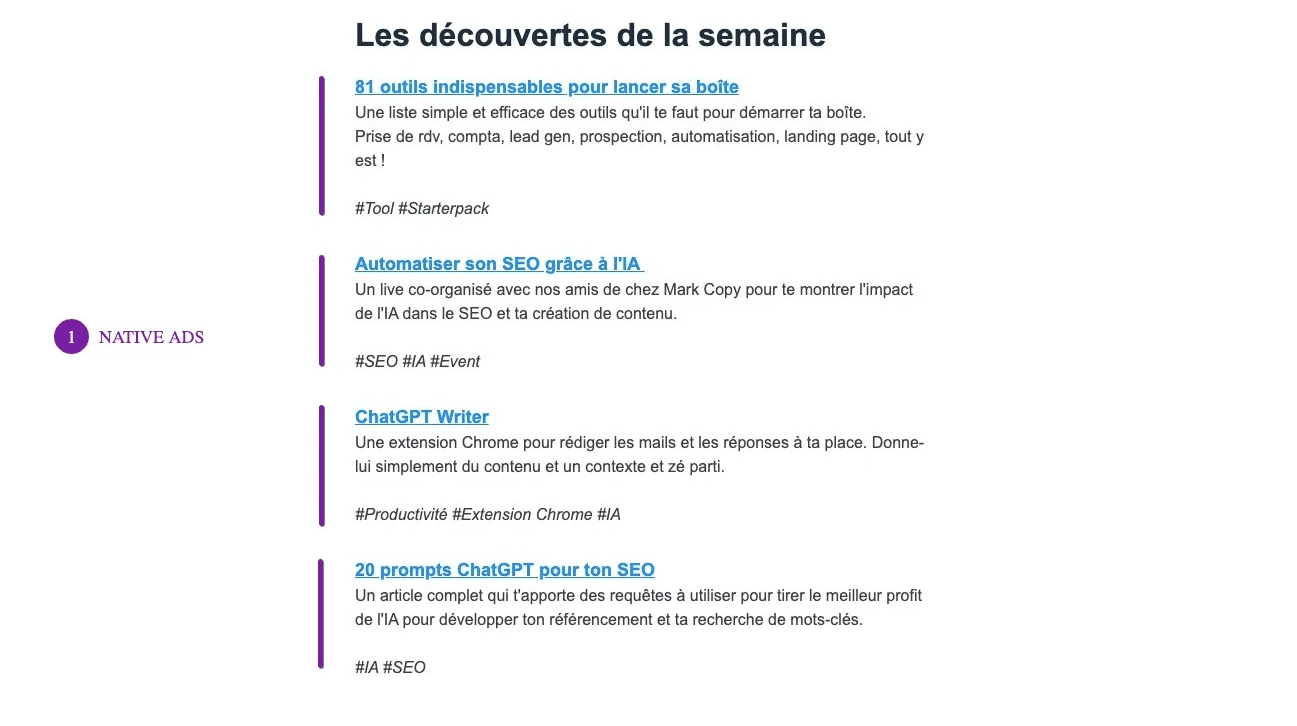
- then native ads (the discoveries of the week)
2. Native ads
Halfway between text and image, they blend into the newsletter’s editorial flow. For example, the newsletter of the French site emarketing.fr, which includes native ads in its selection of articles of the week.
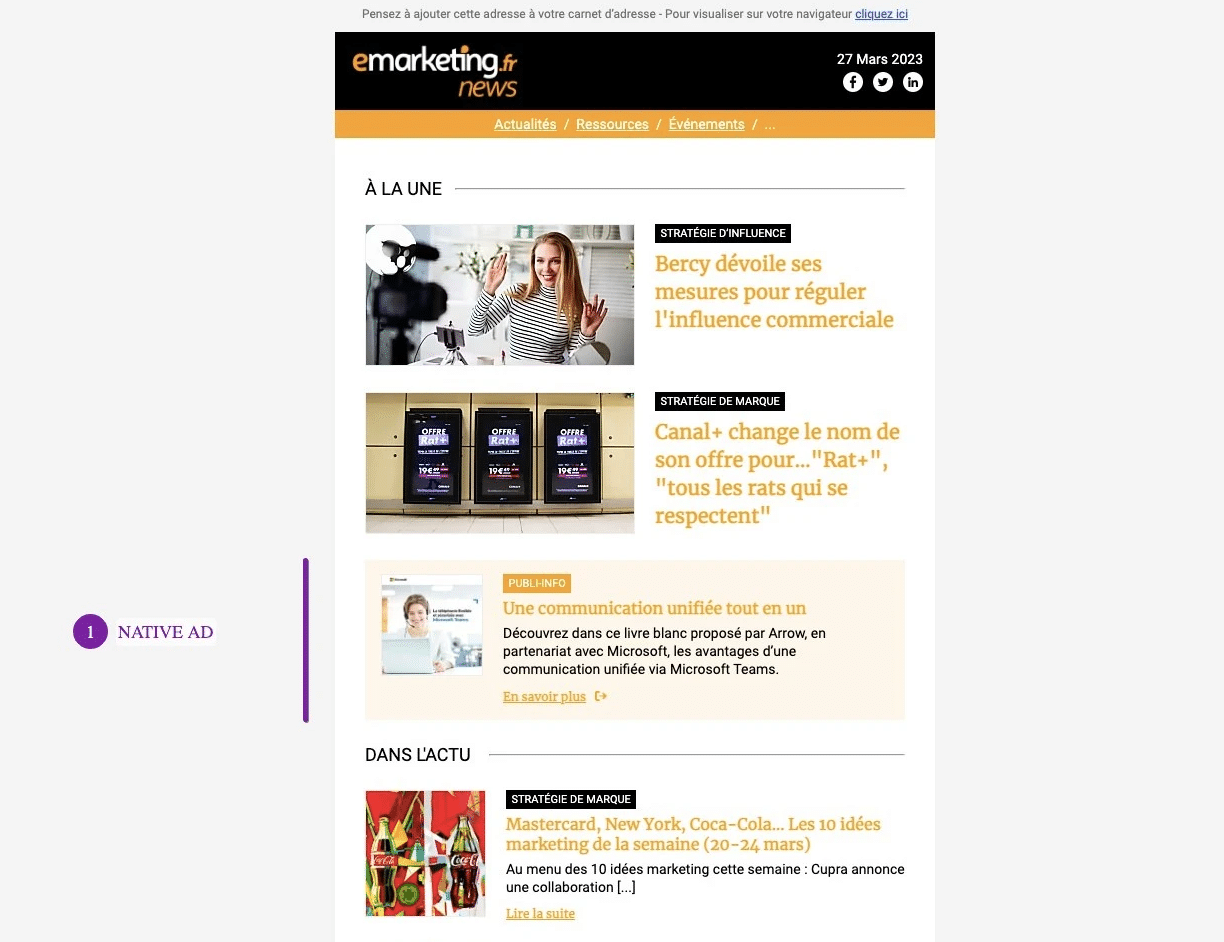
It’s an effective way to get qualified clicks, and it’s generally much cheaper than a written paragraph since the publisher can fit several into each newsletter.
3. The logo
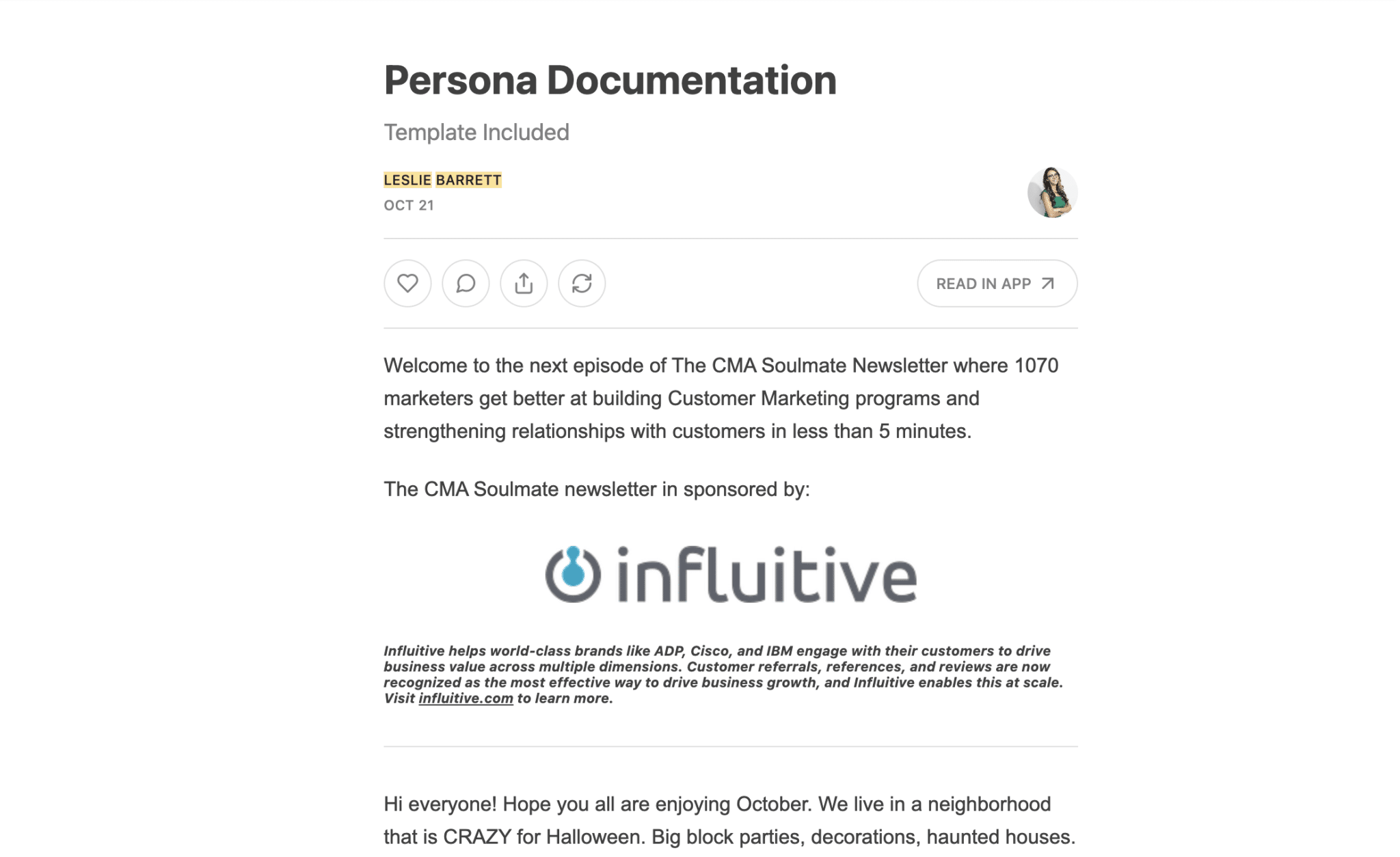
This is the least performance-oriented sponsoring, and the one where the publisher has the most power in the relationship with the advertiser. The advertiser gets “only” a mention, though generally at the top of the newsletter. This kind of sponsoring only really works to build a brand with a very precise audience, and therefore over the long term.
4. The dedicated email
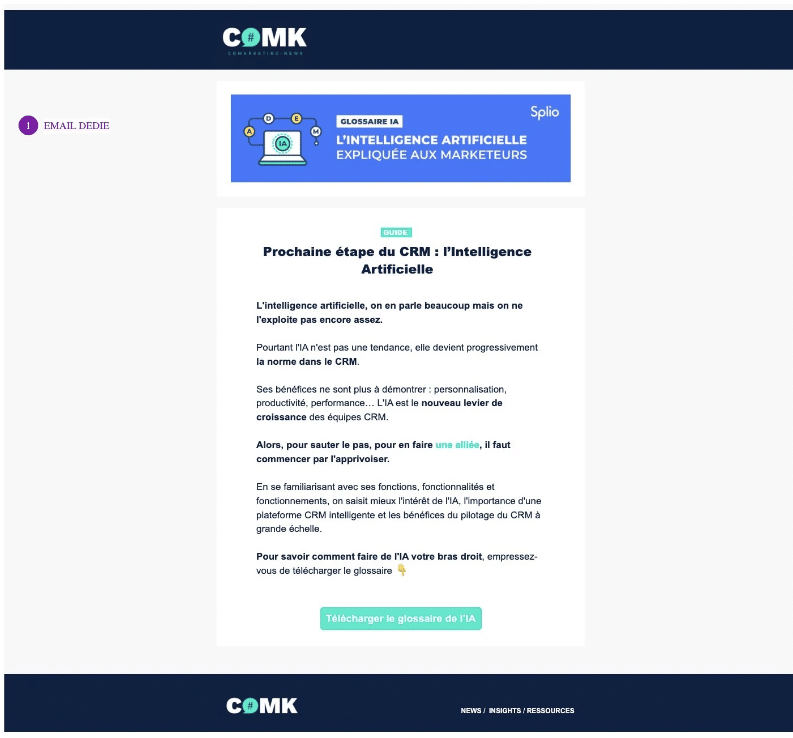
This is a specific mailing dedicated to the sponsor and sent to subscribers, which naturally offers very high visibility. For example, the newsletter of the French outlet ComK showcasing the AI glossary with the CRM Splio.
It’s up to you to define, according to your goals, which content lets you reach them and is best suited to your target.
How do you measure performance?
It’s very important to track and evaluate the performance of your newsletters.
If you’ve chosen the direct sponsoring option, you have to ask each newsletter to report its statistics after each send.
You can also pass UTM parameters to the publishers of the newsletters you sponsor so you can track performance after the clicks, with the well-known limits on attribution.
The best approach is to set an annual budget to have a presence in all the newsletters read by your target. Used well, it’s a very effective acquisition channel.
5 good reasons to sponsor newsletters
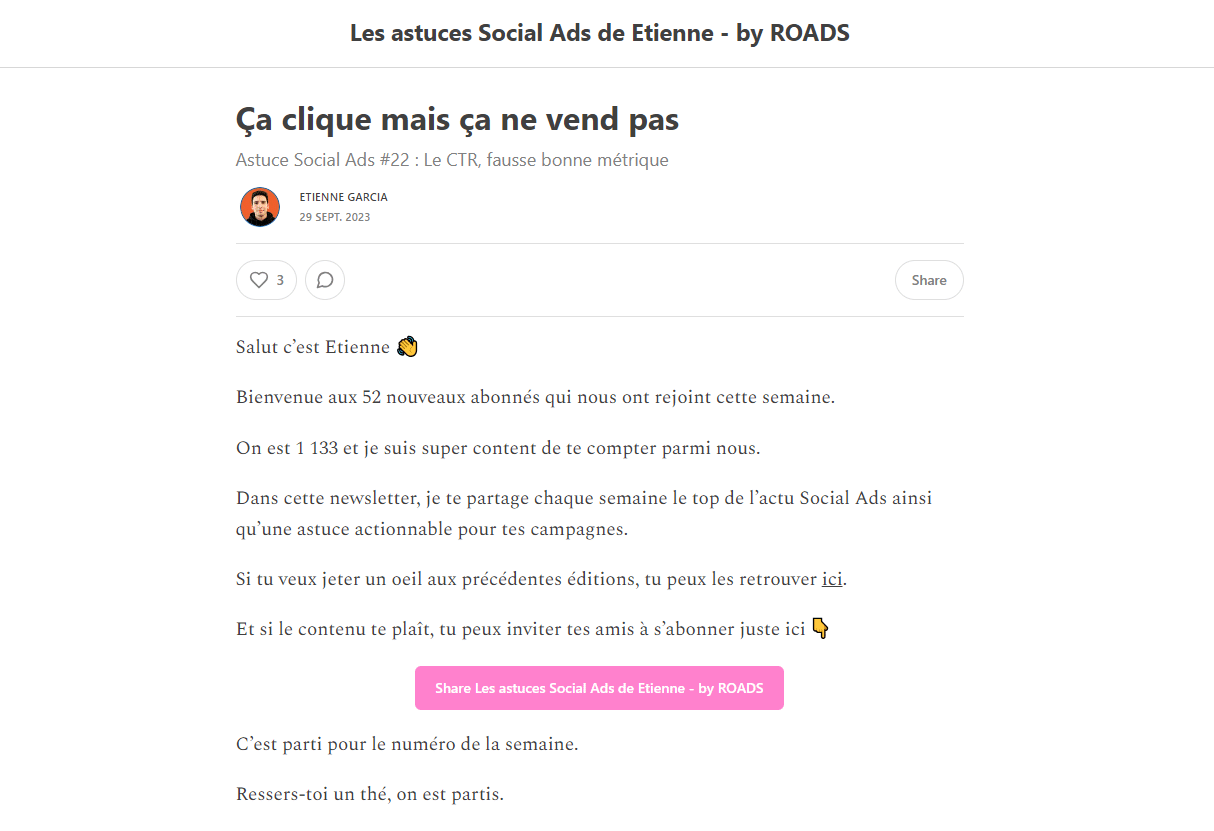
The newsletter Les astuces Social Ads by Etienne Garcia (now The Media Buyer), from the French advertising agency Roads
1. Being recommended by the content creator
On social media, we start by following our friends. Then we extend to other people we don’t know IRL, who become our friends by extension, in a way. What they say (especially in their newsletter) has a big impact on our habits, including our buying habits.
It’s simple: on the Internet, everyone has an opinion. But our brain doesn’t let us listen to all of them. That’s where influencers come in, helping us find our way.
On the one hand, we’re guided by our laziness: researching a product takes time. Reading, testing, comparing … Influencers do the work for us. It’s convenient, you just have to trust them.
On the other hand, if an influencer is followed by 100,000 people, it’s as if what they told us were validated by 100,000 people. By following a few influencers, we feel like we’re collecting the opinions of millions of people.
That’s why readers trust the content creator and have subscribed to their newsletter.
Being mentioned in the newsletter means benefiting from the power of recommendation. It’s one of the pillars of good social selling strategies.
Read alsoThe best social selling tools
2. Increasing repetition with your audience
Newsletters are still underused even though they let you multiply touch points, be visible on every network and reach the rule of 7.
The definitionThe rule of 7 is a very well-known rule in communication, and it states that a prospect must hear about your brand 7 times before buying: this is even truer today because Internet users are overwhelmed with messages and solicitations.
But repeating the same message on the same network is just reheated leftovers for these Internet users, who have access to an unlimited source of new content. Worse still: you risk ad fatigue, meaning your ad loses effectiveness because users have seen it too often.
Today, to respect the rule of 7, Internet users need to see the same message 7 times, on different channels. Hence the value of a recommendation through a well-made newsletter.
3. Reaching new audiences
Acquisition channels are limited, especially for paid: SEA / Social Ads / Affiliate. You quickly hit the limit in your choice of channels. And even on one channel, ROI is inversely exponential.
Newsletter sponsoring opens up a new acquisition channel.
If we take the B2B Marketing target in France, for example, there are the best-known and broadest newsletters (BDM, Siècle Digital, Frenchweb, Maddyness, etc.), but there is also a multitude of other marketing communities that read very targeted newsletters like Audrey Tips, Scalezia, LePtitDigital, Kick Ads, Roads and many others.
4. Easily reaching targeted communities
Let’s take the example of a company that wants to reach investors.
Usually, it will create the identikit of its target: male, 30-65 years old, upper socio-professional category, urban, etc.
Then it will select these criteria to target its Social Ads, hoping it has aimed accurately enough.
With DMPs, you try to find and follow these criteria to show display ads on websites (even if it’s more and more complicated with the GDPR).
With newsletter sponsoring, it’s simple and direct: in France, investors are the people who read Snowball, Tout sur mes Finances, Café de la bourse, Filite, or Epinard for those who follow impact finance.
5. Generating strong engagement
We were talking about laziness just above.
Not only is a newsletter a set of recommendations that land directly in our inbox, without any need to search.
But on top of that, we have a special bond with our inbox: it’s a bit like our home. That allows for creatives that are much less aggressive than in display or on social media, and a much finer, more accurate message.
Read alsoTop 12+ newsletter creation software
The questions we get over and over.
How much does it cost to sponsor a newsletter?
The price depends on the reach, the homogeneity and quality of the audience and the placement of the sponsoring. Publishers generally reason in CPM: with a target CPM of 100 euros, a newsletter that reaches 10,000 subscribers with a 20% open rate costs 200 euros for 2,000 impressions.
What are the pricing models for newsletter sponsoring?
The flat fee, the most common, with a fixed amount for the service. CPM, a rate per 1,000 opens, very uncommon. CPC, a rate per click, which only really makes sense on fairly long commitments.
What sponsoring formats exist in a newsletter?
The paragraph written by the newsletter, native ads blended into the editorial flow, the logo at the top of the newsletter and the dedicated email sent to subscribers.
How do you measure the performance of newsletter sponsoring?
By asking each newsletter to report its statistics after each send, and by passing UTM parameters to publishers to track performance after the clicks.
Why sponsor newsletters in B2B?
To be recommended by the content creator, increase repetition with your audience, reach new audiences, easily reach targeted communities and generate strong engagement.


What the community says.