The tool in detail
Semrush shows the traffic of any website. We checked whether it tells the truth, by opening it next to the Search Console and Google Analytics 4 of a site whose data we have. The backlinks and keywords hold up. The traffic, much less so.
The test ground: ludiquement.fr
An SEO tool should be judged on a site whose real numbers you know. So we took ludiquement.fr, a French board game media site whose data we have, and opened Semrush next to its Search Console and its Google Analytics 4. The site has just over 400 pages that get traffic from Google, mostly game reviews, top lists and alternatives pages.
The test was run on November 11 and 12, 2026, on an active Pro subscription, with the France database. Every Semrush figure quoted here comes from the tool on those dates. Every “real” figure comes from Ludiquement’s Search Console or GA4.
We did not pick this site at random. Semrush is an American tool, and its databases outside the United States are much thinner than its US database. For anyone tracking a site outside the American market, that is the question that matters: what is Semrush worth on a mid-sized site that is not in English? Ludiquement is a good example, and we have its real numbers to check.
Semrush’s France database: incomplete tracking
Semrush does not measure a site’s rankings continuously: it queries Google on a list of keywords it has picked itself, with one database per country and per device. For France, the test turned up three findings:
- Mobile is almost missing. In October 2026, the France “desktop” database tracked 2,235 keywords for Ludiquement, the “mobile” database only 111. Yet Semrush itself estimates that 58% of the site’s visits come from mobile.
- Rankings are not fresh. In the Organic Rankings report viewed on November 11, several keywords show a last update on August 26 or September 6. A drop or a rise takes weeks to show up.
- Real queries are missing. “greylune avis”, the query that brought the site the most clicks over the last four weeks (102 clicks, average position 1.7), does not exist in Semrush’s database.
For tracking a site outside the US market, the consequence is simple: Semrush’s “Organic Rankings” and “Organic Traffic” reports cannot serve as a dashboard. You either go through the Position Tracking module, which checks a list of keywords you choose every day (and is limited to 5 sites on the Pro plan, see below), or stick with Search Console.
Domain overview
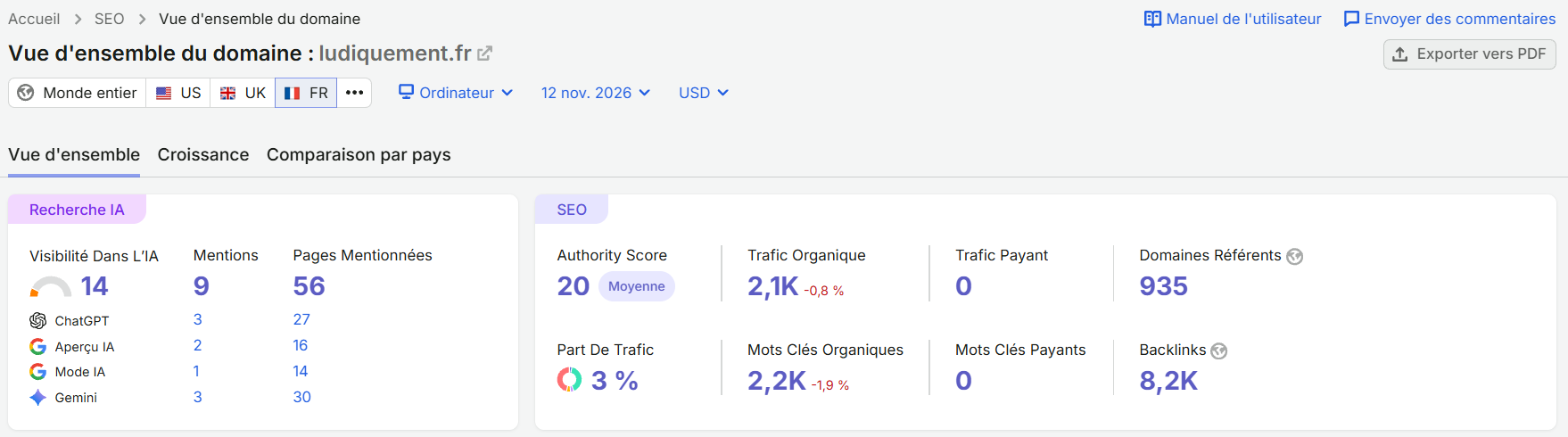
The overview fits on one screen: Authority Score of 20 (“average”), 2.1K organic visits per month, 2.2K ranking keywords, 935 referring domains, 8.2K backlinks (data from November 13, 2026). Since 2026, an “AI Search” block sits at the top left: visibility of 14, 9 mentions in France, 56 pages cited by ChatGPT, Gemini and Google’s AI answers.
The “Market trends and channels” block, further down, gives the traffic split: 69% organic, 22% direct, 3% referral, 1% AI. It also shows “main topics” for the domain: “Eu to uk shoe size” (200K traffic), “Women’s Dresses”, “Women’s Bottoms”. Shoe sizes and dresses for a board game site. This module clearly runs without any consistency check, and it is the kind of detail that makes you doubt the rest.
Organic rankings and top pages
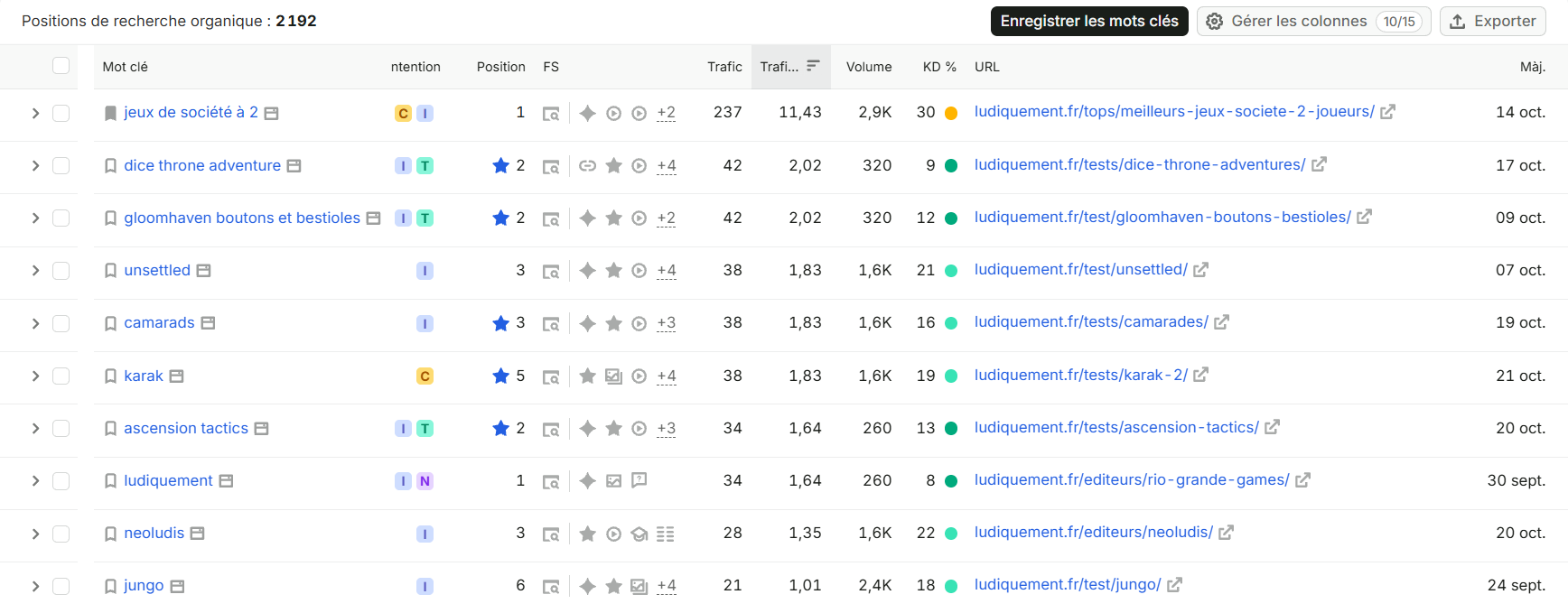
The Organic Rankings report lists 2,192 positions in France, each with its position, search volume, estimated traffic, URL and SERP features. At the top, “jeux de société à 2”: position 1, 237 visits per month, or 11% of the site’s estimated traffic.
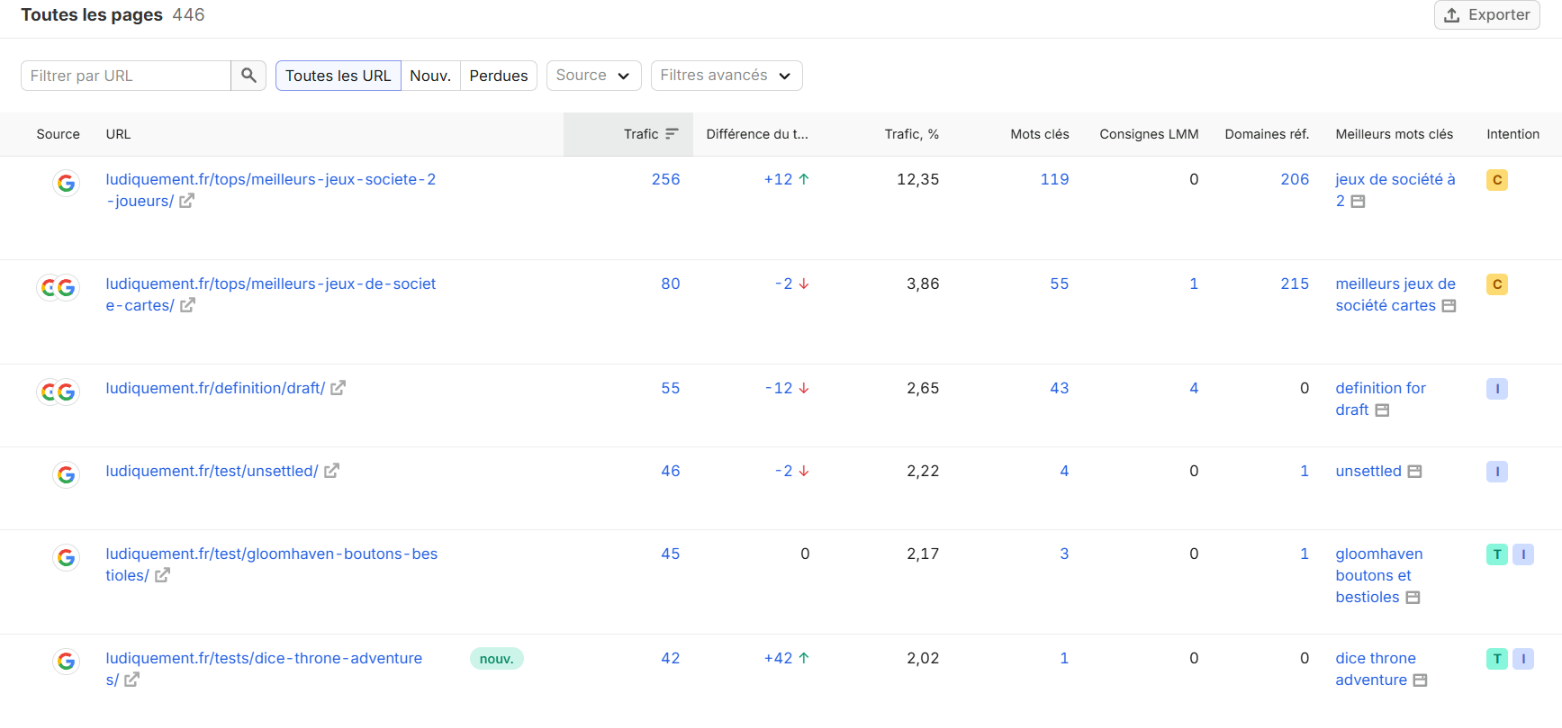
The Top Pages report applies the same logic by URL: 446 pages, with the page on the best 2-player board games at the top with 256 visits, then the card games page (80) and a page defining drafting (55). It also shows, page by page, the keywords that drive each URL and the pages “cited” by AI.
Both reports are quick to read and to filter. They also surfaced a real problem on Ludiquement: several games rank twice, with one URL under /test/ and one under /tests/ (Dice Throne Adventures, Karak, Emblèmes, Thésauros, Jungo, Régicide). Two pages fighting over the same query is a useful finding. But as we will see below, the rankings and traffic shown at the top of these reports do not hold up against Search Console.
Backlinks: a polluted profile the tool shows well
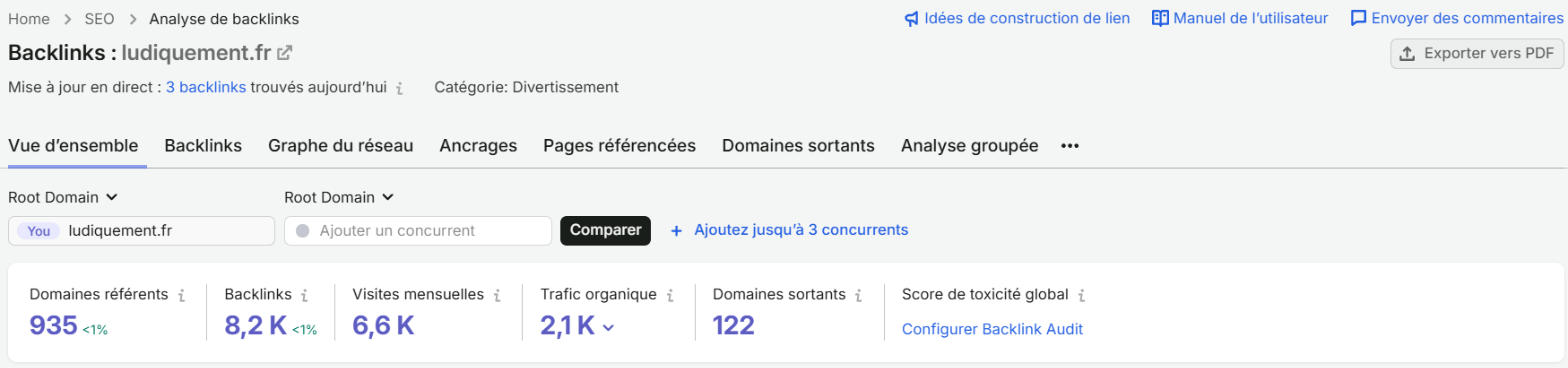
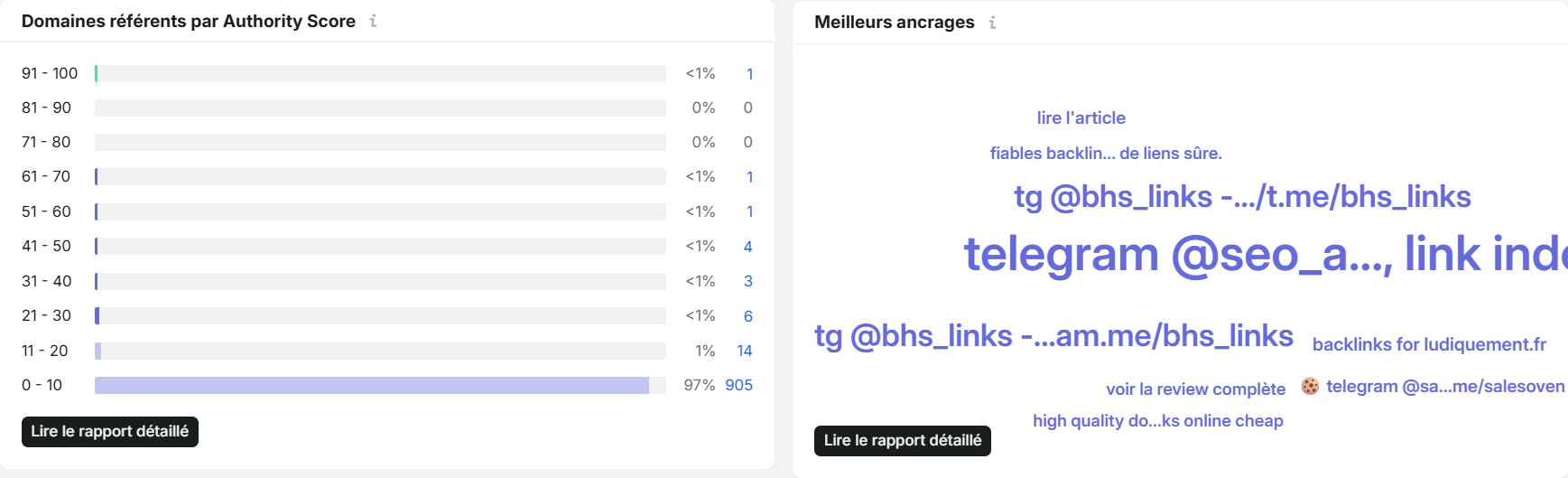
This is the most convincing module of the test. Semrush lists 935 referring domains and 8.2K backlinks, with the trend over one year, new and lost links, anchors, countries and the Authority Score of the linking sites.
The detail shows what a raw count hides: 97% of referring domains (905 out of 935) have an Authority Score between 0 and 10, the most frequent anchors are Telegram ads for link services, the .xyz and .online extensions make up a third of the domains, and Singapore sends four times more domains than France. 84% of the links are nofollow. The “935 referring domains” of the overview therefore mostly describe automated spam, and the tool gives you what you need to see it in two clicks.
The report also suggests relevant “similar profiles” (leludopathe.fr, desjeuxetdesbieres.fr, plateaujunior.fr), which make a good starting list for finding link partners in the same niche.
Keyword research
The Keyword Magic Tool starts from one query and expands it. On “jeu de société 2 joueurs”, it returns 208,069 keywords for a total volume of 2.1 million searches, sorted by relevance and grouped by topic in the left column (classic games, kids’ games, cooperative games, etc.).
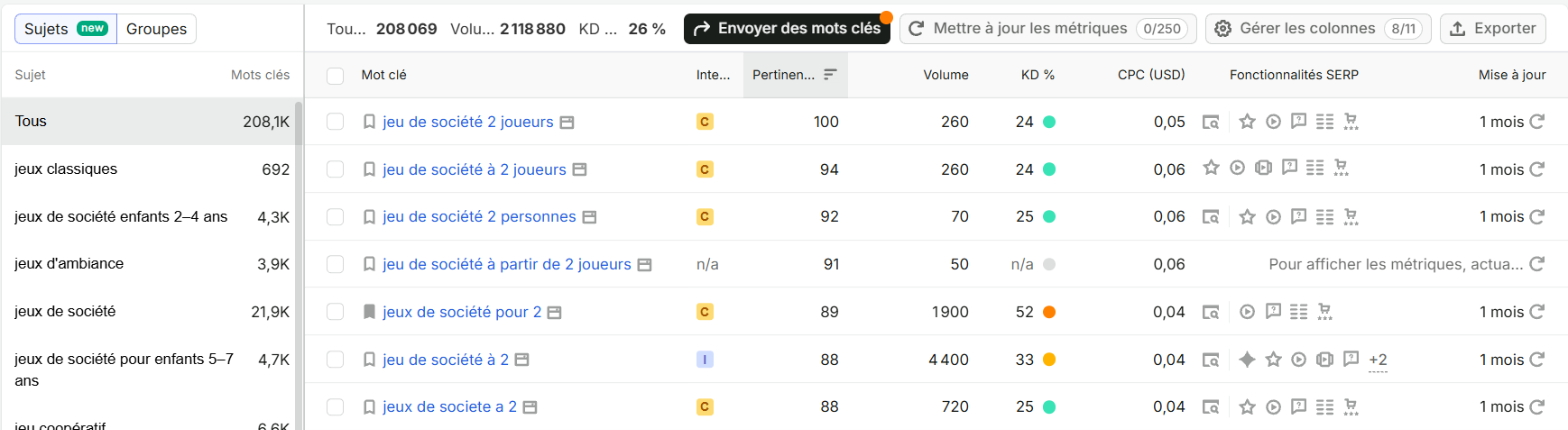
The volume is there, the sorting much less so: “jeu de société à 2”, “jeux de société à 2”, “jeux de societe a 2”, “jeu de société pour 2” each come out on their own line, with different volumes and difficulty scores (from 24% to 52%) for the same intent. You have to group them yourself, or go through the Keyword Strategy Builder.
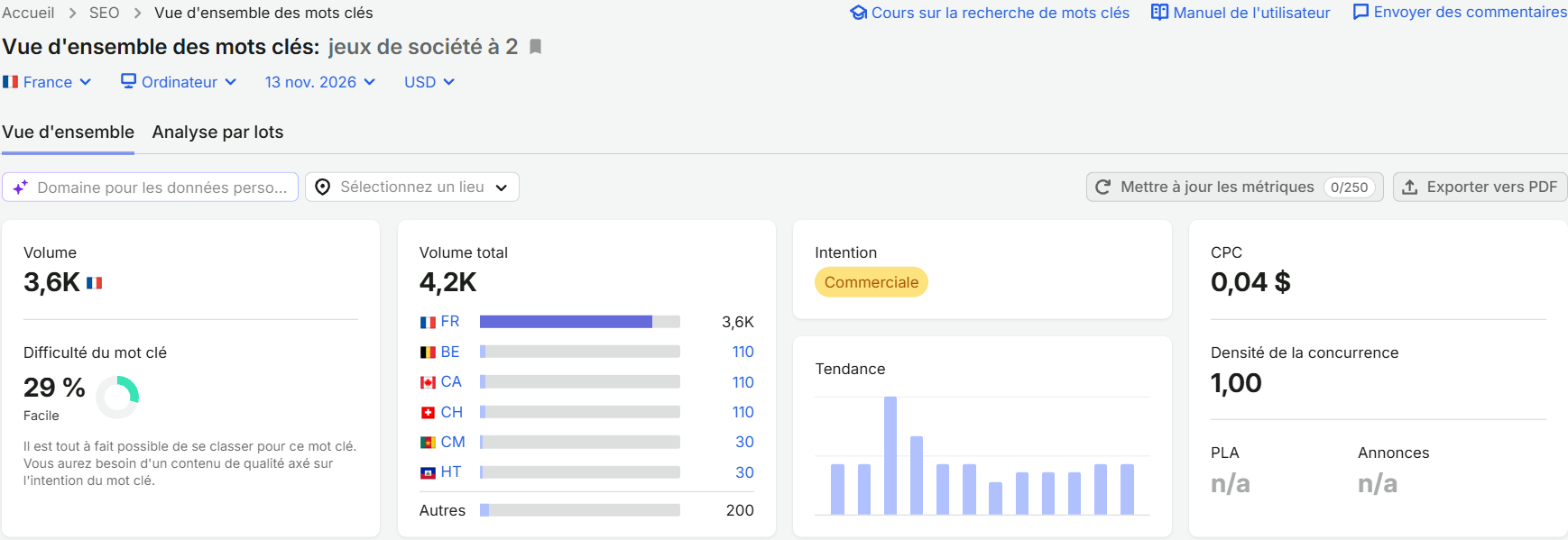
The keyword overview gives the volume by country (3.6K in France for “jeux de société à 2”, 110 in Belgium, Canada and Switzerland), the difficulty (29%, “easy”), the intent (commercial) and the SERP analysis with, for each result, the page’s Authority Score and its referring domains. Handy for judging in a minute whether a topic is worth the effort.
Competitive analysis: good leads buried in noise
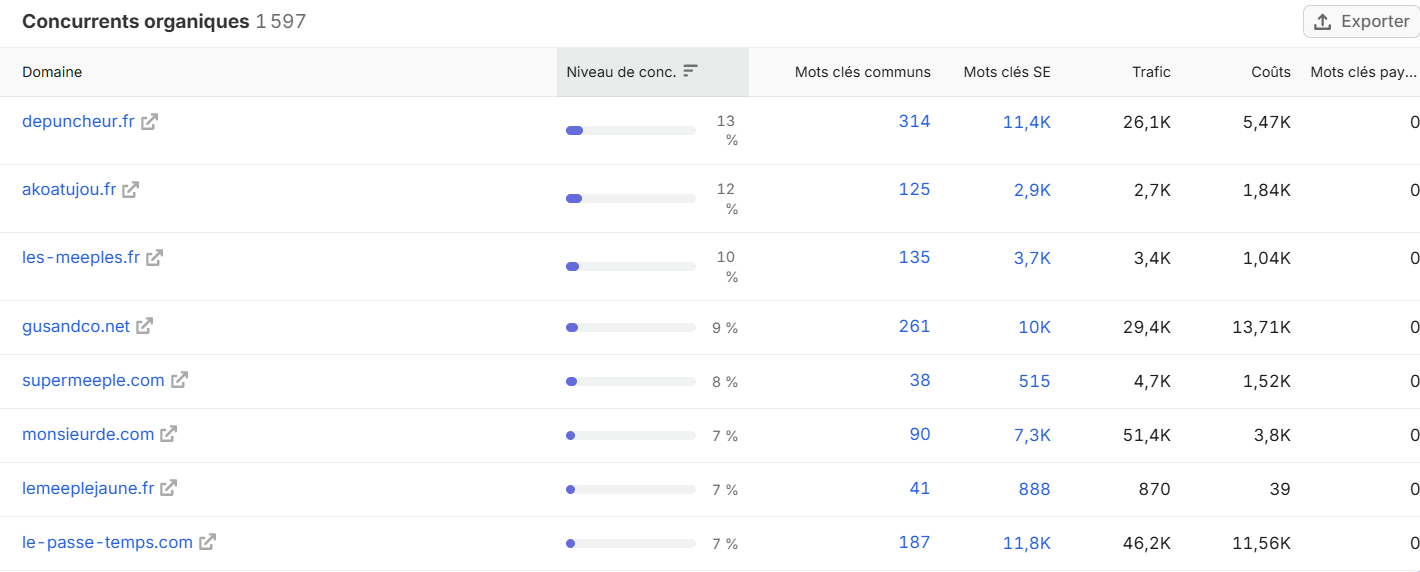
The Competitors report ranks the sites that share the most keywords with Ludiquement. It finds 1,597 of them. At the top: depuncheur.fr, akoatujou.fr, les-meeples.fr and gusandco.net. The list mixes board game media (Gus&Co, Ludovox, Vind’jeu), shops (Monsieur Dé, Le Passe-Temps) and publishers (Iello, Lucky Duck Games). For a media site, a shop that sells the same games is not really a competitor: you have to sort the list again by hand.
The Keyword Gap module compares up to five domains. Ludiquement against depuncheur.fr, gusandco.net and les-meeples.fr, France desktop database, on November 12, 2026: 231 shared keywords, 337 “missing” ones, where all three competitors rank and Ludiquement does not, and 14,800 “untapped” ones, where a single competitor is enough.
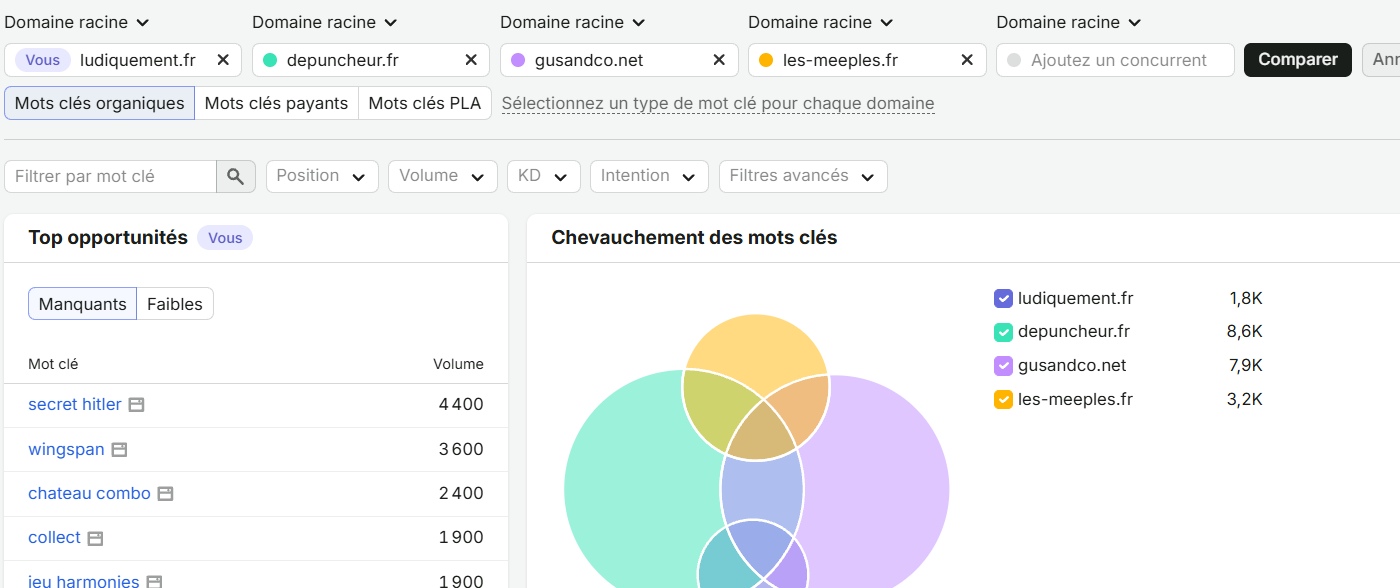
The “missing” keywords are the useful part: Secret Hitler (4,400 searches per month), Wingspan (3,600), Château Combo (2,400), Harmonies (1,900). But Ludiquement has already published a review of Château Combo and one of Harmonies. Either those pages do not show up for these queries, or Semrush’s database does not see them, and the tool alone cannot tell you which.
The “untapped” keywords, sorted by volume, are unusable as they stand: “les compagnons du devoir”, “dragons catalans”, “ticket gagnant” or “tournoi des 6 nations U20” come up because one of the competitors happens to rank for them, in 57th or 88th position. You have to filter by position and by theme before you can pull a list of topics out of it.
AI visibility: a module that lacks credibility
The “AI Visibility” toolkit measures a domain’s presence in answers from ChatGPT, Gemini, Google’s AI Mode and AI Overviews. For Ludiquement: a score of 14 out of 100 (“low”), 12 mentions worldwide including 9 in France, 177 citations, 70 pages mentioned (data from November 12, 2026). Semrush picks the comparison competitors on its own (Board Game Arena, BoardGameGeek, Gus&Co, Ludovox) and lists 120 “promising” topics, the first one being “Regicide: definitions and king games”.
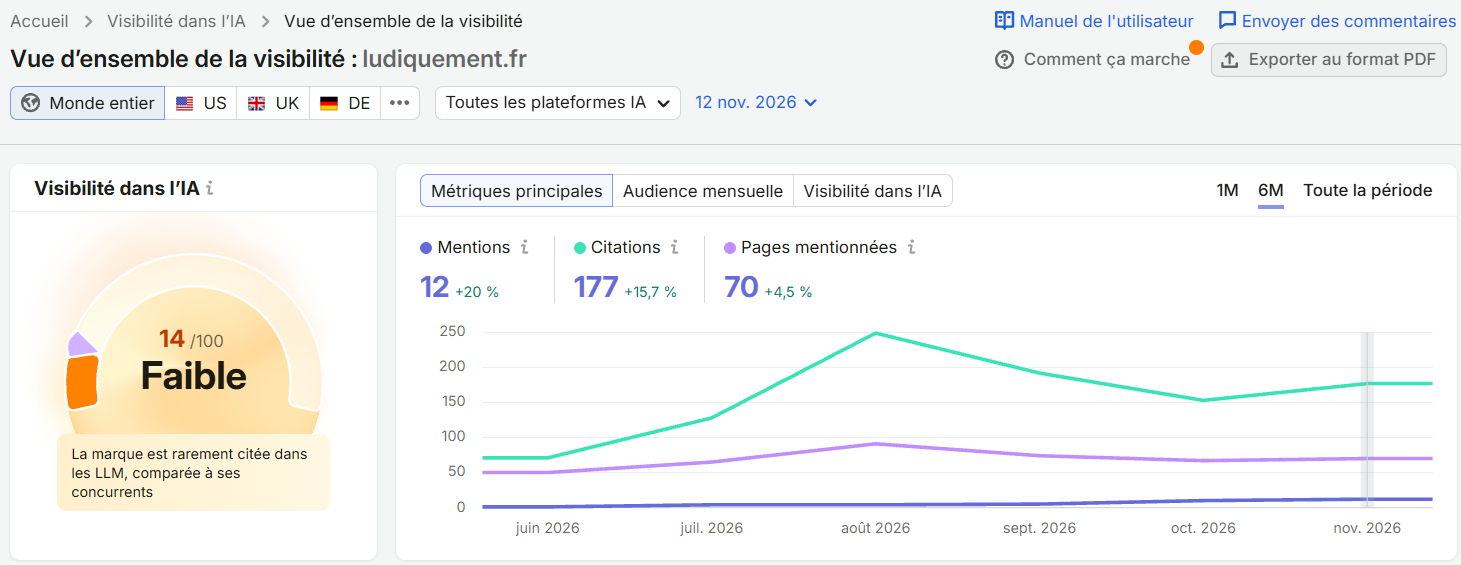
This is the module Semrush pushes hardest, and the one that convinced us least. Twelve mentions worldwide is too few to draw anything from, and the score of 14 out of 100 does not say which sample of questions it is calculated on. The competitors are imposed, and the first “promising topic” suggested, definitions of the word regicide, has nothing to do with the game reviews that drive the site’s traffic.
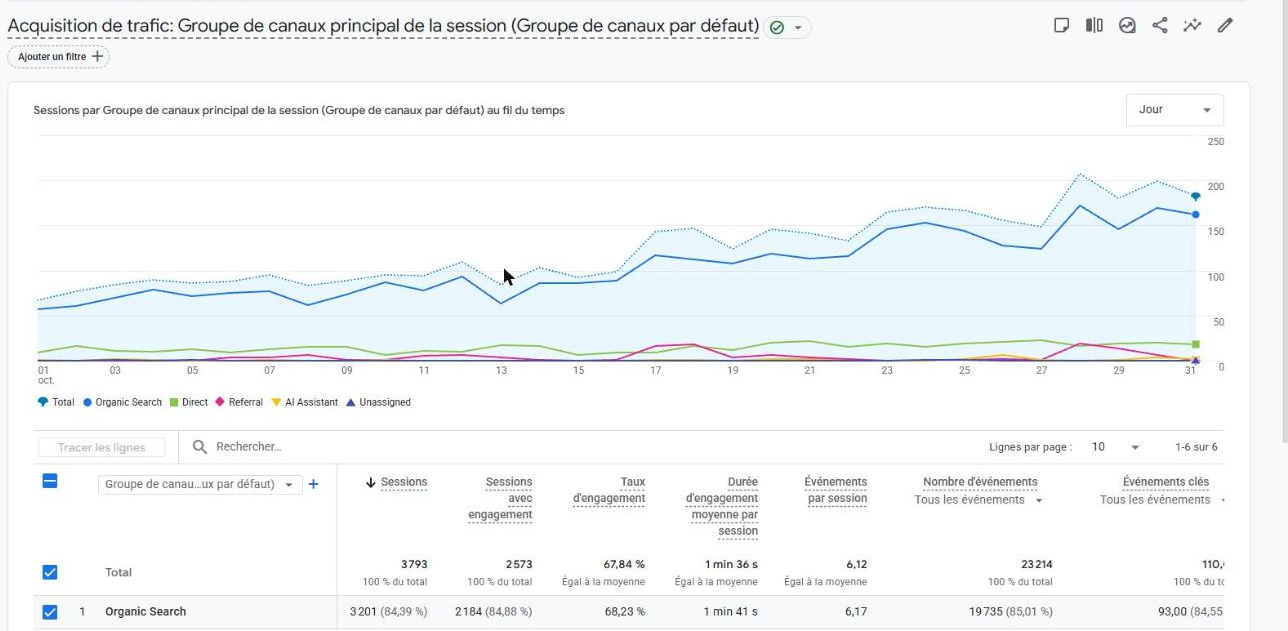
The order of magnitude is not wrong: GA4 counts 28 sessions from AI assistants in October 2026 (0.7% of the total), Semrush reports 1% AI traffic. But on volumes this low, the match does not prove much. As it stands, this module is for showing a client a dashboard, not for deciding on an action.
Traffic and market: estimated visits
The “Traffic & Market” toolkit estimates a site’s total traffic, all sources combined. For Ludiquement in October 2026: 6.6k visits, 6k unique visitors, 1.2 pages per visit, 2 min 21 s per visit and a 92.59% bounce rate, with 95% of traffic coming from France and 58% from mobile. Over six months, the curve hovers around 8k visits, with a dip to 6k in August.
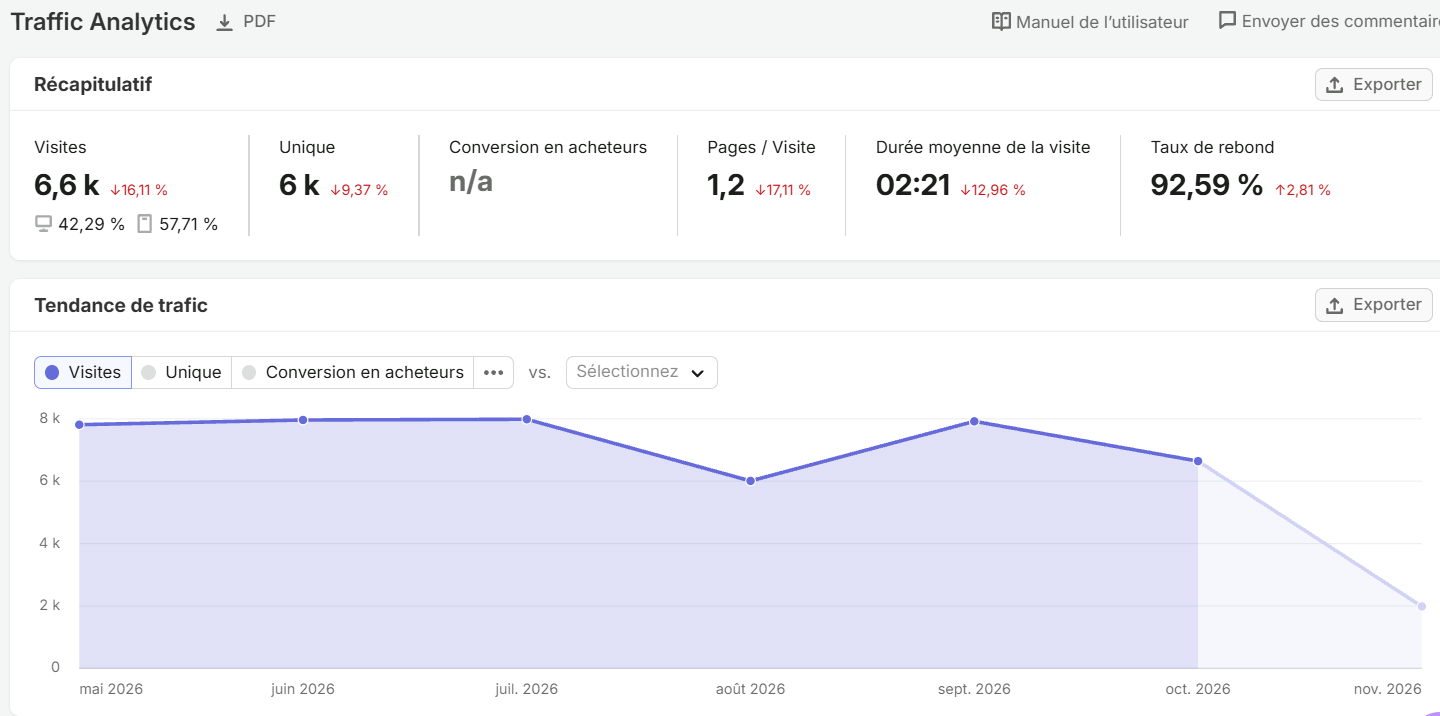
The most interesting reports (pages, traffic anomalies) are locked: you have to buy the “Traffic & Market Pro” add-on, $289 per month on top of the subscription, billed $1,264.48 on the day of purchase on our account.
Semrush against Ludiquement’s real data
Semrush does not see the Search Console of a site it analyzes from the outside: it estimates. Its rankings come from its own checks on Google, its traffic from a click-through rate applied to its search volumes. We compared these estimates with Ludiquement’s real data, on four fronts.
Organic traffic, month by month. We added up Semrush’s “desktop” and “mobile” databases for France, and compared the total with the number of Google clicks in Search Console. Search Console also counts other countries, which account for about 5% of Ludiquement’s visits.
| Month | Semrush (desktop + mobile) | Real clicks (Search Console) | Gap |
|---|---|---|---|
| November 2025 | 4,173 | 10,167 | -59% |
| July 2026 | 5,225 | 4,775 | +9% |
| September 2026 | 3,312 | 2,505 | +32% |
| October 2026 | 3,025 | 5,288 | -43% |
The gap flips sign from one month to the next. Worse, the trend is wrong: Semrush puts the year’s peak in July 2026 when real traffic had been falling since winter, misses the September drop (84 clicks per day, the low point of the year) and misses the October recovery. To follow how your own site is doing, Search Console remains the only reliable source.
Rankings and traffic by query. Comparison over the four weeks from October 12 to November 8, 2026:
| Query | Semrush: position, visits/month | Search Console: average position, clicks over 4 weeks |
|---|---|---|
| jeux de société à 2 | 1, 237 visits | not in the top 1,000 queries |
| greylune avis | absent | 1.7, 102 clicks |
| neoludis | 3, 28 visits | 3.5, 89 clicks |
| dice throne adventures | 3, 16 visits | 5.2, 58 clicks |
| clank catacombes | 6, 16 visits | 8.7, 35 clicks |
| sweet lands | 6, 17 visits | 6.6, 25 clicks |
| gloomhaven boutons et bestioles | 2, 42 visits | 5.8, 31 clicks |
On game names, the long tail that makes up most of Ludiquement’s traffic, Semrush’s rankings are often within two or three places. Traffic, on the other hand, is badly distributed: underestimated on the queries that work, overestimated on the most generic one. And that is where the biggest error of the test lies: the query Semrush presents as the site’s top traffic source, “jeux de société à 2”, brings in almost nothing. Its variants top out around 22nd position in Search Console.
Pages. Semrush ranks the best 2-player games page as the site’s top page, 256 visits per month, in position 1. In Search Console, this page got 80 clicks in four weeks, at an average position of 27.8: it is precisely the page that has dropped the most in a year. Conversely, the three pages that bring in the most real clicks (the Greylune review, 439 clicks, the top games of 2026, 280, the Cluedo alternatives, 275) do not appear in Semrush’s top pages. Someone running Ludiquement off this report alone would be working on the wrong pages.
Total traffic. For October 2026, GA4 counts 3,793 sessions, 2,539 users and 2.1 page views per session. Semrush reports 6.6k visits, 6k unique visitors and 1.2 pages per visit. GA4 undercounts, since it only measures after cookie consent, and Search Console alone already shows 5,288 Google clicks for the month. So Semrush’s order of magnitude is not absurd. The rest does not hold up: the 92.59% bounce rate contradicts the 67.8% of engaged sessions measured by GA4, and the share of direct traffic (22% in Semrush, 12% in GA4) is nearly twice too high.
Our take: Semrush is reliable for comparing sites with each other and for spotting which queries a competitor ranks for. It does not replace your own site’s data, and its traffic figures should never be the basis for client reporting or a valuation.
Site audit: hundreds of errors that are not errors
The technical audit goes through a “project”, and the Pro plan only allows five. The account was already tracking five: when we tried to create one, Semrush replied “You have reached the limit of sites that can be monitored” and offered to “upgrade to the Pro+ plan”, a name that does not appear on the pricing page, where the next tier is called Guru. We had to delete a project to audit Ludiquement. For an agency, the limit hits at the fifth client.
Setup fits on one screen (page limit, frequency, mobile or desktop crawler). The crawl took about two hours for 691 pages, on November 13, 2026. The result is alarming: site health at 76%, 2,388 errors, 999 warnings, and 372 “broken” pages out of 691.
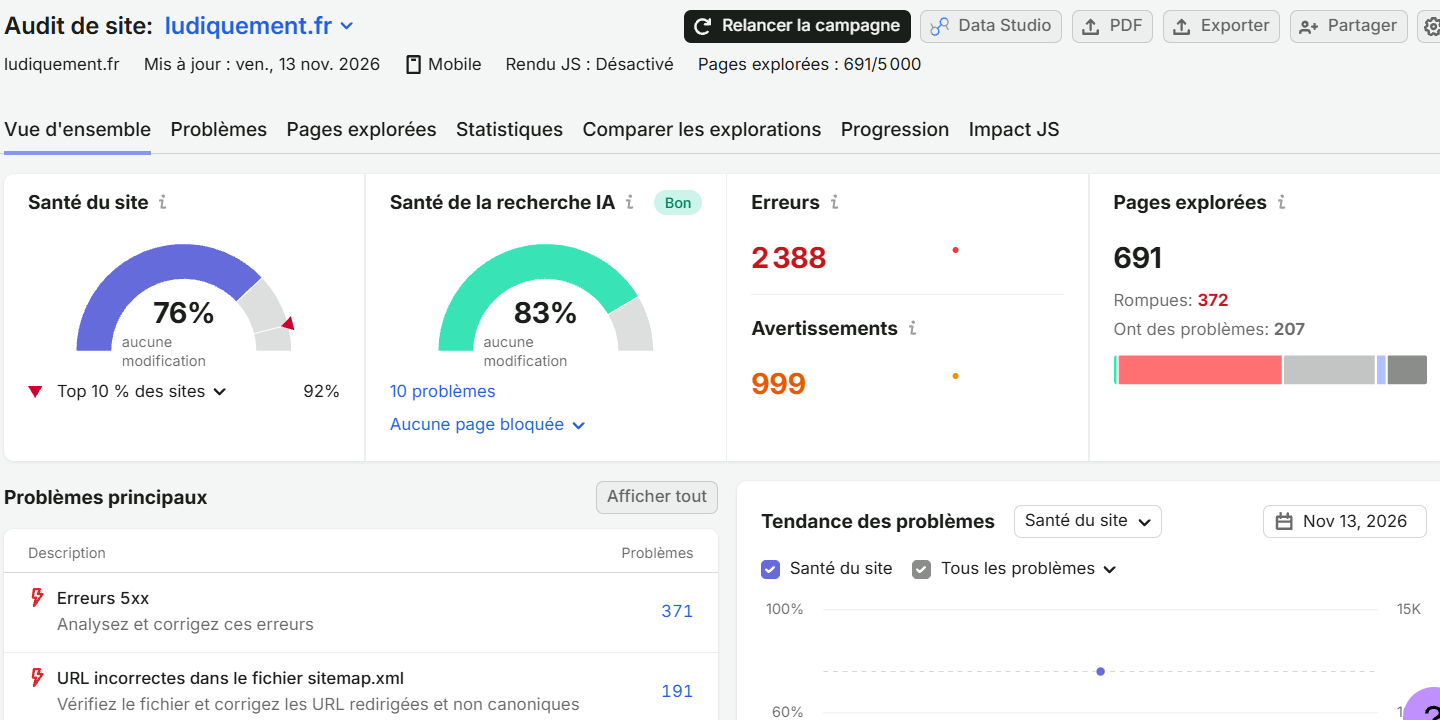
The main errors: 975 broken internal images, 803 broken internal links, 371 pages returning a 503 error and 191 incorrect URLs in the sitemap.
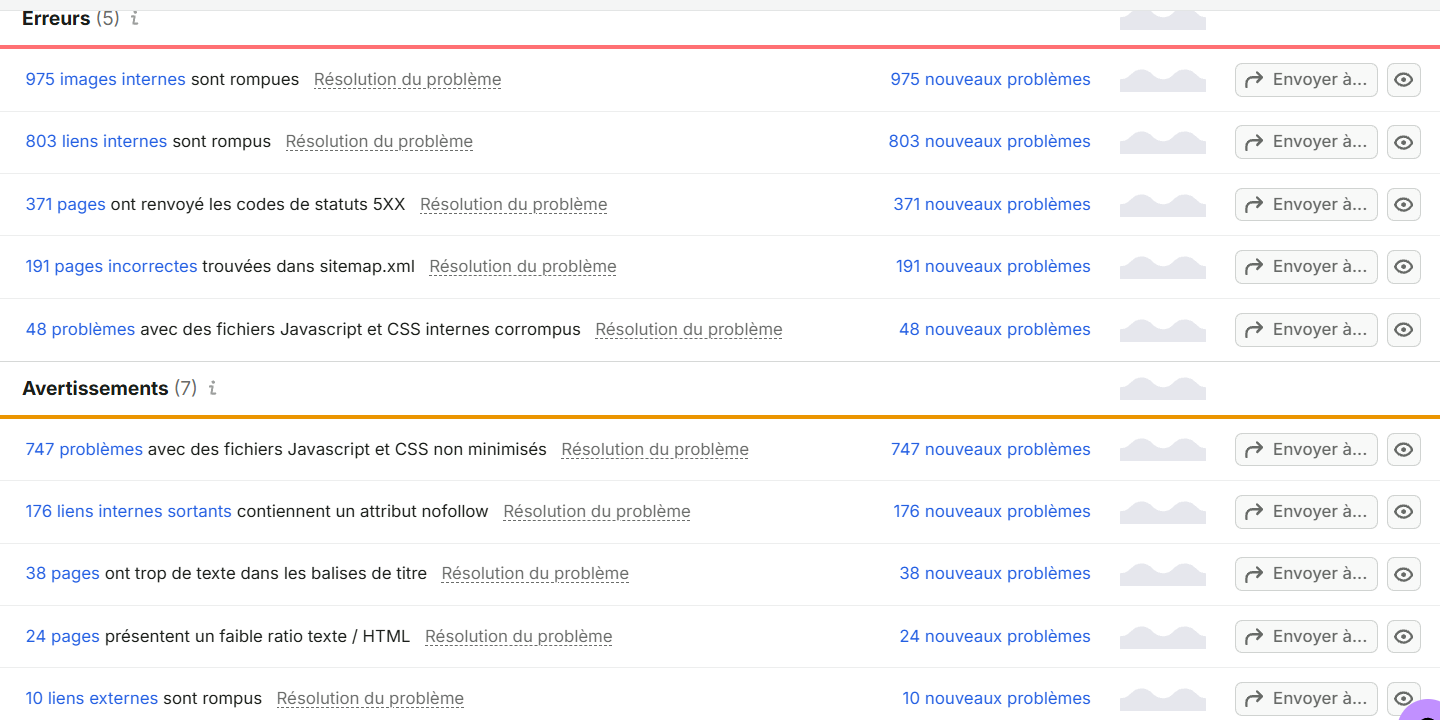
We checked. The pages flagged as 503, including the Cluedo alternatives, one of the pages that bring the site the most clicks, respond normally, even when we identify ourselves as Semrush’s bot. So do the ranking pages the audit reports as broken in the sitemap, as well as a sample of 40 other sitemap URLs. The errors appeared during the crawl itself: Ludiquement’s shared hosting sent 503s back to the bot, probably because it could not keep up, and a good share of the “broken” images and links likely comes from there.
Semrush makes no distinction: these temporary refusals are presented as 371 pages down, at the same alert level as a real server error. To get a usable audit on small hosting, you have to slow the crawler down in the crawl settings and run it again, something the tool does not suggest on its own.
The rest of the list is more useful, but standard: 20 permanent redirects, 79 orphan pages in the sitemaps, 38 titles that are too long, 176 nofollow internal links. The audit also adds an “AI search health” score of 83% (“good”) whose main complaint is the lack of an llms.txt file, a format that is still experimental.
The rest of the suite: many modules, often gimmicks
Semrush is no longer just about SEO. The left sidebar lines up ten toolkits: SEO, AI, Traffic & Market, Local, Content, Advertising, AI PR, Social, Reports and Apps. On paper, all of marketing fits in one tab. In practice, most of these modules are showcases that lead to yet another subscription.
- Content: AI article generation, content optimization and repurposing. It is a separate subscription, $60 per month after a seven-day trial, and its home page stays in English even when the interface is set to another language.
- AI PR: find the media that AI tools cite, find journalists and send them AI-written emails, “no PR experience needed”. A PR tool grafted onto an SEO suite, and English-only as well.
- Social: post scheduling on Instagram, Facebook, X, Pinterest, LinkedIn and Google Business Profile, which dedicated publishing tools already do.
- Apps: a store of third-party apps, paid on top of the subscription. CallRail at $125 per month, SERP Gap Analyzer and Exploding Topics at $99, Influencer Analytics at $249, AdClarity at $298, LLM Gap Analyzer at $49.
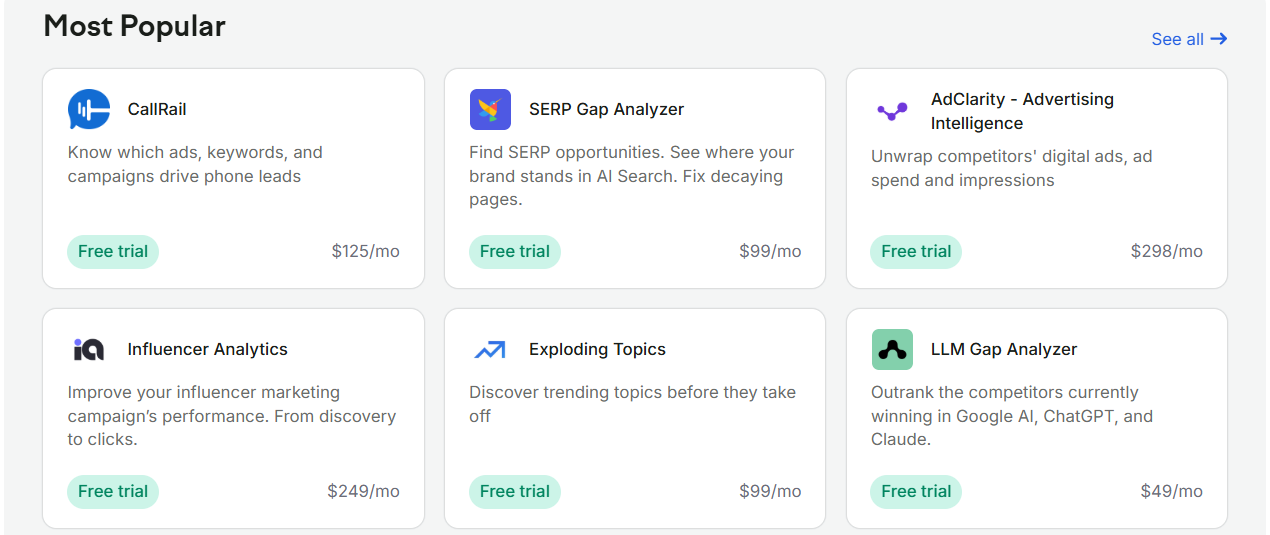
These modules do not get in the way of the SEO core, but they clutter the interface and spread the budget thin. What justifies the subscription is backlinks, keywords and competitive analysis. The rest is optional.
Semrush pricing
Prices recorded on November 12, 2026 on the “Classic SEO” toolkit page, excluding tax:
| Plan | Monthly | Annual (per month) | Monitored sites |
|---|---|---|---|
| Pro | €134.21 | €112.52 | 5 |
| Guru | €239.70 | €199.79 | 15 |
| Business | on quote | on quote | 40 and more |
The entry price hides add-ons sold separately: “Traffic & Market Pro” at $289 per month, and the Content, Local or AI Visibility toolkits each have their own price list. Guru adds historical data, multi-device tracking and content tools. The Pro plan, on the other hand, gives access to Semrush’s MCP server, which lets you query its data from an AI assistant: that is how we retrieved the monthly history used in the comparison.