



- PLG is a strategy where the product is the main growth driver (acquisition, conversion, retention, expansion)
- It reduces customer acquisition cost (CAC) and speeds up sales cycles
- A short time-to-value is crucial: the user must see the value quickly
- Growth loops create organic viral growth
- Aligning every team around the product is indispensable
- The model requires 12-18 months of transformation for established companies
- PLG does not eliminate salespeople but transforms their role
The SaaS world has seen the rise of a new growth model that changes traditional sales approaches. Instead of relying on sales teams or massive marketing campaigns, companies like Calendly, Figma and Typeform have made the product their main driver of acquisition and growth. This approach, called Product-Led Growth (PLG), is changing the way companies win their market. The product becomes the company’s first salesperson, through adoption that happens naturally, without sales pressure.
Product-led growth: what it is and why it matters
Digital transformation has profoundly changed what B2B buyers expect. They want to test, understand and adopt solutions at their own pace, without being pushed by a salesperson. This shift gave rise to Product-Led Growth, an approach that puts the product back at the center of the growth strategy.
Defining PLG
Product-Led Growth is a business strategy where the product becomes the company’s main growth driver. This approach changes the traditional phases of commercial development (acquisition, conversion, retention and expansion). In this model, every interaction with the product turns the user into a potential advocate.
PLG is fundamentally different from sales-led or marketing-led growth. Where traditional strategies rely on sales teams or advertising campaigns to attract customers, PLG relies on direct experience of the product. Users discover the value by themselves, with no intermediary. This end-user-centric approach uses the free trial as its main adoption vector. Freemium or a free trial lets prospects test the product without an immediate financial commitment.
Historical origin and adoption
The term Product-Led Growth was popularized by Wes Bush in his book (The Product-Led Playbook), which has become a reference for SaaS companies. Companies like Slack and Dropbox (the best-known examples) showed the strength of this model by reaching record valuations without massive sales teams. Their success inspired a new generation of companies that adopted the approach.
The shift of go-to-market strategies toward self-guided experiences marks a deep change in user expectations. Today’s buyers would rather test a product than sit through a sales demo. This change pushed many companies to rethink their distribution model and growth strategy.
Understanding how PLG works
To fully grasp the mechanics of PLG, you need to look at how the product becomes self-sufficient in attracting, converting and retaining users. This self-sufficiency does not mean there are no support teams, but rather that resources are orchestrated differently.
How does the product become the growth lever?
In a PLG strategy, the product plays a central role at every stage of the customer journey. Acquisition happens naturally when users discover the product through recommendations or searches. Activation happens when they quickly experience the promised value. Retention improves because users make the product their own at their own pace. Expansion becomes organic when they invite their colleagues or move to a paid plan.
The importance of user experience and « time-to-value » cannot be underestimated in this model. Users must see the value of the product within minutes, not weeks. This requirement pushes product teams to build intuitive interfaces and optimized onboarding flows. The famous « wow moment » has to come quickly to turn a casual visitor into a regular user.
Aligning every team around the product transforms the whole organization. Marketing creates content to educate users. Salespeople step in only to support complex accounts. Support becomes proactive by anticipating needs. This cross-functional collaboration makes the product the company’s center of gravity.
The Salesdorado tipBe careful not to mix things up, though. PLG does not mean no salespeople. It is a product-based approach that aims to be more indirect in how it sells.
Real-world examples of PLG
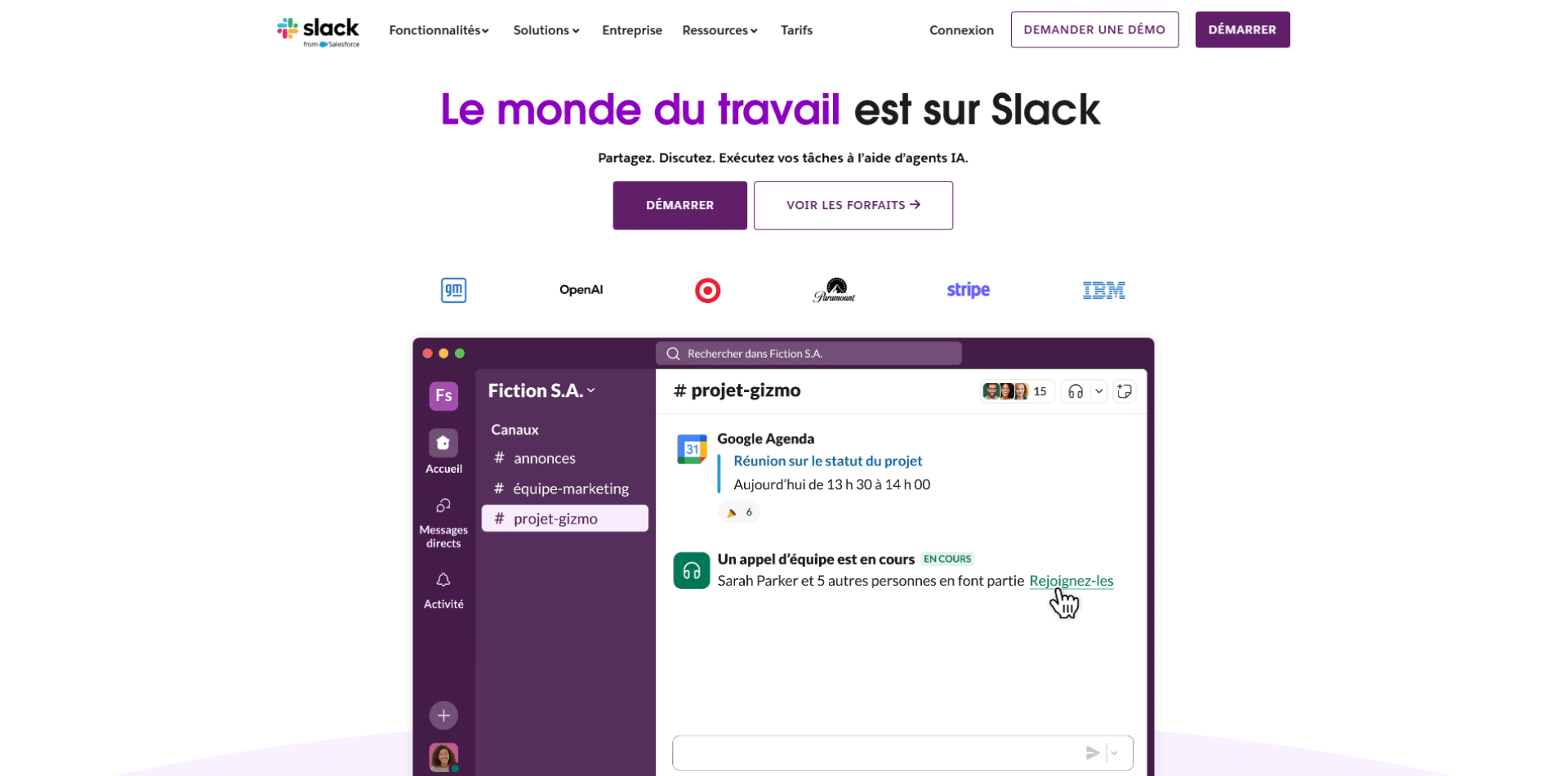
Slack is a textbook illustration of Product-Led Growth mechanics. An employee discovers the tool and creates a free workspace for their team. Adoption happens gradually, first a few colleagues, then an entire department. Internal virality sets in naturally. When usage reaches critical mass, moving to a paid subscription becomes obvious. This organic growth let Slack win millions of users without a traditional sales force. It is the flagship example on the market.
Other B2B SaaS products like Notion, Calendly and Zoom have also adopted this approach successfully. Notion lets you create collaborative workspaces for free. Calendly makes booking meetings frictionless. Zoom made video conferencing mainstream by making it intuitive to use. These examples show that PLG works across a range of sectors.
Benefits and use cases
Executives considering PLG rightly ask about the return on investment. Data from the companies that talk about it show impressive results that justify this strategic shift.
Benefits for the company
Lower customer acquisition cost (CAC) is the most obvious financial benefit of PLG. Product-led companies spend less on marketing and sales while attracting more users. The product generates its own demand, reducing the need for massive advertising spend. This efficiency shows up directly in the financial results.
Growth becomes more sustainable thanks to strong user retention. Customers who chose the product after testing it stay longer. They understand the value and have built it into their daily work. This natural loyalty creates predictable recurring revenue, which SaaS business models depend on.
A product that almost sells itself frees up resources for innovation. Instead of investing heavily in sales teams, companies can focus on continuously improving the product. This optimal allocation of resources creates a virtuous circle where a better product attracts more users, generating more revenue to fund development.
Limits and conditions for success
Dependence on product quality is the main risk of PLG. If the product does not deliver an exceptional experience, the whole strategy collapses. This quality requirement calls for significant investment in R&D and design. Companies must accept that the product becomes their absolute priority.
The cultural and organizational changes required are a major challenge. Moving from a sales-led to a product-led approach demands a deep transformation. Sales teams have to accept a new role. Marketing has to adopt an educational approach. This transition can take 12 to 18 months and trigger significant internal resistance.
How to implement PLG
Rolling out a PLG strategy requires a methodical, gradual approach. Companies that pull off this transformation usually follow a structured framework that minimizes risk while maximizing the chances of success.
The steps of an effective PLG strategy
Choosing a product entry point is the first strategic decision. Freemium gives unlimited access to a basic version. A free trial offers every feature for a limited period. An interactive demo guides the user without them creating an account. Each option has its advantages depending on the type of product and the target audience.
Defining the north star metric guides every product decision. This single metric measures the value created for users. For Slack, it is the number of messages sent. For Dropbox, the storage space used. This metric guides teams and aligns development efforts on what really matters.
Building growth loops (product growth loops) amplifies organic acquisition. These mechanisms built into the product create a snowball effect. Inviting colleagues on Slack, sharing files on Dropbox, sending money on Lydia are all loops that generate new users. These loops must feel natural and bring value to everyone involved.
Integrating PLG into the company
Aligning product, marketing, sales and support becomes crucial to PLG success. Product defines the experience. Marketing educates and attracts users. Salespeople support enterprise accounts. Support anticipates needs. This collaboration requires clear processes and constant communication between teams.
Adjusting the culture to put the user and the experience at the center changes the company’s DNA. Decisions are made based on their impact on the end user. Feedback becomes the main source of improvement. This customer-centric orientation has to be driven by leadership and embodied at every level of the organization.
Measuring success with clear indicators lets you keep optimizing the strategy. Activation measures how many users reach their « wow » moment. Retention tracks engagement over time. Expansion tracks upgrades and additional usage. These metrics should be tracked daily and shared with the whole organization.
The Salesdorado tipAdopting this strategy requires a strong analytics culture. There are many KPIs and they must be managed optimally. That means having a good tech stack in-house. Starting with a CRM.
PLG vs other models
Understanding the differences between PLG and traditional approaches helps companies choose the strategy that best fits their context. Each model has its strengths and weaknesses depending on the market, the product and the resources available.
- PLG vs sales-led growth: PLG relies on the product so the user experiences the value before buying. This bottom-up approach starts with individual users who adopt the product. Expansion happens naturally when these users become internal champions. The sales cycle shrinks drastically because the value has already been proven. Sales-led relies on sales teams to convert prospects. This top-down approach targets decision-makers with presentations and negotiations. The process can take several months, requires significant resources and generates high acquisition costs. This method remains relevant for complex solutions that need personalized support.
- PLG vs marketing-led growth: Marketing-led creates the need through campaigns and content. Marketing teams generate demand through ads, content and events. Leads are then handed to salespeople for conversion. This approach requires large marketing budgets and strong alignment between marketing and sales. PLG makes the product itself the best sales argument. Instead of promising value, the product demonstrates it immediately. Users become the best advocates, sharing their positive experience. This authenticity generates more organic and sustainable growth than any marketing campaign.
The questions we get over and over.
Do you need to be a startup to do PLG?
No, established companies can pivot to PLG tactics partially or gradually. Many traditional companies like HubSpot and Adobe have built PLG elements into their strategy. What matters is identifying the opportunities where the product can create value without human intervention. This transformation can start with one market segment or a specific feature before expanding.
Does PLG work without freemium or a trial?
Yes, but these approaches make adoption and virality much easier. Companies like Airtable and Miro offer limited free versions that let users discover the value. Others like Monday.com use generous free trials. What matters is reducing the friction between discovering the product and using it. Alternatives like interactive demos or sandboxes can also work depending on the context.
What budget should you plan for a PLG transformation?
The budget depends on your company's digital maturity and the complexity of your product. The main investments cover product development (UX improvements, onboarding automation), analytics and tracking tools, and team training. Plan for 6 to 18 months of transformation with gradual investments. ROI is usually measured after 12 to 24 months, with a significant reduction in CAC.
How do you convince sales teams that PLG makes sense?
Salespeople often fear that PLG will make them obsolete. The reality is different. Their role shifts toward higher-value missions. They focus on enterprise accounts, expanding existing customers and strategic support. Data show that PLG companies that keep a sales team for large accounts generate more revenue per customer. PLG qualifies leads better, letting salespeople focus on the most promising opportunities.
What are the main pitfalls to avoid in a PLG strategy?
The common mistakes are often the same. Neglecting user experience by thinking the product speaks for itself, underestimating the time needed for organizational change, blindly copying other companies' strategies without adapting them, dropping sales teams too quickly, and forgetting to measure the right metrics. PLG requires a long-term vision and continuous improvement based on user data.
Is PLG suited to complex B2B products?
Complex products can adopt a hybrid PLG approach. The idea is to identify the simple use cases that can be self-serve and create product-led entry points for those scenarios. For example, complex automation software can offer ready-to-use templates on a freemium basis. Once the user sees the value, sales teams can step in for more sophisticated needs. This "land and expand" approach combines the advantages of PLG and sales-led.


What the community says.