



- A negotiation follows five stages: preparation, framework, discussion of positions, compromise, implementation of the agreement.
- The ATROCE method structures the preparation: stakeholders, grounds, balance of power, objectives, confrontation of objectives, stages.
- The GRID classifies stakeholders as users, decision-makers, advisors or influencers, and gatekeepers, scored on influence, preference and proximity.
- Each party’s BATNA lets you map out the ZOPA, the zone where an agreement is possible.
- With no ZOPA, or with price as the only ground, the negotiation is off to a bad start.
Negotiation is part of everyday life, but in your professional life it can become a real art. And like any art, sales negotiation relies on techniques and calls for some preparation upfront.
What are the stages of a negotiation? How do you negotiate well? How do you prepare a negotiation? How do you build a negotiation plan? How do you qualify a negotiation?
This article is a complete guide to help you prepare your negotiations with a clear head: identify the stakeholders, define the negotiation ground and your goals, anticipate the points of confrontation and the possible limits, then implement and close out the result.
What are the main stages of a negotiation?
Before getting into the hard part, plan every stage of the negotiation so you can anticipate the issues specific to each one.

1. Prepare the negotiation
Before starting the negotiation, ask yourself a few questions:
- What is the context of this negotiation?
- Who are the people involved and how do they perceive the negotiation?
- If there is a conflict, what kind of conflict is it?
Also, before any negotiation, you need to set the date and place of a meeting to discuss the matter: if possible, pick a date soon so the preliminary points get cleared up quickly.
Draw up the list of people who will attend and make sure they all know the facts so they can clarify their position.
Finally, assess their negotiation goals: what are they likely to ask for?
2. Define the negotiation framework
Define the ground rules and procedures of the negotiation with the other parties (and you may well end up negotiating over those rules too!)
- Where will it take place?
- Are there any time constraints?
- Which issues will the negotiations be limited to?
- What procedure do you follow if you reach a deadlock?
This is also when the parties can exchange their first proposals or demands.
3. Discuss and back up each side’s position
Once they have exchanged their initial positions, both parties explain, amplify, clarify, reinforce and justify their initial demands.
But this isn’t necessarily a confrontation! It’s rather a chance to tell the other party how you see things, and to understand how they see them. It’s also when each party can ask the other for documents to back up its position.
4. Reconcile & find a compromise
The very essence of the negotiation process lies in the concessions you make to try to reach an agreement, a good deal. This is where both parties make concessions to come to an agreement.
5. Implement & close out
The final stage of the negotiation process is to formalize the agreement that has been worked out and to develop the procedures needed to carry it out and follow it up.
For major negotiations, the details will have to be set out in a formal contract.
In short, all five stages of the negotiation process have to be negotiated to decide how to share out limited resources while protecting everyone’s interests. Being well prepared also makes you more confident, so you can then apply our sales negotiation techniques and make sure you win the negotiation.
Preparing a negotiation properly: the ATROCE method

Don’t judge it by its acronym: the ATROCE method simply helps you prepare your sales negotiation methods by following a precise process (each letter stands for a French word, given in brackets):
- Stakeholders (Acteurs): who are the stakeholders?
- Grounds (Terrains): what grounds does the negotiation cover?
- Balance of power (Rapport de force): is it balanced between the parties?
- Objectives (Objectifs): what are your objectives and what are the other parties’ objectives?
- Confrontation of objectives (Confrontation): are they compatible?
- Stages (Étapes): have you planned every stage, from the opening to the conclusion? What incidents could happen?
1. Identify the stakeholders in the negotiation
List all the stakeholders in the negotiation
First of all, think (alone or with your team) about everyone who could be involved in the negotiation:
- Do we need to bring in third parties (agents, lawyers, mediators, interpreters)?
- Who should be on my negotiation team? Who should be our spokesperson? What are the specific responsibilities of each team member?
- What authority do I have (or does our team have) to make firm commitments?
- Which parties are not yet part of the negotiation but could also welcome an agreement?
Categorize the stakeholders in the negotiation
Once you have listed all the stakeholders, it pays to categorize them. To do this, you can use the GRID, or Groupe réel d’influence et de décision (actual influence and decision group): a matrix for categorizing the different stakeholders in a negotiation. It is made up of the following elements:
- Users: they are directly affected by the negotiation.
- Decision-makers: unsurprisingly, they are the ones who make the final decision.
- Advisors (inside the company) or Influencers (outside): they influence the decision.
- Gatekeepers: they officially have no stake in the decision, but they can speed it up or slow it down.
Watch outOne person can hold several roles in the decision process.
To refine your analysis of the stakeholders, you can score them on objective criteria of influence (weight), preference and proximity. The idea is to run a quantitative analysis with measurable sub-goals, so you can move a given stakeholder’s indicator up.
- Influence (weight): this means assessing a stakeholder’s weight in the decision, from 1 (little influence but can pass on or block information) to 5 (sits on the decision committee, often the CEO)
- Preference: here you score whether the stakeholders support you or not, from -2 (the person is very unfavorable to you or favors your competitor) to 2 (very favorable), with 0 in between (neutral).
- Proximity: score a stakeholder’s proximity from 0 to 3: is it easy to meet them? Do they share a lot of information with you on the different stakes of the negotiation?
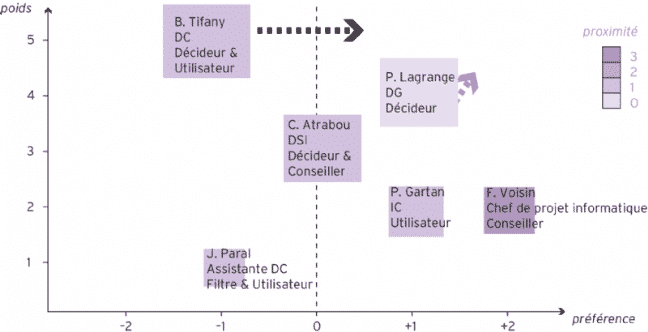
In this example, François Voisin, a new IT project manager, has been won over by a CRM software he wants to buy for his company. The sales engineer, a User here, Philippe Gartan, who attended the demo, was won over too.
The CEO, Pierre Lagrange, is rather favorable because of the reputation of the CRM software vendor. He carries a lot of weight in a decision that affects how sales are organized and represents a sensitive budget.
How do you make use of what you know about the stakeholders?
Once you have identified and assessed all the stakeholders in the GRID, the idea is to maximize your chances of winning at a given moment: to do so, the goal is to raise the product preference score x weight score.
You try, in this order:
- To increase the preference of people with high proximity
- To increase the proximity of people with strong influence
- In extreme cases, to reduce the influence of people who are first and foremost detractors, and very distant.
2. Define the grounds
The idea here is to define the “variables” of the negotiation. What is up for discussion in the negotiation? And conversely, what isn’t?
Grounds include, for example, price, lead time, financing method, scope, functional coverage, etc.
3. List the objectives
Once you are clear on the stakeholders and the grounds, steps 3 and 4 (listing the objectives and confronting them) consist of defining, for each ground:
- Your BATNA: BATNA stands for “Best Alternative to a Negotiated Agreement”, known in French as MESORE: “MEilleure SOlution de REchange/REpli”. It’s your fallback, in other words the best you can get if the other person refuses to negotiate with you. To go further, see the BATNA entry in our glossary of sales techniques.
- Your counterpart’s estimated BATNA: don’t forget to think about the other parties’ BATNA too. The principle is that a BATNA can be revealed to the other side without fear if it’s a good one.
- Your ideal objective
- Your counterpart’s estimated ideal objective
From the BATNA, you can work out the ZOPA (Zone of Possible Agreement): the range within which an agreement is possible.
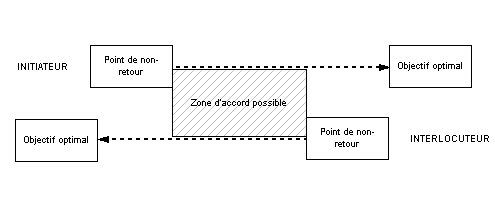
For example, on price (that’s the easy one):
- You won’t go below €20K
- Ideally, you’d like to sell at €50K
- You think your counterpart won’t go beyond €40K, the amount they currently spend on this problem.
- Your counterpart has told you their budget is €32K
- The ZOPA lies between €20K & €40K.
Naturally, the BATNA for each item depends on the other items: with such a significant price gap, you’re not selling the same thing.
The exercise only sets the limits of the negotiation framework, it doesn’t propose solutions yet. Those should emerge fairly naturally, but you need to test each of your assumptions against reality before bringing the negotiation grounds together into a proposal.
First take the time to estimate your objectives & BATNA for each ground.
4. Confronting the objectives
The word confrontation is a bit unfortunate here, since you’re still hoping that most of the objectives point in the same direction.
The idea here is to refine your understanding of your counterpart’s BATNA. The goal is:
- To identify the points that are non-negotiable or hard to negotiate.
- To spot the zones where an agreement is possible.
These two elements will guide you when you want to bring the different negotiation grounds together into one proposal.
Salesdorado’s tipThe more precisely you know your counterpart’s position on each point, the more effective and accurate your estimates will be, and so your proposals too. The sales discovery plan is fundamental to a successful negotiation.
5. The stages of the negotiation
Now the aim is to define precisely how the negotiation will unfold.
- Where and when should the negotiation take place?
- Who will be there?
- How long should the negotiations last? What deadlines must be met?
- How? Will the negotiation take place in person, or will some exchanges happen by email, video conference, etc.?
- In what order should I tackle the different parts of the other party?
- Who are my competitors for this deal? How do our relative strengths and weaknesses compare?
Still, here are a few tips: to keep a negotiation simple, try to limit the number of people in the room, even if it means calling in an outsider at some point if things get stuck.
Make sure the members of your team (or everyone defending your interests) know each other: trust is key, so encourage your “teammates” to meet in neutral settings (restaurants, bars). Depending on what’s at stake in the negotiation, you can organize exercises and simulations to build that trust.
Don’t hesitate to work on that trust with your opponents as well, by getting acquainted just beforehand.
The venue matters a lot: if you feel you’re in a weak position, hold the negotiation on your own premises, where you’ll be more at ease. Once you have gained some negotiation experience, you can ask for it to take place on your opponent’s premises and use what starts out as a weakness as an argument to negotiate major objectives.
Salesdorado’s tipSome practical advice, finally: propose an agenda and try to stick to it. Attach times to it, and don’t hesitate to hang a clock on the wall, in plain sight.
How do you qualify a negotiation?

The ATROCE method also lets you qualify a negotiation quite precisely. At each stage, you can question the potential & the future of the negotiation:
- Stakeholders: if everyone hates you, you’re off to a bad start.
- Grounds: if price is your only negotiation ground, finding a satisfying balance is likely to be quite tough. Conversely, if you can negotiate on 30 different points, you’re getting into a very complex negotiation. And complexity has a cost.
- Objectives: this is what will let you decide whether the negotiation is worth what it costs.
- Confrontation: you should manage to draw a ZOPA, a zone of possible agreement. If there isn’t one, things are off to a very bad start…
- Stages: be careful not to overlook what are often seen as operational details. If you have to travel to New Zealand every week for 5 months, you’ll most likely struggle to see the negotiation through.
Go furtherHere is a series of articles to help make your negotiations a success:
The questions we get over and over.
What is the ATROCE method?
A six-point approach to preparing a negotiation: Stakeholders, Grounds, Balance of power, Objectives, Confrontation of objectives and Stages (Acteurs, Terrains, Rapport de force, Objectifs, Confrontation, Étapes in French). It is also used to qualify a negotiation.
What is the GRID in negotiation?
The Groupe réel d’influence et de décision (actual influence and decision group) is a matrix that classifies stakeholders as users, decision-makers, advisors or influencers, and gatekeepers. Each one is scored on influence (1 to 5), preference (-2 to 2) and proximity (0 to 3).
What is the difference between BATNA and ZOPA?
The BATNA is your best fallback option if the negotiation fails. The ZOPA, zone of possible agreement, is worked out from both parties’ BATNAs: it is the range within which an agreement can be reached.
Where should you hold a negotiation?
If you feel you are in a weak position, on your own premises, where you will be more at ease. With experience, negotiating on the other party’s premises can become an argument to win concessions.

What the community says.