



- A discovery plan is not a list of questions to run through mechanically: the best salespeople ask their questions throughout the call.
- The FARP method pins down the customer’s context, the SONCAS method their buying motivations.
- A prospect who doesn’t match your ideal profile: cut the call short.
- Rephrasing (echo, deduction, summary) gets the prospect to validate your analysis before you put together the offer.
- With a reluctant customer, bring high-value information: figures, social proof, comparison with the competition.
Looking to improve your sales techniques? You’re right to look into the sales discovery plan. It’s the key tool for turning prospects into customers.
But careful: a good discovery plan isn’t just a list of questions to run through mechanically. If you’re here, you know there’s real know-how to pick up before you can design a plan that works. And you’re right!
Too many salespeople go into their meetings with no clear framework, ask questions blindly and miss decisive information about the person they’re talking to. The result? Messy conversations, a poor grasp of needs, and deals that fall through.
In this article, we’ll break down together the secrets of a sales discovery plan that actually delivers. We’ll look at how to:
- Structure your discovery in 7 key steps.
- Ask the right questions at the right time (with concrete examples).
- Analyze your prospect’s answers to fine-tune your approach.
- Adapt your discovery plan to different types of buyers.
Whether you’re a seasoned salesperson or a founder just getting started in sales, you’ll find a complete method here for designing discovery plans built to boost your sales performance.
Find the right providerNeed to outsource your prospecting? Find the provider that matches your real needs.
Find a provider
What is a discovery plan? Definition
A discovery plan is a series of questions (some call it a script) designed to help your salespeople identify the information they need to make the right diagnosis and offer the prospect a fitting proposal.
When it’s well structured, the discovery plan lets you gather relevant information. That data helps sharpen your sales arguments. Your salespeople are then better prepared for the objections the buyer may raise.
The discovery call is the first call between your sales team & a prospect. Its first purpose is to qualify the prospect, but also to get as much information as possible for the rest of the sales process.
The discovery call is therefore one of the most important parts of your whole sales process. This call can decide whether the customer will buy your solution or not, and at what price.
The goals of a sales discovery plan
We’re often told that sales discovery is a key phase of the sales process. But why, exactly? Here are the main goals of a sales discovery plan (and of sales discovery in general):
- Understanding the prospect’s needs. That’s obvious, you’ll say. Yet you’d be surprised how many salespeople miss it. It’s not just a matter of asking “What are your needs?”. No, the point here is to dig, to unearth the needs the prospect isn’t even aware of. That’s where it gets interesting!
- Building trust. People don’t buy from just anyone, right? Sales discovery is your chance to show that you’re not just there to sell your product, but that you genuinely care about your prospect’s problems.
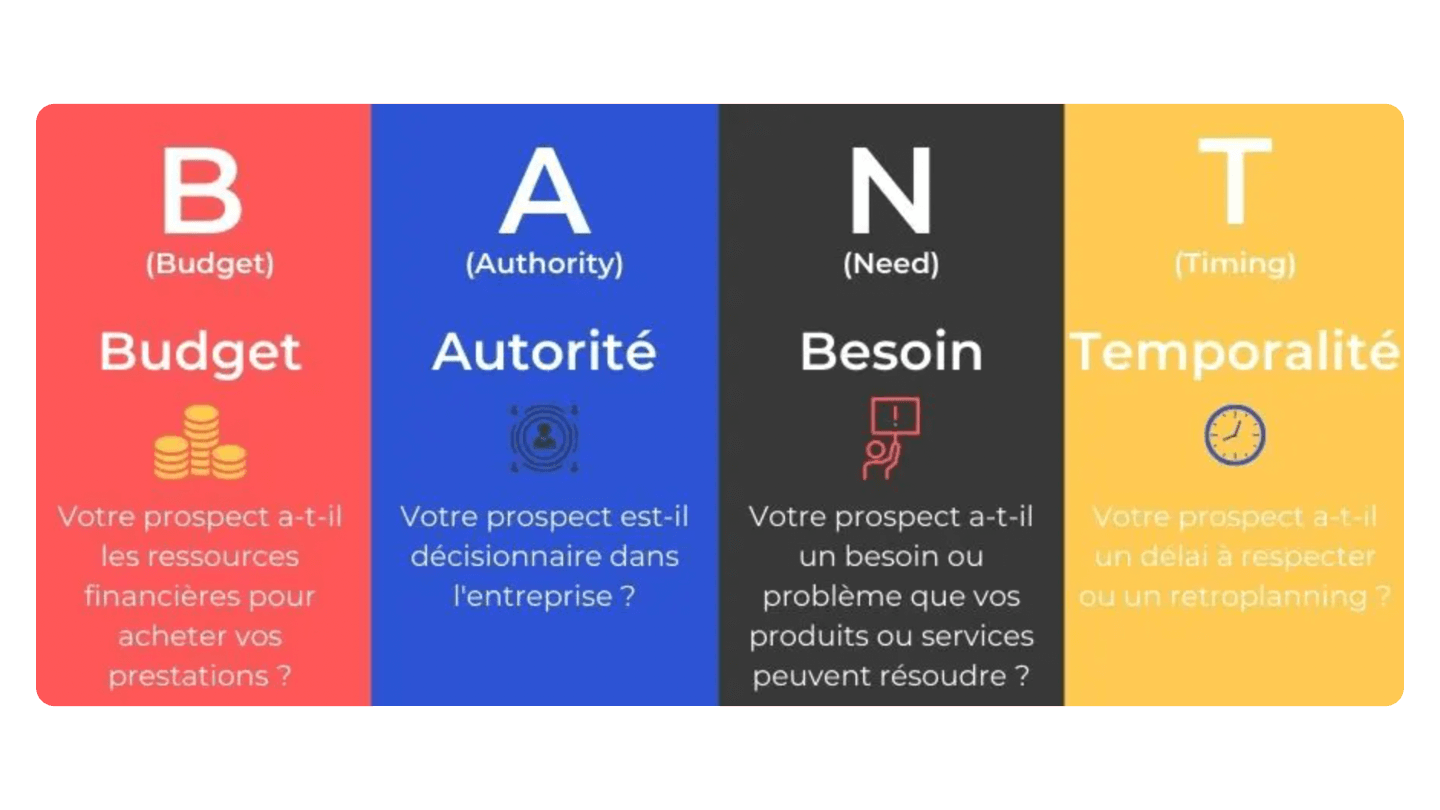
- Qualifying the prospect. Not all prospects are equal, that’s a fact. Sales discovery lets you separate the wheat from the chaff. Budget, authority, need, timing (BANT to those in the know): that’s what you need to assess. It will save you from wasting time on prospects who will never convert.
- Preparing your sales pitch. Picture this: you have all the information in hand to tailor a pitch that fits. That changes everything, doesn’t it? That’s exactly what good sales discovery gives you. No more generic pitches that speak to no one…
- Defining the next steps. A successful sales discovery always ends with a clear sales action plan. Whether it’s a demo, a proposal or another meeting, you need to know where you’re going. And so does your prospect!
In short, mastering sales discovery means going from being just a seller to being a real partner for your customers. And believe me, that changes everything in your sales approach!
Read alsoTop 40 sales best practices
Structuring the sales discovery plan in 7 steps
1. Prepare the call
You put plenty of inbound marketing processes and strategies in place to generate leads and get those first phone contacts. So you can’t afford to rush the preparation of these calls. That means doing thorough research before the call on the company and on the person you’ll speak to, to understand what’s at stake for your potential customer and whether that person has decision-making power or not.
To do this, your sales team should consider the questions below:
- What is the prospect’s industry and what is its value proposition?
- How big is the company?
- Who has decision-making power in the company?
Your salespeople can do some role-playing before going into the discovery call. It will help them build confidence and remember the points they want to cover once they’re actually on the line.

2. Qualify the prospect
The goal is to decide whether or not the customer matches your ideal profile. If they’re not qualified, it’s better to cut the call short quickly. Otherwise, it will cost you precious time you could use to close other deals.
To find out whether they match your ideal profile, ask the following questions:
- What will you use our solution for?
- What annual budget do you have for X?
- What is the process for X in your company?
- How much time have you spent on X?
- What impact does X have on your business?
There should be a limit to the questions you ask. Rank your questions by priority to better understand your customer. Follow a pattern. Ask a question, then wait for the answer. Follow up with a discussion, then ask another question. A successful discovery call must not feel like an interrogation!
Once you know the answers to the questions above, match them against your ideal customer profile. If they match, move on to the next steps; if not, it’s better to stop the process here.
3. Identify the customer’s context
Every prospect or customer needs a solution that meets a need. This is also called the customer’s problem. By the time they get in touch with your teams, the prospect has probably already done some research on the solutions likely to meet their immediate need.
So it’s important to look for this information through a discovery plan. Identifying the customer’s context helps you understand where their needs come from, and whether or not they want to shift their priorities.
To get a grip on the context, your teams should be able to answer some of these questions:
- What events could influence the prospect’s final decision?
- What actions have already been taken and what decisions have they made?
- What results have they seen?
- How does the prospect analyze their situation?
The FARP method
To identify the customer’s context, we recommend looking into the FARP method:
- Gather the Facts,
- the Actions taken,
- the Results achieved,
- and the Perception of the person you’re talking to (their opinion and feelings).
Salesdorado’s tipAdapt your questions and your pace to the “level” of the person you’re talking to: “C-level” buyers (CMO, COO,…) are more pressed for time. So they have much less patience. Use only 4 to 8 good open questions to uncover their business needs. Beyond that, success rates drop sharply.
4. Understand the customer’s needs
Researching and understanding your prospect’s needs lets you identify what they want to change or even improve. To make their decision easier, you and they both need to share the same analysis of their needs.
You need to know what the customer wants to achieve or improve. You also need to understand why that goal matters so much to them.
Your understanding will be complete once you have grasped and listed all of the customer’s needs, and ranked them.
Here are a few questions that may help:
Example questions:
“How do you handle the challenges of onboarding and ramping up new hires as your team grows?”
“To what extent is time an obstacle to coaching your reps more often?”
Get to the pain point fast
So far, you have planned the strategy, done your research and qualified your lead.
Now you talk about the real problem. Uncover the customer’s problems and pain. If you can’t, you need to dig further, then point out the minor problem they have and make them realize how big it can get if you don’t solve it. Use this step to position yourself as a “problem solver”.
At this point, understand the customer’s behavior, read their pain and respond by showing that you’re taking note of these pain points and that you have the answer to their problems. To succeed in your discovery calls, you need to give this call a human dimension, because you’ll have fewer chances to do so later: it’s your opportunity to build a connection with the buyer.

5. Uncover buying motivations
Behind every customer need, there’s a motivation. Your sales team’s goal is to find the prospect’s deeper motivation. That lets you offer a far more effective sales pitch.
This study of deeper motivation goes through a carefully run discovery plan. The more relevant information your teams gather that could trigger the purchase, the more your proposals match what the buyer expects.
Enriching the customer discovery plan, especially by taking notes, is key. You’ll come across as more professional and more involved with the prospect, while collecting high-value data.
The SONCAS method
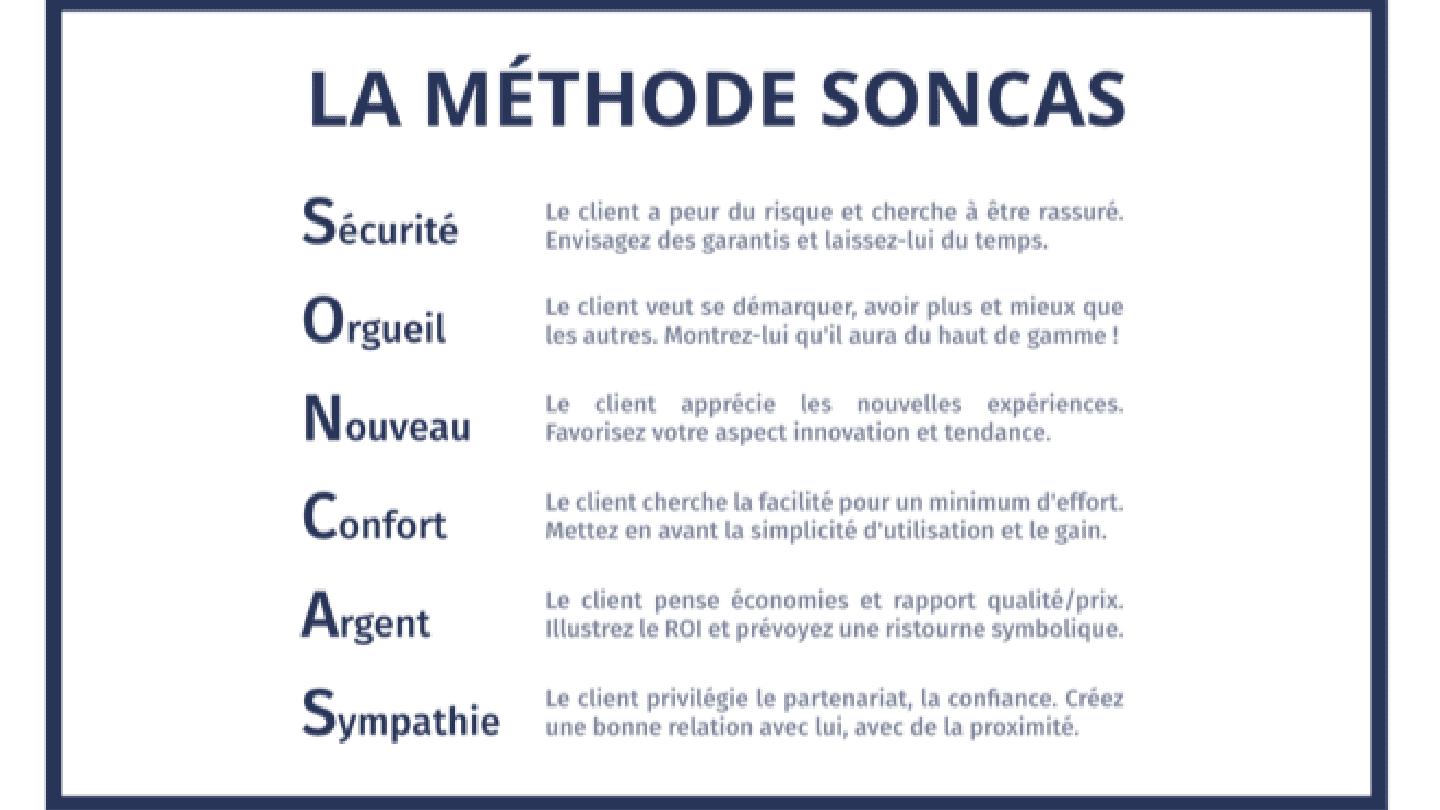
In sales, the SONCAS method (from the French Sécurité, Orgueil, Nouveauté, Confort, Argent, Sympathie: security, pride, novelty, comfort, money, sympathy) is simple to put in place. It consists of getting to know your prospect by asking them questions, to better understand their profile, their expectations and the reasons behind their purchase.
Salespeople then steer their pitch so that it comes close to the prospect’s ideal. Careful, though: other factors come into play, including the subconscious, which accounts for 90% of the decision.
Here are a few questions that can help you go in this direction:
Example questions:
“How much revenue per salesperson do you think you’re currently missing because of your onboarding time, which you consider two months too long?”
“If you could coach your reps more often, how many more deals do you think they would manage to close?”
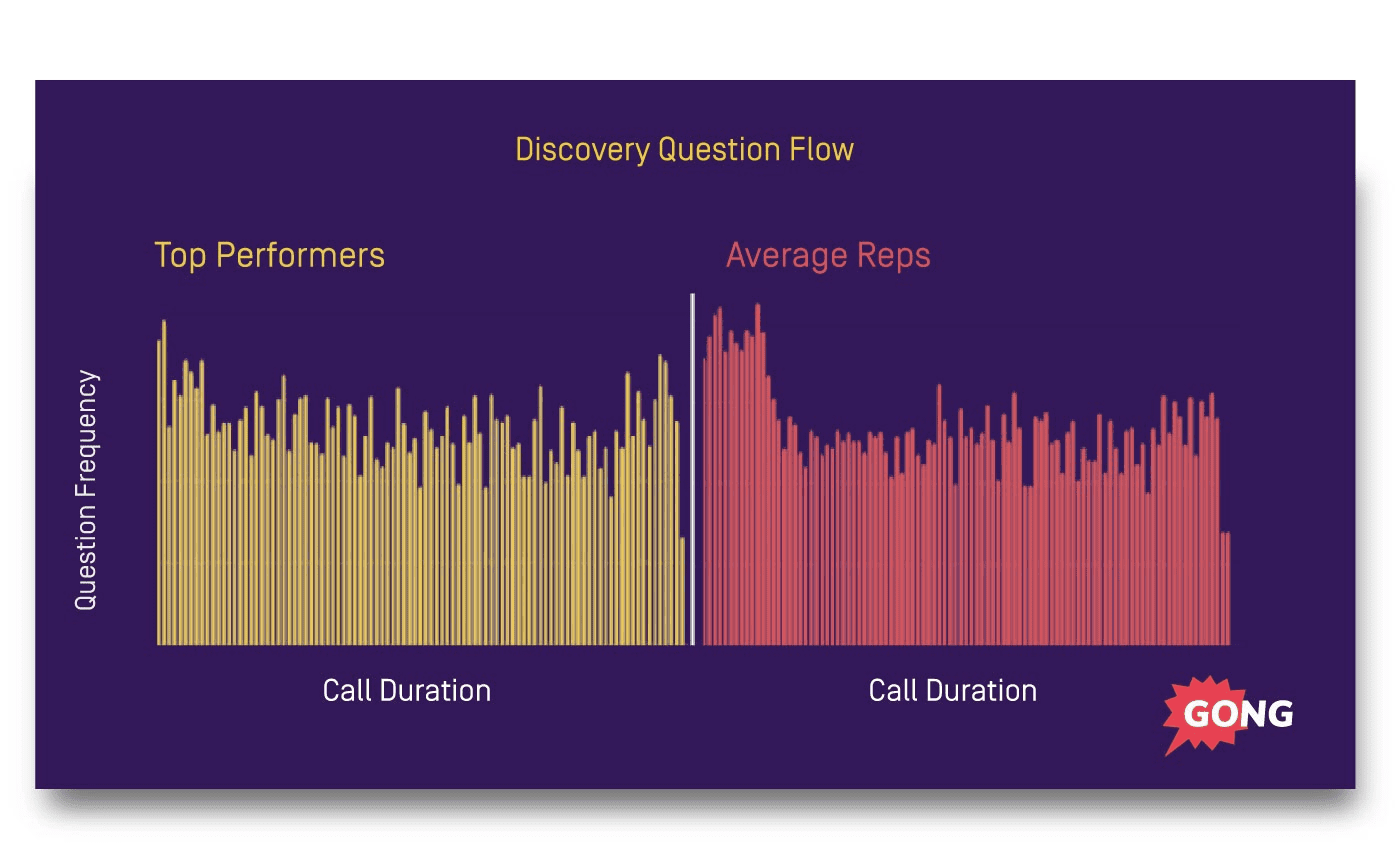
On the left-hand chart, you can see that the top-performing salespeople are those who ask a series of questions throughout the call. They don’t see the discovery plan as something “static”. In other words, they ask their questions as the conversation evolves.
On the right, you can see that “average” salespeople ask most of their questions in the first few minutes of the call. They don’t take into account how the conversation evolves. Very quickly, the number of topics and questions asked drops until it’s very low in the final moments of the call.
Salesdorado’s tipLimit the number of questions you ask here (between 11 and 14 questions). Too many questions make the conversation painful & difficult. Don’t front-load your questions at the start of a call. Listen, and adapt them to create a real dialogue.
Twist the knife
You have almost everything you need. You’ve uncovered the sensitive points, you’ve already researched their business model, and on top of that the customer is qualified.
Once you’ve uncovered the weak points, talk about them. Make the buyer understand that these are serious problems and that it’s important to address and solve them.
Use the questions below to intensify the buyer’s pain.
- How much revenue are you losing because of X?
- How does X improve Y and Z in your business?
- How many deals would you have closed as a result of this operation?
- What opportunities are you missing by not implementing X?
At this stage, your buyer already feels the need to use your solution.
This is the decision-making stage. Beyond this stage, you can no longer sell. Now let them decide what they want.
6. The pitch
Stirring empathy and emotion in the person you’re talking to through storytelling matters. Your prospects base part of their decision on the challenges faced by people with similar experiences, more than on what your salesperson thinks is good or bad for them.
That’s one of the reasons many companies offer case studies. These testimonials show how your offer or service has helped a company solve a problem.
Storytelling is an excellent alternative to pushy sales questions, which can block salespeople. To be ready, though, we recommend not improvising and preparing your approach by:
- Checking the account history in your CRM software
- Checking the recent activity of the company and of the person you’re talking to
- Spending a little time going through press articles and press releases to spot any important updates, initiatives, hires or changes.
- Using LinkedIn to identify your mutual connections and highlight them if needed.
These elements let you prepare in advance the story you could tell your prospect.
Salesdorado’s tipIf you manage to trigger emotion during this phase, name those emotions and help customers feel understood with phrases like: “it sounds like…”; “It seems that…” “it feels like…”
Picture the future
In this step, you build a vision for your customer. At this point in the discovery call, you want to talk about the future and have an open conversation about the results you can bring them with your solution.
Help them understand your product/service. Share the benefits your solution will bring them. Ask the questions below, which speak to the value and importance of the solution.
- How much money have you saved each quarter by solving problem X?
- What benefits have you gained from this solution?
- What steps do you need to take to help make this deal happen?
One of the important discussions at this stage is the customer testimonial. Talk about a similar user you’ve had and how you helped them reach their goal and go from X% to Y%. During this discussion, talk about the problems your other customers have faced and how you managed to help them.
7. Prepare the next steps
The goal of the discovery plan is to move the prospect through the funnel and close them. If your salesperson feels their first approach was a success, they need to sum up the reasons why the product or service seems useful to the prospect.
There are two ways to do this:
- The “hypothetical” close: this method lets you confirm to your prospect how you believe you can help them move toward their goals and meet the challenges identified during the call. The aim is to approach the subject in a tone that builds the buyer’s trust, without overselling your product.
- The “prospect buy-in” close: this method invites the prospect to tell you what challenges they have to meet, while asking you how to get there, for example by using your solutions.
The last important aspect of closing is involving other parties in the sales process. In practice, few salespeople do this. Many of them then miss the chance to shorten the sales funnel.
Never end a conversation on a cold note. Take a minute and go over the topics you covered in the previous steps. Sum it all up and check you haven’t missed anything important, because this will be your last chance.
Ask the buyer the following questions to close the sale.
- When would be a good time to get back in touch?
- How soon can you get back to us?
- Is there anything else we can do to help you?
What questions should you ask a customer during sales discovery?
1. Open questions: the QQOQCP method
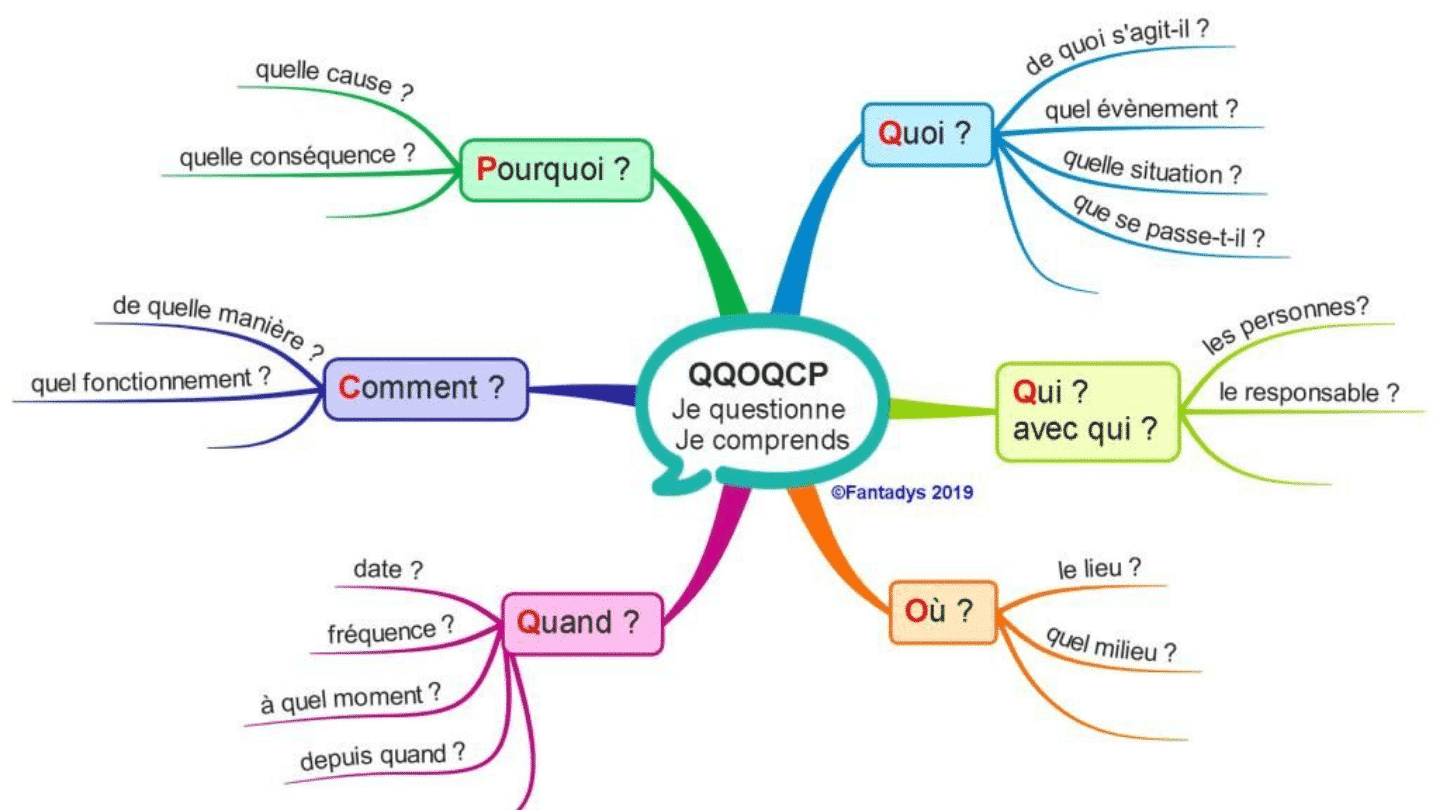
This method aims to define the circumstances of a situation through a series of questions (QQOQCP is the French equivalent of 5W1H: who, what, where, when, how, why). It helps you understand the situation as a whole. In a sales context, the seller can then find the solutions best suited to the prospects’ needs, after analyzing the data.
QQOQCP questions give the prospect the floor. They speak freely about their expectations, needs and motivations. They give structured answers that the salesperson then interprets.
Here are a few example questions:
| Question words | Questions |
|---|---|
| Who? |
|
| What? |
|
| Where? |
|
| When? |
|
| How many? |
|
| Why? |
|
2. Closed questions
The goal of closed questions is to get a precise answer from the prospect, usually “yes” or “no”. This gives you information that may lead them to choose between different solutions. You can also get factual information (a figure, a date).
In a discovery plan, the point of this kind of question is to confirm you’ve understood what was said. You can use these questions to push the person you’re talking to to validate a proposal or to obtain quantifiable data.
CarefulYour sales meeting is not meant to turn into an interrogation. That’s why we recommend reading the situation so you can bring your added value as a salesperson, through a piece of information that is interesting or likely to catch the prospect’s attention, at the right moment.
3. Sales rephrasing
Sales rephrasing lets the prospect confirm your analysis of the information gathered through your discovery plan. This helps you put together a relevant proposal that meets the prospect’s needs.
There are several types of rephrasing:
- ECHO rephrasing: you need to show the prospect that they’re being listened to. This encourages them to expand on what they’re saying and make it more complete.
- Deduction rephrasing: the salesperson’s goal is to deepen their knowledge of the customer.
- Summary rephrasing: the idea is to validate a situation expressed by the prospect, in order to move the conversation toward the goal you’ve set yourself.
4. After the questions: active listening
It’s estimated that the best salespeople talk for 46% of their prospecting call on average. They leave 54% of the total talk time to their prospect.
Of course, talking for 46% of your call time won’t magically close your deal. It’s the ideal threshold. Beyond 65%, however, it’s estimated that the risk of losing their attention, and therefore your deal, is high.
Experience helps you structure your calls better to reach this figure. Combined with a discovery plan and the ability to adapt to your customers’ needs, you’ll then see your numbers improve.
How do you adapt your discovery plan to the customer’s attitude?
Salespeople obviously have to adapt the discovery plan to each customer, but you can make this easier by providing a framework based, for example, on the customer’s attitude. Depending on whether the customer is cooperative, reluctant or indifferent, you can adjust the plan to give your teams leads and guide how they react.
Cooperative customer
A cooperative customer is one who wants to, and is able to, share information during the sales diagnosis. It’s the most straightforward sales situation. It’s the easiest case for your sales teams to handle.
Salesdorado’s tipWe suggest gathering the FARP by alternating open / closed questions and rephrasing, to get the customer’s context, needs and priority motivations.
Reluctant customer
A reluctant customer has some difficulty sharing information during the sales meeting. Wary, or unable to keep the dialogue going, they don’t go into detail.
We suggest giving your customer very high-value information. That will get them to react:
- Use the information gathered earlier: build on the data collected during your previous meetings. You can then link that data to the sales information you plan to put forward.
- Share data and factual information with them: get the person you’re talking to to react by offering figures (key metrics, studies). This opens up the dialogue and lets you go deeper.
- Show how your offer compares with the competition: why is your offer better than your competitors’?
- Use social proof: highlight your recommendations, awards or case studies. This gets the customer to react and start the conversation.
Indifferent customer
In some cases, the person you’re talking to may see no point in talking with you. They may have no desire to change their situation or their point of view. This is what’s called an indifferent customer. It’s the hardest case for sales teams to handle.
Go furtherYou can find out more from our content on phone prospecting and closing techniques:
- Our complete guide to phone prospecting
- Our list of call and sales scripts
- 10 questions to qualify a prospect over the phone
- Our complete guide to help you close faster
- Our phone call plan
- Our pick of the 10 phoning software tools to supercharge your prospecting
- Our comparison of 2 leading business phone solutions: Ringover vs Aircall
The questions we get over and over.
What is a sales discovery plan?
A series of questions, which some call a script, that helps salespeople identify the information they need to make the right diagnosis and offer the prospect a fitting proposal.
What are the steps of a discovery plan?
Prepare the call, qualify the prospect, identify the customer’s context, understand their needs, uncover their buying motivations, make the pitch, then prepare the next steps.
What is the FARP method?
A method for identifying the customer’s context: gathering the facts, the actions taken, the results achieved and the perception of the person you’re talking to, meaning their opinion and feelings.
How many questions should you ask during sales discovery?
With a C-level buyer, 4 to 8 good open questions. To pin down buying motivations, between 11 and 14 questions: beyond that, the conversation becomes painful and difficult.
How much talk time should you leave the prospect?
The best salespeople talk for 46% of their prospecting call on average and leave 54% of the talk time to the prospect. Beyond 65%, the risk of losing their attention is high.
How do you prepare a discovery call?
By researching the company and the person you’ll speak to: industry and value proposition, company size, who has decision-making power. Role-playing also helps salespeople build confidence and remember the points to cover.


What the community says.