



- Email enrichment adds qualitative and behavioral information on the contact to an email address.
- It is used for three things: knowing your base, segmenting it and scoring it.
- A Full service provider handles duplicate removal, normalization and audits, for higher fees; in Self service, the company does the work itself via an API.
- Before choosing, ask for the completion rate of the attributes in the provider’s base and for tests on samples.
- Once the base is enriched, update it regularly.
You have information on your customers and prospects. But do you have enough? Email enrichment lets a company complete its database with additional information on its customers or prospects in exchange for their email address. It is therefore a fundamental tool for any company that wants to fight the obsolescence or incompleteness of its database and get high value-added information. Most of the time, a single email address paired with basic information (last name, first name, postal address) is not enough to tell whether your prospect has strong potential or not. With email enrichment, in exchange for the email address in a contact file, you get access to the contact’s full name, city, social media profiles, or the NAF code (the French business activity code) and revenue for companies. A very effective tool, then!
Take the example of the white paper. In practice, your company offers other companies on its market a set of solutions dealing with the following topic: the buying behavior of French consumers on the mobile market. Obviously, to produce your white paper you will need a lot of information, both qualitative (last name, first name, age, gender, etc.) and behavioral (open rate, click rate), on the consumers in this market, so as to be as precise as possible. That goes through email enrichment, which has become a must.
In this article, we go over the many advantages of email enrichment, the ways you can go about it and the cost of such an operation. We are talking here about enriching a contact file via an email, which is different from enrichment by an email (email appending).
Email enrichment: a close look at three classic use cases
Know your email base
How can you be effective in an acquisition campaign if inactive email addresses are rotting your database? No chance of winning new customers by sending emails to internet users who no longer want to receive them! Worse, you risk being blacklisted, which would be fatal for your deliverability rate.
Email enrichment first gives a company access to qualitative information in exchange for the email address of its prospects, for example. The first goal of email enrichment is to build an identification block: in practice, this means first having more information on the contacts in the base, then making this data more precise to optimize its use. But what is the point of knowing your database? The better and more complete the information collected, the more precisely the company will know its prospects, and the better its relationship with them will be. The point of knowing your base is therefore, for example, being able to target the prospects you need to follow up with to optimize your acquisition campaigns, while avoiding those who ignore your emails.
Imagine you are a company specialized in selling household linen and you set up a special offer for the winter sales. For your emailing campaigns, you have a contact list whose main information is name, gender, age, email address and whether the contact is a customer or a prospect. To enrich this data, you can perfectly well run an email enrichment to collect information such as your contacts’ job title, their location, their last purchase on your site, their purchasing potential, their buying behavior, whether they are clickers/openers, whether they subscribe to your newsletter, etc.: all information you might need and that will let you define which contacts you will target in your campaigns!
Segment your email base
The second central point concerns database segmentation: in other words, the way a company sorts through all the data it has on its customers/prospects.
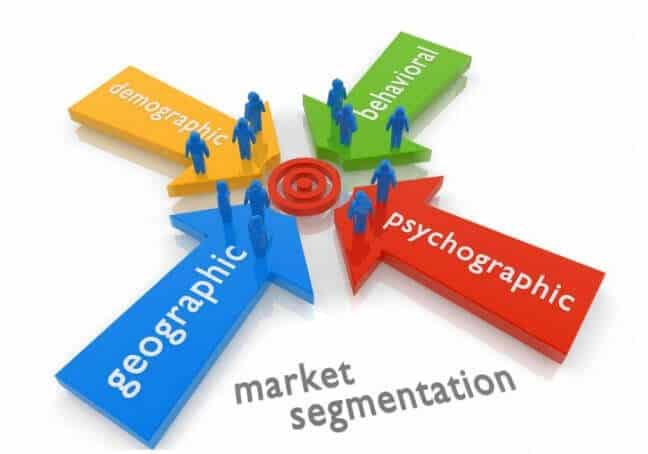
Sorting a database is necessary for two reasons.
First, it helps clean up your base. This can come down to three classic cases:
- first, when you enrich your database there is no guarantee that all the information collected is of good quality or relevant to the business. Some of it is simply not fundamental. For example, if you build loyalty almost exclusively through email, the contact’s phone number is not fundamental for you.
- Likewise, a contact may appear twice (or more) in a database, which is problematic as well as useless. This is called a “duplicate”. The point of email enrichment is to eliminate these duplicates by cleaning the database.
- Finally, email enrichment allows deduplication: in the same spirit as removing duplicates, this tool lets you delete contact records present in different bases that are then merged together.
Second, it also optimizes the use of this base by dividing it into different groups of contacts with close characteristics. This is what we call segmentation: splitting a database into different groups of contacts brought together by similar characteristics. It is fundamental to use it, in particular to write impactful messages for predefined, interested targets. That is the whole point of email enrichment, which gives you a full battery of complete and relevant data, making segmentation both more advanced and, above all, more effective by including behavioral data.
Going furtherBehavioral segmentation can have two sides: the responsiveness of your contacts after an emailing campaign (the number of clickers divided by the number of openers) and commercial behavior (which customer signed up for a trial offer, a subscription, etc.) Two telling examples of the usefulness of behavioral segmentation: 1/you can group together the prospects who clicked on your last two newsletters, which gives a good indication of how warm this lead is; 2/you can segment based on the last purchase made on your site: this then lets you introduce, through personalized emails, new products similar or complementary to the product originally bought.
Having access to this type of information lets you tell internet users apart, group those who behave the same way and therefore segment the database to set up coherent marketing strategies that fit each of these segments.
Salesdorado’s little tipNote that a growing number of providers can clean your base. The Datavalidation API (acquired by Emailable in 2021), however, is an atypical example: on top of letting you quickly run verification tests on email addresses in a database (correcting intel@gmal.com to intel@gmail.com), this tool lets you retrieve information on a contact’s behavior: which email in the database is an opener, a clicker, etc.
Score your email base
Scoring means a company assigns a score to all the contacts in its database, whether they are prospects or already customers. It is a decision-support tool. In practice, it lets the company identify “look-alike” customers, find new high-potential prospects, but above all prioritize its database. It is therefore a statistical classification method that optimizes the use of your database for a loyalty campaign, for example, by answering this type of question: “how do we keep the customers we already have and avoid losing them?”. Scoring your base is therefore fundamental: it lets a company target first the customers with the highest score, who are therefore the ones who will be most receptive to your emails: this is how a company will be able to optimize its deliverability rate!
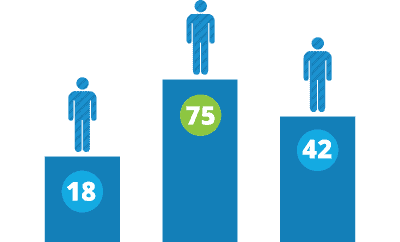
Email enrichment is very useful for improving the scoring of a database, by adding qualitative and behavioral information to your contact records. The more specific information you have, such as buying behavior, purchase amount, type of products bought for your customers, or the size, revenue and purchasing potential of companies, the more precise and effective your scoring will be. It is a must-have method for determining which variables explain a phenomenon (example: why is this customer inactive?).
A striking example is banks which, although they already have a lot of data on their customers, buy additional data from La Poste (the French postal service) to enrich and update this information, especially when a customer moves, for example. That way, you can easily match the customer’s email address with their new postal address.
Email enrichment therefore lets you complete a database with qualitative and behavioral information using a contact’s email address, while getting rid of any superfluous data (duplicates, irrelevant information, etc.), and segment and score this base in order to optimize email campaigns, for example (loyalty for customers, acquisition for prospects). Bear in mind that in the digital world, nothing is fixed or settled: once you have enriched your data, make sure you update your database regularly!
How do you go about enriching an email base?
Before answering this question, let’s first recall a key point: there is a difference between B2B and B2C data enrichment.
- From a legal point of view first: in France, in B2C, there is a legal ban on moving files containing contact data from one base to another without a visitor’s consent. In other words, opt-in is mandatory in B2C. In B2B, the opt-out logic applies, which can be described as permission marketing: it is the legal authorization to prospect professional email addresses on the grounds of the profession the individual practices, without necessarily obtaining their prior consent. They do, however, have a right to unsubscribe afterwards.
- Then for choosing a provider: B2C databases come mainly from press sites, blogs, news sites, online comparison sites, etc., while B2B databases come from companies specialized in renting files and databases they do not necessarily own, from web agencies, or even from owners of a database who want to sell it.
The email enrichment market
To keep it simple, there are two main types of providers that can meet an email enrichment need.
- On one side, there are the providers we will call Full service: these are generally agencies specialized in web services, which their clients hire to enrich their data. They get this data through partnerships and then build megabases that they sell to their clients. This type of provider works in a project management logic and takes care of time-consuming tasks. In practice, a company that wants to run an email enrichment and uses this type of provider delegates the following tasks: removing duplicates, data deduplication, data normalization, purging old email addresses, B2C and B2B enrichment, file audits, etc. Strong trust between the advertiser and the email service provider is therefore fundamental, since the latter will handle data specific to your company. Among the Full service players, we can mention Amabis, a direct marketing agency specialized in web services for cleaning, merging, enriching and updating databases, but also Mediapost and CJMS.
- On the other side, other players exist on this market and stand apart from Full service players by acting instead as solution providers for the client company, for example through an API developed by this type of player and usable by the company. We will call them Self service. As a reminder, an API is a programming interface that acts as a bridge between a software that offers solutions and one or more other software that need them. The difference with Full service players is that with Self service, the client company is responsible for the tasks related to enriching its data and uses for this an API set up on the Self service provider’s site. Well-known players include Clearbit (acquired by HubSpot at the end of 2023 and integrated into its offering since), very effective in B2B especially for quickly identifying qualified leads, or FullContact, more B2C-oriented.
Choosing the ideal provider for email enrichment
As with any strategic decision, you first need to define the criteria that will guide your choice: what is your core business? What is your need? It is from this kind of thinking that a sound choice becomes possible.
- First, you have to decide between a Full service and a Self service. Everything will depend on the need expressed by the company, and on the time it has to deal with the issues related to enriching its base. If the choice falls on a Full service, strong trust and smooth work with the email service provider are necessary: the company will be dealing with a dedicated project manager. The costs incurred will also be higher, offset by a definite time saving and the possibility of handing off time-consuming and complex tasks. Example: deduplication before enrichment, a necessary procedure but far from simple, targeting the variables to enrich in the base, etc. Good knowledge of your company’s needs and of the different providers’ offers is indispensable to make the optimal choice.
- Second, the choice can depend on the provider’s payment model. Imagine you are a company and want to run an enrichment by email. How do you want to pay your provider: per global request (I want to enrich n files, defined in advance), per match (correspondence between the email in your company’s database and the provider’s, with enriched information) or per match on n criteria? Let’s take an example to illustrate this last point: Clearbit, a B2B-oriented Self service provider, commits to sending you back at least one quality piece of information per email address provided by the company. This lets you define the information you need first, and know what you are paying for.
- Last but not least, the choice of provider will depend on its reputation. This is a key aspect to take into account, especially in Full service where a good number of agencies resort to, let’s say… commercial practices. Example: selling an exhaustive list of new customer files, but with incomplete or even outdated information. There are a few tricks to avoid this kind of misadventure for the advertiser: first, remember that you can perfectly well ask for the completion rate of the different attributes in a provider’s base, so you avoid paying for an email enrichment service and ending up with unqualified information. This lets you quickly check that the information you need is present and relevant. Example: customers’ date of birth. Then, you are fully entitled to ask for tests on samples, such as comparing results between an enriched file and another file that is not.
How much does enriching an email file cost?
Email enrichment prices in B2B
We should point out that we did not have access to detailed Full service pricing, since that would require asking these providers for a full quote. However, it is good to know a few things about them: they generally work with fixed costs, which include for example IT costs, phone exchanges, etc. These costs average between 400 and 1000 euros.
For Self service, we first ran a price simulation on Clearbit. Since its acquisition by HubSpot, Clearbit no longer sells subscriptions to new customers: its enrichment goes through Breeze Intelligence, reserved for HubSpot subscribers. Here are the public prices of two tools still on sale, taken from their pricing pages in November 2026.
- 1st case: enriching a B2B file with Dropcontact, Starter plan. Price for 4,000 credits: €79 per month, no commitment. One credit equals one email found: if Dropcontact finds nothing, the credit is given back.
- 2nd case: the same tool for 11,000 credits per month. Price: €199 per month on Starter, €303 on Growth, which adds LinkedIn enrichment and company data.
- 3rd case: API enrichment with People Data Labs, Pro plan. Price: from $98 per month, starting at 350 credits per month. A free plan gives up to 100 credits per month for testing.
Email enrichment prices in B2C
Take the example of FullContact. This provider works per match, that is, on the correspondence between one of your contact records and that contact record in FullContact’s API with enriched data. Without a return of qualified information from FullContact, you don’t pay.
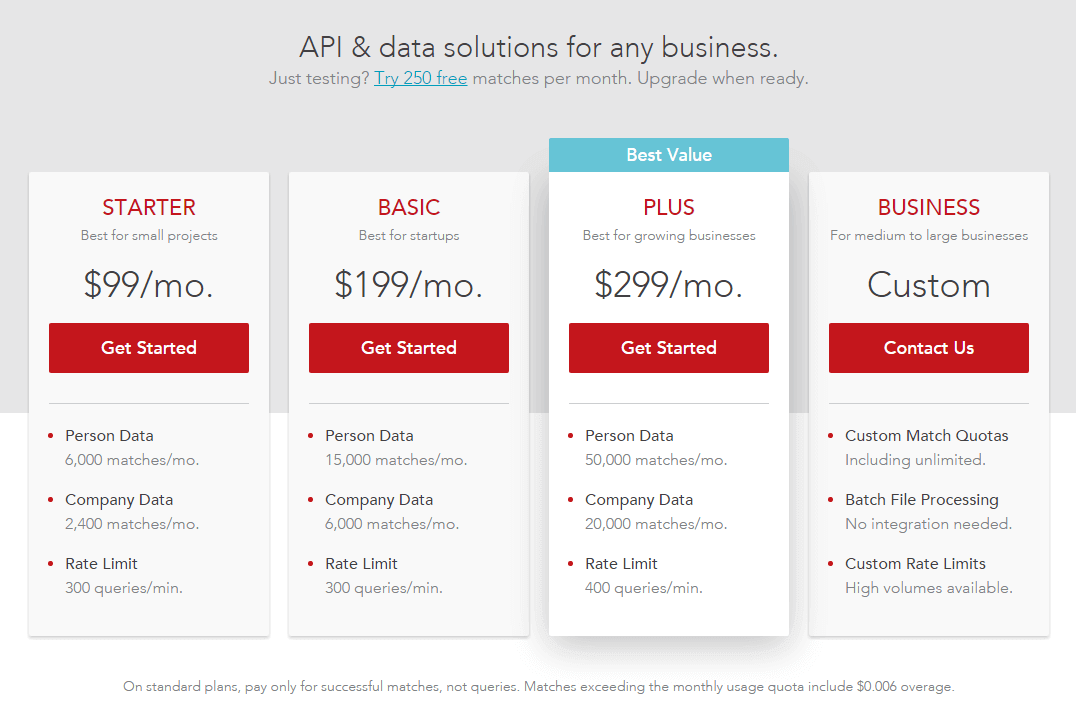
API plans for software developers:
The questions we get over and over.
What is email enrichment?
It means completing your database with additional information on your customers or prospects in exchange for their email address: full name, city, social media profiles, or the NAF code and revenue for companies.
What is email enrichment used for?
To know your email base, to segment it into groups of contacts with close characteristics, behavioral data included, and to score it so you target first the most receptive contacts.
What is the difference between a Full service and a Self service provider?
Full service is generally an agency that handles time-consuming tasks: duplicate removal, deduplication, normalization, purging old addresses, file audits. Self service provides an API: the client company is then responsible for the tasks related to enriching its data.
How do you choose an email enrichment provider?
Based on three criteria: the company’s need and the time it has (Full service or Self service), the payment model (per request, per match or per match on several criteria) and the provider’s reputation. You can ask for the completion rate of the attributes in its base and for tests on samples.
How much does enriching an email file cost?
Full service providers generally work with fixed costs, on average between 400 and 1000 euros. On the Self service side, Clearbit has not sold subscriptions since its acquisition by HubSpot. In November 2026, Dropcontact charged €79 per month for 4,000 credits and €199 for 11,000, and the People Data Labs API started at $98 per month.


What the community says.