



- Hiring is expensive and a newsletter doesn’t replace a salesperson: nurturing activates CRM leads through automated tasks.
- Each status has its own nurturing: lead, MQL, SQL, closed lost, inactive lead and customer.
- The 6 steps: list the entry points, segment, build a priority tree, write, turn it into workflows, test.
- Spread out the outreach on a large database to protect deliverability and your salespeople’s capacity.
- With many off-target leads, scoring (persona, seniority, engagement) filters MQLs before enrolling them in a sequence.
In a market where generating leads is no longer enough, hundreds of thousands of contacts pile up in CRMs without ever being converted into customers. The result: overwhelmed sales teams, lost opportunities, and a huge gap between generation and conversion.
Lead nurturing (the automated, personalized maturing of prospects throughout the buying journey) is the key to turning these dormant contacts into meetings and revenue. Done with good segmentation, this strategy not only keeps your leads engaged, it also raises your conversion rates, shortens your sales cycles and maximizes the ROI of your marketing campaigns.
In this article, we’ll break Nurturing down step by step with concrete cases (€720,000 in 5 months for Komeet, €100,000 of monthly pipeline for Ezus) and see how to effectively automate a system that feeds your salespeople without constant human effort.
The problem
We love it when our CMO does the monthly review and tells us: “This month, we generated 400 leads”. The problem? The salespeople are already full time on their own leads. Which means nobody is going to reach out to the new ones. And it starts again every month. Which leads to this situation: 40,000 leads piled up in the CRM and nobody to work them. There are then 3 solutions:
- Grow the sales team: which means increasing costs, training people and hiring again and again until every lead in the CRM is handled.
- Send newsletters: a false solution. The marketing team will never replace the sales team. Prospects are spoiled for choice (and short on attention), so you need to reach out to them and hold their hand until the sale.
- Set up Nurturing: which means activating our leads through automated tasks. In 90% of cases these are emails, SMS or LinkedIn messages. And sometimes you can add warm calls (phone calls to leads who already know the company after a marketing interaction) for the truly qualified leads.
Nurturing is what we’ll break down and learn to set up in this article. We’ll take 2 real use cases:
- €720,000 generated for the start-up Komeet in 5 months
- €100,000 of pipeline generated per month for the SaaS Ezus
All of it, automatically. Let me explain 👇
Understanding the different types of Nurturing
Definition of Nurturing: a set of actions aimed at pushing our prospects to buy, throughout their sales journey. It involves sending relevant content, personalized interactions and continuous efforts to guide prospects toward conversion.
As you’ve gathered, Nurturing applies to every sales stage. It can cover inbound leads, qualified leads, lost deals and even existing customers you want to renew. So here are the types of Nurturing with the biggest ROI:
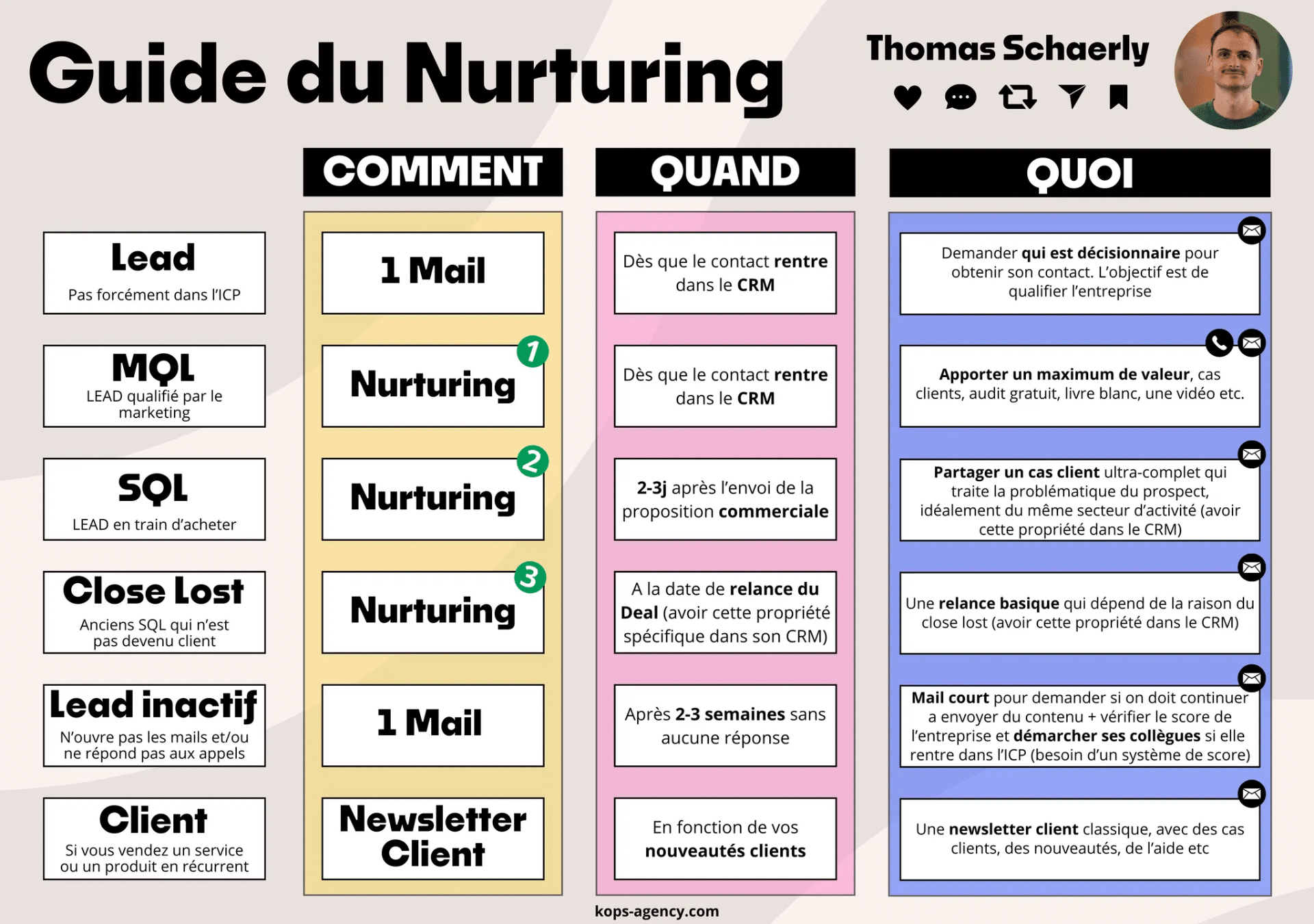
Now that we understand when the sequences should be sent, let’s look at the processes to carry out, and how it worked for our clients Komeet (B2B SaaS, Green tech) & Ezus (B2B SaaS, Travel Tech).
The 6 steps of Nurturing that works
Setting up effective nurturing isn’t something you improvise. To turn your leads into qualified opportunities without manual effort, you need to structure your approach and automate each interaction intelligently. Here are the 6 key steps to build nurturing that performs and adapts to your prospects.
1. List every entry point for leads
Through which channel do your contacts arrive in your CRM? Website forms, imports, additions by salespeople, LinkedIn connections, webinars or events, etc. By identifying these entry points, you know where to look for your leads and how to segment them for what comes next.
2. Segment your leads
Not all leads are equal! You need to sort them by relevant criteria:
- Status (MQL = Marketing Qualified Lead, SQL = Sales Qualified Lead…)
- Which products / offers
- Target persona
- Company criteria, etc.
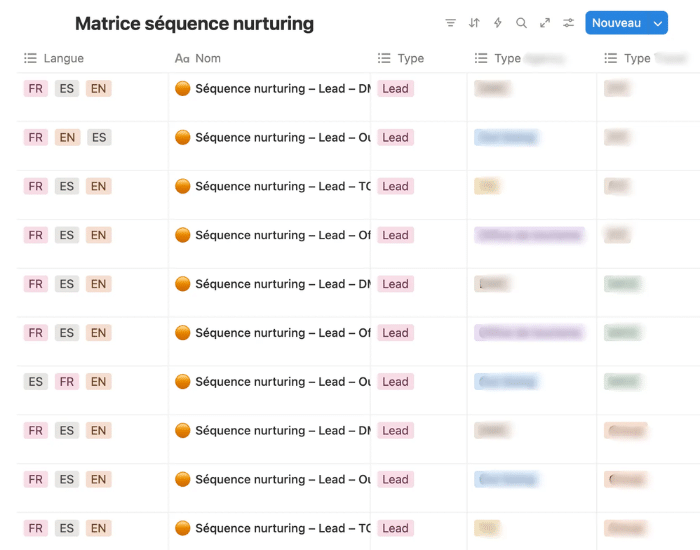
- Languages spoken (as in the Ezus case)
The goal is to personalize messages as much as possible so they hit harder.
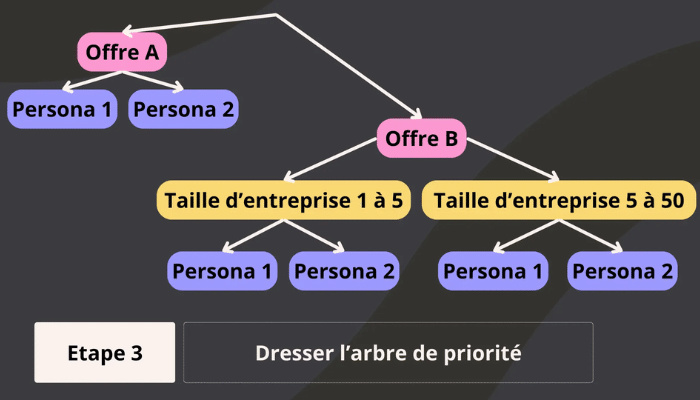
3. Build a priority tree
Now that you’ve segmented your leads, you need to organize the sequences.
- Who should receive what, and when?
- Which message to send depending on the offer or persona?
- What are the different paths your leads can follow?
For example, here we segment on 3 criteria and get 6 possible messages:
4. Write messages that hit
This is the most important step!
- Your messages must be short and punchy.
- They must be personalized and must not look like spam.
So test, optimize and adapt your approaches as much as you can based on the results.
5. Turn your priority tree into workflows
In HubSpot, Attio (or another CRM), you need to create your automations and branches based on:
- The criteria you defined (lead status, past actions…)
- The email or message sequences you want to send
This part translates the first 4 steps into your CRM. This is when the machine is in place.
6. Test & repeat
As with any new module implemented in your CRM, you need to check that it’s properly connected. This step means testing internally, then on a small sample, and finally at full scale. Your Nurturing implementation is only a success if it requires no human time (other than sales). And if your automations run on their own.
Ezus customer case: lead nurturing
Ezus is a B2B SaaS founded in 2019. When they contacted us they had 40,000 leads in the CRM. And only 12,000 had been worked. So we set up Lead Nurturing to reach out to all new inbound leads, and catch up on the existing ones.
This illustration then makes complete sense:
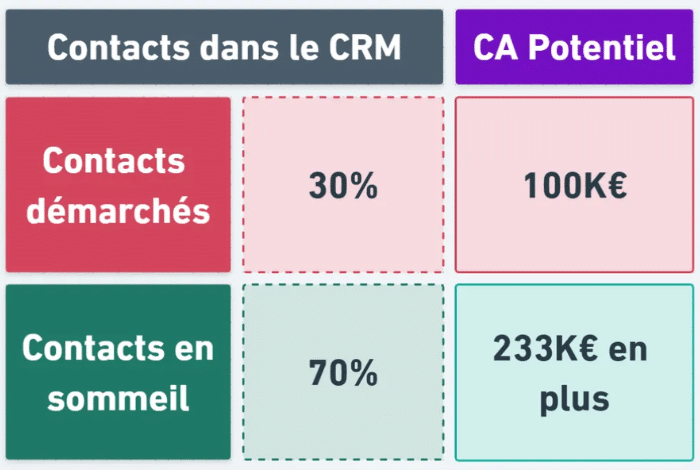
If the company managed to make €X of revenue by working only 30% of its database, there’s still 70% of the revenue left to go after. That’s exactly the reasoning you should have. Your marketing team spent money and energy collecting these leads, so you absolutely must not let them sleep. In the Ezus case, we had to reach out to the remaining 70% of contacts (28,000). Because of spam, you absolutely have to spread out the outreach so you don’t burn:
- The deliverability of our emails
- The energy of our sales reps (400 meetings in one month can’t be absorbed)
- Our database, which isn’t infinite after all
After activating the processes and writing all the Nurturing sequences:
Since October 2025, Ezus has been generating 20 meetings a month. With an average deal size of €5,000, that creates €100,000 of sales pipeline, every single month.
Komeet customer case: MQL nurturing
In the Komeet case, lead nurturing is less relevant. The company collects 3,000 leads a month on average (a lead magnet strategy, for those interested). But lead quality isn’t always there. So a filter has to be applied.
For that, nothing beats implementing a Scoring module. That’s what lets us call these leads “MQLs”, for Marketing Qualified Leads (leads qualified by marketing). In Komeet’s Scoring, it’s a score based on persona, seniority and engagement. We advise you to apply the same filters if you have very large volumes but also leads that aren’t always in your ICP.
Once the filters were applied in the CRM, we were able to automatically enroll all inbound leads. And here are the results:

72 meetings generated in 5 months with an average deal size of €10K. That represents €720,000 of sales pipeline. In the Komeet case, the campaigns consisted of:
- 1 fairly direct email to start a conversation
- 1 Call
- 1 email pushing lots of free content
- 1 Call
- 1 email pushing the next webinar
- 5 more calls if there’s no reply
So Nurturing isn’t 100% automatic, but it let the salespeople reach out to truly qualified leads and book about 60% of meetings with the emails alone. As a reminder, these leads first downloaded a niche piece of content, and are then filtered by ICP. Which means 100% of sales effort should go to them first.
Conclusion
To conclude, nurturing is an approach aimed at activating and reactivating all the leads in your CRM (inbound and dormant). The goal is to never give up on a lead. Because if a lead has already shown interest, there’s a strong chance they’ll be interested several months or years later. The art of following up and reactivating will let you generate dozens of meetings easily every month without spending €1. This module is essential if you want to optimize your sales cycle.
Over to you now.
The questions we get over and over.
What is lead nurturing?
It’s the set of actions that push a prospect toward buying throughout their journey: relevant content, personalized messages, follow-ups. In 90% of cases, these are emails, SMS or LinkedIn messages, sometimes supplemented by calls.
What are the steps to set up nurturing?
List the lead entry points, segment them, build a priority tree of messages, write short personalized messages, turn the tree into workflows in the CRM, then test internally, on a sample and at full scale.
Should you score your leads before nurturing?
Yes when volume is high and quality uneven. Komeet received about 3,000 leads a month: a score based on persona, seniority and engagement was used to keep only MQLs before enrolling them in a sequence.
Can nurturing be fully automatic?
Not always. Komeet’s sequences alternated emails and calls, but about 60% of meetings were booked by the emails alone. The author considers nurturing a success when it requires no human time outside of sales.


What the community says.