


A leader’s visibility is no longer just about the company’s image: it is becoming a strategic performance lever. Personal branding is establishing itself as a pillar of leadership in its own right.
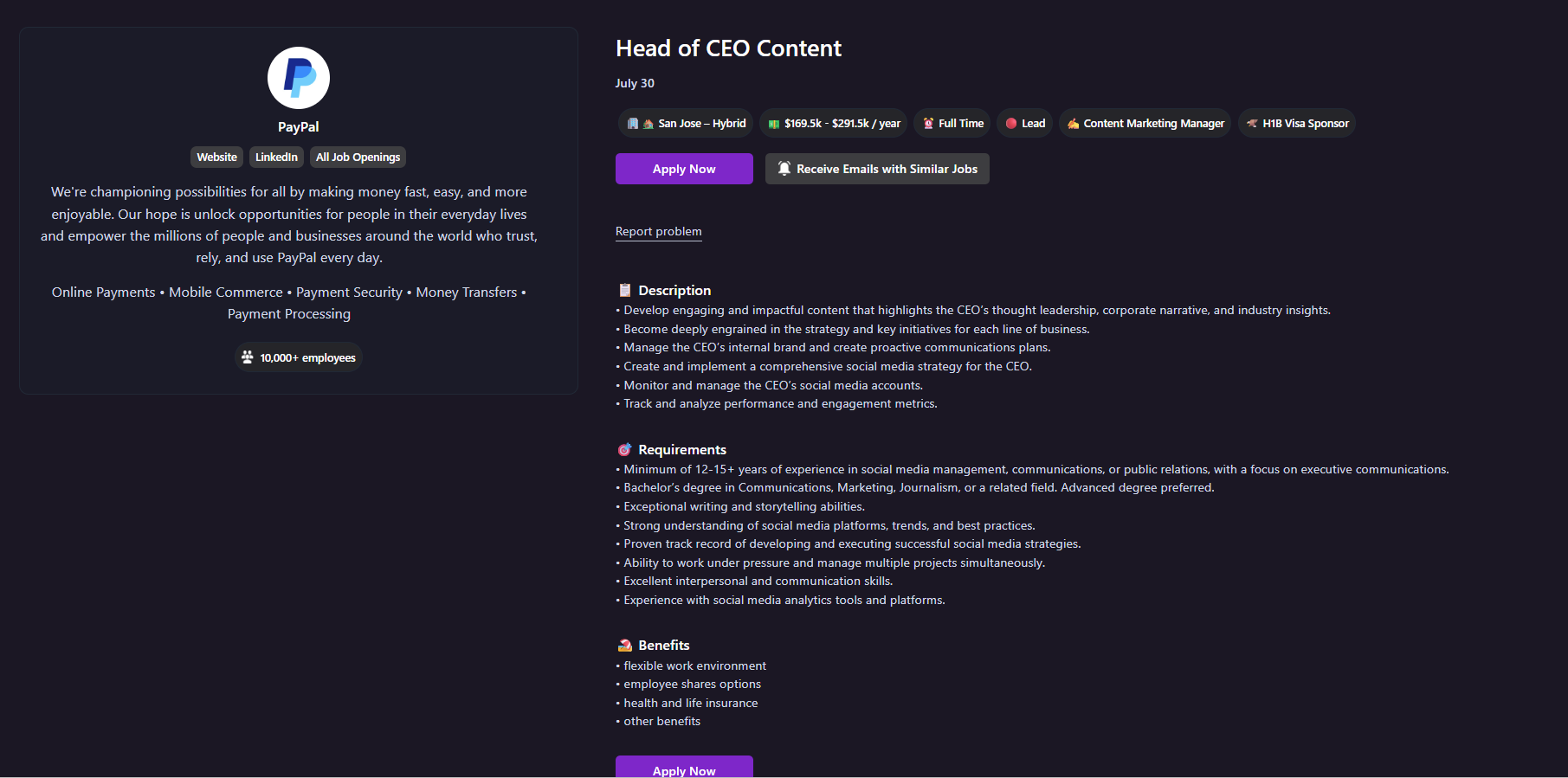
PayPal made waves by hiring a Head of CEO Content for more than $200,000 a year to run the personal communication of its CEO, Alex Chriss. The message is clear: investing in what leaders say is as important as the company’s own marketing strategy. But why? Because a CEO who doesn’t speak up becomes invisible. And an invisible leader doesn’t recruit, doesn’t convince and doesn’t inspire!
In this article, we will explore the levers for structuring, embodying and amplifying an effective personal brand: defining your editorial line, enriching your profile, growing your audience and drawing inspiration from leaders who have understood that their personal influence is as strategic as their P&L (profit and loss).
Personal branding, a lever for credibility and growth
Personal branding: much more than a visibility exercise
Personal branding means showcasing your expertise, your values and your vision to strengthen your credibility and your impact. It is not about “selling yourself”, but about making your legitimacy visible.
A few figures:
- According to the Sprout Social #BrandsGetReal report (2024), 70% of consumers feel more connected to a brand when its CEO is active on social media.
- According to the Edelman Trust Barometer 2024, 63% of consumers trust companies more when their CEO speaks publicly.
It is a strategic asset because it acts on reputation, recruitment and sales performance all at once
Why do invisible leaders lose impact?
The PayPal example is telling. The company is not hiring a marketing director, but a Head of CEO Content! A six-figure position dedicated to building Alex Chriss’s personal brand.
But why does a silent leader lose influence?
- Because they leave a narrative void: In a world saturated with content, not communicating means letting others tell your story for you. A leader who is absent from the conversation loses control of their image and their positioning as an expert.
- Because they lose the battle for trust: An individual’s word inspires 3x more trust than an institution’s. Without speaking up, the figure of the leader becomes abstract. Talent, investors and partners are drawn to leaders with a face, not just logos!
- Because it reduces their internal influence: External visibility also fuels internal engagement. A leader who speaks up gives meaning, brings people together and attracts the right profiles. A silent leader eventually becomes inaudible, even within their own company.
Our advice
As Valentin Decker, a writing trainer, puts it: “Being the face of your company has never been more important.”
Individuals generate more engagement than brands, and a leader’s voice is now a driver of influence, trust and performance.
Structuring your voice as a leader: why a clear editorial line matters
A personal brand cannot be improvised! Without an editorial framework, communication becomes inconsistent, opportunistic and hard to sustain over time. That is why defining a personal editorial line is essential: it serves as a strategic compass for knowing what to say, how, to whom and why. A clear editorial line:
- keeps your messages consistent over time,
- stops you from scattering across topics unrelated to your positioning,
- strengthens your credibility and recognition in your area of expertise.
Choosing your authority topics
An effective personal brand rests on a precise territory of expression. Too many leaders dive in headfirst and post without any guiding line, diluting their credibility. A few simple questions to guide your thinking:
- Why do you want to speak up?
- What is your expertise?
- What added value do you bring to your audience?
- Who do you want to talk to (customers, peers, employees, investors)?
- What tone best reflects your personality?
The winning trio “Expertise + Value + Audience” will help you define a solid, consistent territory of expression.
Striking the balance between authenticity and strategy
Authenticity does not mean “saying everything”! It rests on consistency between what you think, say and do. The most-followed leaders combine 3 ingredients:
- Authenticity: sincere words that reflect their convictions
- Relevance: remarks tied to the news of their industry
- Structure: a clear editorial intent
The example to follow
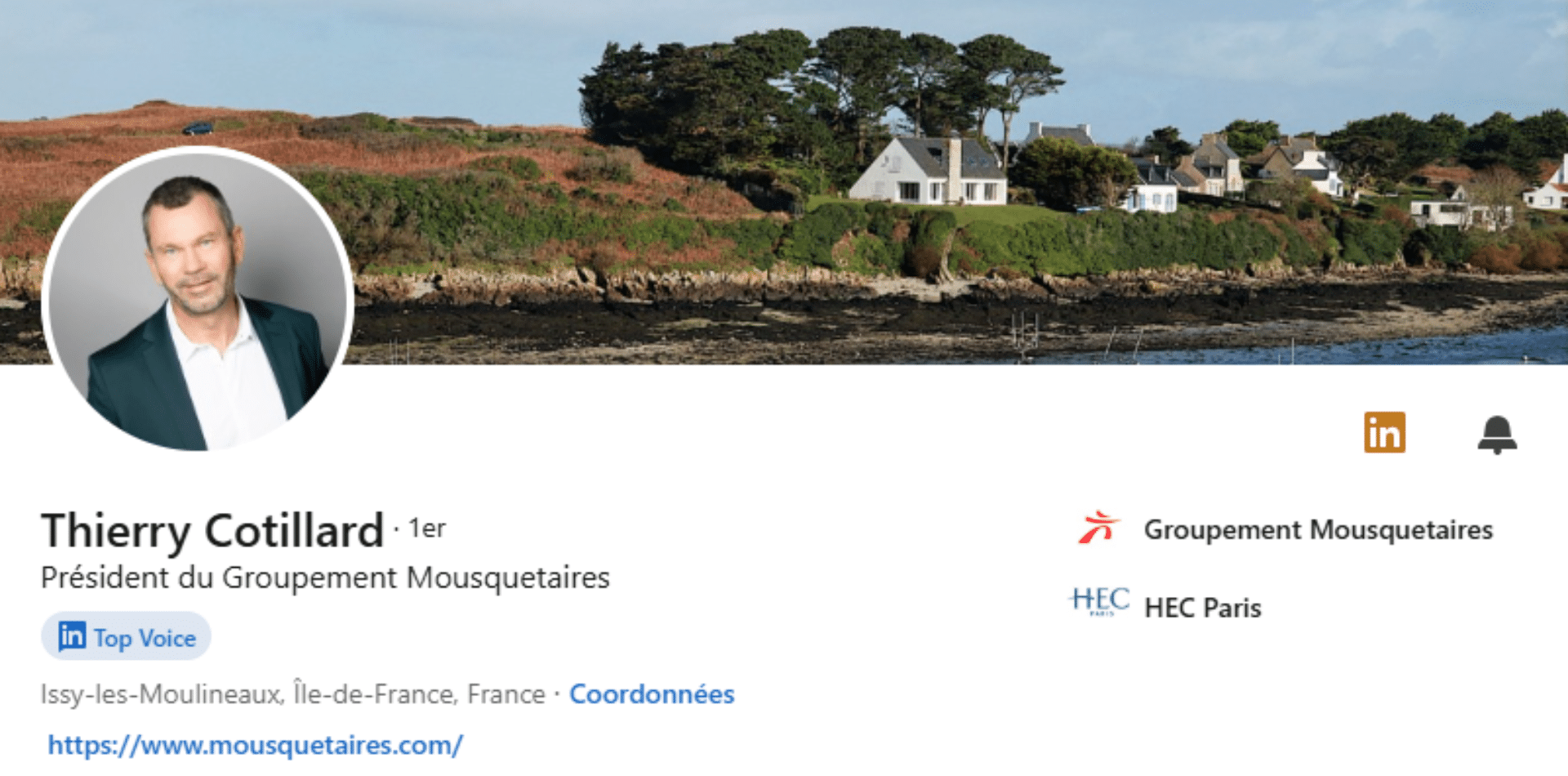
Thierry Cotillard, president of Intermarché, illustrates this balance perfectly. His posts alternate between personal reflections and strategic messages. He highlights his convictions on the food transition, support for local producers and his social commitment, while staying aligned with the company’s overall strategy. He alternates between corporate content and on-the-ground video. His tone is accessible, educational and always aligned with the group’s overall strategy
This consistency between authenticity and strategy strengthens the credibility and impact of your communication
Tip
Create a mini editorial charter. List 2 or 3 key topics, define the tone and set a realistic frequency. This simple framework keeps you consistent and prevents editorial fatigue.
Building and enriching your LinkedIn profile: the fundamentals
A visible leader does more than speak up: they structure their image. Your LinkedIn profile is not a business card, but the digital showcase of your leadership. It must inspire trust, tell a story and show consistency between your role, your values and your vision
Polishing the visible pillars: profile, photo, bio…
The elements to work on first:
- Professional photo and a banner aligned with your brand universe.
- Clear headline: beyond your job title, state your mission (“Founder of Les Secrets de Loly | Committed to diversity and inclusion”) “Break the glass ceilings. Take control of your destiny”
- Narrative summary: a paragraph that tells who you are and what you stand for
- Social proof: recommendations, publications, media appearances
The example of Kelly Massol (Les Secrets de Loly) illustrates this approach very well. Her LinkedIn profile combines an explicit headline, an authentic account of her entrepreneurial journey, a banner reflecting her mission and a tone aligned with her values. A consistent professional photo and a banner reflecting her mission.
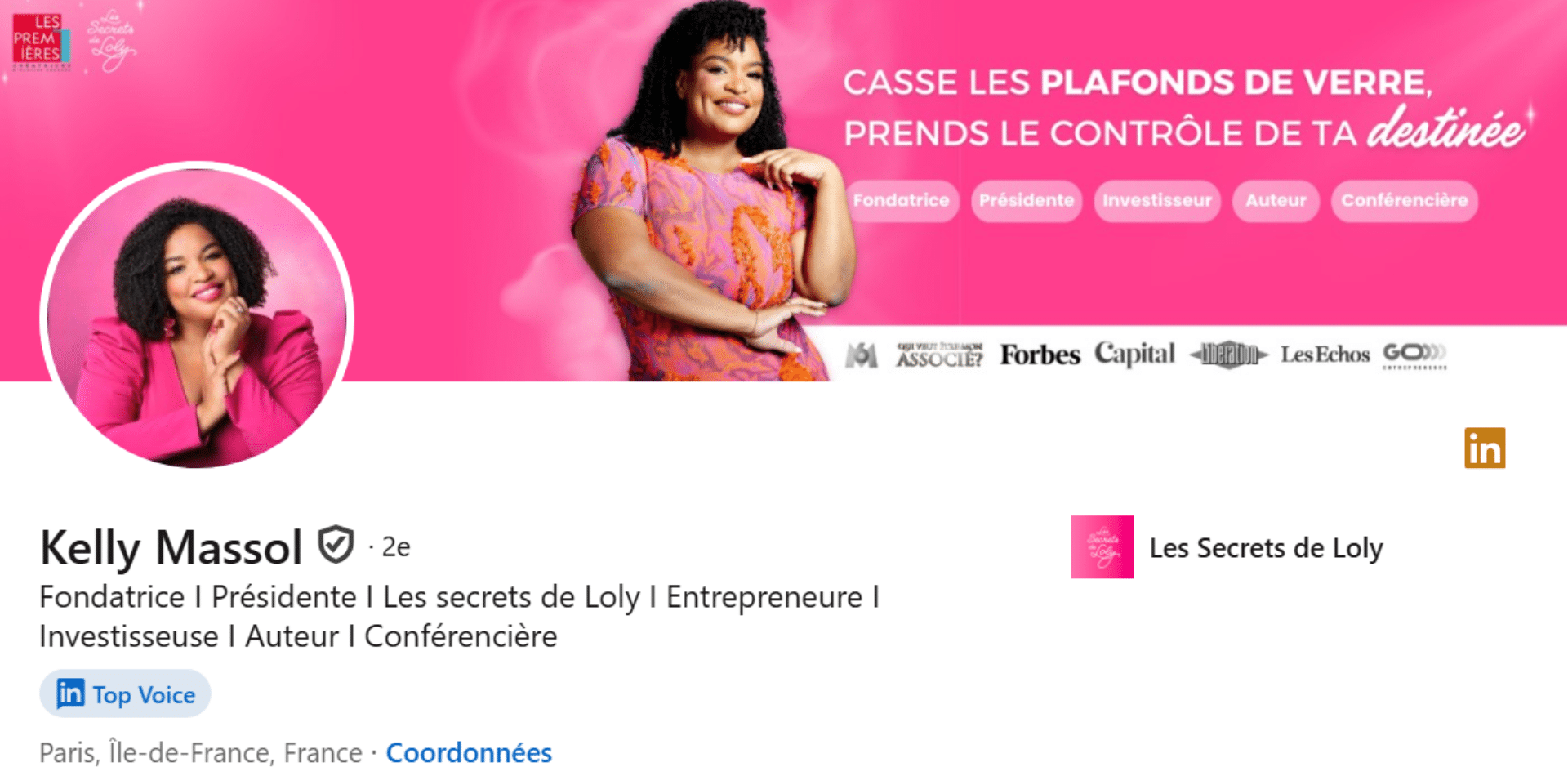
The result: a profile that inspires trust and lends credibility to her leadership. In short, a well-built profile works like an influence landing page: it attracts, convinces and builds loyalty. But a rich profile is not enough! You also need to post at a steady pace.
The most influential leaders post high-value content 2 to 3 times a week: lessons learned, analyses, strategic reflections. The “3C” model sums up this dynamic:
- Clarity: a simple message = one idea per post
- Coherence: a uniform tone and editorial line. Your pieces of content must be consistent with one another.
- Constancy: regular posting = credibility
Growing and engaging your audience
Moving from reach to community
The goal is not to “get views”, but to build a community that shares your values and your vision. The best-performing leaders don’t chase virality, they look for resonance. A few good practices:
- Reply to comments: conversation builds trust.
- Comment on posts by other leaders in your ecosystem
- Link your content to your projects or to current topics
Tips: If your schedule is packed, spend 10 to 15 minutes a day commenting on targeted posts. It is the simplest way to stay visible and credible without “producing” nonstop.
Back to the PayPal case: the mission of its Head of CEO Content is to turn every one of the CEO’s public statements into narrative content with strong resonance. The best-performing leaders treat LinkedIn like an “editorial gym”. They train every week at telling, analyzing and passing on.
Three formats to alternate to feed your audience:
| Format | Goal | Example |
|---|---|---|
| Insight | Share a conviction or a lesson | “What this challenge taught me about…” |
| Behind the scenes | Show reality, humanize leadership | “Why I spend one day a month in the field with my teams” “Why I introduced…” |
| Vision | Give meaning and inspire | “Why energy sobriety is not a constraint, but an opportunity” |
Personal branding trends: toward embodied, responsible leaders
The return of embodied leadership
Leadership communication is shifting from corporate talk to real talk. We are moving from corporate speeches to genuine statements. Audiences are looking for leaders who are more human, more transparent, more embodied. According to Maddyness (April 2025), consumers place more trust in individuals than in brands, which they see as impersonal. And LinkedIn has understood this very well: “the platform gives individual profiles 1,400% more reach than corporate pages”.
This trend reflects a shift: people no longer follow only companies, but the people who embody them. Leaders who can combine expertise, conviction and authenticity build engaged communities well beyond their industry.
The formats that work: video, newsletter, long post, vlog
Today, effective influence formats rest on 3 pillars:
- Short videos (60 to 90 seconds): effective for embodying a strong idea and capturing attention
- Personal newsletters: go deeper, build loyalty and create a regular relationship
- Long LinkedIn posts*: the preferred format for strategic reflections.
(*According to Neil Patel, long, well-argued content generates 45% more shares than a short post, because it lets you demonstrate your command of the subject.)
The winning trio:
LinkedIn for visibility, newsletter for depth, video for embodiment.
Tips for developing your personal brand
Building a solid personal brand takes time, thought and regularity. Here are 6 concrete levers to maximize your impact.
Set clear goals
Before you start, clarify your goals: attracting customers, bringing a community together or strengthening your influence in your industry? Use the SMART method (Specific, Measurable, Achievable, Realistic, Time-bound).
Example: “Increase the number of qualified interactions on my LinkedIn posts by 25% within 6 months to attract strategic partners.”
This approach will help you adapt your content, measure your progress and avoid scattering your efforts. Also identify your values and your core message: they should come through every time you speak
Stand out through what makes you singular
In a hyperconnected world, having skills or quality products is not enough to stand out. Differentiation rests on:
- Your unique strengths and background.
- Your deep convictions.
- Your communication style.
Remember: 63% of consumers trust companies more when their CEO speaks publicly. Direct communication breaks the impersonal image of large organizations and strengthens credibility. An example:
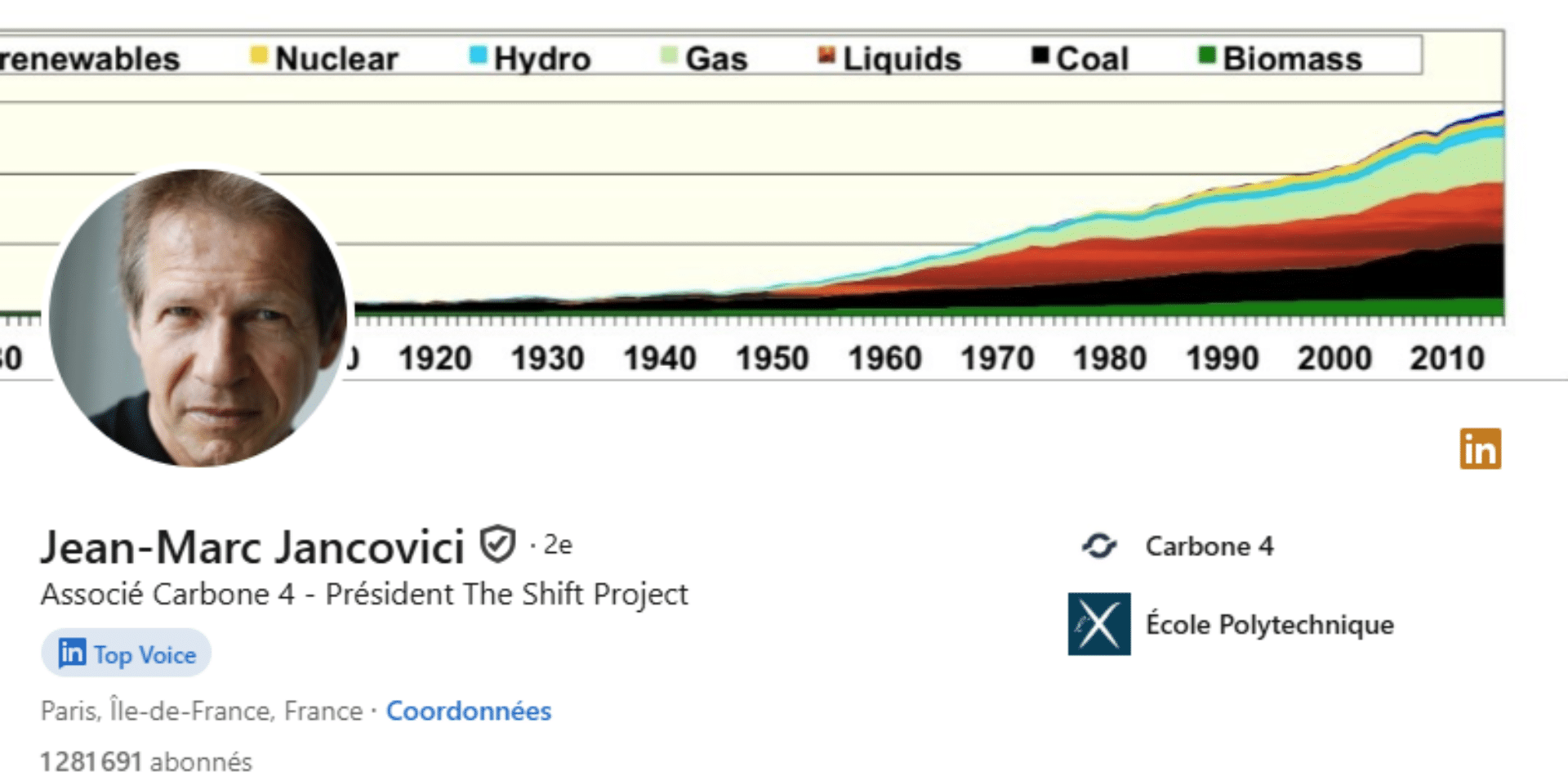
Jean-Marc Jancovici stands out through the combination of his scientific rigor, his teaching skills and his authenticity. His clear editorial line makes each of his statements consistent, recognizable and understood even by non-specialists. His visibility reaches beyond his “climate and environment” ecosystem.
Our advice
Identify your “personal value proposition”: what can you bring that no one else can offer?
Choose the right networks
Not all networks serve the same goals. Pick them according to your strategy:
- LinkedIn: B2B visibility and leadership
- Instagram / TikTok: storytelling and visual formats
- X (Twitter): responsiveness, monitoring and quick exchanges
- YouTube: long-form content, credibility and education
Going back to our earlier examples:
- Kelly Massol (Les Secrets de Loly) combines LinkedIn and Instagram to amplify her mission
- Jean-Marc Jancovici inspires entire communities through volunteer relays on YouTube and Facebook, on top of his presence on LinkedIn and Instagram
Tip
Align your content with your company’s to keep everything consistent.
Interact strategically
Personal branding is not just about posting! It rests on exchange and relationships. Remember, your goal is not to collect likes but to create an active community. To do that, you will need to follow a few good practices:
- Reply to comments and messages
- Comment on your peers’ posts
- Take part in in-depth discussions in your industry
An example: Serge Zaka, a doctor in agroclimatology, interacts with his community every day, which strengthens its engagement and his legitimacy.
Produce quality content
Content is the heart of your personal brand. It lets you demonstrate your expertise, share your convictions and attract a qualified audience. You can vary the formats: LinkedIn posts, articles, videos, podcasts, newsletters, infographics… A few essential rules:
- Share your insights and lessons learned
- Bring concrete, actionable value
- Stay consistent with your editorial line
While long, well-argued content generates 45% more shares than a short post because it shows command of the subject, don’t forget that quality comes first. There is no point writing long posts if you can say it in a few lines!
Our advice
Plan your posts in a project management tool such as Notion or Trello to stay on course and keep a regular rhythm.
Use storytelling to create resonance
Storytelling is the backbone of a strong personal brand. It turns your messages into memorable stories that generate engagement and trust. Why? Audiences remember information presented as a story 22 times better (study conducted by Jennifer Aaker, Professor of Marketing at the Stanford Graduate School of Business). 3 pillars for effective storytelling:
- Why? (Your mission): explain your purpose and the meaning behind your actions
- How? (the process): show the behind the scenes, the lessons, the failures and adjustments (e.g. agroclimatologist Serge Zaka shares his research in real time, combining education and expertise)
- What? (the proof): show concrete results (Kelly Massol highlights her inclusive products, partnerships and social initiatives to illustrate her vision)
A simple structure for your stories: Talk about the context → the trigger → the turning point → the lesson you take from it
Suitable formats:
- LinkedIn posts (idea + emotion + lesson)
- Short videos (60–90 s)
- Newsletters to go deeper
- Podcasts / interviews
Don’t just “talk about yourself”: show what you stand for
Conclusion
Personal branding is not a communication “vanity”, it is a tool for steering leadership. Leaders who master their personal communication create value well beyond their company. They inspire, bring people together and shape the debates in their industry. As the PayPal case shows, investing in a personal branding strategy is not a luxury but a response to a structural shift: a world where trust is earned through direct speech.
Building your personal brand means agreeing to join the conversation with authenticity, method and regularity. And if PayPal can spend $236,000 a year on it, that may be the signal that it is time for every leader to treat their voice as a strategic asset in its own right.



What the community says.