

- The four objections are well founded: AI eroding SaaS perceived value, tools built by prompt, a saturated market, rising acquisition costs.
- Plugging an AI on top of ten tools hides sales complexity without removing it.
- A CRM built by prompt copies what already exists: managing contacts and deals is the easy part.
- In a saturated market, the advantage goes to whoever knows their target best and takes care of execution.
- Before launching, three criteria: an edge built in the field, a vision you can explain in two sentences, the endurance for five to ten years.
A few weeks ago, a friend who runs sales at one of the most profitable SaaS companies in Paris sent me a LinkedIn message when he saw my post announcing the official launch of my CRM. Four words. “You’re totally insane!”
Two months earlier, my advisor at BPI was more diplomatic, but the message was the same: “We’ve already invested in two French CRMs, we’re still waiting for an exit and there’s nothing on the horizon. We can’t help you, even if you’re better than them.”
I could have taken it badly. I chose to listen. Because these two people, like many others who have asked me the same question over the past six months, have four solid arguments against launching a SaaS in 2026, and even more against launching a CRM. This article lays out those arguments honestly, then explains why I went ahead anyway. And why this way of looking at it can be useful to you, whatever market you plan to go after.
Four solid reasons NOT to launch a SaaS in 2026
These objections don’t come from jaded investors or uninformed people. They come from sharp people who have context, and who aren’t trying to discourage you but to keep you from making a mistake. They deserve to be taken seriously.
“AI killed SaaS”
The narrative has taken hold since 2024. The historical promise of SaaS was to package know-how into an accessible interface and bill it as a subscription. The promise of LLMs, since the arrival of Claude, ChatGPT and their equivalents, is to replicate that know-how on demand, in a few seconds, and push it straight into teams’ workflows.
If you can ask your AI to qualify a lead, write a follow-up email, produce a call summary or generate a sales proposal, what’s the point of the SaaS that used to do those things?
According to Bessemer State of the Cloud 2026, 41% of SaaS vendors now monetize their AI features, often to make up for an eroding perceived value. Usage-based pricing is gaining ground: 51% of SaaS products have a usage component in 2026, versus 27% in 2021. The recurring revenue model built over time is seizing up.
Solid argument. The SaaS that merely does what an AI does for free is in for a rough ride.
“You can build your own tools with a good prompt”
On LinkedIn, you’ve surely seen this kind of post: “I vibe-coded a CRM for my client in 24 hours, they dumped their market-leading tool and saved a fortune.” Usually, the post has 200 likes. Sometimes more.
AI-assisted building tools have knocked down a barrier that seemed immovable. Someone with a bit of common sense and access to Claude Code or Lovable can now build, in a few days, what would have taken several months of development two years ago. MVPs ship fast. The demos are convincing. The first users are happy.
If someone can build their own custom SaaS in a week, why would they pay a vendor a subscription? Why accept the compromises of a tool designed for ten thousand companies when you can have your own, tailored to your fifty salespeople, in two nights of prompting?
Solid argument too.
“The SaaS market is saturated”
The global SaaS market is worth 465 billion dollars in 2026 and is still growing 13% a year. That’s massive. Which means thousands of vendors are already established, funded, structured, ahead.
In the CRM market in France, 70% of SMBs are equipped in 2025, and more than 90% of companies with over 10 employees. The market represents 2.3 billion dollars in France alone. Ask a French SMB owner which CRMs they know, they’ll name three without thinking. Ask them if they plan to switch tools in the next twelve months, they’ll say no 80% of the time. Switching costs are high, and so is inertia.
Wanting to enter this category in 2026 looks like wanting to launch a new coffee brand next to Starbucks, McDonald’s and fourteen other established chains. On paper, it’s suicidal.
“Launching a B2B SaaS is one of the hardest challenges there is”
Even when you accept the first three objections, this one is often the final blow. The B2B market has specific features that make entry more expensive than in most other sectors.
Long sales cycles, several months for a serious contract. Acquisition costs that have exploded. According to the SaaS Benchmarks 2026 published by OpenView, the average CAC payback period went from 15 to 18 months between 2023 and 2026, and the cost of acquiring one euro of ARR is up 14%. SEO comparisons are locked down by the leaders, who spend millions on content and backlinks.
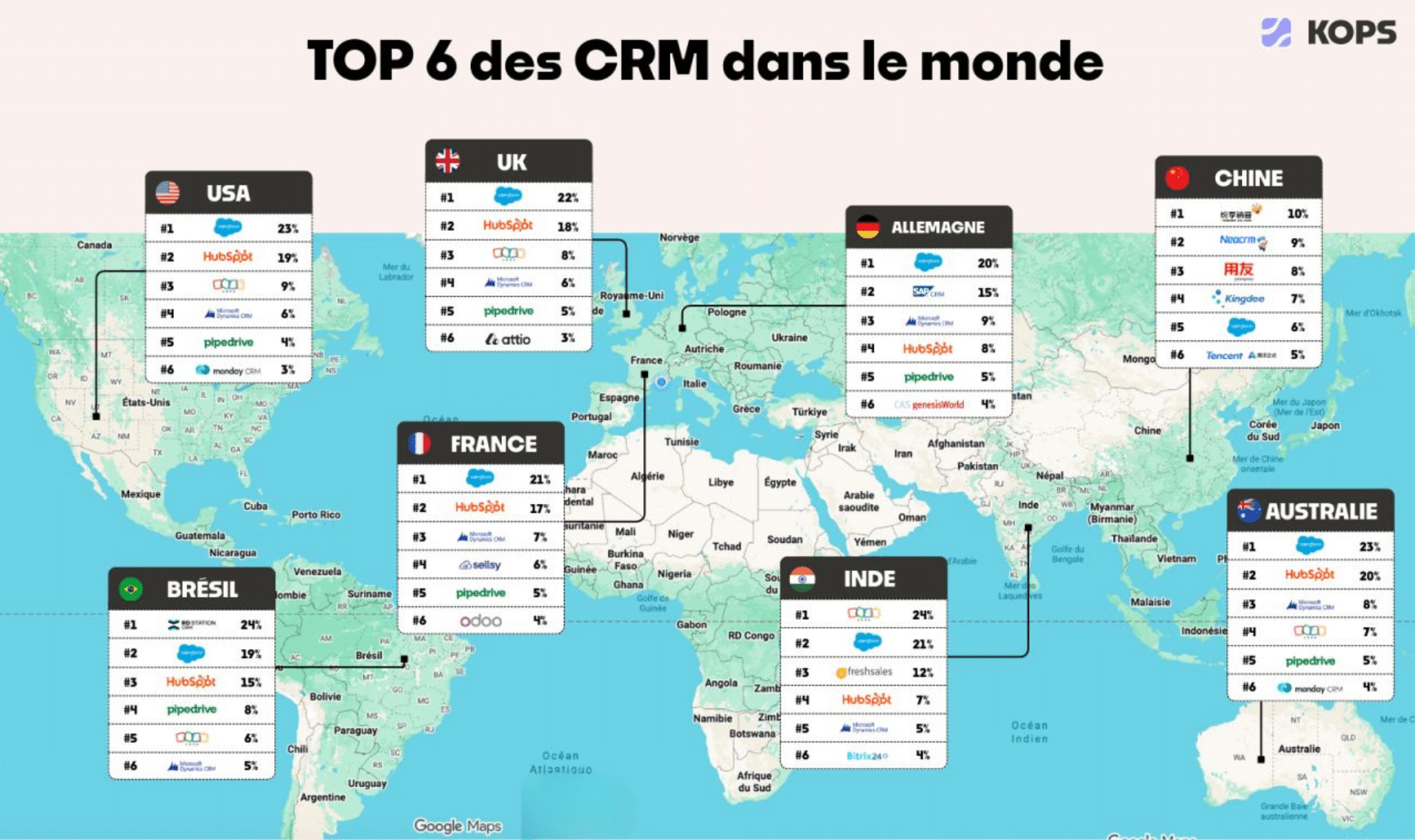
In CRM specifically, Salesforce remains number one worldwide according to IDC Market Share 2025, ahead of some fifteen established players who share the rest with nine-figure marketing budgets.
Launching a B2B SaaS in 2026 means entering a field where the cost of acquiring a customer has doubled in five years, against competitors who are a decade ahead.
These four arguments are true. None of them is exaggerated. And yet, I took the plunge. Here’s why.
Why did I launch my CRM despite the objections?
AI as an extra layer doesn’t remove the problem, it adds to it
The “AI killed SaaS” argument rests on a specific reading: AI will replace tools. What I see in the field is the opposite. AI doesn’t replace existing SaaS, it plugs into it.
In May 2026, Anthropic launched Claude for Small Business, a bundle that connects Claude to everyday tools: HubSpot, DocuSign, QuickBooks, Google Workspace, Microsoft 365. On the surface, the idea is elegant. Your AI talks to your CRM, your invoicing (not valid in France), your e-signature, and summarizes it all for you.
What this move reveals is more worrying. We’re entering an era where, instead of simplifying sales complexity, we add a layer on top to hide it. Your salespeople keep juggling ten different tools, but this time with an AI front end that gives the illusion everything runs smoothly. The underlying problem remains intact. Worse, it gets bigger.
For two years I’ve watched sales teams rush to the new AI prospecting tools, sign up without connecting them to their existing tools, frantically test one and then another, and end up with an unmanageable stack and their data scattered across AWS servers. Curiosity is healthy, but behind it, the company has to be able to steer its results and forecast its revenue. Without real consolidation, that’s impossible.
AI done right removes steps. AI done wrong piles them up. Most of what’s being sold in 2026 falls into the second category.
A CRM produced by prompt stays a prisoner of 2025’s vision
Back to that LinkedIn post about the CRM built in 24 hours. You can smile, or look at what the person actually delivered.
The main mistake is believing that a CRM’s complexity lies in managing contacts, companies or deals. That’s the easy part. That part, yes, you can copy overnight. What takes years to build is the user interface refined through thousands of customer conversations, the handling of edge cases, security, deep knowledge of the subject, and continuous innovation. A CRM is a permanent fight between product creativity and the rationality of business use. You can’t prompt that.
An anecdote to make this concrete. When I worked at Airbus in 2007, we already had rapid prototyping tools that generated code for us. We defined the idea, the system produced the code, we tested. Great for validating a hunch. But when it came time to put the function into a plane carrying three hundred passengers at eleven thousand meters, all of the code was rewritten by hand: specifications, development, unit tests, functional tests, production release. I can’t guarantee that’s still the practice today, but nobody would want to fly in a vibe-coded plane. So why would you accept putting your main source of revenue in the hands of a vibe-coded SaaS?
NB: Building a SaaS with AI has a structural limit: you can’t inject innovation into it. Everything an AI produces is what it has already seen. By definition, the SaaS you build this way is an equivalent of what already exists. You might as well buy it and benefit from a vendor working on it full time. If your answer is “no, I innovate with my prompt”, then you’re a developer, you’re injecting your own know-how into the chain, and you’ll probably end up selling your tool to others. And in the end you’ll be selling a SaaS.
A saturated market still has room for someone with a real vision
The word “saturated” deserves a second look. Saturated in number of players, yes. Saturated in perceived value, never entirely.
Take an example from outside SaaS. The market for takeaway sandwiches and drinks in big cities is probably the most saturated you can imagine. You can all name three chains without thinking. And yet, for about ten years now, Joe and the Juice has filled its queue every day in Paris, London or New York. They arrived well after the others. They didn’t invent a category. They simply used existing competitors’ mistakes to deliver a near-perfect product in their segment: careful customer service, a smart loyalty program, good products, collaborations with recognizable athletes, a smooth mobile app. Execution on the small details makes the difference where the concept seemed exhausted.
That’s also the bet I made in CRM. Not reinventing the category, but using 13 years of integrating tools for French SMBs to see what annoys them, what they’re missing, what wears them out in existing tools. And building from there. In a saturated market, the advantage goes to whoever knows the target better than their competitors and demands a higher quality of execution from themselves. Not to whoever shouts the loudest.
A hard market ends up protecting those who settle in
The objection “the CRM market is one of the hardest to break into” is accurate. And that’s precisely why it’s worth taking on.
In thirteen years of integrating CRMs for French SMBs, I’ve seen a lot of vendors arrive. If I look at the ones that disappeared over that period, I can’t find a single one. Those who crossed the coral reef (having enough visibility to become a legitimate choice in a buyer’s eyes) are all still here. Some repositioned on a niche. Others were bought by a bigger player. But none went under.
Those who didn’t cross that barrier didn’t all fail either. I know a hyper-specialized CRM that pays its small team of three with around twenty very satisfied customers, ready to sign a healthy annual budget to have a tool built for them. That’s also a form of success, just invisible on the radar.
The difficulty of the market is protection for whoever settles in seriously. Few serious players dare to enter each year. Those who enter and last twenty-four months have earned their place. In an easy market, you get copied within the week. In a hard market, your work belongs to you for years.
And you, should you launch your SaaS in 2026?
The contrarian take you’ve just read is useless if you keep it as a convenient justification. The question isn’t whether I was right, the future will tell. It’s whether you should launch your own project.
The useful question isn’t the one you think
When you hesitate to launch a SaaS, the first question that comes up is always the same: “Is the market growing?” That’s the wrong question.
The market for B2B SaaS, CRM and automated prospecting will be growing in 2026, in 2027, in 2030. It keeps expanding. But its nature is changing. You no longer win by entering it to do what others already do. You win by entering it with one specific thing, seen from the inside, that others don’t see yet.
So the real question is: what do you see that others don’t? If you can’t answer, wait. If you can, listen to the objections and strengthen your conviction.
Three criteria to decide honestly
Three criteria come together to tell you whether you should go for it:
- First, your edge (or if you prefer, what makes you positively different). Where does it come from? How many years in the field, of projects or of use built it? An edge built through direct, repeated observation is worth far more than an edge inspired by something you read or an abstract conviction.
- Next, the vision. Do you have a clear vision of what’s missing in the market? Can you explain it in 2 sentences to someone who doesn’t know your trade? A fuzzy vision doesn’t hold up over the medium term.
- Finally, endurance. Are you ready to carry this vision for five or ten years, possibly self-funded, in doubt half the time? If the answer is no, launch a service business or a training offer instead. SaaS is a format that asks a lot and pays back slowly.
Uncertainty is part of the deal
One last thing, and it matters. Not a week goes by without me wondering whether I made the right choice, especially being all-in and self-funded. Doubt. It’s probably a sign you’re not doing something reckless.
What reassures me isn’t investor feedback or macro figures. It’s the sentences I hear in demos, spoken by experts in the field I’ve been working with for years. “You’ve solved annoying issues in [name of another CRM].” “This approach clearly makes a difference.” “I hadn’t seen that anywhere else.” These weak signals from the field are worth ten market studies.
The future will tell whether I was right. We’re at the beginning of the story.
The questions we get over and over.
Did AI kill SaaS?
For Jimmy Hoareau, AI doesn’t replace existing SaaS, it plugs into it. A SaaS that merely does what an AI does for free will suffer, but an AI added as a layer over ten tools hides complexity without removing it.
Can you build your own CRM with a good prompt?
You can copy contact, company and deal management overnight, which is the easy part. The interface refined through thousands of customer conversations, edge cases, security and continuous innovation take years. And an AI only produces what it has already seen.
Does a saturated market leave room for a new vendor?
Yes, for whoever knows the target better than their competitors and demands better execution from themselves. The author cites Joe and the Juice, which arrived after the others in the saturated takeaway market.
What criteria should you use to decide whether to launch a SaaS?
Three criteria: your edge, built through direct and repeated observation; a clear vision of what’s missing in the market, explainable in two sentences; the endurance to carry that vision for five or ten years, possibly self-funded.



What the community says.