


- Wikipedia amplifies a brand’s authority, it does not create it: without underlying SEO, press and brand image, the effect stays weak.
- Wikidata is accessible right away and feeds Google’s Knowledge Graph; Commons hosts freely licensed media.
- Four rules to know before editing: notability, neutrality, verifiability, no original research, plus the conflict of interest declaration.
- The offensive tactics described burn an account and an IP and expose the brand to a near-irreversible blacklisting.
- Three actions to start: audit or create your Wikidata entry, spot five [réf. nécessaire] tags to source, add the Wikidata sameAs to the Organization schema.
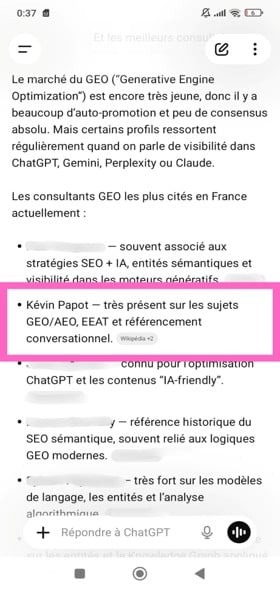
This screenshot is a ChatGPT answer to the question: “who are the best GEO consultants in France right now”. Kévin Papot’s name appears in the list. Not thanks to a six-figure advertising budget. Not thanks to massive press coverage. The “Wikipédia +2” label under the item gives the clue: the source ChatGPT used is a Wikipedia page.
That Wikipedia page no longer exists. It was created on May 7, 2026. It lived for about an hour before moderators deleted it. The account that published it was banned. The URL now points to an empty shell, protected against re-creation. And yet the content lives on. In Google. In ChatGPT. Probably for several more months.
This article explains the mechanism. Above all, it does more than that: it maps out the full Wikipedia game as it exists in 2026, from the purest white hat (citation needed, strategic translation, Wikidata entry) to the openly offensive tactic. Because understanding both extremes is the only way to choose intelligently where to set your cursor.
Why now? Ahrefs analyzed 78.6 million AI queries in June 2025: Wikipedia is cited in 16.3% of ChatGPT answers, 12.5% on Perplexity and 8.4% in Google AI Overviews. Discovered Labs goes further: among the top 10 sources most cited by ChatGPT, Wikipedia alone accounts for 47.9% of all citations. A near-monopoly.
One important caveat before getting into the details. Wikipedia does not create a brand’s authority. It amplifies it. It is exactly how the mushroom works in Mario Kart: without the car (the underlying SEO, PR, brand-building) the boost does not win you the race. With the car, it shoots you ahead of everyone. This article assumes the car exists.
Why Wikipedia has become the #1 GEO accelerator
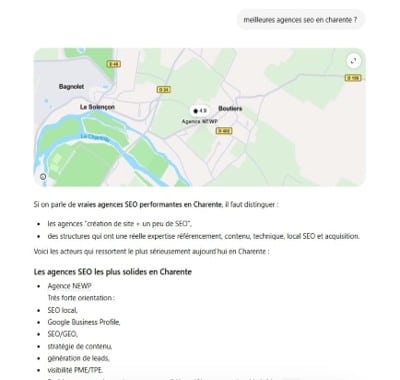
The screenshot above illustrates the point: ChatGPT, asked about the best SEO agencies in Charente, puts NEWP in first position with precise geographic coordinates. It is a typical local GEO use case in 2026. Behind this answer, Wikipedia (and the sources Wikipedia relies on) plays a systemic role. Three distinct mechanisms are at work.
Wikipedia in LLM training corpora
All the major generative models (GPT, Claude, Gemini, Llama, Mistral) were trained on a mix of Common Crawl (a raw snapshot of the web) and curated sources. Wikipedia is one of the curated sources most systematically included, because it combines three rare characteristics: volume, editorial quality, and a free license.
According to a Mozilla Foundation study, Common Crawl accounted for more than 80% of GPT-3’s tokens, and at least 64% of public LLMs released between 2019 and 2023 used at least one filtered version of Common Crawl for pre-training. Wikipedia, for its part, is almost always included on top of Common Crawl, with a relative weight out of proportion to its raw size, precisely because its average quality is considered higher.
The operational consequence: what is written on Wikipedia today will be part of the knowledge of the LLMs trained tomorrow. And what Wikipedia cites today becomes a reference source for those same LLMs.
Wikipedia in real-time citations
The other way in is real-time citation, through the “search-grounded” modes of LLMs (ChatGPT Search, Perplexity, Google AI Mode, Claude with web search). Here, the numbers speak for themselves:
| Platform | Share of answers citing Wikipedia |
|---|---|
| ChatGPT | 16.3% |
| Perplexity | 12.5% |
| Google AI Overviews | 8.4% |
Source: Ahrefs Brand Radar, June 2025, across 78.6 million AI queries
Discovered Labs (December 2025) specifies that among the top 10 sources most cited by ChatGPT, Wikipedia accounts for 47.9% of the total. Reddit, Forbes, Amazon and others share the rest. Profound (analysis of 680 million citations) also ranks Wikipedia as the #1 source of ChatGPT citations, at 7.8% of total volume across all domains. For an SEO in 2026, these numbers mean one very simple thing: a Wikipedia mention is not a backlink. It is a probability of appearing in LLM answers, every time a user asks a question on the corresponding topic.
The amplification effect: free tier-2 backlinks
There is a third mechanism, often forgotten. Wikipedia is used as a primary source by journalists, writers and researchers. When a brand is cited in a well-written Wikipedia article, the probability that a writer at an outside publication (from Le Monde to a niche blog) then picks it up in their own article increases significantly, without any action from the brand concerned.
These tier-2 backlinks, for their part, are standard dofollow links. That is the hidden ROI of good Wikipedia mentions.
The Wikipedia / Wikidata / Commons triangle
First beginner’s mistake: believing that “doing Wikipedia” means “getting a Wikipedia page”. It does not. The Wikimedia ecosystem is a triangle with three vertices, and 95% of French-speaking SEOs only play on one. That asymmetry of effort is what makes the strategy profitable.
| Surface | Audience | Notability required | SEO impact | GEO impact |
|---|---|---|---|---|
| Wikipedia | Human readers | High (reliable secondary sources) | Indirect (E-E-A-T, referral) | Very strong (LLM citation, AI Overviews) |
| Wikidata | Machines (Google, LLMs) | Permissive (verifiable sources are enough) | Direct (Knowledge Graph, Knowledge Panel) | Strong (recognized entity) |
| Wikimedia Commons | Reusable media | Very permissive (a free license is enough) | Indirect (image, author credit) | Moderate but cumulative |
For the vast majority of brands:
- Wikidata is accessible immediately, with no question of press notability. The structured entry feeds Google’s Knowledge Graph directly. A 2024 study picked up by entity SEO researchers shows that brands with a verified Wikidata entry are 3.2 times more likely to have a Knowledge Panel and 2.7 times more likely to be cited in AI Overviews.
- Wikimedia Commons is a freely licensed media bank. Any photo, infographic or diagram uploaded there can be reused anywhere, including on Wikipedia with visible author credit. The barrier to entry is minimal.
- Wikipedia is the top of the triangle. The barrier is the highest, but the GEO impact is also the strongest.
The mistake is going straight for Wikipedia without having built Wikidata and Commons first. With a complete Wikidata entry, freely licensed media already uploaded to Commons, and reliable secondary sources (press, books with an ISBN, academic studies), a Wikipedia page becomes acceptable even to vigilant moderators. Without that infrastructure, the effort is largely wasted.
The 4 rules to know before editing
Four founding rules structure the entire Wikipedia community. Breaking them head-on leads to a domain blacklisting that is close to irreversible. More dangerous for a brand than a Google penalty, because it is manual and no algorithm lifts it.
- WP:N – Notability. The subject must be covered by at least two reliable, independent and substantial secondary sources. Press releases, “about” pages and self-published content do not count.
- WP:NPOV – Neutral point of view. No superlatives, no marketing speak, no promotional angle. The facts, nothing but the facts, balanced.
- WP:V – Verifiability. Every claim must be traceable to a source. It is the most structuring rule: Wikipedia does not publish the truth, it publishes what is verifiable.
- WP:NOR – No original research. You cannot publish on Wikipedia a claim that does not already exist in a secondary source. That is what shuts the door on self-publications of the “concept X that I invented” kind.
On top of that comes WP:COI (conflict of interest): if you edit a topic in which you have a personal or commercial interest, you are supposed to declare it publicly on your user page and on the article’s talk page. And an empirical but critical community rule: before touching a single external link to your own site, build up 10 to 15 constructive contributions on other topics. This is what experienced editors call “warming up the account”. A recent account that immediately adds an external link is automatically flagged by the bots that monitor recent changes.
WHITE HAT: 5 durable, compliant tactics
The “citation needed” sniper
On French-language Wikipedia, around 500,000 claims carry the [réf. nécessaire] tag. It is an explicit invitation from editors to propose a source.
Workflow:
- Identify articles in your topic area with this tag, using the Google query:
site:fr.wikipedia.org "your keyword" "[réf. nécessaire]"
- Read the claim that needs a source in its context.
- Identify on your own site (or elsewhere) a resource that factually validates the claim (not marketing copy, informational content).
- Edit the article and add the reference in the standard Wikipedia format.
- Fill in a factual edit summary.
Edit summary template to copy:
Sourcing the claim “[insert the sentence]” with a verifiable external reference.
The golden rule: the resource proposed as a source must itself meet reliability criteria (identified author, publication date, factual content). A product page or a sales landing page will be removed immediately.
Dead link replacement
Wikipedia has a dedicated category for articles containing dead links: Catégorie:Article contenant un lien mort. Several tens of thousands of French-language articles are listed there. For each one, the original external link no longer works, but the claim remains, orphaned of its source.
Workflow:
- Identify an article in your topic area within the category.
- Locate the dead link in the article’s source code.
- Retrieve the original content through the Wayback Machine (web.archive.org).
- Create or identify on your site a resource that covers the same claim, at least as complete as the original.
- Propose the replacement with an explicit edit summary.
This is the tactic with the highest acceptance rate, because it provides an objective service to the community: replacing a broken link with a live one.
Strategic translation
An English-language Wikipedia article does not always have a French-language equivalent. For a technical B2B topic, that is often the case: there is a dense, well-sourced EN version, but the FR version does not exist or is just a stub.
Workflow:
- Identify on Wikipedia EN an article in your topic area with no FR equivalent.
- Check the sources of the EN article: if they are solid, the translation is legitimate.
- Translate the article while respecting the original sources.
- Add French-language sources, where introducing your own references becomes acceptable (books, studies in French).
- Publish following Wikipedia’s translation rules (mention in the edit summary, interlanguage link).
It is a contribution encouraged by the community. You expand the French-language scope of Wikipedia while legitimately bringing in the sources that structure your topic.
The Wikidata entry (the invisible foundation)
If you were to keep only one action from this entire article, it would be this one. Creating a Wikidata entry is immediate and free, and it is the most direct route for an entity (brand, person, product) to be recognized by Google’s Knowledge Graph and, by extension, by LLMs.
Workflow:
- Go to wikidata.org and create an account (reusable for Wikipedia later).
- Check that no entry already exists for the entity.
- Create a new item (Q-ID assigned automatically).
- Fill in the essential properties: instance of (P31), country (P17), official website (P856), founded by (P112) if relevant, industry (P452), etc.
- Source each property with verifiable external references.
- On your site, implement the sameAs property in the Organization JSON-LD schema:
{
  "@context": "https://schema.org",
  "@type": "Organization",
  "name": "Your Brand",
  "url": "https://votresite.com",
  "sameAs": [
    "https://www.wikidata.org/wiki/Q12345"
  ]
}
This loop (Wikidata entity ↔ the site’s Organization schema) is the strongest signal Google interprets as “this entity is identified, sourced, verified”.
Wikimedia Commons + becoming a reliable secondary source
Wikimedia Commons is spectacularly underused in France. Uploading your professional photos, industry infographics and educational diagrams there under a CC-BY-SA license builds a stock of media that other Wikipedia contributors can reuse freely. Each reuse generates a visible author credit (often the author’s name or the brand’s).
Becoming a reliable secondary source is the strategy that changes everything in the long run. Rather than chasing Wikipedia mentions, the goal is to become the kind of author Wikipedia cites spontaneously. Three structuring levers:
- Publish books with an ISBN. A book with an ISBN released by a recognized publisher (or through structured self-publishing, such as Independently Published) becomes citable as a secondary source. At NEWP, four books on SEO, GEO and AEO have been published, including Le SEO est Mort. Vive l’AEO (ISBN 979-8294376406). These books are regularly picked up as references in French-language articles covering GEO and AEO topics.
- Publish original studies with a public methodology. On the model of Ahrefs or Semrush studies: a sample, a reproducible method, quantified results. A clean study can be cited indefinitely.
- Contribute to the trade press. An op-ed in a recognized publication (JDN, Webmarketing & co’m, Frenchweb, Salesdorado…) in turn becomes a potentially citable secondary source.
GREY HAT & BLACK HAT: 2 offensive tactics
This section is the flip side. Two offensive tactics, illustrated by operations carried out at NEWP. They work. They burn an account (and often an IP). They leave a lasting trace. They should be used with full awareness of the risk.
GREY HAT, inserting a reference into an existing article
The principle. Rather than creating a new article, you target an existing, well-ranked Wikipedia article in your topic area, enrich it substantially (3 to 5 useful, factual, sourced paragraphs), and in the same edit, discreetly insert your own resource (book, study, article) into the bibliography or references.
The mechanism relies on cover: the added value of the enrichment makes the edit acceptable overall in the moderators’ eyes, and the external link goes through with the rest.
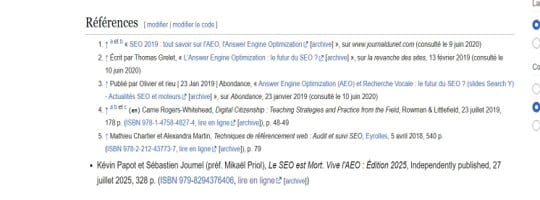
In the References section of the French-language Wikipedia page Answer Engine Optimization, the fifth item is a book by Kévin Papot and Sébastien Joumel, Le SEO est Mort. Vive l’AEO : Édition 2025 (ISBN 979-8294376406). The insertion was made several months ago, as part of a broader edit that expanded the article with additional sourced paragraphs. No challenge has appeared on the talk page. The reference still holds. Why it works (and why it is grey hat):
- What makes the tactic compliant: the real editorial contribution to the article. Without it, the edit would be flagged and the reference removed.
- What makes it grey hat: the absence of a conflict of interest declaration (WP:COI). Under Wikipedia’s strict rules, the editor should have declared their connection to the cited book.
In this specific case, the account used for the insertion was recent, with no contribution history. It would have been better to “warm up” the account with 10 to 15 neutral edits on other articles before the sensitive insertion. The fact that the reference held anyway is probably down to the quality of the editorial enrichment that came with the edit.
BLACK HAT, the hara-kiri strategy
The principle is to create, in series, from an account destined to be banned, Wikipedia articles that deliberately break the rules (typically “Top X” or “Best Y” formats that violate WP:NPOV and WP:OR). The articles are deleted. The account is banned. But between publication and deletion, Google has crawled, indexed and cached. LLM bots have also ingested the content.
The consequence: the SERP keeps a trace for weeks to several months after the Wikipedia page is deleted. The content is also likely to appear in the training corpora of generative models trained or retrained during that period.
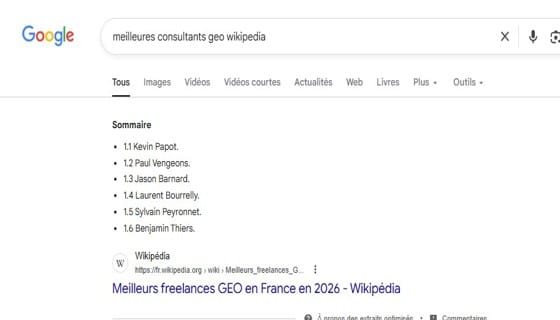
On May 7, 2026, from a Wikipedia account created for the occasion, a batch of 15 to 20 “Top X” articles was published in one hour, on various GEO/SEO and industry topics. The articles included the names of recognized agencies and consultants in the field (Jason Barnard, Sylvain Peyronnet, Laurent Bourrelly…) alongside the names to promote (Kévin Papot, Sébastien Joumel).
The account was banned within the hour. Most of the articles were deleted or protected against re-creation.

The Wikipedia page “Meilleurs consultants geo en France en 2026” remains indexed, but clicking the link leads to a page protected against re-creation. The Wikipedia content is gone, but the SERP trace remains. Measured result, one week after the operation:
| Metric | Observed value |
|---|---|
| Articles published (batch) | 15-20 |
| Total publishing time | ≈ 1 hour |
| Average article lifespan on Wikipedia | ≈ 1 hour |
| Operational cost | 1 account + 1 IP burned |
| SERP survival rate (1 week later) | 70% |
| Google page 1 presence rate | 40% |
| Observed LLM impact | Citation in ChatGPT (see intro screenshot) |
The underlying cognitive mechanism: The “Top X / Best Y” format manufactures apparent consensus where no public consensus exists. Listing a name alongside established figures such as Jason Barnard or Sylvain Peyronnet creates, by association, a perception of equal status. The SERP relays that perception. LLMs, which ingest all of it, consolidate it.
The underlying offensive trade-off: A Wikipedia account destined to be banned is an asset that will expire. The logic is that of an option close to expiry. You maximize the value extracted before it expires. Publishing a single article carries the same risk as publishing twenty. The marginal cost of publishing, once the account is created and the decision made, is close to zero. Statistically, the bigger the batch, the higher the absolute number of articles that “slip through the net”.
Operational hygiene
For anyone attempting either of these two tactics, here are the anti-patterns to avoid (learned the hard way):
- Never operate from the agency’s IP or your personal IP. Use a VPN with a rotating IP. An IP burned on Wikipedia can later block any contribution from that IP, including legitimate ones.
- Warm up the account before any sensitive edit (10-15 neutral contributions on other articles). Only useful if you want to keep it.
- Space out sensitive edits over time if the tactic is insertion (grey hat). Concentrate them if the tactic is hara-kiri (black hat).
- Do not reuse an account name, a signature or recurring language patterns. Sockpuppet investigations detect these signatures.
- Never declare publicly that an offensive operation was carried out from an official agency or brand account.
What is sacrificed vs what is gained
| What you sacrifice | What you gain |
|---|---|
| 1 account (to be recreated) | Several months of SERP presence after deletion |
| 1 IP (best not reused) | A lasting probability of LLM citation |
| A reputational risk if the tactic is publicly traced | A manufactured consensus effect on commercial queries |
| ≈ 1 hour of operational work | A GEO asset that is hard to reproduce once the window has closed |
The Wikipedia agency business: what do they really sell?
A parallel market needs a mention, because most companies interested in Wikipedia are first approached by specialized agencies before they have read a guide like this one. Providers position themselves on creating and maintaining Wikipedia pages, with prices ranging from €100 on Fiverr (questionable quality) to €15,000-20,000 for “full” 12-month packages. The standard sales pitch: “we have in-house Wikipedia editors / we know the rules”. In the vast majority of cases, it is false or greatly exaggerated.
Since June 2014, following the Wiki-PR scandal, the Wikimedia Foundation’s Terms of Use require explicit disclosure of any paid editing (WP:PAID policy). 99% of agencies break this rule. Explicit disclosure, when it is made, labels the page as a “paid edit” and heightens moderator vigilance.
Three scandals to know to understand the market dynamics:
- Wiki-PR (2013). A US agency edited for its clients through an army of sock puppet accounts. The community investigation identified more than 250 accounts linked to the agency. Wiki-PR was banned in October 2013, followed by a cease-and-desist from the law firm Cooley LLP. It was the trigger for the Terms of Use update in June 2014.
- Operation Orangemoody (2015). 381 accounts banned for an extortion scheme: creating Wikipedia pages on minor companies or personalities, then demanding payment to “maintain” or “protect” them.
- The North Face × Leo Burnett (2019). The agency Leo Burnett Tailor Made, hired by The North Face Brazil, replaced photos of popular natural destinations (Aigüestortes, Cape of Good Hope…) with photos featuring North Face products. The goal: rank higher on Google Image Search. The brand bragged about it in a video published by AdAge. The Wikimedia Foundation published a scathing response. The North Face had to apologize publicly. All the photos were removed. The global reputational cost far exceeded the initial marketing benefit.
The business verdict for a decision-maker:
| Situation | Rational decision |
|---|---|
| Real notability (independent press, ISBN, cited studies) | In-house DIY or a consultant declared under WP:PAID |
| No real notability, just a budget | Invest in notability first (see “Becoming a reliable secondary source”) |
| Urgent need for visibility in LLMs | Wikidata + Commons, not Wikipedia |
| A competitor has a page, you do not | An honest notability audit, then Wikidata for 80% of the benefit |
The simplest rule: if an agency offers a Wikipedia page without asking any question about the client brand’s measurable notability, it will sell something that will be deleted. The brand pays for an asset with a limited lifespan, with a risk of domain blacklisting thrown in.
Toolkit
Here are a few complementary tools that can help you with the implementation.
| Tools | Use |
|---|---|
| WikiGrabber | Find articles with [réf. nécessaire] or dead links in your topic area |
| WP category “Articles with dead links” | Raw source of dead link replacement opportunities |
| Wayback Machine (web.archive.org) | Retrieve the original content of a dead link |
| Wikidata Query Service | Audit the structure of a Wikidata entry, compare it with competitors |
| Knowledge Graph Search API (Google) | Check whether Google officially recognizes an entity |
| Ahrefs Brand Radar / Profound / OtterlyAI | Measure visibility in LLM answers |
| Check My Links (Chrome extension) | Quickly detect dead links on a Wikipedia page |
| JSON-LD Generator / Schema App | Implement the sameAs to the Wikidata entry on your site |
Conclusion: 3 actions this week
In 2026, Wikipedia, Wikidata and Commons form the most profitable and most underused GEO triangle in French-language SEO. Not because it manufactures a brand’s authority, but because it amplifies the authority that already exists. Mario Kart.
Three pillars to remember: (1) the triangle has three vertices, not just one; (2) the grey zone exists and is a choice, made with full awareness of the risk; (3) the residual value of an offensive operation can far exceed its operational cost (but the risk/benefit ratio must be weighed with a cool head).
To activate the lever this week, three actions to prioritize:
- Check whether your entity has a Wikidata entry. If it does, audit and complete it. If not, create it. Time: 30 minutes for the initial creation, 1 to 2 hours for clean sourcing of the properties.
- Identify 5 French-language Wikipedia articles in your topic area with a usable [réf. nécessaire] tag. Prepare the corresponding external resource. Time: 1 to 2 hours for all 5.
- Implement the Wikidata sameAs in your site’s Organization schema. Time: 15 minutes for a developer.
These three actions are 100% white hat and durable, and they kick-start the strategy. Everything else (including the offensive sections) will be even more powerful once these foundations are in place.
The questions we get over and over.
Why does Wikipedia matter so much for GEO?
Wikipedia is in the training corpora of all the major models and serves as a source for answers with web search. According to Ahrefs, it is cited in 16.3% of ChatGPT answers, 12.5% on Perplexity and 8.4% in Google’s AI Overviews.
Do you need a Wikipedia page to be visible in LLMs?
No. A Wikidata entry can be created with no notability requirement and feeds Google’s Knowledge Graph directly. The author advises building Wikidata and Commons before aiming for a Wikipedia page.
Which Wikipedia tactic has the best acceptance rate?
Dead link replacement: you retrieve the original content on the Wayback Machine and propose a live resource that covers the same claim. The community sees it as a service rendered.
Should you use a Wikipedia agency?
Rarely. Since 2014, any paid editing must be disclosed, and most agencies do not do it. An agency that promises a page without questioning the brand’s measurable notability is selling a page that will be deleted.



What the community says.