



- All salespeople in the same role get the same rate scale and the same chances of reaching the maximum bonus.
- No more than four or five objectives, qualitative and quantitative combined.
- Short sales cycle: low base salary and high variable pay, between 40 and 60%. Long cycle: base salary of 80% or more.
- Collective objectives should not exceed 20% of variable pay.
- A cap exposes you to the « fridge effect »: the salesperson keeps their hot deals for the next period.
We know it: the compensation model is an effective way to steer your teams’ efforts. But it can be hard to build. Which elements should you take into account, and what are the tricks for setting up an effective compensation plan? We answer in 10 questions.
1. Does everyone understand your commission scheme?
Your compensation system has to be fair and equitable. That does not mean all your salespeople earn the same amount, but that they all work with the same rate scale and have the same chances of landing the maximum bonus.

So it is essential that your compensation policy is readable and understood by everyone. To get there, set no more than four or five objectives (qualitative and quantitative combined) and communicate about your commission plan. This avoids bad surprises and frustration among your salespeople. To do this, you can give your reps bonus calculation tools such as Excel files, or a tool like PaletteHQ, so they can simulate their earnings easily.
On top of that, there has to be a direct link between the company’s success indicators and the way you pay your salespeople. For example, if you pay your reps on volume or revenue, your compensation plan will not be aligned with your profitability goals, and it will not pay reps effectively. So remember to adapt your compensation plan to the company’s objectives, so that the two are aligned. In short: the company’s expectations must be clear, and the compensation system, which encourages employees to meet them, must follow directly from them.
2. Are your commissions easy to calculate?
Some compensation systems are complex. For example, point systems, which weight a mass of figures against the performance of the sales force. Or systems built on tiers that give variable commission rates depending on the thresholds reached. The problem is that this kind of system does not let you predict in advance how much commission the rep will make by the end of the year. And that hurts the motivation of reps, who think short term when it comes to commissions!
For them, in fact: one sale = one commission, which concretely lets them buy item X or Y. So you need to build your compensation plan around this behavior, so that it motivates your salespeople.
3. How much variable pay and how much base salary?
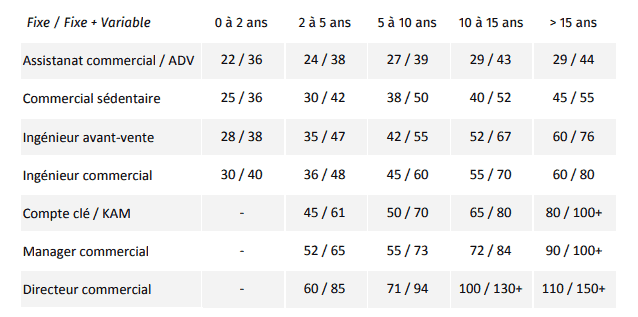
Your salespeople, with few exceptions, are paid both a fixed part and a variable part. The base salary rewards skill, while variable pay rewards performance.
In France, the base salary is at least the SMIC (the French statutory minimum wage) or the minimum wage set by the collective bargaining agreement that governs your business. The market sets this floor: it is the average base salary of salespeople observed in your sector. So a company operating in a market where salespeople are scarce will tend to pay a higher base salary than in a sector where good people are plentiful. Use what you know about the job market in your sector to highlight your strengths compared with competing employers in the same sector.
Once the base salary is set, you then need to build the variable part. Generally, in B2B, variable pay sits roughly between 20 and 30%, which means a base salary between 70 and 80% of total pay.
The shorter the sales cycle, the more it makes sense to adopt a system with a low base salary and high variable pay, between 40 and 60%. In this type of sale, the objectives tied to variable pay can be reached quickly. On longer cycles, on the other hand, a high base salary (80%, or even more) is recommended, because variable earnings come in further apart.
4. How far should you individualize objectives?

The sales director should ask whether to standardize or individualize objectives. The golden rule: people doing the same job and facing the same responsibilities must be treated identically. On the other hand, we recommend different rate scales depending on whether your salespeople sell different offers or handle specific targets (key accounts, SMBs, consumers…), or whether they are inside sales or field sales.
To counter individualism, a good solution is to reward both individual and collective performance. Collective performance encourages salespeople to help one another. However, betting on collective performance lets weaker salespeople hide behind the team’s results, masking their mediocre individual performance. That is why collective objectives should not exceed 20% of variable pay.
Salesdorado’s tipGuillaume Call, then head of sales France at Partoo, explained in an interview with Salesdorado that they worked in cells of 2 SDRs and one Sales to foster healthy competition and limit rivalry. Perhaps one avenue to explore would be to set objectives for cells of salespeople, to foster cooperation and the company’s interests while staying close to individual performance?
In some cases, different compensation systems coexist for the same population of salespeople, for example when you have junior salespeople. You can set them more flexible, lowered objectives, “easier” to reach than the others: number of promising contacts, leads generated… This keeps a performance gap from opening up, and makes them feel that effort pays off.
5. Should you cap the compensation plan?
Setting a cap, which can go beyond 100% in a spirit of overperformance, is an option often considered in a compensation plan. However, this practice can set limits for salespeople, even unconscious ones. What’s more, the risk with capping is the “fridge effect”: the salesperson who has hit the top tier puts their “hot” deals aside for the next period, to secure their next results… To avoid these practices that limit sales results, space out your objective periods (six months, for example).
That said, capping also has advantages, notably that of bounding sales capacity. Beyond a certain level of performance, it is very often other, circumstantial factors that work in the salesperson’s favor without being down to them. Also, a cap can act as a safeguard when rolling out a new compensation policy whose rate scales are not yet final. Only once it has been broken in can your system work without one.
6. Which calculation method should you choose?

There are three main methods for calculating variable pay:
- Commission (on margin, on revenue…): This system is a percentage of the business volume generated by the salesperson, paid out on a linear logic: the more I sell, the more I earn. The base salary is therefore relatively low (in France, it can in any case not be lower than the SMIC or the minimum wage of the collective agreement applied in the company) and variable pay applies from the very first euro.
- Ranking: This means ranking your sales force from first to last, with pay that varies according to each person’s position in the final table. The difficulty is finding fair ranking criteria. And ranking does not reflect gaps in performance… So the top seller will receive the same amount of variable pay as the top seller the following month, for performance that is sometimes very uneven.
- Bonuses on objectives: This means measuring the rate at which a salesperson reaches the objective set. For example, if the objective is to sell 125 units and the salesperson sells 250, they will have achieved 200% of their objective and will be paid accordingly. However, this system can push salespeople to negotiate their objectives down, and so hold back performance.
A salesperson whose variable pay is a percentage of their sales will very often have an interest in selling at the lowest possible price, and selling often, especially when average deal sizes are high.
For example, when calculating a real estate agent’s sales bonus:
- Raising the sale price of an apartment from €200,000 to €220,000 (a 10% increase) means a significant increase in the time it takes to sell.
- For the agent, who earns a commission of up to 5% of the sale price, it means earning 11,000 instead of €10,000.
- So it is much more in their interest to try to sell two properties at €180,000 rather than a single one at €220,000. But that is not at all in the seller’s interest.
7. How do you make the most of indirect compensation?
There is also another type of compensation called “compensation peripherals”, which includes long-term pay. It covers in particular profit-sharing (in France, the “participation” scheme), the share of profits, employee benefits, paid leave, sales training, income security programs and the other perks the company grants its employees…
Companies can opt for this long-term method to retain their employees. For example, you can set up a profit-sharing bonus (the French “intéressement”), received once or twice a year, based on the percentage of revenue achieved. So the longer the employee has worked at the company, the larger their bonus will be.
Other elements that are not compensation in the strict sense can be just as many benefits to highlight to your team to motivate and retain them. A few examples: meal vouchers, company car, seniority bonus, mobile phone, computer, supplementary health insurance…
Don’t neglect contests and other incentive operations either, which also count. Finally, small, simple and inexpensive gestures such as flowers delivered to the workplace, a meal at a fine restaurant, or access to training often prove extremely effective.
8. Do pay gaps reflect performance?
In France, employees have a strong culture of vested rights, and companies avoid discontent at all costs. As a result, the gaps between the different reward levels are often small… which strips variable pay of any motivating effect!
To be motivating, the “good” salesperson must earn a lot, while the “bad” one will get almost nothing extra. This principle encourages overperformance. And a real variable pay policy motivates employees because it lets them truly measure the efforts that are rewarded.
A variable pay plan that lacks appeal creates retention problems for the best salespeople. They are driven by the wish to increase their earnings and collect as many bonuses as possible. So if one of them judges that the products or services they are in charge of selling do not let them perform in good conditions, they will quit. A company that loses its salespeople will therefore need to look at how attractive its variable pay plan is and at the quality of the products and services it offers.
Many business leaders admit to having carried underperforming reps for several years. That costs companies money without bringing any in! An effective compensation plan, in which performance that declines over a long period shows in the pay, will make bad salespeople leave the company.
9. Does your compensation plan motivate all your salespeople?
An effective compensation plan must keep all your salespeople motivated. So it has to satisfy new hires and veterans, top performers and weaker ones alike. Design it so it can adapt to the different situations you see across your sales force, and play with variable pay and calculation methods. We’ll say it again: to be effective, the compensation plan must be fair and equitable, and penalize no one.
Also ask yourself how your compensation plan affects your salespeople’s motivation at the end of the month/quarter/year, and whether it leaves the pipeline full or empty.
10. Do you regularly challenge your commission plan?
Launching a new offer, changing sales strategy, entering a new market… Every time the company wants to take a new direction, it makes sense to challenge your compensation plan. Ask yourself: is your compensation policy still in line with what you expect from your salespeople? Are the planned objectives still as realistic given the economic climate? The point is not to start from scratch, but to adjust the existing one.
A review can also be justified in times of crisis. So how do you adjust the compensation system to keep the sales force motivated without penalizing it? Raising the base salary by 25 to 50% and choosing variable pay on objectives rather than commission puts your sales force at ease in a difficult economic context.
No variable compensation plan means no real pressure. And an effective variable compensation plan should trigger motivation in employees. The variable compensation plan should “challenge” them and push them to go after performance.
In some situations, managers are afraid to talk about the variable compensation plan. Often, it is simply because they do not understand it. And that can come across as a lack of transparency! So the sales director must keep in mind that they have to run the plan, meaning keep it alive day to day and not hesitate to take up questions about calculation errors. A good variable compensation plan must live and must be a topic of discussion in the company!
Go further
The questions we get over and over.
How much variable pay should a salesperson's compensation include?
In B2B, variable pay sits roughly between 20 and 30%, meaning a base salary between 70 and 80% of total pay. The shorter the sales cycle, the higher variable pay can go, between 40 and 60%. On long cycles, a base salary of 80% or more is recommended.
What are the methods for calculating variable pay?
There are three main ones: commission, a percentage of the business volume generated; ranking, which pays according to each person's position in the sales force; bonuses on objectives, which measure the rate at which the set objective is reached.
Should you cap the compensation plan?
A cap exposes you to the "fridge effect": the salesperson who has hit the top tier puts their hot deals aside for the next period. It can however act as a safeguard when rolling out a new compensation policy, as long as the rate scales are not final.
Should you individualize salespeople's objectives?
Salespeople who do the same job and have the same responsibilities must be treated identically. Different rate scales are justified depending on the offers sold, the targets handled (key accounts, SMBs, consumers) or whether they are inside or field sales.
When should you review your compensation plan?
Every time the company takes a new direction: new offer, change of sales strategy, new market. A review can also be justified in times of crisis, for example by raising the base salary and preferring variable pay on objectives to commission.



What the community says.