



- A satisfaction score is only worth the action it triggers. Collecting for the sake of collecting is pointless.
- CSAT, NPS and CES complement each other: immediate satisfaction, overall commitment, effort required. Don’t bet on just one.
- The hands-on approach counts: calling 3 to 5 customers a month brings field feedback that forms will never capture.
- Silent customers speak through their usage. Watch the behavioral signals to spot latent dissatisfaction.
- Consistency beats perfection: a regular tracker reveals trends, a yearly audit reveals nothing.
Companies that excel at customer experience outperform the laggards by nearly 80% according to Forbes. Listening to your customers and improving their experience isn’t just a stance, then: it’s also, and above all, a strong growth lever.
But you can’t improve what you don’t measure. That’s where measuring customer satisfaction comes in. To improve the experience your users or customers have, you need to measure their satisfaction, collect their feedback and, above all, do something with it. That’s what’s called the feedback loop.
In this article, we give you 7 concrete actions to measure customer satisfaction. Some are classics, others more original. The goal is to help you build a setup that’s clear, regular and above all actionable (because a satisfaction score on its own is useless: what counts is what you do with it!).
#1 Send a satisfaction survey after every interaction
It’s the most obvious method and often the most underused. Sending a satisfaction survey after an interaction with the customer is the basic reflex for starting to capture feedback. You still have to do it properly, and we still see far too many companies unable to handle their satisfaction surveys properly.
In many companies, the survey is a plain form sent automatically after a purchase or a support ticket. Surveys are often too long, too impersonal and, in the end, ignored by customers. The result: ridiculous response rates and data nobody ever uses.
Here are a few simple best practices to make it really work:
- Keep it short. Two or three questions, no more. One satisfaction question (CSAT-style), one open question to collect a verbatim and that’s it. It’s not an audit, it’s taking the temperature.
- Get the timing right. When you send the survey matters almost as much as what’s in it. You need to capture the feedback while it’s fresh: right after a call, an order, a delivery, a ticket being resolved…
- Avoid survey fatigue. If you send a survey after every interaction, to every customer, you’re going to lose them. Set simple rules (for example, no more than one every 30 days per customer) or sample instead.
- Personalize the subject line and the intro. An email signed by the right contact, with a personal line about the interaction, will work far better than a generic “We value your feedback”.
On the tools side, you can start with Google Forms or Typeform. If you want to automate at a larger scale, tools like Survicate, Feedier or Jotform can trigger surveys at the right moment, without you having to think about it.
Salesdorado’s tip
Don’t fall into the “collecting for the sake of collecting” trap. If you send surveys, you also need to structure what you do with them. The goal isn’t to fill an Excel spreadsheet, it’s to identify what works and what deserves to be improved.
#2 Rely on scores to make satisfaction objective
It’s good to have a hunch that your customers are satisfied, it’s better to measure it. For that, there are three big classics: CSAT, NPS and CES. They’re the three most widely used indicators for measuring customer satisfaction in a way that’s structured, comparable and above all actionable.
CSAT (Customer Satisfaction Score)
It’s the simplest and most direct indicator. Right after an interaction, you ask the customer:
“Are you satisfied with this interaction?”
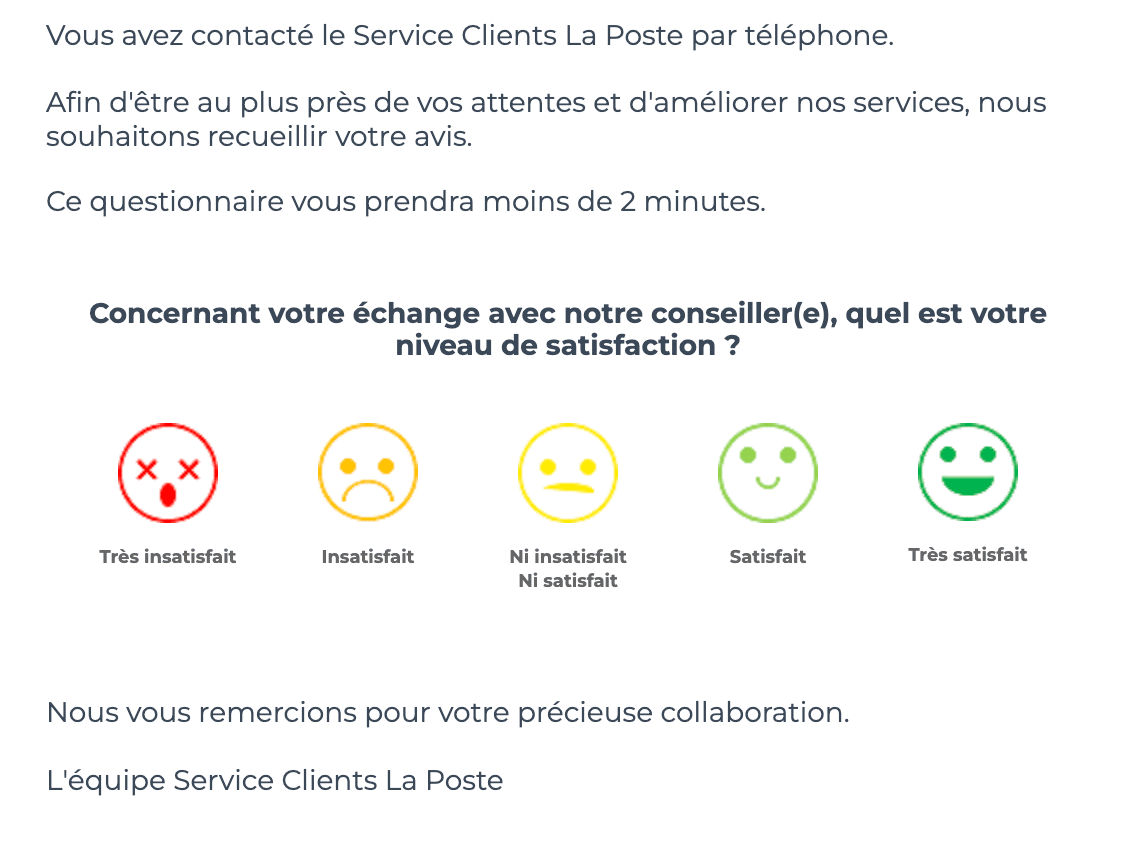
They usually answer on a scale of 1 to 5 (or sometimes 1 to 10), as in the example above from La Poste, the French postal service. You then calculate the percentage of customers who gave a positive score (often 4 or 5 out of 5).
The upside is clarity: the customer understands the question straight away and the answer is easy to interpret. The flip side is the lack of depth. CSAT doesn’t tell you why the person is satisfied or not, or whether they’ll stay loyal.
NPS (Net Promoter Score)
It’s probably the best known and the most used in executive committees. You ask one very simple question:
“Would you recommend our company/product/service to a colleague or a friend?”
The answer is given on a scale of 0 to 10. Respondents are then sorted into three groups:
- 9–10: promoters.
- 7–8: passives.
- 0–6: detractors.
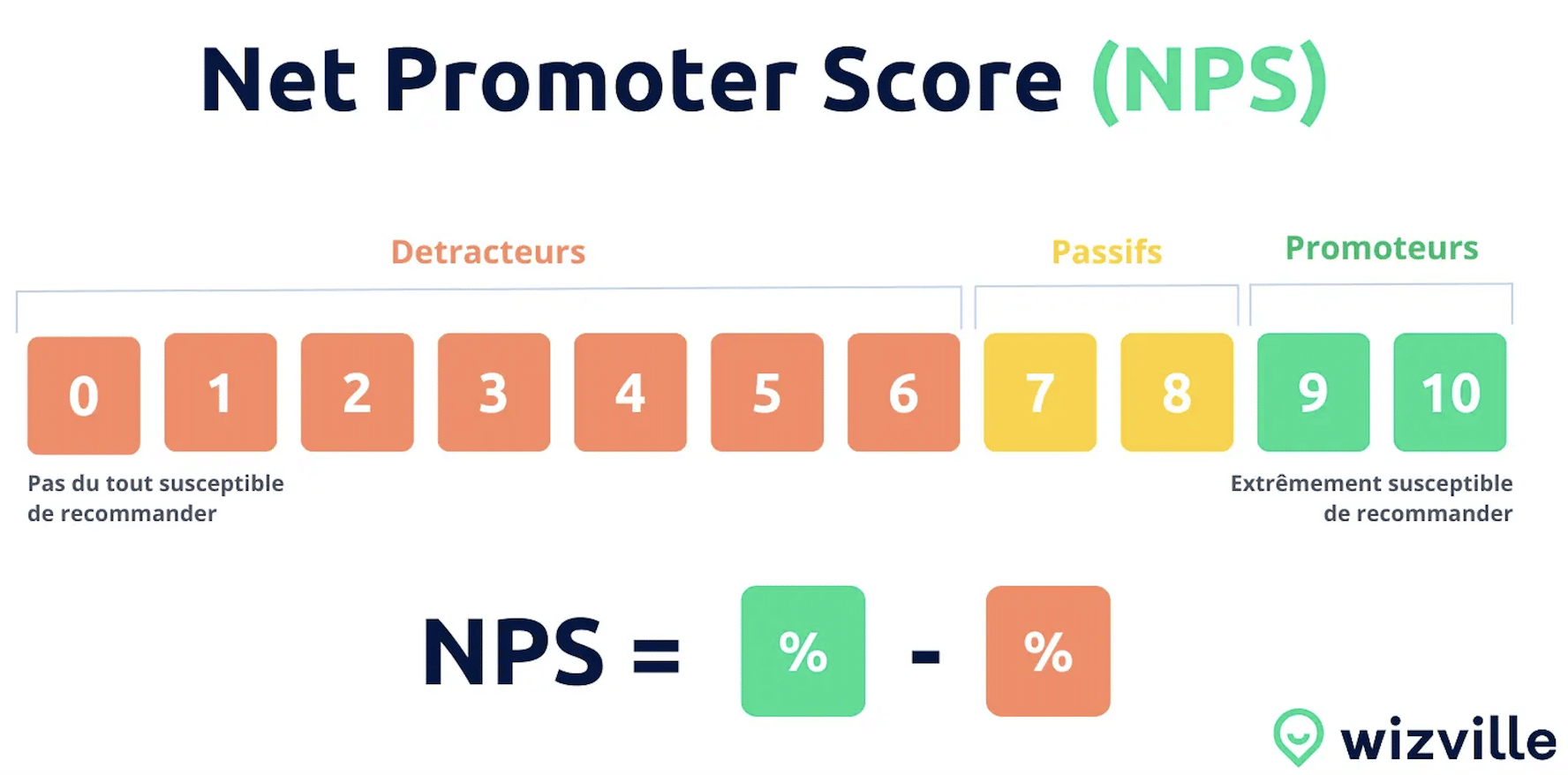
The final NPS equals the % of promoters minus the % of detractors. A score above 30 is already good. At 50, you’re among the best, but average scores vary a lot from one industry to another (hence the point of taking a look at NPS benchmarks).
This score is strong because it captures the overall level of commitment to your brand, but be careful not to use it on its own: a good NPS doesn’t always mean high retention, and a bad score doesn’t necessarily mean everything is going wrong.
NPS is ideal for measuring satisfaction “cold”, a few weeks after the purchase or at the end of the customer journey.
CES (Customer Effort Score)
CES measures another aspect: the effort the customer has to make to solve a problem or complete an action.
The typical question:
“How much effort did it take you to…?”
The scale usually runs from 1 (no effort) to 5 (very difficult). It’s a particularly relevant score for after-sales service, back-office or onboarding journeys. A customer can be satisfied (good CSAT) yet have found the process needlessly painful, and therefore not come back.
CES alerts you to friction in the customer experience. It’s a good complement to NPS or CSAT.
These three scores aren’t mutually exclusive. You can perfectly well use CSAT after a support interaction, CES after a complex procedure (such as a contract change) and NPS once a quarter to take the overall pulse.
#3 Call a handful of customers every month (live)
It’s the hands-on method par excellence. It isn’t scalable, isn’t automated, isn’t “data-driven” in the sense analytics platforms mean it, but its value is unmatched when it’s done well.
At Salesdorado, we like this approach. Because a good call with a customer is often worth 10 answers to a form. That’s where you pick up the nuances, the small irritants, the real expectations, the things customers don’t take the time to write but will happily tell you out loud if you call them at the right moment.
Salesdorado’s tip
No need for a big setup. If you call 3 to 5 customers a month, regularly, and really listen, you’ll quickly get extremely valuable feedback from the field.
A few simple best practices:
- Don’t turn the call into a research interview. The goal is to listen, not to interrogate. Ask one or two open questions such as: “How are things going for you?” or “What did you like / what bothered you recently?”.
- Take notes, not verbatims. The idea isn’t to record every word, but to bring up the key ideas, the weak signals, the changes in tone or perception.
- Vary the profiles you call. Mix satisfied customers, newcomers, silent customers, and so on. It’s not always the ones who complain who give you the most useful information.
#4 Make use of unsolicited customer feedback (emails, reviews, social media)
Not all your customers answer surveys, but that doesn’t mean they don’t speak up. Quite the opposite: many leave you clues in their day-to-day exchanges: a thank-you message by email, a review left on Google, a rating on Trustpilot, a reply to an Instagram story, a slightly annoyed support ticket…
This is what’s called unsolicited customer verbatims. In other words, feedback you didn’t ask for, but that says a lot about the experience they had. And that’s exactly what makes it valuable: these verbatims reflect a real emotion, with no bias from how a question is worded, no filter, no frame.

The problem is that this feedback is often scattered and nobody is really in charge of centralizing it. But it’s not inevitable. You can start very simply:
- Create a Slack channel or a shared board where everyone drops the “notable” feedback they come across (in an email, a call, a video meeting…).
- Set up alerts on your Google, Trustpilot, App Store and LinkedIn reviews, etc.
- Analyze the verbatims in your NPS surveys or in end-of-chat comments.
Little by little, you’ll build up raw qualitative material that rounds out the numerical indicators perfectly. You’ll spot weak signals, recurring pain points, things that surprise (for better or worse)… and concrete ideas for improvement.
Salesdorado’s tip
At Salesdorado, we like this approach. It requires neither a sophisticated tool nor a dedicated budget. Just a bit of attention, method and curiosity about what your customers are saying.
#5 Build customer satisfaction into the long term (tracker & feedback loop)
Measuring customer satisfaction shouldn’t be seen as a one-off project or a marketing exercise you do once a year. If you want to make lasting progress, really, you need to switch to routine mode. That means setting up what’s called a regular satisfaction tracker.
A tracker is a structured measurement, repeated at a fixed frequency (every quarter, every month…), on a stable scope. It can combine several indicators (NPS, CSAT, response rate…), but the most important thing is consistency. The goal isn’t to get the perfect number, but to see the trends, identify the drop-offs, spot the weak signals.
Salesdorado’s tip
A tracker that sleeps in a dashboard has no impact. For it to become useful, you have to bring the results to life: share them with the teams, set up a routine, even a simple one. A monthly meeting dedicated to the voice of the customer, a weekly recap of verbatims, a Slack channel for notable feedback… The format doesn’t matter, as long as it circulates and feeds action.
#6 Watch usage to capture implicit satisfaction
Not all customers speak up. Some never answer surveys, never leave a review, never contact support. But their behavior speaks for them.
This is what’s called implicit satisfaction: it isn’t said, but it shows, whether in the way your customers use (or don’t use) your product, in how often they log in, in the usage rate of features, in the time spent on certain pages, in the steps where they drop off.
When a user comes back regularly, completes their actions and adopts new features, that’s a rather good sign. When they stop logging in, don’t open your emails, stop downloading your deliverables, that’s a warning sign.
We’re not asking you to track everything, but to set up a few simple behavioral indicators to better qualify satisfaction day to day, without having to ask for it. For example:
- The usage rate of key features.
- The activation rate (an “activated” customer is often a satisfied customer).
- A drop in usage (an indicator of latent dissatisfaction…).
- The volume of actions performed.
- The number of logins or the frequency of use.
- Etc.
Salesdorado’s tip
These signals let you identify silent but dissatisfied customers before they leave, and sometimes even segment your feedback campaigns or your follow-ups: no point asking “Are you satisfied?” to someone who hasn’t used you for 3 months.
#7 Run “cold” surveys with lost or inactive customers
It’s probably one of the most useful and most dreaded kinds of feedback: asking your former customers, the ones who left without a fuss, the ones you couldn’t hold on to.
Because they have nothing left to lose, their answers are often very candid, and they let you learn what you didn’t see coming, whether it’s a perceived gap, friction in usage, a broken promise or sometimes just an expectation that was never voiced.
A few best practices to make this kind of survey work:
- Wait a few weeks after the end of the relationship (not in the heat of the moment, otherwise it’s too emotional).
- Phrase the request tactfully, without making them feel guilty or trying to win the customer back. The idea is to understand, not to convince.
- Ask few questions, but the right ones: “What made you stop?”, “What could we have done better?”, “What did you miss?”
- Leave a free-text field at the end: that’s often where the real feedback hides.
Salesdorado’s tip
If you play along, these cold surveys can help you progress faster than any other setup, because it’s the customers who leave who show you what needs to change so the others stay.
The questions we get over and over.
Which indicators should you use to measure customer satisfaction?
Three classic scores: CSAT (Customer Satisfaction Score) for immediate satisfaction after an interaction, NPS (Net Promoter Score) for overall commitment to the brand, and CES (Customer Effort Score) for the effort the customer has to make. They aren't mutually exclusive: CSAT after support, CES after a complex procedure, NPS once a quarter.
How do you calculate NPS?
You ask "Would you recommend our company to a colleague or a friend?" on a scale of 0 to 10. Respondents are sorted into promoters (9-10), passives (7-8) and detractors (0-6). The final NPS = % of promoters minus % of detractors. Above 30 is good, 50 is excellent, but scores vary widely between industries.
How many questions should a satisfaction survey have?
Two or three questions, no more. One CSAT-style satisfaction question and one open question to collect a verbatim are enough. It's not an audit, it's taking the temperature. Surveys that are too long produce ridiculous response rates.
How do you measure the satisfaction of customers who never answer surveys?
Through implicit satisfaction, meaning behavioral signals: usage rate of key features, activation rate, login frequency, volume of actions, drop in usage. A drop in usage is an indicator of latent dissatisfaction that lets you identify silent customers before they leave.
Why survey lost customers?
Because they have nothing left to lose, their answers are often very candid and reveal what you didn't see coming. Wait a few weeks after the end of the relationship and ask a few targeted questions ("What made you stop?"), not to win them back but to understand.


What the community says.