



- Lead management covers lead generation, recording, qualification and scoring, then lead nurturing.
- Respond to a request in under 5 minutes, and communicate across at least 12 touchpoints before giving up.
- Clean the database regularly: duplicates, invalid emails and incomplete data.
- Leads that are still immature, or have no phone number or email, stay within marketing.
- Plan to move a lead back in the funnel if their engagement drops.
You’re launching your business! So you need customers, and for that you need leads. At first, you focus on acquisition and take everything. Good prospects and weaker ones, the promising, genuinely interested ones and the curious passers-by. Very quickly, you realize that managing all these leads comes with a growing cost.
Too many businesses tend to focus on lead generation. Yet the influx of all these potential customers quickly drives up handling and conversion costs. The questions of customer segmentation and of mapping the different journeys soon arise, not to mention dealing with an ever-growing number of touchpoints. Not so simple.
This is where Lead Management comes in. It determines how to communicate, with whom, with what message and at what time. It sorts the flow of leads to route them to the sales or marketing teams depending on their level of interest in your services.
Lead management: definition
Let’s start by drawing the outlines and defining the concept:
“Lead Management is the set of procedures / techniques used to capture prospects (or leads), track their behavior, qualify them and give them constant attention before handing them over to the sales teams when they’re ready to sign.”
Often seen as customer acquisition management or contact list management, it also covers all of the following procedures:
- Generating leads: Sparking the consumer’s interest in a product or service through various marketing levers such as blogs, advertising, white papers or press campaigns.
- Customer inquiry and capture: Marketing targets respond with interest and their data is recorded.
- Qualifying and scoring contacts: Leads are ranked by their potential to become customers. They are then sent to the sales reps. This categorization and scoring work is decisive for the relevance of lead management.
- Lead nurturing: Touchpoints are then scheduled to consistently give leads information they’re interested in.
The great subtlety of Lead Management is that once a sales rep has taken over the Lead, there’s still a lot left to do.
The complexity varies with the size of the company, because organizing 200 leads isn’t quite the same as managing 20,000. And when they become customers, the show must go on! You have to keep nurturing the business relationship, because follow-up is critical to maintaining a good level of customer satisfaction and keeping sales high.
Lead Management best practices
Databases
To get off to a good start, here’s a reminder of the small tricks for managing touchpoints well.
- Validation forms ensure data accuracy; otherwise, a single mistake in the email address or phone number makes the lead unreachable.
- Response time to a request: under 5 minutes.
- Communicate with your Leads across at least 12 touchpoints before giving up.
- The best time to contact a potential customer? Within 5 minutes of receiving their request by email. Otherwise, your time slots are between 7:30 and 8:30 a.m. and between 3:30 and 5:30 p.m.
- Know exactly where each Lead stands in your customer journey thanks to your CRM system, so you don’t “lose” any along the way.
- Automate as much as possible, whether by email or SMS.
The art of automating lead capture
Marketing automation tools are more and more numerous. They will contribute to the efficiency and consistency of your acquisition. By automating the capture of your website’s users, you can not only obtain important data but also start the first exchanges with autoresponders, customer journeys or by making white papers available.
Automated tools are easier to analyze thanks to reporting and API keys. Your marketing team can analyze which content generates the most interest among certain visitor profiles. From there, sales reps can understand the obstacles prospects feel and adapt their strategies accordingly. Both teams make sure no lead receives too much information or, worse, not enough.
Clean your data
The information entering your CRM arrives through different channels, whether manual entry, automated entry or bulk import, and with so many sources, duplicates are inevitable. Incomplete or incorrect data can also be a real challenge. A database cleaning system quickly becomes necessary. The features of some CRMs or Data Management solutions such as Octolis can improve the quality of your data with the right processing (email validity checks, deduplication…).
Prioritize your best leads
Once duplicates are removed and “invalid” emails set aside, your Leads will have very different profiles, more or less close to your typical customer profile. In B2B, you can rely on a scoring method with various variables such as the NAF code, the type of business or revenue. Profiles can be grouped to be dispatched to your salespeople or to your marketing communications depending on how familiar they are with your services. Thanks to this qualification, you automatically route Leads with interesting profiles to the appropriate teams. Validation rules can keep some of your Leads within marketing communications if they’re not mature enough yet or if a key piece of information such as the phone number or email is missing. This avoids routing Leads who aren’t interested enough to your salespeople and wasting their valuable time.
Splitting Leads properly between marketing and sales teams
For effective management, the sales and marketing teams have to manage to work together. As a rule, inbound Leads are discovering your services and are moderately interested in the offers you propose. It’s up to the marketing team to understand their needs and determine whether or not they are potential customers.
Once the marketing teams have routed the Lead to the sales reps, it’s the sales team that will close the deal. It’s crucial to map your sales procedures properly and to clearly define when and how Leads will be handed over to the sales teams. This ensures no lead is neglected or dropped.
How do you go about it?
When you start building a routing funnel, keep in mind that your company is unique. Some organizations have few entry points with a very slow sales cycle, while others multiply touchpoints and close fast sales one after another.
Your specifics will define the type of strategy chosen by marketing and sales. But roughly, your touchpoints should look like this:
- Discovery: How the visitor learns about your company and your services and products.
- Awareness: The mechanisms that turn these visitors into potential customers.
- Entry points: Where the first exchanges between your company and the lead begin.
- Activation strategy: The tools and tactics that help close the sale.
Combine your dashboards and analytics reports
The marketing teams and the sales reps will want to know which channels and promotions are the most effective at attracting qualified Leads. CRM data can support these analyses by linking marketing activities with your CRM data. You’ll know which sources generate the most conversions. With this information, you’ll have a good view of the progress of your sales funnel.
Combining analytics data, reports and dashboards gives you good overall tracking of your customer journey and lets you assess its effectiveness. With these tools, your marketing resources will be better used in the future and ROI indicators will serve to measure the progress of your operations.
Putting it into practice: a close look at a well-oiled Lead handling funnel
Best practices are all very well, but admittedly it’s sometimes hard to picture how it all fits together.
So here’s a typical lead management diagram which, while it doesn’t apply to every business, proves very solid.
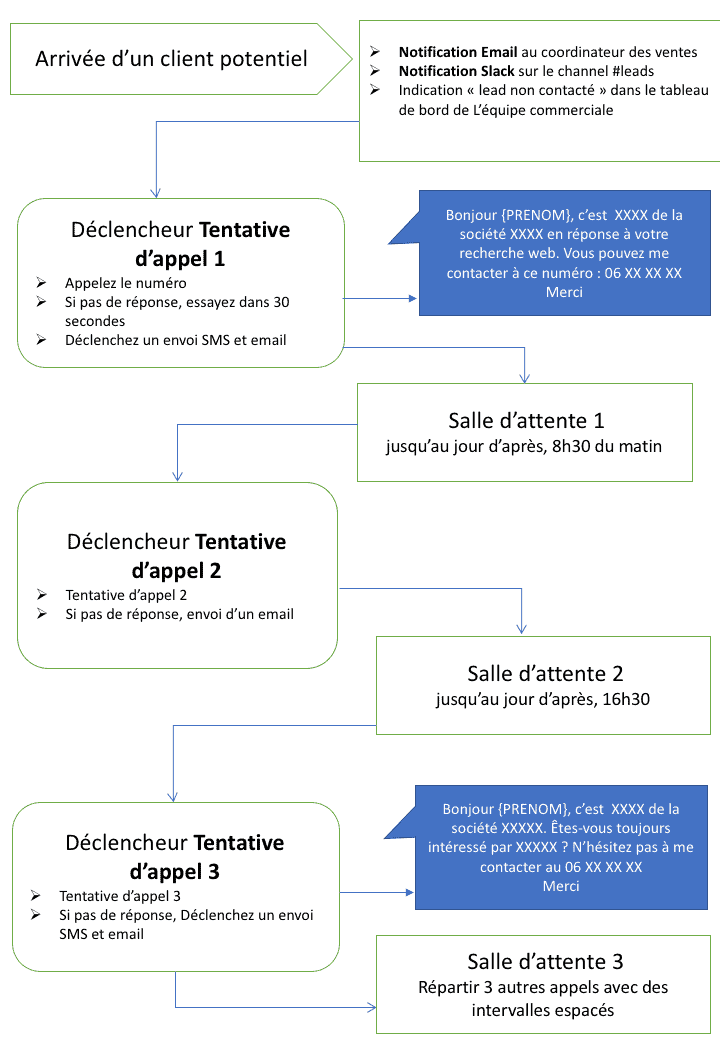
Here you can see how important it is to work on the whole communication chain, starting with Lead qualification, so you don’t waste the lead’s time with unsolicited calls and your own time with a pitch hammered at an uninterested customer. Scoring is a good qualification method you can use by grouping. For example, group A for Leads asking for basic information, group B for those asking for details and group C for those open to receiving a prospecting call.
Of course, we want our Leads to move through a Lead > Marketing > Sales handling funnel, but we also want to be able to move them back if their level of engagement drops. You need to plan for this scenario, which is more common than it seems.
After all these best practices, a vision starts to take shape for setting up Lead Management. Build the parameters of your customers’ lifecycle and don’t hesitate to customize them, because from the first sign-up stage to the status of regular customer, you need to add your own stages to the communication scenarios. This will serve as the basis for creating a Smart list combining the potential customer’s information but also their position in your lifecycle.
Every communication, whether marketing or sales, will refer to this Smart list to create a more personalized message based on the information you have about your Lead as well as how far along they are in discovering your services and products.
The questions we get over and over.
What is lead management?
It's the set of procedures and techniques used to capture prospects, track their behavior, qualify them and give them constant attention before handing them over to the sales teams when they're ready to sign.
When should you contact a new lead?
Within 5 minutes of receiving their request by email. Otherwise, the recommended time slots are 7:30 to 8:30 a.m. and 3:30 to 5:30 p.m.
How do you prioritize leads in B2B?
With a scoring method based on variables such as the NAF code, the type of business or revenue. The most interesting profiles are routed to sales reps, the others stay in marketing communications.
How do you split leads between marketing and sales?
Marketing understands the needs of inbound leads and determines whether they are potential customers, then sales reps close the deal. You need to map your sales procedures and clearly define when and how leads are handed over.


What the community says.