



- “Nurturing” is a process of continuous communication between the company and its prospects (Lead Nurturing) or customers (Customer Nurturing)
- The goal of Lead Scoring is to help sales reps prioritize their work, improve conversion rates and shorten the sales cycle. The best approach to setting up a Lead Scoring system depends on the company’s degree of maturity.
- Lead Scoring can be summed up as a quantitative analysis of fit and pain carried out on the basis of the profile data and behavioral data you have on your leads.
- The big mistakes to avoid when doing Lead Scoring: waiting too long before starting to track user behavior, creating too many lead categories and scoring too many items.
- Email campaigns based on automated workflows let you constantly build your audience’s engagement with your product.
- Gradually segmenting your email campaigns will let you increase their effectiveness and, ultimately, improve your performance indicators.
Always dreamed of a complete guide to Lead Nurturing? Here it is! We’re going to explain in detail how to:
- Implement a complete Lead Nurturing strategy
- Use Lead Scoring to prioritize leads and improve your conversion rates
- Create automated email sequences to warm up your leads.
The main goal of this guide is to help you design or improve your current Lead Nurturing strategy. But this article is also an opportunity to give a complete picture of what’s at stake with Lead Nurturing and Lead Scoring.
What are Nurturing, Lead Nurturing and Customer Nurturing?
Before getting into the details of how Lead Nurturing works, let’s start by recalling what “Nurturing” means in a marketing context.
🇬🇧 In English, “to nurture” can mean “to raise”, “to grow”, “to feed”, “to cultivate”, “to take care of”. There is always the idea of “encouraging the development of something”, of making something progress or move forward.
In marketing, “lead nurturing” is the process of developing a marketing relationship with leads who are not yet ripe for a sales action, in order to increase the chances that they convert.
In this context, you could define “nurture” as “warm up”. Lead Nurturing is all the communications that take place between the moment the individual goes from “prospect” status to “customer” status in the conversion funnel. Lead Nurturing activities are therefore handled by marketing.
Lead nurturing VS Customer nurturing
Lead Nurturing must be distinguished from Customer Nurturing, which is actually more often referred to as “Customer Success management”.
Customer Nurturing refers to all the communications that occur once the individual has become a “customer” of the company. Lead Nurturing is to the prospect relationship what Customer Nurturing is to the customer relationship.
The goal of Customer Nurturing is to move the individual from “customer” status to “loyal customer” status. Customer Success teams take care of Customer Nurturing. Customer Nurturing is a never-ending process, since communication with the customer doesn’t stop once they have become a loyal customer, quite the opposite!
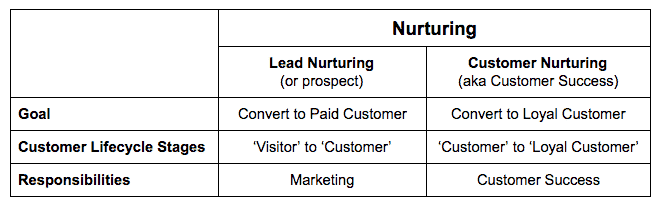
Nurturing is the art of sustaining an effective dialogue with your prospects (Lead Nurturing) or with your customers (Customer Nurturing) throughout the life cycle of individuals: visitors, prospects, users, customers, active customers, loyal customers.
Setting up a Nurturing strategy is essential to develop and sustain your company’s growth. Every interaction you can have with your prospects or customers is an integral part of your nurturing activity.
This guide, let’s be clear, is dedicated to Lead Nurturing. But it was worth spelling out the relationship and the differences between “Nurturing”, “Lead Nurturing” and “Customer Nurturing”.
The role of Lead Scoring in a Lead Nurturing strategy
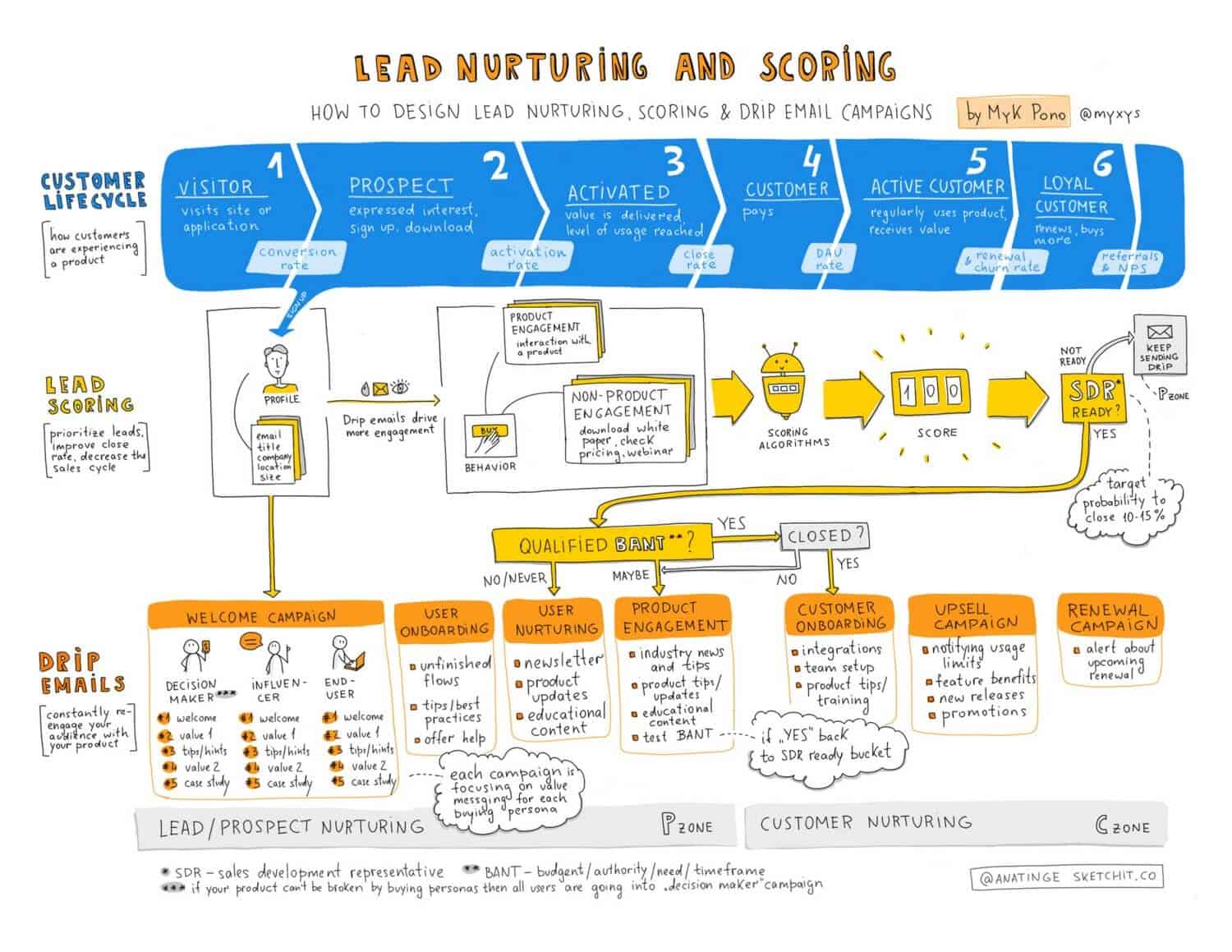
Let’s now turn to Lead Scoring. Lead Scoring is the practice of assigning scores to your prospects based on the profile data and behavioral data you have about them.
The goal of Lead scoringThe goal of Lead Scoring is to rank leads by order of importance, by order of priority, so that you can focus your efforts on the “best” contacts, improve your conversion rates and shorten the buying cycle.
Since Lead Nurturing is a process of continuous communication (or interaction) with prospects that increases the chances of converting prospects into customers, it is fairly logical to combine it with Lead Scoring. The two go together.
Lead Scoring lets sales reps prioritize leads and lets marketing measure the effectiveness of nurturing campaigns.
Depending on the stage of development your company is at, your Lead Nurturing and Lead Scoring strategies won’t be the same. Lead Scoring is more or less relevant depending on your organization’s stage of development. For simplicity’s sake, we can define three stages in a company’s evolution:
- The early stage, which corresponds to the search for Product-Market Fit. The company is trying to create a viable service or product, to establish “proof” of its concept.
- The growth stage, during which the company wins market share and attracts new users.
- The maturity stage, during which the company focuses on optimizing its offering.
Let’s be clear: in the early stage, Lead Scoring is not the top priority. If you only generate two or three leads a day, you don’t need to score your leads.
However, it can be worthwhile to implement a basic scoring system from the start. This will let you collect information about your prospects’ buying journey. When you reach the growth stage, you’ll have several months / years of historical data at your disposal that will let you optimize your Lead Scoring system faster.
So at the start, try to track as many user actions on your product as possible. This will let you establish statistical correlations and identify the behavioral patterns associated with the highest conversion rates.
Download our free lead scorer to qualify your leads easily & for free 👇

It’s during the growth stage of your user base that Lead Scoring really comes into its own. You receive dozens, even hundreds of leads a day: it becomes urgent to set up a scoring system to tell apart the prospects who have a specific pain point from those who need to be educated about the problems and their solutions (in other words: who need to be “nurtured”, or “warmed up”).
At this stage, scoring becomes indispensable to make the best use of your resources.
In your company’s growth stage, Lead Nurturing can evolve from basic communication to more targeted communication, based on profile segmentation. For example, by setting up separate automated workflows for each profile. For example, in the early stage, when a prospect signs up, the company may be tempted to send the same automated email sequence to everyone.
In the growth stage, the company may decide to roll out several separate campaigns: one targeted at decision-makers, another at influencers, one for prospects in the financial sector, etc. Communications can be segmented according to prospects’ roles, industries and identified needs.
In the last stage, maturity, companies should have robust, proven Lead Nurturing and Lead Scoring systems in place. At this stage, the company has enough data to build robust models and segment its campaigns in greater depth.
The core of a Lead Scoring system: the Fit / Pain pair
Before getting into the details of the different scoring systems, let’s recall the goal of Lead Scoring: helping the company prioritize leads, improve its conversion rates and shorten sales cycles. Several reports show it: sales reps spend only about a third of their time on what creates their added value, that is, selling and interacting with prospects or customers.
Lead Scoring improves sales rep productivity by focusing on the prospects with the highest potential Lifetime value. Prioritization lets the company use its resources more efficiently: sales reps spend more time on prospects who have a real chance of converting.
The Sales Acceleration FormulaMark Roberge, former CRO of Hubspot and now a professor at Harvard, put forward a rather interesting way of analyzing leads in his book “The Sales Acceleration Formula”. He suggests analyzing leads through the “Fit” and “Pain” duo. This analysis applies to inbound leads as well as outbound leads. But the way it works is different in the two cases:
- In outbound, you go from Fit to Pain. The company promotes a product at scale and then identifies whether the leads have the problem the product solves.
- In inbound, on the contrary, you go from Pain to Fit. Put simply, the prospect has identified a pain point, a problem they are looking to solve, and that leads them to the company. It’s then up to the company to qualify the lead and determine whether it is a fit for the company.
The larger the share of inbound leads, the more important Lead Scoring becomes. In fact, it’s mainly inbound leads that need to be prioritized.

Lead Scoring, according to Mark Roberge, is essentially a marketing approach, based on a scientific methodology, that consists of assessing fit and pain. It answers the following two questions:
- Regarding “pain”: Is the prospect experiencing the problem our product solves? How important is this problem compared with the other problems and challenges the prospect faces day to day?
- Regarding fit: Does this prospect match our target customer base? Do they have the budget needed to buy our product? Do they have enough internal resources to implement the product in their organization?
Building a Lead Scoring system boils down to defining what the company means by “fit” and “pain”. In scoring, the score tells you to what extent a prospect fits your target customer base, and what problem the lead has based on the behavioral data you have. Put simply:
Lead Score = Fit Score + Pain Score
Read alsoCheck out our complete guide to Lead Qualification.
How do you set up a Lead Scoring system?
The most common way to set up a Lead Scoring system is to use numerical values to assign a score to each lead and then sort leads into three or four categories based on their score: A, B, C, D or “Hot”, “Warm”, “Lukewarm”, “Cold”. For example, you might have:
- A leads = Score of 100 and above = Lead ready to be passed to sales
- B leads = Score between 75 and 99
- C leads = Score between 50 and 74
- D leads = Score below 50
The problem with this classic approach is that while everyone agrees on what an A lead is (= a hot lead, ready to be passed to the sales department), there is often little clear consensus on the difference between B, C and D leads. All you know is that, in every case, these are leads that are not yet ripe enough to be contacted by a sales rep. That’s why we recommend a simpler classification, with only two categories:
- Leads ready to be passed to sales (= SDR-ready)
- Leads that are not yet ready to be passed on.
You can then use numerical values to tell apart the leads that are not ready to be passed on according to their degree of maturity. Numerical scoring is, in our view, far more relevant than category scoring. It allows a much more granular analysis.
Read alsoDiscover 20 high-potential Lead Generation techniques.
What is a mature (SDR-ready) lead?
A lead is mature when it has reached a certain level of fit and pain that qualifies it as ready to be contacted by a sales rep. If you’re new to lead scoring, you’ll need to analyze which actions and behavioral patterns lead a prospect to buy. Ideally, your definition of a mature lead should correlate with a 10-15% conversion rate. In concrete terms, this means that between 10 and 15% of the leads that reach the SDR-ready stage end up buying. To optimize your SDR-ready threshold, you’ll need to run tests to gradually refine your model. You can raise or lower the maturity threshold depending on the workload the sales team can handle. The relationship between the target score (maturity score) and the potential conversion rate matters. If you choose a threshold that is too low (8-10% conversion), your team risks wasting its time qualifying leads that won’t convert. Raising the maturity threshold (15 – 20%) means, on the other hand, longer Lead nurturing work. The first option increases the sales rep’s workload, the second that of the marketing team. The qualification threshold above which a lead is considered mature varies from one company to another. There is no absolute rule. Within each organization, this threshold has to be refined gradually, as your experience and your tests progress.
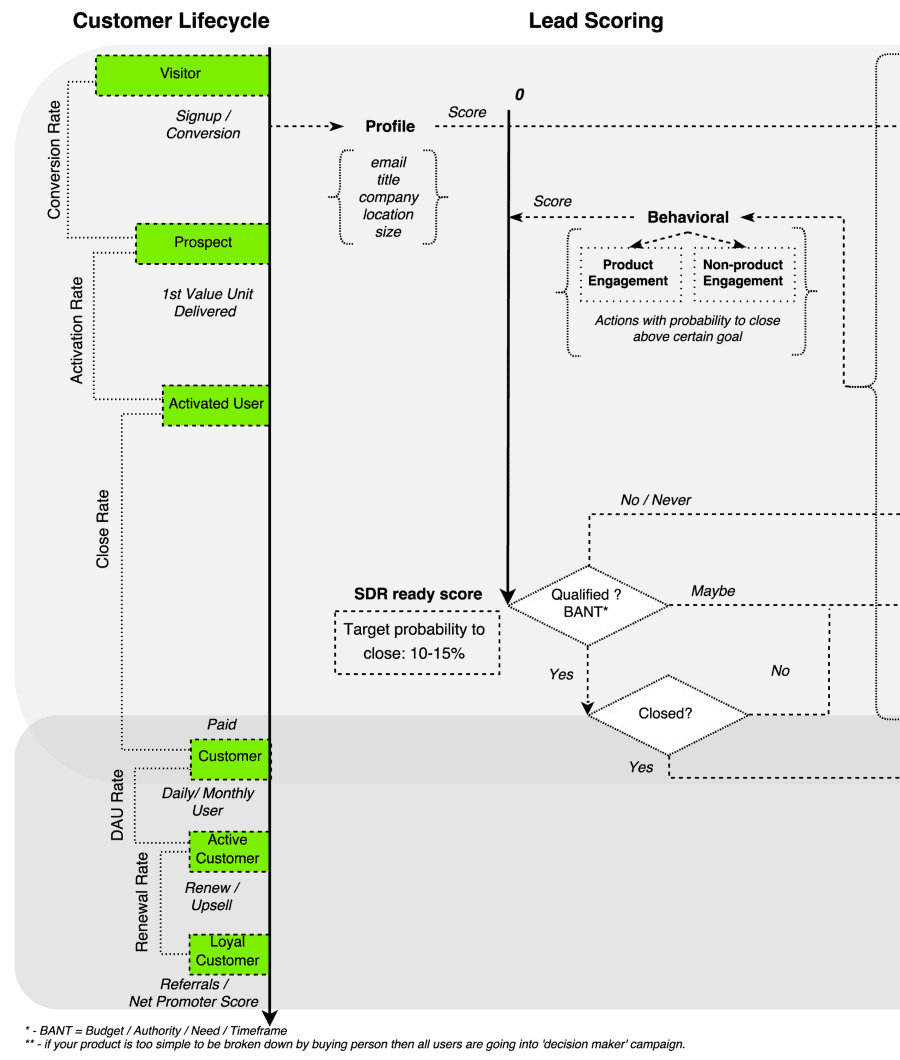
What factors are taken into account when calculating the score?
Let’s go back to our equation: Lead Score = Fit Score + Pain Score. An effective Lead Scoring strategy requires two categories of data:
- Profile / demographic data, to qualify fit
- Behavioral data, to qualify pain.
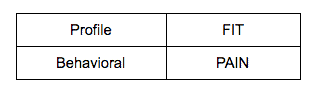
Profile – demographic data
Profile or demographic data is broadly static and is used very early, right after the prospect enters your Marketing Automation tool or your CRM. Here are the 5 most important demographic data points in B2B:
- Email. You need to ask yourself whether it’s a personal or a professional address. Professional email addresses should earn a higher score, since giving their work address means the prospect is willing to communicate with you at the company level.
- Job title. You can get this information by asking your prospects for it, by looking it up online or by using a contact list enrichment solution. The higher the position in the company’s org chart, the higher the score the prospect should receive. But the prospect’s position in the company isn’t only useful for scoring. It identifies the prospect’s role in the buying process. We actually recommend creating a different email sequence for each status: decision-maker, influencer, end user. We’ll come back to this point later.
- Company. It’s important to know the exact name of the company, because it tells you whether or not the company is part of your target customer base. If it is, you can assign the prospect a higher score.
- Location. This is an important criterion, since few companies sell their products all over the world. And even if your company does, not all markets are the same or have the same potential. Location can therefore clearly be used for scoring.
- Size. Size is a very important criterion for estimating the company’s purchasing power and potential revenue. It’s not always the overall size of the company that matters most. For example, if you sell a SaaS solution for sales reps, it can be useful to know the size of the sales department.
Depending on the company and the product being sold, the importance and weight of each of these characteristics will be higher or lower. The difference in how they are weighted will have an impact on scoring.
To get more information, you can increase the number of fields on your lead capture forms. Only, if you do that, your form’s conversion rate will drop noticeably.
To avoid facing this trade-off between lots of prospects you ultimately know little about and few prospects about whom you know everything you need, you can turn to enrichment. Don’t panic, there are very simple enrichment techniques. For example, you can use Similarweb to get an idea of a website’s traffic, or define a list of target companies and reward the prospect with a “+1” if they belong to it, etc.
Salesdorado’s tipIf you want to go further, you can also use an intermediate solution such as Dataiku.
As you will have gathered, with very little initial information you can end up knowing far more than you need. All that’s left is to define your scoring criteria and calculate the prospect’s fit score.
Read alsoDiscover the 50 best prospecting tools.
Behavioral data
Profile data is fairly easy to find and use in scoring. Finding and using behavioral data is much more complex. First, because there are many more behavioral criteria than demographic criteria. Second, behavioral data is dynamic. It has to be updated regularly. Also, there aren’t really any third-party solutions for analyzing the behavioral data to use in scoring. There are a few tools for tracking how your product’s users interact with the product, but only your internal team can make the link between user behavior and conversion rate.
There are two broad categories of behavioral data:
- Engagement data tied to product usage = the data that tells you how prospects use the product. This is by far the most important behavioral data. There is a very strong link between product usage and the likelihood of conversion.
- Engagement data unrelated to product usage, such as:
- Downloading a white paper.
- Registering for a webinar.
- Visiting the pricing page, the FAQ, the knowledge base…
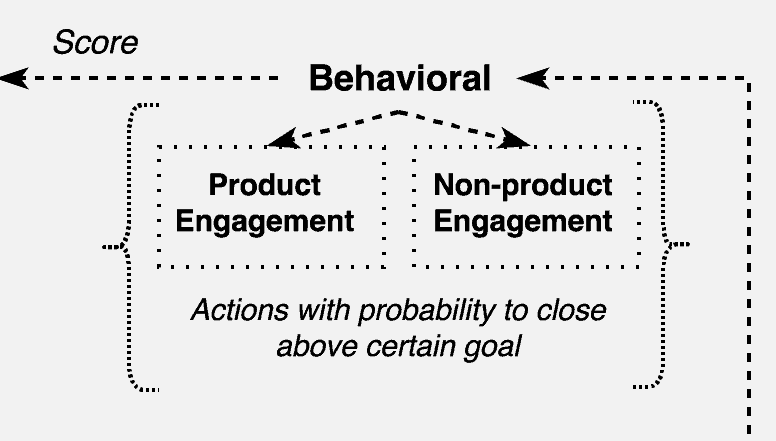
There are two types of actions that say a lot about the prospect’s level of pain.
- The actions that reflect a high level of pain have one thing in common: a direct link with the product. This could be, for example, a call for tenders, a quote request or an add to cart. This kind of behavior reflects a genuine need on the prospect’s part, so they will be rewarded with a good pain score.
- But it doesn’t stop there. Other, less committing actions also deserve to be taken into account in scoring, such as downloading a white paper. Here again you can go further with Dataiku, by setting up affinity scoring based on your analytics logs.
Don’t fall into the trap of giving a score to every action, even the most trivial ones, such as visiting the website, opening an email, clicking a link in an email, etc. These actions require very little investment from the prospect and are rarely a sign of interest in the product. Most of the time, they are simply driven by curiosity.
We recommend setting up tracking of user-product interactions as early as possible, from your company’s early stage. This will give you historical data to work with when you build your Lead Scoring system, in the development stage.
Read alsoFind out how to set up and promote webinars to generate more leads.
What happens once the SDR-ready Score is reached?
Once your leads reach the SDR-ready stage, the handoff between marketing and sales must happen as quickly as possible. In lead management, time is a disqualifying factor. It’s good practice to set a rule stating that sales reps must make sure they contact SDR-ready leads within a maximum of X hours. For example, 48 hours.
For example, you can create a list in your CRM tool that automatically captures contacts who have reached the SDR-ready stage, so you can easily pass them on to your sales teams, who will take over. Keep in mind that scoring is an iterative process and adjustments are possible.
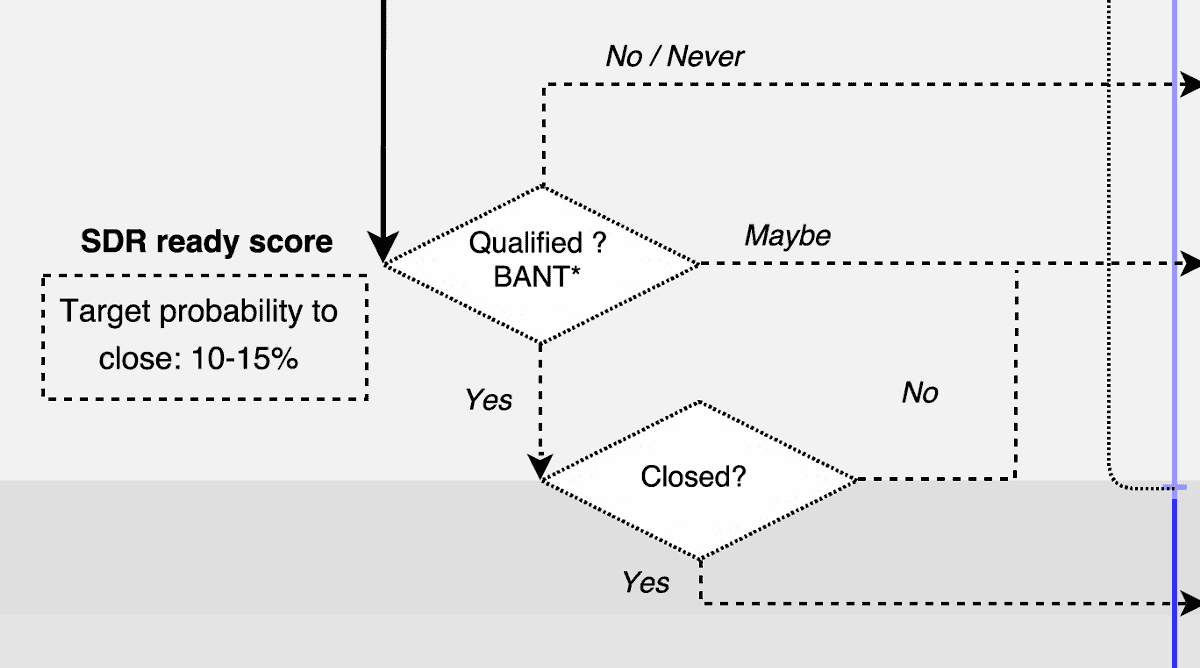
Once the sales reps have done their qualification work, SDR-ready leads can be sorted into three categories:
- Yes – The prospect is qualified. They enter the sales pipeline. Two outcomes are possible: they convert (prospect => customer) or they don’t. If they convert, they move from the Lead Nurturing stage to the Customer Nurturing stage. Onboarding campaigns can be triggered. If, on the other hand, the prospect doesn’t convert, you can add them to your “Product Engagement” campaign. This prospect may turn into a customer in the future. They must not be abandoned. Just because a prospect doesn’t buy right away doesn’t mean they never will.
- Maybe – the prospect is not qualified enough. They may be qualified from a fit standpoint (they match your target customer base), but not from a “pain” standpoint (their need isn’t substantial enough)…or the other way around. In this case, you can warm up these leads by sending them an email sequence focused on goals. We’ll come back in detail to the nature and content of the campaigns a little further on.
- No – the prospect will probably never convert. They are not qualified enough from either a fit or a pain standpoint. That doesn’t stop you from continuing to send them email campaigns or to score them, but if they decide to convert, they will do so on their own.

The question that arises about this last category is quite simple: how is it that leads who don’t match the company’s target customer base and whose need isn’t substantial end up in the hands of sales reps? How did they pass the maturity threshold from a Lead Scoring standpoint? There are several possibilities. Perhaps this lead is a competitor, a student or an investor who researched your product. But if it happens often, there is surely a problem in your Lead Scoring system. Clearly, if more than 5% of the leads passed to sales end up in the “will never convert” category, you need to adjust your Lead Scoring mechanism.
Read alsoDiscover the best tools for generating leads from LinkedIn.
The 4 big Lead Scoring mistakes
In B2B, and especially at SaaS software vendors, Lead Nurturing and Lead Scoring are key components of the strategy. And yet few companies do things the way they should. Here are the four most common Lead Scoring mistakes:
Mistake 1 – Not tracking your leads’ behavior with your product or your website
Once again, you mustn’t wait before tracking. Even if you are a young company handling a very limited volume of leads, you need to plan ahead and start collecting data on your prospects’ behavior in your product or on your website right now. It will help you more when building your Lead Scoring system.
Mistake 2 – Needlessly complicating the Lead Scoring process
Tell yourself right now: you won’t manage to build the perfect Lead Scoring model from the start. So the best approach is to start simple and gradually adjust the model, the data / metrics used, the weightings, etc. Avoid using a category scoring system (A, B, C, D…). Once again, it complicates things and creates confusion. Time spent wondering whether a Lead is B or C is time wasted.
Read alsoRead our complete guide to the art of setting up effective sales processes.
Mistake 3 – Scoring too many indicators
Avoid scoring more than 20 – 25 engagement indicators so that your scoring system doesn’t become overly complicated. We recommend starting with between 10 and 15 indicators. For example, you can drop the indicators whose impact on the conversion rate is below X%, by setting the percentage in question. The goal is to include in the overall score calculation the elements and actions that have a notable impact on converting leads into customers.
Mistake 4 – Trusting your gut
Most companies overestimate the weight of certain factors, relying on experience and intuition. To set up an effective Lead Scoring system, it’s important to set your intuition aside and base your choice of indicators on statistical analysis – even basic analysis.
The main automated workflows for warming up your leads
In this last part, we’ll present predefined email sequences sent automatically based on triggers. These sequences help your leads mature, improve the qualification of fit and pain and build your prospects’ engagement with your products.
Scripted email campaigns are the basic tool of Lead Nurturing. While marketers often know how automated workflows work, the importance of this tool for Lead Nurturing and Lead Scoring is often underestimated.
We’ll also see why segmentation can help you improve the performance of your campaigns.
A quick example of an automated workflow?
The series of emails a prospect receives in the first week or the first two weeks after signing up for a product’s free trial. In this case, it’s a “welcome” workflow.
It is without a doubt the most important workflow, because it covers the first interactions between you and your prospects. Another example: the email sequences sent after a purchase, the first email of which is usually an order confirmation email.
Read alsoFind out how to align sales and marketing with a pragmatic approach.
8 automated workflows to build your leads’ engagement
We’ll now present several examples of automated workflows. These are eight very common workflows. The list is obviously not exhaustive.
1. Welcome campaigns
The goal of this workflow is to complete a prospect’s sign-up to a service and get them to understand the main benefits of your product so they want to go further. Here is an example of email sequences:

You can of course stop the sequence when the prospect becomes an active user. With this sequence, your prospect gets familiar with your value proposition. The next step will be to teach your prospect everything they can do with your product to get the most out of it.
Read alsoFind out how much it costs to set up a sales CRM.
2. New user onboarding campaigns
With this second email sequence, the aim is to encourage the prospect to start using the product and to help them take their first steps.
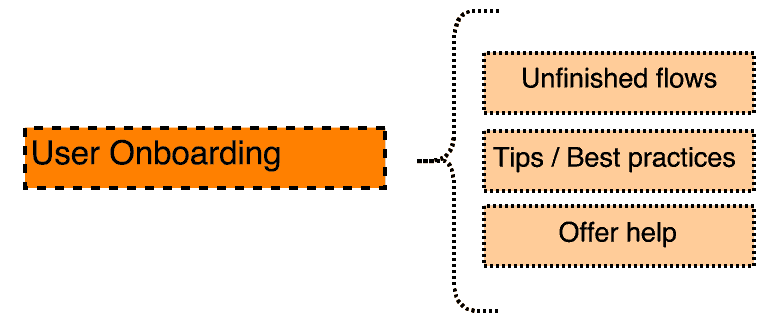
While the welcome campaign makes the prospect understand why the product is worth using, the onboarding campaign explains to the prospect how to get the most out of the product by filling in information or taking their first steps in the product. Let’s take a very concrete example. When a user signs up to LinkedIn, they receive a welcome email.
If this user doesn’t log in to their account after signing up, they receive a sequence of welcome emails to encourage them to come back to LinkedIn. Now, if a user has signed up to LinkedIn and uses the tool but without having completed all the information associated with their profile, LinkedIn will trigger the onboarding workflow. These are emails explaining why and how filling in your profile lets you make better use of LinkedIn.
3. Nurturing campaigns
The goal of this workflow is to turn a lead into a mature (SDR-ready) lead or to encourage them to try a product.
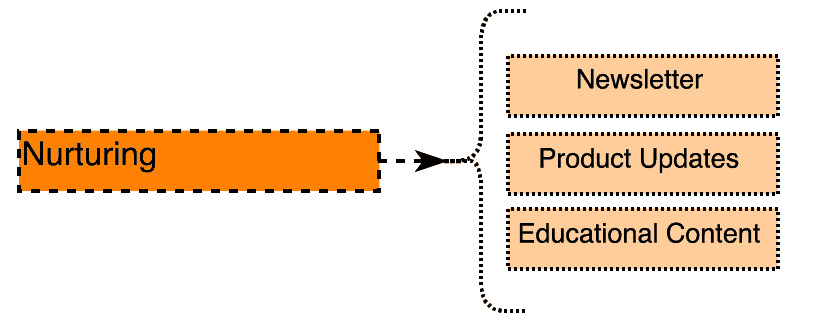
Not all prospects necessarily land on your website’s free trial page. Offering downloadable documents, such as white papers, studies or case studies, is another way to encourage a prospect to sign up for your trial. Depending on the nature of your product and the sales cycle, nurturing campaigns can pursue two goals:
- If you offer a free trial: increase trial sign-ups.
- If you don’t offer a free trial: get prospects to reach the maturity score (which triggers the handoff from marketing to sales).
4. Campaigns to build product engagement
The goal of such a workflow is to encourage your prospects to come back to the product and increase their level of engagement. It’s a very important workflow for a SaaS company using a freemium model. Companies using this model need to make sure that the customers who are not yet paying customers use the product, and use it more and more.

5. New customer onboarding campaigns
This workflow is aimed at users who have just subscribed to a paid plan. The goal is to build a relationship between the Customer Success team and new paying customers. It’s a Customer Nurturing campaign.
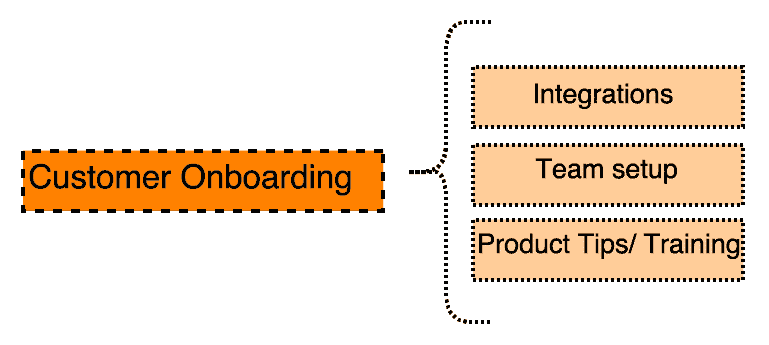
These emails aim to support the new customer in using the product to the full. For example, helping the customer integrate the tool with other services or platforms. In a workflow of this type you can offer: appointments with the support team, webinars, tutorials, training sessions, etc.
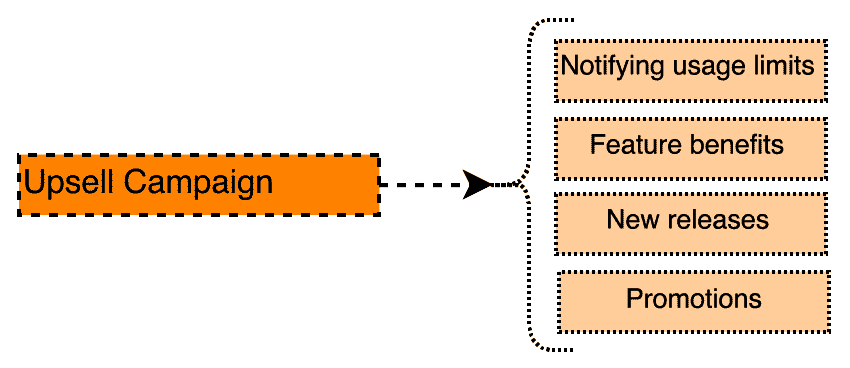
6. Upsell campaigns
With this kind of workflow, the aim is to inform the customer about additional paid modules, features, services or products, and to encourage them to move up to a higher subscription plan.
7. Renewal campaigns
The aim here is to inform the customer that their subscription is about to expire and to encourage them to renew it.
8. Transactional emails
Finally, don’t forget the email sequences sent in a transactional context. It’s important to remember that transactional workflows are also part of your Lead Nurturing arsenal. These can be emails prompting your users to verify their email, reset their password, download their invoices, etc.
Let’s now see how segmentation can help you improve the effectiveness of your automated workflows.
Using segmentation to improve the effectiveness of your automated email sequences
To wrap up, let’s stress the importance of segmentation. If you’ve read the article this far, you probably think that Lead Scoring and automated workflows are very complicated to set up. Often they are, because companies want to put the cart before the horse.
Setting up a Lead Scoring system and scripted campaigns has to be gradual. It’s a process.
You can perfectly well start with a welcome campaign containing two emails. Don’t try to make it complicated at the start.
As your company develops, you’ll mature your Lead Scoring system, enrich your automated workflows, create new ones, refine the segmentation of your contacts, etc.
Segmentation is precisely what makes your campaigns more effective and improves lead qualification.
Ultimately, the goal of segmentation is to optimize conversion rates. But be careful not to make the mistake of pushing segmentation too far and ending up with insignificant audiences in each segment. Segmentation has to be workable.
The time and money invested in segmentation work must be lower than the gains you get from it. We recommend starting with simple segmentation and measuring the impact of your segmentations on your KPIs (open rate, click rate…).
That way you can compare the performance of generic campaigns and segmented campaigns.
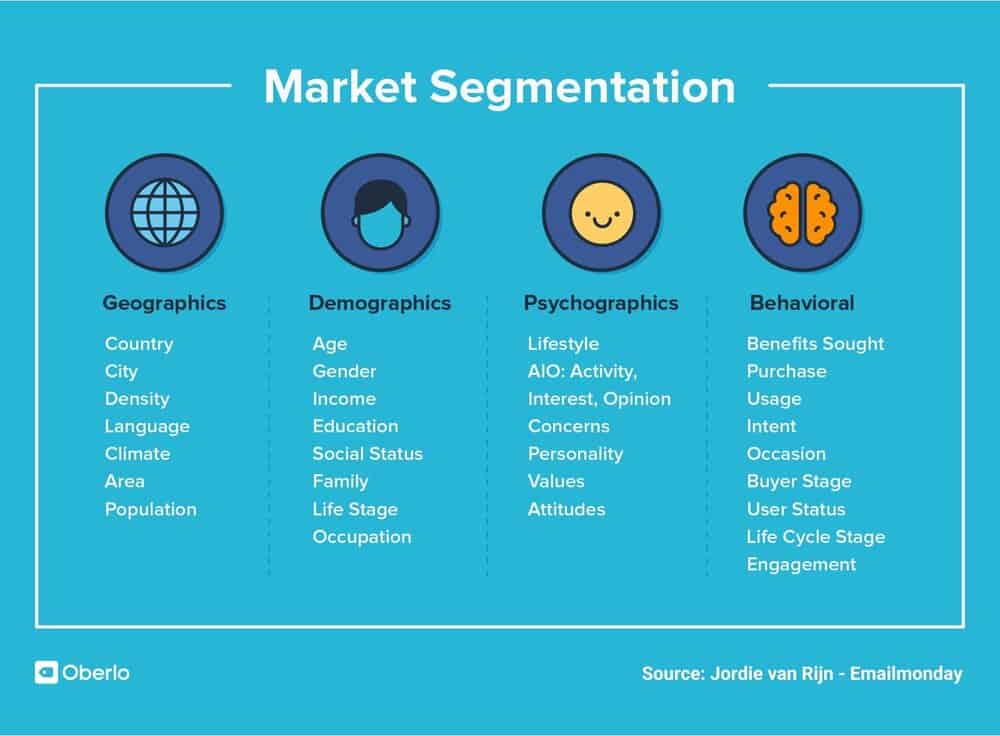
Why segment? Because customers don’t all have the same needs and the same expectations. Segmentation lets you send more relevant messages, and therefore messages that are more effective in the conversion process.
We won’t go into the details of segmentation work here, so as not to lengthen an article that is already quite long. We’ll stick to a few tips. We’ll surely have the opportunity to come back to this topic in more detail in future articles.
Segmentation, in the context of Lead Nurturing campaigns, can be based on the prospect’s role: decision-maker, influencer, end user. You don’t address these three types of people in the same way. You can also create segmentation based on industries: retail, travel, finance, education… As we said earlier, we recommend starting simple.
In your company’s early stage, you can simply send the same campaigns to all your leads.
Then you can start by segmenting according to the lead’s role in the company: decision-maker, influencer and end user.
Later, you can refine your segmentation by adding “industry” segmentation.
And later still, you can refine it even further by segmenting your campaigns by geographic area, products, lead behavior, etc.
But, and this is our main piece of advice, you shouldn’t start right away with ultra-rich segmentation. Take a gradual approach.
The questions we get over and over.
What is the difference between lead nurturing and customer nurturing?
Lead nurturing covers the communications between the moment the individual is a prospect and the moment they become a customer; it is handled by marketing. Customer nurturing starts once the individual has become a customer, to turn them into a loyal customer, and falls to Customer Success teams.
How do you calculate a lead score?
Lead Score = Fit Score + Pain Score. Fit is measured with profile data (email, job title, company, location, size), pain with behavioral data, first and foremost product usage.
What is an SDR-ready lead?
A lead that has reached enough fit and pain to be contacted by a sales rep. Ideally, this definition correlates with a 10 to 15% conversion rate. The handoff must then be fast, for example within 48 hours.
Should you do lead scoring from the moment the company launches?
In the early stage, it’s not the priority: with two or three leads a day, there’s no point scoring. Tracking users’ actions on the product from the start, however, gives you a usable data history in the growth stage.
Which automated workflows should you use to warm up your leads?
Eight common workflows: welcome, new user onboarding, nurturing, product engagement, new customer onboarding, upsell, renewal and transactional emails.



What the community says.