



- Writing a personalized email for every prospect isn’t feasible at scale: segment by potential (deal amount x number of deals).
- Low potential: basic personalization, under 30 seconds per email. Medium: 2 to 5 minutes. High: 10 minutes.
- Hyper-personalization, built around the prospect’s pain points, is only worth it for the top 5% of prospects by potential.
- A new executive, progress by a competitor or a funding round are trigger events: act fast.
- Don’t talk about your product’s features, show instead the benefit the prospect will get from it.
While doing your grocery shopping at the supermarket, you come across a can of Coca-Cola with your name on it.
You buy it, just for the pleasure of having your name on it!
You browse Amazon and see all your favorite gadgets recommended to you on the home page, pushing you to buy.
You resist the urge this time.
You log in to Facebook and see recommendations for the best flight deals to your favorite holiday destination. This time, you click.
Sound familiar?
Welcome to the age of personalization.
The science of personalization
If you’re wondering why companies use personalization to target and attract consumers, there’s a reason for it.
Behind this approach lies a science that proves personalization makes people more receptive to what companies have to offer.
When people receive personalized content, it makes them feel special because of its personalized nature. When someone receives something that is their own, it gives them a sense of being in control.
And that creates a feeling of autonomy in the prospects’ minds, prompting them to make a purchase decision!
The effect of personalization in sales email campaigns
The effects of personalization are not only relevant for big brands or companies selling consumer goods. This strategy has also been used successfully by sales reps and marketing professionals in B2B, especially when prospecting by email.
TipTo personalize your emails, the quality of your prospecting data is key. Look into B2B data enrichment software like Dropcontact to enrich your prospecting lists.
Here are a few facts showing the impact of personalization in emails:
- Personalized emails improve click-through rates by 14% and conversion rates by 10% [ Aberdeen ]
- A personalized email for campaigns generates 20% more sales opportunities than non-personalized ones [ DemandGen ]
- Personalized calls-to-action convert 42% better than generic calls-to-action [ HubSpot ]
- 31% of consumers are more likely to make a purchase if they are offered tailored content [ BloomReach ]
Personalized emails are, without a doubt, one of the most powerful ways to get a response from a potential customer. The question is how much time you are going to spend personalizing your emails.
How personalized should your emails be?
Ideally, you would want to send personalized emails to every prospect, to increase the chances of getting a response. But such a practice is not feasible.
Why?
When you prospect at scale, it’s not possible to write a personalized email for each prospect. Imagine how long it would take you to research and write emails to more than 100 prospects in a single day?
Is it really worth spending that much time on each one of them? No.
Considering that your prospects have different revenue potential for your company, it makes no sense to put the same effort into each of them.
So what’s the solution? Use different levels of personalization for your prospects depending on their potential.
Potential: deal amount x number of deals bought by the customer.
The more attractive the potential, the more personalized your emails will need to be.
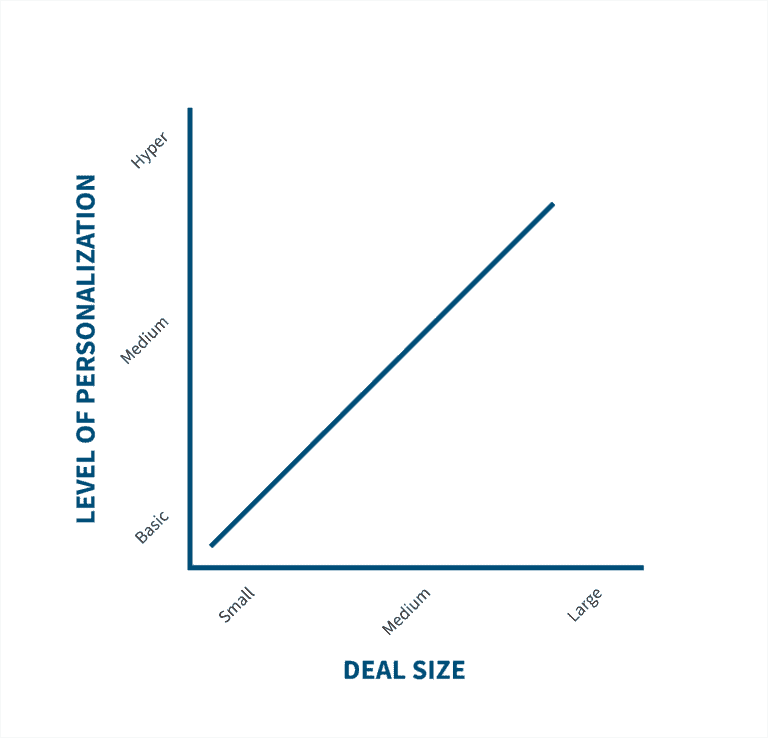
Different levels of personalization
An effective way to decide how far to personalize your email campaigns is to segment your prospects according to the revenue they could bring to your company. That way, you know how much you need to personalize for each prospect:
| Potential | Level of personalization | Time taken to write emails |
|---|---|---|
| Low | Basic | <30 seconds / email |
| Medium | Semi-personalized | 2-5 minutes |
| High | Hyper-personalized | 10 minutes |
The first segment covers prospects with low potential. The vast majority of your targets fall into this category. The level of personalization should be very basic, most of the work being to fill in the data in your spreadsheet. For example, you can personalize the prospect’s name, the company name, the job title, etc.
When you reach out to prospects with medium potential, you need to raise the level of personalization of the emails sent to them to increase the chances of getting a response. This takes a certain amount of research, going beyond their name and job title. For example, you can mention mutual connections and shared interests, news about their company, etc.
Finally, the last segment: the prospects with the highest potential on your prospecting list. These are the heavyweights of your list, and landing them as customers would be a big win. Being the top 5% of your accounts, they are usually only a handful. So, to contact these prospects, emails must be crafted after in-depth research and must be hyper-personalized. For example, addressing the pain points specific to the prospect’s company.
How to personalize your emails?
Here are the different techniques for writing personalized emails for your prospecting campaigns:
Personalize using the prospect’s name
Addressing a potential customer by name is the most basic form of personalization. It’s a simple but powerful strategy to use when sending cold emails at scale.
Why is it a good strategy?
“A person’s name is to that person the sweetest and most important sound in any language”
– Dale Carnegie
The scientific reason behind this is that when people hear their own name, it triggers a unique reaction in the brain, which leads them to pay closer attention to what you have to say.
But while adding a name to an email is an effective strategy, you shouldn’t add it at the start of every sentence. You need to use it appropriately.
Tip: use the prospect’s name in the subject line, because emails with a personalized subject line have 29% higher unique open rates and a 41% higher unique click rate.
Example of an email personalized with just a nameSubject: {prospect name}, here’s something you’ll find interesting…
Hi {prospect name},
Based on what we see with other sales organizations, your reps are probably wasting at least 60 minutes a day on manual data entry.
{Prospect name}, do you want to save time?
Our product, {your company}, can help sales reps save valuable time by automating data entry into your CRM.
I’d be happy to schedule a quick call to tell you more about it.
Thanks!
Personalize around your prospects’ profile type
An easy way to scale your email personalization is to tailor your emails to the type of prospect.
Here’s how you do it:
Group your prospects with similar job profiles, company size, priorities and challenges, then create emails with personalized content that will appeal to each group.
For example, all the VPs of marketing at SMBs will have similar priorities or face similar challenges. Creating an email about how your product can help solve the problem / help them reach a specific goal should interest all of them.
In the same way, you can create emails for other people and send them at scale.
Note: for this technique to work effectively, you need a clear understanding of the needs and challenges of your different buyers. A company with only a few customers may struggle to fully understand their issues. Try different messages for different types of prospects, and pick the ones that work.
Example of a personalized email based on the buyer personaHi {prospect name},
As {describe the prospect’s job title} in the {prospect’s field} sector, you must certainly be aware of how important the performance of your company’s content is across all your channels. At {your company}, we help {prospect’s company size} companies improve the engagement rates of their content.
I’d be glad to schedule a quick call to explain how we can help your company grow your marketing campaign to optimize results.
Best regards!
Personalize around trigger events
Some events, when they happen, bring about changes in companies. And those changes can be real opportunities for your business. Such events are called trigger events.
These events give sales reps an opportunity to contact prospects with an email personalized around the event.
Here are a few examples of trigger events:
→ A new executive in a position of responsibility: they will want to prove their worth and will be inclined to buy a new product as a sign of change and to establish their authority.
→ Progress by a competitor: a move by a rival company can push your prospects to catch up by equipping themselves with new software to compete with their competitors.
→ A funding round: a company that has secured funding will be more willing to invest in new software.
Personalizing your email around a trigger event is an effective strategy, because you contact prospects at a time when they probably need your company / service.
Tip: use a tool such as Owler or Google Alerts to stay informed of all the events that matter for your business. To be effective, you need to act quickly, because timing matters for your prospects and you can’t afford to show up after the battle is over.
Example of personalization around a trigger eventHi {prospect name},
I’ve been following [company name] for a while and I notice you recently joined the group as [new role]. Really excited about the drive you’ll bring to your role with your experience!! With a renewed focus on {goal}, I think you’ll greatly benefit from our sales tool that {value proposition}
Can we schedule a short call this Tuesday to discuss it?
Here’s a link to my calendar:
Best regards,
Personalized email with a compliment
Paying a compliment is a foolproof way to build good relationships with your prospects.
Studies have shown that receiving a compliment triggers the same reaction in our brain as receiving money.
When your prospect reads an email that praises them, they immediately take an interest in you and in what you have to say.
A few examples:
- Winning an award: if your potential customer was recently recognized in their field, you can use it in your email.
- Blogs, seminars, etc.: Did your prospect publish an article or give a seminar you liked? Let them know you enjoyed it.
- A leader in their field: if your prospect is a leader in their field, send an email expressing your admiration for them.
Example of an email personalized with a complimentHi {prospect name},
I recently came across {your prospect’s article} on {platform} and found your ideas very insightful. In fact, I share similar views on the subject. In the meantime, I just wanted to explain how {prospect’s company} can take advantage of our software, which fully covers your CRM needs.
I can schedule a short call this Tuesday to discuss it.
Best regards,
Personalize based on your prospects’ interests
Talking about the topics your contact cares about is the best way to get their attention.
But how can you know what your prospect is interested in?
It’s simple: use the power of social media. By going through your prospect’s social media profiles, you’ll get to know their interests better. Look for mentions, comments and frequent posts that can help you identify what they’re passionate about – it could be a sports club, a movie character, a place, etc.
When you mention something your prospect likes, two things happen:
- It makes them smile
- It shows you made an effort to learn more
It helps you make a good first impression and build good relationships with your prospects.
Example of a personalized email about your prospect’s interestsSubject: Handwritten for sales reps who love {prospect’s interest}
Hi {prospect name}
I wanted to ask you: what are your thoughts on {a recent topic related to the prospect’s interests}?
{Prospect name}, I’d also like to have a quick 15-minute chat about how {your company} can help {prospect’s company} by managing your sales pipeline seamlessly.
Feel free to pick the time that suits you best.
Here’s a link to my calendar.
Tip: Sometimes, even mentioning things they dislike can work, because research shows that people bond more over things they dislike than over things they like!
Personalization around the existing technology
Writing personalized emails about a potential customer’s website can be taken to the next level by looking a bit further into the software currently in place.
There are many tools such as Datanyze, Builtwith, etc. that list all the tools and software used on the prospect’s website.
This gives a fair idea of the prospect’s current needs and priorities. You can even find out whether they use tools similar to your product.
For example, knowing whether your potential customer uses a competitor’s product will help you adjust your emails by asking yourself how you can position yourself better against the product they currently use.
Personalizing emails around the technologies a company uses can also give you a different angle for presenting your product.
How?
Your potential customer may use the same tools as most of your existing customer base. By mentioning this in your email, you bring a sense of familiarity with your tool, to ease the natural hesitation they might have toward a new tool.
Example of email personalization around the technologies usedHi {prospect name}
I see you currently use {their CRM} to manage your database. At {your company}, most of our users also use the same platform. In fact, our native integration lets you {your solution} very easily, without even having to leave your current platform.
Here’s what {their CRM} users have to say about {your company}.
If we can have a quick conversation, I could show you how simple it is to get started.
Best regards!
Personalize with a relevant visual
A great way to personalize emails is to include a relevant visual such as an image or a short video.
Visuals rarely go unnoticed and instantly grab the recipients’ attention.
Why are they powerful?
a) Makes communication effective:
Communication is much easier when it takes the form of visuals. In fact, our brain can process visual images in 1/10 of a second. By including an image, prospects can instantly grasp your product, compared with a paragraph of text.
b) Adds a human touch:
If there’s one thing emails lack, it’s that human contact. Sure, you can personalize as much as you like. But it doesn’t come close to the experience of a real interaction. Adding relevant visual content, such as a video of someone from your company speaking to the prospect, can create a sense of interaction and give visibility to your message.
Here’s how Freshworks landed TimeDoctor with a single personalized imageHi Liam,
First of all, congratulations on your brilliant idea! Your service is inspiring. I remember using Timedoctor to see how I was preparing for my exam, after seeing my father use it for his business. I loved it! My best wishes to your team.
Just like Timedoctor, simplicity and ease are our strength at Freshdesk. We let you engage with your customers through multiple support channels such as email, chat, widgets, forums, phone, etc., on one single platform. Freshdesk helps you manage inquiries using advanced features such as canned responses, automated email management, turning Twitter and Facebook requests into tickets, automatic replies during holidays, customer satisfaction surveys and much more!
Liam, could you connect me with your support manager? I’d love to talk with them and show them the added value of Freshdesk.
Looking forward to hearing from you.
Best regards,
Personalize by highlighting a mutual connection
One of the reasons cold emails go unanswered is the lack of connection between you and your prospect, and mutual connections help bridge that gap.
Mentioning a mutual connection is a great way to create an instant connection and earn your prospects’ trust.
When you talk about someone / something you and your potential customer have in common, you are no longer a stranger to them and your unsolicited email feels less cold. Establishing a common connection also helps you relate and connect easily. Because psychologically, we trust people who resemble us in one way or another.
Since your potential customer may feel a link with the email, they are more likely to reply.
How do you find a mutual connection?
Social media will be a big help. A simple browse through your prospect’s profiles will help you identify a mutual connection you can mention in your email.
A few common connections to use in your emails:
- You both know the same person
- You come from the same city or the same high school
- You are both members of the same Facebook or LinkedIn group
- You attended the same conference, seminar, etc.
Example of using a mutual connection to personalize your emailHi {prospect name}!
I’m {your name}, a close friend of {Mutual connection}.
I’m reaching out because {mutual connection} thinks {prospect’s company} could greatly benefit from {your company}, where we provide a hassle-free billing platform for your business.
Can I schedule a quick call this Tuesday to learn more?
Thanks!
Hyper-personalization with very specific “pain points”
One of the most powerful ways to personalize cold emails is to address a particular problem of that potential customer and offer a solution to it.
Unlike the other personalization methods we’ve seen so far, this can’t be done at scale.
These emails require maximum research and preparation so that the message is personalized to make it as relevant as possible for a potential customer.
And that’s precisely why it can’t be done at scale. It’s only worth it for high-potential prospects, that is, the top 5% of all your prospects.
When you write your email, explain why you chose to contact them by explaining the size of their company, their goals, their role, their recent developments, etc., to show them you paid attention and understood their needs.
Address their problems and explain how your product will solve them. Back up your points with case studies, social proof, information, etc.
Don’t talk about your product’s features, instead show them the benefit they will get from your product.
You can even take your email to the next level by creating personalized pages, video snippets, etc., where you present a quick demo of how you can help the prospect.
Example of a hyper-personalized emailHi {prospect name},
I’ve been following {my prospect’s company} for a while and recently noticed you were looking to hire an experienced executive to lead your sales division in the South Bay area. With a new face at the head of the team and 20 new account executives ready to join as well, I’m convinced this must be an exciting phase for {prospect’s company}.
I think you should easily beat your company’s targets for this quarter, which were discussed at the Techcrunch conference in May.
With their eagerness to get started, the perfect complement for your sales reps would be {your company}’s CRM, letting you save up to 60 minutes a day by eliminating manual entry and helping your team focus on other priorities.
Do you think we could set up a meeting on Thursday at 3:00 pm to discuss how {prospect’s company} can take advantage of our software?
Best regards,
Conclusion
In the ocean of emails exchanged every day, a personalized email is like sending a message in a glass bottle. As soon as your prospect sees the email, they know it was addressed specifically to them, which will greatly increase your chances of getting a reply.
The questions we get over and over.
Should all prospecting emails be personalized to the same level?
No. When you prospect at scale, it isn’t possible to write a personalized email for each prospect, and your prospects don’t all have the same revenue potential. Use different levels of personalization depending on potential, that is, the deal amount multiplied by the number of deals bought by the customer.
How much time should you spend on a personalized prospecting email?
For a low-potential prospect, basic personalization in under 30 seconds per email (name, company, job title). For medium potential, a semi-personalized email in 2 to 5 minutes (mutual connections and shared interests, company news). For high potential, a hyper-personalized email in 10 minutes, after in-depth research.
What is a trigger event in prospecting?
An event that brings about changes in a company and can become an opportunity for your business: a new executive in a position of responsibility, progress by a competitor or a funding round. A tool such as Owler or Google Alerts keeps you informed.
How can you find out which software a prospect uses?
Tools such as Datanyze or Builtwith list the tools and software used on the prospect’s website. That way you know whether they use a competitor’s product, or the same tools as most of your existing customer base.
Where can you find a mutual connection with a prospect?
On social media: a simple browse through your prospect’s profiles helps you identify someone you both know, the same city or high school, the same Facebook or LinkedIn group, or a conference you both attended.



What the community says.