



- Firmographic and demographic data (job title, industry, headcount, technologies…): the least sensitive, you won’t scare your prospects by using them.
- Funding rounds, hiring, mergers, leadership changes: opportunity data that is more delicate to use.
- Search history, articles read, social media activity: with intent data, you are entering a minefield.
- Don’t start with « I know you are working on… » or « I see you are looking for… »: nobody likes feeling watched.
- Public information, such as a press release, can be quoted. Information you are not supposed to know cannot.
How do you personalize a prospecting email without coming across as Big Brother? If you don’t know how to write to prospects who have never heard of you and have no idea how you got hold of their email address, this article is for you!
Find out how to send personalized prospecting emails without scaring your contacts.
The 3 types of personalization data in a prospecting email
Personalization always relies on data. Data is what lets you personalize a prospecting email or a marketing campaign. So which data are we talking about? What types of data can you use to personalize a prospecting email? There are three types.
Firmographic / demographic data
Every marketer works with firmographic/demographic data. This is the basic information without which you simply cannot address your prospects. Most prospects know that marketers have this information anyway. There is no surprise.
We talk about demographic data when it concerns a contact, a person, a representative of the prospect company. The main demographic data are:
- First and last name
- The contact’s job title and position in the company.
- Email address.
- Phone number.
Firmographic data concern the prospect company itself. The main firmographic data are:
- Industry / line of business
- Products sold
- Revenue
- Headcount
- Geographic location
- Technologies used by the company
Without this data, once again, you cannot start a conversation with your prospects. Fortunately, it is the easiest data to collect (even if you can’t always be sure it is accurate). Without firmographic and demographic data, every marketing effort is wasted. Would you, for example, send an invitation to a webinar on managing shipping costs to a prospect who publishes a SaaS solution?? Obviously not. In the SaaS world, physical delivery issues don’t mean much… And that is exactly why, to avoid this kind of blunder, you need to know a minimum about your prospects. In this case: information about the prospect’s business and the products it sells.
Discover the ultimate list of the best B2B prospecting tools
- Contact enrichment
- Sending your prospecting emails
- Outbound call management
- Lead acquisition
- Meeting scheduling
- Video
Firmographic and demographic data are the least sensitive. You won’t scare your prospects by using them in your prospecting emails. They are basic data.
Also readFind out how to write the perfect prospecting email.
Opportunity data
This second type of data is hard to name. It covers all data about events related to the company that can, in themselves, be an opportunity for you to seize. This data is harder to find. A few examples:
- Funding rounds
- Layoffs / hiring
- Profits
- Mergers and acquisitions
- Changes in the company’s management / leadership
- Events organized by the company
Some of this information is easy to access, because it is public. But sometimes you have to contact someone at the company to get this kind of data. Using this data for personalization is more delicate, more « tricky ».
Also readDiscover 15+ tools to build a prospect list.
Intent data
Here we are clearly entering a minefield. Intent data, when used « badly », can scare your prospects. Intent data is activity data that tells you about prospects’ purchase intent, needs and interests. A few examples:
- Search history
- Articles read
- Downloads
- Time spent on a page
- Metrics related to social media activity
Here is an example of a prospecting email that uses intent data. This example comes from DiscoverOrg.
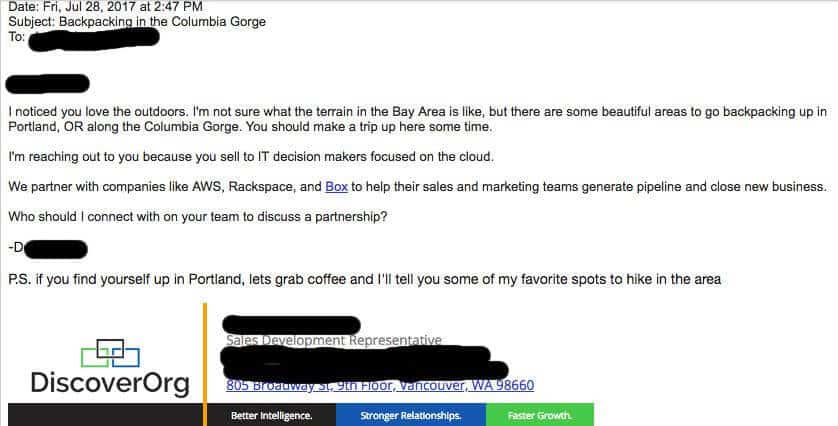
What the email saysI noticed that you enjoy the outdoors. I don’t know what the Bay Area is like, but there are some great places for hiking around Portland, or along the Columbia River Gorge. I recommend checking them out some day.
I’m reaching out because you sell cloud-based solutions to IT decision-makers.
We partner with companies like AWS, Rackspace and Box. We help their marketing and sales teams manage their pipeline and close more deals.
Who should I talk to at your company about a potential partnership?
D*****
PS: If you’re ever in Portland, come by for a coffee. I’ll show you some of my favorite hiking spots.
Note that this is an American prospecting email. The tone is much more « friendly » and informal than in the prospecting emails we are used to reading and writing in France. But never mind, that is not the point here. Notice that this prospecting email uses two types of data. On one hand, firmographic data: « you sell cloud-based solutions to IT decision-makers ». But also intent data.
The company behind this email also used data about social media activity. The writer went on Facebook to identify one of the prospect’s favorite hobbies: hiking. You can find intent data by doing some research on Google and social media. But it is hard. You usually have to go through a third-party data provider. Reading this email from the prospect’s point of view, you feel a little uneasy…
Clearly, the person reading this email will suspect that the sender has been digging through their Facebook profile. That can go down very badly and produce the opposite of the effect personalization is supposed to have… Intent data lets you push the personalization of your prospecting emails very far, but it carries significant risks.
Now here is an example of what you must not do.
Also readRead our tips for following up by email with a prospect who has stopped replying.
What you must never do in your prospecting emails
Opportunity and intent data must be used with great care. We have said it. Let’s take an example. Say you sell corporate performance management (CPM) software. A very interesting piece of news shows up in your feed aggregator:

A prospect has just allocated funds to developing Corporate Performance Management. You are thrilled. You sit down at your keyboard right away and start writing your prospecting email: « I just saw that your finance department has allocated new budget to implement CPM software… ». Big mistake. You really must not start like that… That is exactly what not to do. Don’t start with a sentence like « I heard you were planning to implement CPM software, etc. » either.
More generally, don’t start with sentences such as:
- I know you are working on…
- I heard you have a new project…
- I see you are looking for…
If you send a prospecting email that starts this way, chances are the prospect will never reply. And if they do, their first reaction will be:
- No, that’s not the case.
- How do you know that??
- Where did you get this information?
- Take me off your list right now!
Put yourself in the prospect’s shoes. Imagine getting an email from a stranger who starts by saying: « I know where you live and what you like. I can even tell what you’re eating right now! Is the sandwich good? You’re not a big fan of mustard, are you? ». It’s a bit creepy. Faced with an email like that, the natural reaction is to get defensive. Keep this in mind: nobody likes feeling watched. It is very unpleasant, in a professional context as much as in a private one.
So how do you use this great piece of intent data? How do you write the prospecting email?
Also readDiscover 40+ punchy email subject lines you need for successful email prospecting.
What you should do – or the art of personalizing a prospecting email without creeping people out
To get your prospecting email right, think of a piece of intent data as simply telling you that this is the right time to contact the prospect. But this information must not be explicitly mentioned in the email.
In short, the prospect must not know that you have it. Intent data gives you the timing and context of the message, but it must not be the content of the message. Instead of the opening lines mentioned above, you can write something like: « I’m reaching out because I’d like to show you something that could be of great interest to you ».
Here are a few examples of effective opening lines:
- Many companies in your industry start thinking about [X] when they reach your size. Maybe it’s something you’re currently considering.
- Every day I meet dozens of companies struggling to implement [X]. I have a few ideas to fix that. If you are also having trouble implementing [X], I may be able to help.
Identify your prospects’ pain points (using intent data) and, in your prospecting emails, try to help them solve those problems. Position yourself as a « problem solver » and as an expert. That is the best approach to take. It is the one that will let you turn your leads into customers.
But, obviously, it is very easy to pass yourself off as an expert in a prospecting email. Anyone can do it. You need to be credible, and for that you use what is called « social proof ». Give references, examples of companies you have already worked with. Taking care, of course, to choose companies in the same industry as your prospect.
Give concrete examples of projects you have delivered. Be relevant. And don’t scare your prospects. You can and should use the information you have gathered about your prospects in your prospecting emails. If it is public information, available to everyone, for example information published in a press release, you can mention it explicitly in the email. But if you are not supposed to know this information, don’t bring it up in the email.
In the end, as you will have gathered, writing a good prospecting email means knowing what to say in the message, BUT also knowing what not to say!
The questions we get over and over.
What data should you use to personalize a prospecting email?
There are three types of data: firmographic and demographic data (name, job title, industry, revenue, headcount, technologies used...), opportunity data (funding rounds, hiring, mergers, leadership changes) and intent data (search history, articles read, downloads, social media activity).
Why can intent data scare a prospect?
Because the prospect realizes the sender has been digging through their activity, for example their Facebook profile. Nobody likes feeling watched, in a professional context as much as a private one: the natural reaction is defensive, and personalization produces the opposite of the intended effect.
How do you use intent data without mentioning it?
Intent data tells you it is the right time to contact the prospect. It gives the timing and context of the message, but it is not quoted. Start from a broader sentence, such as "Many companies in your industry start thinking about [X] when they reach your size", then position yourself as an expert who helps solve the problem.
Which sentences should you never use to open a prospecting email?
Avoid "I know you are working on...", "I heard you have a new project..." or "I see you are looking for...". The prospect may never reply, or reply "Where did you get this information?" and "Take me off your list right now!".
How do you come across as credible in a prospecting email?
With social proof: references and examples of companies you have already worked with, chosen from the same industry as the prospect, and concrete examples of projects delivered.



What the community says.