



On April 15, 2026, at its TDX developer conference, Salesforce announced the most ambitious architectural overhaul in its 27-year history. Called Headless 360, this change makes the entire platform accessible to AI agents via API, MCP tools or CLI, without going through a graphical interface. Marc Benioff and Parker Harris openly ask a provocative question: why should a salesperson or a support agent still log in to Salesforce?
- Salesforce exposes its entire platform (Data 360, Customer 360, Agentforce) as APIs, MCP tools and CLI commands for AI agents
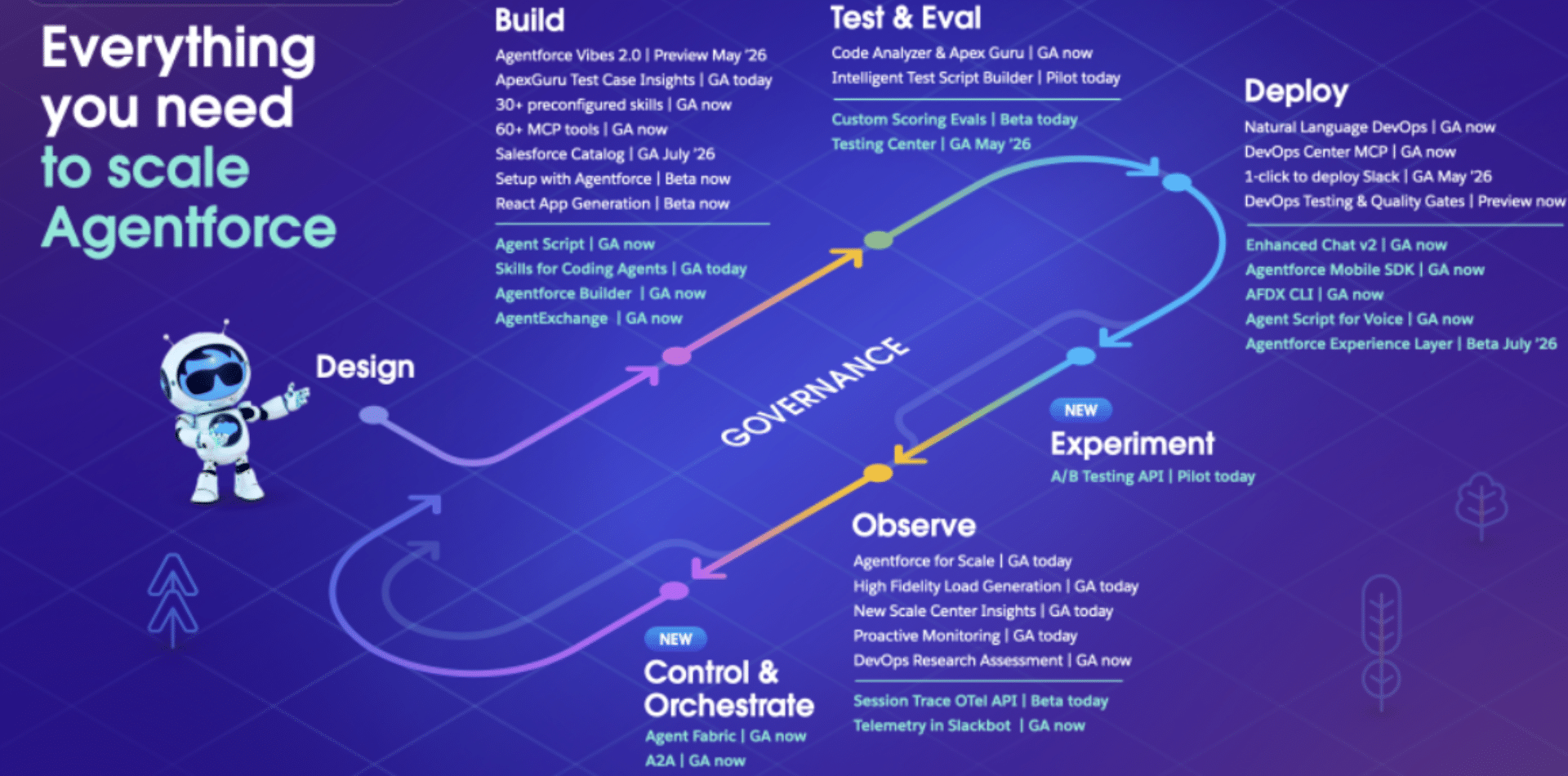
- More than 60 MCP tools and 30 preconfigured coding skills ship with it, compatible with Claude Code, Cursor, Codex and Windsurf
- The new Agentforce Experience Layer separates what an agent does from how it is displayed (Slack, WhatsApp, voice, mobile)
- The governance tools Testing Center, Custom Scoring Evals, Session Tracing and A/B Testing aim to make agents reliable in production
- Analysts flag three sensitive points: no published pricing, uneven tool maturity, and a risk of vendor lock-in through Agent Fabric
- Staggered rollout: some features are already available, others expected in May and June 2026
A deliberate strategic pivot: from clickable SaaS to programmable platform
For 25 years, using Salesforce meant logging in to Salesforce. A salesperson opened a console, clicked into an opportunity, updated a field. With Headless 360, Salesforce acknowledges that AI agents don’t browse in a browser: they call APIs, invoke MCP tools and run CLI commands. Two and a half years ago, the vendor therefore decided to rebuild its platform so that business capabilities could be consumed directly by agents, human or software.
The breakdown is clear. Data 360 becomes the system of context (unified data), Customer 360 the system of work (business logic and workflows), Agentforce the system of agency (building and running agents), Slack the system of engagement. For Joe Inzerillo, President of AI Technology at Salesforce, the goal is for agents to inherit existing business logic without rebuilding it.
What Headless 360 concretely brings to technical teams
Developers get full access to their platform from the tools they already use. The 60 MCP tools and 30 preconfigured coding skills give coding agents such as Claude Code, Cursor or Codex a real-time view of the Salesforce org: data, flows, sharing rules, Apex logic. Agentforce Vibes 2.0 extends this principle natively inside the platform, with multi-model compatibility including Claude Sonnet and GPT-5.
On the DevOps side, the new DevOps Center MCP handles the entire CI/CD cycle through natural language. Salesforce announces cycle time reductions of up to 40%. For developers who want to keep control of the visual layer, native React support is introduced.
The Agentforce Experience Layer: a decoupled UI layer
This is one of the most discussed new features. The Experience Layer is a service that separates an agent’s actions from their visual rendering. The same agent can deliver an approval card in Slack, a rebooking workflow in Teams, a decision tile in ChatGPT or Claude. The principle is to build once and render everywhere users already work.
Scott Bickley, analyst at Info-Tech Research Group, tempers the enthusiasm. He points out that this extra layer adds complexity to a development environment already considered heavy, and that Salesforce has a habit of shipping v1s that shine in demos but are fragile in production.
Governance tools to make agents reliable in production
Agents are probabilistic. They don’t always behave the same way. Salesforce is therefore introducing an arsenal of tools to control their behavior before and after deployment. The Testing Center spots logic gaps before go-live. Custom Scoring Evals don’t grade whether the agent performed an action, but whether it made the right decision according to the defined business criteria.
After launch, Session Tracing and Observability make it possible to trace an agent’s reasoning. A/B Testing runs several versions in parallel on real traffic. These tools fill a gap documented by enterprise teams, but Bickley advises companies to plan their own evaluation frameworks for the next 12 to 18 months.
Agent Fabric: multi-vendor governance goes through MuleSoft
Alongside Headless 360, Salesforce is strengthening Agent Fabric, its control plane for orchestrating AI agents from different vendors. The Script for Broker tool introduces deterministic controls into multi-agent systems, an issue raised by teams moving from POCs to production. Robert Kramer, analyst at Kramer ERP, notes that purely autonomous agents don’t always work well in production because companies need predictable results.
In AI Gateway, Agent Fabric’s control layer, centralized LLM governance makes its debut. It gives CIOs a unified view of token consumption, costs and data flows to third-party models. Without this kind of checkpoint, each business team picks its own model, negotiates its own API contracts and manages its budget locally, which leads to budget drift and inconsistent security policies.
Two MCP capabilities round out the package. MCP Bridge exposes legacy APIs (REST, SOAP, GraphQL) to agents without changing the underlying code, which avoids writing wrappers for thousands of existing endpoints. MCPs hosted by Informatica bring data quality and governance directly into agent workflows, a sensitive point for regulated industries.
Comparison table: the four layers of the Salesforce stack redesigned for the agent era
| Layer | Product | Role |
|---|---|---|
| System of context | Data 360 | Unified, real-time business data that agents can consume |
| System of work | Customer 360 | Business logic and workflows orchestrated by agents |
| System of agency | Agentforce | Building, deploying and supervising agents |
| System of engagement | Slack | Conversational interface between humans and agents |
Points of caution for CIOs and executives
Three warnings keep coming up among the analysts who covered the announcement. The first concerns pricing. Dion Hinchcliffe, VP at The Futurum Group, and Scott Bickley note that no pricing has been released for the headless capabilities. Yet Salesforce has historically monetized new features through new SKUs. CIOs would do well to ask for prices before building architectural dependencies on features that could move to a premium tier.
The second warning is about SLAs. The announcement says nothing about guaranteed service levels for MCP tool calls, a sensitive parameter for real-time agent workflows. If a support agent depends on an MCP call to close a ticket, latency and availability become contractual issues.
The third warning, more structural, concerns vendor lock-in. Scott Bickley observes that the more agents a company registers in Agent Fabric, and the more orchestration rules and governance policies it defines, the harder it will be to detach. The question to ask right now: which components are portable, which are locked in, and what is the exit path?
Availability timeline
The rollout is staggered. Already available: Agentforce Vibes 2.0, the DevOps Center MCP, Session Tracing and the Agentforce Experience Layer. Custom Scoring Evals are in early access. The Testing Center and the Salesforce Catalog arrive in May and June 2026 respectively. Agent Fabric’s deterministic orchestration, still in beta, is expected in June.
What Headless 360 changes for companies
For sales and marketing leadership, the signal is twofold. On one side, the promise of automating tasks that are manual today (CRM updates, lead qualification, opportunity tracking) through agents working in the background, with no human session open. On the other, a stronger dependence on the Salesforce ecosystem if the company chooses to host the orchestration of its multi-vendor agents there.
For CIOs, Headless 360 positions Salesforce as a system of execution and no longer just a system of record. This is consistent with the direction taken by ServiceNow, Oracle Fusion or Workday on their own platforms. The real question is no longer technical but contractual: how much does this shift cost, and under what conditions can it be reversed?


What the community says.