


- AI Overviews and AI Mode are coming to France by September 23, 2026, according to Ouest-France, which revealed a letter from Google.
- Google makes three commitments to publishers: an opt-out from appearing in AI, transparency on generated impressions, and remuneration under neighboring rights for the 450 publishers already covered.
- The obstacle was legal, not technical. The feature already runs in French in Belgium and Switzerland.
- In the United States, the organic click-through rate falls sharply when an AI summary appears, from minus 35% to minus 61% depending on the study.
- Ranking well is no longer enough. You need to be cited as a source in the summary itself.
Google wrote to French news publishers on June 29 to set a date. Its AI-generated summaries, AI Overviews, and the conversational AI Mode are coming to search by September 23, 2026. France was the last major French-speaking market to hold out, while Belgium and Switzerland have been running them in French for months. And for any team that generates leads with its content, the mechanics of organic traffic are no longer the same.
What Google promised publishers
The June 29 letter, revealed by Ouest-France and picked up by several SEOs, comes down to three promises. The first is control. Each media outlet will be able to choose whether or not to appear in AI features, an opt-out that answers the fear of seeing its content summarized with nothing in return. Next comes transparency. Google commits to separating AI-generated impressions from those of classic search, so that each publisher knows where what comes from. And last, remuneration under neighboring rights, already paid to 450 French publishers, extends to content reused in the AI engine and viewed by users.
Why was France served last?
The delay had nothing technical about it. AI Overviews already runs in French in neighboring countries, and the feature has existed in more than 120 countries for two years. The real obstacle was legal. France’s 2019 law on neighboring rights requires platforms to pay media outlets for reusing their content. Google was even fined 250 million euros in March 2024 by the Autorité de la concurrence, the French competition authority, over this issue. The agreement reached at the end of June removes that lock and finally opens the door to the rollout.
AI Overviews and AI Mode, two different things
AI Overviews is the summary written by Gemini at the top of the results, followed by links to the sources. AI Mode changes the format entirely: a conversational interface where users refine their question as the exchange goes on, as with an assistant.
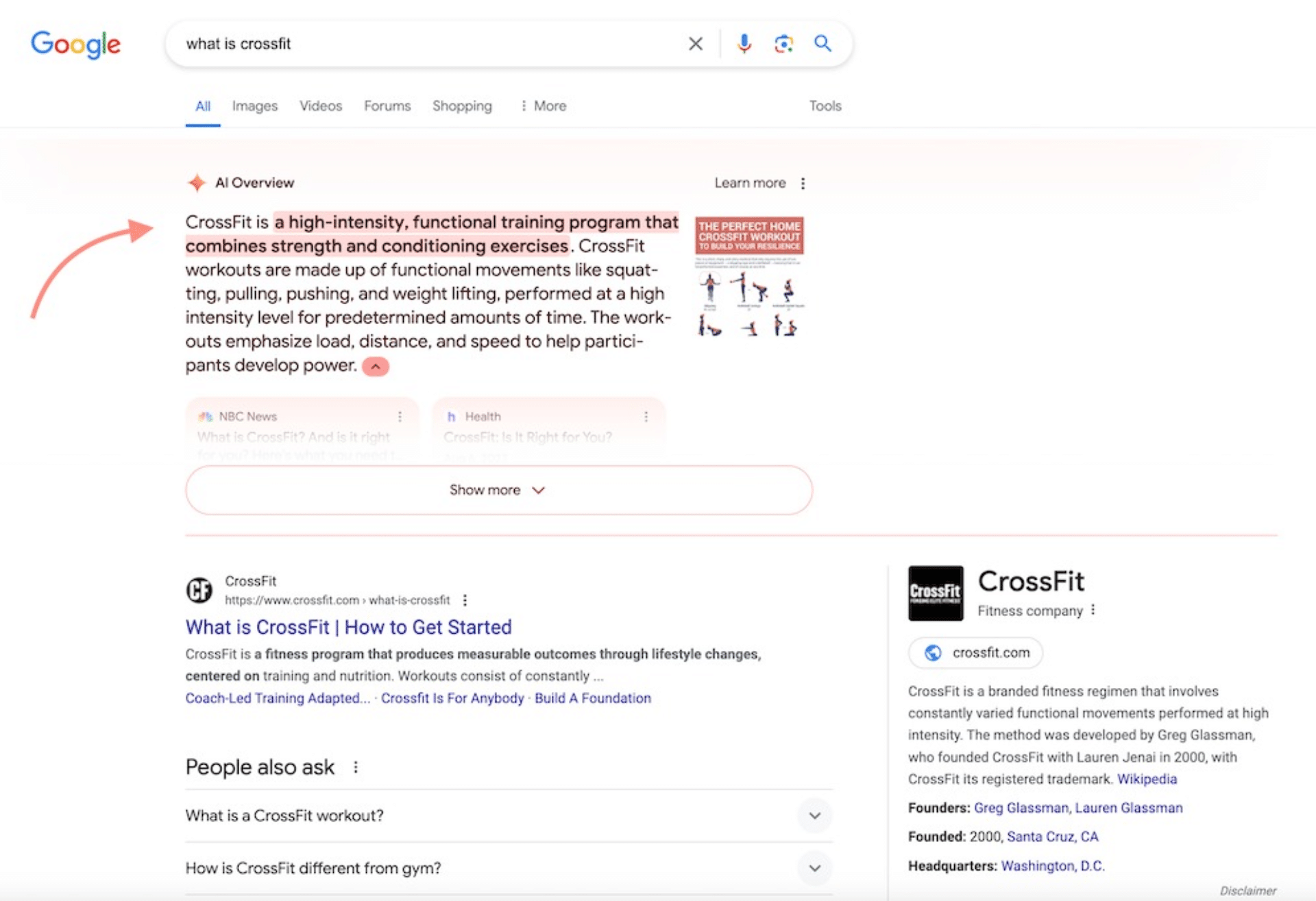
Under the hood, both run on RAG. The model pulls information from Google’s index before answering, which explains the source links in the summary. AI Mode takes the reasoning further with query fan-out: a query is broken down into dozens of sub-questions run in parallel to build a complete answer. Ranking for a single keyword therefore matters less than covering a topic from every angle, related questions and rephrasings included.
The effect on traffic, with figures
In markets that already have it, the effect on clicks is well documented, with several studies using distinct methodologies. The orders of magnitude shift from one study to the next, but the direction stays the same. When an AI summary appears at the top of the page, some users no longer click.
| Study | Effect on click-through rate | Scope |
|---|---|---|
| Seer Interactive | Down 61% for organic, down 68% for paid | 25M impressions, June 2024 to Sept. 2025 |
| Ahrefs | Down 58% for the first position | December 2025 data |
| Pew Research Center | 8% clicks with an AI summary versus 15% without | Usage study, 26% end their browsing session |
| Similarweb and GrowthSRC | Comparable drops | Different methodologies, same conclusions |
One safeguard before mapping these figures onto your traffic: they come from the US market, where the query mix and usage habits have nothing to do with ours. Google also disputes these conclusions. Asked by Ouest-France, Sébastien Missoffe, head of Google France, says the drop observed elsewhere did not happen on news queries. With no data to back it up, for now.
Ranking well no longer means traffic
This is the point that speaks directly to teams. A site can keep its rankings and lose traffic at the same time. Ranking and clicks are drifting apart, and that is new. If your acquisition relies on in-depth content that feeds the pipeline, the consequence is very concrete. You can keep coming out in first position and watch your visits decline, simply because the answer appears before your links. Better to explain this split to a client or an executive committee before it happens, not once the traffic is already gone.
What your teams can do now
Good news: SEO best practices still hold for GEO. A few reflexes just carry more weight. Structure your content into self-contained answer blocks, a clear definition, a sourced figure, a short list, rather than paragraphs that only make sense in context.
Strengthen your schema.org markup (FAQ, HowTo, Article) to give the model clear signals about the nature of your content. Work on your E-E-A-T to be identified as a reliable source worth citing. And on the tracking side, Google Search Console now includes AI answers in its metrics, while a test launched at the end of May 2026 lets users choose their preferred sources for AI Overviews and AI Mode.
A ceiling date, not a fixed countdown
The September 23, 2026 deadline is a ceiling communicated to publishers, not a public launch date set in stone. The scope of the queries affected and the actual timeline have yet to be specified.
So the right reflex is not to wait. It is to look now at the share of your queries likely to show an AI summary, and to work on your ability to be cited before traffic moves. Those who get ahead on this will start the summer one step ahead of their competitors.
The questions we get over and over.
When is AI Overviews coming to France?
By September 23, 2026, according to a letter sent by Google to French news publishers on June 29 and revealed by Ouest-France. This date is a ceiling communicated to publishers, not a public launch date.
Why did France wait longer than its neighbors?
The obstacle was legal, not technical. France's 2019 law on neighboring rights requires platforms to pay media outlets for reusing their content. The agreement reached at the end of June removed that lock.
What is the difference between AI Overviews and AI Mode?
AI Overviews is the summary written by Gemini at the top of the results, followed by links to the sources. AI Mode is a conversational interface where users refine their question as the exchange goes on, as with an assistant.
What did Google promise news publishers?
An opt-out to choose whether or not to appear in AI features, the separation of AI-generated impressions from those of classic search, and the extension of remuneration under neighboring rights to content reused in the AI engine.
What effect does AI Overviews have on organic traffic?
In markets that already have it, the click-through rate drops when an AI summary appears: down 61% for organic according to Seer Interactive, down 58% for the first position according to Ahrefs. These figures come from the US market.

What the community says.