



- Start by defining your typical prospect: you need to know who you are targeting and why.
- As a founder, close the first ten sales yourself, then formalize the process, even as six steps on paper.
- Most sales take 5 to 10 touchpoints: set your expectations accordingly.
- Segment and prioritize your target lists before launching cold emails and calls.
- Do not let your sales rest on a handful of salespeople: have the most experienced coach the beginners.
Setting up a B2B outbound strategy is not easy when you are just starting a business. An inbound strategy, i.e. “incoming prospecting”, usually generates 5 times more leads and 5 times more conversions than an outbound, i.e. outgoing, approach after a few years. However, inbound does not always suit every company at every moment, because this strategy takes time to produce results. We are not talking about a few days or weeks, but months or years. That is where outbound proves particularly effective for closing sales quickly when a business is starting out.
Depending on how mature your company is and how much funding you have, executives and sales managers have to make a sound choice between an inbound, outbound or hybrid sales strategy. Companies usually decide to adopt a hybrid sales strategy. While you wait for your inbound strategy to start paying off, outbound becomes more than indispensable.
Outbound sales are faster and have a relatively short turnaround time, with quicker results. When an outbound strategy is run at scale and executed well, it can generate more revenue than inbound.
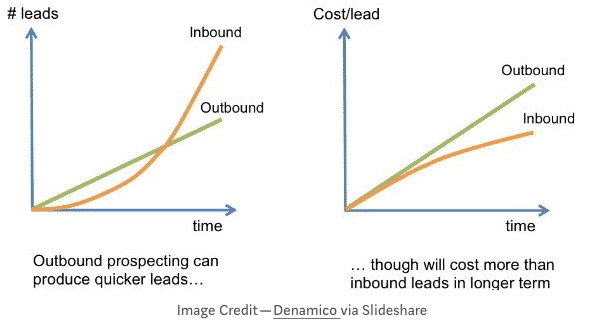
In this article, I will talk about getting started with outbound sales and what you need to put in place at the start to increase your effectiveness.
How do you plan your “outbound” sales prospecting?
Setting up an outbound strategy is an excellent idea, but it depends a lot on the efficiency and productivity of your sales teams. To get them on the right track, you can set a direction to follow, then gradually adjust the process based on your needs and what you observe.
1. Start on solid ground: define the profile of a typical prospect
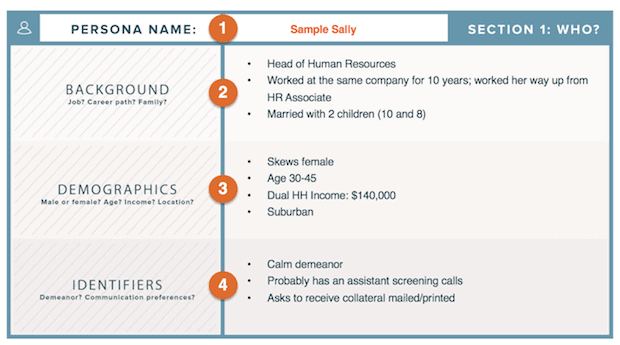
A building withstands storms when its foundation is solid. Step 1 of any inbound or outbound strategy is to identify your typical prospect (or persona) upfront. You need to know who you are targeting and why.
The sooner you get this, the sooner you can pick up the pace. To do it, you need to take the time to define the prospects’ personality from a sales point of view (the buyer persona, widely used, is very useful for marketing and digs into a lot of information that salespeople do not need to waste time looking for).
2. Define your company’s first sales process
As a founder, you need to close the first ten sales yourself. In doing so, you will get a good idea of how your ecosystem works. Write down your journey, even if it is only six steps on paper. It will give the sales manager or new sales reps a practical base and framework to work on and refine over time.
Do not try to make everything perfect, because as technology evolves, sales processes will quickly become obsolete. For example, ten years ago social selling mattered very little, whereas today it produces prodigious results.
3. Set realistic sales targets for your sales team
Once you have closed your company’s first ten sales yourself, you will have a clearer idea of what is achievable.
Depending on the length of your sales cycle and what is at stake, 200 customers a month can be just as credible as 2 a year.
Pro tip: most sales need at least 5 to 10 touchpoints before a deal closes, so be very clear about your expectations.
4. Equip them well and train them well
Outbound sales are a numbers game. The more you optimize your time and your methods, the more sales you will close.
Well-equipped, well-trained sales teams will be able to reach more people, set up more demos and meetings, and so generate more revenue.
The tools you need:
- A lead generation tool to extract prospects’ email addresses and personal information. You can use tools such as Apollo ($49 / month to search 1,000 prospects), Dux-Soup (from $41.25 / month with an annual commitment), etc.
- A solid CRM to look after your data. You can try Pipedrive or HubSpot CRM
- A tool for your emailing campaigns, to schedule sends and track results. You can use tools such as Woodpecker
- A “Click to call” tool to make, record and report on outbound calls. You can use VoIP tools such as Ringover or Quicktalk.
Training:
- Create call scripts and email templates to give your sales teams a starting point.
- Teach them how to handle objections and book meetings.
- Train your teams on your product or service in detail. This kind of training should happen regularly, to make sure every new feature or change is perfectly clear to every team member.
- Sales success is the result of both teamwork and individual performance. Make sure you instill the company culture and team spirit from the start. A team is always more productive than a sum of individuals.
5. Sales support
A sales team can be talented and motivated, but it will still need outside help to perform. That takes the form of the right tools and training, as mentioned earlier, but also of strong marketing support. This can include buying prospecting lists when you start from scratch (it is better, though, to focus on building your own lists and enriching them with extra data, because they convert much better than the ones you buy).
6. Know how to motivate your teams
Depending on the nature of your business, you need to create bonus and commission programs. Here are a few ways to build your program to give your teams an incentive.
a) Set multi-tier targets
Having three tiers in your targets will keep most salespeople motivated to hit the first tier even after a bad month, and to beat the highest tier in most cases.
b) Gamify sales
Running an internal contest for your sales teams, with a prize for the top performer, is seen as extra motivation.
Tip: Try to keep the prize non-monetary. It helps instill a healthier competitive spirit.
c) The bonus program
Set up a quarterly bonus. It works better than an annual bonus to keep teams motivated. Of course, if you have the budget, keep both!
d) Keep a public leaderboard
Keeping a public leaderboard often helps motivate the team members who struggle the most, and pushes them harder to hit their targets so they do not end up at the bottom of the board.
Tip: sales reps handling outbound sales should receive 2 to 3 times more commission than reps handling inbound sales.
7. The right person for the right job
Reps with a lot of experience tend to perform better on inbound sales and to convert faster. They know the right thing to say at the right time, handle objections better, and so on.
Less experienced reps, when they are well trained, are excellent with outbound leads, mainly because the job takes volume and their energy level is much higher.
8. Build a backup – Business continuity plan (BCP)
It is dangerous to make your sales performance rest on a handful of salespeople.
And what if they decide to leave and there is nothing you can do to keep them? On top of that, they will leave with all their contacts.
Top salespeople are reluctant to share all the tricks they know with their colleagues, which is why you need to find a way to get them to contribute to collective success in a positive way.
Set up mentor – mentee programs. If your team is large enough, ask the most experienced reps to coach the beginners, and give them bonuses based on the performance of the person they supervise.
Our quick tipSet up incentives or a game to motivate your reps to keep the CRM up to date and to make sure they share their progress with their managers.
Rolling out your outbound strategy
By now, you have clearly defined your target, a process is in place, and the sales team is motivated and eager to get started. It is time to find prospects.
Once you have a good understanding of your typical prospect, you can tell which communication channels they prefer: email, phone, social media, live events, forums, etc.
Step 1: Brainstorm with your sales team
You need to check with your sales team which criteria they use to build their priority list.
Do they prospect 100 companies at the same time, or do they split them into batches of 20 and rank them by priority?
Let’s say design agency owners are your target market. Here is how to segment the data:
- Step 1: List agency owners by location: United Kingdom, United States, Canada, China, Singapore, etc.
- Step 2: then segment the data by company size, funding status, etc.
- Step 3: Enrich these small lists using tools such as FullContact or Clearbit (since acquired by HubSpot and built into its CRM) with all the public information available on the person and the company.
Next, you need to prioritize the segments based on key criteria:
- How many cities they operate in (shows their growth and their reliance on the automation and communication processes in place)
- Whether they have attended a lot of events lately (shows activity and a willingness to act, and that engaging them at events could be a good idea)
- Is the leadership active on social media (signals an open culture and easier access)
- Number of marketers on the team (LinkedIn shows this well)
- Sponsorship
- Collaborations, etc.
Based on indicators like these, you will be able to build sets of people you need to reach out to.
Now that your target list is ready, it is time to switch to execution mode.
Cold emails
Cold emailing campaigns can produce very good results when they are done right.
Personalization and relevance are the key to conversion. The more you personalize your email campaign and get a good conversion rate, the more you will sell.
Here are a few quick tips:
- Email delivery rates depend on the sender’s reputation: make sure you use a reliable email service provider to schedule your email campaigns.
- Email open rates depend on the timing of the send and how relevant the subject line is. Think carefully about writing the subject line and about when to send, based on the recipient’s local time zone.
- Reply rate / click-through rate depend on how personalized the email is and on an effective call-to-action (CTA).
Cold calls
Cold calling is not dead. In fact, it is an excellent way to find new customers in many industries.
However, modern customers are more careful with their time and their choices. Reps must put every chance on their side by researching the person thoroughly and by making sure their potential customer does not feel like just another name on a prospecting list.
As a founder, it is a good idea to listen to your reps’ first calls to see what is not working in the script. This will help you figure out which kinds of pitch prospects respond to most.
Here are the 3 techniques that work best to hit the mark with your prospect:
- Pick up on company news (funding rounds, new products…)
- Know the person’s exact role and make sure you understand what that role is expected to deliver. This is essential to build a connection with your prospect. It should be your priority.
- Have a shared interest that is not work-related (easy to spot on Facebook or X, formerly Twitter). For example, an interest in travel, basketball, etc.
Cold calling 2.0
This is the modern version of cold outreach popularized by Aaron Ross of Predictable Revenue.
Aaron’s strategy is very neat and worked wonders back when he developed it at Salesforce. Here is how it works:
Let’s say you want to call Samantha in the sales department:
- Step 1: first call Jim in marketing and ask him, very subtly, to put you in touch with the right person in sales.
- Step 2: Most likely, Jim would put you in touch with Samantha or her colleague.
- Step 3: Now, when you call Samantha, you say that Jim referred you to her and that you would like ten minutes of her time.
So it is no longer really a cold call, and Samantha will listen to you more carefully since her colleague passed the call on to her. You have lowered her guard against random phone calls and you score a point.
Our quick tipThis method is easy to carry over to cold emails.
Social selling
Social selling is a major component of modern outbound sales. It is a great way to interact with prospects on social networks by commenting on posts, liking, etc., and then gradually trying to build a relationship with them by phone or email.
However, this method does not produce immediate results and takes time.
Trade events
It is an outbound strategy that can be appropriate but is costly and uncertain. Costly, of course, because you have to pay to set up booths or send attendees to these events.
Uncertain, because unless you are the one organizing the event, you can only rely on other companies and organizations to run it. However, reps who attend and make good connections with attendees can generate quality leads.
Attending events is a good experience because it helps you understand your prospects and the competition well. However, do not keep sending the same people, so that all your reps can benefit from the experience.
In conclusion
Outbound sales are an excellent way to ramp up once you have identified your typical customer profile.
As a founder, it is important that you handle the first 10 sales yourself. It will help you understand the reality of your market.
After that, the founder needs to spend time putting internal processes, tools and methods in place so that the sales teams stay on track and motivated through the right training, incentive programs and outside help.
Then decide on the strategy to follow and apply it with conviction.
The questions we get over and over.
What is the difference between inbound and outbound?
Inbound, or incoming prospecting, attracts prospects and takes months or years before producing results. Outbound, or outgoing prospecting, goes out to find prospects and delivers faster results, which is why it matters when a business is starting out.
Where do you start with an outbound prospecting strategy?
By identifying your typical prospect (or persona) from a sales point of view. The founder then closes the first ten sales personally to write a first sales process and set realistic targets.
What tools does an outbound prospecting team need?
A lead generation tool to find prospects’ emails, a CRM, an emailing campaign tool to schedule sends and track results, and a “click to call” tool to make, record and track outbound calls.
How do you motivate an outbound sales team?
With three-tier targets, an internal contest with a preferably non-monetary prize, a quarterly bonus and a public leaderboard.
What is Aaron Ross’s cold calling method?
Popularized by Aaron Ross of Predictable Revenue, it consists of first calling a colleague of the person you are after so that they point you to them. When you then call that person, you say their colleague referred you: it is no longer really a cold call. It carries over to cold emails.


What the community says.