


- Ethos appeals to trust, logos to logic and figures, pathos to emotion. Kairos adds the opportune moment.
- SONCAS is first and foremost a discovery tool: a few simple questions to spot the prospect’s major motivation and minor motivations, then adapt the pitch.
- The method is only worth anything in a specific context: at a show for new car releases, even a cautious customer tends to behave like an early adopter.
- The E in SONCASE (environnement, écologie: environment, ecology) should only be put forward if it matters to the prospect.
- Reciprocity, consistency, social proof, liking, authority, scarcity: Cialdini’s six principles of influence.
In this article, we dive into the most effective persuasion methods in B2B sales. Starting with Aristotle’s modes of persuasion. We also take an in-depth look at the SONCAS method, even though it’s really more of a discovery tool, and the principles of influence from Robert Cialdini’s excellent book: Influence: The Psychology of Persuasion.
If you want to be more convincing, you’re in the right place.
Aristotle’s 3 modes of persuasion
Ethos, Pathos, Logos are the three modes of persuasion used to convince others of your position, your argument or your vision. Ethos (character) appeals to moral principles, logos (reason) appeals to logic and pathos (experience, sadness) appeals to emotion.
Ethos is a matter of trust. It’s, for example, believing what a scientist recognized in their field says, or thinking that what they put forward is worth reading. It’s what is sometimes called the argument from authority. The white lab coat in shampoo ads.
Logos consists in presenting a logical argument, backed by arguments or figures for example. For political figures, it’s for example putting forward statistics to justify the importance of working toward this or that policy. It’s the “95% of those who tried it are satisfied”. In B2B, it’s a tad more complicated but it’s the same idea.
Pathos seeks to trigger an emotional reaction and appeals to pity, anger or fear. Anecdotes are a common example of pathos.
A fourth mode of persuasion appeals to kairos (the opportune moment). It reflects the importance of setting and timing and makes things interesting.
Read alsoGlossary of sales techniques
Understanding your prospect’s motivations with the SONCAS method
The SONCAS method is based on analyzing your prospects’ behavior. It helps identify your prospects’ needs and buying motivations so you can adapt and therefore trigger the purchase more easily. SONCAS is a French acronym: Sécurité (security), Orgueil (pride), Nouveauté (novelty), Confort (comfort), Argent (money), Sympathie (liking).
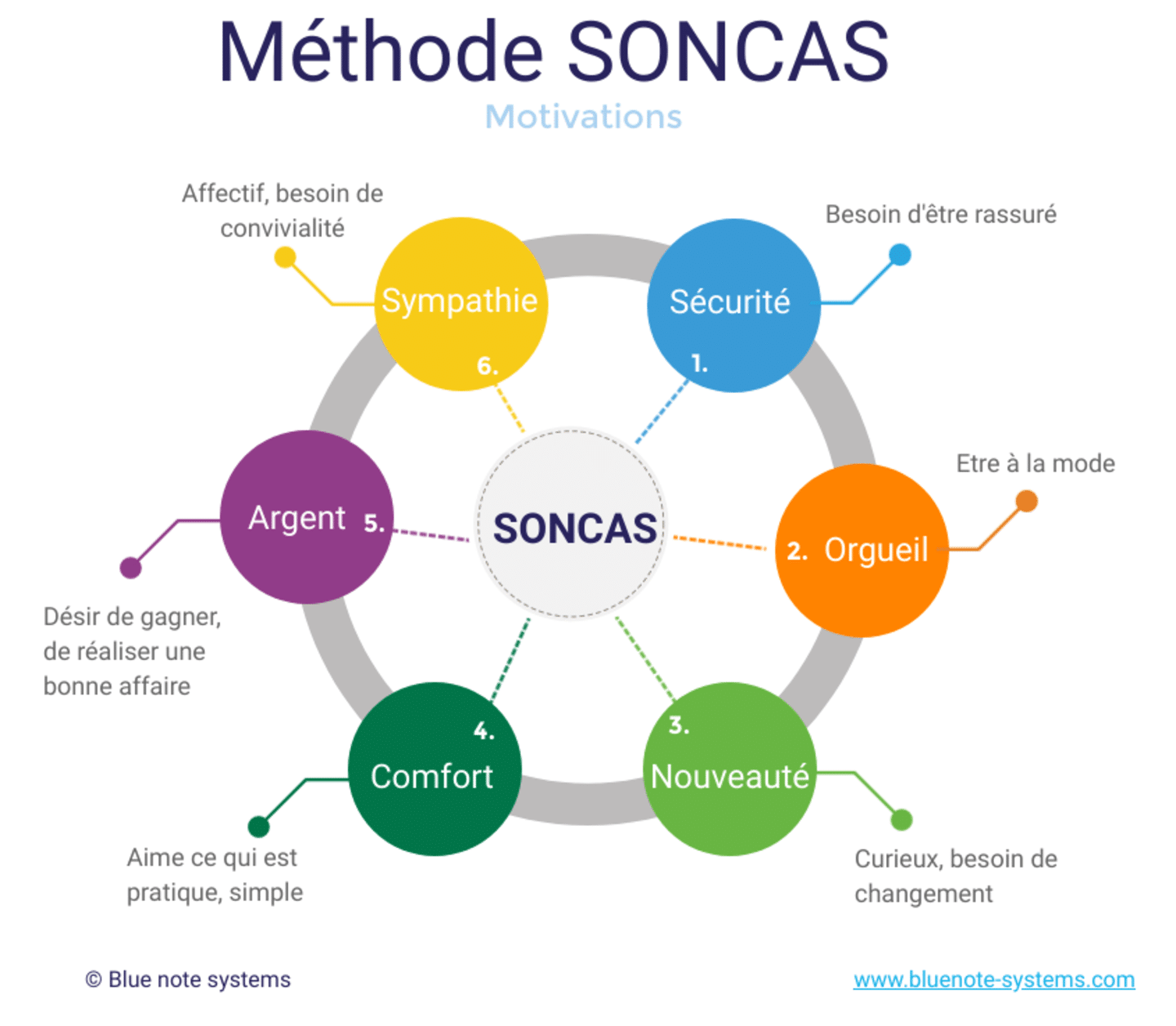
WarningThis method is only useful in a specific context. If you’re at a show for the latest car releases, even someone very cautious and security-minded will a priori be in an early adopter posture, and will value novelty more. And if you sell an insurance product, those who contact you will a priori be looking for security (if they’re the ones contacting you).
The soncas (or soncase) method comes in during the customer discovery phase, which is one of the 7 steps of the sale. The method first invites you to understand the customer’s priority needs and then their deeper motivations.
How do you use the soncas sales technique?
First, customer discovery should let you identify the customer’s main psychological profile. To use the soncase method effectively and detect the dominant motivations, ask simple questions, for example: “What would the ideal product be for you? Why?”, “What benefits will you concretely get out of it?”, “Between two roughly equivalent solutions, what would tip the balance?”, “In your decision criteria, how would you rank them?”
So SONCAS isn’t a school exercise that consists in reciting all the sales arguments associated with each motivation. It’s rather about defining your prospect’s major type and minor types, so you can then adapt your pitch and better convince your prospect.
In this part, for each example, we pretend to sell a GDPR audit to different people.
Sécurité (security)
Security is one of the main psychological levers that drive a purchase. And a customer who is afraid of negative consequences tends to buy more systematically! Identifying the customer’s psychological profile in “security” mode therefore lets you reassure them and build a careful soncas.
- Example behavior: A customer worries about not being compliant.
- Example response: “Fines can go up to 4% of annual worldwide turnover if you’re not compliant. We have the solutions to bring your company into compliance. Here is the method we’ll follow, point by point.”
Orgueil (pride)
Pride is another important decision lever. Pride can range from showing off to reputation. If you want to improve your results, don’t hesitate to flatter your customers and give them a feeling of importance and recognition! It’s, for example, setting up pre-sales or limited editions.
Faced with a proud customer, the rule is therefore to flatter their self-esteem and use the right vocabulary in your soncas method to reach them as much as possible.
- Example behavior: A customer who claims to know the regulations in force and reassures themselves with the idea that they’ve never been audited.
Several possible responses on your side:
- Play on brand image, for example: “You’re right, but it would be a shame to damage such a fine brand over a simple complaint”.
- Play on the value of time: “I imagine you have better things to do than answer data deletion requests from customers who left several years ago?”
- Or on competence: “I’m so glad to hear that! If you know the subject well, we’ll be able to move super fast, and maybe identify one or two things where you’re at risk. If you like, I can offer you a free audit to see where you stand, and we’ll see how to move forward?”
Nouveauté (novelty)
Novelty is something that can easily convince a potential buyer. It’s linked to the feeling that buying a recent product creates. Someone who buys the latest product released will feel they belong to a community of early adopters, different from everyone else.
- Example behavior: A customer who says they love novelty and expresses their weariness with things they consider archaic.
- Example response: “The only consequence is going to be making profiling more expensive, and so reserved for big companies, while small business owners will stay stuck on old technologies. There are clearly technologies of the future that let you stay within the legal framework, without ending up in the dark. If you’re interested, we can do a free audit for you and offer you suitable solutions.”
Confort (comfort)
Commercially speaking, a customer’s comfort is closely tied to their happiness. The comfort-seeking customer expects you to simply meet their needs while maintaining their current comfort. Or, at best, improving it.
To convince this type of customer, the strategy is to highlight how easy your product is to use, the extra comfort it will bring them, or even to play on their emotions!
- Example behavior: A customer who has just been appointed DPO, complains about their workload and doesn’t know where to start.
- Example response: “Don’t worry, we take care of everything, and we’ll be with you at every step to prioritize according to your goals and your constraints.”
Argent (money)
Many sales failures are linked to the cost of the product on offer. Imagine a situation where a customer is motivated by gain and/or the savings made. When building your soncas method, the goal is then to show that the money spent will be spent for useful purposes and that it will bring your customer a real gain.
- Example behavior: A customer who asks for a better offer, a discount or possibly a refund if they aren’t satisfied with the service you delivered.
- Example response: “Normally we charge €2,000 excl. VAT for an audit – in reality you charge €1,600 – but if you can sign before the end of the week I think I can get you a 10% discount” Keep a bit of margin in case you’re forced to go down to a 20% discount (and fall back to €1,600, the base price). In short, pretend to give ground, and also pretend not to give too much.
Sympathie (liking)
This customer is above all focused on the human side and on the relationship they have with their potential seller. So make sure you behave like a friendly, smiling salesperson who seeks to build a connection with your customer.
It’s a decisive factor that can really win sales, against an equivalent product for example. The goal is to find common ground and be aligned with the person you’re talking to, to create a bond!
- Example behavior: A customer who complains about how hard it is to carry out a task and asks you if you have the same problem.
- Example response: “You can say that again, and I totally understand. A terribly time-consuming topic.”
SONCAS vs SONCASE
Today people also talk about the SONCASE method, with the “E” for environnement / écologie (environment, ecology), which has become a motivation in its own right in recent years. It’s not for nothing that people talk about “green business”, the “sustainable economy”, etc.
Make sure you highlight the “environmental” aspects of your offer if and only if it’s an important point for your prospect!
Is your company into zero waste? Has it worked to reduce its carbon footprint or to meet environmental ISO standards? Are your products local / made in your own country? Now’s the time to use it and put your green side forward to win the preference of customers with an environmental motivation.
Using the different principles of influence to turn your prospect into a customer
In his book Influence: The Psychology of Persuasion, Robert Cialdini explains that we all have automatic mechanisms that unconsciously influence our decisions. It’s for example thinking that a product’s high price is a guarantee of quality. Here we cover the 6 main principles of influence that R. Cialdini puts forward.
1. Reciprocity
You can influence a person in several ways, but giving them a gift is undeniably one of the most effective options! Automatically, the person who receives the gift feels indebted and beholden to you, which sets up a real relationship of reciprocity.
If you give of yourself to someone freely and selflessly, you have the power to make that person come back to you when you have a request, out of a concern for reciprocity.
For example, it’s inviting someone to a trade show, while expecting an invitation in return from them!
2. Consistency
According to this principle, people are more willing to take steps, to carry out actions, if they’ve already done so in the past, whether those actions were reasoned or not. In other words, people tend to seek out what is familiar to them.
By the principle of consistency, a customer therefore tends to stay consistent with their previous commitments.
For example, if you carry out an SEO audit for your customer and make concrete recommendations, they will be more inclined to ask you to put the recommendations into action.
3. Social proof
The principle of social proof states that individuals tend to join the majority, to share its opinion. If a large proportion of people consider something right, the others will tend to think the same.
For a seller, social proof consists in showing that lots of other people are satisfied with your product or service. And ideally people who look like your prospect! For the buyer, it’s a way to project themselves, through identification, into the buying experience.
Expert mentions are an excellent example of social proof. They let you raise your brand awareness very effectively and get noticed by new prospects. An expert’s endorsement is a strong sign of approval for a potential customer and reinforces the idea that you offer a quality product – and therefore your credibility.
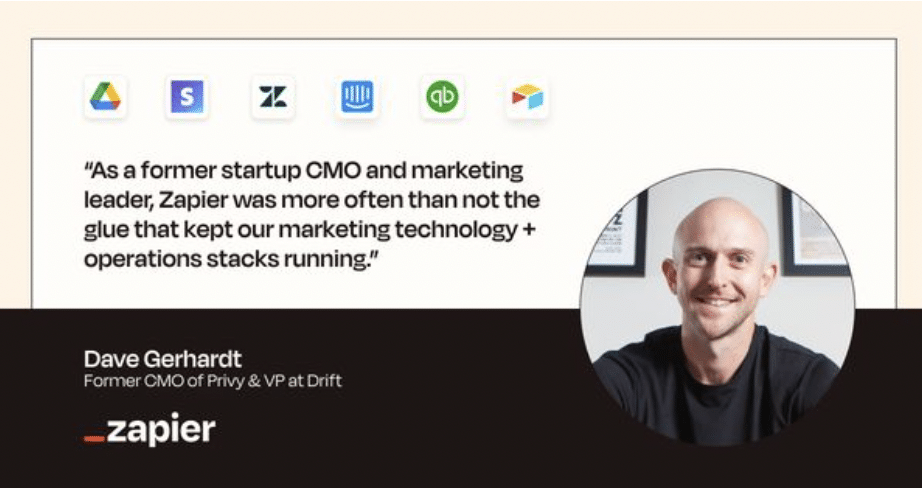
Simply seeing your company’s name cited in an article is a guarantee of reliability!
4. Liking
In psychology, it is said that 10 seconds are enough to decide whether or not to grant your liking to a third person. You make this choice based on purely subjective criteria, like that person’s physical appearance, their facial expression, their bearing, etc. Based on these criteria, you unconsciously link the person to values of honesty and success.
Logically, we therefore prefer to buy from people who seem likable to us.
For R. Cialdini, there are several factors that make it easy to attract liking, notably similarity, through your appearance or your interests, compliments, regular contact or cooperation.
So smile, take an interest in others, listen, empathize, and build the relationship!
5. Authority
Authority is linked to the idea of expertise: a person who enjoys a certain reputation or clear leadership will benefit from greater credibility, and their words will tend to be believed without needing to be checked.
The expert is often recognized as such through symbols, like a title or a physical appearance. So don’t hesitate to show yourself alongside experts who are credible on their subject, by taking part in webinars for example.
Stop believing you’re going to become a reference in your market, it’s not your job, and it only makes money for those who sell ghostwriting on LinkedIn!
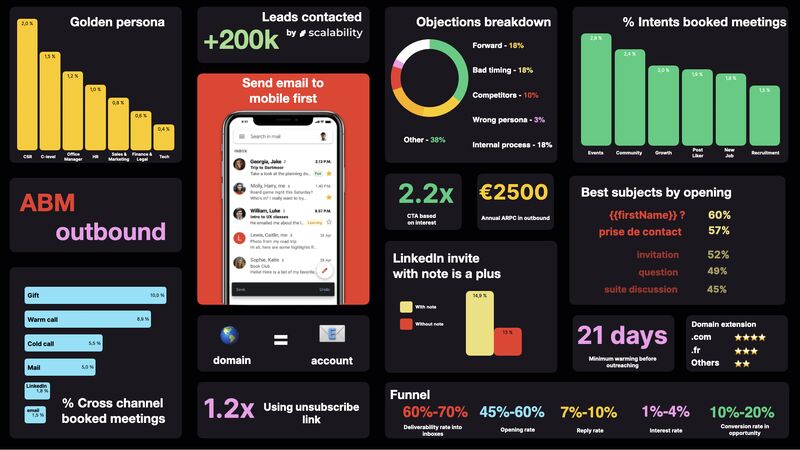
You can also show your results and document your method to build credibility. That’s the principle of “build in public” – You show your successes, and that generates authority. Whatever you do, don’t believe that build in public means sharing everything.
6. Scarcity
The risk of losing one’s freedom to choose triggers an unconscious automatic defense mechanism to preserve that ability to choose. We’ll want to buy a product all the more if it’s out of stock, precisely because our freedom of choice is constrained.
So don’t hesitate to label your product or service as exclusive and accessible to a handful of individuals. It will stir up the curiosity of the person you’re talking to all the more! It’s for example putting a limited number of seats for an event on sale.
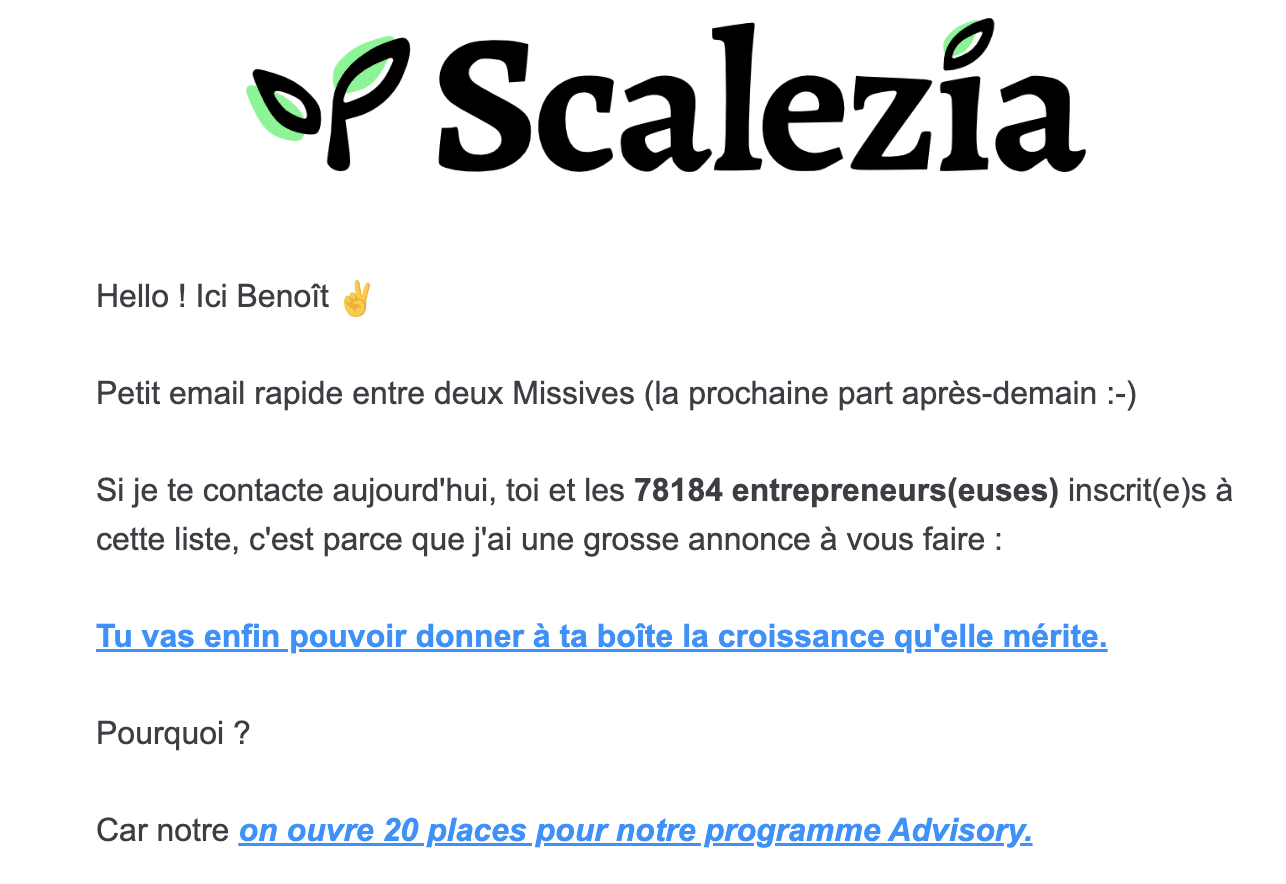
That’s typically what Scalezia does in the sample email below. The problem in their case is that they do it every week, so you end up realizing it’s not that rare after all. But the idea is there.
The questions we get over and over.
What does SONCAS stand for?
Sécurité (security), orgueil (pride), nouveauté (novelty), confort (comfort), argent (money) and sympathie (liking): it’s a French acronym. The method is based on analyzing prospects’ behavior: it identifies their needs and buying motivations to adapt the pitch and trigger the purchase more easily.
How do you use the SONCAS method?
During the customer discovery phase, by asking simple questions like “What would the ideal product be for you? Why?” or “Between two roughly equivalent solutions, what would tip the balance?”. The point is to define the prospect’s major type and minor types, not to recite all the arguments associated with each motivation.
What is the difference between SONCAS and SONCASE?
The E adds environnement or écologie (environment, ecology), which has become a buying motivation in its own right in recent years. Put it forward if and only if it’s an important point for the prospect.
What are Aristotle’s modes of persuasion?
Ethos (character) appeals to moral principles and trust, logos (reason) to logic, pathos to emotion. A fourth mode, kairos, appeals to the opportune moment.
What are Cialdini’s 6 principles of influence?
Reciprocity, consistency, social proof, liking, authority and scarcity, described by Robert Cialdini in Influence: The Psychology of Persuasion.


What the community says.