
The tool in detail
Pimms after real-world use: feature scope, integrations, pricing and concrete limits.
You share a YouTube link on LinkedIn, your prospect clicks and then, instead of opening the YouTube app, the link opens in LinkedIn’s built-in mini-browser. The result: a degraded experience, no authentication, friction. Your prospect gives up and you’ll never know.
This in-app browser problem is a conversion killer. Facebook, Instagram, TikTok, LinkedIn: all these platforms open links in their own browser rather than in the native destination app. According to studies cited by the vendor, this can cut your conversions by 20 to 40%.
That’s exactly the problem Pimms claims to solve. This French platform combines deeplinks, which force the link to open in the native app, with a tracking system that connects every click to real revenue. Not just how many clicks, but how much money they generated.
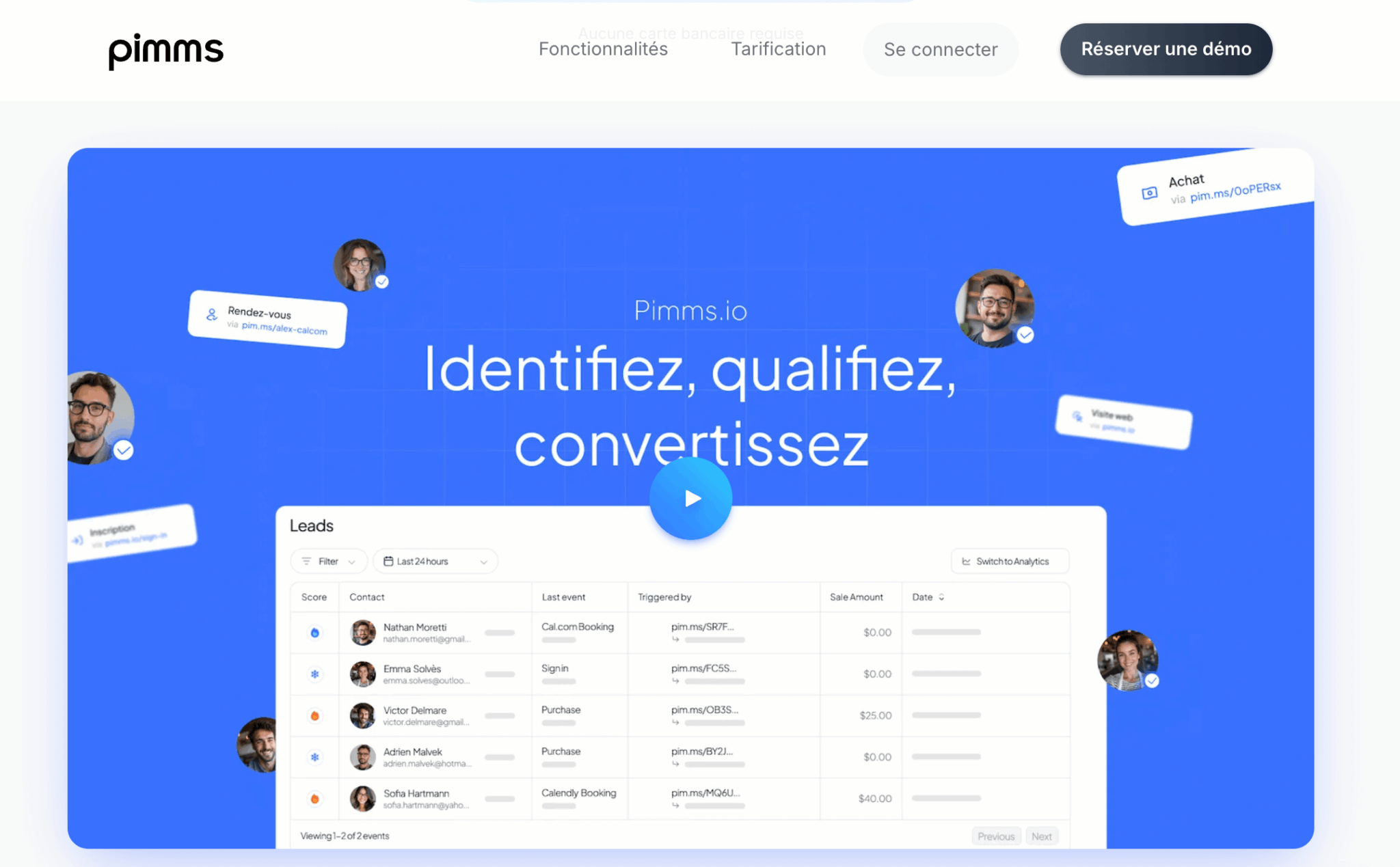
Let’s be honest from the start: Pimms is a very young tool, which had only just launched when these lines were written. We lack hindsight on its long-term reliability and on whether it will last. But we took the time to analyze it in depth, to give a first opinion on a tool that deserves attention and that will probably change quite a bit over the coming months.
Pimms: what is it exactly?
Pimms is a smart link management and conversion tracking platform, founded by Alexandre Sarfati. The tool is based on a derivative of the open source project Dub.co, but with a clear specialization: mobile deeplinks and revenue attribution.
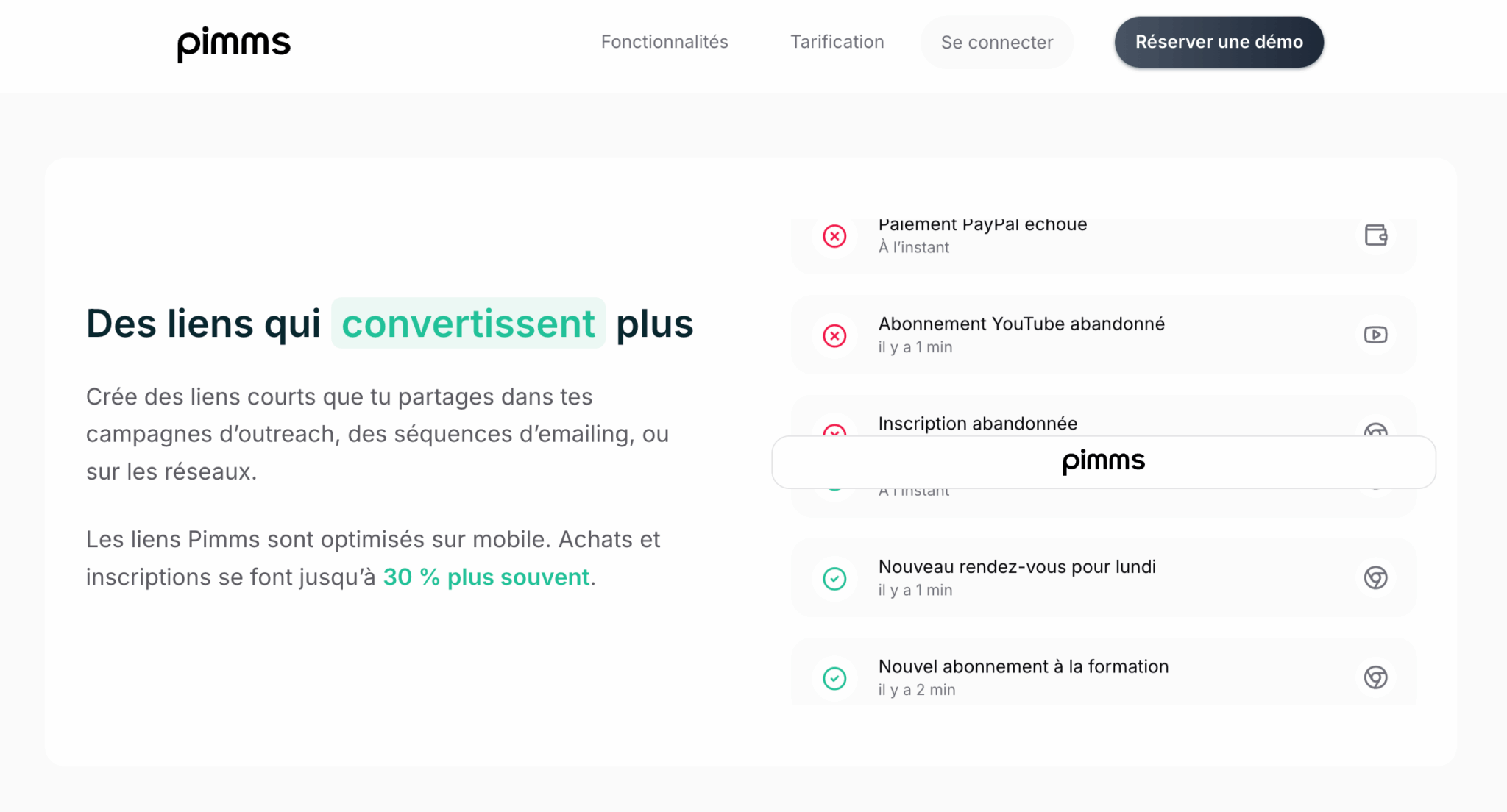
In practice, Pimms does two things that classic link shorteners don’t do, or do badly:
- First, it creates deeplinks that force the link to open in the native app. When someone clicks your YouTube link from Instagram, instead of opening in Instagram’s built-in browser, the link opens the YouTube app directly.
- Second, it connects every click to real revenue. Where Bitly tells you « you got 500 clicks », Pimms tells you « you got 500 clicks, 12 qualified leads and €3,200 in sales generated ». It’s a revenue-first philosophy that changes the way you analyze your marketing efforts.
Pimms targets solopreneurs, bootstrapped SaaS founders and content creators who want to know precisely which marketing generates sales, without paying a monthly subscription.
Pimms key features
Deep linking: the heart of the product
Deep linking is the feature that fundamentally sets Pimms apart from Bitly or classic link shorteners. To understand why it matters, you first have to understand the problem.
When you share a link on social networks, that link usually doesn’t open in the user’s default browser. The platforms have their own built-in browser, which captures the click. It’s deliberate: they want to keep the user in their ecosystem for as long as possible.
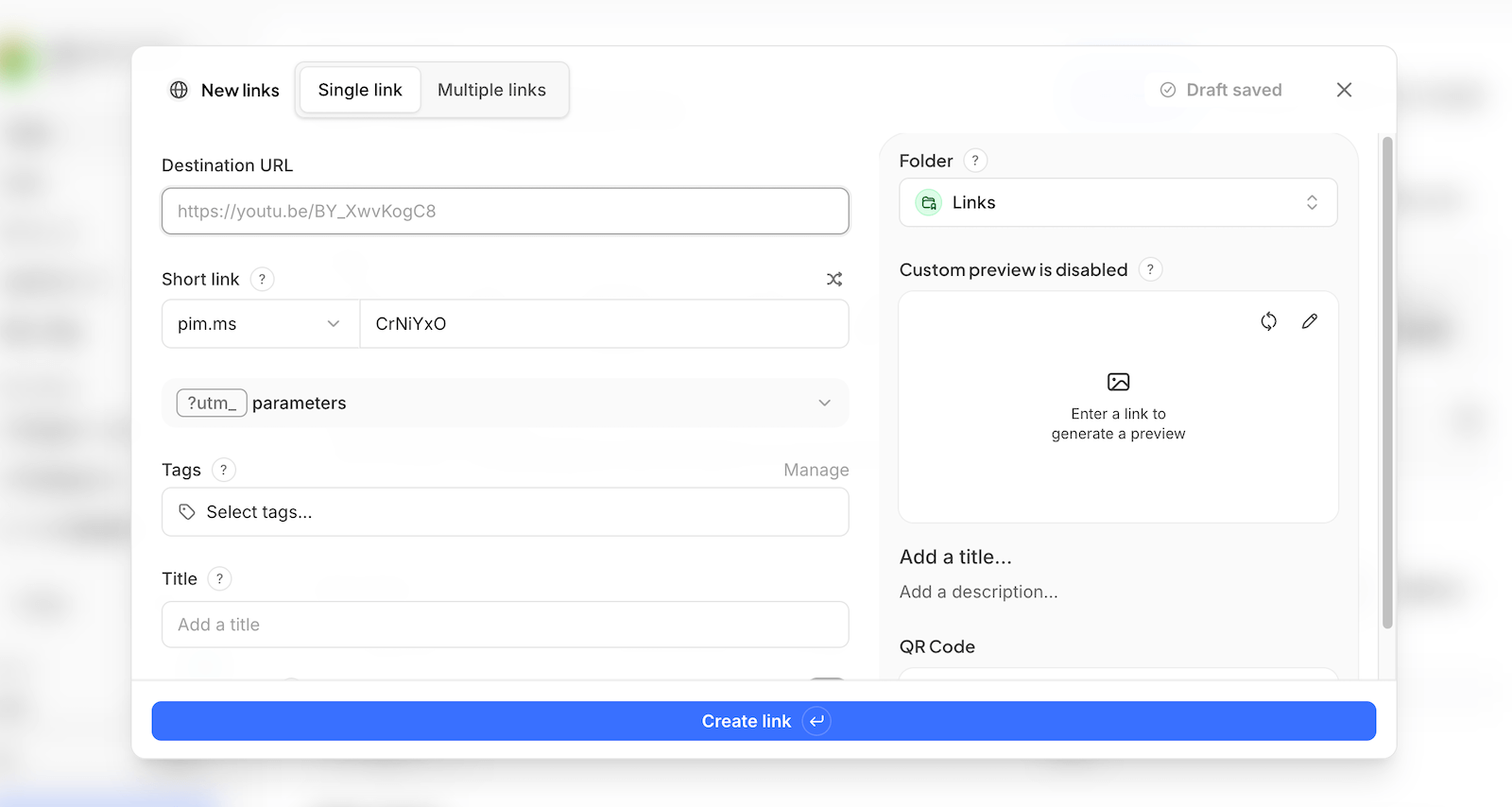
The problem is that these in-app browsers offer a degraded experience. If you share a link to a YouTube video, the user lands on a web version of YouTube instead of the native app, without their subscriptions, without their recommendations, without the smoothness of the app.
Pimms solves this problem by creating links that force the native destination app to open. The technical mechanism is invisible to the user: they click, and the YouTube, LinkedIn, Spotify or Instagram app opens directly.
Revenue attribution: the revenue-first philosophy
This may be the most important difference between Pimms and its competitors. Where Bitly focuses on clicks and engagement, Pimms focuses on revenue.
Most tracking tools give you vanity metrics: number of clicks, bounce rate, time spent on the page. It’s useful, but it doesn’t answer the fundamental question: which marketing actually makes me money?
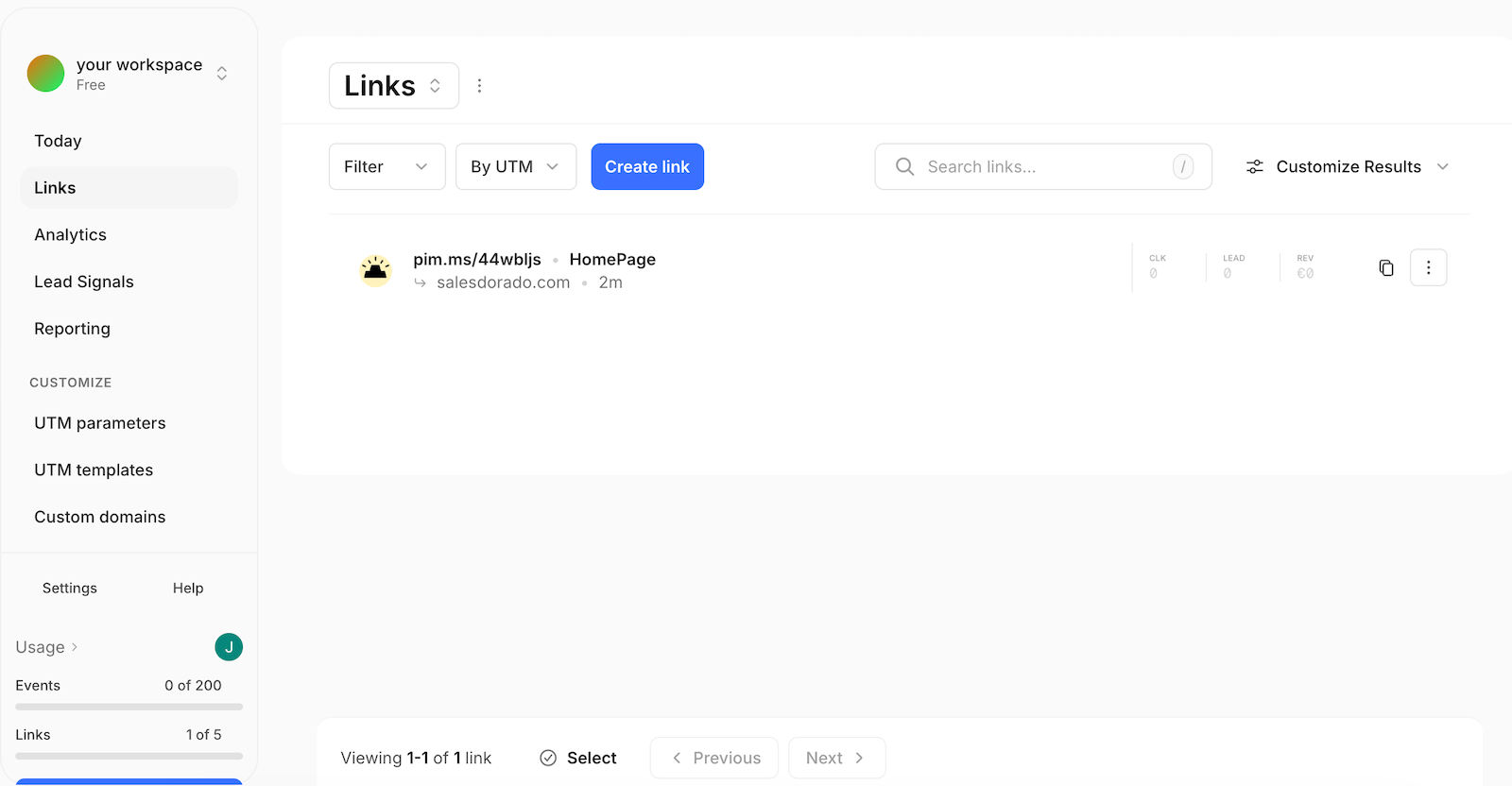
Pimms tracks the entire journey, from click to visit, then to lead, sale and revenue. In practice, the tool can tell you that your LinkedIn post from January 15 generated 47 clicks, 8 newsletter sign-ups, 2 discovery call bookings and €1,500 in revenue. Not just 47 clicks.
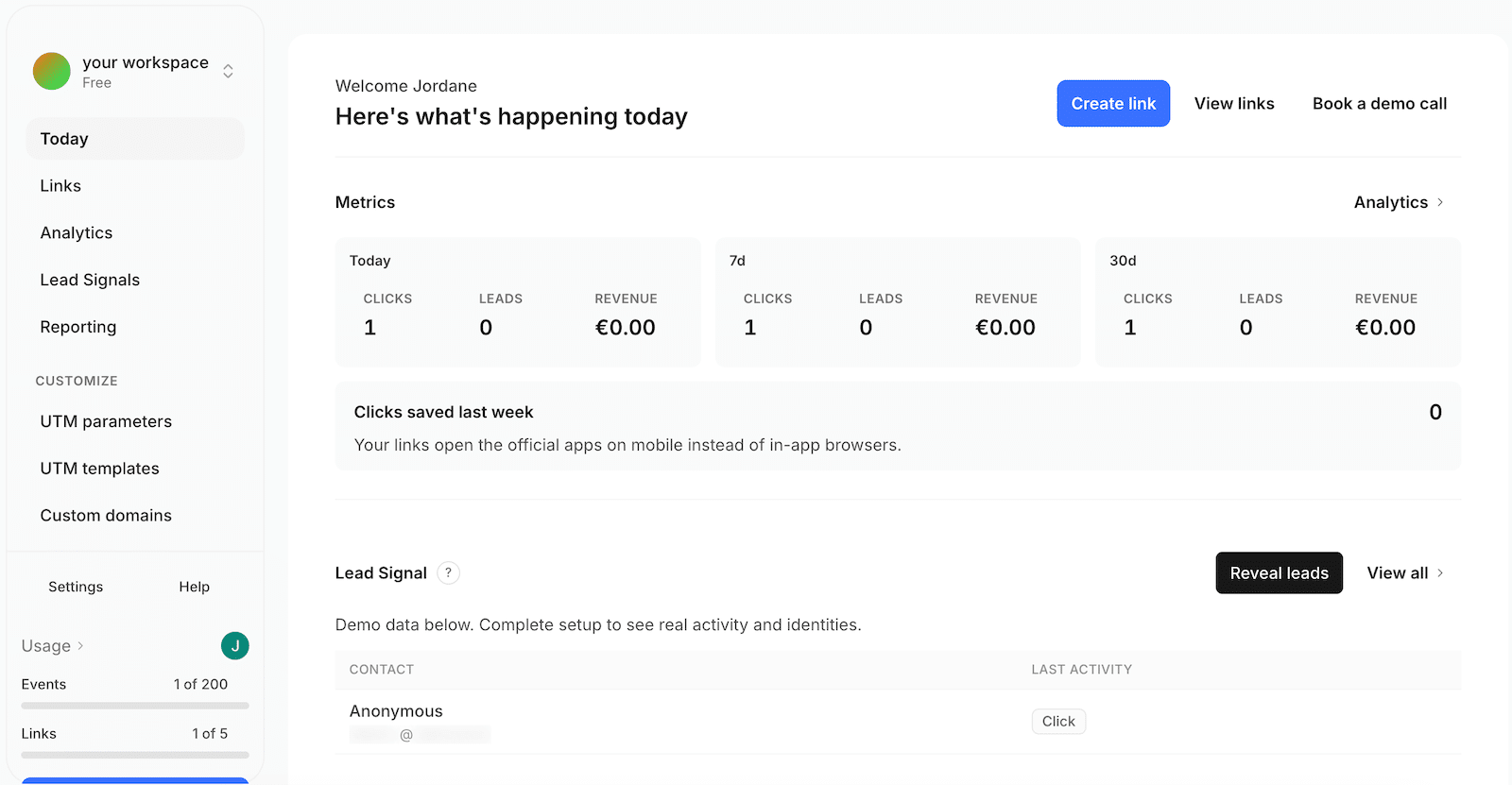
This attribution works thanks to native integrations with payment tools, Stripe and Shopify, and booking tools, Cal.com and Calendly. When a payment comes in on Stripe, Pimms can trace the chain back and identify which link started the buying journey.
The tool also offers AI lead scoring to prioritize the prospects with the most potential, and a complete history of each visitor’s interactions. You can see that a contact clicked your links three times this week, downloaded your ebook and visited your pricing page, before they even contact you.
This revenue-first approach is refreshing. Too many marketers optimize for metrics that don’t pay the bills. Pimms forces you to ask the right question: is what I’m doing generating money? It’s basic, but it’s often forgotten.
Visitor identification: the hidden feature
This is probably Pimms’ most powerful feature, and paradoxically the least promoted. The tool can automatically identify anonymous visitors, with their email and their company.
How does it work? When someone clicks your Pimms link from LinkedIn, the tool captures contextual data and enriches it automatically. You can then see that an identified person, at a given company, visited your pricing page three times this week.
From there, you can trigger actions: send a follow-up email, a LinkedIn message, or simply log the prospect in your CRM. The vendor presents this tracking as legal and GDPR-compliant, because it relies solely on first-party tracking.
This feature is rare. Bitly doesn’t offer it, and neither does Google Analytics. The specialized tools that do, Leadfeeder or Clearbit, often cost €100 to €300 per month. Pimms includes it in its base offer.
Integrations and API
On the integration side, Pimms goes for the essentials rather than exhaustiveness. The tool connects to the key building blocks of the solopreneur and SaaS ecosystem, without trying to cover hundreds of use cases:
- For payments, Stripe and Shopify are integrated natively, and Stripe is the market standard, so that covers most needs.
- For automation, you have Zapier, Make and Systeme.io, which lets you build custom workflows and connect Pimms to pretty much any tool.
- For booking, Calendly, Cal.com and iClosed are supported.
- Tally.so handles forms and Webflow handles website integration.
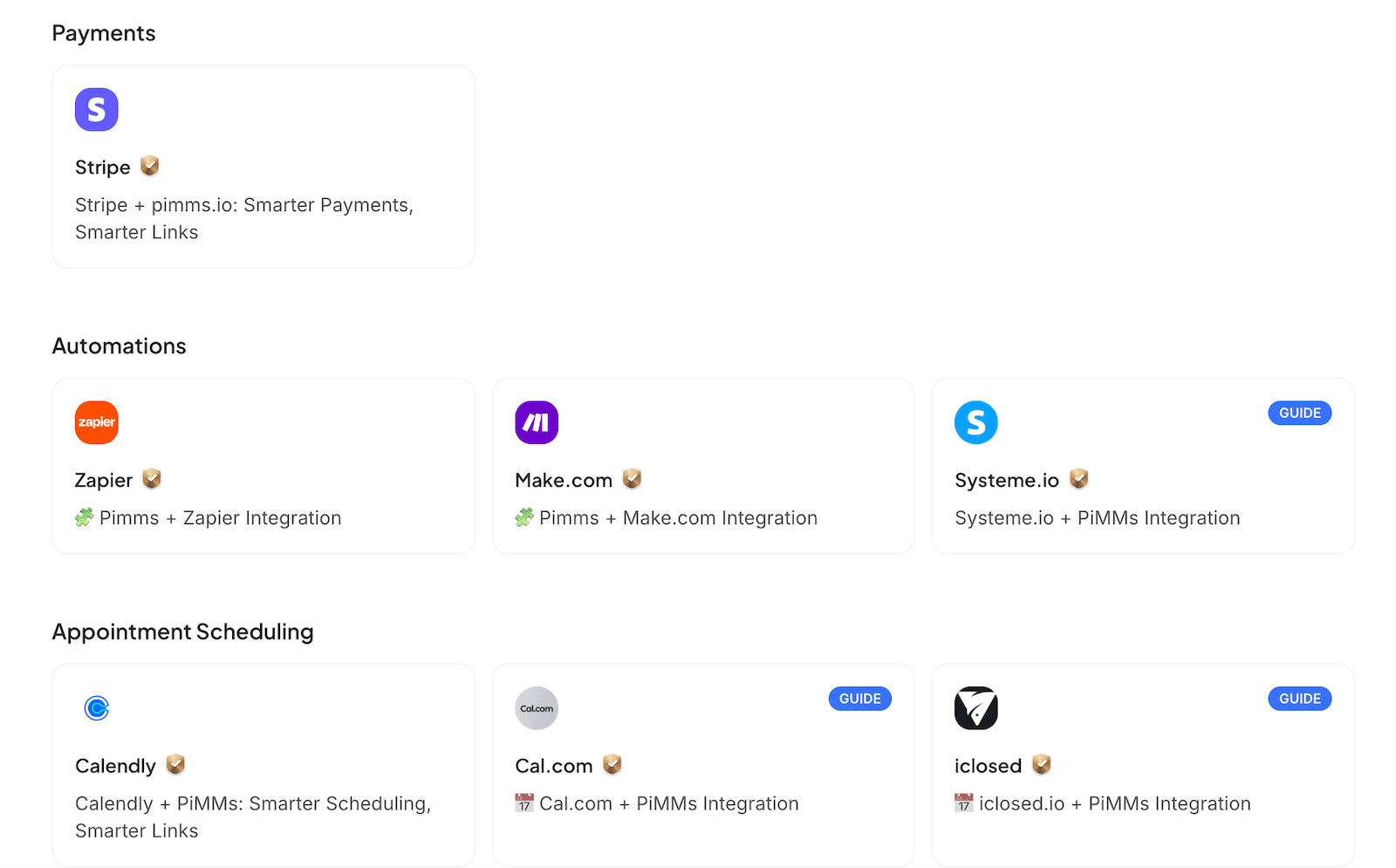
For more technical needs, Pimms offers API keys and webhooks that let you build custom integrations. That’s enough for developers who want to connect the tool to their existing stack.
Pimms now advertises more than 100 integrations, and webhooks as well as Zapier let you fill the gaps. For the tool’s target audience, the essentials are there.
You might also be interested in these articles
Pimms plans and pricing
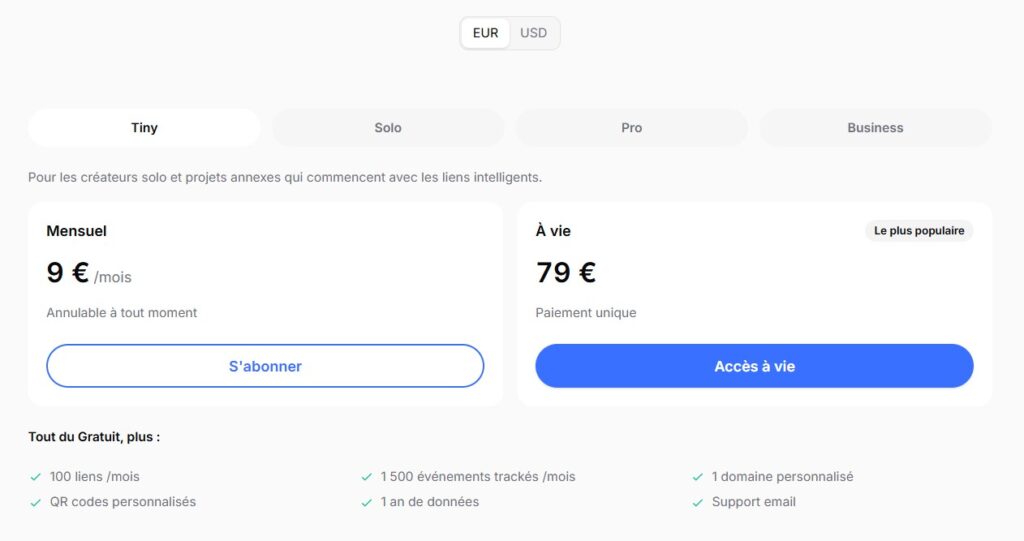
Pimms’ pricing model is radically different from the usual SaaS competition. Where Bitly charges a recurring monthly subscription, Pimms offers you a one-time, lifetime payment on its first two paid plans.
Pricing structure
| Plan | Price | Links per month | Key points |
|---|---|---|---|
| Free | 0 € | 5 | 200 events, QR codes, UTM, 30 days of data |
| Tiny | €9 / month or €79 lifetime | 100 | 1 custom domain, custom QR codes, 1 year of data |
| Solo | €19 / month or €129 lifetime | 500 | 3 domains, 3,000 events, 5 members, A/B tests, webhooks and API, 1 year of data |
| Pro | €39 / month or €390 / year | 1,000 | 5 domains, 10,000 events, bulk link creation, priority support |
| Business | €69 / month or €690 / year | 2,000 | 10 domains, 20,000 events, 10 members, 2 years of data |
On the Pro and Business plans, the annual subscription gives you 2 months free, a saving of about 16%. All paid plans come with a 14-day money-back guarantee.
The math that hurts Bitly
Let’s compare the total cost over 3 years for equivalent use:
| Tool | Monthly cost | Year 1 cost | 3-year cost |
|---|---|---|---|
| Pimms Solo lifetime | €0 after purchase | €129 | €129 |
| Bitly Growth | $35 / month | $420 | $1,260 |
| Dub.co Pro | $30 / month | $360 | $1,080 |
Over 3 years, Pimms Solo lifetime costs about ten times less than Bitly Growth.
The psychology behind lifetime pricing
The lifetime model isn’t just a marketing tactic. It’s a signal of confidence from the founder: I’m so sure my product will satisfy you that I’m only asking you to pay once.
For the user, it removes the psychological friction of a monthly subscription. €129 once is a purchase decision. €19 a month for years is a permanent mental load: am I using this tool enough to justify the subscription? And if your needs grow, you move up to the next plan and only pay the price difference.
The trade-off for Pimms: less predictable recurring revenue. But the founder makes up for it with the Pro and Business plans, at €39 and €69 per month, for teams that need more volume, and probably with a better conversion rate thanks to an accessible price.
The €129 Solo lifetime plan is the best option for most solopreneurs and small teams. It’s low enough to be a quick decision, but high enough to filter out the curious who will never use the tool. If you’re hesitating, start with the free plan or the €19 monthly plan, to test without commitment.