Top 10 Best A/B Testing Software

Comparison of ten A/B testing software. Google Optimize has been shut down since September 30, 2023; AB Tasty and VWO merged in January 2026 under the name Wingify. SMBs and marketing teams: HubSpot (A/B testing from the Pro plan, €90 per seat per month), Convert (from $299 per month billed annually, data in Frankfurt).

Maxime Ben Bouaziz
Maxime Ben Bouaziz
CEO Salesdorado, IA & Sales Tech
April 10, 2026, updated November 10, 2026, 1 min read
See all tools

A/B testing software shows two versions of a page, an email or a feature to two groups of visitors, then measures which one converts better. A badly placed button, a weak headline, a form that is too long: these details cost customers, and testing is how you measure them instead of guessing.

The market has shifted: Google Optimize, Google’s free tool, has been unavailable since September 30, 2023, and AB Tasty and VWO merged in January 2026 under the name Wingify. Depending on your need:

  • test emails and landing pages in your CRM: HubSpot;
  • a complete testing tool with listed prices: Convert;
  • test and personalize a high-traffic site: Wingify or Kameleoon;
  • a large-scale testing program: Optimizely, or Adobe Target if you are already with Adobe;
  • understand what to test before testing: Contentsquare, or Crazy Egg for a small budget;
  • test product features in code: PostHog or GrowthBook.
The 10 tools, side by side

# Logos tool Score Price Best for
01 HubSpot 4.5/5 ★ €90 B2B SMBs already equipped with HubSpot that want to tie each test to the revenue generated Visit site
02 Wingify (VWO et AB Tasty) 4.5/5 ★ On request E-commerce sites with 100K to 1M monthly visitors that want to test and personalize without code Visit site
03 Kameleoon 4.4/5 ★ €495 High-traffic companies, with data and tech teams, that want AI-driven personalization Visit site
04 Optimizely (Agentic Experimentation, ex-Web Experimentation) 4.5/5 ★ On request Tech companies with a strong data culture, large product teams and a substantial budget Visit site
05 Adobe Target 4.3/5 ★ On request Very large companies already equipped with Adobe, with a team dedicated to experimentation Visit site
06 Contentsquare 4.4/5 ★ On request Mature e-commerce and transactional sites that want to know what to test, and why Visit site
07 Crazy Egg 4.0/5 ★ $99 Small businesses, freelancers and agencies discovering website optimization Visit site
08 PostHog 4.4/5 ★ Free Tech startups with an engineering team able to deploy and maintain the tool Visit site
09 Convert 4.3/5 ★ $299 SMBs and agencies that want a complete testing tool, without a quote, with data hosted in Europe Visit site
10 GrowthBook 4.3/5 ★ Free Product and data teams that want to analyze their tests on their own data warehouse, without paying per traffic Visit site
01

HubSpot

4.5/5 From €90

Best for: B2B SMBs already equipped with HubSpot that want to tie each test to the revenue generated

+ Strengths
  • Tests tied to the CRM: every contact tracked through to paying customer
  • Drag-and-drop interface, first test launched in fifteen minutes
  • Segmentation by persona, industry or buying journey stage
  • One of the richest integration ecosystems
− Downsides
  • A/B testing reserved for the Pro and Enterprise plans
  • No complex multivariate tests or mobile tests
  • Tests limited to content created in HubSpot
★ HubSpot in brief

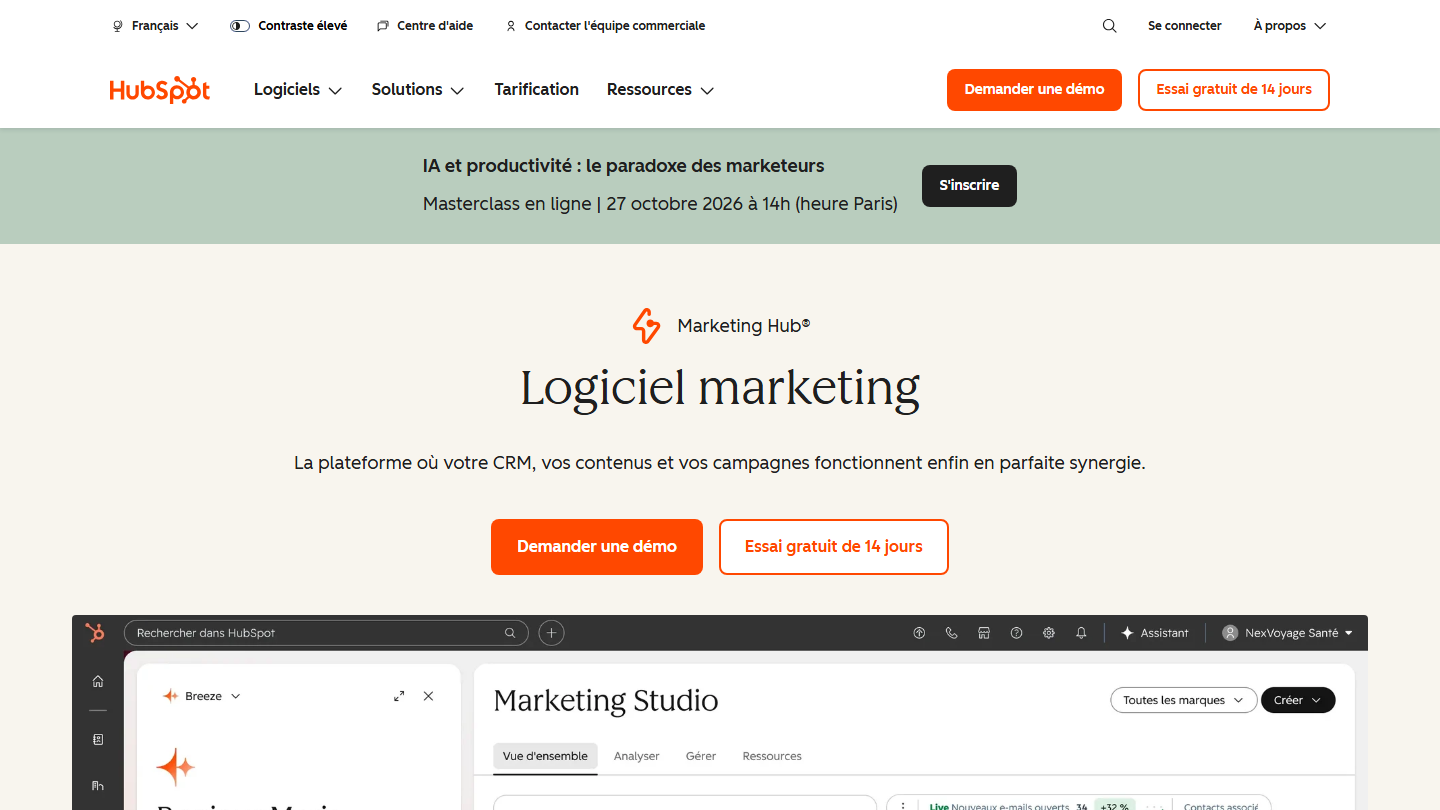
HubSpot Marketing Hub page: “Marketing software”, with the Marketing Studio editor

HubSpot is not a standalone A/B testing tool: tests are part of Marketing Hub, alongside the CRM, emailing, landing pages and workflows. Every test talks to the CRM, and that is what changes how results are measured.

In practice, you create two versions of an email or a landing page in the drag-and-drop editor, HubSpot splits the audience and picks the winner. Tracking does not stop at the click: HubSpot counts how many of those contacts become qualified leads, then paying customers. Smart content also adapts the content to the contact’s properties.

The choice makes sense for a B2B SMB already equipped with HubSpot, with a marketing team of 3 to 10 people and long sales cycles: B2B services, SaaS, agencies. To test an e-commerce purchase journey or an app, you need a dedicated tool.

A/B testing comes with the Pro plan, at €90 per month per seat billed annually; Enterprise costs €175. The free tools and the Starter plan, at €20 per seat per month, do not include it. 14-day free trial.

02

Wingify (VWO et AB Tasty)

4.5/5 From On request

Best for: E-commerce sites with 100K to 1M monthly visitors that want to test and personalize without code

+ Strengths
  • WYSIWYG visual editor and code editor from the Growth plan
  • Personalization, heatmaps and feature flags in the same platform
  • Data centers in the United States, Europe and India
  • Support and training included
− Downsides
  • Pricing on request only, calculated on traffic
  • Multivariate tests reserved for the Pro plan
  • Recent merger (January 2026): AB Tasty and Wingify accesses remain separate
★ Wingify (VWO et AB Tasty) in brief

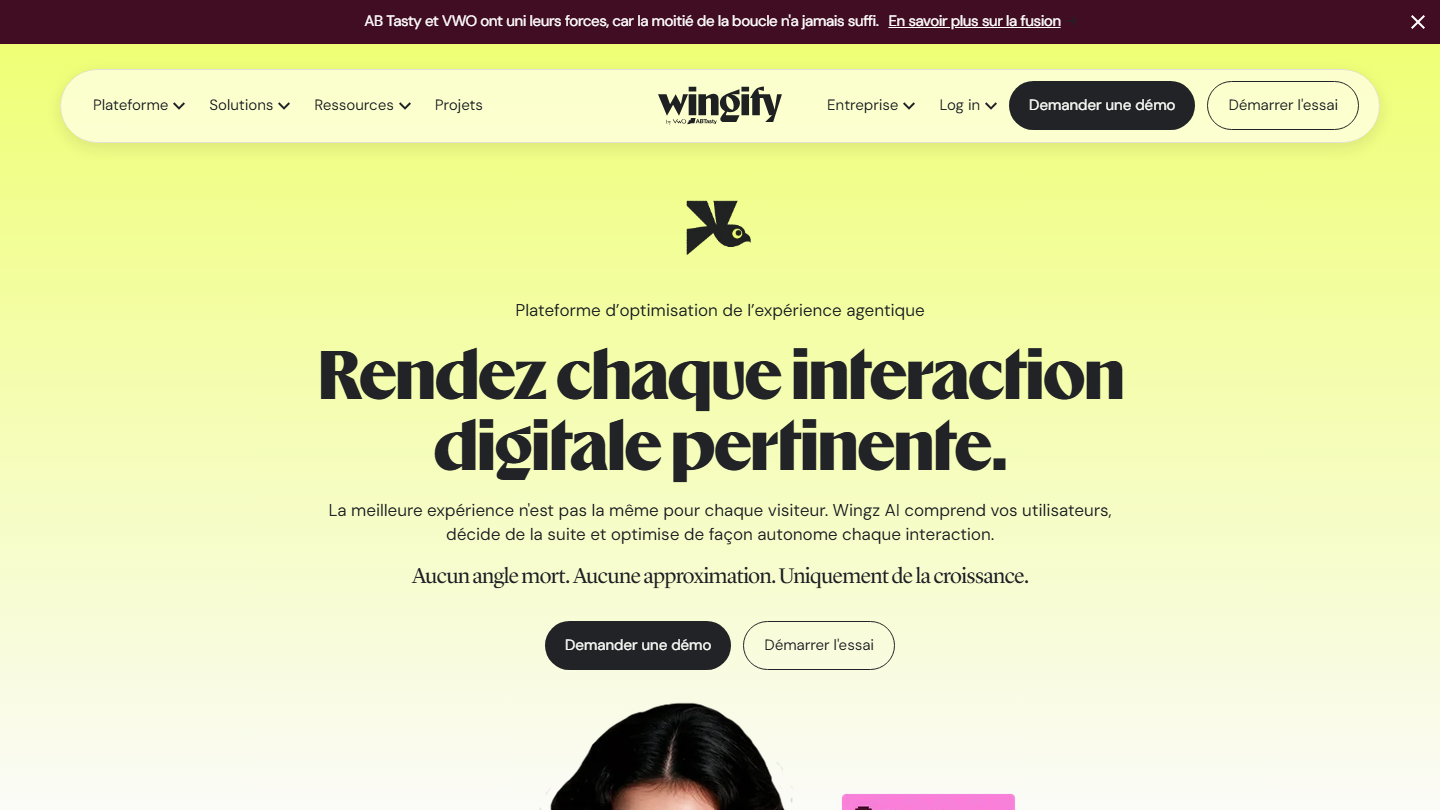
Wingify home page, born from the merger of AB Tasty and VWO: “Make every digital interaction relevant.”

Wingify is the platform born in January 2026 from the merger of AB Tasty, the French publisher founded by Alix de Sagazan and Rémi Aubert, and VWO. The VWO site now redirects to Wingify’s, and AB Tasty customers keep their own access for now.

In practice, after installing a script, marketing teams build their tests in the visual editor: A/B, split URL, then multivariate with the Pro plan. The same platform adds real-time personalization, heatmaps and session recordings, feature flags for server-side tests and a commerce module (search, recommendations).

It targets e-commerce and transactional sites with enough traffic to conclude their tests, typically between 100,000 and one million visitors per month: retail, travel, media, financial services. It goes further than Convert, without requiring the investment of Optimizely or Adobe Target.

Pricing is on request, calculated on monthly active users, with three plans: Growth, Pro and Enterprise. The free trial lasts 30 days, with no credit card.

03

Kameleoon

4.4/5 From €495

Best for: High-traffic companies, with data and tech teams, that want AI-driven personalization

+ Strengths
  • Tests generated from a written instruction (PBX), no developer needed
  • Web, mobile and server SDKs, hybrid client and server tests
  • Private cloud, GDPR and HIPAA compliance, SSO authentication
  • Entry price listed, 30-day trial with no credit card
− Downsides
  • Personalization, feature management and code editor reserved for the Enterprise plan, on request
  • One to two months of setup on the full plan
  • Algorithms not very effective below 100,000 monthly visitors
★ Kameleoon in brief

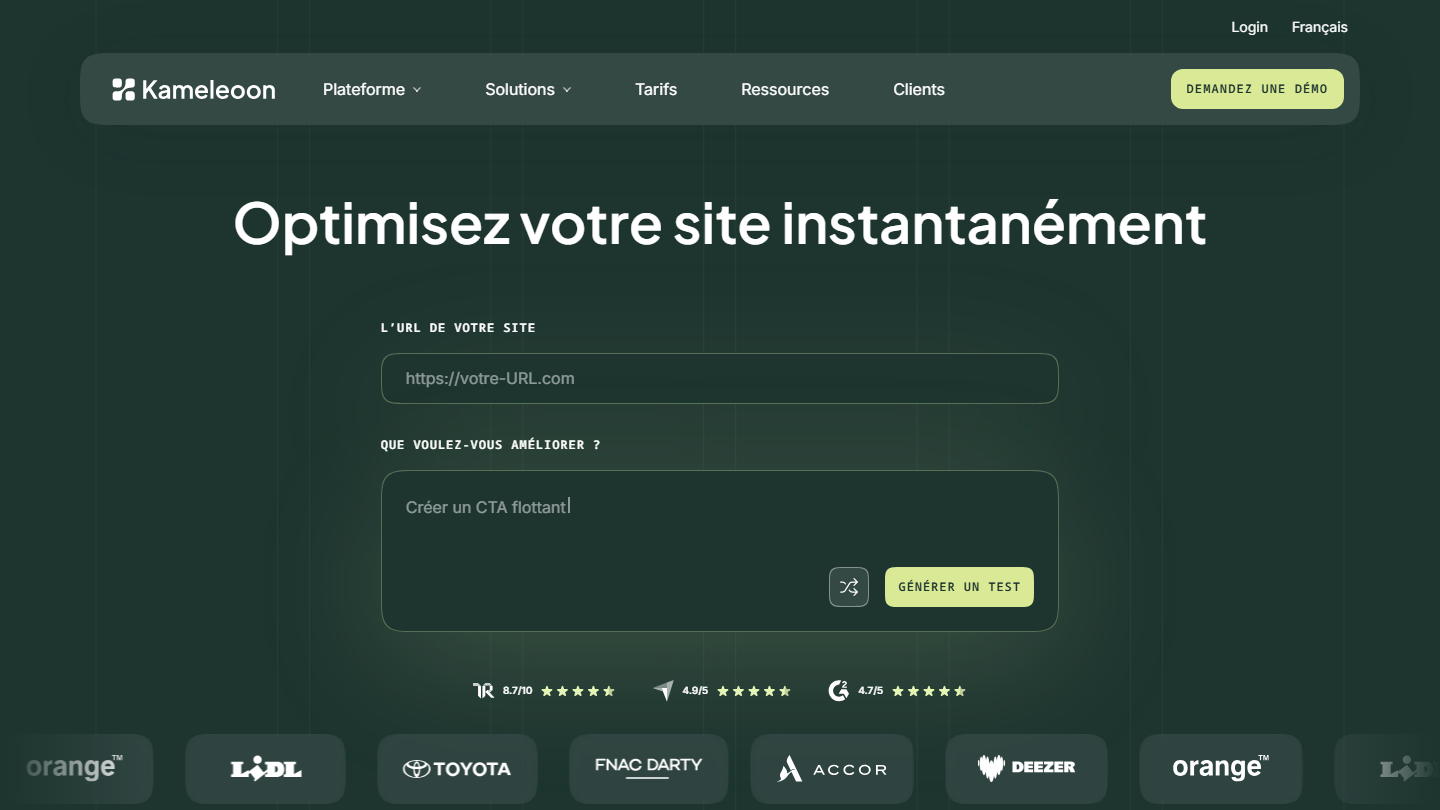
Kameleoon home page: “Optimize your site instantly”, with the prompt-based test generator

Kameleoon is a French A/B testing and personalization publisher that has put AI at the center of its product. Its latest building block, PBX (Prompt-Based Experimentation), creates a test from a written instruction: you give the page URL, describe the change you want, and Kameleoon generates the variant.

In practice, Kameleoon analyzes the page and suggests tests based on visitor behavior, splits the traffic and picks the metrics according to the goal. The Enterprise plan adds personalization, feature management, mobile app tests and contextual bandits, which send each visitor to the variant most relevant to them. The SDKs cover JavaScript, iOS, Android, React, Vue.js and backend frameworks.

Kameleoon makes sense for mature digital companies with data and tech teams: banking, insurance, telecoms, paywalled media. AI needs volume: below 100,000 monthly visitors, its algorithms struggle.

PBX Starter starts at €495 per month for 10 experiments and 50,000 tested visitors per month. The free trial lasts 30 days, with no credit card, and 3 experiments. Enterprise is custom.

04

Optimizely (Agentic Experimentation, ex-Web Experimentation)

4.5/5 From On request

Best for: Tech companies with a strong data culture, large product teams and a substantial budget

+ Strengths
  • Proprietary Stats Engine, designed to limit false positives
  • A/B, multi-page, feature and server-side tests
  • Hundreds of simultaneous tests without conflict
  • More than 100 integrations, training and certification program
− Downsides
  • On request only, large-account budget
  • Dense interface, designed for specialized teams
  • Three to six months to master the tool
★ Optimizely (Agentic Experimentation, ex-Web Experimentation) in brief

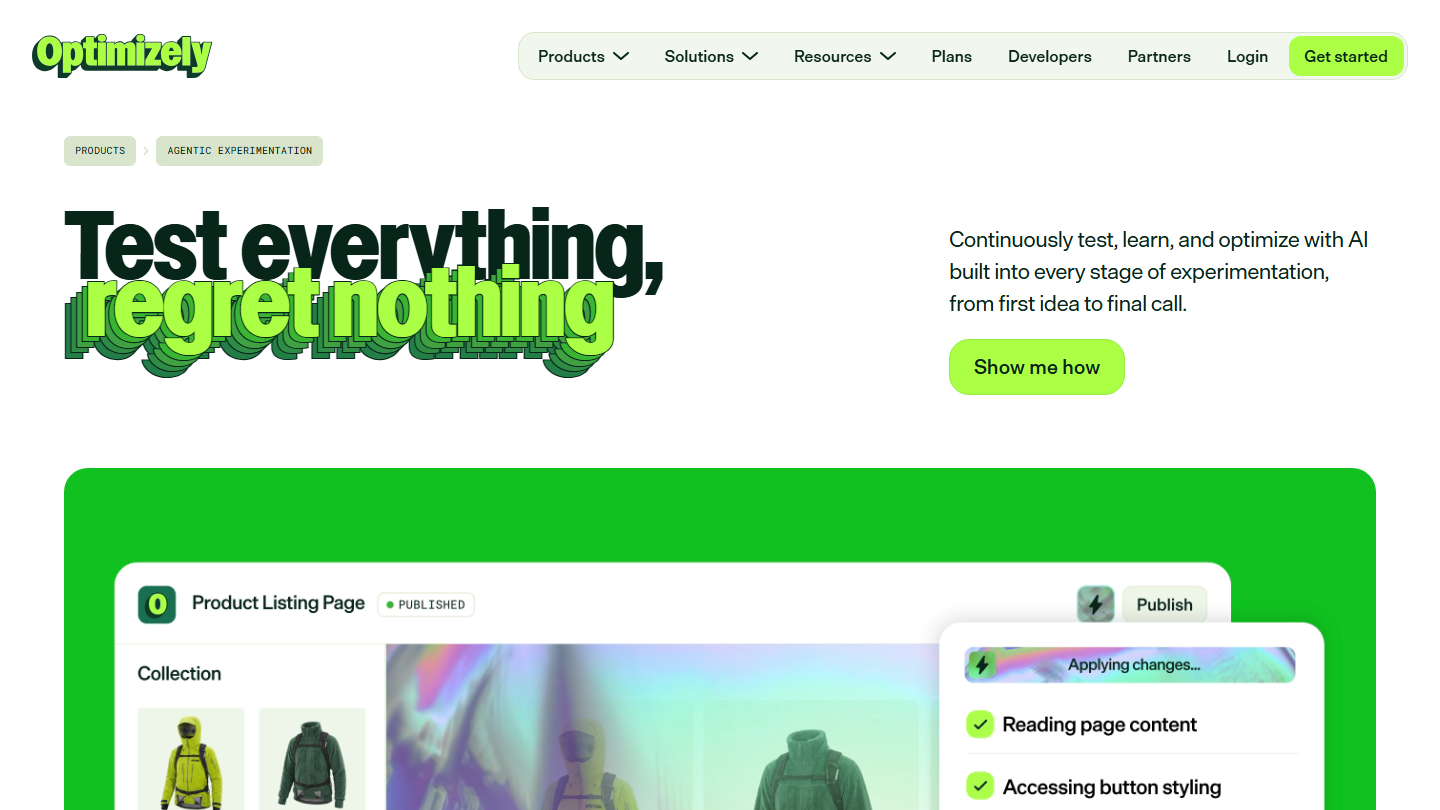
Optimizely Agentic Experimentation page: “Test everything, regret nothing”

Optimizely is one of the pioneers of A/B testing, founded by two Google alumni. Its testing offer is now called Agentic Experimentation, formerly Web Experimentation: AI steps in at every stage, from the test idea to the final decision.

In practice, the platform covers A/B and multi-page tests on the site, feature tests and server-side tests: you test an algorithm or a pricing grid, not just an interface. The proprietary Stats Engine calculates results, analytics plugs straight into the data warehouse, and Program Management runs hundreds of tests in parallel without conflict.

Optimizely is aimed at tech companies with a strong data culture and large product teams: scale-ups, e-commerce leaders, marketplaces, media, online travel agencies. Without a testing culture or a dedicated team, the investment does not pay off.

There is no public price list: each plan is built with a sales rep according to products and volume. The pricing page only offers a demo request.

05

Adobe Target

4.3/5 From On request

Best for: Very large companies already equipped with Adobe, with a team dedicated to experimentation

+ Strengths
  • Automatic personalization of every visit by Adobe's AI
  • Native integration with Adobe Analytics, Audiences and Campaign
  • Built-in product and content recommendations
  • Tests on the web and in mobile apps
− Downsides
  • Six to twelve months of implementation, with dedicated resources
  • Almost irreversible lock-in to the Adobe ecosystem
  • A dedicated team of 5 to 10 people at a minimum
★ Adobe Target in brief

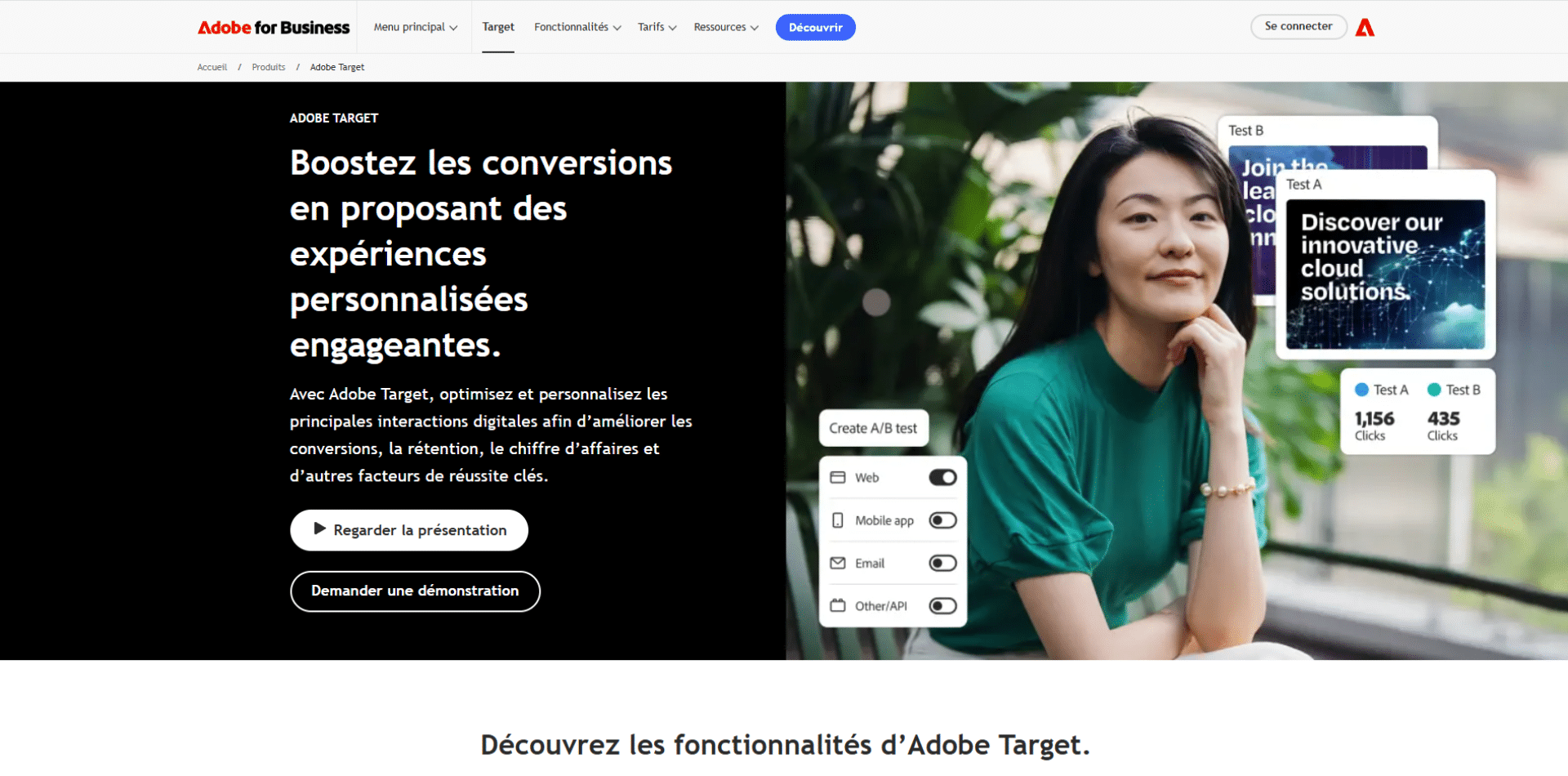
Adobe Target

Adobe Target is the testing and personalization module of Adobe Experience Cloud. It goes beyond classic A/B testing: the goal is to serve each visitor the most suitable experience, continuously.

In practice, Target combines A/B and multivariate tests, targeting by audiences shared with Adobe Analytics, and automatic personalization: Adobe’s AI picks the variant to show each visitor based on their behavior and history. Recommendations activities display products or content based on past activity, and the API opens Target to mobile apps.

It is aimed at very large companies already equipped with Adobe: large retail groups, international banks, airlines, telecoms. Implementation takes six to twelve months and requires a dedicated team of five to ten people; without these resources, most features go unused.

Adobe does not publish prices for Target: the price is negotiated with the sales team, based on volume and the modules chosen.

06

Contentsquare

4.4/5 From On request

Best for: Mature e-commerce and transactional sites that want to know what to test, and why

+ Strengths
  • Automatic capture of every micro-interaction, no configuration
  • Cost of each friction point expressed in revenue
  • Session replay filtered to the sessions that reveal a problem
  • Free plan up to 200,000 sessions per month
− Downsides
  • A/B testing reserved for the Pro and Enterprise plans, on request
  • Mass of data hard to use without a method
  • Delay between insight and action if dev teams do not keep up
★ Contentsquare in brief

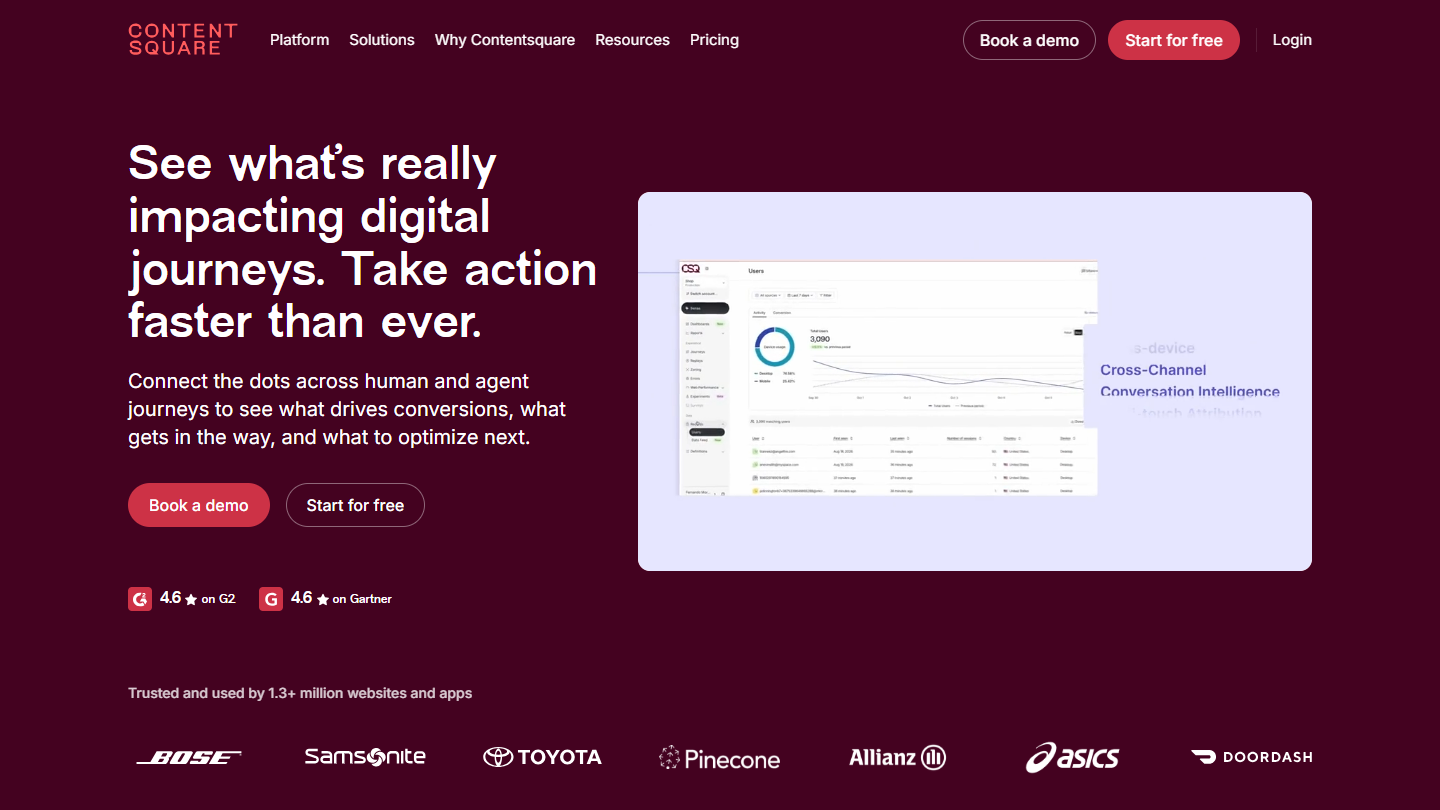
Contentsquare website: “See what’s really impacting digital journeys. Take action faster than ever.”

Contentsquare starts from visitor behavior rather than from a hypothesis. The platform captures every micro-interaction: mouse movements that betray hesitation, rage clicks, incomplete scrolls. Long limited to analysis, it now includes an experimentation module: AI suggests tests, you launch them without code and you see why a variant wins.

In practice, zone-level heatmaps measure the performance of each content block, session replay surfaces the sessions that have a problem and Impact Quantification puts a revenue figure on the cost of a friction point. The test is then launched from the same platform, with the behavioral context next to the results.

It is the tool for mature e-commerce and transactional sites with an established analytics team: online retail, travel, banking and insurance, marketplaces. For a showcase site, the free plan is enough to spot friction, but it does not include A/B testing.

The free plan covers 200,000 sessions per month with one month of history. Growth starts at $39 per month billed annually ($49 monthly). A/B testing is part of the Pro and Enterprise plans, on request.

07

Crazy Egg

4.0/5 From $99

Best for: Small businesses, freelancers and agencies discovering website optimization

+ Strengths
  • Five-minute setup, no technical skills
  • Heatmaps, session recordings and A/B testing in a single tool
  • Variants created in the visual editor or by URL redirect
  • Unlimited team members and domains
− Downsides
  • No A/B testing in Starter, at $29 per month
  • Test targeting limited to device type on Plus
  • Annual billing only
★ Crazy Egg in brief

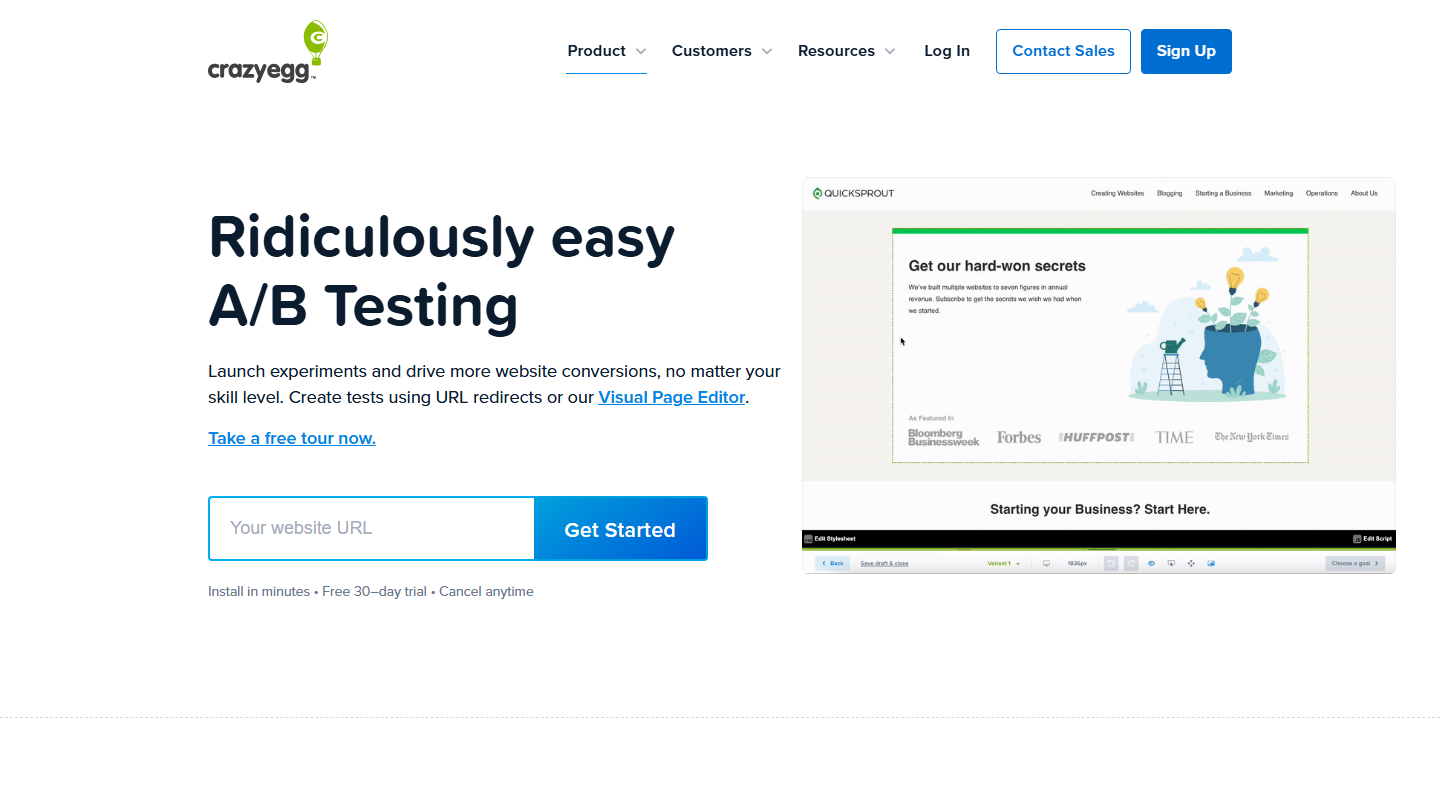
Crazy Egg A/B testing page: “Ridiculously easy A/B Testing”, with the visual variant editor

Crazy Egg, founded by Neil Patel, makes behavioral analysis accessible without technical skills. Heatmaps, scrollmaps and session recordings show where visitors click, how far down they scroll and where they drop off: the revelation is often painful, a good part of the content is never seen.

Crazy Egg also does A/B testing, from the Plus plan: you create a variant in the visual editor or redirect to another URL, and the tool measures conversions. Installation goes through a JavaScript tag and takes a few minutes; reports can be exported to show to non-technical stakeholders.

It is the entry point for small businesses, freelancers and agencies: blogs, showcase sites, e-commerce sites getting started, landing pages. Test targeting stays simple (by device on Plus, by country, UTM or conversions on Pro), with no advanced personalization.

All plans are billed annually. Starter costs $29 per month for 5,000 tracked page views, with no A/B testing; Plus $99 for 150,000 page views; Pro $249; Enterprise $599. The free trial lasts 30 days.

08

PostHog

4.4/5 From Free

Best for: Tech startups with an engineering team able to deploy and maintain the tool

+ Strengths
  • Open source code, self-hosting possible
  • All-in-one: product analytics, feature flags, A/B testing, session recording, heatmaps
  • Direct SQL access to raw data
  • Free plan: 1 million feature flag requests per month, experiments included
− Downsides
  • Demanding self-hosting: Docker, Kubernetes, updates, monitoring
  • Technical interface that can intimidate marketers
  • Community support on the free plan, email support on pay-as-you-go
★ PostHog in brief

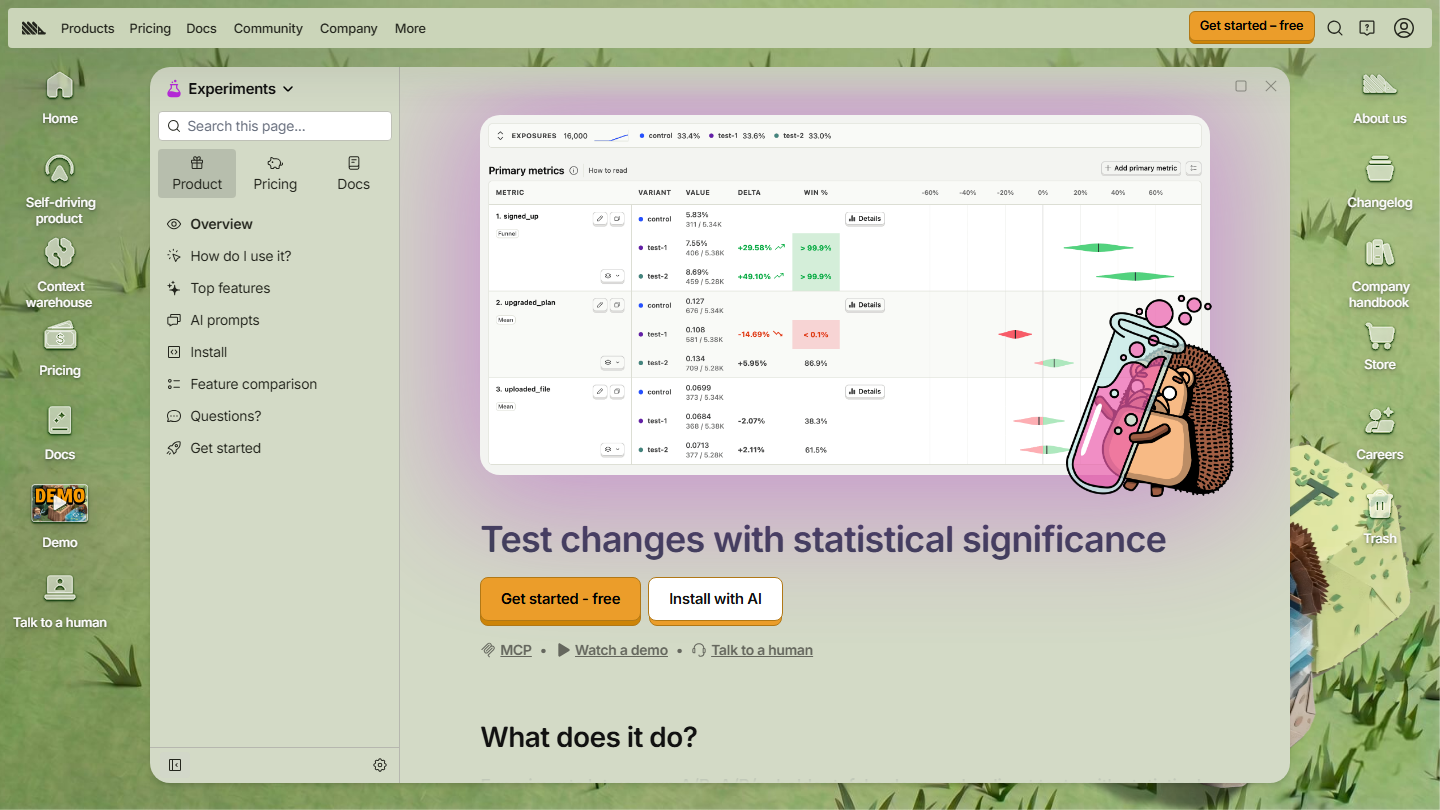
PostHog Experiments page: “Test changes with statistical significance”, with a test results table

PostHog offers a complete product analytics suite whose code is open, under the MIT license: product analytics, feature flags, experiments, session replay, heatmaps, surveys and SQL access to raw data. A startup can thus replace several specialized tools with one.

In practice, a PostHog experiment is built on a feature flag: developers integrate the SDK (web, mobile or backend), define the variants and the primary and secondary metrics, and PostHog calculates significance. A no-code editor also exists for simple tests on the site. Autocapture records interactions without configuration.

PostHog suits tech startups and scale-ups with an engineering team able to implement it: B2B SaaS, fintech, healthtech. Self-hosting reassures companies under heavy compliance constraints, but it requires DevOps skills. A marketing team without a developer will move faster with Convert or Crazy Egg.

The free plan includes 1 million analytics events and 1 million feature flag requests each month, which also serve experiments. Beyond that, pay-as-you-go charges $0.0001 per request, a rate that falls with volume, with no commitment or minimum.

09

Convert

4.3/5 From $299

Best for: SMBs and agencies that want a complete testing tool, without a quote, with data hosted in Europe

+ Strengths
  • Published prices, no mandatory sales call
  • Data hosted in Frankfurt, first-party cookies
  • A/B tests, split URL and Shopify price tests from Growth
  • 15-day trial with no credit card
− Downsides
  • Multivariate tests, multi-page tests and feature flags reserved for Pro ($420 per month billed annually)
  • Billing in dollars, based on the volume of tested users
  • Site and documentation in English
★ Convert in brief

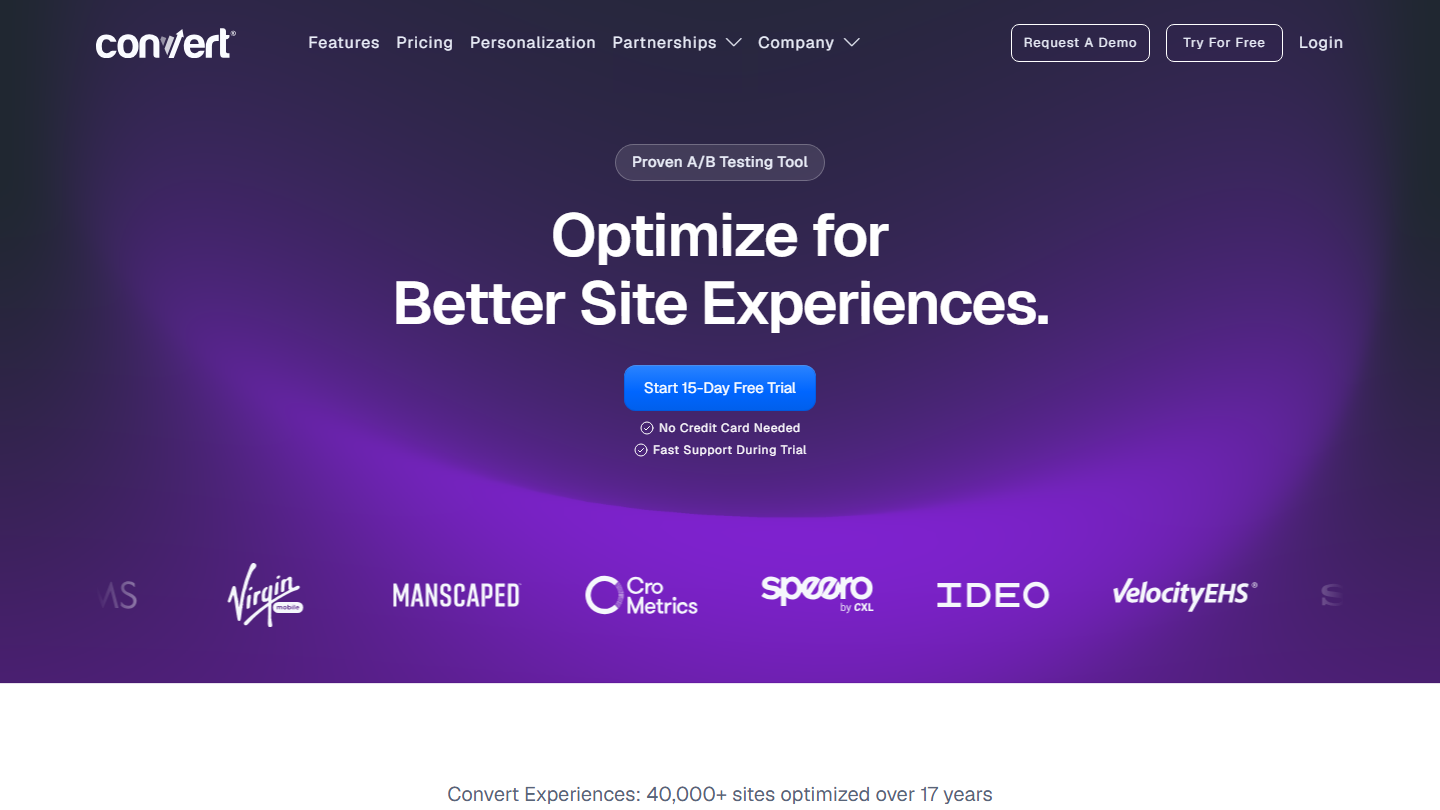
Convert home page: “Optimize for Better Site Experiences”, 15-day free trial

Convert Experiences is an independent A/B testing tool, active for 17 years, that claims more than 40,000 optimized sites. It covers A/B tests, split URL, price tests on Shopify and, in the Pro plan, multivariate, multi-page and full stack tests.

In practice, you install a script, create your variants in the visual editor or in code, then target visitors by source, device or behavior. Data is stored on servers in Frankfurt and the tool relies on first-party cookies, a plus when legal is looking closely at GDPR.

It is the alternative to the big platforms for anyone who wants a serious tool without negotiating a quote: the price grid is public and the trial asks for no credit card. Convert remains a testing and personalization tool: it manages neither emails nor contacts.

Growth costs $299 per month billed annually ($399 monthly) for 100,000 tested users per month. Pro goes to $420 per month billed annually ($599 monthly). Enterprise is on request, annual only.

10

GrowthBook

4.3/5 From Free

Best for: Product and data teams that want to analyze their tests on their own data warehouse, without paying per traffic

+ Strengths
  • Unlimited experiments, feature flags and traffic, even for free
  • Analysis directly in the company's data warehouse
  • Choice of statistical methods: Bayesian, frequentist, sequential, CUPED
  • Open code, self-hosting possible
− Downsides
  • Visual editor and multi-armed bandits reserved for the Pro plan
  • Designed for technical teams: SDK to integrate in code
  • Community support on the free plan
★ GrowthBook in brief

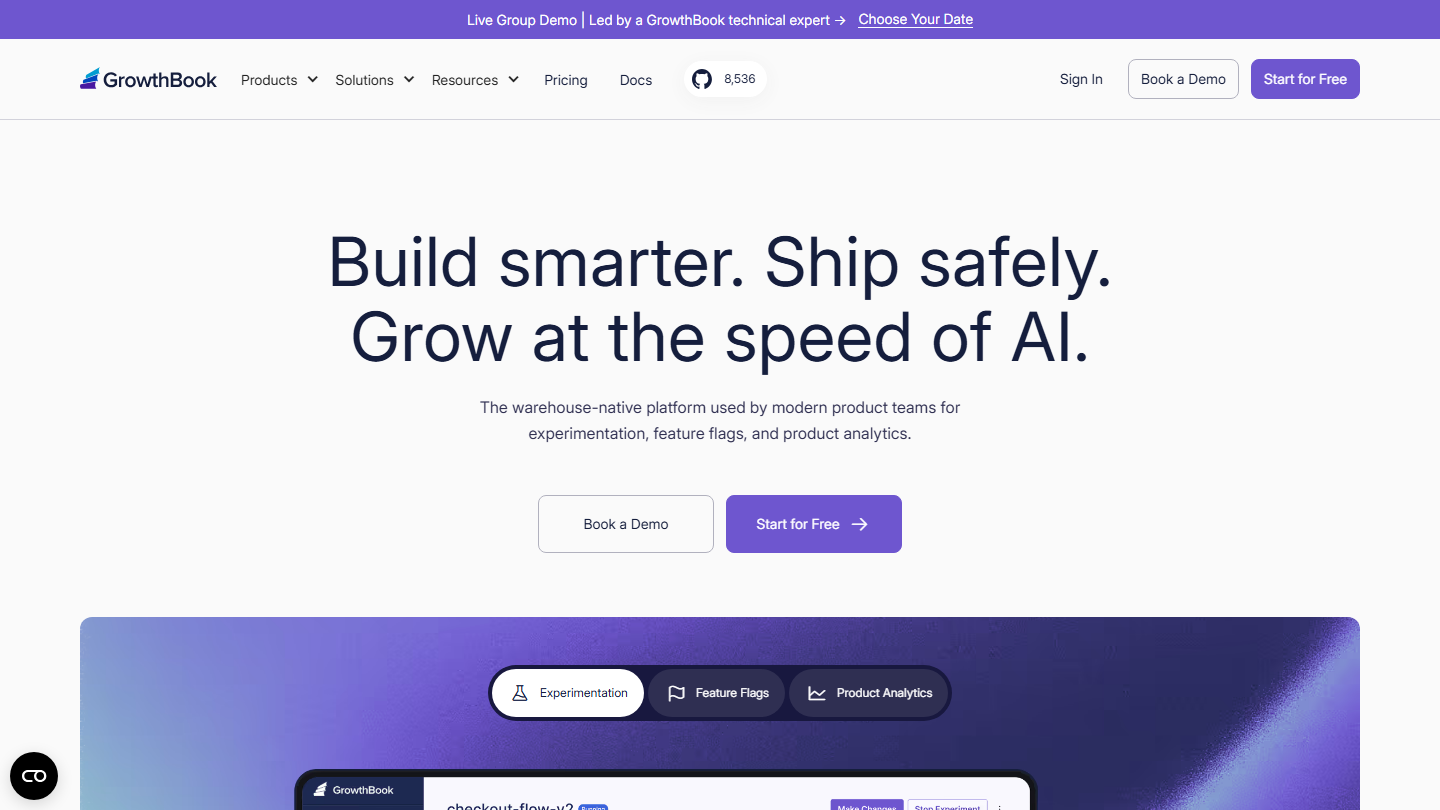
GrowthBook home page: “Build smarter. Ship safely. Grow at the speed of AI.”

GrowthBook is an open source experimentation and feature flag platform that relies on the company’s data warehouse instead of copying data to the vendor. Test results are calculated where the sales or usage data already lives.

In practice, developers integrate the SDK, create feature flags and run experiments on features or, with the visual editor, on site pages. On the statistics side, you choose between Bayesian, frequentist or sequential methods, with variance reduction (CUPED), sample ratio mismatch detection and multiple testing correction. A team without a data warehouse can use the one GrowthBook manages.

It is the alternative to PostHog for anyone who already has their analytics tools and only wants the experimentation layer. Per-seat pricing, with no traffic limit, becomes attractive on a high-volume site, where marketing platforms charge per visitor.

The Starter plan is free up to 3 users, with unlimited experiments and traffic. Pro costs $40 per user per month, up to 30 users, and adds the visual editor, multi-armed bandits and premium support. Enterprise is on request, and the self-hosted version remains available.

How we chose these 10 tools

Every tool in this selection has been used in real conditions by our team or by a Salesdorado consultant, in a B2B sales and marketing setting. No ranking built from a marketing deck. The order of the list is not a ranking: the right tool depends on your needs.

  1. 01
    Benchmark scope

    Broad identification of the tools on the market (G2, Capterra, Salesdorado customer feedback, LinkedIn signals). Initial filtering, then a short list based on a 2-hour setup per tool.

  2. 02
    Test conditions

    3 to 4 weeks of active use per tool, with data representative of a B2B sales use case. When a tool targets a specific profile (SDR, AE, Ops, Marketer…), we match the tester accordingly.

  3. 03
    Weighted criteria

    For each category, 5 to 7 axes weighted according to what matters in the segment: UX, feature depth, native integrations, support, pricing at scale, compliance (GDPR, security), and roadmap quality.

  4. 04
    Independence

    No tool is scored in exchange for payment. Partner links (affiliate) are marked as such and do not influence the score. Non-partner tools are included when their place in the ranking is deserved.

  5. 05
    Updates

    The ranking is reviewed every 6 to 12 months or on every major release of a tool mentioned. The date of the last check is shown at the top of the article.

The questions we get over and over.

Which A/B testing tool should a small business choose?

A small business will get more value from Crazy Egg or Convert than from trying to master Optimizely. Crazy Egg combines heatmaps and A/B testing from $99 per month billed annually; Convert publishes its prices, from $299 per month billed annually for 100,000 tested users per month.

Which A/B testing tool for a scale-up?

A scale-up will find in PostHog or Wingify (formerly AB Tasty and VWO) the balance between power and agility. PostHog assumes an engineering team able to implement and maintain it; Wingify targets e-commerce sites whose monthly traffic sits between 100,000 and one million visitors.

Which A/B testing tools for a large company?

Adobe Target and Kameleoon, provided you have the resources and the culture required. Optimizely suits tech companies with a strong data culture and product teams of more than 50 people.

Which A/B testing tool to use with HubSpot?

HubSpot builds A/B testing into its Marketing Hub, from the Pro plan (€90 per seat per month billed annually): every test talks to the CRM, workflows and campaigns, and HubSpot tracks how many contacts become qualified leads and then paying customers. It suits B2B companies of 20 to 200 employees already invested in HubSpot.

What is the difference between Contentsquare and an A/B testing tool?

Contentsquare first understands the why of behaviors: it captures every micro-interaction (hesitations, rage clicks, incomplete scrolls) to identify what to test and why. It now also offers its own A/B testing module, in the Pro and Enterprise plans, which avoids going through a second tool.

Does a behavioral analysis tool replace an A/B testing tool?

No. Heatmaps and session recordings spot friction; the test measures whether the fix really improves conversion. You analyze first, then you test. Contentsquare and Crazy Egg combine both in the same tool.

What should replace Google Optimize?

Google Optimize and Optimize 360 have been unavailable since September 30, 2023. GrowthBook and PostHog have free plans with experiments, for teams that have developers. Without a developer, Crazy Egg and Convert are the most affordable testing tools in this comparison.

★ The conversation, 0 comments

What the community says.

Basic Markdown, moderated within 24 h
Loading…

    In the same category