



- A lost lead covers five situations: indecision, status quo, competitor, budget or timing, change of contact. Each has its trigger and its window of opportunity.
- The closed-lost reasons entered in the CRM are unreliable: reclassify losses from the rep’s notes before any sequence.
- With a frozen buyer, shrink the size of the decision (scope, easy exit) rather than the price.
- Lost to a competitor: come back between the 7th and 9th month of their contract, without attacking the chosen vendor.
- No new information, no email. And after three waves without a reaction, the record leaves the active database.
Contrary to what you might think, a lost lead isn’t necessarily a lead that went to a competitor. As a rough estimate, half of qualified deals are lost without any competitor signing in your place: the customer simply never decided anything at all.
A lost lead, if you go about it methodically, can very often be recovered.
In this article, we present seven strategies for winning back lost leads, each tied to a specific loss reason, with its trigger and its window of opportunity.
Winning back lost leads: why the campaigns fail
Open any article on the subject (and there are tons of them…) and you’ll find the same sequence: a “we miss you” email at D+90, a follow-up with some content, then a discount valid for ten days to create urgency. This playbook comes from e-commerce, where it produces modest but real results. In B2B, it doesn’t just underperform.
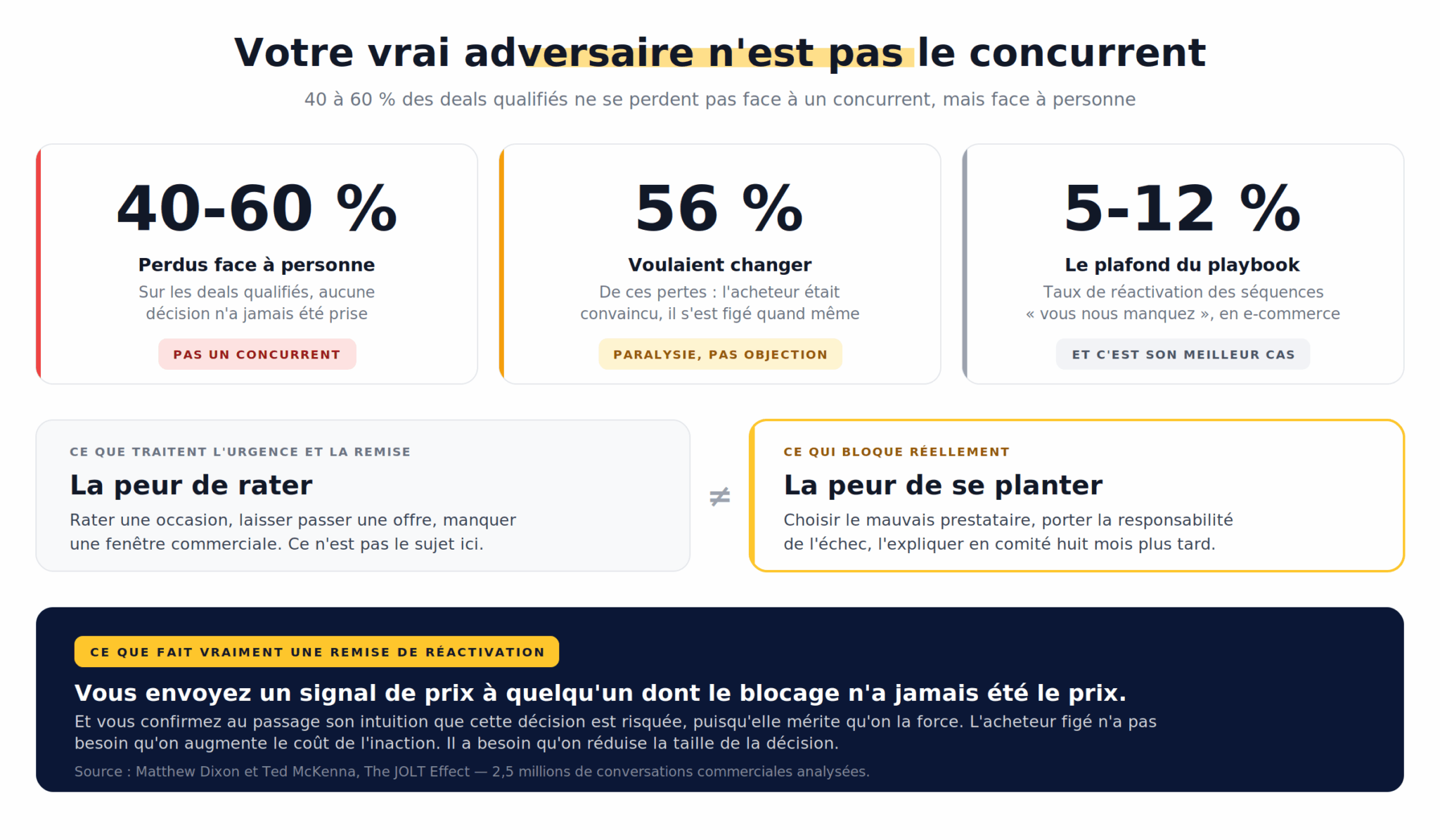
Matthew Dixon and Ted McKenna analyzed 2.5 million sales conversations for The JOLT Effect. Their central finding: between 40 and 60% of qualified deals aren’t lost to a competitor, but to nothing. Nobody signed. And in 56% of those losses, the buyer wanted to change. They were convinced of the need. They froze anyway.
What paralyzes them isn’t the fear of missing out. It’s the fear of messing up, of choosing the wrong vendor, of carrying the responsibility for the failure, of having to explain it to their leadership eight months later.
You can see where this goes wrong.
All the urgency techniques you’re told to use to win back a lost lead target the fear of missing out. Yet the reflex of piling on against inertia, of repeating everything the prospect stands to lose if they don’t move, backfires on the seller 84% of the time.
What a reactivation discount really doesYou send a price signal to someone whose blocker was never the price, and in passing you confirm their hunch that this decision is risky, since it deserves to be forced. A frozen buyer doesn’t need you to raise the cost of inaction. They need you to shrink the size of the decision.
The 5 reasons behind a lost lead: the win-back grid
“Lost lead” isn’t a category, but a word that flattens five situations that have nothing to do with each other:
- The one who froze.
- The one who signed elsewhere.
- The one who never acknowledged the problem.
- The one whose budget got cut.
- The one whose contact changed jobs along the way.
The triggers differ, and so do the messages and the windows of opportunity. An article that gives you eight strategies without ever asking which lead we’re talking about is selling you a generic sequence.
Here’s the grid I recommend you pin to the wall before launching anything.
| Type of loss | What it means | Recoverable? | The trigger to watch for | Window of opportunity |
|---|---|---|---|---|
| Indecision | The buyer was convinced of the need but never dared to make the call | Very | Anything that reduces perceived risk: pilot format, exit guarantee, reference in their exact industry | As soon as that element exists, without waiting for a date |
| Status quo | The problem was never considered costly enough to deserve a budget | Moderately | An event that makes the problem visible and measurable: incident, audit, regulatory change, arrival of a new executive | At the event. Never before |
| Competitor | An identified vendor signed in your place | Yes, but not right away | The approach of the cancellation window on their contract | Between the 7th and 9th month of the competitor’s contract |
| Budget or timing | The project existed, an external decision cut or postponed it | Very | The return of the budget: funding round, new fiscal year, new strategic plan | At the start of the next budget cycle |
| Contact | Your contact moved on, or the buying committee was reshuffled mid-cycle | Yes, and on both sides | The job change itself, at their new company as well as at their former one | The first 90 days in their new role |
There is a sixth row that has no place in this grid: the lead who never replied. That’s not a loss. It’s an opportunity that never existed. Filing it in your closed-lost means telling yourself a story about the size of your pipeline.
There’s still a big problem…
This grid assumes you know why you lost. And you probably don’t.
Clozd, which interviews buyers after their decision, claims that 85% of closed-lost data in a CRM is wrong or missing the essentials, and that 44% of the reasons entered are actually outcomes, not reasons (source). “Lost to a competitor” tells you what happened, but not why.
It’s not a discipline problem.
A sales rep who has just lost a deal enters the reason in three seconds, often at the end of the quarter, to clean up their pipeline before the review. They tick “price”, because it’s the fastest and least accusatory option. Nothing in the tool encourages them to do otherwise.
Read alsoData quality: a practical guide
Requalifying a lost lead: the closed-lost reclassification prompt
Before launching any sequence, pull an export, filter on opportunities lost over the last 24 months and keep five columns:
- Account name.
- Amount.
- Close date.
- Loss reason entered.
- The rep’s free-text notes.
The notes are what you’re after. The reason entered is noise. The notes contain the sentence the prospect actually said, the one the rep copied down without thinking because it had stuck with them.
Paste this prompt into the AI of your choice, along with your export.
The Salesdorado reclassification promptYou are a sales ops analyst. I’m giving you an export of lost opportunities from my CRM. Each row contains the account name, the amount, the close date, the loss reason entered and the rep’s free-text notes.
For each row, completely ignore the loss reason entered.
Reclassify the loss into one single category among these five, based only on the notes:
1. INDECISION: the prospect was convinced of the need but never committed
2. STATUS QUO: the prospect never acknowledged that the problem was worth a budget
3. COMPETITOR: an identified vendor signed
4. BUDGET: the project existed but was cut or postponed by an external decision
5. CONTACT: the contact changed jobs, or the committee was reshuffled mid-cycle
For each row, give the category you chose, your confidence level (high, medium or low) and the exact sentence from the notes that justifies your classification. If the notes don’t allow you to decide, answer INSUFFICIENT and phrase the question that should have been asked to the prospect.
Finish with a breakdown table by volume and by amount per category. Then flag the ten biggest gaps between the reason entered by the rep and your reclassification.
What you discover will serve you well beyond winning back leads. Most teams that do the exercise find that their “price” category shrinks by half, and that the “indecision” row explodes. It’s uncomfortable, but it’s the only sound basis for deciding who to follow up with, when and with what.
Want more use cases like this one? We’ve listed the AI use cases in B2B sales that actually produce something.
1. Loss debrief: following up with a lost lead without selling anything
60% of marketing and sales executives never conduct interviews with lost prospects.
Nobody asks, nobody tells, and everybody follows up blindly six months later.
The loss debrief solves two things at once:
- It gives you the real reason, the one that feeds the grid.
- It reopens a door, because it’s the only contact you can initiate without selling anything.
The mechanics come down to four points:
- Wait three to four weeks. On the day of the rejection, your contact wants to hang up, not explain. A month later, they have some distance and nothing left to defend.
- Say upfront that you’re not trying to change their mind. That’s what gets them talking. As long as they think it’s a disguised recovery attempt, they’ll give you the polite version.
- Talk to the decision-maker, not the champion. The champion liked you, they’ll tell you what you want to hear. The decision-maker is the one who made the call.
- Have it run by someone who didn’t carry the deal. A rep who debriefs their own loss systematically hears confirmation of what they already believed, usually that the product is too expensive.
The message that works best is also the shortest:
Hi X, you went with another solution last month and that’s settled, I’m not going back on it. I’d just like to understand what tipped the scales, so we can use it internally. Fifteen minutes, no sales rep in the loop. Does that work for you?
On losses, participation rates for this kind of interview hover around 10 to 15% with a standard request. Well introduced and well timed, they climb significantly higher. Volume isn’t the point: three interviews are enough to surface a reason your CRM didn’t contain.
2. Lead lost to indecision: shrink the decision, not the price
This is your biggest reservoir, and the one everyone works the wrong way round.
A frozen buyer has no objection to handle. They have a decision that is too big for them. Every follow-up that adds pressure, choice or documentation makes the problem worse. Every follow-up that narrows the decision unblocks it.
The levers, in order of observed effectiveness:
- Reduce the scope of the first commitment. One team, one use case, three months. Not an overhaul. The goal isn’t to sell less, it’s to make the first signature painless.
- Explicitly recommend one option. A paralyzed buyer doesn’t want a comparison of your three plans. They want someone competent to tell them which one to take, and why.
- Stop sending material. The umpteenth white paper, the extra demo, one more case study: all of it feeds the endless exploration that is precisely the symptom.
- Make the exit easy, and say so. Contractual reversibility, short commitment, exit clause. What costs you a few points of margin wins you deals that a discount would never have unblocked.
This shift requires being able to tell a real objection from a decision block. It’s not the same job. We covered the first part in our article on the most common sales objections and the drivers of the second in the one on the psychology of selling.
3. Following up with a lost prospect when their decision-maker changes jobs
This is the most profitable strategy on this list (and the least practiced!).
The decision-maker who said no to you at company A is not the same person at company B. New budget, often broader authority, need for a quick win in their first hundred days. And above all, no past choice to defend. At A, coming back to you meant admitting a mistake. At B, it costs them nothing.
Start with the least disputable figure. In the United States, the Bureau of Labor Statistics Employee Tenure survey measures a median tenure of 3.9 years in January 2024, the lowest since 2002, and of 5.2 years in management, business and financial roles.
In other words, a buying committee of eight people largely turns over during the lifetime of a multi-year contract. Vendor figures point the same way. Champify reports 36% of new customers having had a lost opportunity in the past, and a markedly higher close rate on contacts already exposed to the product. UserGems claims larger deal sizes and shorter cycles on deals involving a former champion.
Salesdorado’s takeThese figures come from vendors that sell precisely job-change tracking tools. Take the direction as reliable and the decimals as marketing. What interests us more is a finding from the same report that concerns your own data: CRMs miss the vast majority of former champions who have changed employers, and of those who are in it, only half have been contacted again. The issue isn’t whether to believe in the value of the signal. It’s that most teams don’t see it go by.
Setting it up doesn’t require a sophisticated tool at first:
- Extract the list of contacts identified as champion or decision-maker on your lost opportunities from the last three years.
- Put them under watch, via an enrichment tool or a simple alert on their profile.
- When one of them moves, the follow-up goes out within 15 days. Once the settling-in period is over, they’ll already have decided on their tools.
- Treat the signal both ways. Their departure creates an opportunity at their new employer, and a risk on the account they’re leaving.
For tooling, we compared Pharow, Cognism, Sales Navigator and Apollo for this kind of use and listed the B2B data enrichment tools that hold up on French databases.
4. Lead lost to a competitor: when should you follow up?
When you’ve lost to an identified vendor, following up at six months is pointless. Your contact is in the middle of the rollout, defending their choice, and has no desire to hear that you’re still around.
Except that this contract has a date, and that date can be calculated.
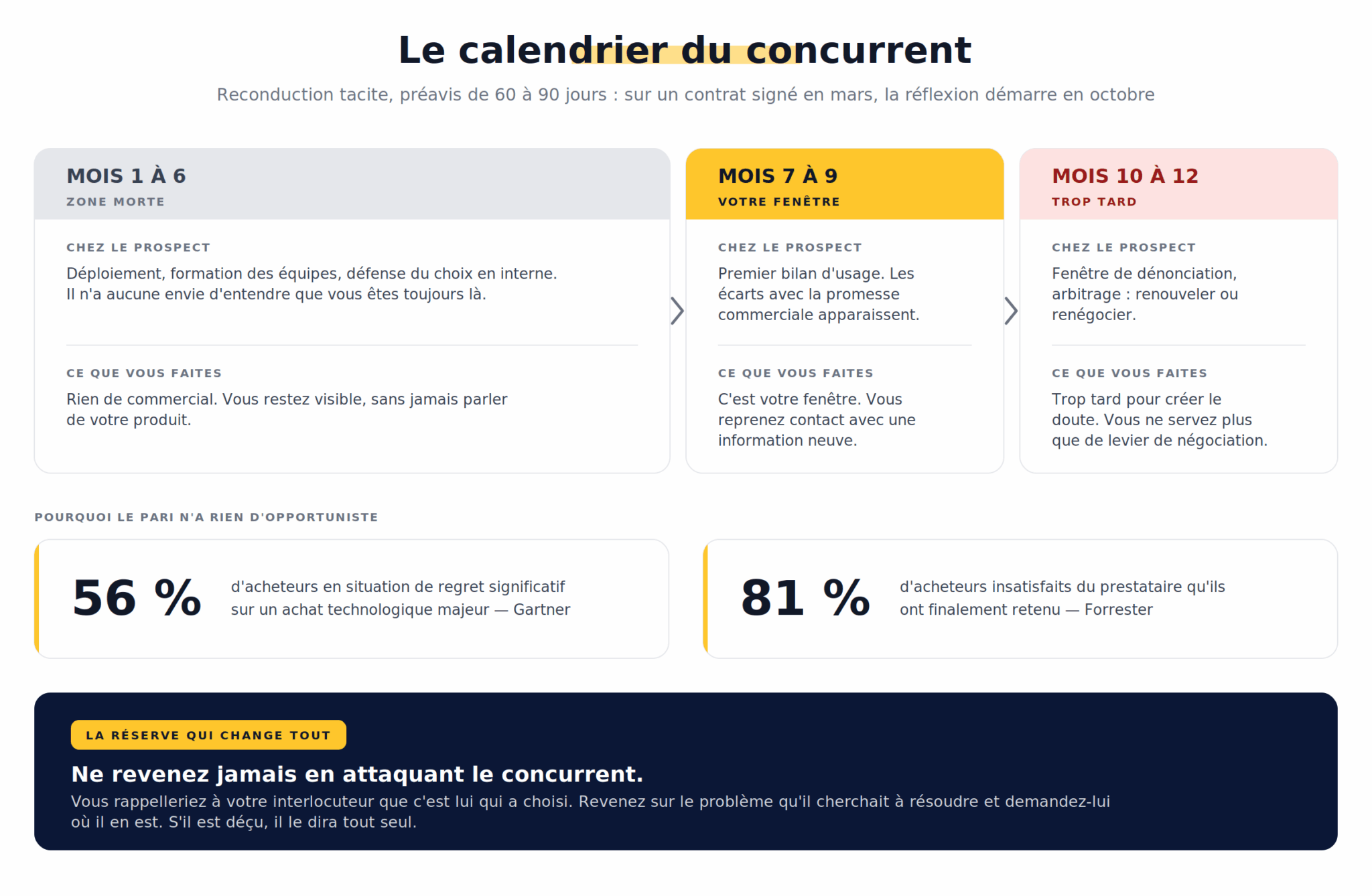
The SaaS market standard is automatic renewal with a cancellation window of 60 to 90 days. Organized buyers start their re-evaluation about six months before the notice deadline, enough time to compare market prices, estimate migration costs and build an internal case.
In other words, on an annual contract signed in March, the thinking starts around October.
| When | What’s happening on the prospect’s side | What you do |
|---|---|---|
| Months 1 to 6 | Rollout, team training, defending the choice internally | Nothing sales-related. You stay visible, without ever talking about your product |
| Months 7 to 9 | First usage review, the gaps with the sales promise appear | This is your window. You get back in touch with new information |
| Months 10 to 12 | Cancellation window, decision to renew or renegotiate | Too late to create doubt. You’re now only a negotiating lever |
The bet is not opportunistic, it’s statistical. Surveying 1,503 buyers in 2023, Gartner found that 60% of those involved in a decision to renew or expand a software subscription regret nearly every purchase they make. Six points more than in 2020.
One caveat (and it’s an important one): don’t come back by attacking the competitor. Hank Barnes, the Gartner analyst who led the survey, notes that this regret rarely comes from the vendor or the product and much more often from dysfunctions within the buying committee itself. Attacking the chosen vendor therefore misses the target, while reminding your contact that they’re the one who chose. Come back to the problem they were trying to solve, and ask them where they stand. If they’re disappointed, they’ll say so on their own.
5. Following up on a lost opportunity on a signal, not on a fixed date
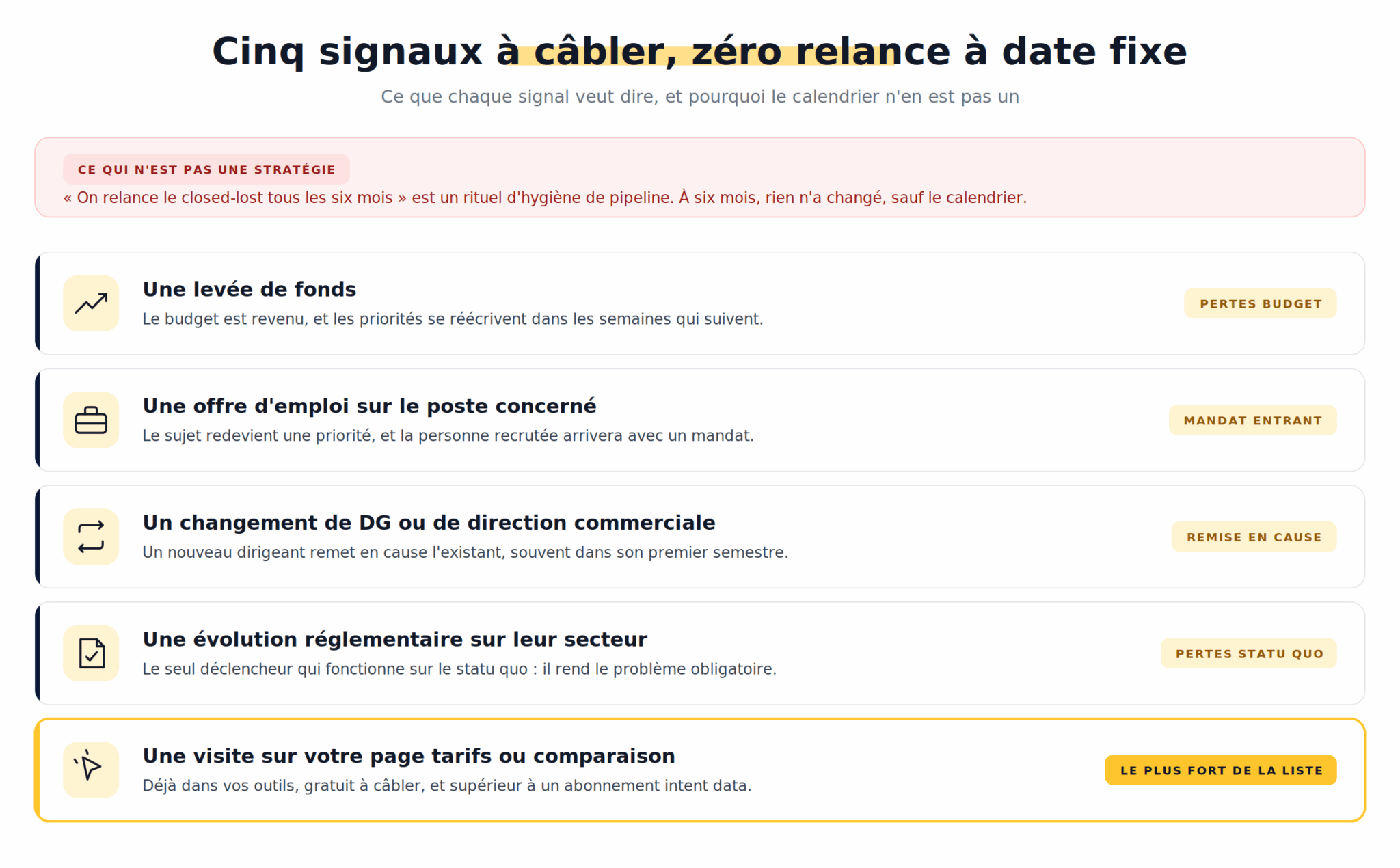
“We follow up on closed-lost every six months” isn’t a strategy. It’s a pipeline hygiene ritual. At six months, nothing has changed for your prospect, except the calendar.
Winning back leads isn’t a campaign you launch when the pipeline is empty. It’s a system that waits for the right event and fires on it. That’s exactly the logic of event-based marketing, applied to a database you already own.
The signals worth wiring up, and what they mean:
- A funding round. The budget is back, and priorities get rewritten in the following weeks. It’s the best trigger for losses classified as “budget”.
- A job posting for the role your solution addresses. The topic becomes a priority again, and the person hired will arrive with a mandate.
- A change of CEO or sales leadership. A new executive challenges what’s in place, often in their first six months.
- A regulatory change in their industry. It’s the only trigger that works on status quo losses, because it makes the problem mandatory.
- A return visit to your pricing or comparison pages. The most underused, even though it’s already in your tools.
A word on that last point. If you have a CRM connected to your website, a closed-lost contact visiting your pricing page is the strongest signal on this whole list. It costs you nothing to set up, and it’s worth more than a subscription to an intent data database. We detailed the mechanics in our article on marketing automation examples.
6. Following up with a lost lead: what to say in your email?
This is the rule that eliminates 80% of the win-back emails you would have sent.
“Just circling back”, “any news on your side?”, “we miss you”: these messages ask the prospect to redo all the work of remembering, evaluating and deciding, in exchange for nothing. They don’t reopen anything because they don’t bring anything.
Compare.
Hi X, I’m taking the liberty of getting back to you following our conversations last year. Where do you stand on this topic? I’d be happy to catch up again if things have changed on your side.
And now:
Hi X, in February you ruled out our solution because it didn’t connect to your ERP. That’s been fixed since September, the connector is native. I don’t know if the topic is still open on your side, but it seemed only fair to let you know.
The second one works for a simple reason: it proves you listened and it brings a verifiable fact. It doesn’t ask for anything, which makes it all the harder to ignore.
Three sources of new information, to review before each wave:
- On your side: a feature shipped, an integration opened, a revised price list, a customer signed in their exact industry.
- On their side: the signals from the previous section.
- In the market: a standard that changes, a competitor acquired, a general price increase at the vendor they chose.
If none of the three boxes is ticked, there’s no email to send. Put the list away and wait. For the writing mechanics as such, we covered the subject in depth in our guide on following up with prospects by email.
7. When to remove a lost lead from your database: the GDPR criterion
This is the strategy that makes the other six work.
Endlessly recycling your closed-lost means maintaining a ghost pipeline and hiding an acquisition problem. A lead you follow up with for the fifth time in two years without ever getting a reply isn’t a lead. It’s a line in a file that reassures everyone.
Set an explicit exit criterion and stick to it. Three follow-up waves without a single inbound reaction, and the record leaves the active database. No debate in the pipeline review.
There is also a constraint that almost every article on this subject forgets to mention.
Your lost-lead database has a legal expiry dateIn its reference framework on the management of commercial activities, the CNIL sets the retention period for prospecting data at three years from collection or from the last contact coming from the prospect. The detail that changes everything lies in the words “coming from”. It’s an action on their part that resets the clock, a click on a link for example. Not the email that you send. Mechanically following up with a 2022 database therefore doesn’t refresh it. The CNIL does, however, provide a useful way out: at the end of the period, you can contact the prospect again to ask whether they wish to keep receiving your messages. These frameworks aren’t binding, but departing from the suggested durations requires you to justify your choice.
You should see this constraint as an ally rather than a chore. It forces you to do what you should have done anyway: distinguish the records that carry real intent from those you keep out of superstition. It’s the same reasoning that makes us say lead scoring is often useless, and it applies here word for word.
On the purge method, we wrote a dedicated guide on cleaning up a customer database.
Winning back leads: the 3 reflexes to drop
To finish, the practices you find in every article on the subject and that cost you more than they bring in.
- The “we miss you” email. It transposes to B2B an emotional register that only makes sense in e-commerce. Your prospect has no emotional bond with you, they had a problem to solve. Talk about the problem.
- The reactivation discount. It only unblocks losses that were really about price, a minority of your database once the reclassification is done. On everything else, it devalues your offer and confirms the sense of risk.
- The fixed-date follow-up. It produces activity volume, not opportunities. And it burns your attention capital with the only contacts who might have come back one day, on a real signal.
Measuring a win-back campaign: the 4 useful metrics
The open rate of a win-back campaign means nothing. A former prospect always opens, they know you. What matters comes down to four metrics.
| Metric | What it tells you |
|---|---|
| Reopen rate by loss category | Which segment of the grid deserves your time. If you don’t track it by category, you get an average that steers nothing |
| Close rate on reopened opportunities, compared with cold | The only figure that justifies the investment. It’s also the one that will tell you whether you’re reopening real opportunities or comfort pipeline |
| Cycle length on reopened deals | A deal reopened on a signal should move faster than a cold deal. If it drags on just as long, the trigger wasn’t one |
| Share of closed-lost removed from the active database | The hygiene metric. If it stays at zero quarter after quarter, you’re piling up instead of sorting |
One last point of method: always compare your reopened deals to your cold prospecting benchmark, never to zero. A win-back campaign always looks profitable if you forget the sales time it consumes. Our benchmarks on sales performance indicators will give you the basis for comparison.
And if your topic is really about customers who left you after signing, that’s not the same exercise. We covered it separately.
The questions we get over and over.
Why do you lose a qualified lead?
Not necessarily to a competitor. According to The JOLT Effect, between 40 and 60% of qualified deals are lost to nothing: nobody signed. In 56% of those losses, the buyer wanted to change but froze, out of fear of messing up.
Should you offer a discount to reactivate a lost lead?
Rarely. A discount only unblocks losses that were really about price, a minority of the database once losses are reclassified. On the rest, it devalues the offer and confirms to the buyer that the decision is risky.
When should you follow up with a lead lost to a competitor?
Between the 7th and 9th month of the contract signed with the competitor, at the time of the first usage review. Before that, the contact is defending their choice; during the cancellation window of months 10 to 12, it’s too late to create doubt.
Which signals trigger a follow-up with a lost lead?
A funding round, a job posting for the role your solution addresses, a change of CEO or sales leadership, a regulatory change in the industry and a closed-lost contact visiting your pricing or comparison pages.
How long can you keep a lost lead in your database?
In its reference framework on the management of commercial activities, the CNIL sets the retention period for prospecting data at three years from collection or from the last contact coming from the prospect. An email sent by you doesn’t reset that clock.



What the community says.