



- Comparison content targets prospects who already know the product: it positions you against a competitor.
- To get detailed reviews, contact about twenty bloggers in your niche and keep the three best price / domain authority ratios.
- Case studies convince, but require the customer’s agreement, a good knowledge of the value you bring them and a careful layout.
- An honest listicle that names your competitors is better than leaving them the high-intent keywords.
- Start with the most aware prospects and the product-aware ones, before generic content with low conversion rates.
Content marketing is not necessarily a (very) long-term investment. On the contrary, it can be fairly simple to generate leads quickly in B2B.
In this article, we present 7 examples of content marketing campaigns that are relatively easy to run and that quickly capture qualified leads.
We have ordered them from the simplest to set up to the most complicated.
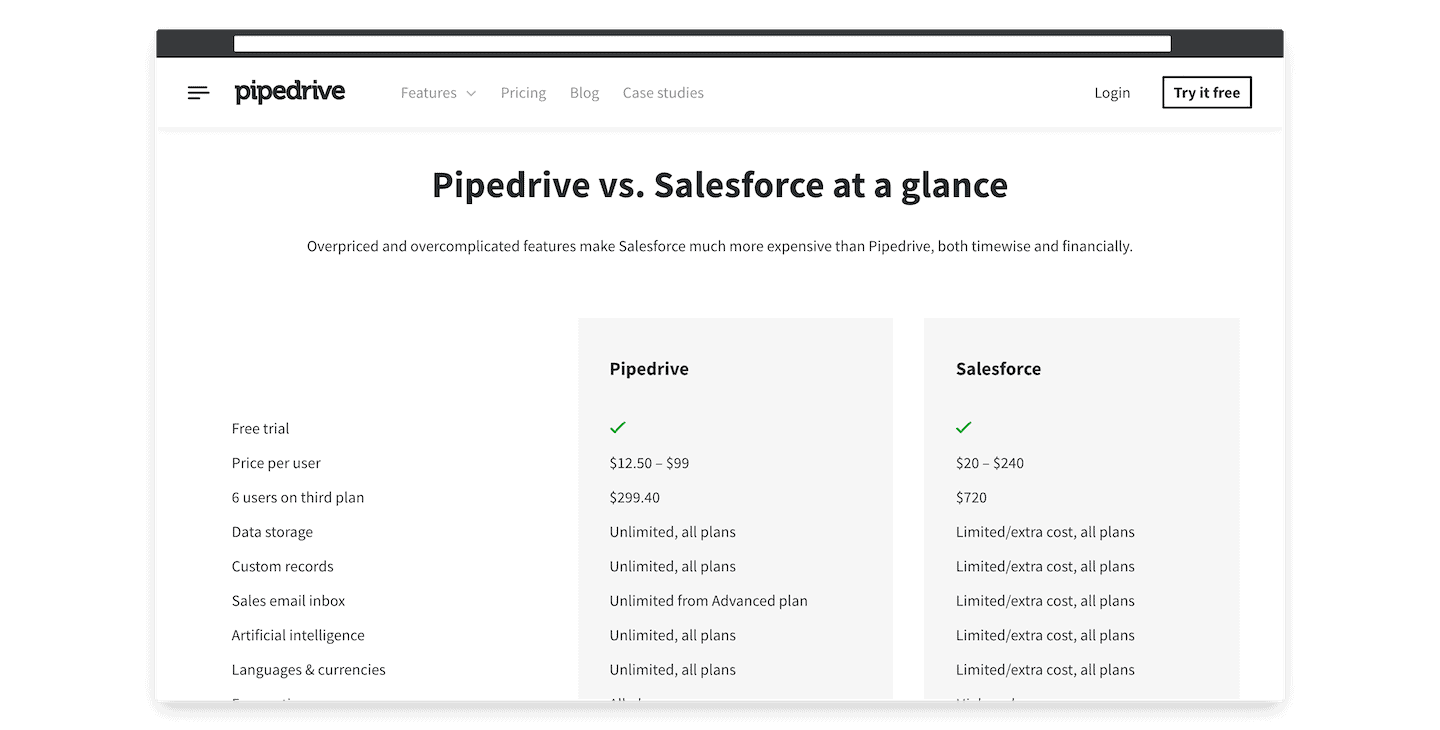
Example 1: Compare your product to the competition
The idea is to create content by comparing your product to a competitor’s. Comparison content targets product-aware customers and gives you the chance to present your product against a competitor’s.
Example 2: Generate detailed positive reviews of your product
Product review content is aimed at solution-aware customers. When you create content that reviews a particular product or app, you can tell people why it is the best of its kind on the market.
Here is an effective method to set up this type of content:
- Type into Google the 2 or 3 keywords closest to the need your product meets. Grab the top 10 blogs ranking for these keywords with Linkclump.
- Contact 20 bloggers who are relevant in your niche. Their traffic matters little; what matters most is the authority of their site. Use tools like Ahrefs, SEMRush or Moz to assess it.
- Ask each of them to publish an article about your product. Each will reply with a price (except a few pure-content hardliners who prefer selling banners or other stuff that has no value).
- Pick the top 3 by price / domain authority ratio.
- In 1 month, type your brand name into Google: you will have 3 results backing you, with a detailed review of your product.
Going further: if your product lends itself to it, and if you want, you can encourage these bloggers to talk more about you on their sites with an affiliate program.
Salesdorado’s tipDo not work on a performance-only basis. The good ones will refuse and you will waste a huge amount of time convincing the bad ones. In the best case, you will get bad content that will never be seen, and in the worst case, you will only get freeloaders looking to earn money off your brand without generating visibility or helping conversion, or even scams (it is fairly easy to fool an affiliate platform).
Example 3: Case studies or customer reviews
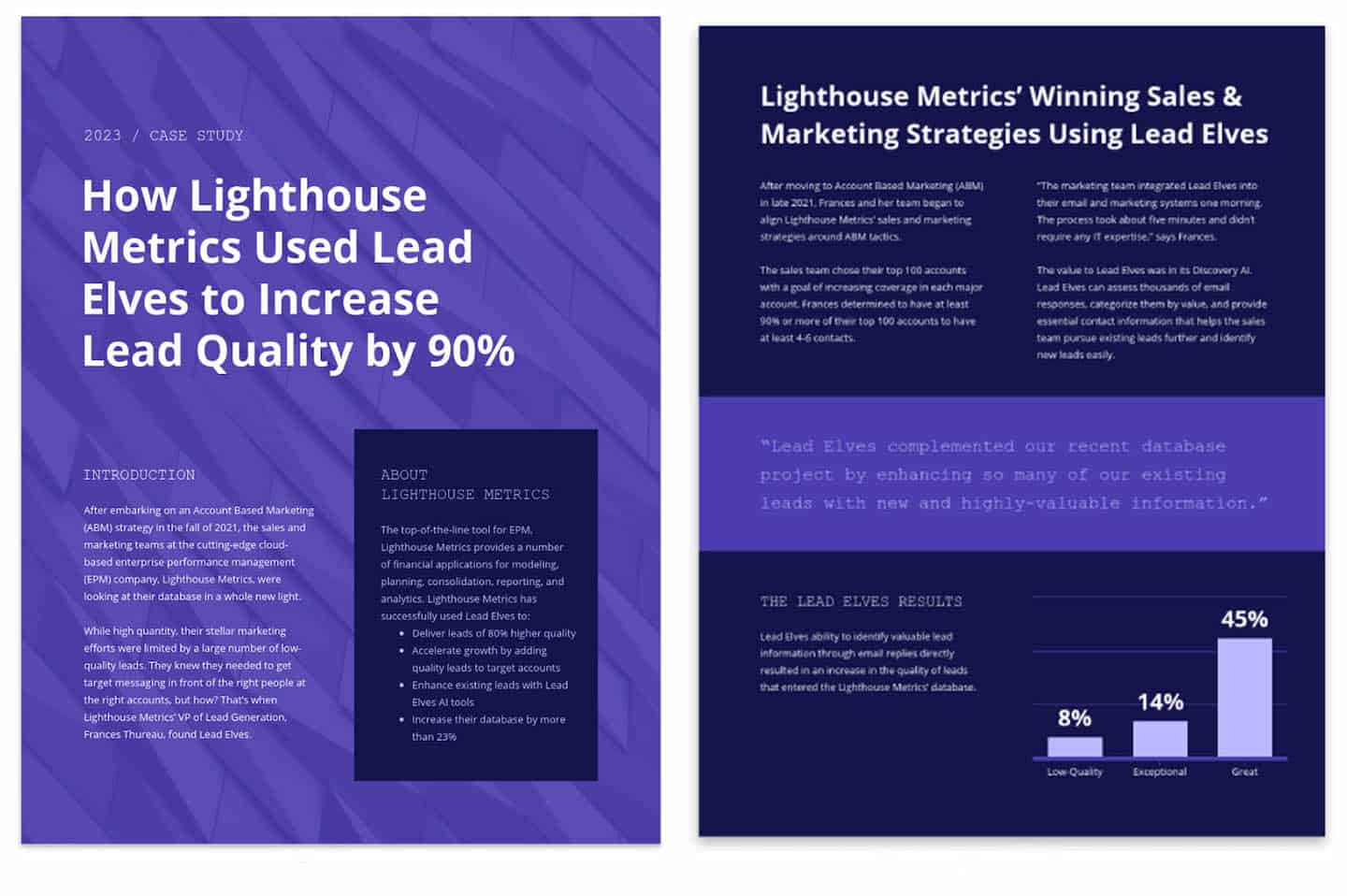
Case studies are part of the content strategies of almost every B2B company. They show how your product helped a customer overcome a specific challenge or achieve a certain result.
As a result, this type of content can target both product-aware and solution-aware customers.
Case studies:
- Help product-aware customers compare your results with those of the competition.
- Help customers looking for solutions to their problems understand how you work and how you can solve their problems.
Case studies must show how you can deliver the desired results. You can even set up mailings for existing prospects that show them the case studies related to their needs. The problem with case studies is that they are very complicated content to create:
- You need the customer’s agreement, ideally with permission to include figures and things a bit more interesting than three meaningless testimonials
- You need an excellent knowledge of the value you generate for your customers, and of your customers’ business stakes
- You need to illustrate and prepare a concise and convincing document, often with a more complex layout than a simple landing page.
Example 4: Hyper-detailed case studies

Hyper-detailed case studies help customers become aware of solutions. Since these people examine solutions in depth, they need to see your thought process in detail.
Hyper-detailed case studies are very specific accounts of how your company solves a customer’s problems. They give potential customers a glimpse into your company’s thought process and show them your strategies at a high level.
Example 5: Other people’s case studies
You have just seen how case studies can generate revenue. But what if you have not yet worked with customers? In that case, you can interview influential people about the results your customers want.
You are probably thinking: “Since I did not get these results, why would this content generate leads?”
Well, for two reasons:
1. You associate your brand with the result. Yes, you did not get the result. But by interviewing other people, readers will assume, rightly, that you understand this process better. It is a fairly similar idea to partnerships for creating a webinar.
2. You can add your thought leadership to the content by sharing your own perspective.
Example 6: Listicles
To create a “best of” article, you need to draw up a list of your competitors and briefly review them. You can put your product or company first on the list, but remember to be honest in your comments.
Here too, I can hear all the “But we are not going to advertise our competitors, are we?”.
OK, let your competitors and a few bloggers rank in SEO for the highest-intent keywords and keep buying your clicks from Google.
Or you accept it and move on. You cannot hide your competitors from your prospects in 2022.
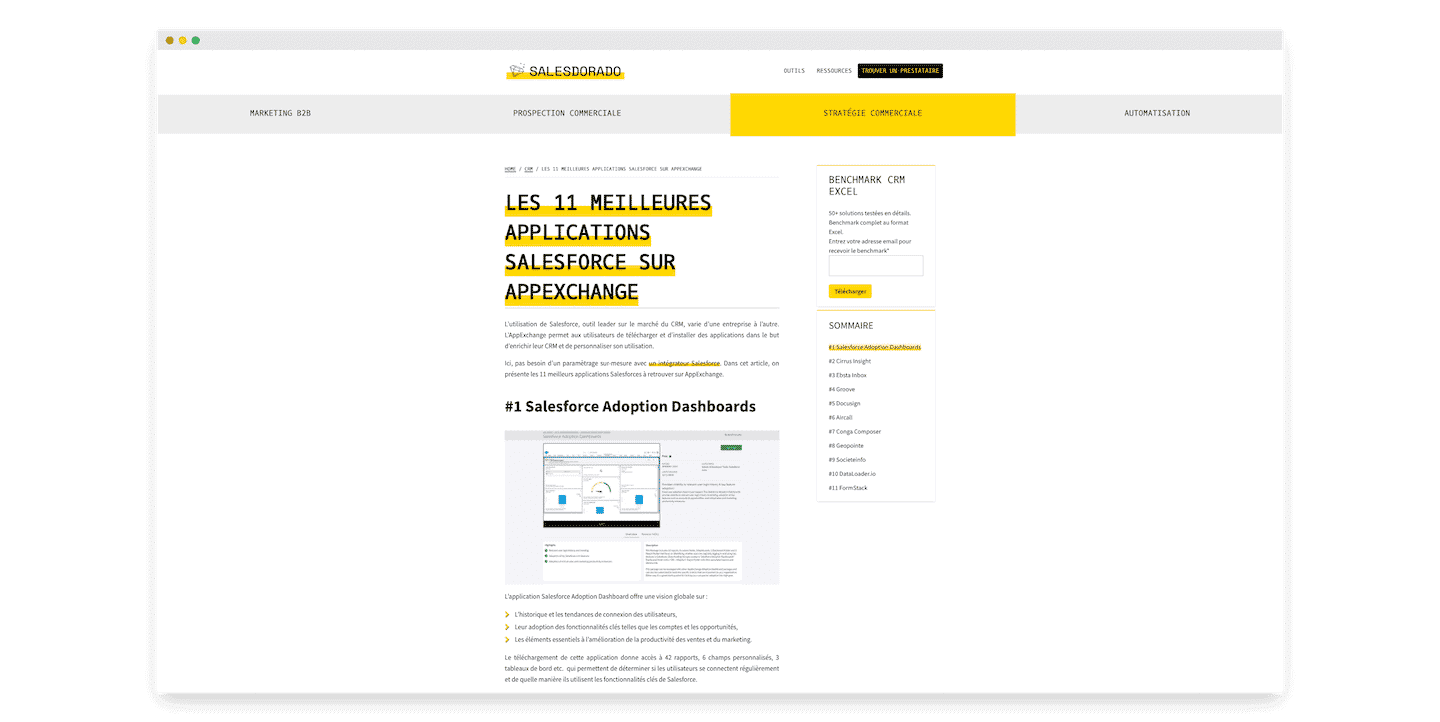
Salesdorado’s tipWriting a listicle article yourself is good, but you can go even further. It is fairly easy to get a few bloggers who already rank well on Google to mention you in their content. To do this, build lists of blogs that have already ranked articles on the keywords you are interested in, and contact them in a very open way to ask whether they would be open to adding you to these articles. If you do not already know it, we recommend linkclump (free) to build these lists quickly.
Example 7: Topic guides
Topic guides let you answer customers’ most frequent questions. They can take the form of a landing page gathering a lot of information and a call-to-action button that will capture leads.
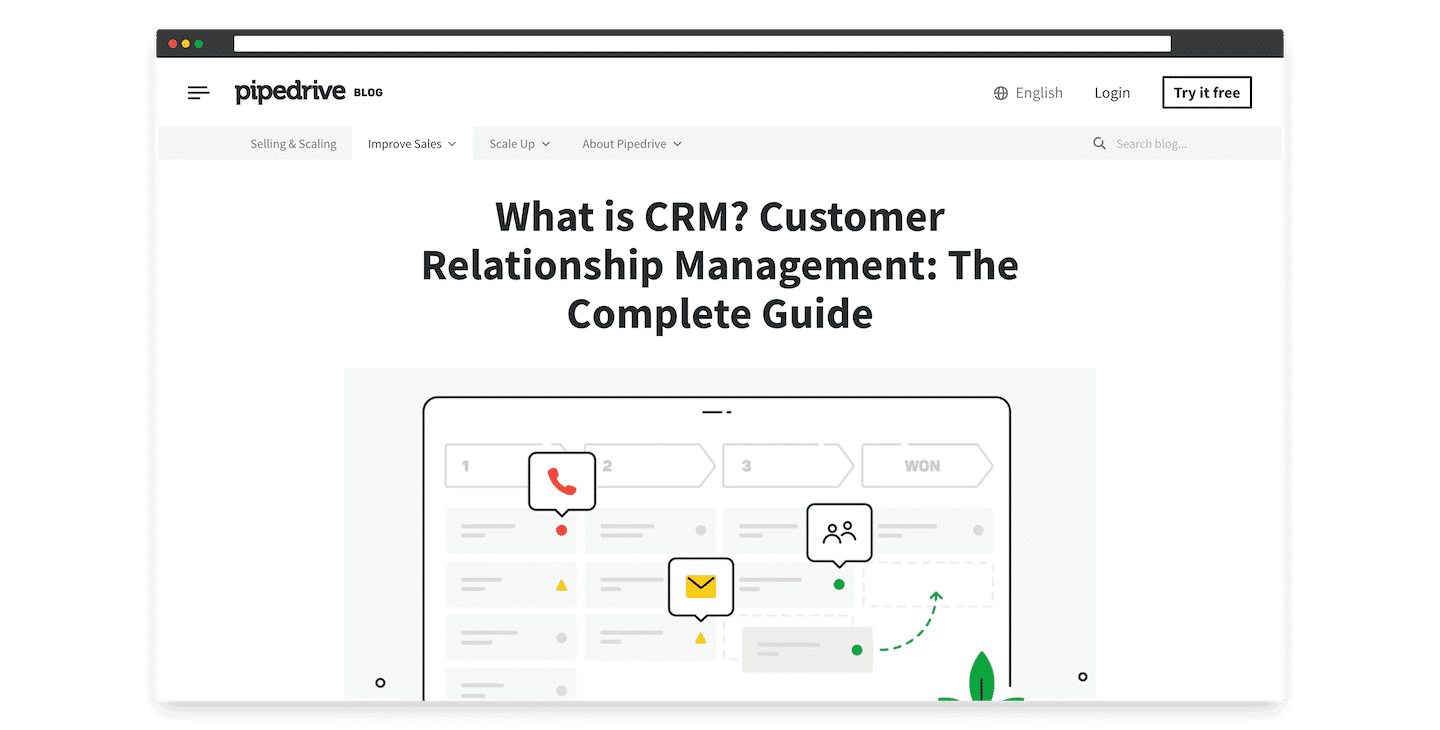
It is a relatively simple approach to execute when you know a subject well, since you master its different dimensions. But it is, by far, the most expensive approach to content marketing, since what is valued is exhaustiveness.
You have to cover a subject in its entirety to bring value, since you are only gathering information that already exists. This is what content marketing gurus call a “pillar page”. Conceptually it is very good, but you should not only make pillar pages: your inbound marketing agency would be delighted, but you a little less.
The AnswerThePublic site is a free and very handy tool for creating your topic guide: it is a generator of questions and idea associations on a given theme. In a few seconds, it identifies a whole series of questions related to a keyword or key phrase.
Buying journey stages and the relevance of content marketing
To go further, a quick word on the stages of the buying journey. Content marketing is often presented as marketing aimed at people who are still very far from the end of the buying journey… Wrongly! Here, we focus on the stages close to conversion. Simply because that is where the money is.
The strength of content marketing is that you can target intents fairly precisely. Depending on the targeted keywords and the customer’s maturity stage, the type of marketing to favor is different.
1. Converting the most aware prospects
When your prospect knows your product and recognizes the need for it, you are almost entirely in reassurance and “social proof”. You favor case studies, customer reviews, etc. All the content that will help you finish convincing the visitor.
You might think SEO does not matter and that you are 100% in “brand content”. In reality it is a bit more complicated than that. Some keywords reveal a very strong, immediate intent and a high level of maturity, and the main challenge on the marketing side is to be there. Ideally first.
Tackling these topics therefore lets you not only convert your existing pipeline, but potentially also directly acquire very mature leads, very close to conversion. The holy grail.
2. Convincing product-aware prospects
When your prospect knows your product exists, but is not sure it suits them or that it is better than your competitors’… The kind of lead we like because all that is left is to convince them: favor comparisons and partnerships with influential blogs or media to position yourself against the competition.
The goal here is not so much to show that you are a solution, but rather that you are the best solution. To everyone who, somewhat dogmatically, mentions none of their competitors in this type of content: change your mind.
Obviously you do not want to give ideas to a visitor at the very start of their journey. But at the end of the journey, if you do not dare compare yourself to others, your leads will choose one of those who do.
3. Solution-aware prospects
Your prospect is well aware of their difficulties and knows the solution they need. However, they may not know your product and how it can solve their problem. More precisely, they do not know the keyword yet. The need has not yet been expressed in a transactional way.
To caricature, these are the people who type “customer relations” and “sales pipeline” rather than CRM software.
While there is a real opportunity to convince these customers, you will also have a lot of education work to do. Depending on your product and your competitive environment, it may be more worthwhile to leave this work to others.
In any case, start by being rock solid on stages 1 and 2 of the buying journey before tackling generic stuff with lousy conversion rates. If only because once they have found the keyword that matches their need, people have an annoying tendency to type it into Google. If you give them the keyword but are no longer there afterwards, you have lost everything.
4. Problem-aware prospects
Your prospect recognizes their difficulties but knows neither the solution, nor how to identify the problems they face, nor their options for solving them.
Getting the customer to conceptualize their problem, consider solutions and choose yours will cost you a lot, and it is rather easier to focus on prospects who are already further down the conversion funnel (closer to conversion).
Overall, it is a real rich person’s problem. You tackle these topics once you dominate everywhere else and are getting a bit bored.
5. Unaware prospects
Your prospect has problems but is not aware of them. Think of this customer as someone suffering from an illness who has not yet been diagnosed by a doctor.
Paradoxically, these are the prospects people talk about most often when they talk about content marketing.
Yet it is more market education than marketing. While long-term marketing can be effective (think Blablacar), it is very expensive and takes a very long time.
In this article, we instead offer examples of content marketing that quickly capture qualified leads. We will leave market education and “demand creation” to PhD students and content marketing agencies.
The questions we get over and over.
How do you get detailed reviews of your product?
Grab the top 10 blogs ranking for the 2 or 3 keywords closest to your need, contact 20 relevant bloggers in your niche, ask each of them to publish an article about your product and pick the top 3 by price / domain authority ratio.
Why are case studies hard to produce?
You need the customer’s agreement, ideally with figures, an excellent knowledge of the value you generate and of your customers’ business stakes, and a concise, convincing document whose layout is often more complex than a landing page.
What if you do not have a customer case study yet?
Interview influential people about the results your customers want. You associate your brand with the result and you can add your own perspective to the content.
Should you name your competitors in a listicle?
Yes. You can put your product first, while staying honest in your comments. Otherwise, your competitors and a few bloggers will rank for the highest-intent keywords.
Which prospects should content marketing target first?
The most aware prospects and those who already know the product, because they are close to conversion. Problem-aware or unaware prospects fall more under market education, which is expensive and takes time.



What the community says.