Our pick of the best Google Analytics alternatives

Ten alternatives to Google Analytics. In France, Google Analytics requires the visitor’s consent: the CNIL classes it among the offers that reuse data for their own purposes. Universal Analytics has been shut down since July 1, 2023.

Maxime Ben Bouaziz
Maxime Ben Bouaziz
CEO Salesdorado, IA & Sales Tech
February 16, 2023, updated November 10, 2026, 1 min read
See all tools

Google Analytics is still the most widely installed audience measurement tool, and it is free. But in France it does not work without the visitor’s consent: the CNIL puts it among the offers that reuse data for their own purposes, so it falls outside the exemption provided for audience measurement. Every visitor who refuses the cookie banner drops out of your reports, or only appears as modeled data.

Everything else has moved too. Universal Analytics stopped processing data on July 1, 2023, and its history has not been accessible since July 2024: only GA4 is left, a platform redesigned around events, which needs Looker Studio or BigQuery to get back what a well-configured Universal Analytics used to do. On transfers, the Data Privacy Framework adopted by the European Commission on July 10, 2023 once again governs sending data to the United States, after the CNIL’s 2022 decisions against Google Analytics. The consent question, for its part, remains entirely open.

The CNIL does not issue a label: each vendor self-assesses with its grid, and a tool is only exempt if it is configured to be. We picked ten tools, favoring those that leave you in control of your data. Depending on your need:

  • replace GA with a full tool, configurable without consent: Matomo, or Piwik PRO for high volume;
  • a large site that wants a French vendor: Piano Analytics;
  • simple audience measurement, cookieless and hosted in Europe: Plausible or Simple Analytics;
  • several sites to track on a small budget: Fathom Analytics;
  • a site already behind Cloudflare, with no budget: Cloudflare Web Analytics;
  • tracking users inside a SaaS product: PostHog, Mixpanel or Heap.
The 10 tools, side by side

# Logos tool Score Price Best for
01 Matomo 4.5/5 ★ €22 Keeping ownership of 100% of your data, with self-hosted open source or in the Cloud Visit site
02 Piwik PRO 4.4/5 ★ €36 Companies that handle a large volume of data, especially in regulated sectors Visit site
03 Plausible Analytics 4.2/5 ★ €9 Sites that want lightweight, open source audience measurement hosted in Europe Visit site
04 Simple Analytics 4.0/5 ★ €20 Marketing teams that want a simple tool, published in the Netherlands and hosted in the EU Visit site
05 Cloudflare Web Analytics 4.1/5 ★ Free Sites already served by Cloudflare, which can read their traffic without an extra script Visit site
06 Fathom Analytics 4.0/5 ★ $15 Measuring the audience of several sites without cookies, with European visitors’ data isolated in the EU Visit site
07 PostHog 4.4/5 ★ Free Combining website and product analysis across the whole user journey Visit site
08 Mixpanel 4.5/5 ★ $100 SaaS vendors who want to see where their users convert or drop off Visit site
09 Heap 4.3/5 ★ On request Answering a product question after the fact without having defined the event in advance Visit site
10 Piano Analytics 4.3/5 ★ On request Large sites that want in-depth measurement, and to measure visitors who refuse cookies without consent Visit site
01

Matomo

4.5/5 From €22

Best for: Keeping ownership of 100% of your data, with self-hosted open source or in the Cloud

+ Strengths
  • Open source, free when self-hosted with no limit on users or hits
  • Configurable to the CNIL’s consent exemption criteria, in the Cloud and self-hosted
  • Cloud hosted in Europe, with no data sampling
  • Google Analytics data import
− Downsides
  • Paid Cloud from €22 excl. VAT per month for 50,000 hits
  • In an exempt configuration, some reports are no longer available
  • Self-hosting to maintain: server, updates, PHP security
★ Matomo in brief

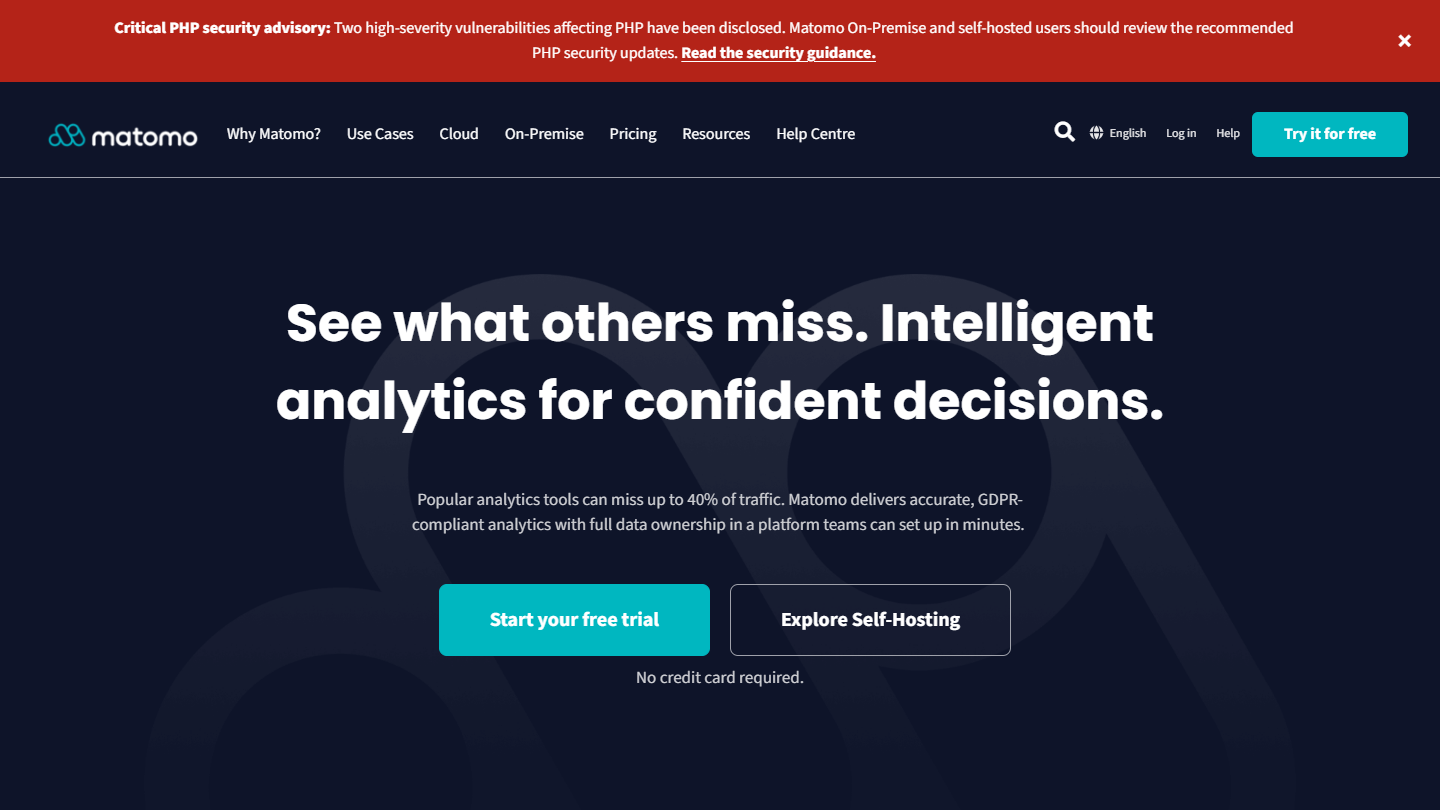
Matomo website: “See what others miss. Intelligent analytics for confident decisions.”

Matomo, formerly Piwik, is the most widespread open source alternative to Google Analytics: the tool has existed since 2007 and claims more than a million sites. You own 100% of the data, whether it stays on your servers or in Matomo’s Cloud, hosted in Europe.

For a French site, the main argument remains the consent exemption. Matomo documents a configuration that meets the CNIL’s criteria, both self-hosted and in the Cloud. It has a cost: some features fall outside the scope, and the exemption lapses as soon as you add other trackers. If you install Meta or LinkedIn pixels alongside, the banner comes back anyway.

On analysis, Matomo goes further than the simplified tools: e-commerce, funnels, cohorts, multichannel attribution and a tag manager, with heatmaps, session recordings and A/B testing in the Cloud. Importing Google Analytics data avoids starting from scratch.

The self-hosted version is free, with no limit on users or hits, but you need a server and someone to maintain it. The Cloud starts at €22 excl. VAT per month for 50,000 hits, with two months free on annual billing and a 21-day trial with no credit card.

02

Piwik PRO

4.4/5 From €36

Best for: Companies that handle a large volume of data, especially in regulated sectors

+ Strengths
  • Analytics, tag manager, consent management and data activation in one suite
  • Cloud operated in the EU, hosted in Sweden
  • Configuration guide for the CNIL exemption
  • No data sampling by default
− Downsides
  • No free plan: 30-day trial, then €36 per month
  • Raw data access by API only
  • Enterprise offer from €366 per month billed annually
★ Piwik PRO in brief

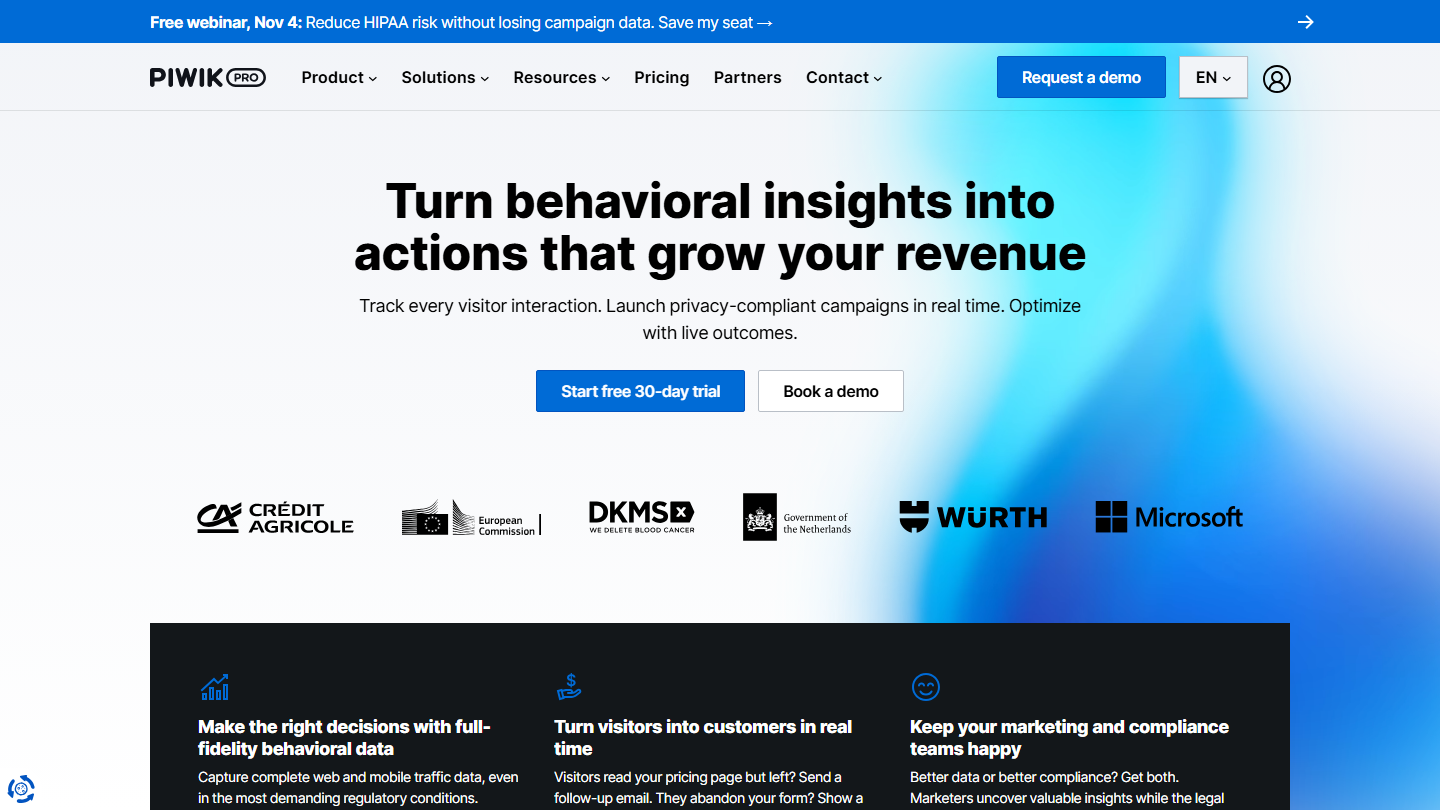
Piwik PRO home page: “Turn behavioral insights into actions that grow your revenue”, with the 30-day free trial

Piwik PRO targets organizations that Google Analytics puts in legal difficulty, in regulated sectors: healthcare, finance, public administrations. The suite brings together four modules, analytics, tag manager, consent management and data activation, which saves you from assembling several tools around GA4.

The cloud is operated in the EU and hosted in Sweden. Piwik PRO wrote a configuration guide for the consent exemption, which the CNIL hosts on its site. For visitors who refuse cookies, the tool also offers anonymous tracking, which the vendor presents as a way to recover part of the lost data.

Data is not sampled by default, but access to raw data goes through the API. The Business offer covers up to 2 million actions per month across 20 domains, with 25 months of retention.

Business starts at €36 per month, after a 30-day trial with no credit card. Enterprise starts at €366 per month billed annually, in three tiers, with a choice of hosting, including private cloud.

03

Plausible Analytics

4.2/5 From €9

Best for: Sites that want lightweight, open source audience measurement hosted in Europe

+ Strengths
  • No cookies or persistent identifier
  • Script 54 times lighter than Google Analytics’
  • Data processed in the EU, open source code
  • Google Analytics data import and Search Console connection
− Downsides
  • No free plan: 30-day trial, then €9 per month
  • Only one site on the Starter offer
  • Analysis limited to traffic, with no individual user tracking
★ Plausible Analytics in brief

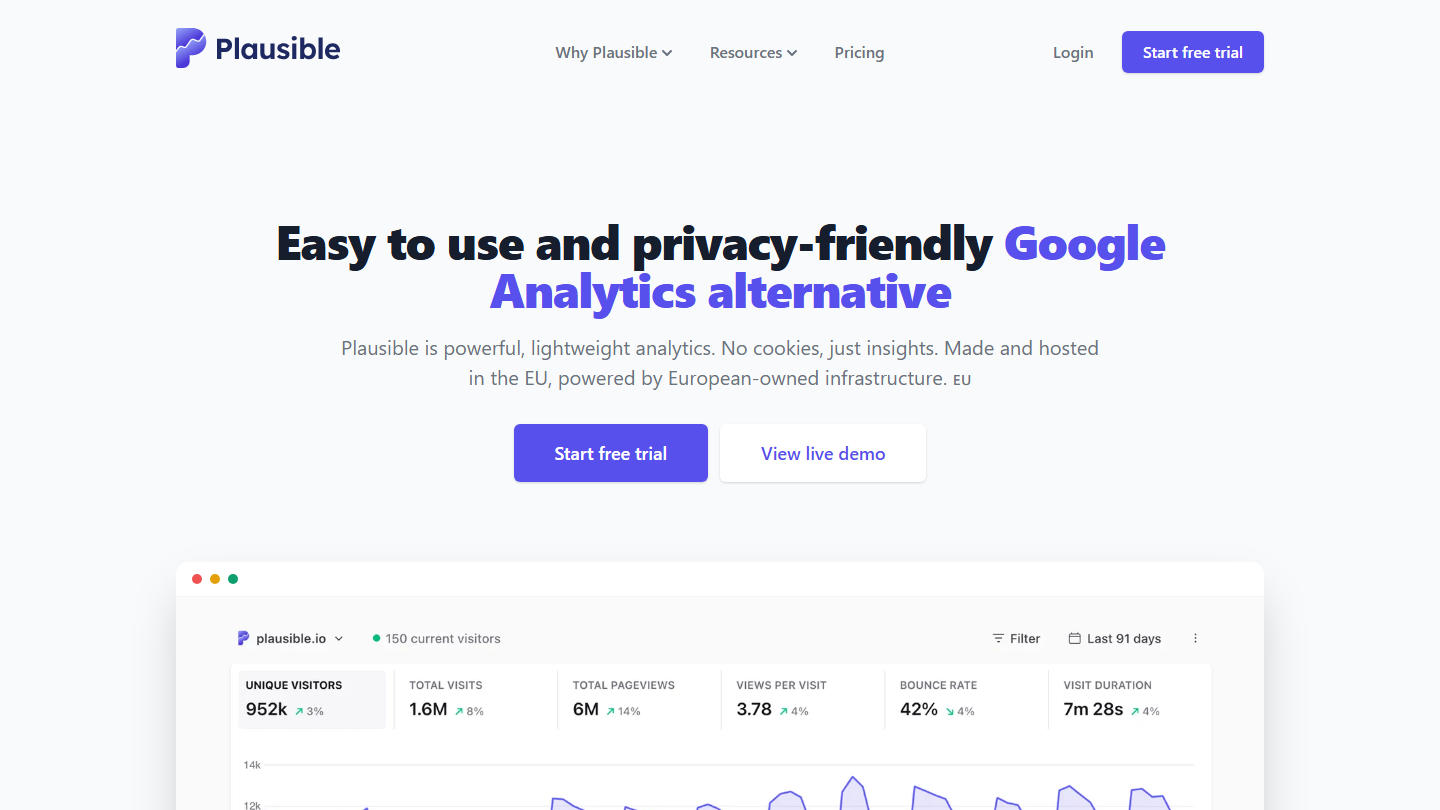
Plausible home page: “Easy to use and privacy-friendly Google Analytics alternative”, with a dashboard preview

Plausible is the most direct alternative to Google Analytics for a site that wants to know its traffic, nothing more. The essentials fit on one page: visitors, sources, pages, countries, goals. No endless menus or reports to build.

The tool sets no cookies and keeps no persistent identifier: no tracking from one site to another or from one device to another. Data is processed on servers of European companies and does not leave the EU. Plausible concludes that no banner is needed for it; that is no longer true if other tools on your site set cookies.

The script is 54 times lighter than Google Analytics’, which matters for loading speed. The tool also covers no-code goals, revenue, funnels, scroll depth and traffic sent by AI assistants like ChatGPT or Perplexity.

The Starter offer costs €9 per month for 10,000 page views and one site, Growth €14 per month. Two months are free on annual billing, after a 30-day trial with no credit card. The code is open source and the team is self-funded, with no investors.

04

Simple Analytics

4.0/5 From €20

Best for: Marketing teams that want a simple tool, published in the Netherlands and hosted in the EU

+ Strengths
  • No cookies or personal data
  • One-page dashboard, no configuration
  • Free plan for personal sites: 5 sites, one month of history
  • 30-day proof of concept to compare with GA4
− Downsides
  • Limited depth of analysis
  • Paid plans from €20 per month for 100,000 page views
  • Extra user billed €20 per month
★ Simple Analytics in brief

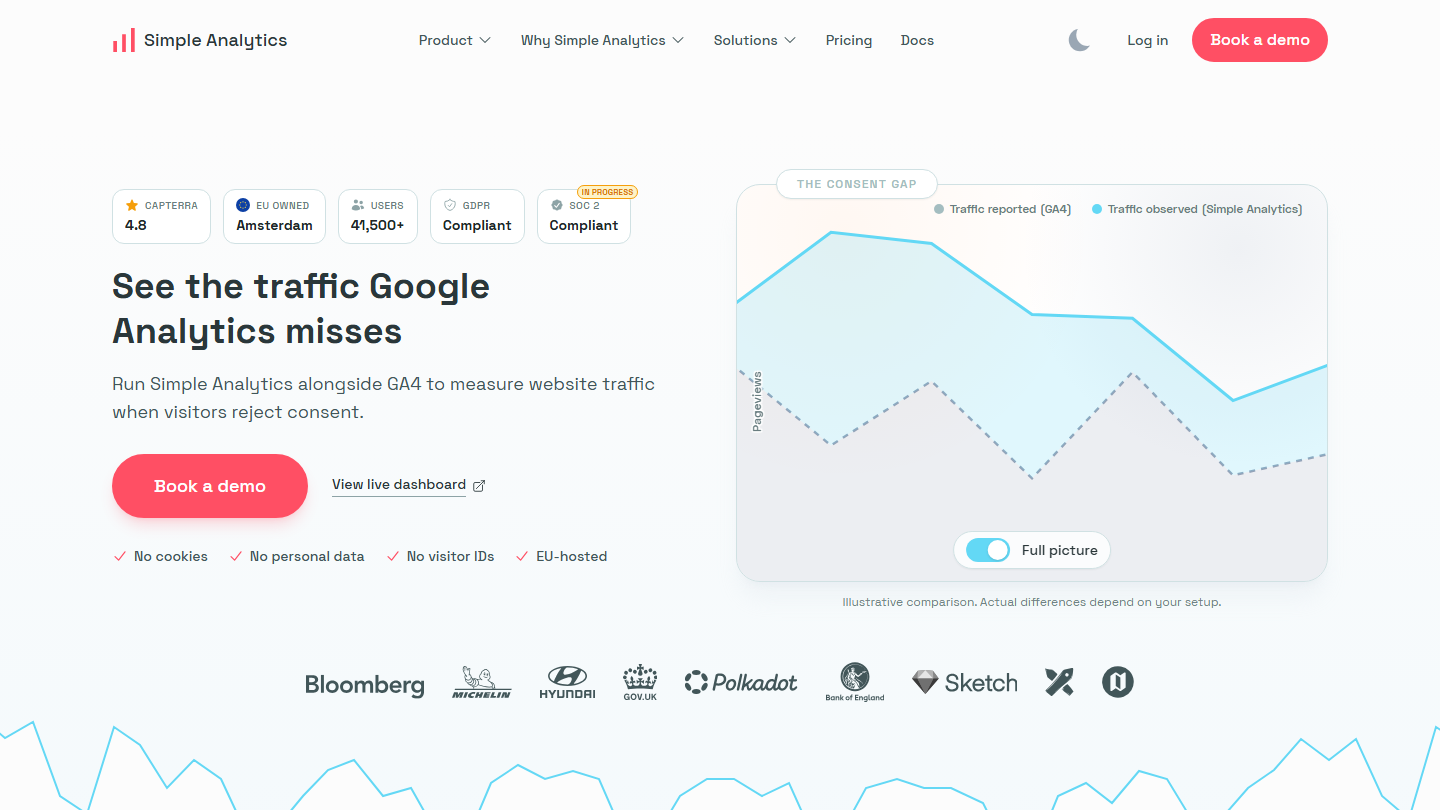
Simple Analytics home page: “See the traffic Google Analytics misses”, with the comparison of measured traffic

Simple Analytics is a Dutch company, based in Amsterdam, that bets on simplicity: a one-page dashboard, no configuration, readable in a few seconds. The tool is aimed at marketers, developers and companies that do not need the depth of GA4.

On privacy, the tool sets no cookies and collects no personal data, which exempts it from a consent banner according to the vendor. Data is hosted in the EU.

Its most recent argument targets large accounts: run Simple Analytics alongside GA4 to measure the traffic Google no longer sees when visitors refuse consent. The vendor offers a free 30-day proof of concept to compare the two.

The free plan covers 5 sites and one user, with one month of history and a mandatory badge. Paid plans start at €20 per month for 100,000 page views, two months free on annual billing, with a 14-day trial.

05

Cloudflare Web Analytics

4.1/5 From Free

Best for: Sites already served by Cloudflare, which can read their traffic without an extra script

+ Strengths
  • Free
  • No cookies or local storage, no visitor fingerprinting according to Cloudflare
  • Very light JavaScript script, or direct measurement through the Cloudflare proxy
  • Real-time reports and easier data filtering than with GA
− Downsides
  • Fairly basic reports
  • Not a classic web analytics tool: takes time to understand
  • American vendor
★ Cloudflare Web Analytics in brief

Cloudflare Web Analytics page: “Free website analytics tools”

Cloudflare stands out from the other tools by how it works. As elsewhere, you can install a very light JavaScript script that collects visits from browsers. But you can also route your site through Cloudflare’s proxy, with a simple change to your DNS. That may already be the case: Cloudflare acts as CDN and load balancer for a large share of the web.

Cloudflare uses neither cookies nor local storage to measure audience, and says it does not fingerprint visitors, whether by IP address or user agent. With the proxy, you simply read the logs of exchanges between your server and your visitors, in a more readable form.

Compared with GA, data filtering is easier and reports are real time. The reports remain basic, though, and it takes some adjustment to read data that does not look like that of a classic web analytics tool.

The service is free. Cloudflare is an American company: for a site subject to strict data location requirements, Plausible or Simple Analytics, hosted in the EU, will be easier to defend.

06

Fathom Analytics

4.0/5 From $15

Best for: Measuring the audience of several sites without cookies, with European visitors’ data isolated in the EU

+ Strengths
  • Cookieless
  • 50 sites included from the first plan
  • European visitors’ requests processed on European infrastructure
  • Unlimited API, exports and email reports
− Downsides
  • No free plan: 7-day trial, credit card required
  • Fairly basic analysis
  • Prices in dollars
★ Fathom Analytics in brief

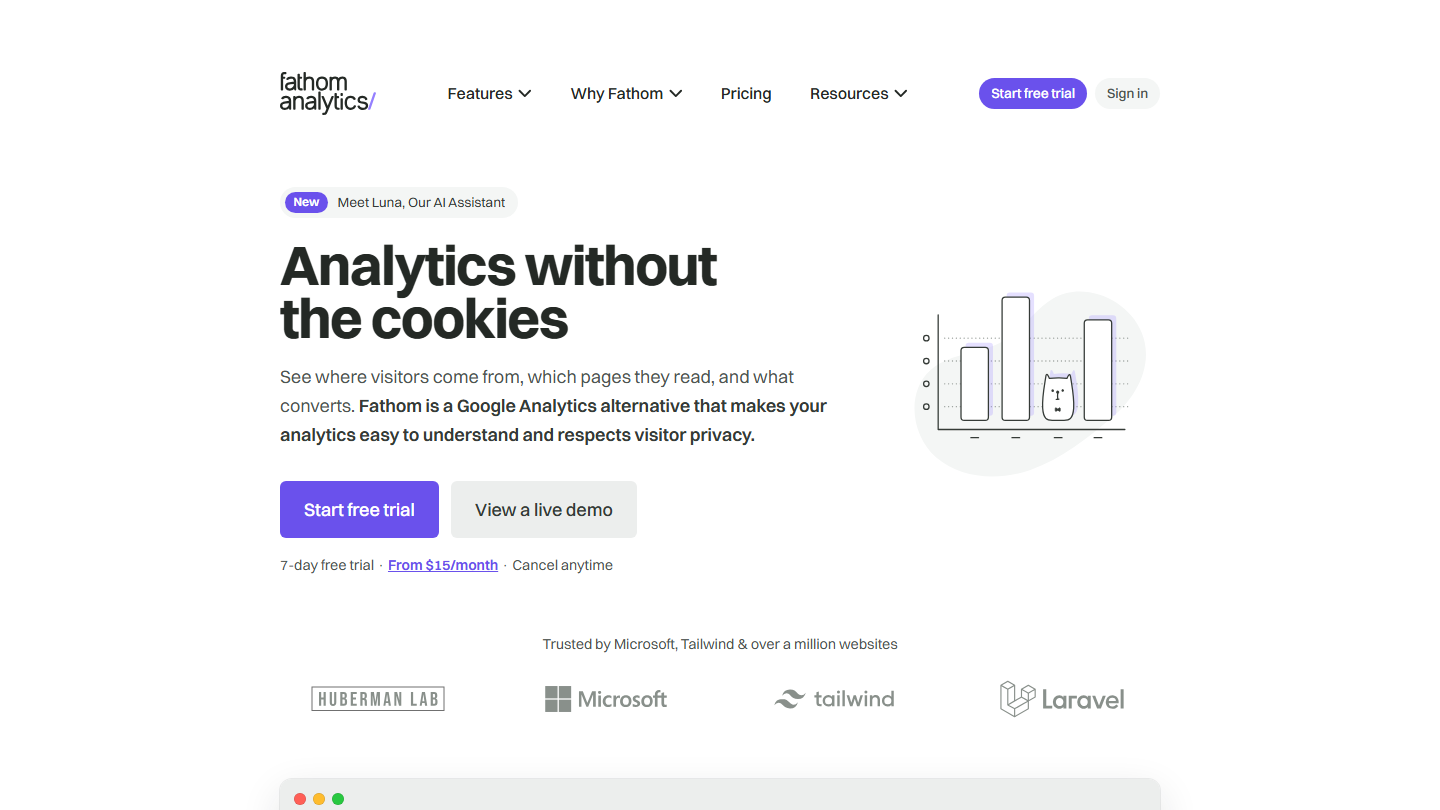
Fathom Analytics home page: “Analytics without the cookies”

Fathom Analytics, not to be confused with Fathom, the meeting note-taking assistant, is a cookieless web analytics tool. It shows where visitors come from, what they read and what converts, on a simple dashboard.

Its strong point for a European site: EU data isolation, enabled automatically. European visitors’ requests go through European infrastructure, and their raw IP addresses and user agents never reach American servers. A stronger option routes all requests through Europe, whatever the visitor’s origin.

Fathom tracks events, revenue and UTM campaigns, filters bots and offers shared dashboards. As with Plausible, the analysis stays basic: it is a traffic tracking tool, not a journey analysis tool.

All plans include the same features and 50 sites. The first costs $15 per month for 100,000 page views, then $25 for 200,000 and $45 for 500,000. The 7-day trial requires a credit card.

07

PostHog

4.4/5 From Free

Best for: Combining website and product analysis across the whole user journey

+ Strengths
  • Web analytics and product analytics in the same tool, open source code
  • PostHog EU Cloud hosted in Frankfurt
  • Session recording to replay a journey
  • Free plan: 1 million events per month
− Downsides
  • Consent banner needed if the tool sets cookies
  • One year of data retention on the free plan
  • Usage-based billing beyond the free quotas
★ PostHog in brief

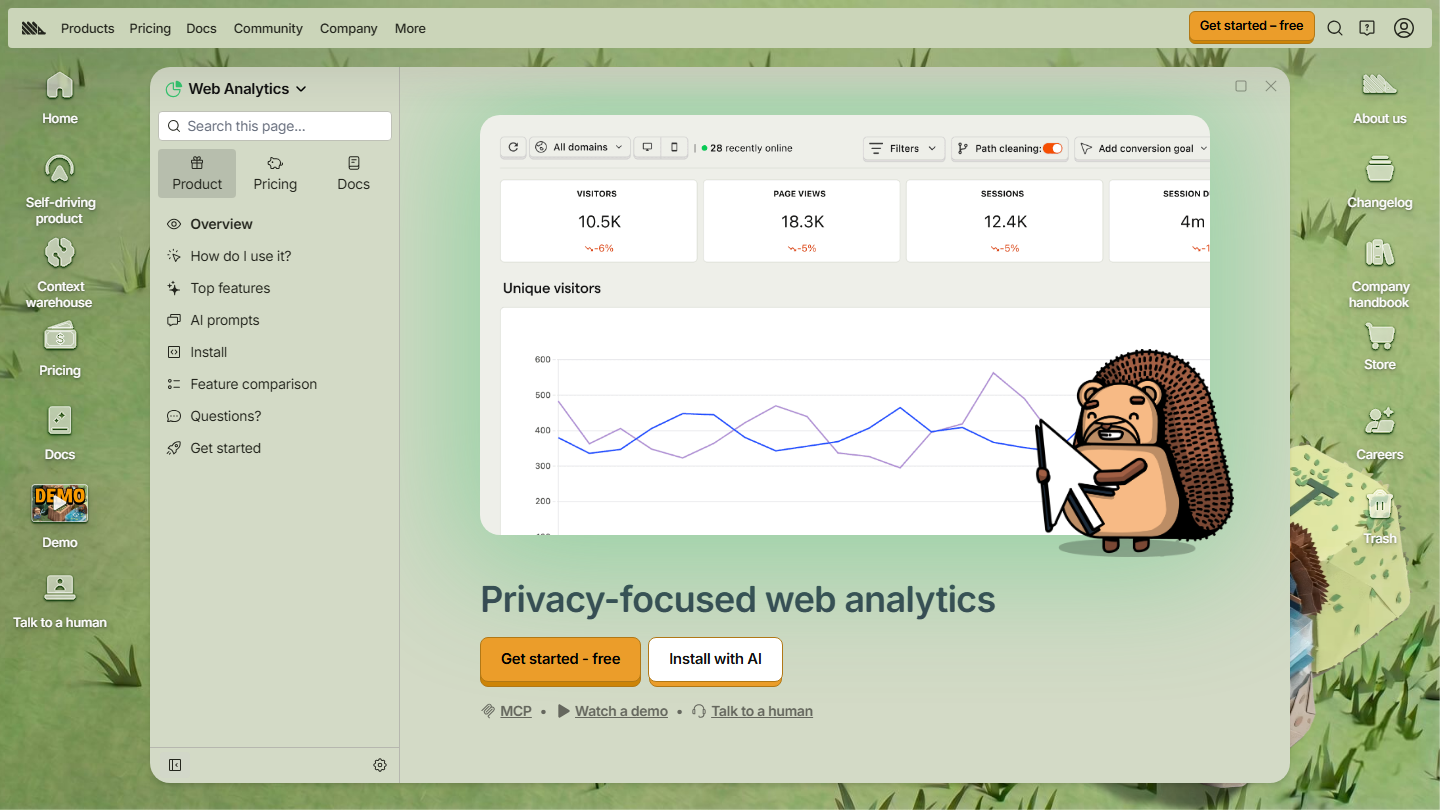
PostHog Web Analytics page: “Privacy-focused web analytics”, with a visitor dashboard

PostHog comes from product analytics and added a web analytics module: visitors, page views, sessions and sources, in a dashboard close to GA’s. The point is to follow the journey from the site to product usage, without switching tools.

On GDPR, PostHog recommends its EU Cloud version, hosted on servers in Frankfurt. The vendor does not promise the exemption: if you use PostHog with cookies for logged-out visitors, its own documentation advises a consent banner, or cookieless tracking.

The rest of the suite goes well beyond a web analytics tool: session recording, feature flags, experiments, surveys, error tracking. A product team can thus replace several tools; a marketing team that only wants its traffic will find more complexity than needed.

The free plan includes, each month, 1 million events, 5,000 session recordings and 1 million feature flag requests, with one year of data retention. Beyond that, an anonymous event costs $0.00005 and an identified event $0.000198, with no minimum.

08

Mixpanel

4.5/5 From $100

Best for: SaaS vendors who want to see where their users convert or drop off

+ Strengths
  • Both simple to use and capable of in-depth analysis
  • Funnels and retention to see where users convert or drop off
  • EU data residency option
  • Free plan up to 1 million events per month, unlimited users
− Downsides
  • Data stored in the United States by default
  • Product analytics tool, broader than simple audience tracking
  • Growth at $100 per month billed annually for 1.5 million events
★ Mixpanel in brief

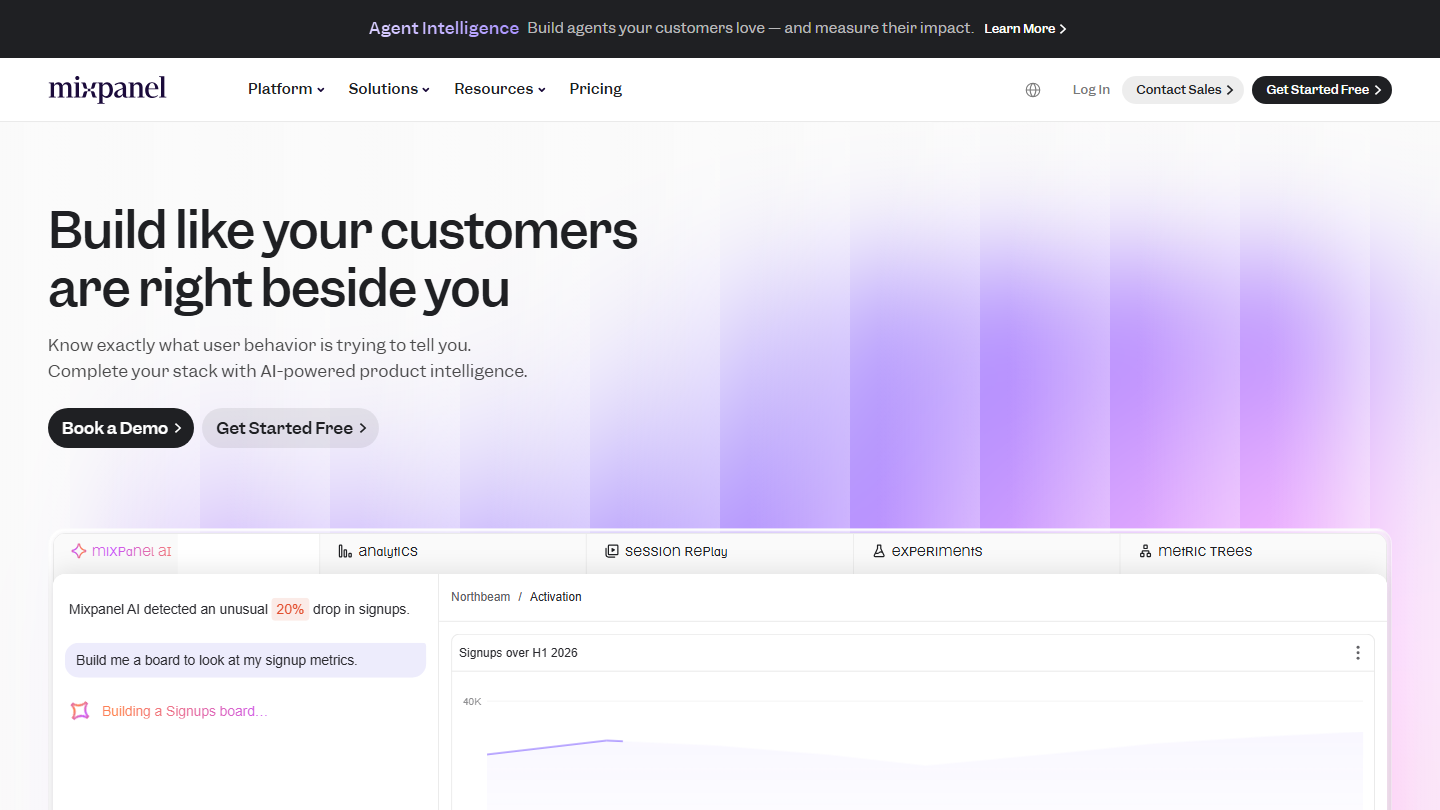
Mixpanel home page: “Build like your customers are right beside you”

Mixpanel’s advantage is that it is both very simple to use and capable of in-depth analysis: you see how users convert or drop off at each step of their journey. It is a suite widely used in SaaS.

It is not an audience measurement tool in the GA sense: you track events (sign-up, activation, payment) and users, more than page views. The suite has expanded to session recordings, heatmaps, experiments and feature flags, with an AI assistant.

On GDPR, Mixpanel stores data in the United States by default, on Google Cloud. An EU data residency program exists: you choose it when creating the project, with dedicated European endpoints.

The free plan covers 1 million events per month, unlimited users and 10,000 session recordings. Growth starts at $100 per month billed annually for 1.5 million events, $140 billed monthly.

09

Heap

4.3/5 From On request

Best for: Answering a product question after the fact without having defined the event in advance

+ Strengths
  • Auto-capture: clicks, forms and so on recorded with no prior configuration
  • Events defined after the fact, with the data history instantly available
  • Free plan up to 10,000 sessions per month
− Downsides
  • Paid plan prices known only after installation or on request
  • History limited to 6 months on the free plan, 12 months on Growth
  • Data storage in a chosen region reserved for the Premier offer
★ Heap in brief

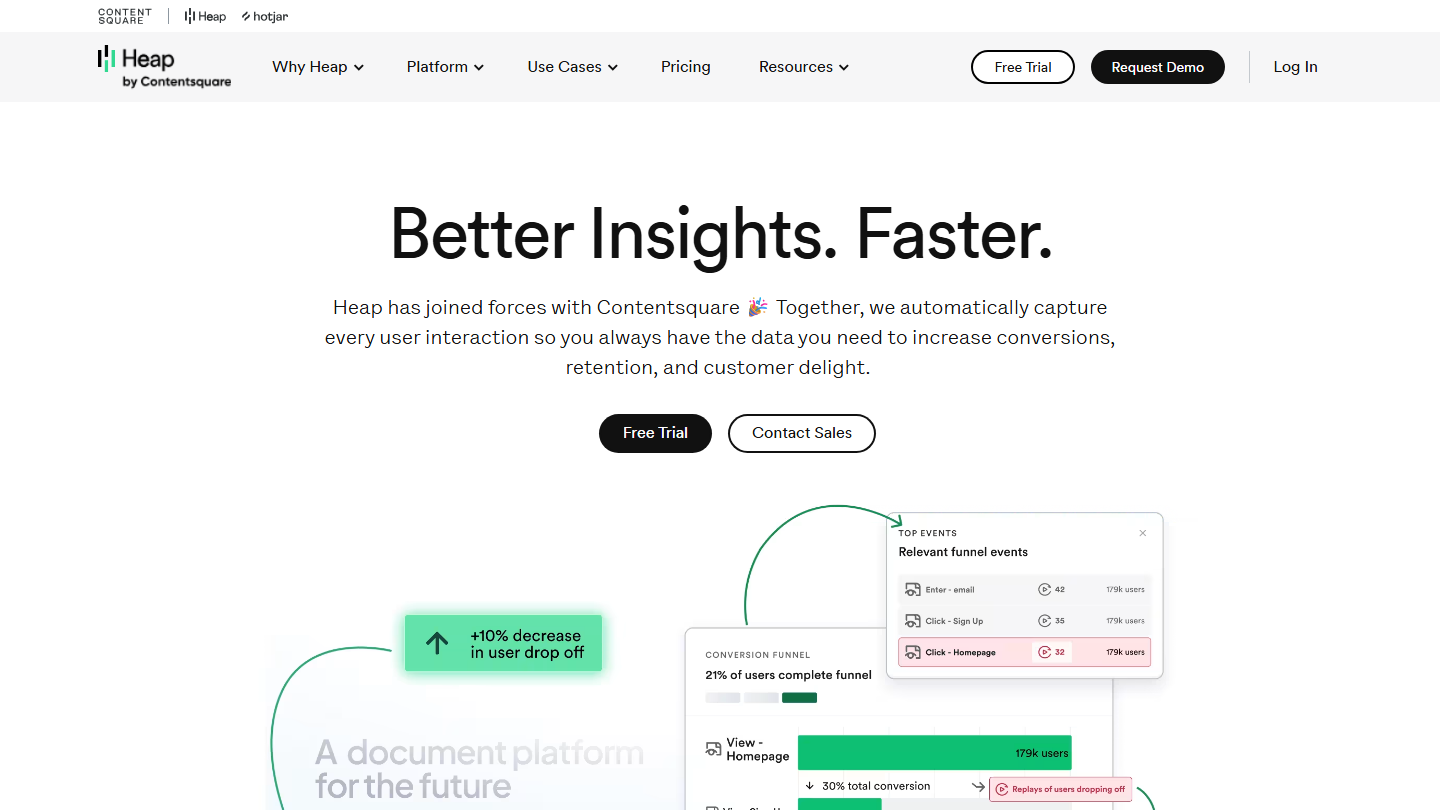
Heap by Contentsquare home page: “Better Insights. Faster.”

Heap is a product analytics tool based on passively collecting all your data, which you then filter according to what you are looking for. It is now part of Contentsquare, whose AI assistant it shares.

Heap’s strong point is auto-capture. Whereas other tools ask you to define each event you want to track (if this happens, record that event), Heap records all clicks, forms and so on, so you define events after the fact.

It is very handy if you forgot to create an event and want to answer a question at a given moment: just create the event and you instantly have the data history.

It requires storing a lot of data. The free plan is limited to 10,000 sessions per month and 6 months of history; the Growth price is estimated after installing the script, Pro and Premier go through a quote. Storing data in a specific region, useful to keep it in Europe, is only included in Premier.

10

Piano Analytics

4.3/5 From On request

Best for: Large sites that want in-depth measurement, and to measure visitors who refuse cookies without consent

+ Strengths
  • “Exempt” mode that measures without consent, limited to strictly necessary data
  • Configuration guide for the exemption hosted by the CNIL
  • Hybrid measurement: full data for visitors who consent
  • Unlimited custom metrics, anomaly detection
− Downsides
  • Pricing not published, on request
  • Exemption subject to signing an annex to the data processing contract
  • Sized for large accounts, not for a showcase site
★ Piano Analytics in brief

Piano Analytics page: “Better data. Better tools. A better relationship.”

Piano Analytics is the former AT Internet, an audience measurement vendor based in Mérignac, near Bordeaux, now part of the Piano group. It is one of the few French alternatives built for high volumes.

Its strong point for a French site: hybrid measurement. Visitors who accept cookies are tracked normally; those who refuse switch to “exempt” mode, where only the data strictly necessary for audience measurement is collected, with the visitor identifier masked. AT Internet’s configuration guide for the exemption is on the CNIL’s site, and enabling it requires signing an annex to the data processing contract.

On analysis, Piano Analytics lets you define as many custom metrics as needed and monitors deviations continuously, with anomaly detection and root cause analysis.

Piano publishes no pricing: everything goes through a demo and then a quote. The tool is aimed at large editorial and retail sites, which have the volume and the team to use it.

How we chose these 10 tools

Every tool in this selection has been used in real conditions by our team or by a Salesdorado consultant, in a B2B sales and marketing setting. No ranking built from a marketing deck. The order of the list is not a ranking: the right tool depends on your needs.

  1. 01
    Benchmark scope

    Broad identification of the tools on the market (G2, Capterra, Salesdorado customer feedback, LinkedIn signals). Initial filtering, then a short list based on a 2-hour setup per tool.

  2. 02
    Test conditions

    3 to 4 weeks of active use per tool, with data representative of a B2B sales use case. When a tool targets a specific profile (SDR, AE, Ops, Marketer…), we match the tester accordingly.

  3. 03
    Weighted criteria

    For each category, 5 to 7 axes weighted according to what matters in the segment: UX, feature depth, native integrations, support, pricing at scale, compliance (GDPR, security), and roadmap quality.

  4. 04
    Independence

    No tool is scored in exchange for payment. Partner links (affiliate) are marked as such and do not influence the score. Non-partner tools are included when their place in the ranking is deserved.

  5. 05
    Updates

    The ranking is reviewed every 6 to 12 months or on every major release of a tool mentioned. The date of the last check is shown at the top of the article.

The questions we get over and over.

Why look for an alternative to Google Analytics?

In France, Google Analytics cannot run without the visitor’s consent: the CNIL classes it among the offers that reuse data for their own purposes, so it falls outside the exemption provided for audience measurement. Visitors who refuse the banner escape measurement. On top of that come the end of Universal Analytics, which forces GA4, and the CNIL’s 2022 decisions on transfers to the United States, now governed by the Data Privacy Framework of July 2023.

Which Google Analytics alternative lets you drop the cookie banner?

Plausible, Simple Analytics, Fathom Analytics and Cloudflare Web Analytics do not set cookies, and their vendors state that no banner is needed for them. Matomo, Piwik PRO and Piano Analytics can be configured to the CNIL’s exemption criteria, at the cost of a few features. If you install Meta or LinkedIn pixels alongside, the banner becomes necessary again.

Which Google Analytics alternative is free?

Matomo is free when self-hosted, with no limit on users or hits. Cloudflare Web Analytics is free. PostHog and Mixpanel have a free plan up to 1 million events per month, Heap up to 10,000 sessions, and Simple Analytics a free plan for personal sites, with one month of history.

What is the difference between web analytics and product analytics?

Web analytics tools, whether traditional like Matomo or simplified like Plausible, measure a site’s audience. Product analytics tools like PostHog, Mixpanel or Heap follow the user’s journey inside the product, to understand where they convert or drop off, and are gradually adding web analytics.

Which analytics tool should a large site or a media outlet choose?

Piano Analytics, formerly AT Internet, targets large sites: custom metrics, anomaly detection and an exempt mode to measure visitors who refuse cookies without consent. Pricing is on request. For high volumes, Piwik PRO and Matomo’s Enterprise offer are the two other options.

Does the CNIL publish a list of tools exempt from consent?

No. It provides vendors with a self-assessment grid, and no tool can present itself as “certified” or “approved by the CNIL”. The trackers must serve audience measurement alone, on behalf of the site, produce anonymous statistics and allow neither cross-referencing nor tracking from one site to another. The CNIL recommends a tracker lifetime of 13 months and data retention of no more than 25 months. Ask the vendor for a contractual commitment not to reuse the data.

★ The conversation, 0 comments

What the community says.

Basic Markdown, moderated within 24 h
Loading…

    In the same category