


- Prepare each demo 10 to 15 minutes in advance: discovery notes, company research, notifications off.
- Show only 3 or 4 features, the ones that solve the prospect’s pain points, and ask a question between each one.
- Talk less than 50% of the time: a demo is a conversation, not a monologue.
- Present the pricing, then stay quiet for a few seconds, without trying to justify it.
- End with the next steps and always send a follow-up email.
About this article
- This article was originally published in English, on Alex’s blog
A well-executed sales demo can make the real difference between closing a deal and losing a potential customer.
The software demo is a crucial part of the sales process for any SaaS solution, especially if you are sales-led.
If you lean more towards PLG (Product-Led Growth), more and more companies are using interactive demo videos as a way to present their product. Check out this article to learn more about it.
The 3 elements of an effective SaaS product demo
A good sales demo combines 3 elements:
- Structure
- Value-driven messaging
- Two-way communication
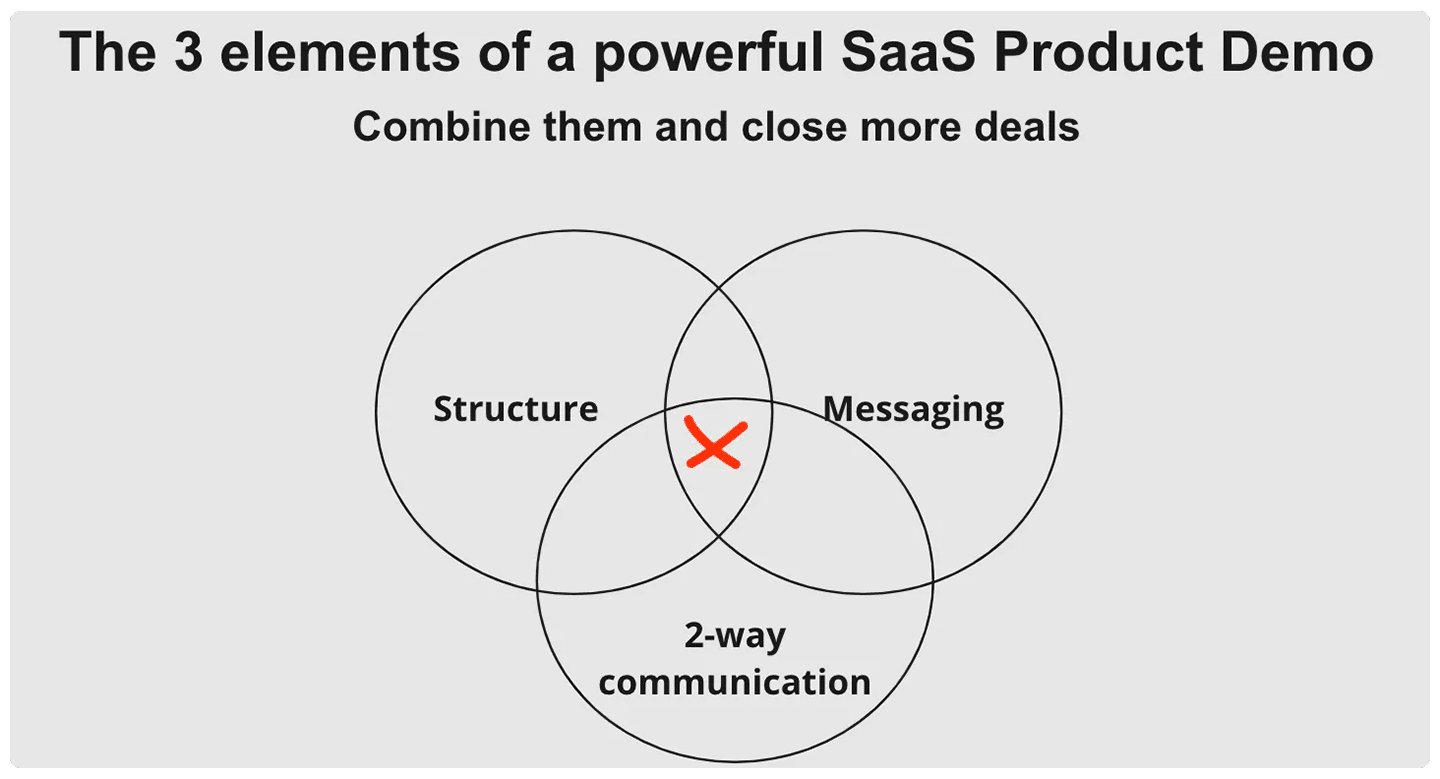
If you manage to combine each of these elements, your product demo will be truly effective and you will close more deals.
You will learn more about each of these three elements in the following sections.
The 9 phases of a successful demo
Don’t make the mistake of jumping into your demos without a structure and a clear plan. Having a structure doesn’t mean you have to follow a script word for word. It’s more of a guide that helps you stay in control of your demo. Within these 9 steps, you still have room to add your own style and be creative.
Following these 9 steps will also help you keep a good balance between presenting, asking questions and listening, so that your prospect doesn’t get bored or lose interest.
Step 1: Research and preparation (before the demo, 10-15 minutes)
I recommend taking about 10-15 minutes to prepare your next demo. That includes researching the prospect as well as preparing your demo setup.
For researching the prospect:
- Go over your notes from your first discovery call (if you had one before).
- Check the information provided in the sign-up form.
- For free trial users, look at the actions they have taken in the product.
- Do some quick research on the company (for example, website, LinkedIn page, etc.).
The more information you collect upfront, the less time you will need to spend during the call asking questions that could easily have been answered. I recommend gathering the following information (if available):
- What does the company do?
- Who are the people attending the call (their roles & responsibilities)?
- What solution are they currently using (if available)?
- Do they belong to your target audience/ideal customer profile?
Preparing for the demo:
- Turn off all notifications (for example, Slack, email, calls).
- Set up your browser with the right tabs (for example, the prospect’s website, your tool, your customer testimonials page).
- Make sure you are in a quiet space (for example, a meeting room, a phone booth).
- Check your call settings before the meeting (for example, headset connected, two screens).
- Have your Sales Deck ready and prepared (→ The perfect Sales Deck template)
Note: Doing research is always a good thing, but don’t assume you know everything about the prospect. Don’t neglect the discovery part with your prospect, especially the information about their specific problem, the implications and the expected outcome, because it’s hard to know everything in advance.
Step 2: Introduction and small talk (3-5 minutes max.)
Start by introducing yourself and your company briefly and concisely, ideally in 3-4 sentences.
Then ask your prospect to introduce themselves.
The goal of this initial conversation is to break the ice and get to know each other better.
Step 3: Framing the demo and the sales process (1-2 minutes)
Don’t assume your prospect knows what will happen during the demo. Set the stage by outlining what you are going to cover, and also explain what will come next.
Encourage your prospect to share their expectations for the meeting, and do your very best to meet them.
Step 4: Recap of the Sales Discovery or discovery call (10-15 minutes)
If you plan to run a two-step sales process (the discovery call and the demo are two separate meetings), you should always do a quick recap of your discovery call.
If you only have one meeting with your prospect, you absolutely need to run a more in-depth discovery of the prospect’s profile during your demo. Without understanding the current situation, the pain points and the desired outcomes, you can’t deliver an effective product demo.
Here is a list of questions you can ask your prospect:
- Tell me a bit more about your company. What is the current priority for you/your company?
- Can you tell me a bit more about your role? What does your day look like?
- How do you currently handle [XYZ topic]?
- Are you satisfied with your current solution?
- What challenges are you currently facing with [XYZ topic]?
- How do you currently handle [XYZ challenge]? And what effect does it have on you/your company/your costs, etc.?
- What have you done so far to solve [XYZ challenge]?
- Why is it so important for you to solve this specific problem? And why now?
- What do you do if you can’t solve [XYZ challenge]? Do you have another solution in mind?
- What do you expect from a solution? What is essential and what is less so?
- What would be the ideal outcome for you 6 months after implementing our tool?
- How many people would use the product?
- What other software are you currently using (related to this topic)?
Worth mentioning:
- These questions are just for inspiration. Use them and create your own versions that best fit your target audience.
- Don’t fire the questions one after the other. It’s not an interrogation.
- You can also ask these questions as part of the other steps. What matters is that it feels natural to the prospect and that they don’t feel like they are being interrogated.
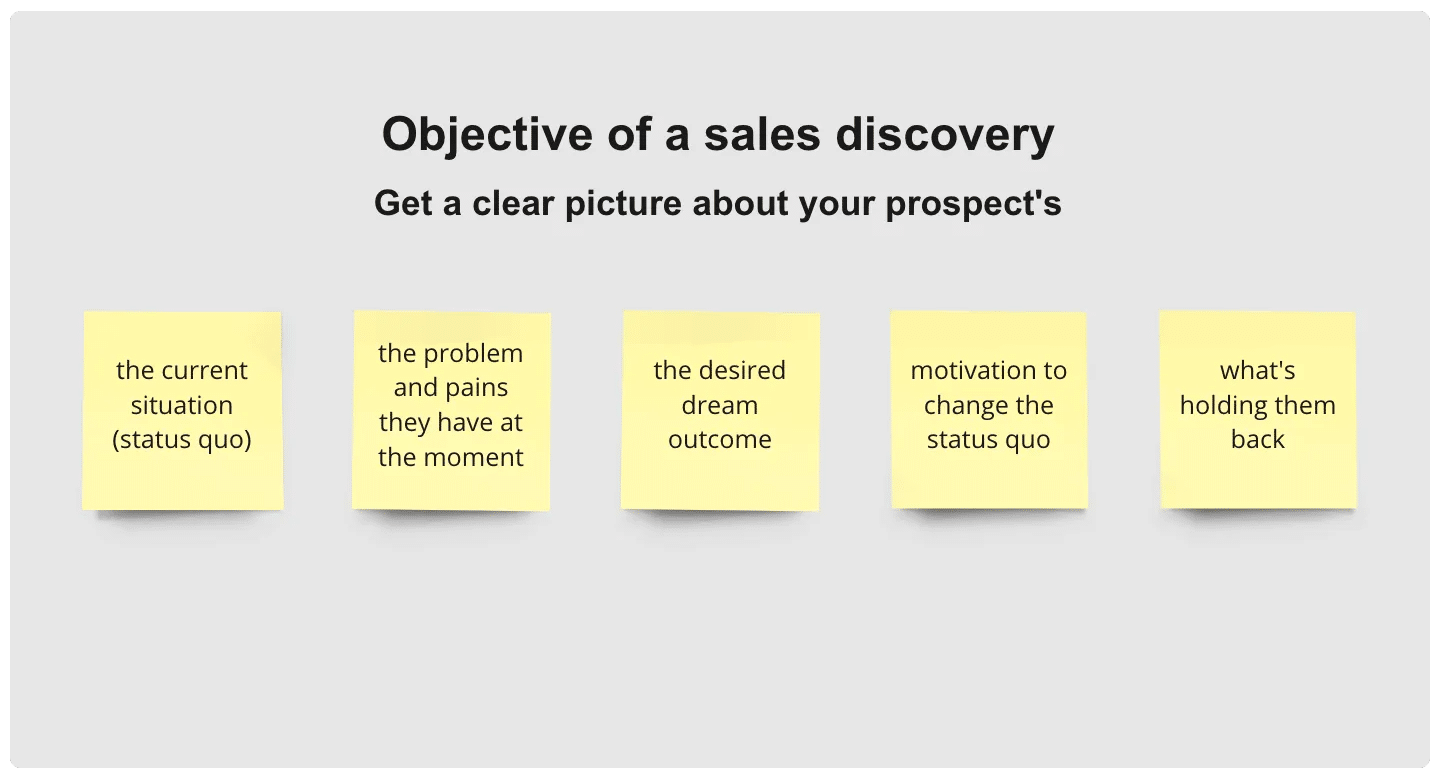
The goal of a discovery call is to get a clear picture of:
- the prospect’s current situation;
- the problem and the pain points they have right now;
- the desired dream outcome;
- their reasons for wanting to change the current situation and
- the obstacles that are holding them back.
Step 5: Make sure you have understood the pain points and the desired outcome (1 minute)
Before moving on, make sure you have correctly understood the challenges and the expected outcome(s). A great way to do this is to recap what you understood and ask them whether you got it right.
“Great. So, if I understood correctly, you currently handle [XYZ topic] with [current solution], but you’re rather unhappy because [pain points]. And solving this problem is your current priority, because otherwise [negative implications of the status quo]. On the other hand, the ideal scenario is [desired outcome]. But I understood that [what’s holding you back] is something I need to be aware of. Did I miss anything?”
Step 6: Present the 3-4 key features that help solve the identified pain points (15-20 minutes)
Now it’s time to present your product. But don’t just show off every feature you have built. Your job is to carefully select the 3-4 key features that directly solve your prospect’s pain points.
To keep engagement high and the conversation going, I recommend asking questions between the presentations. If you present for 20-30 minutes straight without any interaction, you risk losing the prospect’s interest.
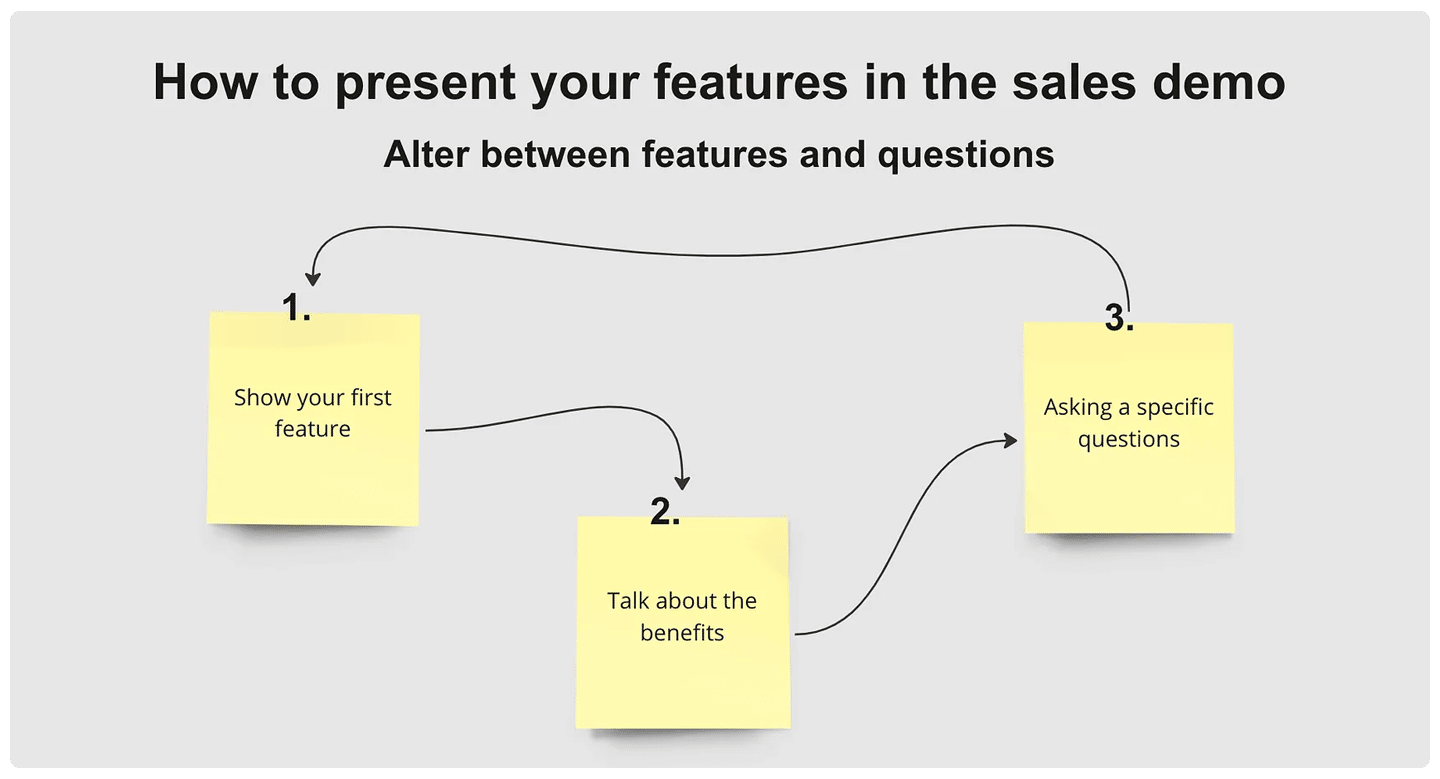
It’s not about showing all your features at once. It’s better to alternate:
- Show feature 1 + talk about its benefit
- Ask a question
- Show feature 2 + talk about its benefit
- Ask a question
- Show feature 3 + talk about its benefit
- Ask a question
You are presenting the features, but you are not going to say:
“If you click here, then XYZ happens…”
Instead, you show the feature, but verbally you talk about how this feature enables them to achieve XYZ and how it is 10 times better than their current solution. Using concrete examples will make it easier to understand. It could sound like this:
“Imagine you need to [job to be done], but instead of doing it [the current way], you can simply use [this feature], which would make your work 10 times [faster, cheaper, more professional, less complicated, etc.]”
Add a question to keep them engaged. For example:
- “How would this change your current situation?”
- “Is this how you imagined it?”
- “What would you like to add here to make it even better for you?”
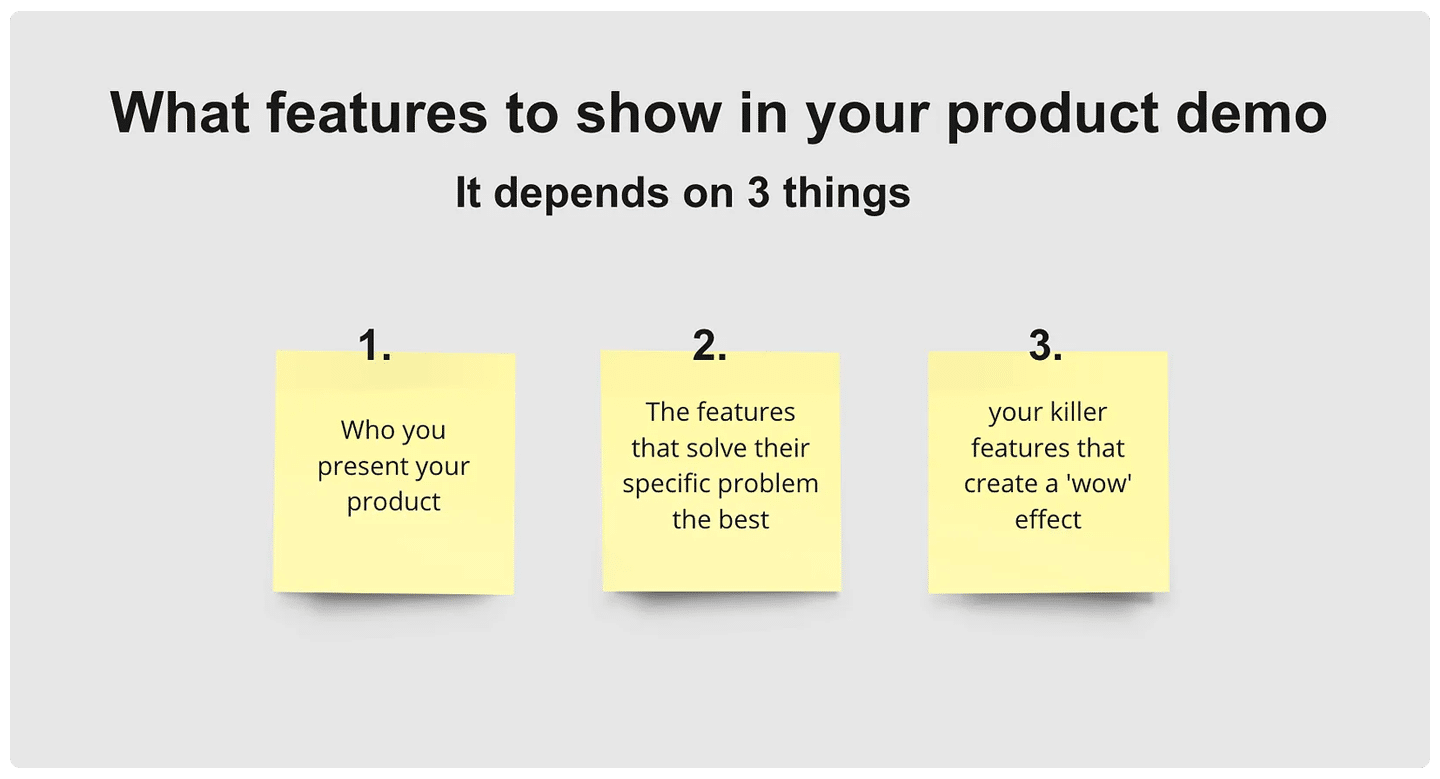
The features you are going to show depend on 3 things:
- Which features best solve their specific problem.
- Your flagship features that create the “wow” effect.
- Who you are presenting the product to (user vs decision-maker).
If your product is used by different types of users (for example, users, team leads, managers), also include how each of them benefits from using the tool.
Step 7: Get re-confirmation (1 minute)
As described above, it is important to get re-confirmation that the features you presented actually help them solve their problems and bring them closer to the desired outcome.
Asking for re-confirmation helps you with two things:
- making sure that what you presented is useful to them,
- and that they have understood how it works and how it will make their day-to-day easier.
Step 8: Pricing (3-5 minutes)
Once they confirm that what you presented is useful to them, it’s time to talk about pricing.
A good way to do this is: “Okay, now I’ve shown you how our product can help you overcome [the pain point] and bring you closer to [the desired outcome], which obviously represents huge value for you. Speaking of value, this is probably the right time to talk about our pricing”.
So talk (proactively) about your pricing and give them your honest recommendation on the plan (pricing tier) that suits them best.
You also do this to get a sense of where they are in their buying decision and to build a mutual timeline. Use the pricing discussion to move smoothly into discussing the next steps.
Important:
- Don’t talk about price. For them, it’s an investment. It’s a trade (price against the value of your product).
- Don’t start justifying why your product costs what it costs. You don’t need to defend your pricing (if the prospects don’t say anything about it).
- Present your pricing, then stop and stay quiet for a few seconds. Ignore the urge to argue or justify. Just stay silent for a few seconds, wait for their response, and see what happens.
Step 9: Quick summary and next steps (3-5 minutes)
Quickly summarize how your product (your key features) helps them overcome their specific problem (just 1-2 sentences). The point is to repeat it so they remember it.
Depending on your target audience and the type of product, you could even try to close the deal during the demo. To learn more about end-of-demo questions, see point 11 (below) of the 12 key aspects of SaaS product demos.
For products with a higher ACV (Annual Contract Value), you should detail the next steps and try to get commitments on them.
Mutual action plans are a great way to achieve this.
For example:
- Another call with the decision-makers;
- A 14-day free trial period and a follow-up call at the end of the trial;
- Another meeting with the legal department on date xx.
Always send a follow-up email after the demo. This is a point not to overlook.
An example of a follow-up email after a demo
If you don’t know what to send as a follow-up email, you can take inspiration from this template.
Hi {contact name},
I really enjoyed our meeting today.
Thank you for sharing more about {client company name}’s goal to {desired goal} and to overcome {challenge X} with {status quo/use case}. In particular, it was interesting to hear that you are facing {specific challenge X}.
It helped me better understand how (your product name) can help you reach your {desired goal}.
Quick summary:
Here are the main ways (your product name) will bring value to {client company name}:
(Benefit 1): Improve/reduce {pain point 1} through (solution/feature 1)
(Benefit 2): Improve/reduce {pain point 2} through (solution/feature 2)
(Benefit 3): Improve/reduce {pain point 3} through (solution/feature 3)
[I’m attaching (resource name X) for more context on (benefit X)]
[(testimonial name) was facing very similar challenges. Here is how (your product name) helped them reach {desired goal}.]
[(Open questions):
You asked some really good questions during our call. I discussed them internally and here are some first answers:
(Question/objection 1) → (answer/solution 1)
(Question/objection 2) → (answer/solution 2)]
Next steps:
As agreed, please find attached a quote based on your needs (X seats & X resources, X features). I’ve invited you to a video call on (date, time of the next meeting) to discuss it.
[Alternative: I’ve activated a 30-day free trial for your account. You can access it here.]
[To get started, I recommend following our (insert academy video / help article).]
Let me know if you have any questions.
{Signature}
12 key aspects of an effective SaaS product demo
Compared with less effective demos, effective demos share the following characteristics:
1. Keep it concise and engaging
Your sales demo should get straight to the point. Focus on the most important features and benefits of your product. Keep the prospect interested and listen to them. It’s two-way communication, not a monologue.
The presentation part should not exceed 30 minutes at most (unless your product is really complex and the prospects want it, otherwise 15 to 20 minutes).
2. Interact with your prospect, it’s not a monologue
A demo of your product is not a one-sided speech where you talk without interruption. It’s not you on one side showing the product and the prospect on the other just “watching” the show. It’s a two-way conversation.
Your demo is only truly convincing if you can adapt it to your prospect’s situation.
You shouldn’t talk more than 50% of the time. Listening and guiding with questions is crucial.
A great way to do this is to ask them questions.
3. Lead your demo with questions
The best way to get closer to the customer is to show genuine interest in their needs. Instead of just presenting information, start with questions that encourage a conversation. Actively listening to the prospect is crucial.
Try to understand them. Try to help rather than sell.
4. Highlight the prospect’s key pain points in your demo
To sell the product’s benefits effectively, you need to understand the customer’s challenges. Understand their challenges and pain points, and show them how the product can solve them.
Make sure you address their real challenges and create a clear gap between their current situation and the one they could reach with the product (desired situation).
The Pain Points model (I call it the 4-step DAIC model) is a four-step process that helps you fully leverage the power of the customer’s pain points. Here are the steps:
- Discover the Pain: Ask questions and run a proper sales discovery to uncover your prospects’ pain points.
- Awareness of the Pain: Knowing the pain is not enough. Make your prospects aware of the problem.
- Implication of the Pain: What are the negative implications of the problem? What happens if they don’t solve it?
- Confirmation of the Pain: Get your prospects to confirm the pain.
It’s like going to the doctor. A doctor can’t give you the right treatment before knowing your pain and your symptoms.
5. Understand your customers’ goals
If you know your ideal customer profiles, you should know their jobs to be done. What is the main reason customers use your product? What do they want to achieve?
Knowing them helps you communicate better about how your features work. You can use real-world examples and present a customer case.
6. Use real-life examples
Show your product in action using real-world examples. This will help your potential customers better understand how your product can solve their problems.
A great way to do this is to use examples from your other customers (your testimonials) on how they use your product (only if possible).
It also strengthens social proof and builds trust with your prospect.
7. Handle pushback and objections
Anticipate and proactively address any objections your potential customers might have. This will show that you understand their concerns and that you are ready to respond to them.
8. Focus on benefits, not on presenting features
The goal of a product demo is not to show your features, but to sell their benefits. It’s important to highlight how the product can solve the customer’s pain points and make their life easier. Make sure you tailor the demo to the customer’s needs and interests.
9. Assess the current situation against the ideal one
Once you know the prospect’s current situation (point A) and their challenges, you should know what their dream situation looks like (point B).
You can position your product as the element that gets them from this (mediocre) situation at point A to point B.
Also highlight what staying in their current situation means for them and the negative implications that come with it.
In short, you need to make your prospects picture two options – a good one (using your product) and a bad one (staying in the current situation).
10. Summarize and repeat the problem
It’s important to make sure the customer understands the problem and how your product can solve it. Summarize the problem several times and repeat how the product can solve it.
11. Close the deal
- At the end of the demo, it’s important to talk about the deal (or find out what’s missing) and to know the next steps.
Here is a list of short questions to ask at the end of a demo:
- “I really think we are on the same page. What will it take for you to become a customer?”
- “Unless you have any other questions or concerns, I think we are ready to get started.”
- “If you don’t have any more questions, I think we can get this deal done.”
12. Follow-up
After your sales demo, make sure you follow up with your potential customer. This will show that you really care about them.
The questions we get over and over.
What are the elements of an effective SaaS product demo?
A good sales demo combines three elements: structure, value-driven messaging and two-way communication.
How long should the product presentation last during a demo?
The presentation part should not exceed 30 minutes, unless the product is really complex and the prospects want it. Otherwise, 15 to 20 minutes is enough.
How many features should you show during a demo?
3 or 4 key features, chosen because they directly solve the prospect’s pain points. The choice also depends on the flagship features that create the “wow” effect and on who you are presenting to, user or decision-maker.
How do you talk about pricing during a demo?
Once the prospect has confirmed that what was presented is useful to them, talk about pricing proactively and recommend the best-suited plan. Present it, then stay quiet for a few seconds, without arguing or justifying.
What questions should you ask at the end of a demo to close?
For example: “What will it take for you to become a customer?”, “Unless you have any other questions or concerns, I think we are ready to get started” or “If you don’t have any more questions, I think we can get this deal done”.



What the community says.