Kommo (formerly amoCRM) helps you turn WhatsApp, Instagram, and your other messaging platforms into a true sales channel, with a single inbox, a visual pipeline, and bots that qualify your leads while you sleep.
But what good is this promise when selling in France, where a WhatsApp marketing message costs ten times as much as in Brazil? Does the product hold up beyond messaging?
We put Kommo through its paces—here’s our full review.

Sommaire
Our Review of Kommo: A Summary
| Perimeter | Score | Our opinion |
|---|---|---|
| Overall rating | 3,8 | Kommo is probably the best CRM on the market for selling via messaging, at a very low introductory price. However, the six-month prepaid commitment, the cost of the WhatsApp channel in France, and the lack of French-language support mean it’s best suited for teams whose customers actually message them on WhatsApp or Instagram. |
| Mail-Order Sales | 4,6 | The heart of the system. All conversations are routed to the same place, linked to a record and a pipeline stage. In this specific area, no general-purpose CRM system performs better at this price point. |
| Getting started | 4,4 | A visual pipeline you can understand in thirty seconds, plus a native mobile app with business card scanning. Even a team that has never used a CRM can be up and running in just a few days. |
| Salesbot and AI | 4,2 | One of the most advanced no-code bot builders on the market. AI agents operate on a monthly credit basis allocated per seat, with no carryover from one month to the next. |
| Quality-price ratio | 3,6 | €13 per user, but no monthly plans: a minimum six-month prepaid commitment. And in France, Meta’s billing for the WhatsApp API quickly exceeds the subscription price. |
| Support and Compliance | 2,8 | Users’ top complaint: No support in French, standardized responses, and a security page that mentions neither certification nor data location. |
. Kommo offers a 14-day free trial with full access to the Pro plan, 10 GB of storage, and no credit card required. Given the six-month commitment that follows, make the most of these two weeks.
So, what exactly is Kommo?
Kommo has been in existence since 2009 under the name amoCRM, prior to a rebranding in October 2022. Same software, same publisher, new name: you’ll come across both names when searching for user reviews, and they do indeed refer to the same platform. The publisher is QSOFT LLC, registered in California, and the tool claims to have thousands of business customers in over 100 countries.
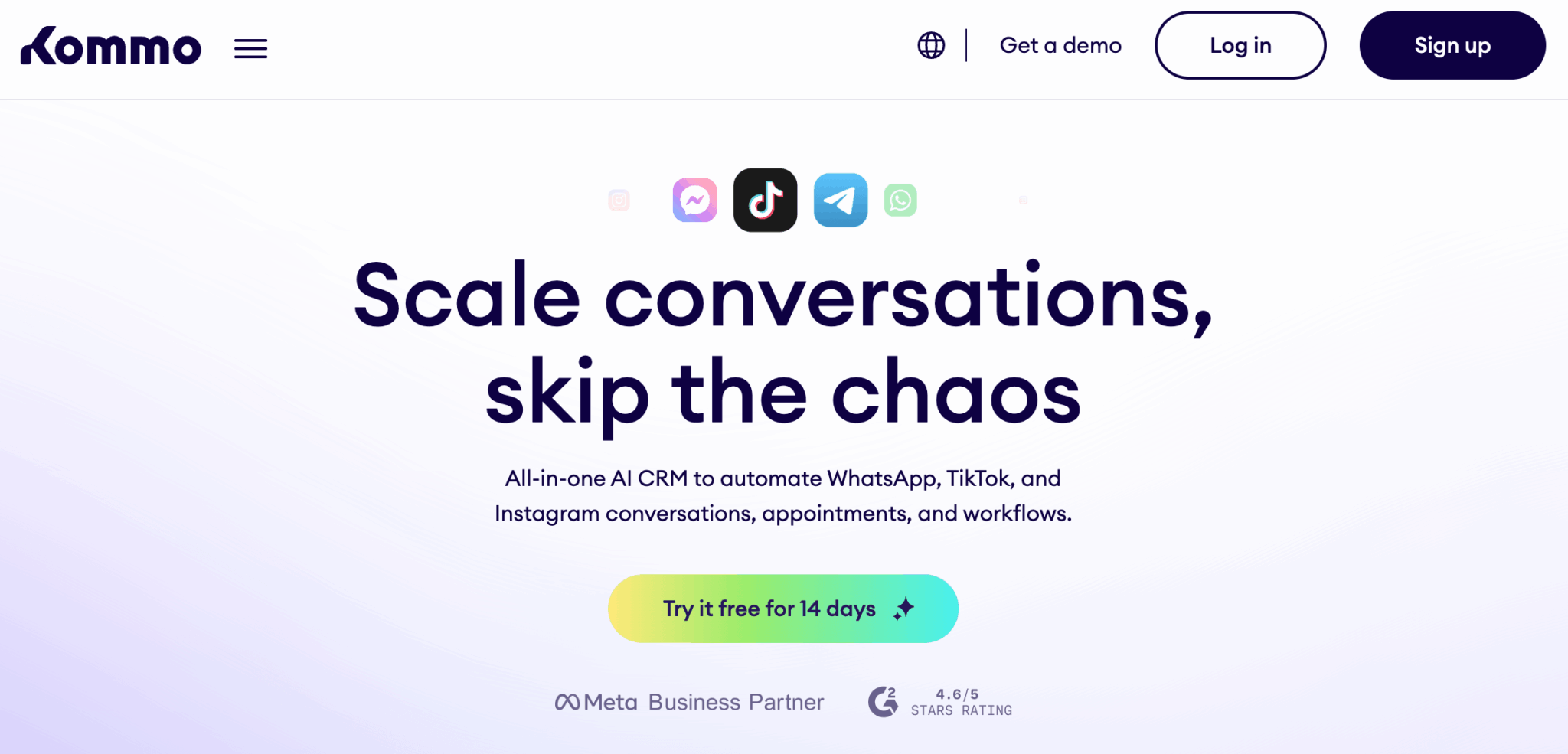
As for its positioning, it’s very clear: Kommo bills itself as the first messaging-based CRM. T
All of this architecture is based on a simple observation. In much of the world, sales aren’t made via email or phone, but through private conversations. The customer messages on WhatsApp or reacts to an Instagram Story, then comes back to ask their real question three days later.
The customer case studies highlighted by the publisher are from Brazil and Costa Rica, two markets where WhatsApp is the default sales channel. This is no coincidence, and it says a lot about the tool’s natural target audience.
The product is organized around four key components:
- Centralize all customer conversations in a unified inbox, regardless of the channel: WhatsApp, Instagram, TikTok, Messenger, Telegram, or email.
- Organize your follow-up process using a visual pipeline where each conversation becomes a task to be moved forward.
- Automate lead qualification and responses with Salesbot, the no-code bot builder, supplemented by AI agents.
- Connect the rest of your stack through a marketplace with over 100 integrations and a network of 5,000 partners.
One detail that matters for the reliability of the main channel: Kommo is an official Meta partner, which guarantees direct access to the WhatsApp Business API, without any additional intermediaries.

The Unified Inbox: Where Kommo Outperforms the Competition
That’s the best reason to switch to Kommo.
All your conversations are centralized in one place, each linked to a customer profile and a pipeline stage. Your sales reps no longer have to juggle six different apps and a personal phone where no one knows what was said. The complete history of the relationship, across all channels, is visible on a single screen.
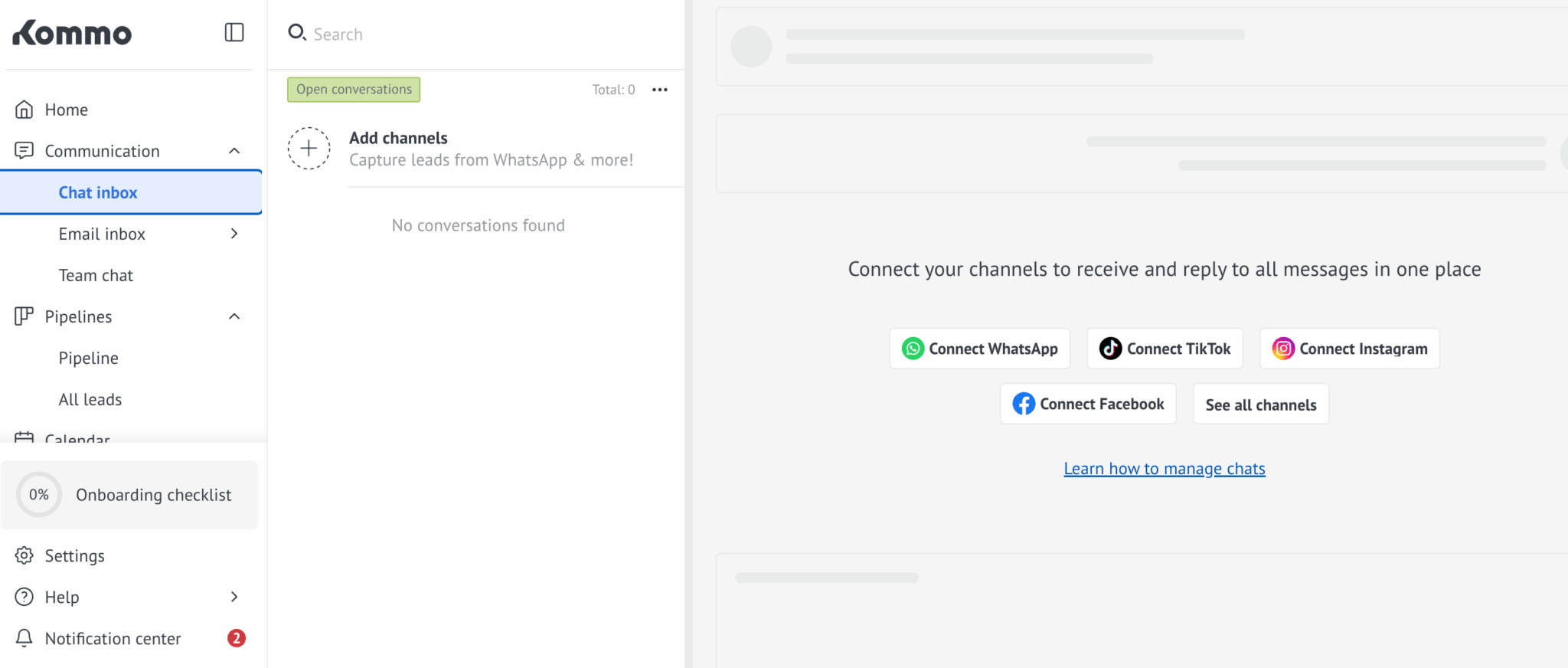
In practice, two things stood out to us:
- First, the conversation and the deal are one and the same: replying to a message and moving the deal forward in the pipeline both take place in the same view, without having to navigate away.
- Second, automatic routing works well, even when the same customer contacts you through multiple channels.

The downside of this deep integration is dependency. The channels belong to Meta, not Kommo. Users report that Meta sometimes treats the Messenger connection as a bot, which triggers stricter conversational rules and can interrupt the integration in the middle of a campaign. No traditional CRM poses this type of operational risk. This one does, by design.
Salesbot and AI Agents: Automation Without a Developer
Salesbot is another major strength of the product. The builder lets you create complete conversational flows without writing a single line of code: qualifying leads, answering frequently asked questions, scheduling appointments, and following up on unanswered conversations.
The level of achievement is real. We build a functional qualification bot in one hour, with branching based on responses and a handoff to a human at the right moment.


AI agents round out the system, from conversation summaries to automatic lead qualification. The billing mechanism warrants careful review. Credits are allocated per seat and renewed monthly; unused credits do not roll over. On lower-tier plans, your credit balance will deplete quickly if you enable AI for all conversations.


Start with a single bot for your most repetitive use case, then measure the results before expanding. The classic pitfall with Salesbot is automating conversations too quickly that would be better handled by a human. Your customers can spot a poorly configured bot within two messages, and on WhatsApp, the impact on the relationship is immediate.
The rest of the CRM: decent, but nothing special
Once you exit the messaging feature, Kommo reverts to a standard CRM. The visual pipeline is effective and can be understood in thirty seconds—which is important when training a team of beginners. The native mobile app is actually available on both app stores, complete with a business card scanner—whereas many newer CRMs simply offer a website optimized for small screens. Our comparison of mobile CRM software details how the others stack up in this area.

But the customization options are quickly limited. Kommo’s pipeline model works as long as your process fits within it. As soon as you step outside of it, you run into problems. The tool doesn’t adapt well to sales cycles lasting several months, which pretty much describes the typical French B2B landscape.
Three limitations round out the picture:
- Lead limits are set per seat: 2,500 for the Base plan, 5,000 for Advanced, and 10,000 for Pro. That may seem like plenty, but an acquisition team can use up the 2,500 leads in the Base plan in just a few weeks.
- The API documentation is incomplete, contains errors, and lacks clarity regarding channel registration. Set aside development time for your custom connections.
- Reporting remains basic. For effective sales management, we’ll need to export.

Key fact: In France, the channel costs more than the software
This is the post that Kommo’s pricing page cannot display, because it doesn’t belong to it.
The WhatsApp Business API is billed by Meta, not by Kommo. Since July 2025, Meta has been billing for each template message actually delivered, based on the recipient’s country and the message category. And France is among the most expensive markets on the pricing scale: approximately $0.13 per marketing message, compared to about $0.012 to India—a tenfold difference.
Let’s break this down into concrete terms. A team of five people on the Basic plan pays €65 per month for their subscription. At 12 cents per marketing message, 550 outgoing messages per month are enough for your Meta bill to exceed your Kommo bill. A single follow-up campaign targeting your customer base will use up that quota in a single day.

Two caveats, because the reality is less stark than this calculation suggests:
- Open-ended responses sent within the 24-hour service window—the one that opens when a customer messages you—are free.
- Transactional messages—such as appointment confirmations or delivery notifications—cost significantly less than marketing messages.
In other words, costs skyrocket for cold calling but remain manageable for inbound calls. This is exactly the opposite of what sales pitches about WhatsApp prospecting promise.
One final point to keep in mind: Meta revises its pricing structure regularly, and two price changes have already been announced for August and October 2026. This means you’re basing your budget on a rate that’s beyond your control.
Kommo’s Offers and Rates
Here is the complete pricing table, in euros per user per month.
| Formula | 6 months | 9 months | 1 year | 2 years | Leads per user |
|---|---|---|---|---|---|
| Base | 13 € | 12 € | €11 | 10 € | 2 500 |
| Advanced | 22 € | 19 € | 18 € | €16 | 5 000 |
| Pro | 39 € | 35 € | 33 € | 30 € | 10 000 |
| Enterprise | By quote | Beyond standard limits | |||
Kommo does not offer a monthly plan. The minimum subscription period is six months, paid in advance. The sign-up fee is therefore not €13 per month; it’s a one-time payment: €78 per user for the Base plan and €234 for the Pro plan. A team of five on the Pro plan pays €1,170 before sending their first message, and €3,600 if they commit to a two-year term to get the best discount.
The savings achieved by extending the commitment period are around 23% for terms ranging from six months to two years. That’s fair enough, but nothing more, considering the locked-in period is four times as long.
The cost is still modest compared to HubSpot or Salesforce. The real issue is that it’s irreversible: you’re committing to six months with a tool you’ve only known for a 14-day trial, with support that doesn’t speak French.
. Kommo phrases it in two ways that don’t mean the same thing. The dedicated page states that subscriptions are non-refundable. The billing FAQs, however, mention a refund for unused time. On forums, several users report having difficulty getting their money back after canceling. Before paying, ask the sales department in writing for the exact terms applicable to your contract, and keep a record of their response.
What we like (and don’t like)
- The best messaging-based sales management solution on the market at this price: unified inbox, automatic linking to customer profiles, conversations, and the sales pipeline—all in a single view.
- Salesbot, a truly sophisticated no-code builder: a fully functional lead-qualification bot can be set up in an hour, without a developer.
- Get started right away: a crystal-clear visual pipeline and a native mobile app with business card scanning. Even a team of beginners can be up and running in just a few days.
- A robust ecosystem: over 100 integrations, thousands of partners, and official Meta partner status for direct access to the WhatsApp API.
- A very low introductory price, starting at €13 per user, with a full 14-day trial that requires no credit card.
- No monthly plans: a minimum six-month prepaid term, with a refund policy that is described inconsistently across different pages.
- Customer support is the top complaint from users: standardized responses, disjointed ticket tracking, and no support in French—something the developer itself mentions on the official page for its Shopify app.
- A hidden channel cost on the pricing page: In France, Meta’s billing costs exceed the subscription fee once a team of five on Base sends 550 marketing messages per month.
- A structural dependency on Meta’s rules, with users reporting integration issues.
- Security transparency is severely lacking: the dedicated page mentions an SSL certificate and backups, but provides no certification, no information on server locations, and no accessible data processing agreement. It would be difficult to get this proposal approved by an IT department.
- Customization reaches its limit as soon as the process deviates from the planned model, particularly in the case of long sales cycles.
Our verdict: Who is Kommo designed for?
Kommo is for you if:
- Most of your business conversations take place on WhatsApp, Instagram, or Messenger
- Are you in an industry where sales are conducted via private messages: real estate, e-commerce, training, coaching, agencies?
- Your usage is primarily for incoming messages, where the 24-hour window makes replies free
- Your team has never used a CRM and needs a tool they can learn in a day
- Your sales cycle is short, ranging from a few exchanges to a few weeks
Skip it if :
- Your customers don’t message you: you’d have to pay six months in advance for a standard CRM (Pipedrive or HubSpot are better options, with no commitment)
- You’re doing cold outreach on WhatsApp from France: Meta’s new policy will make the platform unpredictable
- Your sales cycle spans several months and involves a specific process
- You must have the supplier approved by a demanding IT department or DPO
- If you’re looking for support in French, check out French CRM platforms like Axonaut or Sellsy. And if your main need is for chat-based support, check out Crisp
Final rating: 3.8/5. Kommo is the best messaging-based sales CRM for small teams, and just any old CRM for everyone else. If your customers are active on WhatsApp, it’s definitely worth a try: the unified inbox and Salesbot are unmatched at this price point. Otherwise, the six-month prepaid commitment, the cost of the channel in France, and the lack of French-language support tip the scales toward more traditional alternatives. The trial is easy to set up, and it costs nothing.
Take advantage of the 14-day trial to connect your real WhatsApp Business number and run your actual conversations—not a set of test data. If, after two weeks, your sales reps are opening Kommo on their own in the morning, sign up. If they’re still responding from their personal phones, don’t pay for six months just hoping that will change.