


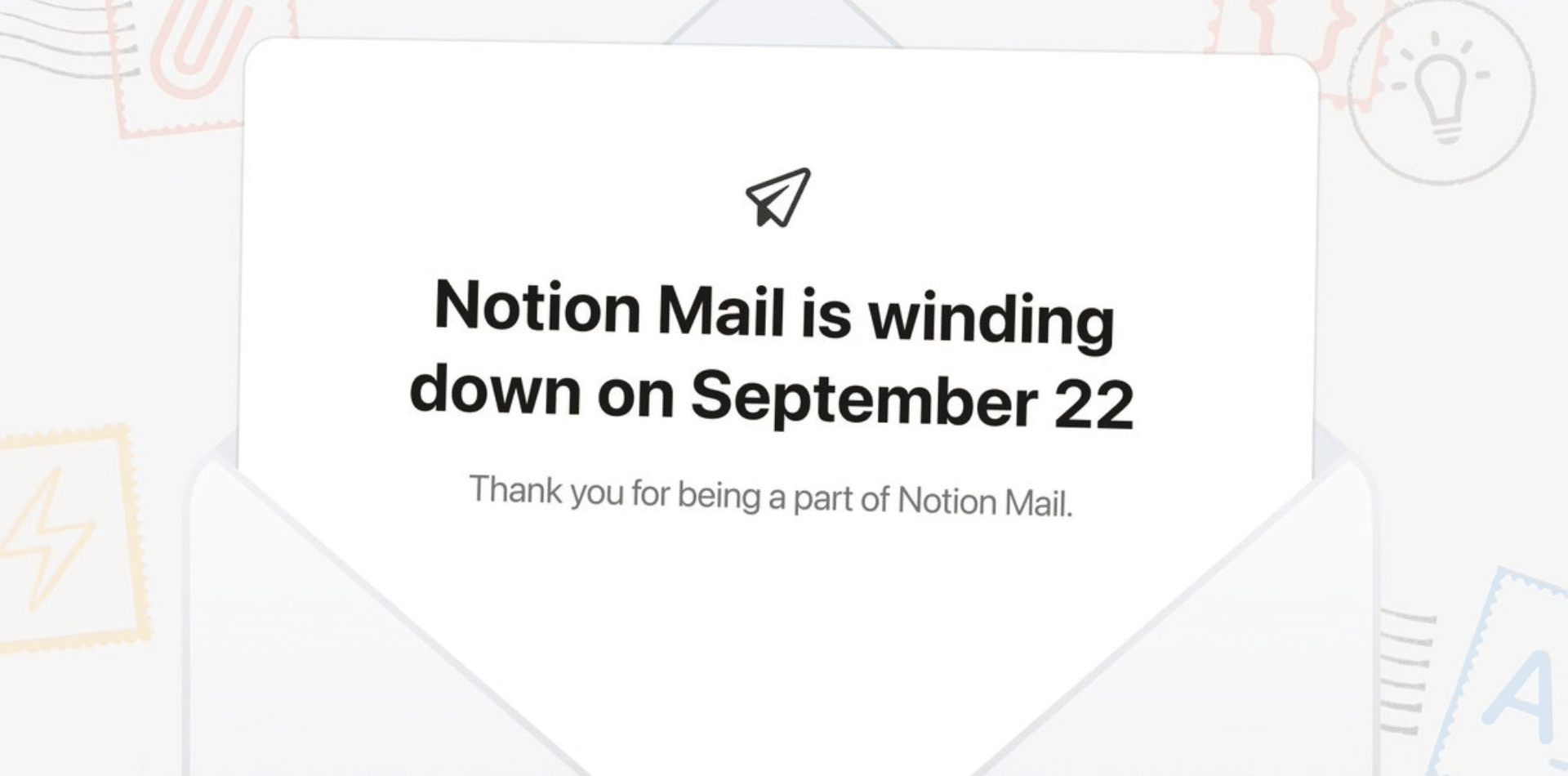
- Notion turns off Notion Mail on September 22, 2026, across all three versions, about fourteen months after its arrival.
- The official reason: more than half of users were already managing their emails without opening their inbox, through Notion’s AI agents.
- Your emails stay in Gmail. Drafts, scheduled emails and snippets must be exported before September 21, otherwise they disappear.
- Notion AI’s Gmail connector keeps running: agents will still read and send emails.
- For a sales organization, the real issue is not Notion. It is the idea of email driven by agents rather than by people.
Notion is ending Notion Mail on September 22, 2026, on web, desktop and iOS. Barely fourteen months after launch. And the reason is surprising: more than one user in two no longer even opened their inbox. AI agents did it for them. Behind this shutdown lies a question that directly concerns sales and marketing leaders: what if email were no longer really made for humans?
A quick shutdown, fourteen months after launch
Notion dropped the news on June 25 on X, from the Notion Mail account. All three versions, web, desktop app and iOS, stop on September 22. It was a short ride. It all started in February 2024 with the acquisition of Skiff, an encrypted email service. A year of integration work, then the launch on April 15, 2025: a client plugged into Gmail, with automatic AI labeling, filtered views and assisted writing. Less than eighteen months later, curtain. In the end, buying Skiff mostly served to strengthen Notion’s AI skills, not to build a real alternative to Gmail or Outlook.
Why Notion is giving up: the inbox is becoming invisible
One figure sums it all up. More than half of Notion Mail users managed their emails without ever opening their inbox. AI agents read the mail, filtered out spam and drafted replies, directly through the Gmail connection, without anyone having to step in. So keeping a separate email client no longer made much sense for Notion. The company would rather bet on the infrastructure that helps agents read, understand and process conversations than on an interface made for humans. It already claims more than a million agents created on its developer platform, launched in May.
What changes for your data before September 22
First, the good news: your emails stay put. Notion Mail ran as an interface synced with Gmail, so your entire received and sent history remains in your Google inbox. Only items specific to Notion Mail require action on your part. Anything not exported before September 22 goes to the trash for good.
| Item | What happens to it | Action to take |
|---|---|---|
| Received and sent emails | Kept in Gmail | Nothing to do |
| Drafts | Not migrated automatically | Copy them into Gmail before September 21 |
| Scheduled emails | Deleted at shutdown | Reschedule them in Gmail |
| Snippets (reply templates) | Exportable | Export them to reuse elsewhere |
| Snippet attachments | Not exported with the rest | Download them manually from the settings |
| Automatic labeling rules | Reusable | Save them for an agent connected to Gmail |
Notion provides a migration guide, available from the app or the web. If your company is subject to compliance constraints, better to plan ahead and not play with the deadline.
Email as a channel for agents, no longer for humans
The Notion case goes beyond the software. It tells of a deep shift in productivity tools. A growing number of vendors now see email as a channel used by agents, no longer by people. Startups are already building inboxes designed for AI. Salesforce is gradually turning Slack into an AI-driven environment. Asana is betting on autonomous workflows. Google and Microsoft are adding assistants everywhere that handle work communication for you. And Spark Email wasted no time: as soon as the news broke, the client published a welcome message to pick up disappointed Notion Mail users, pointing out its compatibility with Gmail, Outlook and iCloud.
What sales and marketing leaders should take from it
Email remains the backbone of B2B prospecting. So seeing a player like Notion go all in on agents is worth a look, even if you have never touched Notion Mail. Several readings emerge for a French-speaking sales organization.
- Your email sequences will have to reckon with non-human recipients: If a growing share of inboxes is filtered by agents, your prospecting emails will first go under the eye of an AI that sorts. The emotional hook will carry less weight. What will count: a clear subject line, a relevant message and good sender reputation signals. Your sequence templates would benefit from being tested against this automatic sorting, where until now you only looked at the human reaction.
- Your customer data passes into the hands of third-party agents: When an agent reads, writes and sends on your behalf, it handles the content of your sales conversations. For a French-speaking company, the question of data processing and GDPR compliance comes up right away. Where does the content go? Which model reads it? On which server? Before handing your prospecting over to an agent, ask the vendor these questions clearly, especially in regulated sectors such as finance, healthcare or the public sector.
- The right reflex: audit your stack before following the trend: The noise around AI agents will grow between now and the back-to-work season, right when many companies are settling their tool budgets. Before swapping an email client or a sequencer for the promise of an autonomous agent, look at what your teams actually use. A brand-new product can disappear in fourteen months, Notion Mail just proved it. A tool well embedded in your processes, with data you keep under control, is worth more than a shiny but fragile novelty.
In short
Notion is not closing Notion Mail out of failure, but out of conviction: tomorrow, the inbox will matter less than the intelligence that processes it. The bet is bold and remains to be confirmed. For your sales teams, the message fits in one sentence: email is not disappearing, its interface is changing hands. Might as well get ready while the market is still finding its bearings.
The questions we get over and over.
When does Notion Mail shut down?
Notion Mail stops on September 22, 2026, across all three versions: web, desktop app and iOS. Notion announced it on June 25 on X, about fourteen months after the April 15, 2025 launch.
Why is Notion ending Notion Mail?
More than half of Notion Mail users managed their emails without ever opening their inbox: AI agents read the mail, filtered out spam and drafted replies through the Gmail connection. Notion would rather bet on the infrastructure that helps agents process conversations than on an interface made for humans.
What happens to emails sent and received with Notion Mail?
They stay put. Notion Mail ran as an interface synced with Gmail, so the entire history remains in the Google inbox. Only drafts, scheduled emails, snippets and their attachments required action.
Does Notion AI's Gmail connector keep working?
Yes. Notion AI's Gmail connector keeps running: agents will still read and send emails.
What does this shutdown change for email prospecting?
If a growing share of inboxes is filtered by agents, prospecting emails will first go under the eye of an AI that sorts. The emotional hook will carry less weight: what will count is a clear subject line, a relevant message and good sender reputation signals.



What the community says.