


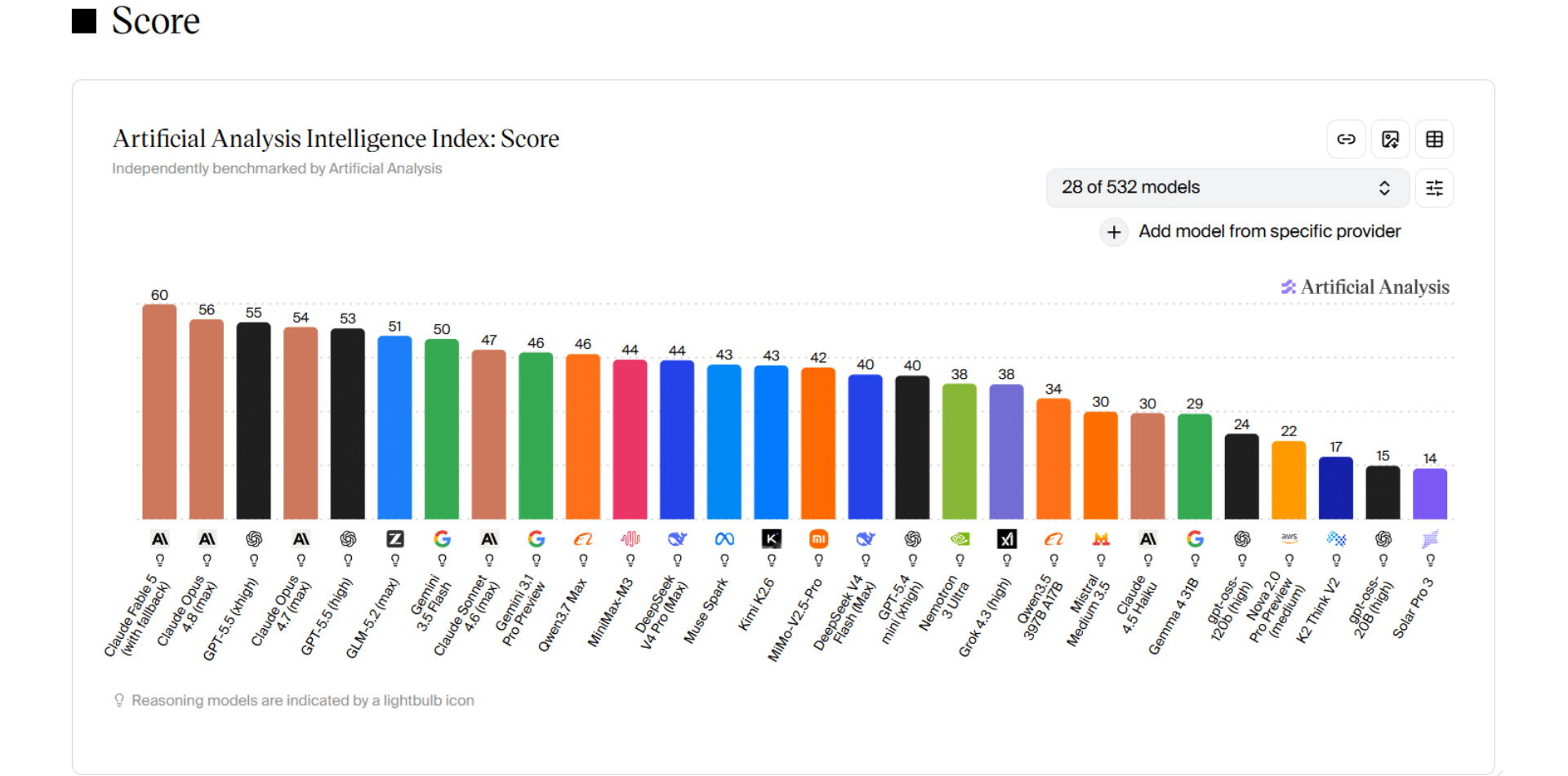
- GLM 5.2 scores 51 out of 100 on the Artificial Analysis Intelligence Index, the best score ever reached by an open-weight model, ahead of DeepSeek V4 Pro and Kimi K2.6.
- It sits just behind GPT-5.5 (55) and Claude Opus 4.8 (56), for about $1.4 input and $4.4 output per million tokens.
- A 744-billion-parameter mixture of experts architecture, a one-million-token context window, MIT license.
- A model you can download and host on premises, a sovereignty argument for French-speaking organizations.
- Its arrival follows Washington’s blocking of Anthropic’s Fable 5 and Mythos 5 models.
- The flip side: the race for token consumption, « tokenmaxxing », can send budgets off the rails.
zAI, the Beijing startup behind the GLM family, released GLM 5.2 in mid-June. The model is open, under an MIT license, and it ranks just behind GPT-5.5 and Claude Opus 4.8 on Artificial Analysis’s benchmark. All for a price ten times lower. If you track AI budgets in a French-speaking sales or marketing team, it’s worth a close look: a model of this level that you can download and host yourself changes quite a few things.
An open model hot on the heels of the American heavyweights
On the Artificial Analysis Intelligence Index, GLM 5.2 scores 51 points out of 100. Eleven more than GLM 5.1, and above all the best result ever posted by an open-weight model. It overtakes MiniMax M3 and DeepSeek V4 Pro (44 points each), Kimi K2.6 (43), and even Gemini 3.5 Flash (50). Above it, only GPT-5.5 (55) and Claude Opus 4.8 (56) remain. To give an idea of the gap, Anthropic’s Fable 5 topped out at 60 before it was pulled from the market.
zAI also claims second place worldwide on Code Arena’s front-end benchmark, behind only Fable 5, according to Yellow.com. Itamar Golan, head of Prompt Security, sums up the testers’ feeling well: it is the first open model that doesn’t clearly fall behind the best proprietary systems.
744 billion parameters and a one-million-token context
GLM 5.2 keeps the mixture of experts architecture of the previous version: 744 billion parameters in total, but only 40 billion activated per request. As a result, the compute bill stays contained, since the model never mobilizes its full weight for a single answer.
The real leap is the context window. It goes from 200,000 to one million tokens. Enough to swallow a full tender, months of CRM history or an entire document base in one go. zAI says it trained the model on real long contexts, not just stuck a number on the product sheet. An in-house technique called IndexShare cuts the indexing cost of these extended contexts by 75%.
The argument that makes the difference: price
This is where it gets interesting for leadership teams watching spend. zAI charges $1.4 per million input tokens and $4.4 per million output tokens. Anthropic asks $5 and $25 for Opus. That’s a gap of one to five, and even more on output.
Wade Foster, CEO of Zapier, ran the model on his own benchmark, AutomationBench. His verdict: GLM 5.2 matches the best score of Opus 4.7 max, for $0.67 per task versus $1.80. Less than half the price.
| Model | Input price ($ / million tokens) | Output price ($ / million tokens) |
|---|---|---|
| GLM 5.2 (zAI) | 1.4 | 4.4 |
| Claude Opus 4.8 (Anthropic) | 5 | 25 |
One caveat though: GLM 5.2 reasons more, so it uses more tokens. Artificial Analysis records 43,000 tokens per task on average, versus 26,000 for version 5.1. The per-token saving remains large, but volume goes up, and that’s what you need to keep an eye on.
What does GLM 5.2 change for sales and marketing teams?
A model of this level at this price lowers the barrier to entry for all everyday sales use cases: enriching prospect records, qualifying leads, writing prospecting sequences, summarizing calls, scoring opportunities. All these repetitive tasks that used to run on a premium model can move to GLM 5.2 without driving up the bill.
Open-weight status adds the argument that IT managers and CIOs in the French-speaking market were waiting for: hosting the model on premises, in France, Belgium, Switzerland or Luxembourg, rather than sending customer data to a foreign cloud. Keep in mind: going through the Chinese API exposes you to China’s intelligence law, which can require access to the data passing through. Local hosting removes that risk, but it comes at a cost.
In FP8, the model weighs nearly 900 GB and requires at least eight Nvidia H100 GPUs. Count on around $400,000 to buy, or $20,000 a month to rent, according to Itamar Golan. Versions compressed by Unsloth fit on a large workstation, provided you accept a loss of quality.
The context: the blocking of Fable 5 and Mythos 5
GLM 5.2’s arrival is no accident. On June 12, the US Department of Commerce ordered Anthropic to cut foreign access to its Fable 5 and Mythos 5 models within 48 hours, on security grounds. Both models were disabled worldwide, for all customers. zAI released its open model the next day.
The move revives the race between Chinese and American labs. Stanford’s AI Index 2026 puts the gap between the two countries’ best systems at 2.7 percentage points, even if the American lead remains clearer on the hardest reasoning tasks. zAI’s founder, Tang Jie, also publicly contradicted Elon Musk, who expected a Chinese rival to Fable 5 only in early 2027.
The flip side: watch out for tokenmaxxing
A cheaper model doesn’t exempt you from managing costs. A trend is rising in large groups: « tokenmaxxing », which consists of judging employees on their token consumption to push AI adoption. Amazon, JPMorgan, Meta and Disney have reportedly set up internal rankings of this kind. One Disney employee reportedly interacted 460,000 times with Claude in nine days, Business Insider reports.
The problem, well summarized by Logan Wolfe of Kyndryl: token consumption says nothing about real productivity. You reward volume, not results, and the bill climbs while quality stagnates. The advice from the specialists interviewed by CIO fits in one sentence: track outcome metrics, such as code actually deployed or deals won, rather than the number of tokens burned. A model at $1.4 per million protects you from nothing if every task consumes ten times too much.
For French-speaking teams, GLM 5.2 is more than a curiosity from Beijing. It’s a real option for routine tasks, as long as you frame the use cases and keep a premium model on hand for the toughest files. The right reflex: test on your own cases, calculate the cost per task, and decide on the evidence.
The questions we get over and over.
What score does GLM 5.2 get against American models?
GLM 5.2 scores 51 out of 100 on the Artificial Analysis Intelligence Index, eleven more than GLM 5.1 and the best result for an open-weight model. Above it, only GPT-5.5 (55) and Claude Opus 4.8 (56) remain.
How much does GLM 5.2 cost compared to Claude Opus?
zAI charges $1.4 per million input tokens and $4.4 per million output tokens. Anthropic asks $5 and $25 for Opus. Watch the volume: GLM 5.2 uses 43,000 tokens per task on average according to Artificial Analysis, versus 26,000 for version 5.1.
Can you host GLM 5.2 yourself?
Yes, the model is open-weight and downloadable. In FP8, it weighs nearly 900 GB and requires at least eight Nvidia H100 GPUs, around $400,000 to buy or $20,000 a month to rent according to Itamar Golan. Versions compressed by Unsloth fit on a large workstation, with a loss of quality.
Which sales use cases can move to GLM 5.2?
The repetitive everyday tasks that used to run on a premium model: enriching prospect records, qualifying leads, writing prospecting sequences, summarizing calls, scoring opportunities.
What is tokenmaxxing?
It's the practice of judging employees on their token consumption to push AI adoption. Consumption says nothing about real productivity: specialists advise tracking outcome metrics, such as code actually deployed or deals won.


What the community says.