Top 10 Customer Success Tools

Comparison of 10 B2B customer success tools. Dedicated platforms: Gainsight, ChurnZero, Planhat, Vitally and Odie (formerly Totango, which merged with Catalyst), all on request except Odie, from $1,500 per month for the Customer Operating System with a one-year commitment. Adoption and metrics: Pendo (free up to 500 monthly active users) and Paddle's ProfitWell Metrics (free).

Maxime Ben Bouaziz
Maxime Ben Bouaziz
CEO Salesdorado, IA & Sales Tech
February 21, 2023, updated November 10, 2026, 1 min read
See all tools

A customer success tool brings together what the company knows about each customer account (product usage, tickets, NPS, contract end date) to track its health, spot churn risk before the deadline and prepare renewals and upsell. It mainly targets SaaS vendors and B2B companies that sell by subscription.

The need comes from scattered data. In a SaaS company with more than 200 employees, there is often one tool that handles NPS on its own, the ticketing software that handles CSAT, the CRM that handles renewal, Stripe that handles card renewal and dunning, and a marketing automation tool that sends sequences for all sorts of reasons. A report that aggregates all of this by hand has to be redone constantly; the CSM tool centralizes it under one account record.

The solutions we selected are aimed at more mature companies, with at least one person dedicated to account follow-up. To handle inbound requests first, customer support software is enough.
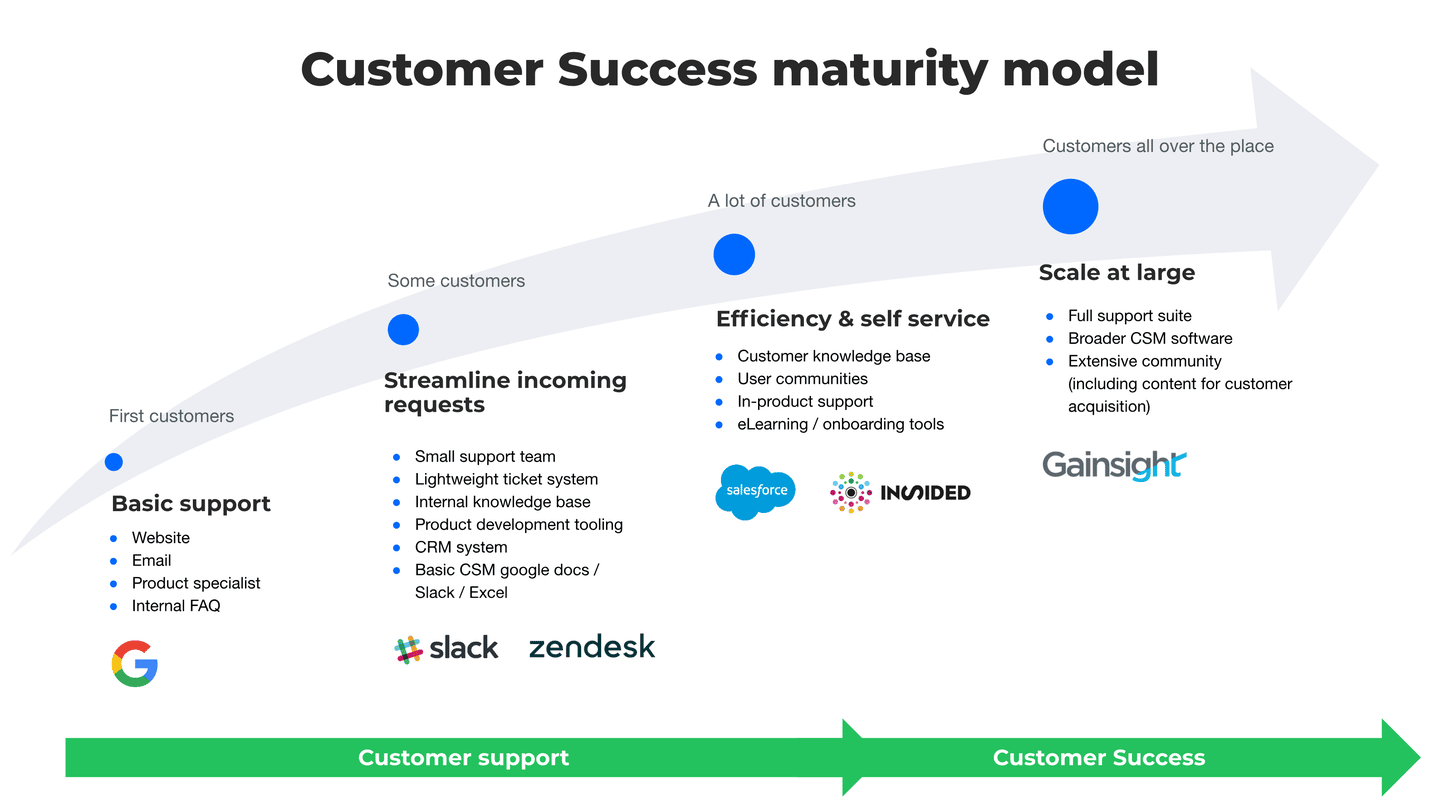
Customer success maturity model according to Insided: from basic support to customer success at scale

(Customer success maturity model published by inSided)

Depending on your need:

  • a complete platform for a large CSM team: Gainsight;
  • detect churn risk and act account by account: ChurnZero;
  • a single database for sales, renewals and customer success: Planhat;
  • a daily tool for the CSMs of a growing SaaS company: Vitally;
  • account follow-up partly handed to AI agents: Odie, formerly Totango;
  • measure and guide in-product adoption: Pendo, free up to 500 monthly active users;
  • track MRR and churn without paying: ProfitWell Metrics;
  • stay in the tools you already have: HubSpot (health scores from Service Hub Pro), Intercom for in-app messages, Zendesk for support signals.
The 10 tools, side by side

# Logos tool Score Price Best for
01 Gainsight 4.5/5 ★ On request Structured customer success departments, with several CSMs and renewals to forecast across hundreds of accounts Visit site
02 ChurnZero 4.4/5 ★ On request B2B SaaS vendors that want to spot at-risk accounts and act before the contract deadline Visit site
03 Zendesk 5.0/5 ★ €55 Teams already on Zendesk that want to make support the first source of signals on customer satisfaction Visit site
04 Planhat 4.2/5 ★ On request B2B companies that want a single database for sales, renewals and account follow-up Visit site
05 Pendo 4.1/5 ★ Free Software vendors that want to measure usage of their product and guide their users inside the app Visit site
06 HubSpot 4.5/5 ★ €20 Companies that already use the HubSpot CRM and want to track account health without adding a tool Visit site
07 ProfitWell Metrics (Paddle) 4.0/5 ★ Free Subscription businesses that want precise financial metrics on their customers Visit site
08 Intercom 4.5/5 ★ $29 Teams that want to communicate with their users inside the product: chat, chatbots, guided tours Visit site
09 Odie (ex-Totango) 4.3/5 ★ $1,500 Post-sales teams that want a daily analysis of every account and want to hand part of the follow-up to AI agents Visit site
10 Vitally 4.3/5 ★ On request Growing SaaS vendors that mix personalized follow-up of large accounts with automated follow-up of the long tail Visit site
01

Gainsight

4.5/5 From On request

Best for: Structured customer success departments, with several CSMs and renewals to forecast across hundreds of accounts

+ Strengths
  • Health scores, playbooks, surveys and success plans from the Essentials plan
  • A range that also covers product analytics, community and customer training
  • Unlimited readers to open account records to sales and product
− Downsides
  • No public price, quote after a demo
  • No free plan
  • Heavy setup for a small team
★ Gainsight in brief

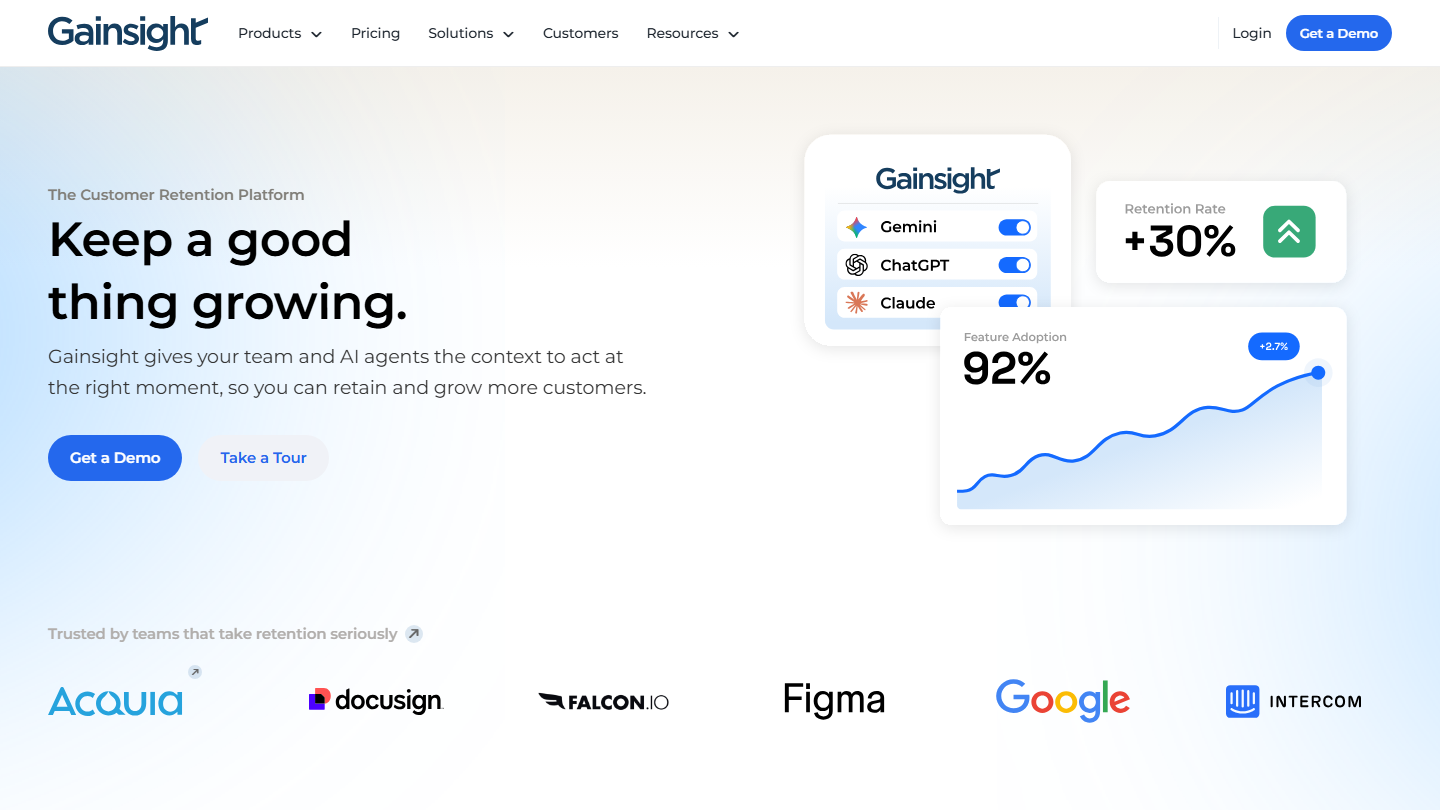
Gainsight homepage: “Keep a good thing growing.”, customer retention platform with feature adoption rate

Gainsight is the historical reference in customer success, and the vendor now presents itself as a customer retention platform. Its CS module gives a 360° view of each account: usage, satisfaction, contract, contacts, history of exchanges. Around it, through acquisitions over the years, Gainsight has added a product analytics tool with in-app guides (PX), a customer community and customer training with Skilljar.

Day to day, the CSM starts from their portfolio. Each account has its health score, its usage signals and its tasks; when a score drops, a playbook triggers the planned actions, from calling the customer to alerting the salesperson. Accounts that no CSM follows closely go through automated journeys (Digital Journeys).

Gainsight makes sense when customer success is a real department, with net retention targets and renewals to forecast quarter by quarter. Renewal and expansion forecasting, mapping of the customer’s organization and sponsor tracking are reserved for the Enterprise plan. For two or three CSMs, the rollout weighs more than the gain.

No price is published. Essentials includes 10 full users and 100 customers per user, Enterprise 20 users and 200 customers per user; both plans go through a pricing request.

02

ChurnZero

4.4/5 From On request

Best for: B2B SaaS vendors that want to spot at-risk accounts and act before the contract deadline

+ Strengths
  • AI assistant (Kit) that answers on any account and acts across the whole portfolio
  • Native integrations with CRMs: Salesforce, HubSpot, Dynamics 365, Pipedrive, NetSuite
  • Connection to product and support tools: Pendo, Mixpanel, Segment, Zendesk, Intercom
− Downsides
  • No public price, quote after a demo
  • Neither free trial nor free version
  • Site in English only
★ ChurnZero in brief

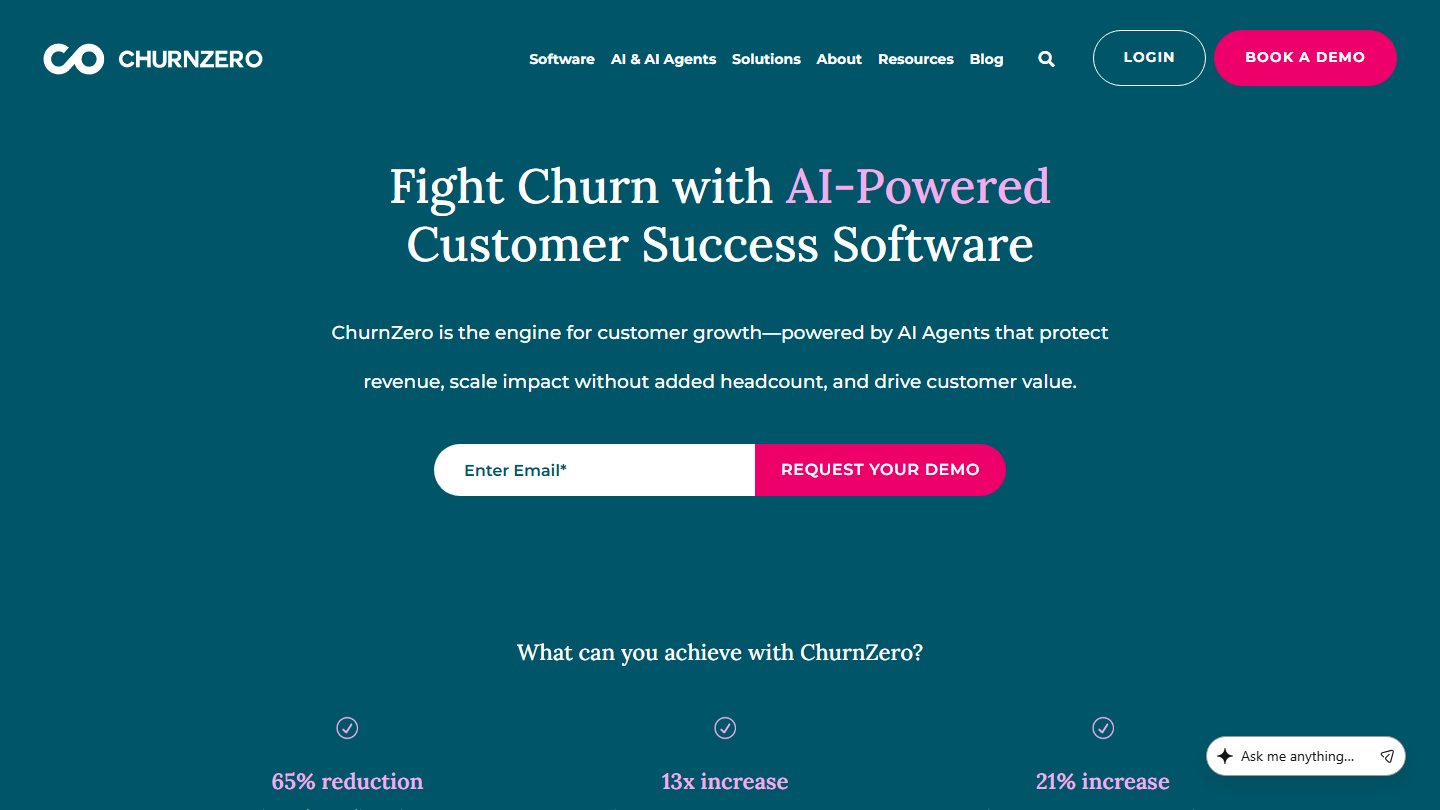
ChurnZero homepage: “Fight Churn with AI-Powered Customer Success Software”

ChurnZero carries its goal in its name: reducing customer attrition. The software gathers, for each account, product usage, exchanges, and CRM and billing data, calculates health scores and creates alerts and tasks when an account slips.

The current version bets on AI agents, each dedicated to one task: Harbinger flags a relationship risk early, Beacon detects buying intent, Baton and Liftoff organize the handover of an account from sales or implementation to CS, Retrospective writes the churn note when a customer leaves.

ChurnZero makes sense for a SaaS vendor that lives off renewals and whose CSMs each follow dozens of accounts. It needs clean usage data: without product tracking plugged in, health scores stay approximate.

The site publishes no pricing grid: the price is discussed after a demo.

03

Zendesk

5.0/5 From €55

Best for: Teams already on Zendesk that want to make support the first source of signals on customer satisfaction

+ Strengths
  • Ticket system with custom forms and fields
  • Chat, messaging, telephony and knowledge base in the Suite
  • AI agents included in all Suite plans
− Downsides
  • Per-agent cost that climbs fast with advanced features
  • Neither renewal tracking nor product usage data
  • No free plan
★ Zendesk in brief

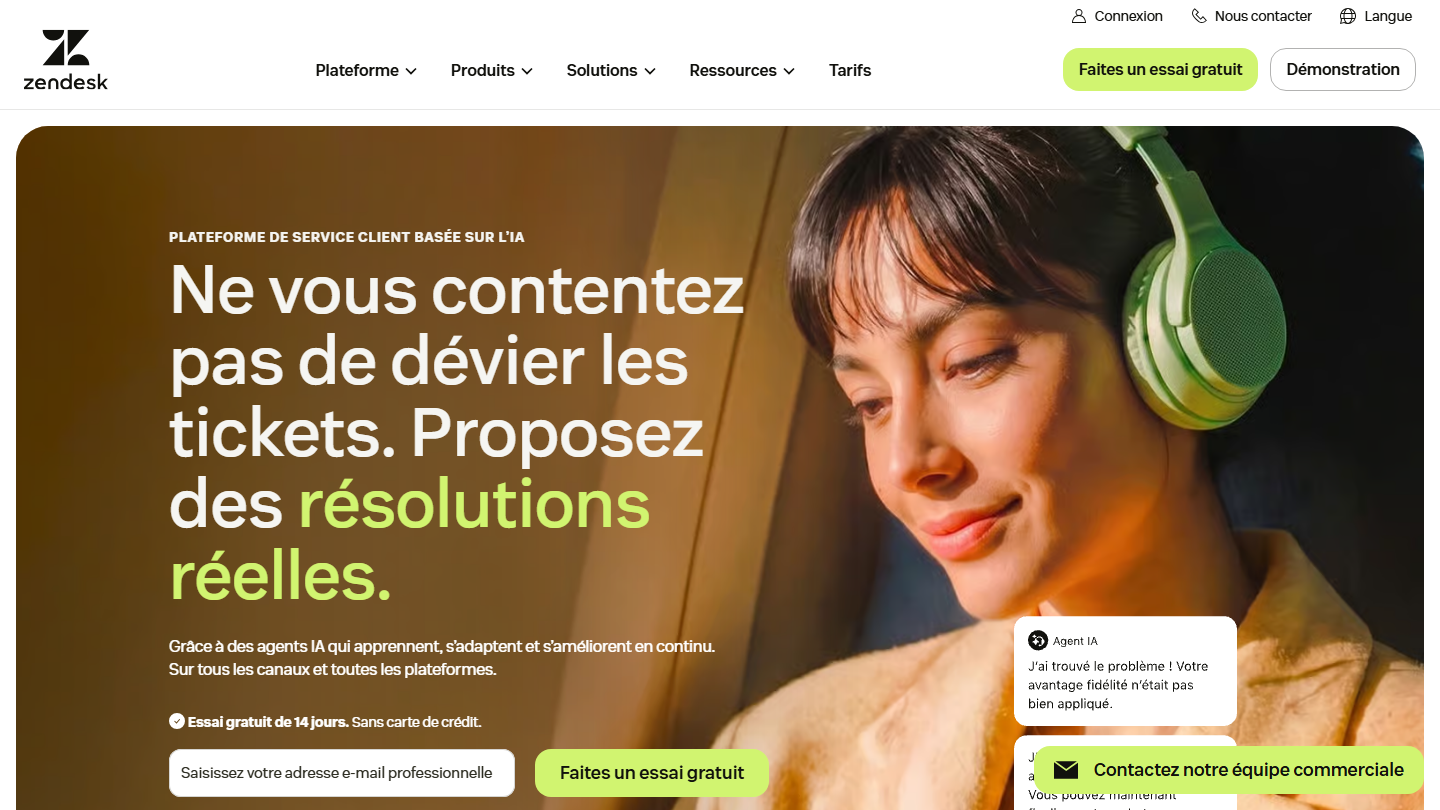
Zendesk homepage: “Don't just deflect tickets. Deliver real resolutions.”

The giant of ticketing software goes further and further into the customer’s life, but Zendesk remains first and foremost support software: every request becomes a ticket, whatever the channel, with its history and satisfaction rating.

It earns its place here because support sees before anyone else which customers are slipping: rising tickets, falling CSAT, the same questions coming back. ChurnZero, Planhat and Vitally read this data in Zendesk to feed their health scores.

Zendesk makes sense in this ranking for a team that already uses it and wants to start by exploiting what support knows about customers, before buying a dedicated platform.

Suite Team costs €55 per agent per month billed annually; Support Team, limited to email tickets, starts at €19. The trial lasts 14 days.

04

Planhat

4.2/5 From On request

Best for: B2B companies that want a single database for sales, renewals and account follow-up

+ Strengths
  • A single database: no sync to maintain between CRM and CS tool
  • Dashboards, automations and open API in every plan
  • Integrations with Salesforce, HubSpot, Pendo, Mixpanel, Segment, Snowflake, Zendesk and Intercom
− Downsides
  • Pricing on request only
  • Neither free plan nor displayed trial
  • Scope extended to CRM: more setup if you only want customer success
★ Planhat in brief

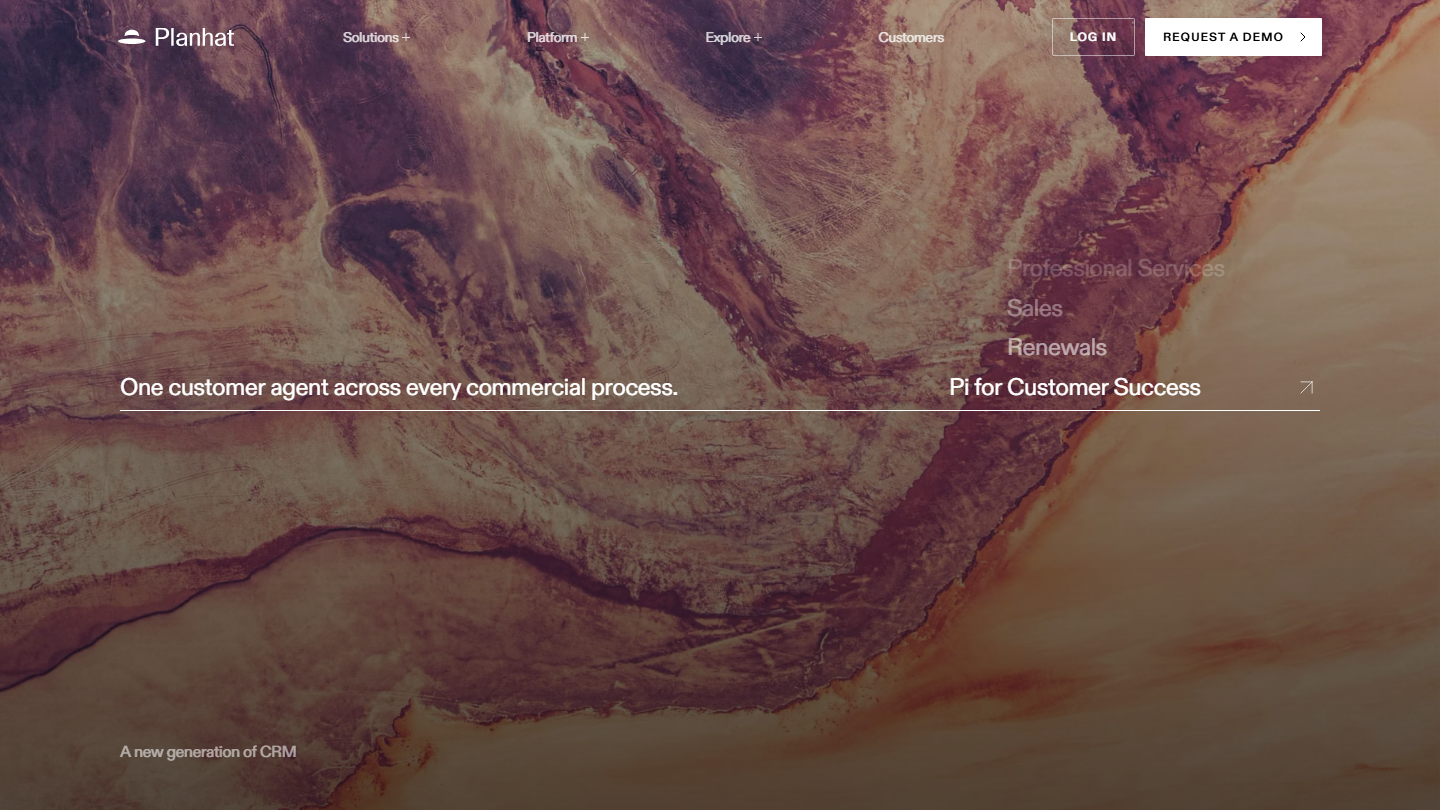
Planhat homepage: “One customer agent across every commercial process”, with Pi for Customer Success

Planhat started as a customer success platform. It now presents itself as « a new generation of CRM » and sells three modules on the same database: the sales CRM (pipeline, scoring, email sequences, forecasts), the customer success platform and professional services software.

The core remains the original one: collecting all of an account’s data, from the CRM to product usage, emails and support, and making it readable in dashboards and reports. The in-house AI agent, Pi, comes in versions by function, with one dedicated to customer success.

Planhat makes sense when sales, account management and CS keep passing the same accounts back and forth and syncing two tools becomes a project in itself. A team that keeps Salesforce or HubSpot as its CRM can also use it as a simple CS tool plugged into it.

Prices are requested through a form. Options (advanced AI, emailing, customer portals) and support (onboarding, technical deployment) are added to the quote.

05

Pendo

4.1/5 From Free

Best for: Software vendors that want to measure usage of their product and guide their users inside the app

+ Strengths
  • Free plan up to 500 monthly active users, analytics and in-app guides included
  • Retroactive analytics: history is available from installation
  • Priced on active users, not on the number of apps
  • Optional Predict module to forecast churn and prioritize upsell
− Downsides
  • Paid plans on request only
  • Free plan NPS in Pendo's colors
  • Neither account record nor CSM portfolio: a complement to a CS tool
★ Pendo in brief

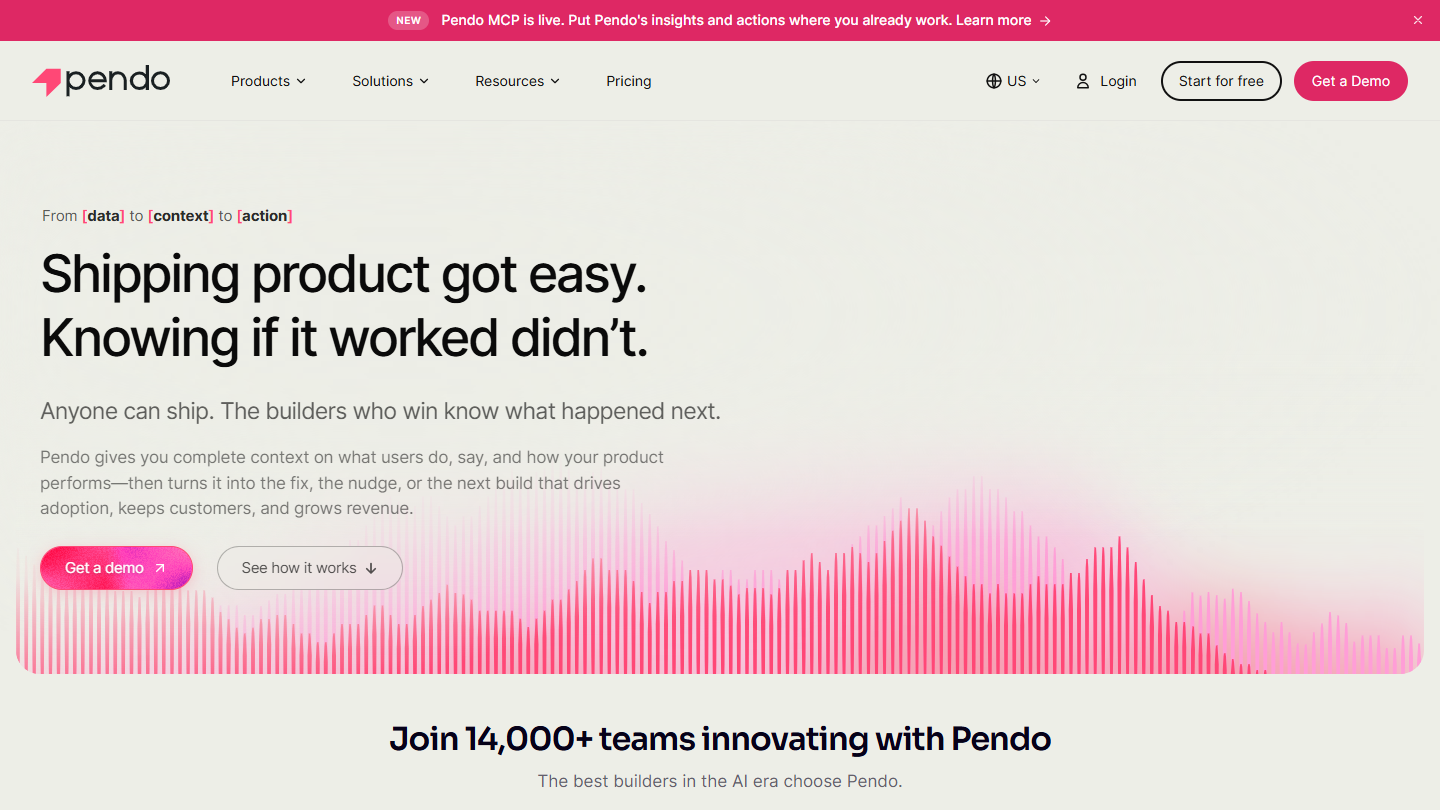
Pendo website: “Shipping product got easy. Knowing if it worked didn’t.”

Pendo is a product analytics tool: it measures what users do in an application, then lets you act in the interface with guides, tooltips and surveys.

For customer success, Pendo answers the question the CRM can’t see: is the customer actually using what they bought? Usage data flows up to CS platforms (ChurnZero, Planhat and Vitally connect to it) and feeds health scores. Guides serve onboarding and the launch of each new feature, without going through support.

Pendo makes sense for a SaaS vendor whose product team and CS team want the same adoption numbers. The free plan is enough to test on a small product.

Paid plans (Base, Core, Ultimate) are calculated on the number of monthly active users and the modules chosen: session replay arrives in Core, NPS surveys without the Pendo branding and journey orchestration in Ultimate, or as options before that.

06

HubSpot

4.5/5 From €20

Best for: Companies that already use the HubSpot CRM and want to track account health without adding a tool

+ Strengths
  • Configurable health scores and alerts when an account changes status
  • Sales, marketing and support data on the same customer record
  • Free plan to get started: tickets, routing and chat up to 2 users
− Downsides
  • Customer success workspace absent from the free and Starter plans
  • Long learning curve, users' first complaint
  • Hard to customize in depth
★ HubSpot in brief

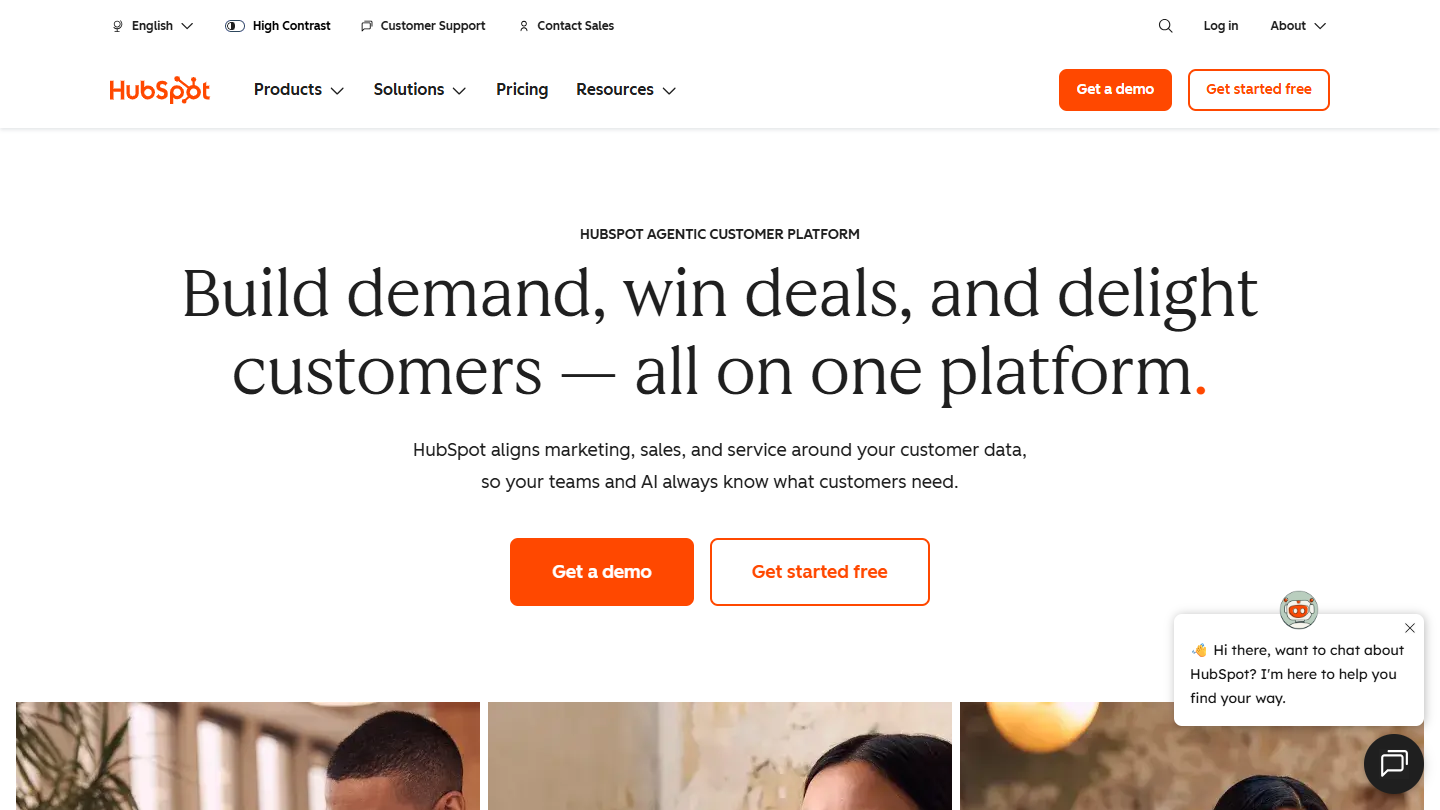
HubSpot website: “Build demand, win deals, and delight customers, all on one platform”

HubSpot is first a CRM and a marketing automation tool, but its Service Hub makes it a decent customer success tool for teams that already live in the suite. Customer messages arrive in a shared inbox, assigned to team members, and satisfaction surveys feed back onto the customer record.

From the Pro plan, the customer success workspace serves as the CSM’s dashboard: today’s tasks, views of their accounts, key account activity, and a ranking of customers as « at risk », « neutral » or « healthy ». The value is in the data: the record is kept up to date by the other hubs, with what was said during the sale and the tickets opened since.

For those hesitating to adopt a customer success platform, HubSpot CRM and Service Hub can be enough, if data flows well between tools. Beyond a few hundred accounts followed by several CSMs, a dedicated platform goes further on playbooks and renewal forecasting.

Service Hub is free up to 2 users, then costs €20 per seat per month on Starter. The customer success workspace starts with Pro, at €90 per seat per month; Enterprise goes to €175.

07

ProfitWell Metrics (Paddle)

4.0/5 From Free

Best for: Subscription businesses that want precise financial metrics on their customers

+ Strengths
  • Free
  • One-click connection to Stripe, Chargebee, Recurly or Paddle, history included
  • Health scores and signals to spot customers at risk or ready for an upsell
− Downsides
  • Interface not very intuitive for the least experienced users
  • No portfolio management or tasks for CSMs
  • Site in English only
★ ProfitWell Metrics (Paddle) in brief

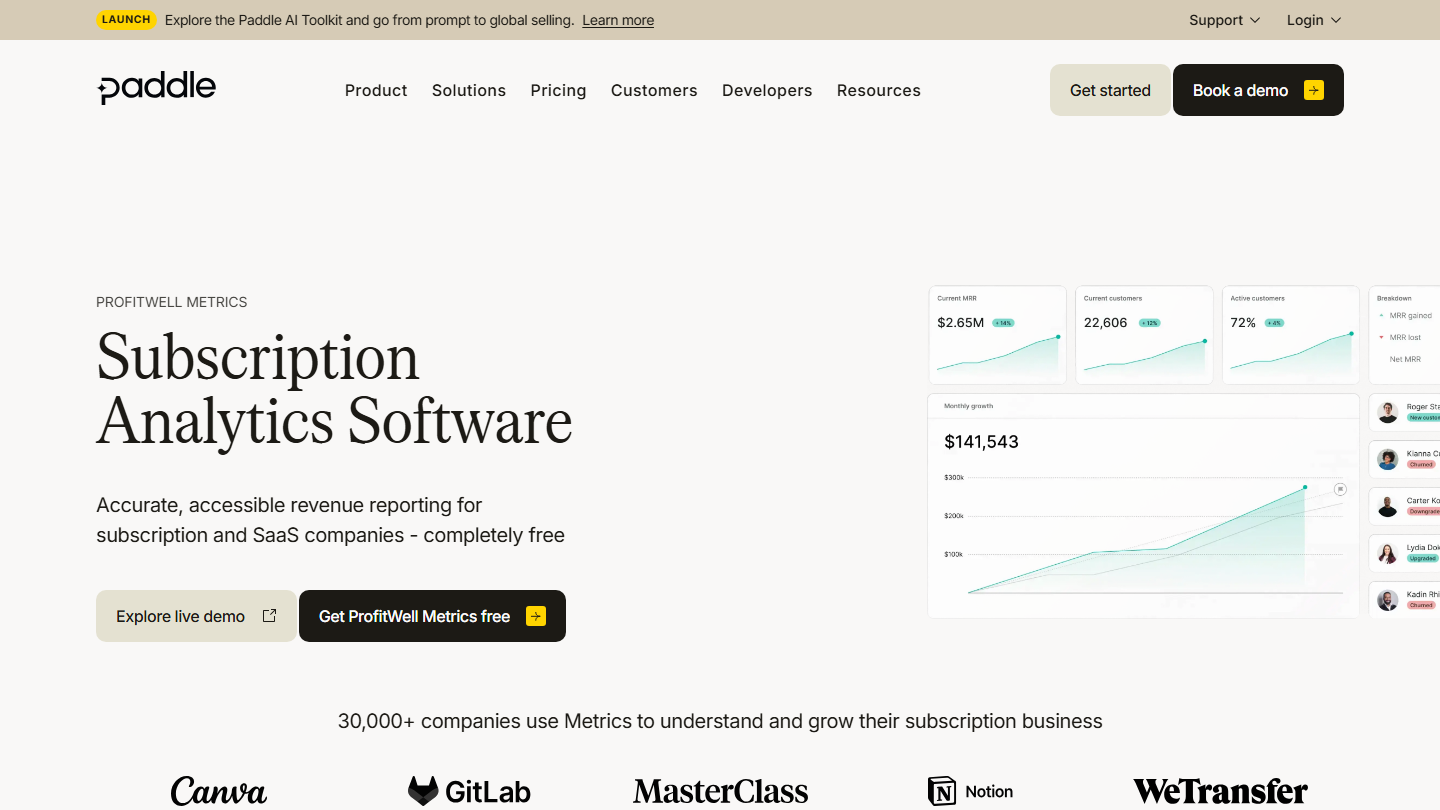
Paddle's ProfitWell Metrics page: “Subscription Analytics Software”, with a monthly recurring revenue dashboard

ProfitWell Metrics is ProfitWell’s subscription metrics tool, now part of Paddle. It reads data from the billing tool and calculates the indicators of a subscription business: monthly recurring revenue, churn, upgrades and downgrades, customer lifetime value, active customers, revenue per customer.

On the customer success side, it compares customer activity by plan and sends alerts on accounts at risk of leaving. Cohorts and segments by pricing plan show where churn is concentrated.

It is a starting point before buying a CS platform, or a complement that gives the CSM the account’s financial figures. Retain, ProfitWell’s anti-churn tool (failed payment recovery, cancellation flows), is now integrated into Paddle Billing, at no extra cost for its customers.

08

Intercom

4.5/5 From $29

Best for: Teams that want to communicate with their users inside the product: chat, chatbots, guided tours

+ Strengths
  • Messenger with chat, chatbots and the Fin AI agent, displayed in the product
  • Advanced user segmentation to target messages
  • Clear reporting, with many well-designed reports
− Downsides
  • Expensive tool overall, cost hard to predict between seats and AI resolutions
  • Steep learning curve
  • Guided tours, checklists and surveys as a paid add-on
★ Intercom in brief

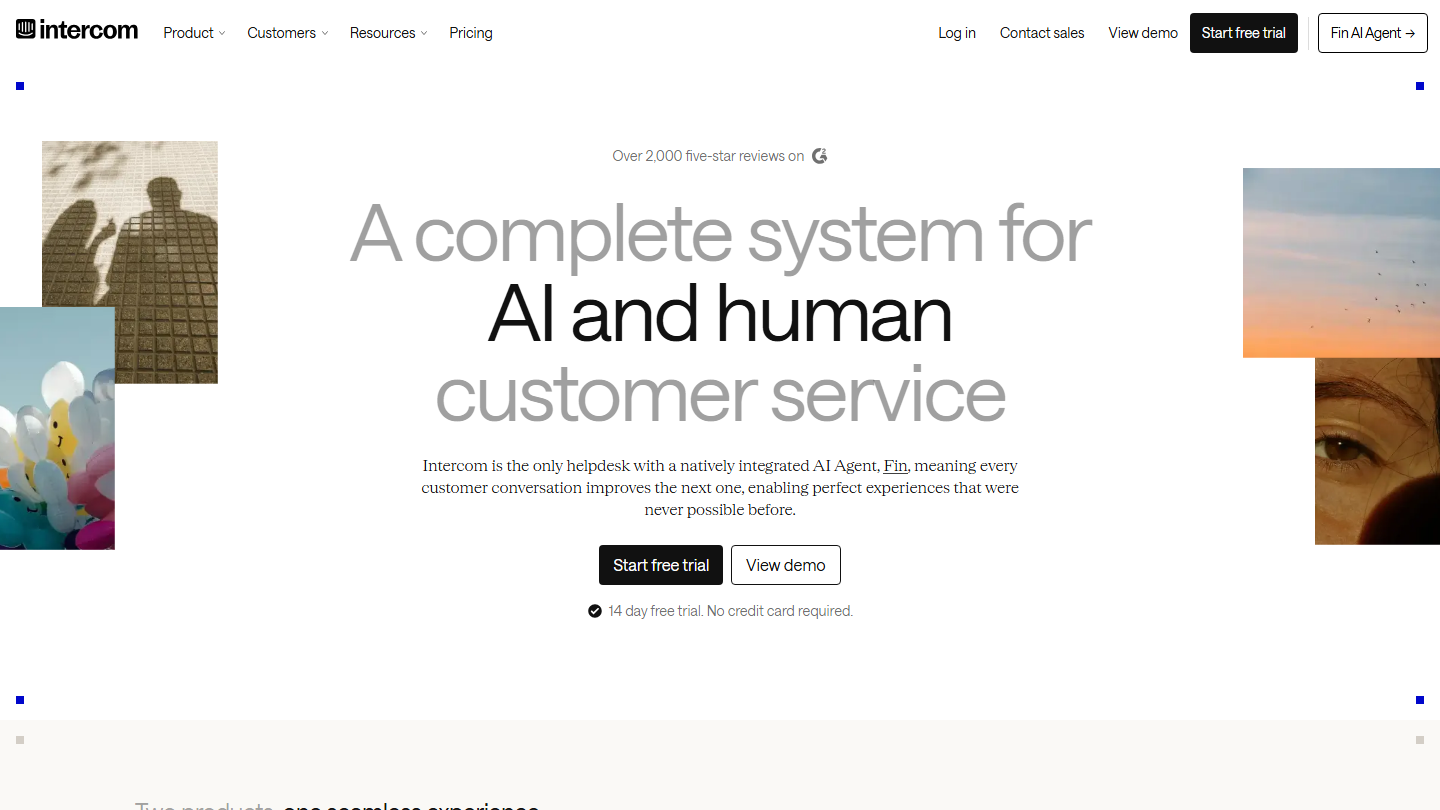
Intercom homepage: “A complete system for AI and human customer service”, 14-day free trial

Intercom is a customer messaging platform that lives in the product: the messenger appears in the app or on the site, and the Fin AI agent answers first before handing over to the team.

For customer success, Intercom is mostly used to talk to the right user at the right time: welcome message, guided tour of a feature on first use, onboarding checklist, survey after a few weeks. These formats go through the Proactive Support Plus add-on, from $99 per workspace per month.

Intercom doesn’t replace a CS platform: it is built around conversations, not an account portfolio. ChurnZero, Planhat and Vitally connect to it to bring these conversations onto the customer record.

The Essential plan costs $29 per seat per month billed annually, Advanced $85 and Expert $132. Fin is billed $0.99 per resolution, and the 14-day trial requires no credit card.

09

Odie (ex-Totango)

4.3/5 From $1,500

Best for: Post-sales teams that want a daily analysis of every account and want to hand part of the follow-up to AI agents

+ Strengths
  • AI evaluation of each account every day
  • Predictive models of non-renewal risk
  • Workflow and campaign engine included
  • MCP server to plug in the AI agents already used in the company
− Downsides
  • No monthly payment
  • Neither free plan nor trial
  • Recently renamed and rebuilt platform, little track record
★ Odie (ex-Totango) in brief

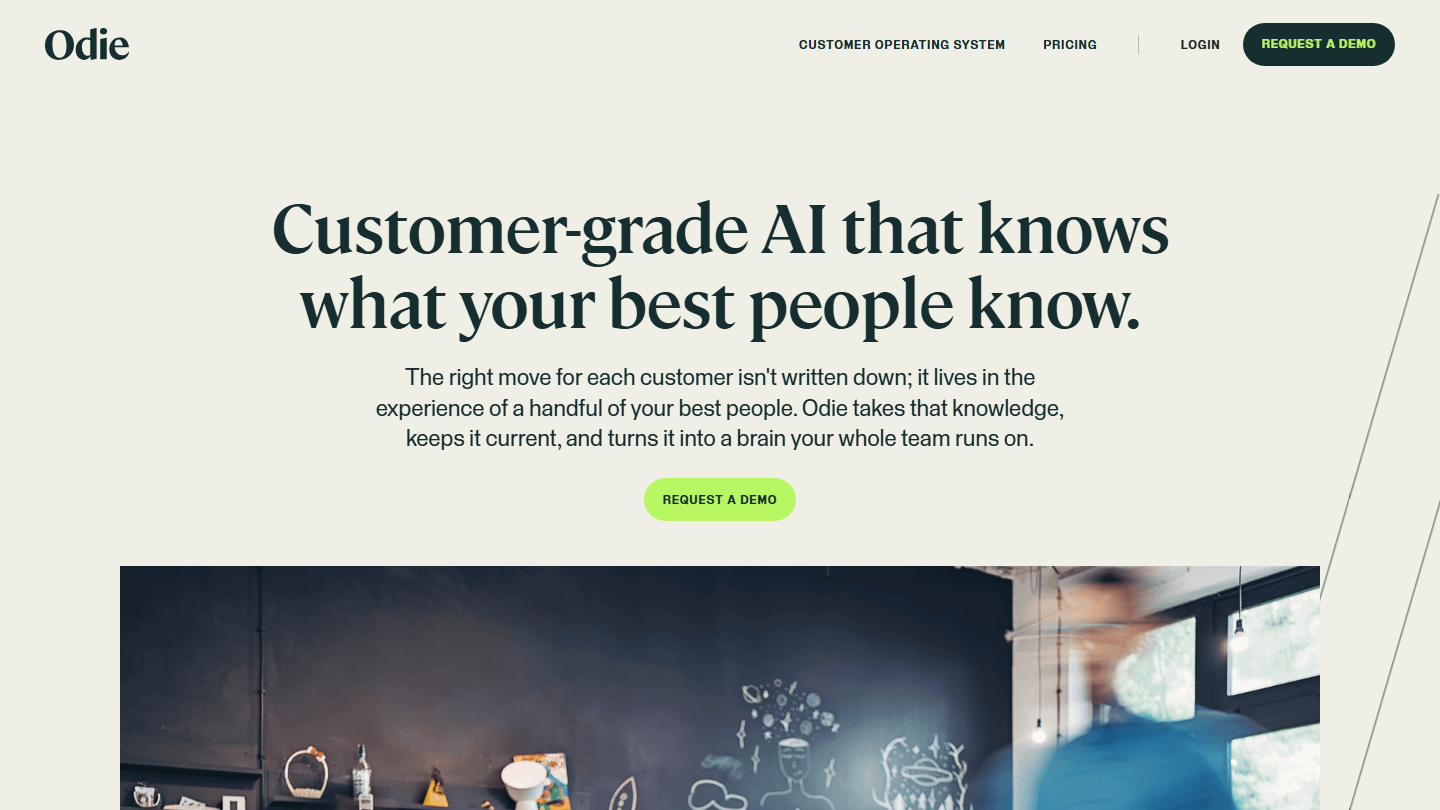
Odie homepage, formerly Totango: “Customer-grade AI that knows what your best people know.”

Totango, one of the pioneers of customer success, merged with Catalyst and then changed its name: the platform is now called Odie. Catalyst, which appeared in earlier versions of this ranking, is part of the same group.

Odie is sold in two building blocks. The Customer Knowledge Engine gathers customer data (CRM, usage, exchanges) and the teams’ knowledge in a base that the company’s AI agents can query. The Customer Operating System, presented as the alternative to classic CS platforms, adds on top a guided workspace for CSMs and their managers.

The product targets teams that want to hand part of the follow-up to AI, with a portfolio where many accounts have no assigned CSM. For classic health scores and playbooks, Gainsight, ChurnZero or Vitally are more direct.

Prices are shown as « starting at »: $500 per month for the Knowledge Engine alone, $1,500 per month for the Customer Operating System, depending on portfolio size and depth of analysis. Contracts start at one year, and most customers sign for two years.

10

Vitally

4.3/5 From On request

Best for: Growing SaaS vendors that mix personalized follow-up of large accounts with automated follow-up of the long tail

+ Strengths
  • Same features in all three plans, only the follow-up model changes
  • Unlimited automations, documents and readers, SSO included
  • Health scores, NPS, surveys, project management and note-taking in the same tool
− Downsides
  • Pricing on request only
  • No free plan
  • Site in English only
★ Vitally in brief

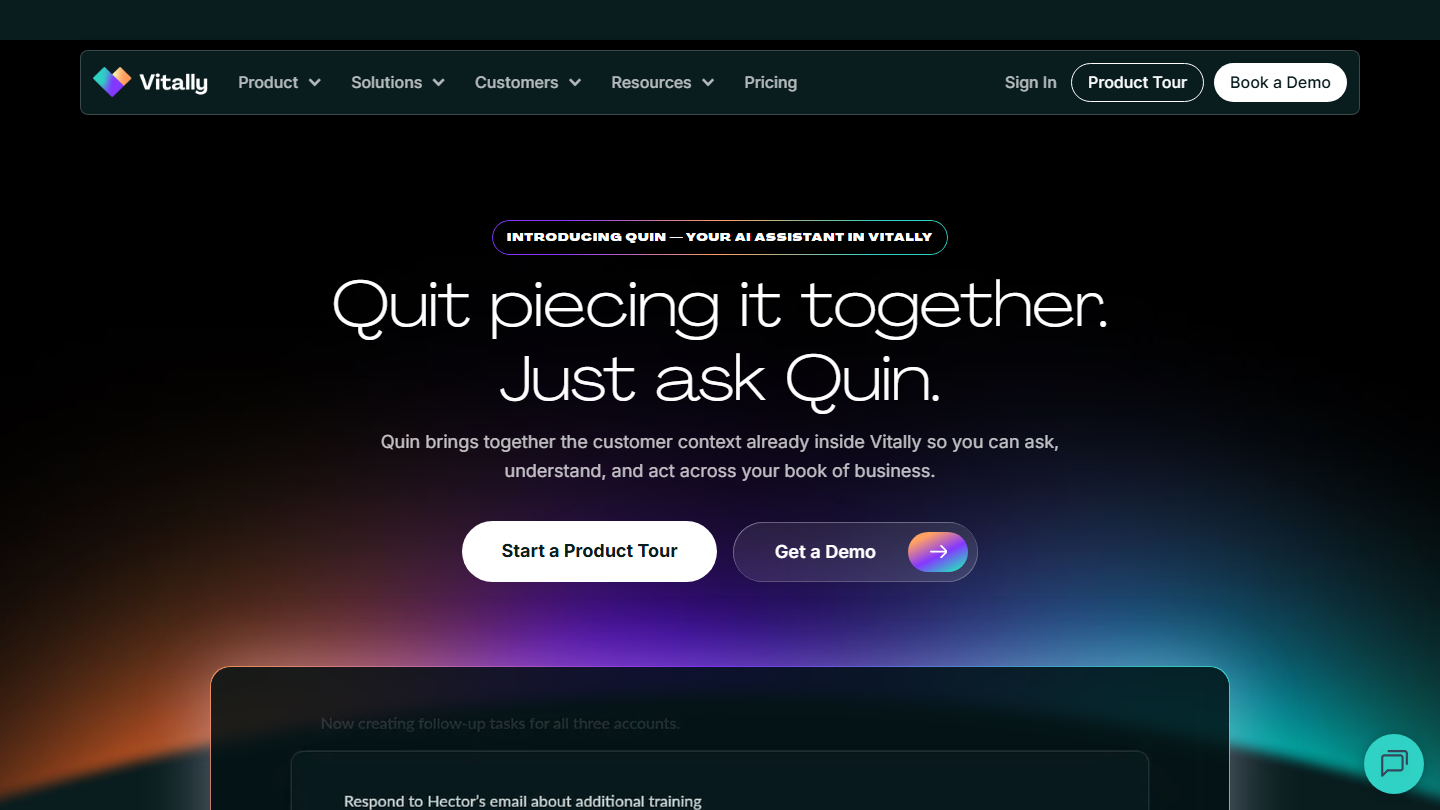
Vitally homepage: “Quit piecing it together. Just ask Quin.”, the customer success platform's AI assistant

Vitally is a customer success platform designed for B2B SaaS vendors, and claims more than 500 customer teams. Each account has its record there, fed by the CRM, billing, product analytics and support: Salesforce, HubSpot, Stripe, Chargebee, Segment, Mixpanel, Pendo, Zendesk or Intercom.

The plans are named after the follow-up model: Tech-Touch for remote follow-up and product-led growth, High-Touch for one CSM per account, Hybrid-Touch in between. Quin, the AI assistant, queries the data already in Vitally to prepare a meeting or create follow-up tasks across several accounts at once.

Vitally makes sense for a team that finds Gainsight too heavy to deploy and looks for a daily working tool for its CSMs, more than a reporting tool for management.

The three plans are on request. After the demo, Vitally offers a trial in a dedicated environment, with the team’s data.

How we chose these 10 tools

Every tool in this selection has been used in real conditions by our team or by a Salesdorado consultant, in a B2B sales and marketing setting. No ranking built from a marketing deck. The order of the list is not a ranking: the right tool depends on your needs.

  1. 01
    Benchmark scope

    Broad identification of the tools on the market (G2, Capterra, Salesdorado customer feedback, LinkedIn signals). Initial filtering, then a short list based on a 2-hour setup per tool.

  2. 02
    Test conditions

    3 to 4 weeks of active use per tool, with data representative of a B2B sales use case. When a tool targets a specific profile (SDR, AE, Ops, Marketer…), we match the tester accordingly.

  3. 03
    Weighted criteria

    For each category, 5 to 7 axes weighted according to what matters in the segment: UX, feature depth, native integrations, support, pricing at scale, compliance (GDPR, security), and roadmap quality.

  4. 04
    Independence

    No tool is scored in exchange for payment. Partner links (affiliate) are marked as such and do not influence the score. Non-partner tools are included when their place in the ranking is deserved.

  5. 05
    Updates

    The ranking is reviewed every 6 to 12 months or on every major release of a tool mentioned. The date of the last check is shown at the top of the article.

The questions we get over and over.

What is the difference between a customer success tool and a CRM?

The CRM is first and foremost a sales tool: the promises made to close a deal are rarely recorded there, and the customer record is rarely updated when a ticket is opened. Customer success software connects to the CRM and pulls usage and satisfaction data to identify opportunities or churn risks, which are then passed on (or not) to the CRM.

What is a customer success tool for?

It is used to optimize the onboarding of new customers, encourage deeper adoption of the software, identify at-risk customers and communicate better with them, by centralizing customer feedback under one account record. It must integrate with the other tools (CRM, product, marketing, support) to make this data simple to use.

Which customer success tool for detecting customers at risk of churn?

ChurnZero made it the core of its product: health scores, alerts, and AI agents, one of which flags relationship risks early. Gainsight and Vitally also cover this need, and Odie (formerly Totango) analyzes each account every day with predictive models of non-renewal risk. For a free first level, ProfitWell Metrics flags at-risk customers from billing data.

Which customer success tools offer a free plan?

Pendo offers a free plan limited to 500 monthly active users, with analytics and in-app guides. ProfitWell Metrics, at Paddle, is free. HubSpot has a free plan, but its customer success workspace and health scores require Service Hub Pro, at €90 per seat per month. Gainsight, ChurnZero, Planhat and Vitally are on request, with no free plan.

Which tool for communicating with your users inside the app?

Intercom displays its messenger inside the app: chat, chatbots and the Fin AI agent. Guided tours, checklists, announcements and in-app surveys go through the Proactive Support Plus add-on, from $99 per workspace per month. Pendo puts the emphasis on in-app guides, which help users get to grips with the app, and includes them from its free plan.

★ The conversation, 0 comments

What the community says.

Basic Markdown, moderated within 24 h
Loading…

    In the same category